Uber will start deactivating riders with low ratings

Uber is now requiring the same good behavior from riders that it has long expected from its drivers. Uber riders have always had ratings, but they were never really at risk of deactivation — until now. Starting today, riders in the U.S. and Canada are now at risk of deactivation if their rating falls significantly below the city’s average.

“Respect is a two-way street, and so is accountability,” Uber Head of Safety Brand and Initiatives Kate Parker wrote in a blog post. “Drivers have long been required to meet a minimum rating threshold which can vary city to city. While we expect only a small number of riders to ultimately be impacted by ratings-based deactivations, it’s the right thing to do.”

For drivers, they face a risk of deactivation if they fall below 4.6, according to leaked documents from 2015. Though, average ratings are city specific. Uber, however, is not disclosing the average rider rating but says “any rider at risk of losing access will receive several notifications and opportunities to improve his or her rating,” an Uber spokesperson told TechCrunch.

For example, Uber will offer tips to riders around encouraging polite behavior and keeping the car clean.

“Ultimately, we expect this to impact only a very small number of riders,” the spokesperson said.

This is part of Uber’s refreshed community guidelines, which will appear front and center on the Uber app and require confirmation of acknowledgment.

Following FTC complaint, Google rolls out new policies around kids’ apps on Google Play

Google announced this morning a new set of developer policies aimed at providing additional protections for children and families seeking out kid-friendly apps on Google Play. The new policies require that developers ensure their apps are meeting all the necessary policy and regulatory requirements for apps that target children in terms of their content, ads, and how they handle personally identifiable information.

For starters, developers are being asked to consider whether children are a part of their target audience — and, if they’re not, developers must ensure their app doesn’t unintentionally appeal to them. Google says it will now also double-check an app’s marketing to confirm this is the case and ask for changes, as needed.

Apps that do target children have to meet the policy requirements concerning content and handling of personally identifiable information. This shouldn’t be new to developers playing by the rules, as Google has had policies around “kid-safe” apps for years as part of its “Designed for Families” program, and countries have their own regulations to follow when it comes to collecting children’s data.

In addition, developers whose apps are targeting children must only serve ads from an ads network that has certified compliance with Google’s families policies.
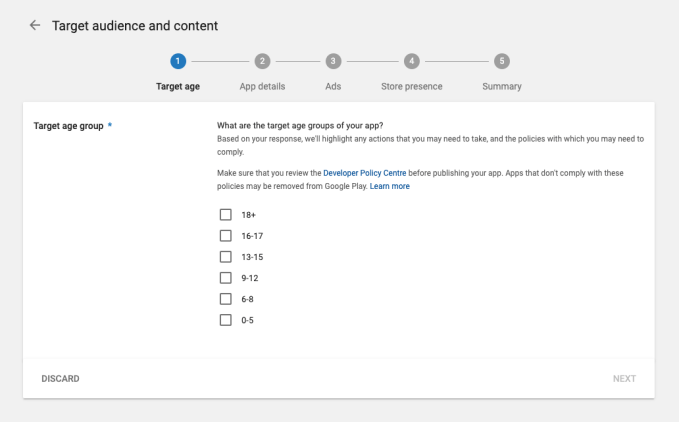
 

To enforce these policies at scale, Google is now requiring all developers to complete the new target audience and content section of the Google Play Console. Here, they will have to specify more details about their app. If they say that children are targeted, they’ll be directed to the appropriate policies.

Google will use this information, alongside its review of the app’s marketing materials, in order to categorize apps and apply policies across three target groups: children, children and older users, and older users. (And because the definition of “children” may vary by country, developers will need to determine what age-based restrictions apply in the countries where their app is listed.)

Developers have to comply with the process of filling out the information on Google Play and come into compliance with the updated policies by September 1, 2019.

The company says it’s committed to providing “a safe, positive environment” for kids and families, which is why it’s announcing these changes.

However, the changes are more likely inspired by an FTC complaint filed in December, in which a coalition of 22 consumer and public health advocacy groups, led by Campaign for a Commercial-Free Childhood (CCFC) and Center for Digital Democracy (CDD), asked for an investigation of kids’ apps on Google Play.

The organizations claimed that Google was not verifying apps and games featured in the Family section of Google Play for compliance with U.S. children’s privacy law COPPA.

They also said many so-called “kids” apps exhibited bad behaviors — like showing ads that are difficult to exit or showing those that require viewing in order to continue the current game. Some apps pressured kids into making in-app purchases, and others were found serving ads for alcohol and gambling. And others, still, were found to model harmful behavior or contain graphic, sexualized images, the groups warned regulators.

The time when violations like these can slip through the cracks is long past, thanks to increased regulatory oversight across the online industry by way of laws like the EU’s GDPR, which focuses on data protection and privacy. The FTC is also more keen to act, as needed — it even recently doled out a record fine for TikTok for violating COPPA. 

The target audience and content section are live today in the Google Play Console, along with documentation on the new policies, a developer guide, and online training. In addition, Google says it has also increased its staffing and improved its communications for the Google Play app review and appeals processes in order to help developers get timely decisions and understand any changes they’re directed to make.


 

InWin’s Alice is a mid-tower PC case you can match to your cosplay

There’s a huge amount of crossover between the gaming and cosplay communities and InWin’s Alice computer chassis will appeal to many in the middle of that Venn diagram. The company is currently showing off Alice and its other PC cases at Computex in Taipei.

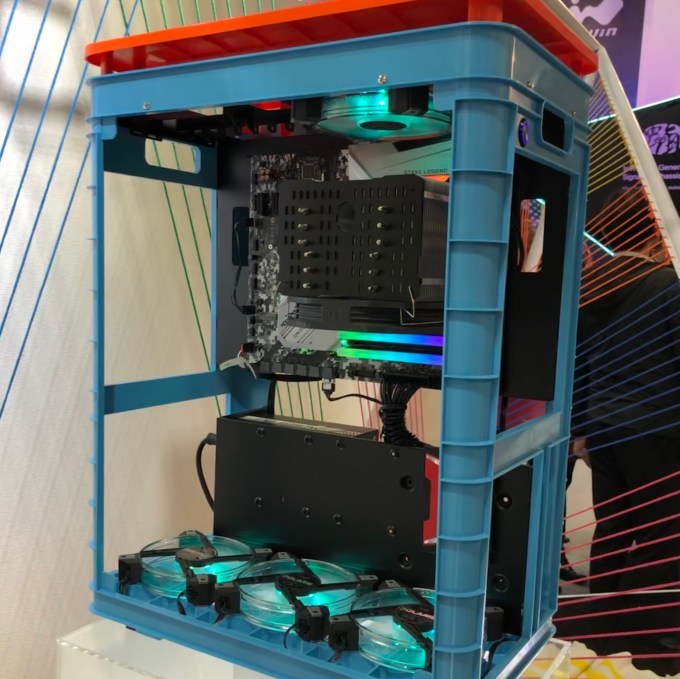
The interior of InWin's Alice chassis

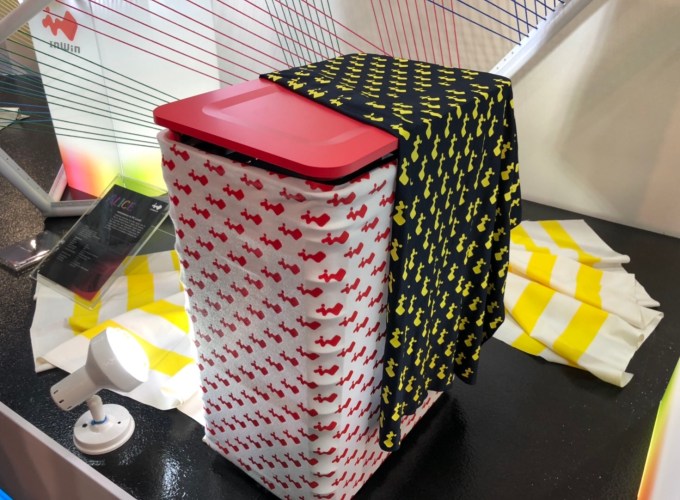
Named after the Lewis Carroll character, the mid tower case comes in several colors of lightweight ABS plastic, but its real draw are its easily removable fabric covers. InWin sells a large array of covers, so you can switch them up, but of course you can also make them. InWin’s Alice covers are designed to be dust-proof, but the concept also has the bonus of allowing for plenty of airflow and making it easy to clean the inside of your PC or change components.

Some of InWin's fabric covers for its Alice PC case

The Alice will be compatible with 12-inch by 9.6 inch ATX, Micro-ATX and Mini-ITX motherboards and is just little over 24-inches tall, with a width of 11.6 inches and a depth of 17.5 inches.

Amazon adds ‘Alexa, delete what I said today’ command

Buried in the this morning’s Echo Show 5 announcement are a couple of new security features worth highlighting. In addition to the inclusion of a built-in camera shutter on the new smart display are a pair of Echo commands that let users delete voice recordings with an Alexa command.

“Alexa, delete what I said today” rolls out to Alexa users starting today. “Alexa, delete what I just said” will arriving for U.S. in the coming weeks and other countries where the smart assistant is available in the next month. Amazon has offered the ability to delete recordings via the app for some time now, but this brings the functionality to the front with a simple via command.

The process works similarly to deleting recordings via the app, starting the deletion process immediately.

While the company has long contended that it doesn’t actively record conversations and protects records on encrypted servers, the always-on nature of Echo and similar smart home products have raised alarms among security analysts and regular users alike.

The addition of the feature is clearly a response to such pushback and an attempt for Amazon to let users be a bit more proactive about controlling how Amazon treats their conversations.


Logz.io lands $52M to keep growing open source-based logging tools

Logz.io announced a $52 million Series D investment today. The round was led by General Catalyst.

Other investors participating in the round included OpenView Ventures, 83North, Giza Venture Capital, Vintage Investment Partners, Greenspring Associates and Next47. Today’s investment brings the total raised to nearly $100 million, according to Crunchbase data.

Logz.io is a company built on top of the open source tools Elasticsearch, Logstash, and Kibana (collectively known by the acronym ELK) and Grafana. It’s taking those tools in a typical open source business approach, packaging them up and offering them as a service. This approach enables large organizations to take advantage of these tools without having to deal with the raw open source projects.

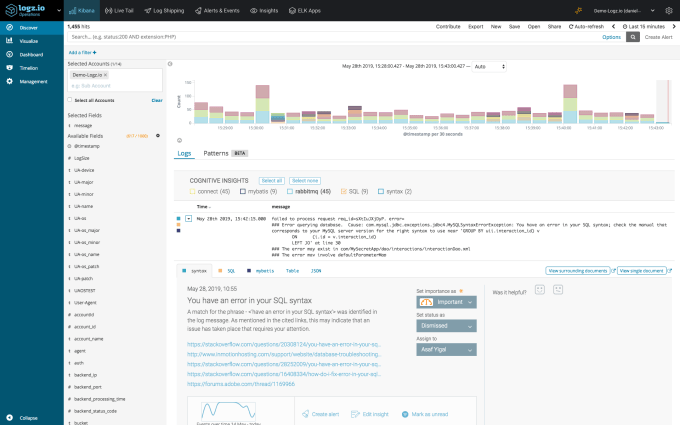
The company’s solutions intelligently scan logs looking for anomalies. When it finds them, it surfaces the problem and informs IT or security, depending on the scenario, using a tool like PagerDuty. This area of the market has been dominated in recent years by vendors like Splunk and Sumo Logic, but company founder and CEO Tomer Levy saw a chance to disrupt that space by packaging a set of open source logging tools that were rapidly increasing in popularity. They believed could build on that growing popularity, while solving a pain point the founders had actually experienced in previous positions, which is always a good starting point for a startup idea.

Screenshot: Logz.io

“We saw that the majority of the market is actually using open source. So we said, we want to solve this problem, a problem we have faced in the past and didn’t have a solution. What we’re going to do is we’re going to provide you with an easy-to-use cloud service that is offering an open source compatible solution,” Levy explained. In other words, they wanted to build on that open source idea, but offer it in a form that was easier to consume.

Larry Bohn, who is leading the investment for General Catalyst, says that his firm liked the idea of a company building on top of open source because it provides a built-in community of developers to drive the startup’s growth — and it appears to be working. “The numbers here were staggering in terms of how quickly people were adopting this and how quickly it was growing. It was very clear to us that the company was enjoying great success without much of a commercial orientation,” Bohn explained.

In fact, Logz.io already has 700 customers including large names like Schneider Electric, The Economist and British Airways. The company has 175 employees today, but Levy says they expect to grow that 250 by the end of this year, as they use this money to accelerate their overall growth.

Amazon just launched a $90, 5.5-inch Echo Show

Amazon just announced a 5.5-inch Echo Show model with a $90 price tag, and I’d be remiss if I didn’t mention right out of the gate how much the thing looks like that new Google Assistant-sporting Smart Clock. These things happen, of course. Call it convergent evolution if you will — as a matter of fact, something similar occurred with Lenovo Smart Clock and standard Facebook Portal. Everyone wants to be like Lenovo, I suppose.

The Echo Show 5 (that’s “five” for inches, not generation or fighting) doesn’t replace any existing Amazon smart screen, even through the price point will no doubt make many think twice about the $130 Spot.

Unlike, say the Google Home Hub, there’s a camera built-in here, though Amazon’s clearly heeded customer feedback by adding a shutter for extra privacy. Also new on that front are the “Alexa delete everything I said today” and “Alexa delete what I just said” features, which are coming soon — again, no doubt by popular request.

The company doesn’t seem to be positioning this as a bedside alarm clock as it did with the Spot, but it should scratch that itch for more users (especially with the new camera shutter), along with your standard array of smart home controls and the ability to view on the small screen feeds from security (Ring) and baby (Arlo) cameras.

Like other Amazon displays, it’s got basic touchscreen functions, which are now coupled with a bunch of different customizable faces. The Show 5 is up for pre-order today and starts shipping in July. There’s also an optional $20 magnetic stand for adjusting viewing/camera angles.

Soda Says, a curated consumer electronics retail platform, launches in the U.S.

Grace Gould has spent her life thinking about the intersection of retail and tech. She started out in Apple Retail, and then moved on to Index Ventures where she worked on early stage investments. She then worked at PCCH International as the VP of Global Retail Strategy, working with companies and hardware makers to develop, manufacture, package and distribute products.

But throughout her career, Gould has always seen a hole in the consumer electronics retail space.

“The interesting thing about consumer electronics is that you have these brands — Apple stores, Microsoft stores, Samsung stores &mdash that sell a very limited number of products,” said Gould. “And then you have big box retailers like Best Buy. No one is doing an interesting lifestyle business within consumer electronics.”

That’s where Soda Says comes in.

Soda Says is an ecommerce marketplace focused on lifestyle gadgets, such as the Elvie Smart Breast Pump and the Gingko Edge alarm clock.

The company curates useful, aesthetically pleasing gadgets and puts them in categories like Accessories, Wellness, Lifestyle and Kids, with a specific aim to help small hardware companies grow.

Today, Soda Says launches in the United States with a new vertical: women’s sex tech.

As it stands now, there isn’t really a retail experience that makes sense for women’s sex tech. Customers either have to wander into a sex toy store or go for a little internet adventure. But Soda Says is taking an offline approach to this online business, partnering with department stores like Nieman Marcus and Nordstrom to offer pop-up experiences where shoppers already are.

The Sex Tech collection includes products from brands such as Dame, MysteryVibe, and Le Wand.

Soda Says operates on a hybrid model, sometimes buying inventory of products for resale and other times simply listing the product on the website.

The company has raised a total of $2.5 million from lead investor UK-based LocalGlobe, with participation from investors including ADV, and founder and CEO of PCH International Liam Casey, among others.

Huawei files motion to challenge sweeping US ban, calling it ‘not normal’

Huawei this morning began the process of challenging the Trump administration’s sweeping ban. The Chinese hardware giant has filed a motion for summary judgement that calls into question the constitutionality of the section of the National Defense Authorization Act used to halt imports.

The company’s Chief Legal Officer cited Huawei’s usual arrays of arguments against the U.S. government. “Politicians in the U.S. are using the strength of an entire nation to come after a private company,” Song Liuping said in a prepared statement. “This is not normal. Almost never seen in history.”

Developing…


Ducky’s new limited-edition mechanical keyboard pays tribute to Taiwan’s Paiwan community

Ducky, known for its popular mechanical keyboards, is based in Taiwan and today at Computex it showed off its tribute to the country’s culture: the limited-edition “Year of the Pig” 65 percent keyboard. The latest of Ducky’s yearly Zodiac releases, the keyboard was created in collaboration with metalwork artist Kulele Ruladen, the keyboard pays tribute to the Paiwan, one of Taiwan’s indigenous tribes.

Symbols inspired by Paiwan culture on Ducky's limited edition Year of the Pig mechanical keyboard

Ruladen’s design draws on several aspects of Paiwan culture, including a metal cut-out at the front of the keyboard inspired by a wild boar, a symbol of bravery for Paiwan people, and a golden backplate with images of Paiwan warriors battling the boars.

https://platform.twitter.com/widgets.js

The keycaps are bronze red, a reference to the importance of bronze as a medium in Paiwan art. Instead of the alphabet, each key has a pictogram that draws on other symbols that are meaningful for the Paiwan community. For example, the space bar has a hawk feather representing “the aristocracy of men and women.” There are also four keys inspired by Paiwan glass beads that represent different values: agility (kaluazung), courage (mananigai), nobility (mulimulitan-maca) and kurakurau-liling (love).

Details from Ducky Keyboard's Year of the Pig limited edition mechanical keyboard

The Year of the Pig keyboard is limited to 2019 pieces, in reference to the year, and designed to last. Each one has adopted aluminum casing with nano coating, a zinc alloy keyobard stand and dye-subliminated keycaps, as well as a Type-C USB port and RGB backlighting.

Review of UK migration rules calls for more dev jobs to be fast-tracked

A public body that advises the UK government on immigration policy has recommended including more programming and software development jobs on the shortages occupation list which would make it easier for employers to bring in skilled tech talent from outside the European Union .

In a review of the Shortage Occupation List (SOL) published today by the Migration Advisory Committee (MAC), it advocates broadening the list to include all roles related to programming and software development, as well as suggesting web designers as a new addition — recognising the difficulty UK employers can have filling such roles.

The current SOL does include some IT jobs but more tightly defines those roles considered to be in shortage — and therefore to qualify for relative fast tracking through the immigration system.

The MAC’s proposed expansion of the SOL means it would cover some 9% of jobs in the UK labour market vs what is currently around 1%. It does not solely focus on tech jobs, with veterinarians, architects and health workers among the other occupations also recommended for inclusion.

In another recommendation the MAC suggests the removal of a condition restricting the recruitment of chefs via the SOL if they work at an establishment that offers a take-away service — perhaps a sign of the on-demand times, when startups like Deliveroo and JustEat have been expanding the pipeline of eateries that serve up take-out.

“Today’s labour market is very different to the one we reviewed when the last SOL was published in 2013,” writes MAC chair, professor Alan Manning, in a statement. “Unemployment is lower and employers in various industries are facing difficulties in finding skilled people to fill their vacancies. That is why we have recommended expanding the SOL to cover a range of occupations in health, information and engineering fields.”

If a job vacancy is on the SOL it means UK employers don’t need to run a resident labor market test, where they are required to advertise the role to the settled workforce for a set period of time and retain proof that they have done so — a process that adds bureaucracy, delay and cost to hiring migrants, as well as increasing compliance risk.

It also allows for lower wages to be paid vs roles not on the SOL. Shortage jobs are also prioritized vs non-SOL jobs which means they can be less affected by any binding immigration cap (i.e. because the monthly visa quota has been exceeded).

So the widening of programming roles on the SOL could be a boon for UK startups looking to expand their talent base — at least if the government moves quickly to implement the recommendations.

“We are grateful to the Migration Advisory Committee for a very comprehensive report. We will consider it carefully and respond in due course,” a Home Office spokesperson told us when asked for its response and any timeline for implementing the changes.

That said, even if the MAC’s recommendations are implemented quickly they are only likely be a stop-gap because the government has signalled its intent to move to a single points-based immigration system, post-brexit, once the UK has left the EU — publishing a white paper about the planned future skills-based system at the back end of last year. (At that point envisaging the new system would apply from 2021.)

The MAC notes that the revised SOL it’s now recommending would need to be looked at again to mesh with that future system.

“Our recommendations are clearly only applicable under the current immigration system, while EU free movement remains,” writes Manning. “We are recommending a full review of the SOL once there is a clearer picture of what the future immigration system will look like.”

So even with what looks like a little recruitment relief coming down the pipe for UK startups worried about filling skilled vacancies, the country’s immigration rules remain fogged by ongoing brexit uncertainty and the unknown parameters that will apply in a future system when both non-EU and EU migrants will be squeezed through the same government-controlled funnel.