Twaice picks up backing from Cherry Ventures to help electric vehicles eke out more battery life

Twaice, a Munich-based startup developing “predictive analytics” software to help with battery management in electric vehicles and other devices, has raised €2 million in additional seed funding.

The round is led by Berlin’s Cherry Ventures, with participation by existing investors UVC Partners and Speedinvest. It brings the total raised at seed stage by the nine month-old company — a spin out of Technical University of Munich (TUM) — to €3.2 million.

Already used in trucks, cars, e-scooters and stationary power storage, the Twaice software creates a “digital twin” of battery systems by utilising sensor data, and physical and data-driven battery models. From here it claims to be able to analyse and make accurate real-time predictions about the “health status” of an energy storage system.

Use-cases include closing the loop between product development and application, as well as new possibilities such as predictive maintenance and extending a product’s warranty.

“Batteries represent 30 to 50 percent of the electric vehicle costs, but they are complex blackboxes and degrade over lifetime,” Twaice co-founder Dr. Stephan Rohr tells TechCrunch.

“The complexity creates enormous risks and challenges for manufacturers of battery electric vehicles, as they have to test and model the 8 to 10 years lifetime of a battery in only six to 12 months of testing time. And after the start of production the users of these batteries have the challenge to understand how the battery is degrading as the impact of operating parameters on the degradation is too complex and no battery ages like another one”.

Enter Twaice’s “digital twin,” which Rohr says is fed time-continuous data from a device’s battery management system to constantly update the virtual model of the battery with regard to its current condition.

“Through an augmentation of empirical-analytical models and machine learning, we are then also able to predict, simulate and optimize each individual battery’s lifetime,” he says.

To that end, Twaice generates revenue via a Software-as-a-Service model. The young company charges an annual recurring fee per digital twin which scales based on the number of batteries.

DHL brings Africa eShop to 20 countries in a competitive nod to Jumia

DHL is expanding its DHL Africa eShop business to 9 additional markets, upping the presence of the global shipping company’s e-commerce platform to 20 African countries.

DHL went live with the digital retail app in April, bringing more than 200 U.S. and U.K. sellers — from Neiman Marcus to Carters — online to African consumers.

Africa eShop operates using startup MallforAfrica.com’s white label fulfillment service, Link Commerce. Payment methods include local fintech options, such as Nigeria’s Paga and Kenya’s M-Pesa.

DHL’s move to offer Africa eShop to 20 of the continent’s 54 countries comes a month after Africa’s most visible (and well funded) e-tailer, Jumia, went public. Jumia—which operates consumer retail and online service verticals in 14 African countries—raised over $200 million in an NYSE IPO.

There’s a competitive e-commerce scenario brewing between the two platforms. DHL Africa e-Shop touts itself as “Africa’s Largest Online Shopping Platform.” Jumia said “We believe that our platform is the largest e-commerce marketplace in Africa,” in its SEC S1 filing.

It’ll take a little more time to shake out the stats behind each company’s branding claims.

DHL didn’t respond directly to the question of Africa eShop’s new market moves and competition with Jumia. “DHL’s growth expansion has always been centered around satisfying our customer’s wants…Africa e-Shop will be no different,” DHL spokesperson Megan Roper told TechCrunch.

DHL’s app takes advantage of the shipping giant’s existing delivery structure on the continent, able to get goods to doorsteps through its DHL Express courier service.

DHL’s partner for the new app, MallforAfrica, brings experience collaborating with a number of big-name retailers, including Macy’s and Best Buy. MFA’s payment and delivery system serves as a digital broker and logistics manager for big-name retailers to sell goods in Africa.

E-commerce ventures have captured the attention of VC investors looking to tap Africa’s growing consumer markets. McKinsey & Company projects consumer spending on the continent to reach $2.1 trillion by 2025, with e-commerce accounting for up to 10 percent.

Africa’s e-commerce startup landscape has already seen some ups and downs. Jumia’s recent IPO filing on the NYSE is a first for any startup operating in Africa. Despite continuing losses, Jumia’s post-IPO results earned the confidence of Wall Street analysts.


DHL’s Africa e-Shop expansion also demonstrates momentum for digital sales on the continent.

On the flip side, the distressed acquisition of Nigerian e-commerce hopeful Konga.com, backed by roughly $100 million in VC, created losses for investors. And in late 2018, Nigerian online sales platform DealDey shut down.

As for the big global names, Alibaba has talked about Africa expansion, but for the moment has not entered in full.

Amazon offers limited e-commerce sales on the continent, but more notably, has started offering AWS services in Africa.

To watch is how DHL’s Africa eShop expansion factors into the continent’s online-sales market, particularly vis-a-vis Jumia.

On a B2C level, Africa eShop brings distinct advantages on a transaction cost basis (i.e. the cost of delivery) given it’s connected to one of the world’s logistics masters.

Another component of DHL and MallforAfrica’s partnership is the market for offering e-commerce fulfillment services. MallforAfrica CEO Chris Folayan acknowledged Jumia as a competitor to his company’s logistics offering, but said, “I’m not building Link Commerce to go after Jumia…I’m building Link Commerce to become the powerhouse e-commerce platform to help emerging markets gain access to U.S. and UK products.” On a call with TechCrunch, Folayan also confirmed Link Commerce would open up to vendors from Asia in the next 12 months.

On its recent earnings call, Jumia CEO Sacha Poignonnec flagged carving out the “Jumia logistics services as a standalone entity” as a future company priority.

These developments could put DHL’s Africa eShop, MallforAfrica, and Jumia on a footing to compete with (or work with) big e-commerce names entering Africa. They certainly add another layer of competition to online retail and fulfillment services on the continent.
For the moment, the DHL Africa eShop expansion creates additional choice on overlapping product categories with Jumia, such as phones, tablets, fashion, health, beauty, and gaming.

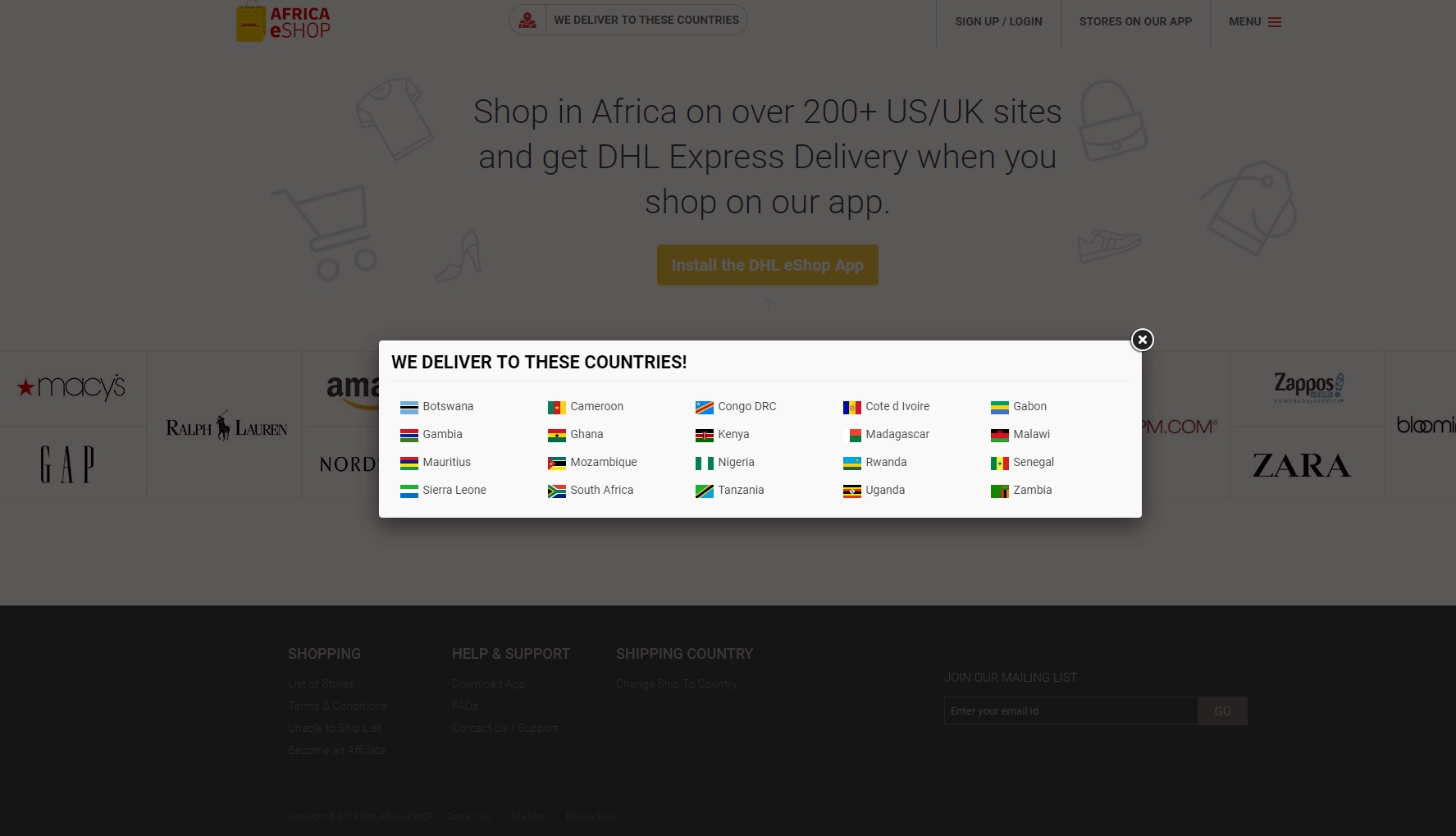
Africa eShop will also offer African consumers more price competition in the operating countries it shares with Jumia—currently 10: South Africa, Kenya, Nigeria, Tanzania, Cameroon, Uganda, Ivory Coast, Rwanda, Senegal, and Ghana.



China’s used car marketplace Uxin to raise $230M via convertible notes

Uxin, a Chinese second-hand car dealer with Leonardo DiCaprio as its latest brand ambassador, is tipped to get a bag of new funding less than a year after it raised $225 million from its public offering on the Nasdaq.

The company announced on Wednesday that it’s selling $230 million worth of convertible notes to 58.com — China’s answer to Craigslist, Warburg Pincus, TPG and other investors. The notes, due in June, convert to Uxin’s Class A ordinary shares at a price of $1.03 per share or $3.09 per ADS. Upon closing the deal, each of 58.com, Warburg Pincus and TPG will obtain the right to nominate one board director to Uxin.

Uxin was trading at $2.46 at the end of Tuesday, a 74 percent decline from its recent peak in January. Its stock tanked in April after short-seller J Capital Research broadsided it over alleged frauds. Uxin denied the accusations, saying they were “false and misleading.”

The Chinese company is in a bruising fight with well-backed rivals including Chehaoduo, which pocketed $1.5 billion from Softbank’s Vision Fund in February, and Renrenche, which raised $300 million led by Goldman Sachs a year earlier.

As part of the transaction, 58.com, a 14-year-old Chinese internet firm that went public in New York six years ago, will come into a strategic partnership with Uxin in areas such as user traffic and inventory acquisition, used-car inspection, big data analysis and SaaS, says Uxin in a statement. The move follows Uxin’s agreement with Alibaba in December to set up a used car section on the ecommerce giant’s Taobao marketplace.

There are increasing synergies between 58.com and Uxin as both are exploring opportunities outside the crowded markets of China’s megacities. 58.com hit a notable milestone in 2018 after it racked up 100 million new users for its classifieds services customized for small-town populations, which include everything from job listings to trading cars.

In the same vein, Uxin has churned out reports that show demand for used cars coming from China’s lower-tier cities has surged in recent years. The boom is in part a result of a new Chinese policy that allows consumers to buy second-hand cars from a different province, enriching the variety of car options for rural residents.

“We see enormous growth potential in China’s used car market and believe that the volume of used-car transactions will overtake that of new cars in the years ahead,” said Michael Yao, chairman and chief executive officer of 58.com, which runs its own online used car business.

The deal will allow 58 Used Car to “benefit from Uxin’s tremendous offline transaction-related expertise,” added Yao, referring to Uxin’s mix of digital and physical sales channels. “By jointly integrating our online and offline services, we will be ideally positioned to significantly enhance the user experience for purchasing used cars and drive greater efficiency in this growing market.”

iRobot’s newest mop and vacuum talk to each other to better clean up

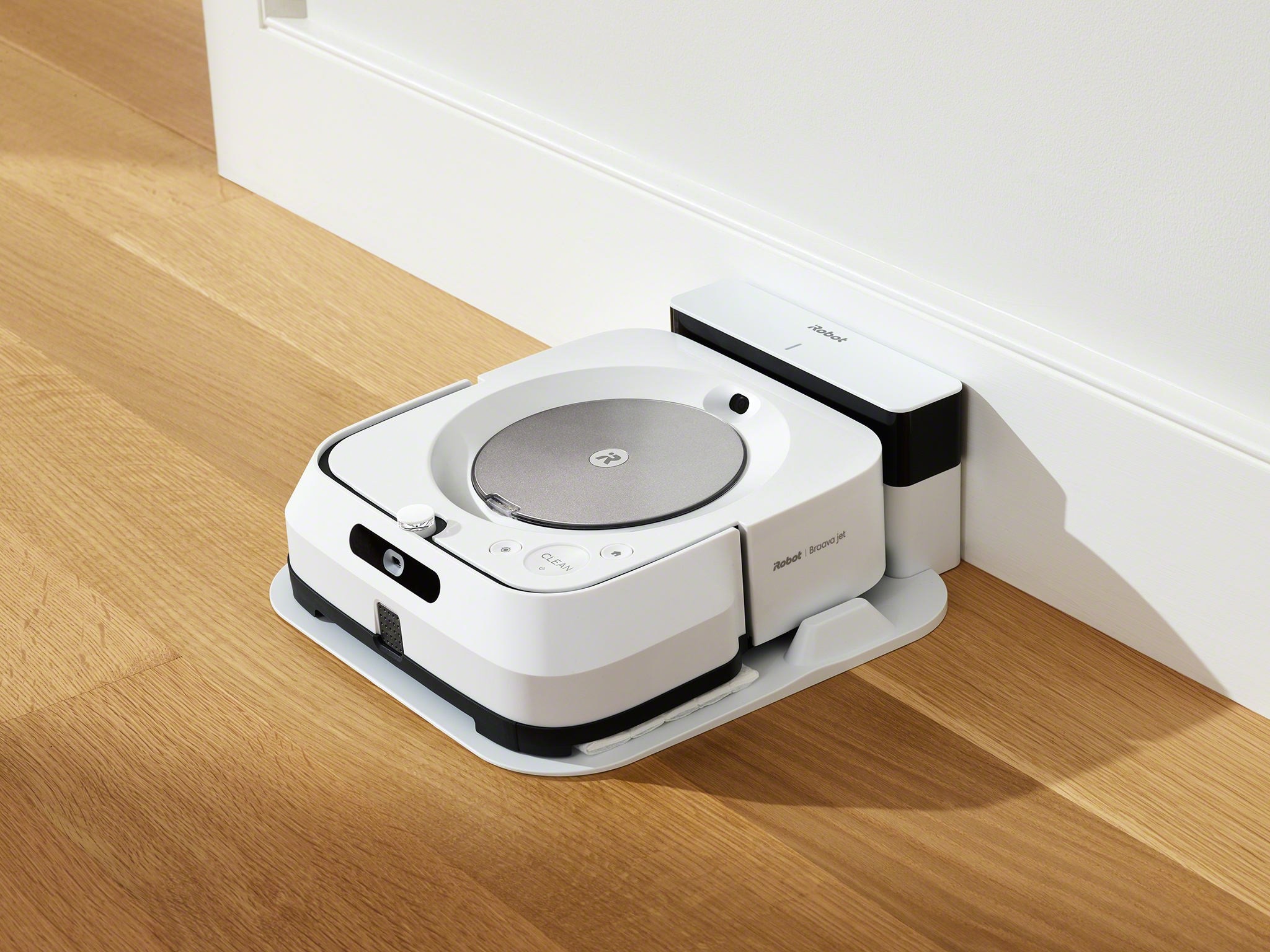
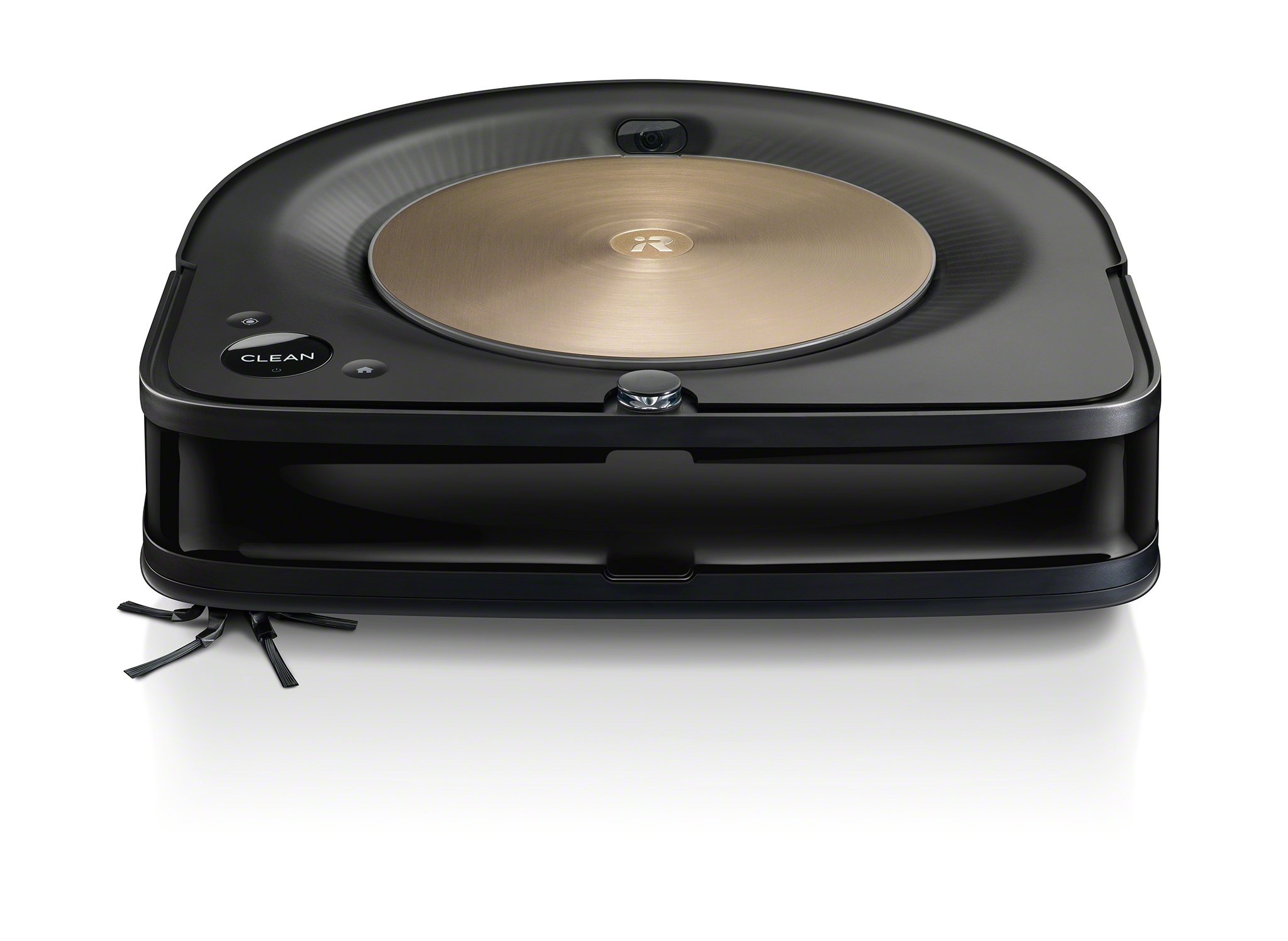
Some spring cleaning news from iRobot . The Bedford, Mass.-based company just unveiled a pair of new robots designed to tag-team dirty floors. The Roomba s9+ and Braava Jet m6 both sport iRobot’s mapping technology, coupled with Imprint Link, which lets to two devices communicate in order to take turns on the floor.

The s9+ marks a new premium standard for the Roomba. That starts with arguably the most radical redesign in the robotic vacuum line’s 17-year history. The company’s moved away from the iconic fully round puck design that’s defined the product since its inception — and on that front, at least, it borrows from the Braava.

The front of the vacuum is flat, part of the new “PerfectEdge” tech that lets it get closer to walls — apparently one of the most requested features in recent Roomba generations. The corner brush has five 30mm arms that get dirt that early models were unable to reach. The downside of the flat side, however, is that the system has to do much more maneuvering, which in turn requires more battery.

No word on specifics there, but iRobot says it’s amped up the mAH accordingly. The top, meanwhile, features a large brushed metal circle that opens up to grab and replace the filter. Like last year’s i7+, the system ships with the optional Clean Base (notably, however, they use different Clean Bases with different connectors, so they’re not cross-compatible), which empties out the dirt while docked.

The new model features an upgraded 3D sensor that helps the system map and navigate, scanning for obstacles at a rate of 25 times a second. Also new is the Imprint Link Technology, which is the next step in the company’s floor-cleaning domination plan. The tech allows the Roomba to communicate with the new Braava, so they can take turns cleaning up the floor.

As always, cleans are initiated via the Home app. That sends the s9+ out to clean an area, followed by the m6. iRobot CEO Colin Angle tells TechCrunch that the company’s positioned the new robots (and its lawn mowing robot, Terra) as “iRobot 2.0.”

“It’s a coherent — from a design and communication perspective — set of top-end robots that are designed to raise the bar of functionality,” he tells explains.

Certainly it’s a step forward in the company’s long-promised vision of home robots becoming an integral part of the smart home, particularly when coupled with mapping and Alexa and Google Assistant functionality.

The new Braava, meanwhile operates as before, using a sprayed solution and dry pads, rather than the water tank used by Scooba. It uses similar mapping technology to get a floor plan and avoid obstacles. The cleaning system has been updated throughout, as well, with improved spraying and larger pads with a range of different materials.

Naturally, none of this comes cheap — and let’s be honest, affordability has never really been iRobot’s strong suit. The s9+ runs $1,299 with the Clean Base and $999 without. The Braava m6 is $499, with a box of seven cleaning pads going for $8. They’ll both be available June 9. The vacuum sports a new 3D sensor for advanced room mapping and object detection. Unlike previous models, this Roomba is scanning the room for what’s in front of it at a rate of 25 times a second.

That’s coupled with iRobot’s new proprietary PerfectEdge technology, designed to better skirt the edges of rooms. The brushes and other cleaning bits have been rejiggered, as well.

Flipboard hacks prompt password resets for millions of users

Social sharing site and news aggregator Flipboard has reset millions of user passwords after hackers gained access to its systems several times over a nine-month period

The company confirmed in a notice Tuesday that the hacks took place between June 2, 2018 and March 23, 2019 and a second time on April 21-22, 2019, but the intrusions were only detected a day later on April 23.

Hackers stole usernames, email addresses, passwords and account tokens for third-party services. According to the notice, “not all” Flipboard users’ account data were involved in the breaches but the company declined to say how many users were affected.

Flipboard has about 150 million monthly users.

“We’re still identifying the accounts involved and as a precaution, we reset all users’ passwords and replaced or deleted all digital tokens,” the notice read.

Although the passwords were unreadable, Flipboard said passwords prior to March 14, 2012 were scrambled using the older, weak hashing SHA-1 algorithm.. Any passwords changed after are scrambled using a much stronger algorithm that makes it far more difficult to reveal in a usable format.

The hacks also exposed account tokens, which gives Flipboard access to data from accounts on other services, like Facebook, Google, and Samsung.

“We have not found any evidence the unauthorized person accessed third-party account(s) connected to users’ Flipboard accounts,” said the statement. “As a precaution, we have replaced or deleted all digital tokens.”

Flipboard becomes the latest tech giant to be hit by hackers in recent months. Developer platform Stack Overflow earlier this month confirmed a breach involved some user data. Canva, one of the biggest sites on the internet, was also hacked. Last week, the Australia-based company admitted close to 140 million users had data stolen following the breach.

Read more:

Go chat yourself with Facebook’s new Portal companion app

Ignoring calls that it’s creepy, Facebook is forging onward with its Portal smart display. Today Facebook quietly launched iOS and Android Portal apps that let owners show off photos on the screen without sharing them to the social network, and video call their home while they’re out.

The app isn’t likely to move the needle for Portal whose potential users fall into two camps: those so alarmed by Facebook’s privacy practices that they couldn’t imagine putting its camera and microphone in their home, and those ambivalent or ignorant regarding the privacy backlash who see it as an Amazon Echo with a nice screen and easy way to video call family. Critics were mostly surprised by the device’s quality but too freaked out to recommend it. Those willing to buy it have given it a 4- to 4.4-star average rating on Amazon, praising its AI camera that keeps people in frame of a video chat while they move though jeering some setup difficulties.

Facebook announced at f8 a month ago that the Portal app was coming and eventually so would encrypted WhatsApp video calls. It also extended sales to Europe and Canada, though the new app is currently only available in the US according to Sensor Tower which tipped us off to the launch. The $199 10-inch Portal and $349 15.6-inch Portal+ launched in October, soured by a swirl of Facebook privacy scandals. Last week, the company tried to score some points with the public by funding an art project displayed at the SF Museum Of Modern Art. But the “immersive” exhibit was just some Portals stuck to some funky painted wooden backdrops, and it all felt smarmy and forced.

Facebook stuck Portals into wooden backdrops and called it art

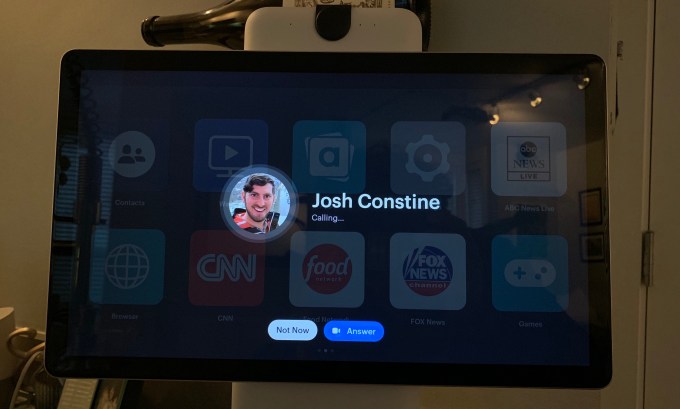
Portal’s app lets you video call your Portal so you can say hi to family while you’re out. That’s great for traveling parents or seeing who is around the house in the post-land line age. The app also allows you to add and remove accounts on Portal and manage who’s in your speed dial Favorites, which you could already do from the device. There’s still no Amazon Prime Video or Smart home controls as were promised at F8.

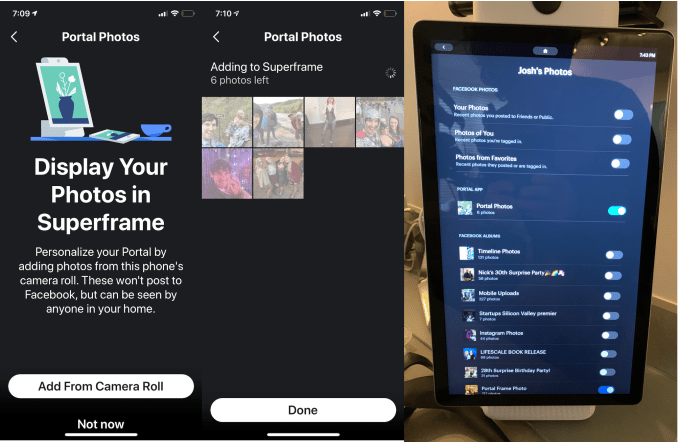
The option to send photos directly from your camera roll to Portal’s Superframe fixes the worst feature of the digital photo frame. Previously you’d have to select just from photo/video albums you’d shared to Facebook. That meant you were only showing off sacchrine photos you were willing to post online, and if you selected Your Photos or Photos Of You, you might end up displaying shots that were embarrassing or that don’t make sense outside of the News Feed.

My workaround was to create a Facebook album of photos for Portal set to be visible only to me, but that was a hassle. Now you can manually grab pics and videos from your phone and send them to Portal without the worry they’ll show up on your profile. Portal also now can show off your Instagram photos, as was announced at F8. Still missing is Google Assistant support, which Facebook told me it was working to integrate last year.

Facebook’s steady improvements to Portal might not have shook its paranoia-inducing reputation amongst tech news readers and privacy enthusiasts, but they’ve kept it perhaps the best big screen and camera-equipped smart speaker. But in the seven months since launch, Google has copied Portal’s auto-framing camera for video chat in its new Nest Hub Max while Amazon is making a slew of home appliances smart. Portal will need more marquee innovations and some brand rehabilitation if it’s going to stay competitive.

Pokémon GO will soon use sleep data to “reward good sleep habits”

Well, here’s a bit of surprise news this evening: at some point in the future, Pokémon GO is going to wrap the player’s sleep habits into the gameplay.

It’ll come as part of a wider initiative by The Pokémon Company to — as CEO Tsunekazu Ishihara put it in a press conference this evening — “turn sleep into entertainment”. Which… well, we’ll see how that goes.

Niantic CEO John Hanke took the stage at the press conference for a moment, but didn’t really offer much in the way of details. Said Hanke:

Niantic pioneered a new kind of gaming by turning the whole world into a gameboard, where we can all play and explore. By creating a new way to see the world and an incentive to go outside and exercise, we hoped to encourage a healthy lifestyle and to make a positive impact on our players and on the world. We’re delighted to be working with The Pokémon Company on their efforts to encourage another part of a healthy lifestyle: getting a good night’s rest.

At Niantic, we love exploring the world on foot. And that can’t happen unless we have the energy to embark on these adventures. We’re excited to find ways to reward good sleep habits in Pokémon GO as part of a healthy lifestyle. You’ll be hearing more from us on this in the future.

Ishihara also announced that they’re working with SELECT BUTTON (the company behind the 2017 mobile title Magikarp Jump) to make a separate game called Pokémon SLEEP. Next to no details on that one yet, though, besides the logo:


All of it will tap a just-announced device called Pokémon GO+ Plus (Yeah. Two plusses, one written. Go Plus Plus). It’s a follow-up to the original GO+, which was built primarily to let you play Pokémon GO without actually looking at the screen. The GO Plus Plus will do everything the GO+ did — letting you tap a button to spin Pokéstops or catch nearby Pokémon — but also has a built-in accelerometer allowing it to be laid on your bed to track sleep habits and send’em back to your phone via Bluetooth.

And here’s a screenshot of a video that played alongside the announcement, showing the device as it’s meant to be used:


FireEye snags security effectiveness testing startup Verodin for $250M

When FireEye reported its earnings last month, the outlook was a little light, so the security vendor decided to be proactive and make a big purchase. Today, the company announced it has acquired Verodin for $250 million. The deal closed today.

The startup had raised over $33 million since it opened its doors 5 years ago, according to Crunchbase data, and would appear to have given investors a decent return. With Verodin, FireEye gets a security validation vendor, that is, a company that can run a review against the existing security setup and find gaps in coverage.

That would seem to be a handy kind of tool to have in your security arsenal, and could possibly explain the price tag. Perhaps, it could also help set FireEye apart from the broader market, or fill in a gap in its own platform.

FireEye CEO Kevin Mandia certainly sees the potential of his latest purchase. “Verodin gives us the ability to automate security effectiveness testing using the sophisticated attacks we spend hundreds of thousands of hours responding to, and provides a systematic, quantifiable, and continuous approach to security program validation,” he said in a statement.

Chris Key, Verodin co-founder and chief executive officer, sees the purchase through the standard acquisition lens. “By joining FireEye, Verodin extends its ability to help customers take a proactive approach to understanding and mitigating the unique risks, inefficiencies and vulnerabilities in their environments,” he said in a statement. In other words, as part of a bigger company, we’ll do more faster.

While FireEye plans to incorporate Verodin into its on-prem and managed services, it will continue to sell the solution as a stand-alone product, as well.

NIO shifts electric vehicle plans as losses pile up

Chinese automotive startup Nio is tweaking its plans for future electric vehicles, a move prompted by sluggish sales of its ES8 model.

Nio, which reported in its unaudited financial results Tuesday a loss of $390.9 million in the first quarter, is taking a number of measures in response to a slowdown in sales. Those changes include a shift in its vehicle production plans, a reduction in R&D spending and a 4.5 percent cut to its workforce, the company’s founder and CEO William Li said during an earnings call.

The drop in sales is primarily driven by the EV subsidy reduction in China and macroeconomics trends in the country that have been exacerbated by the U.S.-China trade war, Li said.

Nio shares still closed 3.6 percent higher Tuesday — and had popped as high as 7 percent) because the results still beat Wall Street’s expectations.

Nio began deliveries of the ES8, a seven-seater high-performance electric SUV, in China in June 2018. And while deliveries initially surpassed expectations, they have since slowed in 2019. Nio reported it delivered 3,989 ES8 electric SUV in the first quarter, a 50 percent drop from the previous period.

Li suggested that the upcoming ES6, a cheaper SUV that will come to market next month, could be cannibalizing ES8 sales.

Meanwhile, Nio has changed its strategy for future electric vehicles. Instead of bringing its next-generation ET7 to production, the automaker will instead focus on a third vehicle under its ES series lineup.

“Looking ahead to the second quarter, we expect an even more challenging sales environment and anticipate overall sequential demand and deliveries to decrease, as competition continues to accelerate and the general automobile market in China remains muted. Against this backdrop, Nio is focusing on rolling out our ES6 nationwide, and at the same time, improving overall network utilization and operating efficiencies,” Nio CFO Louis T. Hsieh said in a statement.

Nio showcased a preview version of the ET7 during last month’s Shanghai Auto Show. The automaker has said it will design and develop the ET series with a new next-generation platform 2.0 (NP2) that will feature Level 4 autonomous driving capabilities, a designation by SAE that means all of the driving is handled by the vehicle under certain conditions.

The launch timeline of the ET series will largely hinge on how Nio’s joint venture with Beijing E-Town International Investment and Development unfolds. Under the joint venture, Beijing E-Town International Investment and Development will invest 10 billion yuan ($1.45 billion) and will support a new factory for its NP2 platform vehicles, Reuters reported. The company said the parties are still working towards a final binding definitive agreement on the investment.

As those discussions shake out,  Nio plans to “leverage the platform technologies from the ES8 and ES6 to create a new model design.” This third vehicle model tied to the ES8 and ES6 platform is expected to launch in 2020.

Meanwhile, the company has high hopes for its nearer term ES6. The company has 12,000 pre orders for the ES6; some 5,000 of those were added in the five weeks since the Shanghai Auto Show. The first deliveries of the smaller SUV will begin in June.

SF will allow additional dockless bike-share operators

Uber’s JUMP will soon no longer be the sole operator of stationless bike-share programs in San Francisco. Today, the San Francisco Municipal Transportation Agency announced the expansion of its stationless bike-share program to allow additional companies to operate in the city.

JUMP received an exclusive, 18-month permit to operate a stationless electric bike-share service in the city last January. That meant companies like Lime and Spin, which has since gone all-in on scooters, were unable to deploy their bikes in the city. Now, following an application process, other companies may be able to operate stationless bike-share programs in San Francisco.

Interested companies can apply between now through June 24, 2019. The application requires companies to outline things like their pricing structures, proposed service area and fleet size, how they plan to ensure proper parking, and how they will ensure equal opportunity and fair wages among its labor.

While the city looks to expand its dockless bike-share offerings, the SFMTA says it has no plans to get rid of station-based bike-share systems like the one from Lyft’s Ford GoBike.

“A stationless system can help fill in the gaps where stations are yet to arrive or where stations are not required,” SFMTA’s Benjamin Barnett wrote in a blog post today. “We see the combination of both systems as the best fit for our unique City and an important part of our transportation network.”