MyndYou partners with Mizuho to expand senior care services assessing cognitive degeneration

MyndYou, which has developed a technology to assess cognitive degeneration in senior citizens, has partnered with the Japanese company Mizuho Information & Research Institute to test the company’s product for a potential nationwide rollout later in 2019. 

Starting with five cities in Japan over the course of May, MyndYou’s technology will be deployed in homes around Japan to provide remote care and analyze for changes in cognitive function.

The company has a downloadable app that passively tracks movement and monitors conversations for any signs of diminishing brain function.

“What we market today is anomaly detection and this allows us to go into the market without detecting specific anomalies,” says Ruth Poliakine, the company’s chief executive and co-founder. “As we grow and progress we see this going into more specific conditions and early conditions… first we have senior adults getting service.”

MyndYou says it already has over ten occupational therapists that have incorporate use of the MyndYou app into treatment regimes for their patients. That means hundreds of patients are currently testing out MyndYou’s service, the company said.

Partnering with Mizuho opens MyndYou up to a market that is acutely aware of the need to develop services for an aging population.

Roughly one quarter of Japan’s working population will be 75 years-old by the year 2040, according to a recent report.  And dementia is on the rise in the country.

“The number of dementia patients in Japan has reached 4.62 million and is expected to increase even further to seven million, which equals to one in five seniors over 65, in 2025. The disease has become an important problem not only for medical field but also for the whole of Japanese society. As in many cases, patients of dementia receive the diagnosis after the symptom has progressed, making a diagnosis and providing adequate care in the early stage is necessary,” said Hitoshi Morio, Joint General Manager, Innovation & Strategy Division, Mizuho Information & Research, in a statement.

The company charges between $10 and $50 for its service, depending on the use case and the number of patients that are using the technology.

News of the new partnership with Mizuho follows an extension of the company’s seed round, which included Amplifyher Ventures, Female Founders Fund and the angel investor, Howard L. Morgan. To date the company has raised $2.1 million.

“As a New York-based company with proprietary technology developed in Tel Aviv, we have partnered with MHIR to further the global potential for MyndYou,” said Poliakine, in a statement. “Now, the senior adult population in Japan will have access to a technology that can not only reduce readmission rates, but also prolong independence of senior adults, while providing them with personalized, data-driven remote care.”


Walmart hires former Google, Microsoft and Amazon exec Suresh Kumar as new CTO

Walmart announced today it has hired former Google, Microsoft and Amazon veteran Suresh Kumar in the newly created position of Chief Technology Officer and Chief Development Officer — a role that will report directly to Walmart CEO Doug McMillon. The CTO position was previously held by Jeremy King, who departed the retailer in March to become Pinterest’s head of engineering.

Kumar, meanwhile, most recently worked at Google where he served for over a year as  VP and General Manager of display, video, app ads, and analytics. Prior to that, he was Corporate Vice President of Cloud Infrastructure and Operations at Microsoft for three and a half years.

However, the experience that likely appeals the most to Walmart is Kumar’s 15 years spent in a variety of positions at Amazon, most recently as VP, Worldwide Retail Systems and Retail Services. He also previously led Amazon’s retail supply chain and inventory management systems.

Earlier in his career, Kumar was a research staff member at the IBM Thomas J. Watson Research Center. He holds a PhD in Engineering from Princeton and a Bachelor of Technology from the Indian Institute of Technology, Madras.

“The technology of today and tomorrow enables us to serve our customers and associates in ways that weren’t previously possible. We want to take full advantage of those opportunities,” said Walmart CEO Doug McMillon, in a statement about the new hire. “Suresh has a unique understanding of the intersection of technology and retail, including supply chain, and has deep experience in advertising, cloud and machine learning. And, he has a track record of working in partnership with business teams to drive results,” he added.

“Walmart is one of the great success stories in how a company evolves over time to serve the changing needs of its customers, and today, it is in the midst of a very exciting digital transformation,” Kumar noted. “With more than 11,000 stores, a high-growth eCommerce business and more than two million associates worldwide, the potential for technology to help people at scale is unparalleled, and I am excited to be part of this.”

Walmart’s U.S., Sam’s Club and International CTOs will report to Kumar, who will set Walmart’s technical strategy. As Global GDO, he will lead the team in building systems to digitally transform Walmart’s business operations, including the use of Walmart’s data to deliver a competitive advantage.

In addition, Clay Johnson and the Global Business Services team will also report into Kumar.

The hire comes at a time when Walmart and Amazon are battling head-to-head across a number of fronts, including e-commerce, omnichannel, advertising, logistics, brick-and-mortar operations, and even the cloud. Kumar’s over 25 years of technology experience will help here, as he has deep experience in retail, e-commerce, advertising, cloud, and machine learning, the retailer says.

Walmart has more recently been positioning itself as a tech company, not just a retailer. Former CTO King pointed to Walmart’s use of technology like VR headsets and machine-learning powered robots at this year’s SXSW, explaining that Walmart was building tech organization but struggles with its perception as being just warehouse-like store known for low prices.

Kumar will begin his new role on July 8.

Below is the full memo that was distributed this morning by Doug McMillon to Walmart’s internal teams about the hire:

Re: Suresh Kumar appointed Global Chief Technology Officer and Chief Development Officer

The technology of today and tomorrow enables us to serve customers and associates in ways that weren’t previously possible. We have started a significant digital transformation in our business, but we have a long way to go. We want to pick up the pace and increase the magnitude of change, so we’re creating a new role, reporting directly to me, of Chief Technology Officer (CTO) and Chief Development Officer (CDO), and I’m excited to announce we have found a uniquely qualified leader for this position in Suresh Kumar.

Suresh has 25 years of technology leadership experience, coming most recently from Google and previously working at Microsoft, Amazon and IBM. He has a unique understanding of the intersection of technology and retail, including supply chain, and has deep experience in cloud, advertising and machine learning. And, he has a track record of working in partnership with business teams to drive results. He is not only a strong technologist, but a strong business person as well.

As the Global CTO, Suresh will set our technical strategy, combining advances in computing with Walmart’s strengths to deliver the best customer experiences. As the Global CDO, he will lead the team in building tools and systems to digitally transform our business operations, using the scale and power of our data to deliver a competitive advantage while improving the productivity of our associates and their experience of being part of Walmart.
Our Chief Technology Officers (U.S., Sam’s and International) will dually report into Suresh and their respective business leaders to ensure our technology teams continue to meet the needs of our customers and associates. Clay Johnson and the Global Business Services team will also report into Suresh.

I’d like to take this opportunity to thank our technology team for the progress they’ve led and for their ability to make things happen during a period of change in our industry and our business.

Suresh was most recently at Google, serving as Vice President and General Manager of Display, Video, App Ads and Analytics. Prior to Google, he was the Corporate Vice President of Microsoft’s Cloud Infrastructure and Operations. Suresh spent 15 years at Amazon in various leadership roles, including Vice President of Technology for Retail Systems and Operations, and he led Amazon’s retail supply chain and inventory management systems. Before Amazon.com, Suresh was a research staff member at IBM T J Watson Research Center.

Suresh holds a PhD in Engineering from Princeton University, and a Bachelor of Technology from the Indian Institute of Technology, Madras. He and his wife Gayathri currently live in Cupertino, CA and have two daughters. He will be based in our Sunnyvale office, officially starting on July 8.
Please join me in welcoming Suresh!

Doug


VCs give failed AR startup Meta a do-over with new CEO, corporate entity

AR startup Meta’s original investors might have been screwed by the company’s collapse and fire sale, but a pair of VC firms are giving the brand another shot with a new corporate entity and CEO that the new backers hope will lead to a less abysmal outcome.

Meta Company is now Meta View, “a wholly new and unaffiliated entity.”

Meta v1’s not-so-differentiated approach to the AR market led it into trouble competing with teams from Magic Leap and Microsoft that were more focused on new technologies, though Meta was also well-financed with some $73 million in funding raised according to Crunchbase. The issue came as the company burned through that cash with the expectation that more was on the way. The unexpected dissolution of a $20 million funding round sunk the company and left it scrambling.

Ultimately, the company’s assets were sold months ago for “less than the bank was owed” to a mystery buyer that we now know was Olive Tree Ventures.

This isn’t the most conventional investment for Israel-based Olive Tree Ventures. One would imagine a deal like this comes from a specialized investor who finds dead startups, puts a new coat of paint on their IP and attempts to revive old relationships, but Olive Tree is just an early-stage VC firm. The fund generally focuses its investments on Israeli startups though Meta View will be based in San Mateo and it has traditionally invested in health-tech, something the AR startup was not particularly focused on its former life.

“We remain extremely bullish on the potential for spatial computing. Our belief was so strong that we did a somewhat non-traditional VC deal to acquire the assets, start a new company and find a new CEO with a vision and focus we believed in,” said Olive Tree Ventures GP Mayer Gniwisch in a statement.

The new company is also launching with an undisclosed amount of funding from Montreal-based BNSG Capital.

It’s not entirely clear what the worth is in so fully reviving the Meta brand other than scrounging up some faith in the Meta 2 headsets which the company staked its reputation on. The company will not be selling the Meta 2 but will be supporting previously-sold headsets as it works on new hardware.

While this whole situation feels a tad dodgy, the new company’s CEO Jay Wright lends the new venture some credibility. Wright was a co-founder of Vuforia which really helped blaze a lot of trails in the AR space and he has led the product at PTC since it was acquired in 2015. Not mentioned in any communications from the new company is the name of Meta’s founding CEO Meron Gribetz whose role, if any, with Meta View is unclear.

Leaked screenshots confirm dark mode is coming to iOS 13

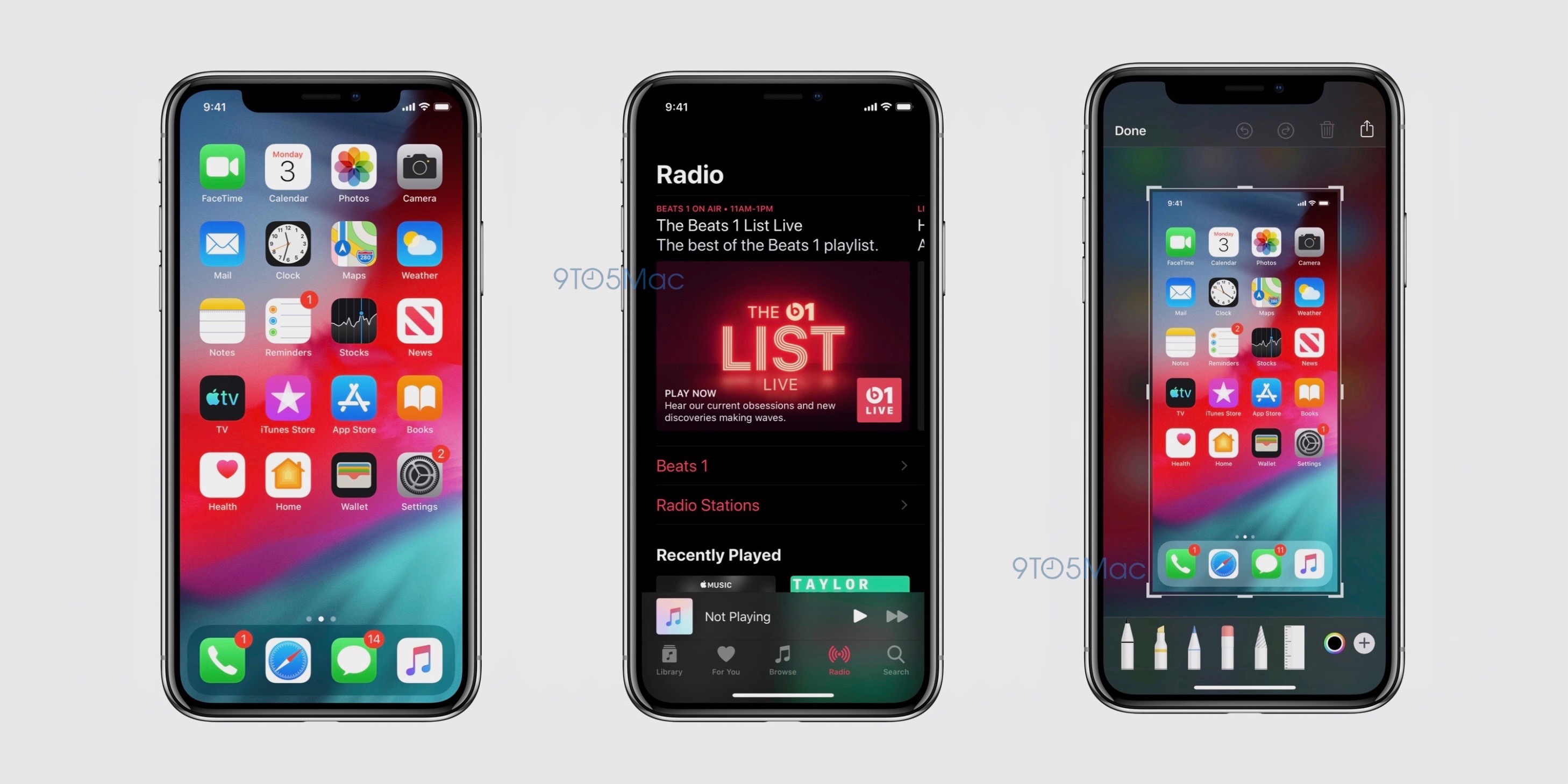
9to5mac’s Guilherme Rambo managed to obtain screenshots of iOS 13. While it still looks like iOS, there’s a twist — there will be a system-wide dark mode to make your apps look better at night. Apple is expected to announce the new version of iOS at its WWDC keynote on Monday.

With iOS 13, users can enable dark mode in the Settings app or with a toggle in Control Center — you may have to add the Control Center button in the Settings app first.

And here’s what it’ll look like according to 9to5mac’s screenshots:

As you can see, the home screen doesn’t change much except the dock at the bottom. But the Music app looks completely different with white text on top of a black background. The tab bar at the bottom also switches from transparent white to transparent black. Apple still uses red for buttons and links, which makes the app slightly less readable.

Enabling dark mode also affects user interface elements at the operating system level. When you take a screenshot and tap on the screenshot thumbnail, top and bottom menus are dark for instance. Developers should be able to support dark mode in third-party apps as well.

In other news, Rambo also shares a screenshot of the new version of the Reminders app. It now features four different menus — today, scheduled, all and flagged. The user interface has been refreshed as well.

Finally, 9to5mac also confirms a previous scoop with the icon of a new app called “Find My”. Apple plans to merge Find My Friends and Find My iPhone into a single app on both the iPhone and iPad.

Rumor has it that there will be more fundamental changes with iOS 13. Apple plans to let you open multiple windows of the same app. This way, users will be able to work on multiple documents or see multiple conversations at the same time. This will be a key new feature for iPad users in particular.

You can also expect smaller updates to Safari, Mail, font management, the volume indicator, the keyboard, etc.

The challenges of truly embracing cloud native

There is a tendency at any conference to get lost in the message. Spending several days immersed in any subject tends to do that. The purpose of such gatherings is, after all, to sell the company or technologies being featured.

Against the beautiful backdrop of the city of Barcelona last week, we got the full cloud native message at KubeCon and CloudNativeCon. The Cloud Native Computing Foundation (CNCF), which houses Kubernetes and related cloud native projects, had certainly honed the message along with the community who came to celebrate its five-year anniversary. The large crowds that wandered the long hallways of the Fira Gran Via conference center proved it was getting through, at least to a specific group.

Cloud native computing involves a combination of software containerization along with Kubernetes and a growing set of adjacent technologies to manage and understand those containers. It also involves the idea of breaking down applications into discrete parts known as microservices, which in turn leads to a continuous delivery model, where developers can create and deliver software more quickly and efficiently. At the center of all this is the notion of writing code once and being able to deliver it on any public cloud, or even on-prem. These approaches were front and center last week.

At five years old, many developers have embraced these concepts, but cloud native projects have reached a size and scale where they need to move beyond the early adopters and true believers and make their way deep into the enterprise. It turns out that it might be a bit harder for larger companies with hardened systems to make wholesale changes in the way they develop applications, just as it is difficult for large organizations to take on any type of substantive change.

Putting up stop signs

Move over Ready Player One — the future of AR might be in furniture

Last week Modsy, a San Francisco-based startup raised a large amount of funding – $37 million in C-round funding to be precise. And that followed a $23 million series B round in December 2017.

Why the large amounts I hear you ask? Well, Modsy is developing a platform that lets property owners create virtual renderings of rooms and restyle them in real time. So that means 3D automation, plus virtually positioning furniture items, combined with a marketplace where you can buy the items. Modsy’s tech replicates rooms in 360 degrees, with furniture from dozens of well-known brands. It’s a powerful combination.

The move shows that AR/VR technologies are now finding their place, not in a ‘Ready Player One’ style future but in the more mundane, but lucrative area of interior design.

But there’s another company out there that claims to have reached 40 million users with far more modest funding.

Planner 5D is a design tool that lets you create floor plans and interior designs using VR and AR. But its approach is different.

It first learns about how the house is used and then automatically creates a design. The startup claims its users have already designed more than 80 million projects without requiring any special design or software skills.

The software allows users to add rooms and floors in 3D, choose furniture and other objects from a catalog of over 4,500 items, and customize the materials, colors, and dimensions of the interior items and rooms. The AR aspect is used for capturing the dimensions of real rooms, while switching to VR lets you walk through the interiors virtually.

But homes are just the start. Founded in 2011 by Alexey Sheremetyev and Sergey Nosyrev in Lithuania, with backing from investor Igor Matsanyuk and Farminers Academy, Planner 5D plans to apply its AI features to home planning, robotics, scene-understanding, and more.

In the meantime, it’s easy to see why apps like this are taking off. The average interior design costs for a US homeowner are between $2000 and $8300, so using these apps can be a huge cost saving.

While Modsy and Planner 5D battle it out in this space, they are not the only apps available.

Users have a bewildering range to try. Pottery Barn’s 3D Room View app lets you put new furniture items in your home, while companies like Wayfair, IKEA and Houzz also have augmented reality solutions to allow customers to try out furniture in situ.

But while retailers try to lift sales with these apps, the likelihood is that the average consumer will not want several branded apps on their phone, when one app can do most of the heavy lifting and give direct access to furniture brands or retailers.

Then there is also the different approaches taken by these apps. Typically, retailer apps will just place an item of furniture in a room. Modsy will render an entire room, but take a couple of days to do it, though it’s latest funding will help speed that up. Planner 3D doesn’t render the room, but builds a scene based on dimensions, in a faster process.

Whatever methodology a tech company uses, all of these apps are sure to benefit. A survey Modsy took of its customers found that 80% plan to buy based on the rendered design.

When apps are connected with marketplaces, as Planner 3D and Modsy are, this means potentially huge revenues for these startups, and of course, the large rounds of venture funding we’ve seen to date.

IBM-Maersk blockchain shipping consortium expands to include other major shipping companies

Last year IBM and Danish shipping conglomerate Maersk announced the limited availability of a blockchain-based shipping tool called TradeLens. Today, the two partners announced that a couple of other major shippers have come on board.

The partners announced that CMA CGM and MSC Mediterranean Shipping Company have joined TradeLens. When you include these companies together with Maersk, the TradeLens consortium now encompasses almost half of the world’s cargo container shipments, according to data supplied by IBM .

That’s important because shipping has traditionally been a paper-intensive and largely manual process. It’s still challenging to track where a container might be in the world and which government agency might be holding it up. When it comes to auditing, it can take weeks of intensive effort to gather the paperwork generated throughout a journey from factory or field to market. Suffice to say, cargo touches a lot of hands along the way.

It’s been clear for years that shipping could benefit from digitization, but to this point previous attempts like EDI have not been terribly successful. The hope is that by using blockchain to solve the problem, all the participants can easily follow the flow of shipments along the chain and trust that the immutable record has not been altered at any point.

As Marie Wieck, general manager for IBM Blockchain told TechCrunch at the time of last year’s announcement, the blockchain brings some key benefits to the shipping workflow.

“The blockchain provides a couple of obvious advantages over previous methods. For starters, [Wieck said] it’s safer because data is distributed, making it much more secure with digital encryption built in. The greatest advantage though is the visibility it provides. Every participant can check any aspect of the flow in real time, or an auditor or other authority can easily track the entire process from start to finish by clicking on a block in the blockchain instead of requesting data from each entity manually.”

The TradeLens partners certainly see the benefits of digitizing the process. “We believe that TradeLens, with its commitment to open standards and open governance, is a key platform to help usher in this digital transformation,” Rajesh Krishnamurthy, executive vice president for IT & Transformations at CMA CGM Group said in a statement.

Today’s announcement is a big step toward gaining more adoption for this approach. While there are many companies working on supply chain products on the blockchain, the more shipping companies and adjacent entities like customs agencies who join TradeLens, the more effective it’s going to be.

MacKenzie Bezos pledges to give away more than half her $37B fortune to charity and philanthropy

MacKenzie Bezos, the world’s third-richest woman following her divorce from Amazon founder and CEO Jeff Bezos, has signed the Giving Pledge — a commitment that will see her giving away more than half her wealth to philanthropy or charitable causes, either during her lifetime or in her will.

Bezos recently made headlines when she gave ex-husband Jeff 75 percent of their joint Amazon stock and voting control in their divorce, along with their interests in The Washington Post and Blue Origin. However, that still left her with an at least $35.6 billion stake in Amazon. Bloomberg’s Billionaires Index now estimates her net worth at $36.6 billion.

“We each come by the gifts we have to offer by an infinite series of influences and lucky breaks we can never fully understand,” wrote MacKenzie Bezos, in a letter published by the Giving Pledge today, announcing her intention to give away her wealth.

“In addition to whatever assets life has nurtured in me, I have a disproportionate amount of money to share. My approach to philanthropy will continue to be thoughtful. It will take time and effort and care. But I won’t wait. And I will keep at it until the safe is empty,” she said.

Ex-husband Jeff Bezos tweeted praise for MacKenzie’s pledge this morning:

https://platform.twitter.com/widgets.js

Jeff Bezos has not signed the Giving Pledge himself.

Founded in 2010 by Bill and Melinda Gates and Warren Buffett, the Giving Pledge encourages the world’s richest people to give away over half their wealth. Other notable names who have previously signed the pledge include Mark Zuckerberg and Priscilla Chan, Elon Musk, Richard Branson, Larry Ellison, Michael R. Bloomberg, Pierre Omidyar and many more.

Today, the program announced 19 more philanthropists have signed their names to the pledge, bringing the total number of signatories to 204.

In addition to Bezos, other tech industry additions announced today include: Tegan and Brian Acton — the latter who co-founded WhatsApp, the messaging app bought by Facebook in 2014 for $19 billion; Coinbase co-founder and CEO Brian Armstrong; co-founder of bitcoin trading platform BitMEX Ben Delo; Twilio CEO Jeff Lawson and Erica Lawson; Lowercase Capital partners Chris and Crystal Sacca; and Pinterest co-founder Paul Sciarra and Jennifer Sciarra.

Globally, there are now signatories from 23 countries: Australia, Brazil, Canada, China, Cyprus, Germany, India, Indonesia, Israel, Malaysia, Monaco, Norway, Russia, Saudi Arabia, Slovenia, South Africa, Switzerland, Tanzania, Turkey, Ukraine, United Arab Emirates, the United Kingdom and the United States. In the U.S., the largest contingents are from New York and California.

Bezos’ full letter detailing her plans is below:

May 25, 2019

Thinking about the Giving Pledge, my mind kept searching its folds for a passage I once read about writing, something about not saving our best ideas for later chapters, about using them now.

I found it this morning on a shelf of my books from college, toward the end of Annie Dillard’s The Writing Life. It was underlined and starred like all of the words that have inspired me most over the years, words that felt true in context, and also true in life:

“Do not hoard what seems good for a later place in the book, or for another book… The impulse to save something good for a better place later is the signal to spend it now. Something more will arise for later, something better… Anything you do not give freely and abundantly becomes lost to you. You open your safe and find ashes.”

I have no doubt that tremendous value comes when people act quickly on the impulse to give. No drive has more positive ripple effects than the desire to be of service. There are lots of resources each of us can pull from our safes to share with others — time, attention, knowledge, patience, creativity, talent, effort, humor, compassion. And sure enough, something greater rises up every time we give: the easy breathing of a friend we sit with when we had other plans, the relief on our child’s face when we share the story of our own mistake, laughter at the well-timed joke we tell to someone who is crying, the excitement of the kids in the school we send books to, the safety of the families who sleep in the shelters we fund. These immediate results are only the beginning. Their value keeps multiplying and spreading in ways we may never know.

We each come by the gifts we have to offer by an infinite series of influences and lucky breaks we can never fully understand. In addition to whatever assets life has nurtured in me, I have a disproportionate amount of money to share. My approach to philanthropy will continue to be thoughtful. It will take time and effort and care. But I won’t wait. And I will keep at it until the safe is empty.

MacKenzie Bezos


Glovo faces safety protests after delivery rider killed on the job

Spanish on-demand delivery startup Glovo is facing angry protests from couriers on its platform following the death of a 22-year-old rider on Saturday in Barcelona where the business is headquartered.

Local press reports that the man, a Nepalese national called Pujan Koirala, had been substituting for a registered Glovo courier at the time he was struck and killed by a garbage truck. It does not appear that Koirala had a visa to work legally in Spain.

After Koirala’s death, a number of Glovo couriers held protests in front of the company’s office, burning the signature yellow delivery backpacks and criticising it for ignoring long-standing safety concerns — using hashtags #glovonosmata #glovomata on social media — aka, ‘Glovo kills us’, ‘Glovo kills’.

In Barcelona Glovo couriers are a more common sight than on-demand rivals such as Uber Eats and Deliveroo — typically to be found thronging eateries waiting to collect take-away orders and/or biking at speed to a drop off. The city is one of the Glovo’s best markets, though it also operates in other countries in Europe, as well as in LatAm and Africa.

https://platform.twitter.com/widgets.js

https://platform.twitter.com/widgets.js

https://platform.twitter.com/widgets.js

The tragedy highlights persistent safety concerns attached to conditions for service providers on so-called gig economy’ platforms which rely on scores of individuals to deliver the core platform proposition who are classified as ‘self-employed’, rather than employed as workers with all the rights and protections that would entail — while also often having their work rate tightly controlled and managed remotely via location-tracking algorithms.

In the case of Glovo the platform appears to weight delivery speed and availability between specific hours as key factors in distributing jobs. So, in other words, if a rider doesn’t make themselves available when the app demands, and get each delivery done quickly enough, they risk future work on the platform drying up.

A critical report last year by a UK politician, which examined conditions for couriers using the rival Deliveroo on-demand delivery platform, found a dual market in operation which encourages a surplus of labour that results in a winner takes all outcome where the best riders get rewarded with more stable work, while another group is left at a disadvantage to compete for whatever is left. (Deliveroo disputed the report’s findings.)

Hence both the safety concerns attached to gig economy platforms’ algorithmic management; and the practice of registered riders substituting themselves — i.e. in order to try to keep up with the work rate being demanded by sharing their account with a non-registered rider, as appears to be the case in Koirala’s case.

In a statement yesterday Glovo confirmed that Koirala had not been officially registered, writing that “the fact that he carried a Glovo backpack suggests that he could be using a third party’s account”.

It does not officially authorize this type of unregistered account sharing. But whether the pressures of working on its platform encourage unofficial substituting is quite another matter. (In its statement Glovo also writes that it tries to prevent unregistered substituting by offering riders and users mechanisms where they can report suspected cases, after which it says it may immediately and permanently cancel the account in question.)

Undocumented, unregistered platform service providers plying a black economy, cash-in-hand trade entirely off the platform’s books are clearly another, even more precarious tier of ‘gig’ workers — given they are working illegally, meaning they risk exploitation by those they are substituting for, as well as falling entirely outside any insurance benefits that a platform may offer to officially registered workers. (Glovo does offer riders a level of insurance.)

El Espanol reports that on the fateful day Koirala had agreed to do a delivery for his roommate. In such cases the paper suggests a substitute rider expects to be paid as little as €5 (~$5.60) for fulfilling the job on the registered user’s behalf.

Glovo, meanwhile, has raised more than $346M in VC funding since being founded just over four years ago, per Crunchbase — including a $169M Series D just last month. Investors include Seaya Ventures, Rakuten, Lakestar, Cathay Innovation, Antai Venture Builder and others.

We reached out to Glovo with questions about the safety and legal risks of using algorithms to manage a distributed ‘self-employed’ workforce at scale. At the time of writing we’re waiting for a response and will update this report when we have it.

Glovo investor Seaya Ventures did not respond to a request for comment about how it priced such a level of risk into its valuation of the startup.

In its statement yesterday Glovo said it would pay to cover the expenses of the private insurance that Koirala would have been entitled to had he been working legally and able to officially register on the platform.

It’s not clear how many similarly undocumented workers are gigging on Glovo’s platform.

Huawei reassesses FedEx relationship over ‘misrouted’ packages

Huawei is understandably reexamining a number of relationships in the wake of a recent U.S. trade ban. While various component and software providers including Google and ARM have suspended dealings with the Chinese hardware giant, the latest issue comes from an altogether different source. 

The company told Reuters this week that it’s reassessing its relationship with FedEx after the delivery company misrouted a handful of packages. Huawei says the packages contained documents, rather than specific technologies covered by the current Trump ban.

“The recent experiences where important commercial documents sent via FedEx were not delivered to their destination, and instead were either diverted to, or were requested to be diverted to, FedEx in the United States, undermines our confidence,” a rep for the company said. “We will now have to review our logistics and document delivery support requirements as a direct result of these incidents.”

FedEx has since apologized for the error on Chinese social media, stating its “regret” over the “inadvertently misrouted” packages. The company went on to explain that the issue was not the result of external pressure — no doubt addressing concern that the U.S. government may have played a role in the issue.

It remains to be seen whether Huawei will accept the apology. The company, which has long denied its own ties to the Chinese government that have put it under international scrutiny, is no doubt skeptical of its remaining relationships with U.S.-based corporations.