Q&A with J Crowley, Head of Product at Airbnb Lux, on what makes a great PM

The role of Product Manager can mean very different things at various companies. Should a product manager be technical? Scientific? Opinionated?

J Crowley has run product at three big-name companies. At Foursquare, he led the rebuild of Swarm after a rocky initial launch and eventually became Head of Product. He then moved on to Blue Apron as Head of Product, overseeing growth and monetization. This was right before Blue Apron went public, which ushered in a turbulent time for the company but one that yielded a wealth of life lessons for Crowley.

Now, he serves as Head of Product for Airbnb Lux.

I hopped on the phone with J to talk about what makes a great product manager, some of the lessons he’s learned, and how he’s made difficult decisions and communicated that to his team.

Editor’s Note: This interview has been edited for length and clarity.

Jordan: How did you get into the tech world in the first place? You used to work in TV, right?

J Crowley: I worked in the television industry for about 10 years. Many years at NBC for a bunch of different departments. Started in the Page Program, and worked on everything from late night comedy, to sports, news, election coverage, digital programming.

I ended up leaving NBC to start my own company, which was a small digital studio here in New York City. We made hundreds of digital shorts and web series. It was probably the most challenging, but most fun three years of my career.

I eventually packed it up to join Foursquare as their Director of Business Development in 2010. There, I helped them grow their brand by securing hundreds of media partnerships with major publishers, sports leagues, TV networks, musicians, etc. That was actually my first job in tech. It wasn’t a product role. It was business development.

Paladin Drones picks up $1.3M to give first responders a live feed of emergencies

In emergency situations, minutes can mean the difference between life and death. Paladin Drones, a company launching out of Y Combinator, wants to use technology to minimize the amount of time between a 911 call and a response through autonomous drones.

The company today announced the close of a $1.3 million seed round with participation from Khosla Ventures and Paul Bechheit.

Paladin’s software allows a drone — right now the software works with DJI drones — to deploy to the location of an incident and let first responders scope out the area beforehand. For example, a Paladin Drone might be deployed to the site of the fire, where it will arrive before first responders in an attempt to map out any dangers and locate hot spots of the fire inside the building.

The hope is to do as much data gathering and analysis as possible before any first responder gets on site. This allows them to jump straight into the process of saving lives and preventing further damage as soon as they arrive as opposed to taking the time to map out the situation.

According to Paladin, one of the big issues in emergency situations is lack of information. Usually, the only information that first responders have when they get on site is what was gleaned from a 911 call. Because people placing 911 calls are usually in a state of panic, that information can be unreliable.

In fact, that’s how Paladin came to be. Cofounder and CEO Divyaditya Shrivastava had a conversation with firefighters after his friend’s house had burned down while the family was on vacation. The 911 call was placed by a neighbor walking by. The firefighters told Shrivastava that they originally didn’t have the right location of the emergency due to an unreliable 911 call.

“They said that this actually happens about 70 percent of the time because whenever there is an emergency, generally, the person calling 911 is panicking and can only give so much information,” he said. “That’s when I realized this is a huge problem. These are firefighters trying to save lives and they don’t have good information.”

As a recreational drone pilot, Shrivastava realized there was an opportunity to give firefighters and other first-responders a real-time view of the scene to close the information gap. And so Paladin was born.

Shrivastava and his cofounder Trevor Pennypacker recently graduated out of Y Combinator and are running a pilot program with Memorial Village police department just outside of Houston, TX.

The Paladin Drone technology offers clear benefits to first responders — the average response time for an emergency ranges from 8 to 15 minutes, whereas a Paladin-powered drone can get there in 30 to 90 seconds. That said, there are looming concerns about the invasiveness of this type of surveillance technology.

But Paladin has thought ahead. Not only does the company plan to work with local, state and federal government to ensure that its platform is compliant, but it has also built software to ensure that Paladin Drones record the sky when they’re en route to an emergency, only panning down to the ground when they’re on site.

Out of stealth, Stratio emerges with predictive AI to stop your bus breaking down

Remember that future we were promised where our vehicle magically tells us that we’re about to break down? Or actually never does? Or that the pick-up truck arrives before the driver even knows something wrong? That future is arriving. But like many things, the practical reality is that this technology starts to arrive in the fleet management industry before it arrives for consumers.

The market for maintenance of fleets of buses and trucks is worth $200B in annual expenditure, so as you can imagine, it’s a juicy sector to get into. Down in Portugal, a tea of entrepreneurs and scientists assembled to look into this and came up with a fascinating startup that is now attracting the attention of investors.

Today, Stratio is emerging from stealth to help OEMs, Distributors and Fleets benefit from AI-driven predictive intelligence.

The idea is to apply machine learning models that retrieve and analyze millions of data points per vehicle per day to vehicles both in development and on the road. It turns out that if you compare the real vs. the expected behaviour of the actual vehicle components themselves, you can improve automated testing and predictive intelligence that can assess the vehicle’s condition. Then you can detect early anomalies and failure. This is exactly what Stratio does.

It does this by putting a sensor box-of-tricks under a vehicle, like a bus. This box connects with existing sensors in the vehicle using the existing API – something crucial for OEMs. Using proprietary machine learning it can predict when something will break, days ahead of time. Most existing boxes like this only track location, not analytics.

Stratio also works with OEMs during the vehicle testing phase to identify issues and their root cause to get more reliable vehicles to market faster, lower the potential for warranty claim fraud costs and expand the aftersales revenues. It’s a triple whammy in cost savings.

Stratio has now attracted a $3.5m VC round from London-based Crane VC, with participation from fellow London VC, Localglobe.

The round is one of the largest ever seed deals in Portugal and potentially the largest enterprise/deep tech first investment in the country.

It has a proprietary AI engine, Stratio CortexTM, and technology support from the European Space Agency. Ultimately the aim is to apply machine learning models and enable the so-called “zero downtime” future.

Rui Sales and Ricardo Margalho, co-founders of Stratio say the idea for Stratio came to them when their bus broke down and they missed what could have been a career-changing meeting in New York: “Knowing that today’s existing vehicles produce a massive amount of data, we set out to build a machine learning product suite that analyses high-density vehicle data in real time to predict and prevent vehicles from breaking down.”

Stratio launched in 2017, after receiving technological support from the European Space Agency and earning recognition from the EU Commission.

Alongside the co-founders is Rune Prytz, a former Volvo Trucks Research Engineer in machine learning and big data, who now leads all of Stratio’s efforts in AI. Stratio now counts MAN, DAF Trucks and VECTIA as customers, among others.

Krishna Visvanathan, Partner at Crane Venture Partners, commented “Stratio Automotive is one of the most exciting companies in our portfolio of data-driven enterprise software businesses. It has the trifecta of a super product, a deep data moat coupled with AI expertise and great customer traction.”

So far, Stratio has attracted customers and operations in over 10 key markets
across Europe, the UK, US, India and Singapore.

DJI launches a new onboard drone computer for enterprise users

DJI this morning announced the latest version of its Manifold onboard drone computer. The second generation device can be programmed for myriad different enterprise purposes, from research to routine inspections.

The Manifold 2 packs either an Intel Core i7 or NVIDIA Jetson TX2, integrating with the built-in sensors on the company’s Matrice 210 and 600 series drones. They’ve also got a variety of ports, including USB, UART and CAN, allowing users to connect multiple devices together for greater processing power.

The system essentially lets the drone do a lot of the necessary processing on-board, allowing for complex tasks, including real-time data and image processing. It can also be used to program the systems to avoid obstacles and fly autonomously in otherwise inaccessible situations, per DJI.

The system is available now via DJI’s site, at $1,379 for the Intel version and $1,099 for the NVIDIA. It offers a compelling proposition to companies look to get a bit more from off-the-shelf drones. It’s going to be an increasingly key category as more and more look to these technologies for routine inspections and other dull or dangerous jobs requiring a bird’s eye view.

Since not every company has the means or know how to create custom drone solutions, many will no doubt be looking to DJI for a more accessible solution.

Google makes mobile-first indexing the default for all new domains

At the end of 2018, Google said mobile-first indexing — that is, using a website’s mobile version to index its pages — was being used for over half the web pages in Google search results. Today, Google announced that mobile-first indexing will now be the default for all new web domains as of July 1, 2019.

That means that when a new website is registered it will be crawled by Google’s smartphone Googlebot, and its mobile-friendly content will be used to index its pages, as well as to understand the site’s structured data and to show snippets from the site in Google’s search results, when relevant.

The mobile-first indexing initiative has come a long way since Google first announced its plans back in 2016. In December 2017, Google began to roll out mobile-first indexing to a small handful of sites, but didn’t specify which ones were in this early test group. Last March, mobile-indexing began to roll out on a broader scale. By year-end, half the pages on the web were indexed by Google’s smartphone Googlebot.

Google explained the change to how sites are indexed is aimed at helping the company’s “primarily mobile” users better search the web. Since 2015, the majority of Google users start their searches from mobile devices. It only makes sense, then, that the mobile versions of the website — and not the desktop pages — would be used to deliver the search results.

Mobile-first indexing isn’t the only way that Google has begun catering to the larger mobile majority.

Several years ago, it also began to boost the rank of mobile-friendly webpages in search. Last year, it added a signal that uses page speed to help determine a page’s mobile search ranking. Starting in July 2018, slow-loading content became downranked.

While many sites today now show users across desktop and mobile the same content, those that have not yet achieved this parity have a variety of resources to help them get started. Site owners can check for mobile-first indexing of their website by using the URL Inspection Tool in the search console to see when the site was last crawled and indexed. Google also offers a host of documentation on how to make websites work for mobile-first indexing, and suggests that websites support responsive web design — not separate mobile URLs.

“We’re happy to see how the web has evolved from being focused on desktop, to becoming mobile-friendly, and now to being mostly crawlable and indexable with mobile user-agents,” said Google, in its announcement today.

Amazon defeated shareholder’s vote on facial recognition by a wide margin

Efforts by shareholders to instruct Amazon to stop selling its facial recognition technology to government customers failed by a wide margin, according to a new corporate filing with regulators.

About 2.4 percent of shareholders voted for the proposal, a fraction of the 50 percent necessary to pass. The measure needed to reach a 5 percent threshold for it to be re-introduced to shareholders again.

A second proposal to ask Amazon to carry out an independent human rights assessment of its facial recognition technology also failed. About 27.5 percent of shareholders voted in favor of the proposal.

Amazon has come under fire for its facial recognition tech, Rekognition following accusations of bias and that it’s inaccurate, which critics say can be used to racially discriminate against minorities.

The ALCU first raised “profound” concerns with Rekognition last year after it was installed at airports, public places and by police. The company has also pitched the product to Immigration and Customs Enforcement.

Although there was growing support from civil liberties groups like the ACLU as well as the public, senior Amazon staff have a majority stake and voting rights — making any dissent from outside shareholders difficult. Amazon founder and chief executive Jeff Bezos retains 12 percent of the company’s stock. The company’s top four institutional shareholders collectively hold about the same amount of voting rights as Bezos.

Read more:

Super Mario Maker 2 builds on Nintendo’s rich history

In 1992, Nintendo released Mario Paint. The SNES title was a strange departure, even as far as the diverse and wide-ranging gameplay of Mario’s world goes. For one thing, it shipped with a mouse, perhaps the unsexiest of all Nintendo peripherals.

For another, it was far more focused on creation than gameplay — drawing, music, animation.
The title provided a cursory glimpse at the creation side of gaming, and for a generation of young players, a taste of what it might be like to build a game themselves.

2015’s Super Mario Maker was a spiritual sequel of a kind. Released on the Wii U (then later, mercifully, the 3DS), the title was a more straightforward take on Mario world building. Released on the 30th anniversary of the original Super Mario Bros., it played on the company’s biggest strength: offering a new spin on a familiar franchise.


As the name implies, Super Mario Maker is a more direct sequel to its predecessor. It’s a broadening of the Wii U title in just about every aspect imaginable. In fact, Nintendo’s been happily teasing it out, block by block in recent months — and likely will continue the approach until the game finally arrives on the Switch on June 28. It’s a similar approach to the one it took with Super Smash Bros., only Maker is far more concerned with features and gameplay dynamics than hidden characters.

Playing the title at a Nintendo-hosted event last week, I was fairly impressed with the game play out of the box. The mechanics of world building can be tough to master with the Switch controllers provided, requiring players to scroll through a lot and memorize some less than intuitive button combinations to build courses. Though you should be pretty comfortably up and running within about five minutes or so.

Where the title really succeeds is in the sheer depth of gameplay. In the days of $1 smartphone games, $70 can seem like a tough pill to swallow, but as with just about every other Mario title, Maker 2 is an immensely replayable game. The new story mode lets the player hop in with 100 Nintendo-designed levels, or you can simply sample what others have been working on, competing on a world-wide stage on third-party creations.

Like the best Mario games, it’s a healthy mix of nostalgia and new ideas — and here it quite literally takes the player through four decades of Mario gameplay. The building blocks cleverly remix Marios of yore, including Super Mario Bros., Super Mario Bros. 3, Super Mario World, New Super Mario Bros. U and Super Mario 3D World.

For this old and old-school Nintendo player, most were familiar and some were new — the cat suit and pneumatic glass pipes from Super Mario 3D World in particular took some getting used to. As did the team mechanics of the multiplayer mode, which finds Mario, Luigi, Toad and Toadette teaming up to get through the levels in one piece.

I enjoyed the hour or two I had with the game, but ultimately it only felt like scratching the surface.

Seedlegals closes $4M Series A, led by Index Ventures, to automate startup fundraisings

When SeedLegals launched in 2017 in the UK, I’d say many of us thought “why has that not been done before?”. After all, two things have happened which make this an obvious idea for a startup: startup funding rounds are now so common that there is no reason large amounts of automation could be done. If you can buy a divorce online, surely you can organise funding rounds?

The second trend is the sheer level of automation happening in legal software today. After all, we now have “Uber for Lawyers” (Lexoo, Linkilaw, Lawbite) and AI-driven legaltech (KIRA, Luminance, ThoughtRiver). (Eventually, we will have blockchain smart contracts do ALL the work, but that’s for another time…).

So it’s not unsurprising that today SeedLegals announces it has closed a $4 million Series A led by venture capital firm Index Ventures (London/SF/etc) with participation from Kima Ventures (Paris/TelAviv), The Family (Paris) and existing investor Seedcamp (London).

SeedLegals says it now has 7,000 startups — capturing, it claims, 8% of all early-stage UK funding rounds — using its platform to manage the entire fundraising process and all related legal documents. The platform helps companies build and negotiate terms sheets, shareholder agreements, cap tables, stock option allocations, EIS approvals, hiring agreements, NDAs and more.

It also have two new products: SeedFAST and Instant Investment, which enable startups to quickly top up investment between funding rounds.

If UK companies created over 27,000 contracts on SeedLegals last year, the start-up reckons that saved them an estimated £4.5M in legal costs. Normally, lawyers create custom documents for each transaction. That means 18 weeks, on average, to complete a funding round, with legal fees starting at £3,000 for a simple seed round to £20,000 and up for each side for later-stage rounds.

The platform replaces spreadsheets and Word docs with a database-driven platform. You enter data once and the system uses pre-built knowledge, deal data and document automation to dynamically build all the outputs.

Anthony Rose, co-founder and CEO at SeedLegals, says they have removed the “complexity, unnecessary middlemen, standardized and automated the processes, and that has really resonated with both founders and investors.”

Hannah Seal from Index Ventures who joins the board with this round commented: “SeedLegals
is making the complex process of fundraising straightforward for everyone involved.

“We closed this round on SeedLegals and have been impressed with the speed and ease of use. For startups who spend thousands on legal fees on agreements that vary little from company to company, this is an absolute no-brainer.

SeedLegals was created by serial entrepreneur Anthony Rose, known in the tech industry for his work launching BBC iPlayer, and VC and angel investor Laurent Laffy, whose own portfolio includes consumer brands such as Graze and Secret Escapes .

Apple announces a new… iPod touch

Apple is updating the iPod touch with an A10 Fusion system-on-a-chip. Other than that, it looks pretty much like the old iPod touch with a 4-inch display, a classic home button and many different color options.

The A10 Fusion chip was first introduced with the iPhone 7. In other words, the new iPod touch will perform more or less just like an iPhone 7. Just like the previous version of the iPod touch, it supports iOS 12.

This is a developing post, please refresh for more information…

Indonesia’s vegetable hawkers are going digital thanks to a new startup

Few things are more interesting that the convergence of old and new. It’s with that in mind that we once again look to Indonesia where East Ventures, an early-stage VC that’s behind a project to digitize the country’s street vendors, has backed a new startup that is modernizing street vendors who sell fresh produce.

In Indonesia — and other parts of Southeast Asia — street-based vendors are a common and important part of local life. Best known for street food, they also span general convenience kiosks and sellers of fruit, vegetables and snacks, who often operate through cycle-based mobile ‘stores.’

The focus for Kedai Sayur, which means ‘vegetable store’ in Bahasa, is mobile vegetable sellers. The six-month-old startup aims to bring the benefits of the digital economy to these humble “hawkers” in Indonesia.

Perhaps the most important focus of the business is that it helps hawkers get better pricing when it comes to sourcing their produce. As things stand currently, the procurement process is dogged by issues. Most notably that’s a long supply chain which adds cost — prices increase as more middlemen take their cut — and means that vegetables are less fresh by the time they reach the hawker.

The combat that, Kedai Sayur groups orders together and negotiates better-than-retail rates for its hawkers who order their produce through an app. Orders are made by 6pm each day, and delivered to hawkers by 5am the next morning, Kedai Sayur co-founder and CEO Adrian Hernanto told TechCrunch in an interview.

The startup also provides hawkers with a financial float that allows them to upsize their order without necessarily having the money up front, as is currently required. So, for example, they can double their orders for a day if they believe that one particular vegetable can sell beyond what they usually stock.

“The problem is barging power between hawkers and distributors,” Hernanto explained. “They trade in small quantity but across many products and that’s why they can only get retail price.”

With the working capital — which is not a loan — he explained that hawkers can “order as much as they can sell and then pay later after they receive payment from customers.”

“We want to remove their working capital limits,” he added.

Full repayment is required before a hawker can make their next order, said Hernanto.

This is what the average setup for a vegetable seller in Indonesia looks like (Image via Bay Ismoyo/AFP/Getty Images)

Distribution is also an area for modernization. Kedai Sayur offers an app for consumers that allows customers to order produce remotely, which the hawker can then deliver. This augments trade that hawkers traditionally do offline and, according to Hernanto, combined with working capital, some vendors have increased their takehome profit three- or four-fold.

The most visibily striking part of Kedai Sayur’s offering to hawkers is an upgraded mode of transport: three-wheeled vehicles that are brightly branded and contain a chiller section to keep produce cool. They can be leased from the company to replace the typically-dowdy bike-based kiosks that are synonymous with hawkers.

Beyond nicer aesthetics, there are practical benefits. Hernanto said the new transport can open up other avenues for making money.

That’s because the storage section is removable and it can be set up a kiosk. Hernanto said some enterprising hawkers sell coffee, bread and other daily products on the street or at night markets in addition to their vegetable sales.

Potentially there may be other options in the future based around logistics. Kedai Sayur is in talks with prospective partners about teaming up to deliver parcels and more.

“Hawkers are the neighborhood logistics experts. There is potential to utilize them for last-mile delivery as they already have a vehicle and know the neighborhoods well,” explained Hernanto — whose co-founders include Ahmad Supriyadi, whose mother was a vegetable hawker, and Rizki Novian.
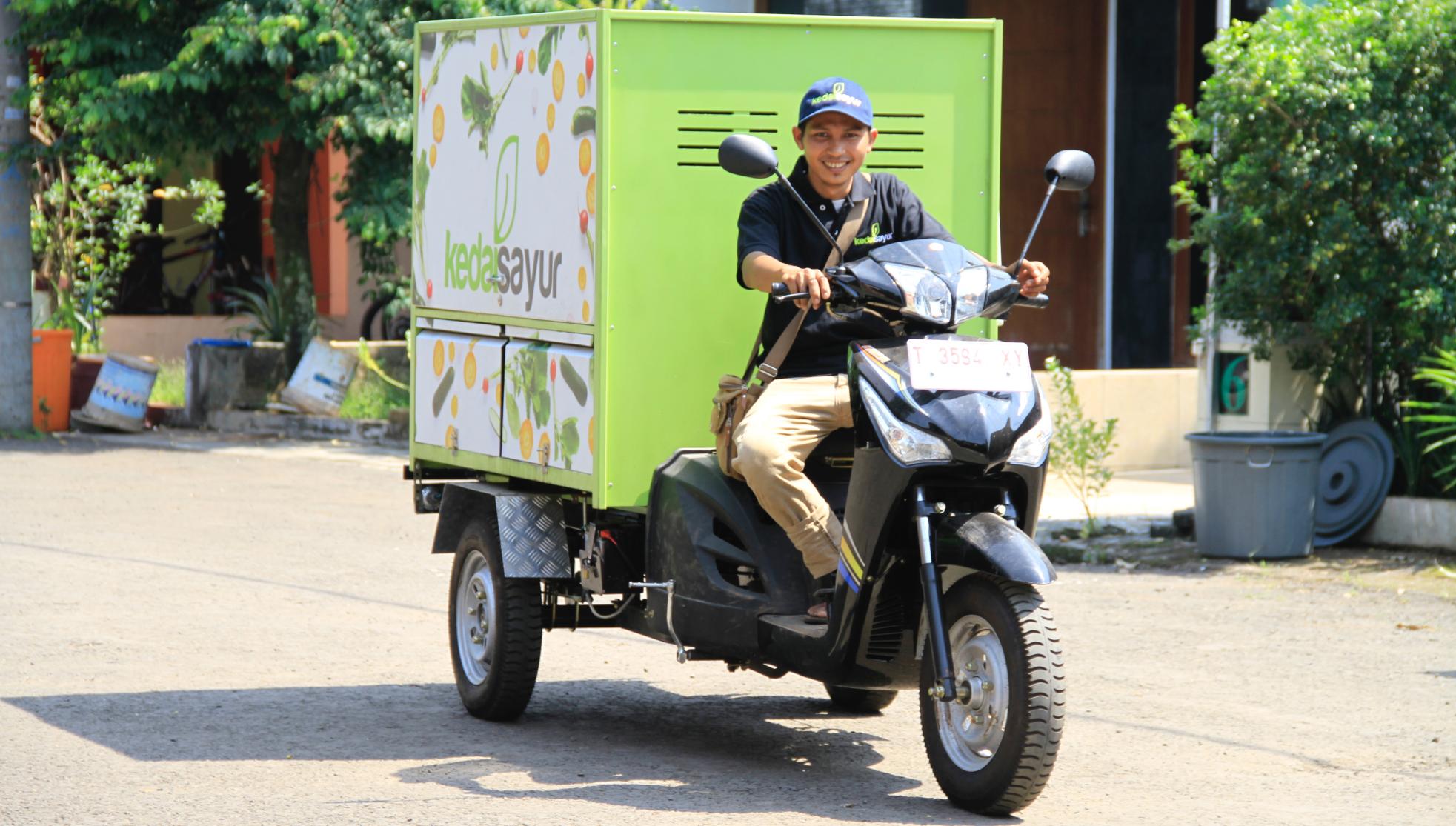
A Kedai Sayur hawker [Image via Kedai Sayur]

One area where the Kedai Sayur offering is lacking right now is digital payments since most transactions are handled in cash, despite a proliferation of mobile wallets from all manner of companies, including ride-hailing unicorns Grab and Go-Jek.

Most hawkers are comfortable with cash, it is after all the tradition, but it makes paying the working capital back somewhat cumbersome. Cash requires Kedai Sayur to dispatch an agent to collect any outstanding money from the previous order before a new order can be made, but more fundamentally moving cash around is messy.

The startup currently works with Alfamart’s retail-based payments for offline over-the-counter payback and it takes a chunk of payments via bank transfer, but Hernanto said cash accounts for some 55 percent of collections.

That could change in the future since there are plans to add digital services like OVO — which is part-owned by Grab — and Go-Pay from Go-Jek. That’ll make collecting money easier, and it might also appeal to consumers who buy the products, too.

On the subject of collecting money, Kedai Sayur is — like many early-stage startups — currently in “growth mode.” Hernanto believes it will become sustainable through revenue collected on margins between selling product to hawkers and sourcing — which he sees at 20-30 percent — as well as a delivery fee charged to bring products to hawkers. In the future, he sees the potential to introduce more formalized financing in the future which could also drive revenue whilst helping provide new financing options.

“When hawkers join our system, they become bankable,” he said. “We see the potential for microloans to hawkers in the future.”

After six months of operations in Jakarta, Kedai Sayur has reached over 3,000 hawkers, according to Hernanto, with 60 percent growth on a monthly basis. He isn’t providing revenue details, but the company said in a press release that GMV — the total amount of product bought from its hawkers — has grown five-fold in the past four months. Finally, and importantly, the startup also this week announced a $1.5 million seed investment from East Ventures.

As mentioned at the top, the startup fits with East Ventures’ thesis of using tech to augment traditional business.

In the case of Waring Pintar, the startup focused on street kiosk vendors that span out of East Ventures, the project has shown enough potential to merit a $27.5 million Series A round that closed earlier this year. The VC firm will be hoping for the same from Kedai Sayur which has already started planning for its next round of funding, according to CEO Hernanto.
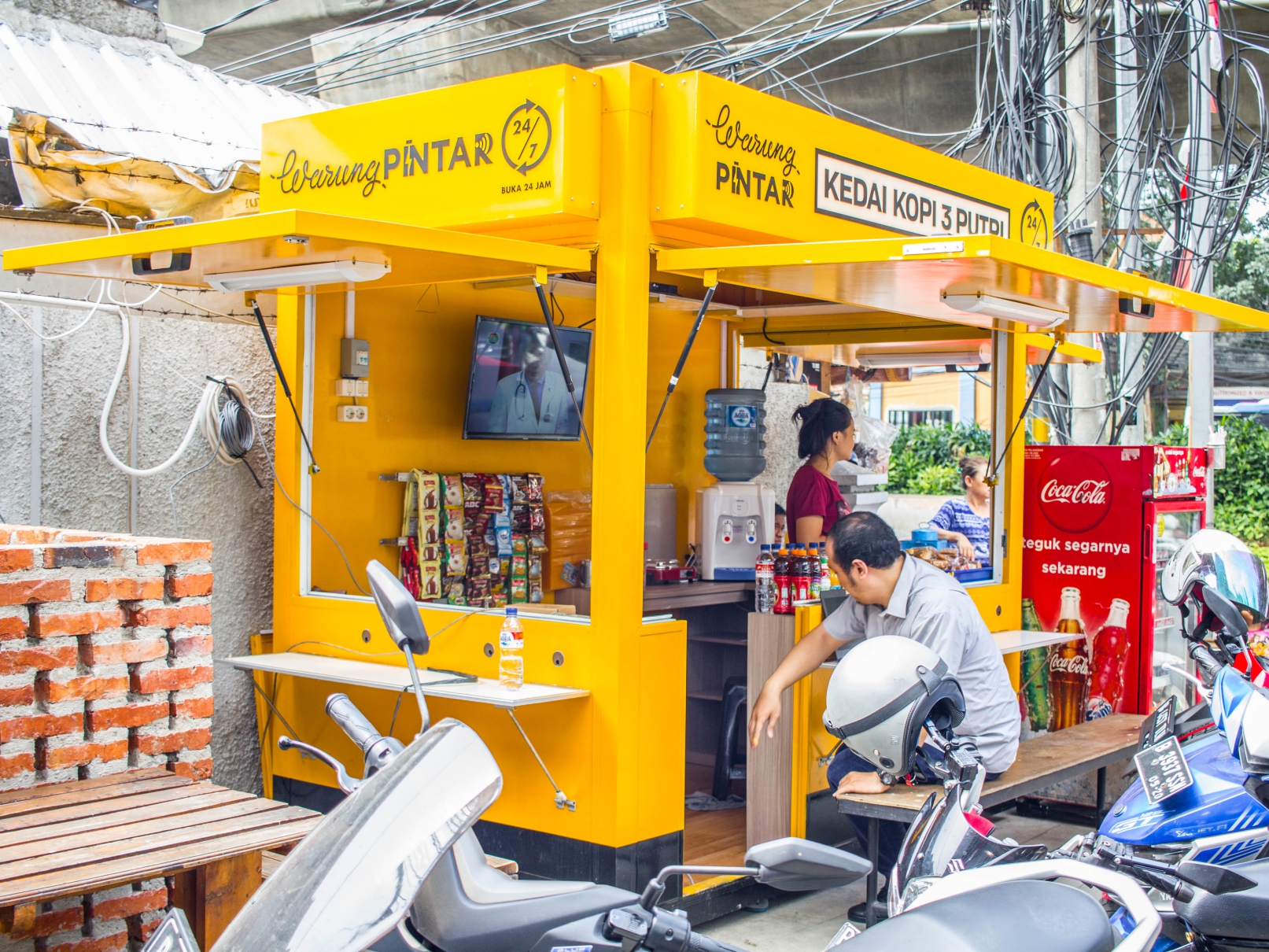
East Ventures previously backed a project to modernize street vendors in Indonesia by equipping them with WiFi, power points, improved inventory and more

“Door-to-door vegetable hawkers probably had existed for hundreds of years ago in Indonesia. Surprisingly, they are still available in today’s modern society, standing side-by-side with the fast-growing modern supermarket and convenience store. In fact, the vegetable hawkers are one the most convenient way to get our daily produce,” said Willson Cuaca, East Ventures co-founder and managing partner, in a statement.

“Kedai Sayur fits into two of East Ventures hypothesis. The first one, technology inclusion to upgrade the underserved merchant accessing technology and second, improvement of Indonesia supply chain. There is local wisdom that helps traditional on-demand vegetable hawker to exist for so long and we want to preserve that culture with a touch of technology,” Cuaca added.

Hernanto, meanwhile, is optimistic that the business can expand to other countries, most likely those in Southeast Asia. For now, though, he is looking at expansion into three new cities beyond Jakarta next year before gearing up to venture overseas at a later date. As the world’s fourth largest country by population and Southeast Asia’s largest economy, Indonesia remains the priority.