Which public US universities graduate the most funded founders?

A lot of students attend public universities to lessen the financial burden of higher education. At last tally, tuition and fees at American public colleges and universities averaged around $6,800 a year, per the federal government. That’s far below the $32,600 mean price tag for private, nonprofit institutions.

Yet when it comes to public universities, the old adage “you get what you pay for” clearly does not apply. Leading public research universities in particular have a track record of turning out enviably knowledgeable and successful graduates. That includes a whole lot of funded startup founders.

And that leads us to our latest ranking. At Crunchbase News, we’ve been tracking the intersection of alumni affiliation and startup funding for the past few years. In a story published earlier this week, we looked at which U.S. universities graduated the most founders of startups that raised $1 million or more in roughly the past year.

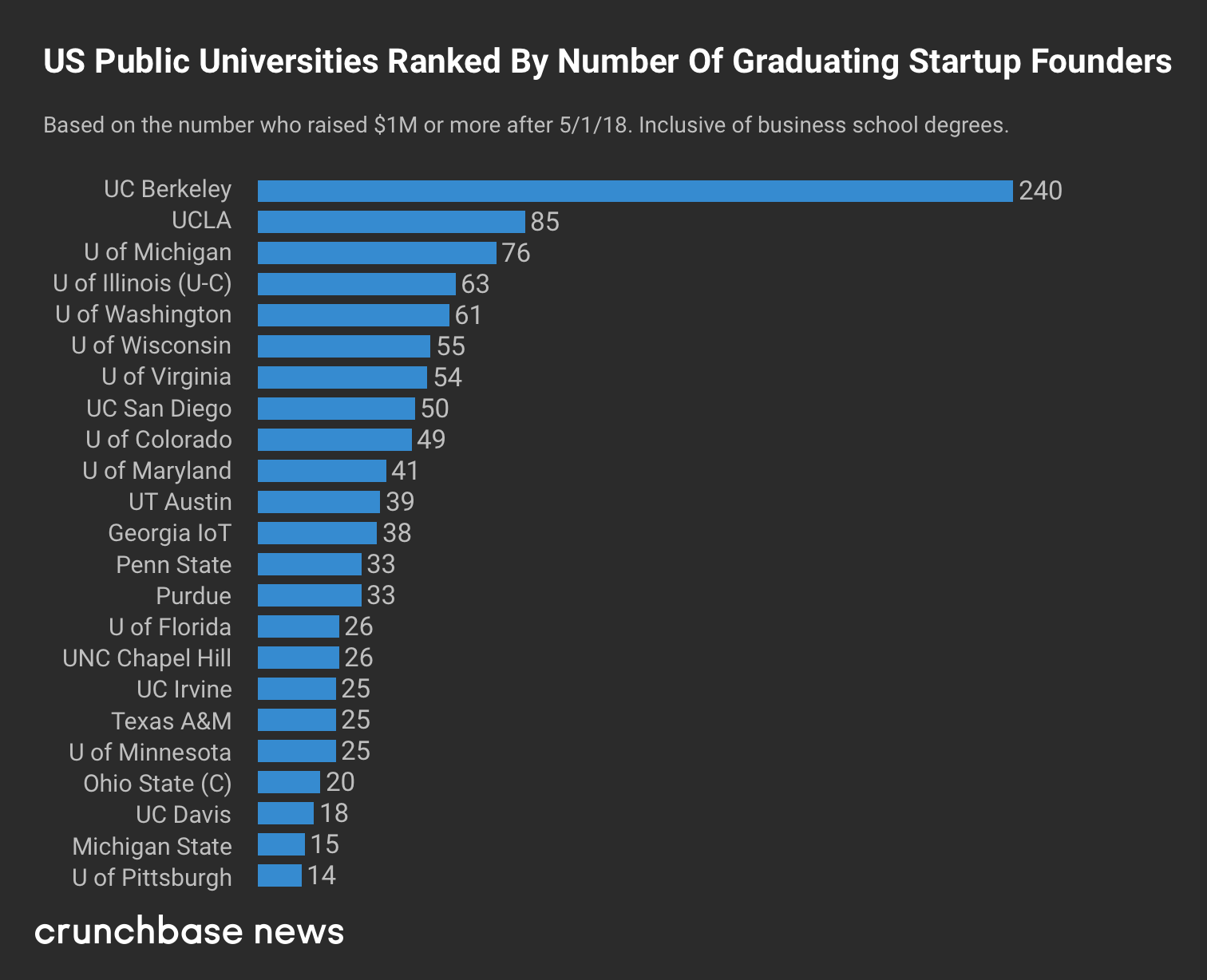
For today’s follow-up, we’re focusing exclusively on public universities. Starting with a list of top-ranking research universities, we looked to see which have graduated the highest number of funded founders.

For the most part, we used the same criteria as the public-and-private list, focusing on startups that raised $1 million or more after May, 2018. The public list, however, does not separate out business school grads.

Without further ado, here’s the list:

Key findings

Looking at the list above, a few things stand out. First, our top ranker, University of California at Berkeley, is multiples above the rest of the field when it comes to graduating funded founders.

Berkeley is a school that’s generally hard to get into, prominent in STEM and located in the VC-rich San Francisco Bay Area. So seeing it top the list isn’t necessarily surprising. However, the magnitude of its lead — with nearly three times the funded founders of runner-up UCLA — does warrant attention.

Big Midwestern schools also did well, with University of Michigan and University of Illinois, Urbana-Champaign nabbing the third and fourth spots.

More broadly, the list includes schools from all U.S. regions, including the East Coast, West Coast, South, Midwest and Southwest. So no particular region has a lock on graduating funded entrepreneurs. That’s also not surprising. But it’s good to have some more numbers to back up that notion.

Startups Weekly: VCs are drunk on beverage startups

Hello and welcome back to Startups Weekly, a newsletter published every Saturday that dives into the week’s most noteworthy venture deals, fundraises, M&A transactions and trends. Let’s take a quick moment to catch up. Last week, I wrote about an alternative to venture capital called revenue-based financing and before that, I jotted down some notes on one of VCs’ favorite spaces: cannabis tech. Remember, you can send me tips, suggestions and feedback to kate.clark@techcrunch.com or on Twitter @KateClarkTweets.

This week, I want to share some thoughts — questions, rather — on beverages. Just as my inbox has been full of cannabis-related pitches, it’s also been packed with descriptions of new…drinks. Perhaps the most noted so far is Liquid Death, canned water for the punk rock crowd, because why not? Liquid Death has attracted nearly $2 million in funding from angel investors like Away co-founder Jen Rubio and Twitter co-founder Biz Stone. Before I tell you about a few other up-and-coming beverage makers, I must beg the question: Does the beverage industry need disrupting?

Founders say yes. Why? For one, because millennials, according to various studies, are consuming less alcohol than previous generations and are therefore seeking non-alcoholic beverage alternatives. Enter Seedlip, a non-alcoholic spirits company, for example. Or Haus, launching this summer, an all-natural apéritif distilled from grapes that has a lower alcohol content than most hard liquors. Haus, like any good consumer startup in 2019, is shipped directly to your door.

https://platform.twitter.com/widgets.js

Bev, a canned wine business that recently raised $7 million in seed funding from Founders Fund, thinks marketing in the alcohol industry is the problem. Founder Alix Peabody designed a line of female-focused canned rosé. If you’re wondering why alcohol needs to be gendered in such a way, you’re not alone. Peabody explained most alcohol brands cater to men, and that’s a problem.

“The joke I like to make is there’s a go-to type of alcohol for every type of bro and we just don’t have that for women,” Peabody told TechCrunch earlier this year.

Finally, the wellness movement is taking over, driving VCs toward some odd upstarts. From wellness chat and journaling apps to therapy substitutes to fitness companies, stick wellness in a pitch and investors will take a second look. More Labs, for example, is backed with $8 million in VC funding. The company is readying the launch of Liquid Focus, a biohacking-beverage that claims to “solve modern-day stressors without the negative side effects.” Finally, Elements, “an elevated functional wellness beverage formulated with clinical levels of adaptogens to give your body exactly what it needs in four categories (focus, vitality, calm, and rest) for specific cognitive functions” (damn, what copy), recently launched. It doesn’t appear to be funded yet, but let’s just give it a few months.

There’s more where that came from, but I’m done for now. On to other news.

IPO Corner

I almost skipped IPO corner this week because no big-name companies dropped or amended their S-1s or completed a highly anticipated IPO, as has been the case basically every week of 2019. But I decided I better give a quick update on Luckin Coffee’s tough second week on the stock market. Luckin Coffee, if you aren’t familiar, is Starbucks’ Chinese rival. The company raised more than $550 million after pricing at $17 per share a little over a week ago. Immediately the stock skyrocketed 20 percent to a roughly $5 billion market cap; then came concerns of the company’s lofty valuation, major cash burn and uncertain path to profitability.  Luckin has dropped around 25 percent since closing its debut trading day. It closed Friday down 3 percent.

More changes at Y Combinator

Y Combinator, the popular accelerator program and investment firm announced this week that it has promoted longtime partner Geoff Ralston to president. This comes two months after former president Sam Altman stepped down to focus his efforts full-time on OpenAI. The promotion of Ralston is an unsurprising choice for YC, an organization that employs roughly 60 people, many of whom have been affiliated with it in one way or another for years.

M&A

Automattic acquires subscription payment company Prospress

Shopify quietly acquires Handshake, an e-commerce platform for B2B wholesale purchasing 

Streem buys Selerio in an effort to boost its AR conferencing tech

As Amex scoops up Resy, a look at its acquisition history 

Fundraising

The Los Angeles ecosystem is $76 million stronger this week as Fika Ventures, a seed-stage venture capital firm, announced its sophomore investment fund. Fika invests roughly half of its capital exclusively in startups headquartered in LA, with a particular fondness for B2B, enterprise and fintech companies. The firm was launched in 2017 by general partners Eva Ho and TX Zhuo, formerly of Susa Ventures and Karlin Ventures, respectively. The pair raised $41 million for the debut effort, opting to nearly double that number the second time around as a means to participate in more follow-on fundings.

Startup capital

DoorDash raises $600M at a $12.7B valuation
TransferWise completes $292M secondary round at a $3.5B valuation
Auth0 raises $103M, pushes its valuation over $1B
Canva gets $70M at a $2.5B valuation
Payment card startup Marqeta confirms $260M round at close to $2B valuation
Modsy scores $37M to virtually design your home
Sun Basket whips up $30M Series E
Zero raises $20M from NEA for a credit card that works like debit
Nigeria’s Gokada raises $5.3M for its motorcycle ride-hail biz

Extra Crunch

Our premium subscription service had another great week of interesting deep dives. This week, TechCrunch’s Lucas Matney went deep on Getaround’s acquisition of Drivy for his latest installment of The Exit, a new series at TechCrunch where we chat with VCs who were in the right place at the right time and made the right call on an investment that paid off. Here are some of the other Extra Crunch pieces that stood out this week:

Equity

If you enjoy this newsletter, be sure to check out TechCrunch’s venture-focused podcast, Equity. In this week’s episode, available here, Crunchbase News editor-in-chief Alex Wilhelm and I discuss how startups are avoiding IPOs and VC’s insatiable interest in food delivery startups.

China’s largest chipmaker is delisting from the Nasdaq

The U.S-China trade war is increasingly influencing tech. Huawei has suffered a turbulent past week with key suppliers pausing work with the company, and now China’s largest chipmaker is planning to delist from the New York Stock Exchange.

Semiconductor Manufacturing International Corp (SMIC) announced in a filing published Friday that it plans to delist next month ending a 15-year spell as a public company in the U.S. The firm will file a Form 25 to delist on June 3, which is likely to see it leave the NYSE around ten days later. SMIC, which is backed by the Chinese government and state-owned shareholders, will focus on its existing Hong Kong listing going forward but there will be trading options for those holding U.S-based ADRs.

In its announcement, SMIC said it plans to delist for reasons that include limited trading volumes and “significant administrative burden and costs” around the listing and compliance with reporting.

What it doesn’t say is that this is linked to the frosty relationship between the U.S. and China, and already the company has played that rationale.

“SMIC has been considering this migration for a long time and it has nothing to do with the trade war and Huawei incident. The migration requires a long preparation and timing has coincided with the current trade rhetoric, which may lead to misconceptions,” a spokesperson told CNBC.

Still, it is impossible to ignore the current context. Huawei’s entry to a U.S. blacklist has paused its relationship with key suppliers including ARM, Qualcomm, Intel and Google, which supplies the Android OS for its phones, so SMIC’s decision to remove its financial links to the U.S. fees into fears of a bifurcation of U.S. and Chinese tech, deliberate or not.

SMIC’s shares dropped 4 percent in Hong Kong on Friday. Trading of its U.S-based ADRs crossed one million on Friday, that’s well above an above 90-day volume of nearly 150,000 per day.

The company is China’s largest chip firm, specializing in integrated circuit manufacturing with clients such as Qualcomm, Broadcom and Texas Instruments. SMIC made a profit of $746.7 million in 2018 on revenues of $3.36 billion. Its most recent Q1 results released earlier this month saw revenue fall 19 percent year-on-year.

There has always been tension around Chinese companies using U.S. public markets to go public, and not just from an American standpoint. Chinese companies are increasingly exploring other options, including Hong Kong — where Xiaomi went public last year — while a-soon-to-launch ‘science and tech’ board in Shanghai is hotly touted as an alternative destination.

The board launches in pilot mode next month, but already Chinese bankers and tech companies have found it challenging to deliver on expectations, as a Reuters report earlier this year concluded.

Business author Julian Guthrie on the biggest difference between ‘alpha’ men and women

If you’ve been out and about in Silicon Valley in the last month or so, chances are you’ve heard of “Alpha Girls,” a new book written by longtime journalist Julian Guthrie about four investors who’ve made a big impact on the world of startup investing. The book recognizes the four — Theresia Gouw, MJ Elmore, Sonja Hoel Perkins, and Magdalena Yesil — because they are interesting individuals, each with very different upbringings and skill sets and areas of expertise, but also because they succeeded in the venture industry during a time when they were almost always the only woman in the room, or at the conference, or in the middle of a team-building event.

Indeed, well before a light was shone bright on gender disparity in the world of VC, the four were blazing a trail. Elmore signed on with IVP in 1982,  becoming a general partner by age 28. Yesil cofounded the dot com high-flier CyberCash before joining USVP as a partner in 1988. Perkins’s star also rose quickly. By age 29, she was a general partner at Menlo Ventures, staying nearly 22 years before launching her own venture fund. Down the street, Gouw was building a track record at Accel, where she spent 15 years before cofounding her own firm in 2014, Aspect Ventures.

We talked with Guthrie earlier today about the four and how much time she’d spent with them. (“I think they were ready to block my calls and texts,” she laughed.) We wanted to know how these so-called alpha women differ from the many other subjects Guthrie has spent time with across her 20-year reporting career with the San Francisco Chronicle, during which time she also authored books about Larry Ellison and Peter Diamandis. We wondered, too, how long it took her to work on the book (roughly two years, including interviews with the women and the colleagues and their partners and the founders they’ve funded, among others).

But what really piqued our interest was whether, after working on the book, Guthrie viewed the venture industry as any more or less welcoming to women than at the outset of her research. “It is not as bad as it’s portrayed, in my opinion,” Guthrie told us. “There are success stories.”

Still, Guthrie noted that each of these investors had to grapple with much that a man might not, particularly in the early days of their careers but not exclusively. Some of these were mundane but constant considerations, including, “Should you take notes or not? When do you speak up? How do you network? Do you go to these boondoggles when it’s all guys?” Said Guthrie, “Some of these things were shocking to me, coming from my own very gender-neutral experience as a reporter.”

We also wondered if, in talking with the subjects of her book, they’d ever expressed having to emulate their male peers in order to get ahead.

Guthrie said on this front it was “not so much about emulating men but steering the spotlight away from their femininity, so it didn’t become a distraction.” She says Elmore quickly learned that if she wore a dress to a board meeting, for example, it would elicit compliments that weren’t necessarily expected, so she soon cut her hair and began wearing suits. Meanwhile, Perkins and Gouw participated in male-dominated events on the theory that you can’t win if you don’t play the game. For Perkins, this meant skiing alongside former Navy Seals when she was still a relative novice on the slopes. For Gouw, it was getting elbowed in the stomach during a competitive game of flag football.

Were they perhaps not so different after all from their male colleagues, we wondered? Is there one path to the top?Interestingly, Guthrie said that many of the men she has interviewed — including Ellison, Diamandis, Richard Branson and Elon Musk — “were happy to talk about their vulnerabilities, because it kind of rounds them out. It softens them in a nice way.” She observed that women who’ve enjoyed success meanwhile have a “much harder time sharing their mistakes, their regrets, their vulnerabilities,” said Guthrie. Because women are often provided less room for missteps, “I had to tell [the investors] again and again that it was important that we tell the good, bad, and ugly — not because I was seeking scandal but because I wanted these stories to be honest.”

Before we parted ways, we asked Guthrie about women and money, after she volunteered that it’s a “tricky issue for women. If you go after too much, you’re greedy; if you marry someone with money, you’re a gold digger.”

She pointed to a Forbes piece from last summer that called Gouw “America’s richest female venture capitalist.” Gouw apparently felt uneasy about the story and participated in it mostly to draw attention to her work with the advocacy organization she helped cofound, called AllRaise.  But as Gouw told Guthrie, it’s had a somewhat surprising impact. “She was a serious player before, but it kind of gave her street cred” with those who pay attention to Forbes’s Midas List and other forms of score-keeping, said Guthrie.

It’s a good thing, suggests Guthrie, who has been promoting her book to women in numerous industries, including in homebuilding and law and in medicine. “You see the same barriers across them all,” Guthrie said. But
“you’re also seeing these women’s groups and networks becoming more powerful across all these industries, where women are speaking out and creating these sisterhoods.”

Increasingly, they’re agreeing to some self-promotion, too. As Guthrie puts it, “It’s not boasting when it’s based on fact.”

Pictured above, left to right: Theresia Gouw, Sonja Perkins, MJ Elmore, Magdalena Yesil, and Julian Guthrie.

Uber’s first employee Ryan Graves resigns from board

Ryan Graves, a longtime Uber employee and former chief executive officer, has resigned from the company’s board of directors, effective Monday.

The newly-public company announced the departure on Friday afternoon. Ron Sugar, the company’s independent chairperson of the board, wrote in the filing that Graves was key in shaping what Uber is today. 

“As a thoughtful and engaged director, Ryan has continued to add value to Uber, offering insights and judgments that have helped us navigate the ups and downs of the business as we have grown over the past decade,” Sugar wrote. “While this is a bittersweet moment, we accept his personal decision that this is the right time for him to step down. Dara and I are grateful for his contributions to Uber’s success and wish him all the best going forward.”

Graves, who currently leads the investment firm Saltwater Capital, joined Uber in 2010 after co-founder and CEO Travis Kalanick tweeted that he was “Looking 4 entrepreneurial product mgr/biz-dev killer 4 a location based service.” Graves responded to the request and the rest is history.

https://platform.twitter.com/widgets.js

Graves served as the up-and-coming ridehail business’s CEO for a brief stint in 2010, helping officially launch the service and raise its first round of capital. He was the company’s senior vice president of global operations from 2011 to 2017, before stepping down in August mere months after Kalanick resigned

News of Graves resignation comes weeks after Uber completed a long-awaited initial public offering. The business (NYSE: UBER) was valued at $72 billion by venture capitalists ahead of its offering. Ultimately, Uber priced its stock at $45 apiece for a valuation of $82.4 billion in an early May offering, then began trading at $42 per share. It has since floundered on the stock market, failing to match its IPO price. Uber closed down 2.6 percent Friday.

According to Business Insider, Graves, a board member for nearly a decade, was expected to take home some $1 billion from the company’s IPO.

First American site bug exposed 885 million sensitive title insurance records

News just in from security reporter Brian Krebs: Fortune 500 real estate insurance giant First American exposed approximately 885 million sensitive records because of a bug in its website.

Krebs reported that the company’s website was storing and leaking bank account numbers, statements, mortgage and tax records, and Social Security numbers and driving license images in an enumerable format — so anyone who knew a valid web address for a document simply had to change the address by one digit to view other documents, he said.

There was no authentication required — such as a password or other checks — to prevent access to other documents.

According to Krebs’ report, the earliest document was labeled “000000075” — with newer documents increasing in numerical order, he said.

The data goes back at least to 2003, said Krebs.

“Many of the exposed files are records of wire transactions with bank account numbers and other information from home or property buyers and sellers,” wrote Krebs. First American is one of the largest real estate title insurance giants in the U.S., earning $5.8 billion in revenue in 2018.

A spokesperson for First American did not immediately respond to a request for comment but told Krebs that its web application was shut down and that there would be “no further comment” until its review was complete.

It’s the latest breach of sensitive mortgage data in recent months.

TechCrunch exclusively reported in January a trove of more than 24 million financial and banking documents were left inadvertently exposed on a public cloud storage server for anyone to access. The data contained loan and mortgage agreements, repayment schedules and other highly sensitive financial and tax documents that reveal an intimate insight into a person’s financial life.

How to see another company’s growth tactics and try them yourself

Every company’s online acquisition strategy is out in the open. If you know where to look.

This post shows you exactly where to look, and how to reverse engineer their growth tactics.

Why is this important? Competitive analysis de-risks your own growth experiments: You find the best growth ideas to adopt and the worst ones to avoid.

First, a warning: Your goal is not to repurpose another company’s hard work. That makes you a thief. Your goal is to identify other companies who face the same growth challenges as you, then to study their approaches for solutions to draw from.

As I walk through uncovering a competitor’s tactics, keep in mind which competitors are worth looking at: For instance, you should rarely over-analyze early-stage companies. They’re unlikely to be methodical at growth.

Meaning, if you blindly copy their site and their ads, it’s possible you’ll be copying tactics that are not actually responsible for their growth. Their success may instead be from network effects or other hidden factors.

Instead, it’s safest to get inspiration from companies who’ve sustained high growth rates for a long time, and who face the same growth challenges as you. They’re likely to have sophisticated growth operations worth studying deeply. Examples include:

  • Pinterest
  • Airbnb
  • Amazon
  • Facebook
  • Uber

If these aren’t your direct competitors, don’t worry. You don’t need to audit a direct competitor’s tactics to get incredibly valuable insights.

You can look past direct competitors.

You’ll gain useful insights from auditing the user acquisition funnel of any company who has a similar audience and business model.

Examples of audiences:

  • Wealthy consumers
  • Enterprise businesses
  • Middle-class adults who use Chrome
  • Dog owners
  • And so on

Audiences matter because their behaviors and needs differ wildly. Each requires its own growth strategy. You want to audit a company whose audiences is similar to yours.

You also want to ensure the company shares your business model. Examples include:

  • A high-touch sales process with multiple phone calls
  • A consumer ecommerce site with easy checkout
  • A self-serve SaaS signup with a freemium plan
  • A pay-to-play mobile game
  • And so on

Each model may necessitate different ads, landing pages, automated emails, and sales collateral.

The process

Never implement another company’s tactics blindly.

There’s an effective process for growth analysis, and it looks like this:

  1. Source potential growth ideas.
  2. Prioritize them.
  3. A/B test them.
  4. Measure if an A/B variant significantly outperformed its baseline and whether the cost of implementing the winner would be worthwhile.
  5. Only then should you implement it.

An example

Here’s a brief example before we dive into tactics.

Let’s pretend we’re a SaaS company offering consumer banking tools, and that we’re struggling to get users to onboard our app. Our hypothesis is that visitors are bouncing because they don’t trust us with their sensitive information.

Our first step is to define both our audience and our business model:

  • Audience: Tech-savvy, adult consumers.
    Business model: SaaS freemium funnel.

Our next step is to look for companies who share those two aspects. (We can find them on Crunchbase.)

Once we have a few in hand, we look for how they handle customers’ sensitive information throughout their funnel. Specifically, we audit their:

It’s time to learn how we audit all that. I’ll share how our marketer training program teaches marketers to do this on the job.

Tactic #1: How to see a company’s A/B tests

‘Observation’ is a tense, atmospheric puzzler where you play a modern HAL 9000

When you watch 2001: A Space Odyssey, do you find yourself criticizing HAL 9000’s machinations and thinking, “I could do better than that!” If so, Observation may be right up your alley. In it you play a space station AI called SAM that is called upon by the humans on board to help resolve a deadly mystery — though you may be a part of it yourself.

The game takes place in the near future on board the titular space station, a sort of expanded version of the ISS. You are booted up by astronaut Emma Fisher after an unspecified event that seems to have damaged the station. You, as the Systems Administration and Maintenance AI, are tasked with helping her out as she first tries to simply survive the immediate aftermath, then starts to investigate what happened.

To do so you perform various tasks such a digital agent would do, such as unlocking and opening hatches, checking for system errors, collecting information from damaged laptops, and so on. It’s mostly done through the many cameras mounted throughout the station, between which you can usually move freely and change the angle so you can get at this hatch or that scrap of paper on the wall.

But from the beginning it’s clear that this is not a simple case of a micrometeorite or some other common space anomaly. I won’t spoil any of the surprises, but suffice it to say that like in 2001, the mystery runs deeper than that, and SAM itself is implicated.

Observation is a puzzle game that plays out in real time, though you are rarely presented with a task that needs to be completed in a rush — your commands are rarely an urgent “Open the pod bay doors, SAM!” and more “Something’s wrong with the cooling system, so this hatch won’t open, can you look into it?”

And so you search using your cameras for, say, the server that controls that system, or the scrap of paper that has its schematic so you can reboot it. These solutions are usually just a matter of being, well, observant, but occasionally can be frustrating gadget hunts where you don’t know what you’re looking for among the busy background of a working space station and the detritus of the disaster.

If you’re having trouble with something, chances are you’re overthinking it. I had to look up the solution to one situation, and it turns out I had simply overlooked some interactive objects because they looked so much like background. (For the record, it turns out you can turn stuff on and off at power outlets.)

When you have to operate something, like an airlock, there is usually a little minigame to complete in which you must figure out which series of buttons to hit or hold — nothing too taxing, just a way to make it so you aren’t just pressing the Action Button all the time. The controls can be a bit clunky, such as one that had me hold down s to do one thing, then press and hold w at the same time. Do they not understand the same finger does both those things? Fortunately you can remap controls and although mouse movement is a bit stiff, there’s no need for twitchy response time.

Although the puzzles are a bit simplistic, it’s a pleasure navigating the station because it is so beautifully realized. The creators clearly did a ton of research and Observation, that is to say the station, is a convincing 21st century operation — cameras and laptops are stashed everywhere, sticky notes from the Russian and Chinese denizens, luggage and experiments tucked away or half finished.

It’s also all viewed through a combination of post-processing effects that make it all feel like you really are viewing it through a security camera system. These effects are a bit inconsistent — at one time you’ll hear what sounds like the whine of an 80s drive or system spinning up; others reflect a sort of Windows 98SE aesthetic; your own interface looks like something out of Terminator. It isn’t cohesive, exactly, but the truth is neither are the systems onboard the ISS and other space hardware. And it’s a nice touch that lets the developer differentiate each part of the station and the different devices you connect to.

The modeling of the main character, Emma, is also excellent, though lapsing a bit into uncanny valley territory due to some clunky animations here and there. Maybe it’s just the microgravity. But one thing that can’t be faulted is the voice acting — Emma’s actor is brilliant, and other voices you encounter are also well done. Considering the amount of dialogue in the game this could have been a dealbreaker, but instead it’s a pleasure to hear. Ambient audio is likewise lovely — wear headphones.

The atmosphere is oppressive and tense, but not exactly scary; Don’t expect a xenomorph to bust out of any vents, but also don’t expect Space Station Simulator 2019. This is a serious, adult (though not explicit or violent) sci-fi narrative and, from what I’ve played, a smart and interesting one.

I haven’t finished the game (which was sent to me in advance for review… but I’ve been in an intense love/hate relationship with Mordhau), but based on what I’ve played I can easily recommend Observation to anyone with a mind to take on mildly difficult puzzles and experience a well-presented story in a carefully crafted environment. Space buffs will also enjoy. At under $25 right now (less with this week’s sale going on) I’d say it’s a no-brainer.

Observation released earlier this week on the Epic Games and PlayStation stores.

Coinbits launches as a passive investment app for bitcoin

Erik Finman is a twenty-something bitcoin maximalist as famous for his precocity as he is for his $12 bet on the currency a few years ago.

Now, Finman, who built his first company while still in High School, is launching a new startup called Coinbits, which allows users to passively invest in bitcoin.

The idea, according to Finman, is to democratize access to the currency by letting everyday folks invest nominal sums through well-known mechanisms like roundups on transactions made with a credit or debit card or through regular transactions from a customer’s savings or checking account to bitcoin through Coinbits.

Every transaction also helps Finman’s own bitcoin holdings grow and makes the young entrepreneur a little wealthier himself through his bitcoin holdings.

Users can make one-time investments of $10, $25, $50, or $100 dollars through the web-based platform and can establish a level of risk for their holdings.

Finman’s app collects no commissions on transactions and 98% of the Bitcoin is stored offline — for safety.

“Overall, investing in Bitcoin is complicated and can feel almost impossible,”. said Finman. “Coinbits allows you to put that spare change in Bitcoin. For example, if you spend $1.75 on French fries, that remaining 25 cents is invested automatically.”

Withdrawals are handled by CoinBits which will give users same-day processing for a 50 cent-fee and offers an easily downloadable record for accountants to deal with any gains or losses associated with bitcoin.

Given the fractional nature of these investments, and the volatility of bitcoin, it’s hard to know what real value investors can reap from these small transactions, but it’s a less risky way to experiment with building bitcoin holdings than take a huge flyer on the market.


Livekick raises $3M to use live video for private training

Livekick, a startup that gives customers access to one-on-one personal training and yoga from their home (or hotel room, or elsewhere), is announcing that it has raised $3 million in seed funding.

The company was founded by entrepreneur Yarden Tadmor and fitness expert Shayna Schmidt. Tadmor said that with all his travel for work, his fitness routine “really eroded,” so he contacted Schmidt and asked her to train him remotely — they’d connect via FaceTime, he’d mount his phone at the gym and she’d supervise his workout.

“We trained this way for a while, and then we realized: Hey, this is something that other people can really benefit from,” Tadmor said.

So with Livekick, users can sign up for one, two or three live, 30-minute sessions with a remote trainer, who they’ll connect with via the Livekick iOS app or website. (After a two-week trial, pricing starts at $32 per week.) The workouts will be tailored to the space and equipment that you have access to, and the trainers will also assign other workouts for the rest of the week.

Tadmor and Schmidt contrasted this approach with companies like Peloton and Mirror, which are bringing new exercise equipment and classes into the home, but which don’t offer one-on-one interaction with a trainer. Tadmor said this individualized approach is not just better tailored to each user’s needs, but also more effective at keeping them motivated. And Schmidt said the live interaction also ensures that people are doing their workouts correctly and safely.

As for the trainers, Schmidt said this gives them a new way to find clients, particularly during their off-hours.

“For trainers, the hours that user are never booked are usually noon to 4pm — they never get a client because people are at work, obviously,” she said. “So we can give trainers in London those hours because for a user in New York, that’s morning. We can really fill their schedules [and] help them make some more income.”

Beyond consumer subscriptions, Livekick also offers a corporate program called Livekick for Travelers. And just to be clear, the service isn’t just for frequent travelers, as Tadmor noted: “If you live in New York, you have access to a lot of fitness options, but most people don’t. You’ve got to do a lot of commuting to get to a studio with great trainers, and so part of what we’re trying to bring is really let you do that from the comfort of your home.”

And while we recently covered the launch of a similar service called Future, Livekick actually launched in September, and Tadmor said the average retention rate has been over six months.

The round was led by Firstime VC, with participation from Rhodium and Draper Frontier.

“With its leading technology and ethos to make exercise accessible and affordable, we believe Livekick has the capacity to improve the lives and health of millions,” said Firstime’s Nir Taralovsky in a statement.