Firefly raises $30M to bring more ads to Ubers, Lyfts and taxis

Firefly, a startup that allows ridehail drivers to make money from advertising, has raised $30 million in Series A funding.

The company is about to launch in New York City, where it’s also acquiring the digital operations of advertising company Strong Outdoor. Co-founder and CEO Kaan Gunay said this will allow Firefly to start working with traditional taxis in a big way.

“It’s essentially locking in the largest taxi advertising contract, partnering with the largest taxi trade organization in the United States,” Gunay said.

Firefly already operates in San Francisco and Los Angeles, where it works with drivers for Uber, Lyft and other services to install a “digital smart screen” that can run targeted, geofenced advertising from companies like Brex, Segment, Caviar and Zumper. And although the startup is starting to work with taxis too, Gunay said it won’t be ignoring ridehail drivers: “Firefly is for everyone.”

The new funding comes just six months after Firefly announced a big seed round of $21.5 million. Gunay said that by raising even more money, the company can “make sure we are able to scale very quickly and very efficiently.”

Firefly

The round was led by GV (formerly Google Ventures), with participation from NFX.

“Firefly is creating a significant new ad format at scale,” said GV’s Adam Ghobarah in a statement. “In addition to taxis, the scale of rideshare networks has created a large opportunity to provide digital out of home advertising with granular city-block and time targeting.”

The recent IPOs of Uber and Lyft have also brought more attention to the issue of driver compensation, with some drivers staging a brief strike. (Last year, Firefly said it was bringing its drivers an additional $300 per month on average.)

“In this current environment, where unfortunately it is becoming more difficult for our driver partners to make a livelihood in these expensive cities, I think having a platform like Firefly whose mission really is to help these drivers make a better living is incredible,” Gunay said. “We have been extremely lucky to see such an incredible reception from our driver partners, and we’re doing everything possible to make sure we continue to increase the income we are providing to them.”

He also described the Firefly approach as a “win-win-win scenario” — not just for drivers and advertisers, but also for local businesses, nonprofits and local governments, to whom the company has committed 10 percent of its inventory.

Netflix releases new trailer for ‘The Dark Crystal: Age of Resistance’

Netflix has released a new teaser trailer for its collaboration with The Jim Henson Company on “The Dark Crystal: Age of Resistance,” and wow, is it a doozy.

For a certain generation of moviegoer (including this author), “The Dark Crystal” was an eye-opening introduction to the darker, explicitly fantastic side of Jim Henson’s genius. Long-known for his work with “Sesame Street” and “The Muppet Show,” “The Dark Crystal” had… well… darker themes and was set in an alternative universe replete with magical creatures embodying good and evil.

It preceded Henson’s other fantasy films “Labyrinth” and “The NeverEnding Story” (both excellent), and explored a more mature narrative with visual and thematic elements that remain compelling.

Now it’s getting a reboot nearly 27 years after the film debuted through the collaboration with Netflix. The trailer returns audiences to the world of Thra with its alien races of Gelflings and Skeksis. As Henson said in a documentary about the making of the first movie, “It’s probably the hardest thing that I’ve worked on.”

The teaser looks stunning and the show will likely prove to be another win for Netflix’s budding entertainment juggernaut.

Google’s Indigo subsea cable is now online

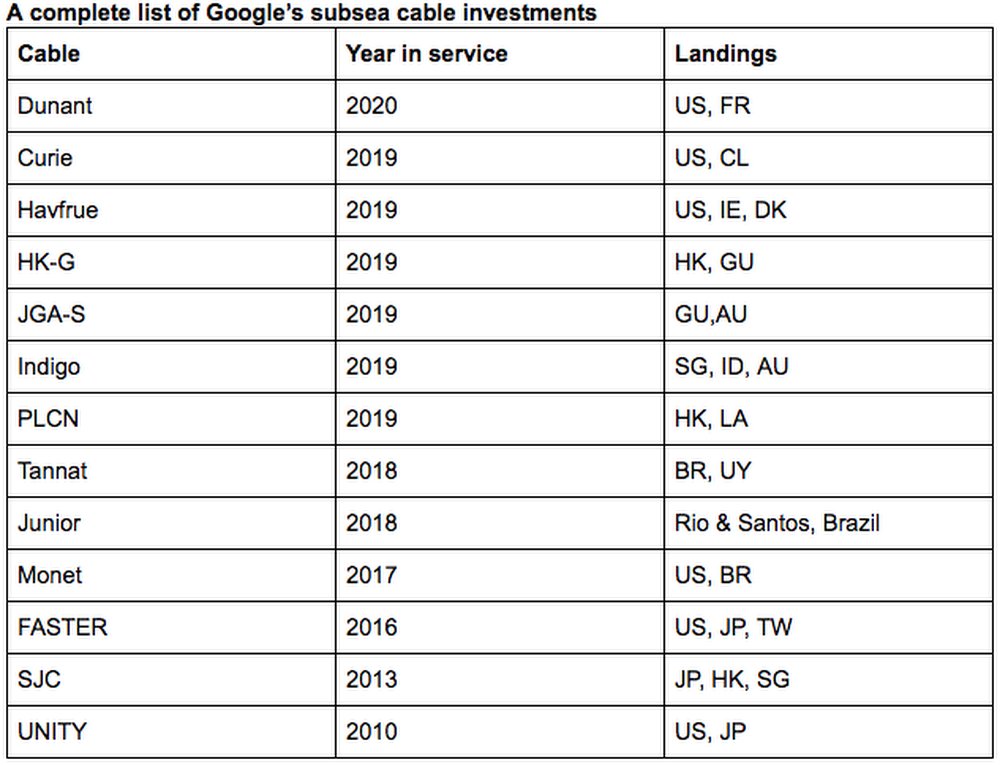
Google and its partners today announced that the 5,600-miles-long INDIGO subsea cable, which connects Sydney and Perth with Jakarta and Singapore, is now ready for service. To build the cable, which will significantly strengthen the connectivity between Australia and Southeast Asia, Google partnered with AARnet, Indosat, Singtel, SubPartners and Telstra.

The cable, which features about 110 repeaters, will have a total design capacity of 36 terabits per second with the option to expand in the future. Google says that’s more than enough to handle a few million simultaneous Hangout (or Meet) video chats between Singapore and Sydney.

The cable was first announced in 2016, when it was still called APX-West and didn’t include the extension to Sydney, which is now called Indigo Central. Google joined the efforts in early 2017 and construction started in 2018.

Indigo is a good example of Google’s expanding network of submarine cables. Typically, the company builds those with partners — and even occasionally competitors — but last year, for example, it also announced that it would build its own cable between the U.S. and France, the company’s fourth private cable.

Quite a few of the cables Google invested in in recent years are scheduled to go online in 2019, so chances are we’ll hear a bit more about the company’s efforts in this area in the coming months.


Soona raises $1.2M for quick, affordable content creation

Businesses need to keep the content flowing on social media, so a startup called soona says it’s developed a new way to provide those photos and video.

The company was founded by CEO Elizabeth Giorgi and Chief Creative Officer Hayley Anderson. Giorgi told me they both worked in production (Anderson as an animator, Giorgi as the founder of her own video production company), and they “kept finding ourselves saying no to projects that needed to be done quickly — we could never find a way to make production move fast enough.”

At the same time, they saw a growing need, as small and medium businesses increasingly rely on email and social marketing to promote themselves, which means they either “go to a stock content site and buy something that isn’t even relevant to their brand, or they can do a DIY solution.”

With soona, customers can get the photos and videos they need within 24 hours, and at a relatively affordable price. Giorgi compared the company’s approach to Kinko’s, which “turned printing into a same-day business 20 years ago.”

soona storefront

Giorgi said soona combines “the best of retail innovation with a strong background in technology.” It operates actual studios where customers come in for photos and video shoots, but it’s also developed software to encode and upload the footage quickly, and to allow customers to “shop [their] content in real-time.”

Soona started out with a studio in Denver and just launched in Minneapolis, and Giorgi said her hope is to open three to five studios in 2020. The service costs $393 per hour for a one-time shoot (with a guarantee of nine edited photos or one edited video), or $453 for a monthly membership.

The company has also launched a service called soona anytime for customers in other geographies — you send soona your product and you get your content in about a week.

Soona is announcing that it has raised $1.2 million in seed funding led by 2048 Ventures, with participation from Matchstick Ventures and Techstars Ventures.

Giorgi noted that the fundraising documents include something she’s calling the Candor Clause, which requires investors to disclose if they’ve ever faced issues with sexual assault, sexual harassment or sexual discrimination.

Giorgi said the team at 2048 fully supported this move. In addition, soona is publishing the clause in the hopes that other startups will include take advantage of it, allowing founders and investors to “move past tweets, move towards action, move towards something that makes it clear that there will be consequences” for bad behavior.

“This is not just a woman’s issue, this is an everyone issue,” she added. “We all want to be treated fairly.”

NBC target millennials with launch of a new streaming news service

NBC’s new digital streaming news network, NBC News Now, has officially launched. The service offers viewers 8 hours of continuous daily programming from 3 PM to 11 PM on weekdays. Its goal is to capture the attention of younger news consumers — those who don’t necessarily subscribe to pay TV or watch television in a more traditional manner, and who instead often get their news from apps and various streaming channels.

NBC News Now can also be found in an app: the NBC News app for mobile devices and for TVs (by way of apps for Roku, Apple TV, and Amazon Fire TV). The service is free to stream and supported by ads. Citi is a debut sponsor as the service goes to launch.

The programming featured on the service will be hosted by various NBC News reporters and correspondents from around the world, while production is headquartered in New York. Its content will include hourly live updates it’s calling “Briefly’s” as well as breaking news coverage, in-depth features, interviews, and behind-the-scenes looks at key stories.

NBC is not first to launch an over-the-top (OTT) streaming news service with the aim of targeting millennials and even younger viewers.

CBS’s streaming news service, CBSN has streamed online for several years, and became a part of CBS’ OTT app, CBS All Access, in 2017. It also launched a sports-focused service in 2018. ABC’s more recent effort in this space, ABC News Live, partnered with Roku to become a part of The Roku Channel last year. There’s also the live-streamed business news network, Cheddar, recently acquired by Altice USA. And many more.

But NBC News has found ways to reach a younger demographic before now. It offers several original podcasts and audio shows, and even runs a Snapchat news show that reaches millions, NBC Stay Tuned. The viewers and listeners already familiar with NBC News’ brand and its reporters may decide to follow NBC News to new platforms by way of the new service.

However, it would also make sense for the service to be included in the channel lineup of live TV streaming providers like Sling TV, YouTube TV, PlayStation Vue, Hulu with Live TV, and others. NBC doesn’t have any plans for that at present, though, but it’s a likely next step.

Pitching accuracy rates of over 99% for multiple cancer screens, Thrive launches with $110 million

For more than 25 years the founders of Thrive Earlier Detection have been researching ways to improve the accuracy of liquid biopsy tests.

The fruits of that labor from Dr. Bert Vogelstein, Dr. Kenneth Kinzler and Dr. Nickolas Papadopoulos — all professors and researchers at Johns Hopkins University — is CancerSEEK, a liquid biopsy test that has demonstrated specificity of over 99% in a retrospective study published by Science earlier this year.

By minimizing false positives, in cancer screening tools and providing a test with proven accuracy doctors can take treatment actions earlier, which can lead to better survival rates for cancer patients.

Now, with FDA approval for its tests for pancreatic and ovarian cancer and a new study underway with a large healthcare provider, CancerSEEK is being rolled out to market through Thrive Earlier Detection with the help of a new $110 million round of funding.

Thrive works by analyzing highly targeted sets of DNA and proteins in the blood to detect cancer.

“Over the past 30 years we have made great strides in understanding cancer. Combining this knowledge with the latest in molecular testing technologies, our founders have developed a simple and affordable blood test for the detection of many cancers at relatively early stages,” said Christoph Lengauer, Ph.D., partner at Third Rock Ventures, and co-founder and chief innovation officer of Thrive, in a statement. “We envision a future where routine preventative care includes a blood test for cancer, just as patients are now routinely tested for early stages of heart disease. We know that if cancer is caught early enough, it can often be cured.”

As part of its rollout, the company’s screening tool is being evaluated in DETECT, a study of 10,000 currently healthy individuals that’s being conducted in conjunction with the healthcare organization Geisinger. So far, 10,000 women between the ages of 65 and 75 without a history of cancer have been enrolled in the trial.

“To be truly useful to patients, new medical technology must be developed with rigorous evidence and designed to be affordable and readily integrated into routine medical care,” said Steven J. Kafka, Ph.D., partner at Third Rock Ventures and chief executive officer of Thrive, said in a statement. “With the help of experts and strategic partners, Thrive is launching today to advance a novel test for the earlier detection of multiple cancers, which we aim to augment with an integrated service that helps patients maneuver the often confusing path that follows a cancer diagnosis.”

Third Rock Ventures actually led the Series A financing for Thrive, and comprise the bulk of the company’s executive team, while Kinzler and Papadopoulos — the researchers from Johns Hopkins who developed the technology — will have seats on the company’s board.

Other investors in the round include Bill Maris’ Section 32 investment firm, Casdin Capital, Biomatics Capital, BlueCross BlueShield Venture Partners, Invus, Exact Sciences, Cowin Venture, Camden Partners, Gamma 3 LLC and others.

According to Thrive, ovarian, pancreatic and liver cancers are difficult to detect because they can develop in pathways that aren’t always well understood.

Using CancerSEEK, Thrive hopes to develop a blood-based test that can be used in routine medical care, with the goal of identifying multiple cancer types at earlier stages.

The technology works by following genomic mutations in circulating tumor DNA (ctDNA) and cancer-associated protein markers in plasma to identify abnormalities that are common across multiple cancers. In a retrospective study published by Science in 2018, CancerSEEK was shown to perform with greater than 99% specificity and with sensitivities ranging from 69% to 98% for the detection of five cancer types – ovarian, liver, stomach, pancreas and esophageal, which the company says are cancers for which there no screening tests available for average-risk individuals.

Thrive’s research has attracted an all-star executive team in addition to Lengauer and Kafka from Third Rock. Former Goldman Sachs lead medical technology analyst Isaac Ro is joining the company as chief financial officer, and the company’s head of research is Isaac Kinde, a co-inventor of the CancerSEEK technology.

It’s hard to overstate how transformative the Thrive test could prove to be. Having a blood-based diagnostic test for cancer prevalence and the ability to initiate treatment earlier radically improves the chances for surviving a cancer diagnosis.


Machine learning startup Weights & Biases raises $15M

Weights & Biases, a startup building development tools for machine learning, has raised $15 million in its second round of funding.

The company was started by CrowdFlower founders Lukas Biewald and Chris van Pelt, along with former Google engineer Shawn Lewis. (Under its new name Figure Eight, CrowdFlower was acquired by Appen for up to $300 million in March.)

When Weights & Biases launched last year, Biewald (who I’ve known since college) said he wanted to create the tools needed to “build and deploy great deep learning models.” Its initial product allows companies to monitor those models as they develop and train them.

“When people build machine learning models they need to track everything that happens — the code that went into the model, the hyperparameters that go into the model and then basically how well the model does,” Biewald told me this week. “You add a couple lines of code to your … training code and then every time your model runs, it reports what happens to the server.”

Customers include OpenAI, Github, Qualcomm and Toyota Research Institute, as well as research institutions like Stanford and Columbia. The new round — led by Coatue Management, with participation from angels including GitHub CEO Nat Friedman and Salesforce Chief Scientist Richard Socher — brings Weights & Biases’ total funding to $20 million.

Weights & Biases

The company has also launched Benchmarks, a new product that allows practitioners to collaborate on the same machine learning models. Biewald acknowledged that commercial enterprises probably won’t want to take this approach, but he suggested that researchers can use this so they “don’t have to rerun lots of training examples” and “just to move the state of the art forward.”

Looking at how the industry has evolved, Biewald said, “It’s gone really mainstream. What people don’t realize is how much machine learning is actually used in real companies today … Almost any company of reasonable size is doing machine learning. A lot of the applications are kind of boring but important to the company that’s doing them.”

Nor does Biewald think we should be discouraged by headlines like the news that Google’s Duplex service for restaurant reservations often relies on humans rather than bots.

“I don’t think it’s smoke and mirrors to combine humans and machine learning algorithms,” he said. “Every credit card company is using machine learning to prevent fraud, or whatever do, they have humans check a lot of it … I don’t know why people feel it needs to be so binary, like we either automate everything or nothing. If you can automate half of it, that’s pretty good.”

Pillar launches with $5.5M from Kleiner Perkins and others to tackle your student loan debt

A new startup aims to help you get your student loans under control. Today, an app called Pillar, backed by $5.5 million in seed funding led by Kleiner Perkins, is launching a simpler way for consumers to better understand their student loan debt — and even pay it off early.

To do so, the app connects with your student loan servicer and bank, then makes personalized suggestions based on your loans, your income, and your spending. When it finds a way you can make a bigger dent in your overall student loan debt, it will send an alert to your smartphone.

Pillar co-founder and CEO Michael Bloch, an early DoorDash employee, said he came up with the idea after his wife graduated from law school with around $300,000 worth of student loans.

“We struggled to figure out the right way to pay them back,” he explains. “We read blog posts and articles. We made spreadsheets. We even talked to a financial advisor. But there really was no easy way for us to figure out what was the right thing for us to do. And I realized there are 45 million people with loans, and millions of those people have had the exact same experience as I did.”

Bloch decided then to drop out of Stanford Business School to instead focus on building Pillar along with co-founder and CTO Gilad Kahala.
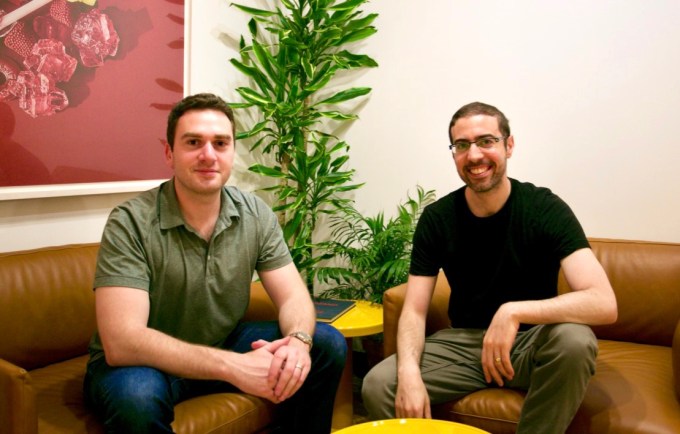
Above: Michael Bloch (L) and Gilad Kahala (R)

The problem they’re attacking is massive. Student loan debt is the second largest type of consumer debt in the U.S., with 45 million borrowers owing more than $1.5 trillion in student loans. 7 out of 10 students take out loans to pay for college, and the average person graduates with $30,000 in debt which takes 20 years to pay off. For those with $60,000 in debt, it can take more than 30 years to pay off. And nearly 20 percent of borrowers have over $100,000 in debt.

In addition, women are disproportionally affected by this problem, notes Bloch. Women hold two-thirds of student loan debt, he points out. This is because there are more women (around 56%) than men attending college these days, and because of the gender pay gap — which means it takes longer for women to pay back their loans.

At launch, Pillar walks new users through a quick sign-up process where you authenticate with your loan provider and bank account. (The company says it uses security best practices, and doesn’t store any login information or passwords on its own servers.)

As Pillar analyzes your spending and pay schedule, it can figure out when you can start making an extra payment towards your loans. It also calculates what that means in terms of paying off your loan earlier. This is especially useful for those who don’t necessarily receive a steady paycheck, or whose income fluctuates for other reasons — they may have trouble determining how much they can actually afford to chip in.

The company does not offer to refinance loans, to be clear, nor will it point you toward those options. In fact, it expects many of its users wouldn’t be able to take advantage of refinancing options, anyway.

“Companies like SoFi actually turn away around 97 percent of everybody who applies for refinancing, because they’re too high a credit risk — they look at your credit scores, your income, the type of job you have — most people don’t qualify for lower rates on refinancing,” Bloch says.

Instead, Pillar targets the larger majority who make less than $100,000 per year and have fewer options.

“What we found is that these small actions that people can take — where it’s not necessarily a hundred dollars this month. But even making a $5 a week extra payment can make a really big difference to somebody’s financial life in the long run,” he explains.

Users can opt to make these additional payments through Pillar itself, instead of having to go through the sometimes clunky student loan provider’s website.

Pillar works with nearly all major student loan servicers — including Nelnet, Navient, Great Lakes, Fedloan Servicing, and others.

Prior to today, the company had been running a private beta with an undisclosed number of users who are now using Pillar to manage their collective $50 million-plus in loan debt. During this period, the average borrower saved around $6,000 and about four years on repayment, Bloch claims.

What Pillar does not do, at this point, is to help borrowers navigate student loan forgiveness programs. That’s on its roadmap, however. It plans to offer tools and automation to help its users navigate those programs in the future. Longer-term, Pillar wants to do for all consumer debt — including credit cards — what it’s now doing for student loans.

While Pillar is attacking a real problem, it’s not yet a comprehensive solution — or even the best way for a consumer to handle their overall debt.

As Genevieve Dobson, founder and CEO of debt management company Degrees of Success, points out, the interest rates on consumers’ student loans may lower than the high interest rates on their credit cards and other debt that should be paid down first.

Plus, she notes, “it would not be suggested for anyone who qualifies for an income-based repayment or other lower payment option. It’s also not a good option for those who qualify for any of the forgiveness programs. And unfortunately, it doesn’t seem to tell people to utilize the income-driven repayment options instead, which could end up harming someone rather than helping them.”

In time, hopefully, Pillar will become more comprehensive to address the needs of all borrowers. For now, however, it makes the best sense for those who only hold student loan debt and are looking to pay it down more quickly.

Pillar says it will keep all its advice free, but will charge a low, around $1 per month subscription fee for premium features at some point in the future. The company will also provide (not sell) anonymized loan data to nonprofits and research institutions who are working to advance the national conversation and policy around student loans.

In addition to Kleiner Perkins, other seed round participants include Rainfall Ventures, Great Oaks VC, Financial Venture Studio, Kairos, and Day One Ventures. Individual investors include Adam Nash, the former CEO of Wealthfront and Acorns board member; Noah Weiss, former SVP of Product at Foursquare; Zach Weinberg and Nat Turner, co-founders of Flatiron Health; Misha Esipov, CEO and co-founder of Nova Credit; and Robinhood’s Head of Growth, Patrick Kavanagh, and Head of Finance, Nadia Asoyan.

The Pillar team is currently 10 people in New York, and looking to double the size of the team over the next year with a particular focus on hiring engineers.

Pillar is available on iOS and Android. You will still need to join the waitlist, as people are being allowed into Pillar in stages as it launches.


Two years after Essential’s launch, still no Home hub or second phone

This morning’s Moto Z4 news was good cause to go back and reassess the state of the modular phone. Three years after the line launched, the concept hasn’t exactly ignited the market — in fact there are really just a handful of scattered competitors to show for it. Essential is among the most prominent with the PH-1’s clever two pin connector.

By sheer coincidence, it turns out today is the two year anniversary of the company’s debut. Founder Andy Rubin took to the stage at Code 2017 with big ideas and two products. One, the Ph-1 has come and gone, launching a couple of months late in August 2017 before being discontinued late last year. The other, the Essential Home hub never appeared at all.

The day the products were announced, then COO Niccolo de Masi (who appears to have since moved on to Honeywell spinoff, Resideo), spoke of a the company’s ten-year plan. It was an acknowledgement that it had a tough road ahead, as it planned to take on big names like Apple and Samsung. But the company certainly had the money. A $300 million raise helped the startup achieve unicorn status not long after taking the stage at the conference

But the intervening two years have been plagued with bad news. In spite of positive reviews,  the company reportedly only shipped 88,000 phones in 2017. The PH-1 got a massive price drop and its first modular accessory, a 360 camera, was discounted to $19, down from $250.

Last May, rumors surfaced that the company had gone up for sale and its followup phone had been canceled. And in October, it laid off nearly a third of its staff. Founder Andy Rubin has been laying low in the meantime. That same month, The New York Times published an explosive story about a $90 Million Google pay off in the wake of sexual misconduct claims, causing him to take leave from Essential.

All the while, however, the company has firmly denied claims that it’s going away. I spoke to a rep and the company recently who said things are in the works, without revealing any specifics. There have been ton of patent filings that appear to point to some future handset. It announced a new mod for the PH-1 in June and even acquired a company in December. Hell, earlier this month, it issued a new security patch, holding to its promise of monthly updates — a hell of a lot more than many more successful smartphone makers have offered.

That’s part of what makes the Essential story so frustrating. The PH-1 was a novel device, among the first to go with a camera notch display. Its $699 price (later reduced to $499) also predated Samsung/Apple/Google’s move into budget flagships. But even with a unicorn valuation, hardware is hard. And Essential may have entered the market at the worst possible time, as smartphone sales were beginning to flag for the first time ever.

Two years after launch, it’s hard to shake the feeling that Essential’s time may have come and gone. For now, however, the company appears to simply be biding its time before announcing what comes next.

Northwestern Mutual has carved out $150 million for another fintech and insurance investment fund

Northwestern Mutual is setting aside $150 million for a second venture fund.

“We’re committed to transforming the client experience to drive change within the financial services industry,” said Souheil Badran, executive vice president and chief innovation officer, in a statement. “This additional capital will allow us to build on the success of Northwestern Mutual Future Ventures and invest in new technologies that have the ability to accelerate growth and advance innovation so we can create what’s next for our clients, financial representatives and employees.”

Criteria for the fund won’t change. It will still invest between $500,000 and $5 million ins Series A or B stage deals focused on technologies that can address changing customer preferences; new user experiences for the insurance industry and consumers; digital health; data and analytics technologies that can power new products and services; and other strategic objectives.

Since its launch in 2017, Northwestern Mutual Future Ventures has backed 14 startups and invested $43 million. The much larger commitment the firm is making through this second investment vehicle proves that insurers are waking up to the importance of new technology companies in the old insurance business.