Automakers have a choice: Become data companies or become irrelevant

While Bezos amassed billions, Apple took over our culture, Google became ubiquitous and software ate the world, the automotive industry needed a bailout. Since then, they have more or less recovered, but they are no longer the undisputed titans of American industry. That title now belongs to companies that traffic in data, and the FAANGs of the world have their digital fingers on the pulse of what moves us.

However, not all hope is lost for the old auto titans. Cars are here to stay, whether they have drivers or not. Automakers can ensure their seat at the table by implementing strategies better suited for the digital age and making data a core part of their future business.

Massive opportunity

“Big data” is a tired phrase, but the data boom is in full swing. New mobility giants like Lyft and Uber are built on data. Existing data and technology-focused companies, like Samsung (acquiring Harman), Intel (acquiring Mobileye), Google (with Maps and Waymo) and Apple (with Maps and Titan), are building mobility products. This makes perfect sense given the scale of the transportation and mobility sector.

There are 1.2 billion vehicles in operation globally, and people travel more than 23 trillion (that is with a T) miles every year. By 2020, each person on Earth will create an estimated 1.7 MB of data per second. A 2016 report from AAA showed that Americans spend an average of 17,600 minutes driving every year. By those estimates, Americans will be generating 1.8 TB of data every year in their vehicles. Add additional sensors to a vehicle like cameras, radar and lidar, connect these vehicles to the cloud, and suddenly Intel’s claims that autonomous vehicles will produce 4 TB of data in one and a half hours of driving doesn’t look too crazy. McKinsey believes there could be as much as $750 billion of value in vehicle data by 2030. Both numbers are hand-wavy, but the message is clear: there exists a massive opportunity.

Who wants the data?

Not all data is created equal and different data customers are seeking different data points to augment and expand their existing services. Automakers themselves and dealerships want to track vehicles post-production to better understand how customers are using their products. They can use this data to improve their product, push customers to dealerships for maintenance and repair and ultimately retain customers to enhance lifetime value.

Telecommunication companies are seeking to provide in-vehicle Wi-Fi and data services and ultimately scaling 5G networks to connect vehicles to the internet. Repair shops want to have remote access to sensors and systems on the vehicle to diagnose and even predict maintenance and repair events. Urban planners, advertisers and hedge funds want to access location-based analytics to understand how and why we are moving to provide a complete picture of individual preferences.

Insurance companies want access to speed, acceleration and navigation data to provide more accurate premium estimates for individual users and usage-based insurance. Developers want access to vehicle data to build new products and services that we have yet to conceive. The list goes on and on.

Data customers have a more advanced vehicle data strategy than the automakers themselves, and they have partnered with many startups that are trying to collect and aggregate vehicle data. For example, many startups provide a piece of hardware that plugs into the onboard diagnostic (OBD) port of a vehicle in partnership with insurance companies or repair shops. However, the OBD provides only a small subset of the total vehicle data.

Who has it?

Despite these “hacks,” the richest data set for vehicle-specific data is recorded on the CANBUS, and the automakers have the easiest access that data. This puts automakers in the best position to decide who can utilize the data and how.

We’ve already seen that larger automakers like BMW do not want to cede control to large technology companies — so what are the other options? Data management and monetization are not core competencies of the automotive industry. Manufacturers and suppliers currently operate on seven-year product cycles, which give them complete control over a stable value chain at the expense of interaction with end customers and less than state-of-the-art digital capabilities. Privacy and security concerns are looming, particularly for luxury brands with century-long heritages. Key for automakers will be finding a way to gain access to data expertise without giving away their proprietary position in the market.

Smaller automakers may be okay ceding some position to technology companies that could provide ADAS, autonomy and data management solutions (e.g. Aurora, Waymo) as they would likely struggle to build on their own. Ceding this position would relegate those automakers down the automotive hierarchy, but perhaps bring them greater volume in the future. For example, Waymo is developing its technology stack on Chrysler and Jaguar vehicles.

Automakers overwhelmed by this prospect may want to consider an acquisition, as they did for self-driving technology with Argo AI and Cruise. For instance, Ford acquired TransLoc and Autonomic to develop internal capabilities. General Motors took a substantial stake in third-party data platform Wejo. Automakers could also attempt to build these capabilities on their own. Toyota is developing a $1 billion data center.

What’s next?

It is abundantly clear to us at Autotech Ventures that there is a lot of value to be captured from vehicle data. That value will only grow as more and more sensors are added to vehicles. Automakers are in prime position to capture a tremendous share of this value, but will need to move quickly and perhaps reorganize their priorities along the way. We are skeptical that they can do it on their own.

Whether automakers decide to engage tech companies, acquire startups to help them gain expertise or rely on a startup to supply their data management needs, we expect a lot of activity in the space soon.
Streem buys Selerio in effort to boost its AR teleconferencing tech

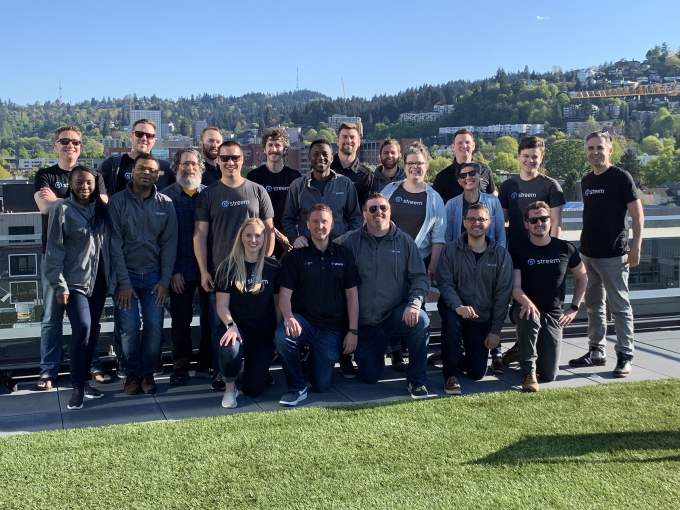
Streem, an AR startup that is meshing teleconferencing software with computer vision tech, has acquired a small UK startup called Selerio that’s also building out augmented reality technologies.

The startups were both members of betaworks’ VisionCamp accelerator program last year where they met and collaborated while tackling separate computer vision problems in the AR space.

Streem’s play is that they can create a kind of souped-up Skype call that enables home service providers to get more visual data in the course of chatting with home-owners. This can be something simple like character recognition that enables users to point their phone rather than reciting a 30-character serial number, the company can also take measurements or save localized notes.

The Portland startup has disclosed more than $10 million in funding, though they have also just closed a new bout of funding though they’re not sharing the amount yet.

Selerio’s focus is all about gaining a contextual understanding of a space. The startup was spun out of research from Cambridge University. The company has not disclosed its amount of seed funding, but betaworks, Greycroft Partners and GGV Capital are among its backers. All three of Selerio’s employees have joined Streem as part of the acquisition.

Snap, which has yet to release a diversity report, hires its first head of D&I

Snap has brought on its first-ever diversity and inclusion lead, former Google Director of Diversity Strategy Oona King.

In a memo sent to Snap employees today, Snap Chief People Officer Lara Sweet announced King’s hiring. Although Snap is late in the game of hiring a diversity lead and has yet to release a diversity report, Sweet said Snap wants to “lead by example and contribute to human progress by breaking down systemic barriers that lead to people feeling excluded.”

This comes shortly after reports surfaced that Snap paid settlements to at least three female employees who alleged they were laid off due to their gender. And about one year ago, a former Snap engineer‘s email surfaced from November 2017 that criticized the company for having a toxic and sexist culture that is unwelcome to people of color and women. The former Snap engineer, Shannon Lubetich, described how Snap is not adequately promoting diversity at the company.

“The letter was a really good wake-up call for us,” Snap CEO Evan Spiegel said last May at a tech conference.

Spiegel described how, in light of the letter, Snap hired external consultants to help the company figure out areas in which to improve. Snap also ran a company-wide survey and changed its promotion structure, Spiegel said.

While Snap has previously said it provides diversity numbers to its employees, the company has yet to publicly produce a diversity report, unlike its many peers in the tech industry.

Here’s the full memo Sweet sent to employees:

Hi Team,

At Snap we are deeply committed to making progress on Diversity & Inclusion. We want to lead by example and contribute to human progress by breaking down systemic barriers that lead to people feeling excluded. And we know we have to start at home: ensuring Snap’s employee culture represents the diversity of our global users is critical to our success.

As a part of this commitment, I’m very excited to announce Oona King as Snap’s first VP of Diversity and Inclusion. Oona comes to us from Google, where she is Director of Diversity Strategy. She brings extensive experience from a variety of industries including technology, media, and politics, having been an advisor to the British Prime Minister on issues of equality and the second black woman elected to British Parliament earlier in her career. She also held Head of Diversity and Inclusion roles at both YouTube and the British Broadcaster, Channel 4. Oona will report to me, and help ensure our diversity and inclusion efforts are even more impactful – both within the company and across our products and content.  Oona starts on June 11.

We’re so excited to have Oona join us, to help us build diversity and inclusion into everything we do – from how we build teams, to how we create products and content.  We’re confident she will help us make Snap a more diverse and inclusive company at all levels, so please join me in welcoming Oona to Snap — we can’t wait to have her on the team!

Lara

Original Content podcast: Dragons love symbolism, and other lessons from the ‘Game of Thrones’ finale

This post and podcast include spoilers for “Game of Thrones.”

Remember how it felt six weeks ago, right before “Game of Thrones” returned for its final season? The excitement? The anticipation? That was so, so long ago.

Darrell Etherington, the original co-host of the Original Content podcast, joins us once again to wrap up our week-by-week discussion of the show’s final season. And while there were critics who liked the finale, we weren’t among them.

Anthony, at least, defends the first half of the episode, which deals with the fallout from “The Bells” and takes the story to its tragic conclusion. We might wonder why, exactly, a dragon would want to melt the Iron Throne, but it’s a bold, striking image — and the moments around it, with Drogon grieving for Daenery’s death, are surprisingly moving.

But none of us can make sense of what comes afterward. If you look carefully, you can probably see the seeds of a complex and satisfying conclusion — and in his final performance as Tyrion, Peter Dinklage almost sells you on that conclusion through sheer charisma and force of wall. What ends up on screen, however, is a listless march through the final plot points, with nearly every character seeming to shrug and give up — because hey, it’s the finale.

We close out our discussion with our general thoughts on the show, now that we know the full story. And before we get into our spoiler-y “Game of Thrones” discussion, we also review “Wine Country,” a Netflix comedy directed by Amy Poehler, with an impressive cast that includes Poehler, Maya Rudoph, Rachel Dratch and Tina Fey.

If you feel like skipping ahead, here’s how the episode breaks down:

0:00 Intro
1:25 “Wine Country” review
9:50 “Game of Thrones” review

You can listen in the player below, subscribe using Apple Podcasts or find us in your podcast player of choice. If you like the show, please let us know by leaving a review on Apple. You can also send us feedback directly. (Or suggest shows and movies for us to review!)

WikiLeaks’ Assange charged under the Espionage Act in a ‘major test case’ for press freedom

Julian Assange, founder of whistleblowing site WikiLeaks, has been charged with over a dozen additional charges by U.S. federal prosecutors, including under the controversial Espionage Act — a case that will likely test the rights of freedom of speech and expression under the First Amendment.

Assange, 47, was arrested at the Ecuadorean embassy in London in April after the U.S. government charged him with conspiracy to hack a government computer used by then army officer Chelsea Manning to leak classified information about the Iraq War. Ecuador withdrew his asylum request seven years after he first entered the embassy in 2012 to avoid extradition to Sweden to face unrelated allegations of rape and sexual assault. Assange was later jailed in the U.K. for a year for breaking bail while he was in the embassy.

According to the newly unsealed indictment, Assange faces 17 new charges — including publishing classified information — under the Espionage Act, a law typically reserved for spies working against the U.S. or whistleblowers and leakers who worked for the U.S. intelligence community.

Both Manning and Edward Snowden, two former government employees turned whistleblowers, were both charged under the Espionage Act for leaking files to the media. 

Prosecutors said Thursday that the WikiLeaks founder — who published numerous troves of highly classified diplomatic cables, military videos showing the killing of civilians, and government hacking tools — was charged in part because Assange published a “narrow subset” documents passed to him by Manning while she was working as an Army intelligence analyst that revealed the names of confidential sources.

A statement from the Justice Department read:

After agreeing to receive classified documents from Manning and aiding, abetting, and causing Manning to provide classified documents, the superseding indictment charges that Assange then published on WikiLeaks classified documents that contained the unredacted names of human sources who provided information to United States forces in Iraq and Afghanistan, and to U.S. State Department diplomats around the world.

According to the superseding indictment, Assange’s actions risked serious harm to United States national security to the benefit of our adversaries and put the unredacted named human sources at a grave and imminent risk of serious physical harm and/or arbitrary detention.

The department said many of the files were classified as “secret,” meaning their release could do “serious damage” to U.S. national security.

Assange is also accused of engaging in “real-time discussions” with Manning to send over the classified files.

After Assange’s arrest in April, prosecutors had two months to lay additional charges before it sought extradition from the U.K. to the U.S., where he would be tried in court. In refusing to testify to a grand jury about Assange, Manning was held in contempt and jailed for two months. Prior to the release of Thursday’s superseding indictment, Manning was jailed again for refusing to provide testimony.

Debate remains over whether Assange, the self-styled editor of WikiLeaks, should be considered a journalist and be granted protections as such. John Demers, who heads the Justice Department’s National Security Division, told reporters that Assange “is no journalist.”

But the case will likely strike at the heart of the First Amendment, which protects against government interference with citizen and reporters’ rights to freedom of speech and expression. It’s rare but not unheard of for reporters to be charged under the national security law — less so for publishing news reports embarrassing to the government but more so to obtain details of the sources who revealed the information in the first place.

Steve Vladeck, a professor at the University of Texas School of Law, said the indictment will be a “major test case” for press freedoms because  Espionage Act “doesn’t distinguish between what Assange allegedly did and what mainstream outlets sometimes do, even if the underlying facts [or] motives are radically different.”

The Obama administration, which charged several federal employees under the Espionage Act during the president’s two-term administration, reportedly wanted to charge Assange with but too worried it would have a chilling effect on press freedoms.

News of the indictment already sparked anger and frustration among free speech and civil liberties groups.

WikiLeaks called the news “madness” ia tweet. “It is the end of national security journalism and the First Amendment,” said its Twitter account.

“The Department of Justice just declared war — not on WikiLeaks, but on journalism itself,” tweeted Snowden. “This case will decide the future of media,”

Shopify quietly acquired Handshake, an e-commerce platform for B2B wholesale purchasing

E-commerce platform Shopify has quietly made an acquisition to continue its expansion of the services and products that merchants can sell and purchase through its platform. It has acquired Handshake, a New York startup offers a commerce platform for businesses that sell wholesale goods.

Shopify has confirmed the deal in a short statement:

Handshake is now a part of Shopify. We consider acquisitions in the normal course of business as we focus on making commerce better for everyone.” It hasn’t disclosed the value but a source tells us it was under $100 million.

We also received an emailed tip that noted that the acquisition was announced to staff earlier this month, and that the team, is operating as part of Shopify’s extended service tier, Shopify Plus, headed by David Moellenkamp. Indeed, Handshake’s profile on LinkedIn now indicates that it was acquired by Shopify, and Glen Coates, who had been the founder and CEO of Handshake, is now the director of product at Shopify Plus.

Handshake had raised about $23.5 million and was valued in its last round (in 2016 — note that it’s not this Handshake) at just under $54 million, according to PitchBook. Investors included Boldstart Ventures, Emergence Capital, SoftTech VC, Point Nine and others. (We’re trying to find out more on the price.)

The opportunity that Handshake had identified, and now Shopify is targeting, is the end of the e-commerce market for brands and other merchants selling items wholesale, potentially alongside consumer-focused retail efforts.

This is big business: a recent report found that B2B e-commerce sales in the U.S. alone passed $1 trillion for the first time in 2018. As with consumer-focused sales, platforms like Handshakes offer merchants the ability to handle these sales directly, rather than handing off the sales to third-party marketplaces.

Handshake’s customers include the likes of Bugaboo, Williams Sonoma and Roland.

This deal comes at an interesting time for Shopify.

Some weeks ago, we reported on how Mailchimp and Shopify had stopped working together, only to find out days later that Mailchimp had actually also quietly acquired an e-commerce startup to start to build out more purchasing tools for its customers. In that regard, this latest acquisition by Shopify underscores how it’s also growing and expanding its scope — albeit in a way that puts it into closer competition with the likes of Alibaba and Amazon, which themselves have carved out a strong place as B2B marketplaces.

Former FDA chief Scott Gottlieb has rejoined the venture world — but he hasn’t forgotten Juul

Scott Gottlieb, the former Food and Drug Administration chief, became known during his tenure for his efforts to regulate the tobacco and e-cigarette industries — and for his particular focus on Juul, the fast-growing e-cigarette company that Gottlieb squarely blames for creating a “youth epidemic” of e-cigarette use by teenagers.

Indeed, when he announced that he would be stepping down from his post in early March, it seemed Gottlieb had dealt the tobacco industry a winning hand. There was even talk that he’d been pressured to leave by conservative groups along with some Republicans in Congress, including Senator Richard Burr, who’d blasted Gottlieb on the Senator floor in January over a plan to ban menthol cigarettes. (Burr’s home state of North Carolina produces more tobacco than any other state.)

But Gottlieb isn’t giving up so easily, he says. In an interview this morning, Gottlieb said there was nothing more to his resignation than his stated reason at the time: his family. “I was commuting from Westport (Connecticut) to Washington every Friday night; I was only home with my three young kids on Saturdays,” he told us. “After two years, that got difficult.”

Gottlieb, who just rejoined the venture firm New Enterprise Associates as a special partner focused on healthcare, further suggests that he will continue to bang the drum when it comes to e-cigarette usage as a private citizen. To wit, in addition to his work at NEA, where he previously served as a venture partner from 2007 until joining the FDA in 2017, Gottlieb is becoming a regulator contributor at CNBC, where he will appear both on television and in print. He also anticipates contributing to the Wall Street Journal and to the Washington Post and to writing deeper dives in medical journals. (“I was publishing on an almost weekly basis” before joining the FDA, Gottlieb notes.)

Indeed, though Gottlieb will have plenty of demands on his time — he has also resumed an earlier role as a fellow with the American Enterprise Institute, the conservative think tank — he says he’s not done with the work he started in Washington, noting that he’s “very efficient” when it comes to both his writing and policy work and insisting that he will “still be actively engaged.”

Partly that owes to Gottlieb’s concerns that Juul — which hitched its wagon to tobacco giant Altria in December by  selling it a 35 percent stake in its business for $38 billion — is only becoming more pervasive owing to the tie-up.

Gottlieb still very much believes that the company “bears an outsized responsibility for this public health crisis” wherein one in five people in the U.S. now vapes occasionally, and a growing percentage of those users are teenagers. With Altria’s marketing muscle and much bigger retail footprint, says Gottlieb, Juul adoption could well erase a generation of gains in the fight against nicotine addiction.

As for whether Gottlieb’s public campaign will have real teeth, that remains to be seen. It also isn’t yet clear how aggressively or not the acting FDA commissioner, Ned Sharpless, will be when it comes to battling big tobacco, particularly considering the 80-plus lobbyists employed by Juul in Washington and that, according to the New York Times, have three primary goals: fighting proposals to ban flavored e-cigarette pods, pushing legislation that includes provisions denying local governments the right to adopt strict vaping controls, and working to make sure that bills to discourage youth vaping do not have stringent enforcement measures.

Gottlieb says he’s optimistic. “He’s a cancer doctor,” he notes. “He has certainly expressed interest in advancing [the] policies [the FDA has already set in motion].”

At the very least, at an all-hands meeting last month, Commissioner Sharpless suggested that fighting nicotine addiction remains a priority. Among his other comments, he said agency will “maintain our focus on ending the use of combustible cigarettes among adults, and on preventing kids from ever starting.

“That includes undertaking vital research to ensure we have the data necessary to make informed regulatory decisions on electronic cigarette products, so that we can reverse the growing epidemic of youth ENDS [electronic nicotine delivery systems] use. We simply won’t tolerate misleading marketing or selling tobacco products to children.”

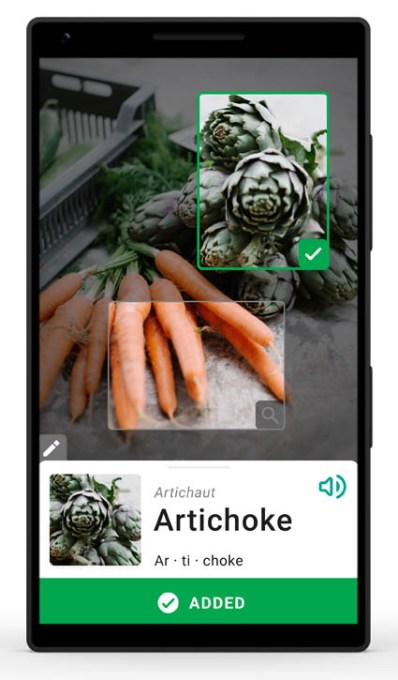
Microsoft’s new language learning app uses your phone’s camera and computer vision to teach vocabulary

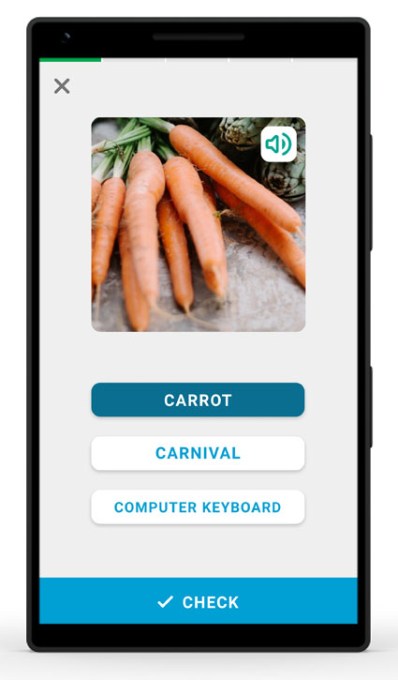
Eight Microsoft interns have developed a new language learning tool that uses the smartphone camera to help adults improve their English literacy by learning the words for the things around them. The app, Read My World, lets you take a picture with your phone to learn from a library of over 1,500 words. The photo can be of a real-world object or text found in a document, Microsoft says.

The app is meant to either supplement formal classroom training or offer a way to learn some words for those who didn’t have the time or funds to participate in a language learning class.

Instead of lessons, users are encouraged to snap photos of the things they encounter in their everyday lives.

“Originally, we were planning more of a lesson plan style approach, but through our research and discovery, we realized a Swiss army knife might be more useful,” said Nicole Joyal, a software developer intern who worked on the project. “We wound up building a tool that can help you throughout your day-to-day rather than something that teaches,” she said.

Read My World uses a combination of Microsoft Cognitive Services and Computer Vision APIs to identify the objects in photos. It will then show the word’s spelling and speak the phonetic pronunciation of the identified vocabulary words. The photos corresponding to the identified words can also be saved to a personal dictionary in the app for later reference.

Finally, the app encourages users to practice their newly discovered words by way of three built-in vocabulary games.

The’s 1,500-word vocabulary may seem small, but it’s actually close to the number of words foreign language learners are able to pick up through traditional study. According to a report from the BBC, for instance, many language learners struggle to learn more than 2,000 to 3,000 words even after years of study. In fact, one study in Taiwan found that after 9 years of learning a foreign language, students failed to learn the most frequently-used 1,000 words.

The report also stressed that it was most important to pick up the words used day-to-day.

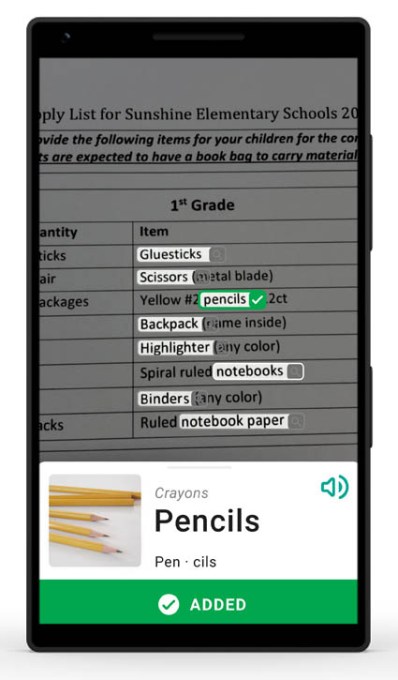
Because the app focuses on things you see, it’s limited in terms of replacing formal instruction. After gathering feedback from teachers and students who tested an early version, the team rolled out a feature to detect words in documents too. It’s not a Google Lens-like experience, where written words are translated into your own language — rather, select words it can identify are highlighted so you can hear how they sound, and see a picture so you know what it is.

For example, the app pointed at a student’s school supply list may pick out words like pencils, notebooks, scissors, and binders.

The app, a project from Microsoft’s in-house incubator Microsoft Garage, will initially be made available for testing and feedback for select organizations. Those who work with low literacy communities at an NGO or nonprofit, can request an invitation to join the experiment by filling out a form.


Fresh off a $530M round, Aurora acquires lidar startup Blackmore

Aurora, the self-driving car startup backed by Sequoia Capital and Amazon, is in an acquiring mood. The company, founded in early 2017 by Chris Urmson, Sterling Anderson and Drew Bagnell, announced Thursday that it acquired lidar company Blackmore.

The Blackmore purchase follows another smaller, and previously unknown acquisition of 7D Labs that occurred earlier this year, TechCrunch has learned. 7D, founded by former software engineer from Pixar animation Magnus Wrenninge, is a simulation startup that makes photorealistic synthetic dataset for street scenes. Aurora confirmed the acquisition.

Aurora’s larger Blackmore acquisition come on the heels of its $530 million Series B funding round led by Sequoia Capital and “significant investment” from Amazon and T. Rowe Price Associates. Aurora did not disclose the terms of the deal.

Lidar, or light detection and ranging radar, measures distance. It’s considered by many in the emerging automated driving industry — with the exception of Tesla CEO Elon Musk and a handful of others — as a critical and necessary sensor for self-driving vehicles.

Blackmore, which has 70 employees, might not be a household name. And its base of operations in Bozeman, Montana makes it a seeming oddball amongst the Silicon Valley scene.

But in the world of autonomous vehicles (and in military circles), Blackmore is well known and has been considered an acquisition target for some time. Two funding rounds in 2016 and 2018 that brought in backers like BMW i Ventures and Toyota AI Ventures raised Blackmore’s profile. (The company has raised $21.5 million). Cruise, GM’s self-driving unit, was looking at the company last year, according to two sources familiar with the discussions.

But it’s the company’s tech that got Aurora CEO Chris Urmson’s attention.

Blackmore CEO Randy Reibel, noted in a recent interview, a highlight was getting a chance to see the look on Urmson’s face when he first saw the lidar in action.

Not all lidar is the same, both Urmson and Reibel noted. The vast majority of the 70-odd companies that exist in the industry today are developing and trying to sell AM lidar sensors, which send out pulses of light outside the visible spectrum and then track how long it takes for each of those pulses to return. As they come back, the direction of, and distance to, whatever those pulses hit are recorded as a point and eventually forms a 3D map.

Blackmore is one of the few companies developing Frequency Modulated Continuous Wave (FMCW) lidar, which emits a low power and continuous wave, a bit like keeping a flashlight on, the company’s CTO and co-founder Stephen Crouch explained. The upshot is FMCW lidar can measure distance with a higher dynamic range and instant velocity, meaning it can gauge the speed of the objects coming to or moving away from them. It’s also “immune” to interference from sun or other other sensors, Crouch added.

The big win, Urmson and Reibel echoed, is that it is optimized with the perception stack. In other words, this lidar is technically compatible in a way that will improve perception of Aurora’s “driver.”

The acquisition of Blackmore is just one example in the past two months of lidar startups either announcing large equity and debt rounds or being snapped up by companies developing autonomous vehicle technology. In 2017, Cruise acquired Strobe and Argo AI bought Princeton Lightwave.

That kind of consolidation will likely continue, Reibel predicted, in part because it’s challenging for lidar companies to “go it alone.” AV companies are particularly protective of their tech and opening the door to an outside lidar company takes convincing.

Cruise releases video purporting 1,400 successful unprotected left hand turns

Unprotected left hand turns are tough for robots and humans alike. The compounding variables of crossing in front of oncoming traffic make it one of the toughest maneuverers in driving. It’s one of the toughest challenges for self-driving platforms — even more so as drivers often look for non-verbal cues from other drivers to when it’s safe to cross.

Cruise, the self-driving division within General Motors, today released a video reporting it successfully completed 1,400 such turns within a 24 hour period. The test took place on the busy and hilly streets of San Fransisco. Some of the examples on the video show a vehicle cautiously entering an intersection only to wait for another vehicle to pass before making the turn. Other times, the vehicle is assertive and enters the turn without delay. Only four examples are shown, though Cruise insists they have video proof of all 1,400. None of the videos show the Cruise vehicle navigating around crossing pedestrians.

“In an unpredictable driving environment like SF, no two unprotected left-turns are alike,” Kyle Vogt, president & CTO, Cruise said in a released statement. “By safely executing 1,400 regularly, we generate enough data for our engineers to analyze and incorporate learnings into code they develop for other difficult maneuvers.”

Self-driving companies often rely on data collected from its vehicles. Successful or not, both instances will give the engineers data that can be added to existing models to make future rides more successful. In this case, having successfully completed 1,400 in a short amount of time will give Cruise’s engineers loads to work with.

Cruise is permitted to test about 180 Generation 3 on public roads in Califorina. It didn’t state how many vehicles were needed to complete this test.