DoorDash, now valued at $12.6B, shoots for the moon

More than five years ago, Sequoia partner Alfred Lin called Tony Xu, the founder of a small on-demand delivery startup called DoorDash, to say he was passing on the company’s seed round.

This was, of course, before venture capital funding in food delivery startups had taken off. DoorDash, launched out of Xu’s Stanford graduate school dorm room, wasn’t worth Sequoia’s capital — yet.

Today, venture capitalists are valuing the San Francisco-based company at a whopping $12.6 billion with a $600 million Series G. New investors Darsana Capital Partners and Sands Capital participated in the deal, which nearly doubles DoorDash’s previous valuation, alongside existing backers Coatue Management, Dragoneer, DST Global, Sequoia Capital, the SoftBank Vision Fund and Temasek Capital Management.

As for Sequoia’s Alfred Lin, he realized his mistake years ago and jumped in on DoorDash’s 2014 Series A and has participated in every subsequent round since. DoorDash, a graduate of Y Combinator’s Summer 2013 cohort, is also backed by Kleiner Perkins, CRV and Khosla Ventures, among others. In total, the company has raised $2.5 billion in VC funding, making it one of the most well-capitalized private companies in the U.S.

SoftBank, via its prolific dealmaker Jeffrey Housenbold, was responsible for making DoorDash a unicorn in early 2018. The nearly $100 billion Vision Fund led DoorDash’s $535 million Series D, valuing the business at $1.4 billion. Just three months ago, the SoftBank Vision Fund, DST Global, Coatue Management, GIC, Sequoia and Y Combinator put an additional $400 million in the fast-growing business.

SAN FRANCISCO, CA – SEPTEMBER 05: DoorDash CEO Tony Xu speaks onstage during Day 1 of TechCrunch Disrupt SF 2018 at Moscone Center on September 5, 2018 in San Francisco, California. (Photo by Kimberly White/Getty Images for TechCrunch)

Xu told TechCrunch the company’s Series F financing was “a reflection of superior performance over the past year.” DoorDash was currently seeing 325 percent growth year-over-year, he said, pointing to recent data from Second Measure showing the service had overtaken Uber Eats in U.S. coming in second only to GrubHub.

“I think the numbers speak for themselves,” Xu said at the time. “If you just run the math on DoorDash’s course and speed, we’re on track to be number one.”

At a venture capital-focused summit hosted in April, Xu added that DoorDash was the largest delivery platform in America by “pretty wide margins,” explaining that it was, in fact, growing 4x faster than its next closest peer. In this morning’s announcement, the company said it’s grown 60 percent since its late February Series F, with its annualized total sales hitting $7.5 billion in March, an increase of 280 percent year-over-year. 

Still, one wonders what kind of growth metrics DoorDash might be sharing to attract that kind of valuation multiple. The company has yet to disclose revenues and is not yet profitable but has seen its price tag grow astronomically in just two years. Since March 2018, DoorDash’s valuation has skyrocketed from $1.4 billion to $4 billion with a $250 million Series E to $7.1 billion with a $350 million Series F and finally, to nearly $13 billion with its Series G.

The $12.6 billion valuation makes DoorDash one of the 10 most valuable venture-backed companies in the U.S., surpassing Coinbase, Instacart and even Slack, according to PitchBook.

DoorDash is currently active in more than 4,000 cities in the U.S. and Canada, with hundreds of partners including both restaurants and supermarkets (Walmart is using DoorDash for grocery deliveries). The company also operates DoorDash Drive, which allows businesses to use the DoorDash network to make their own deliveries.

 

Instagram’s vertical IGTV surrenders to landscape status quo

A year ago Instagram made a bold bet with the launch of IGTV: That it could invent and popularize a new medium of long-form vertical videos. Landscape uploads weren’t allowed. Co-founder Kevin Systrom told me in August that “What I’m most proud of is that Instagram took a stand and tried a brand new thing that is frankly hard to pull off. Full-screen vertical video that’s mobile only. That doesn’t exist anywhere else.”

Now a dedicated hub for multi-minute portrait mode video won’t exist anywhere at all. Following lackluster buy-in from creators loathe to shoot in a proprietary format that tough to reuse, IGTV is retreating from its vertical-only policy. Starting today, users can upload traditional horizontal landscape videos too and they’ll be shown full-screen when users turn their phones sideways while watching IGTV’s standalone app or its hub within the main Instagram app. That should hopefully put an end to crude ports of landscape videos shown tiny with giant letterboxes slapped on to fill out the vertical screen.

Instagram spins it saying “Ultimately, our vision is to make IGTV a destination for great content no matter how it’s shot so creators can express themselves how they want . . . .  In many ways, opening IGTV to more than just vertical videos is similar to when we opened Instagram to more than just square photos in 2015. It enabled creativity to flourish and engagement to rise – and we believe the same will happen again with IGTV.”

The potential flood of repurposed YouTube videos could drive more attention to IGTV after a launch that felt like a flop. There’s been no break-out stars, must-see shows, or cultural zeitgeist moments on IGTV. Instagram refused to provide a list of the most viewed long-form clips. Sensor Tower estimates just 4.2 million installs to date for IGTV’s standalone app, amounting to less than half a percent of Instagram’s billion-plus users downloading the app. In the last month, and it saw 3.8 times more downloads per day in its first three months on the market than than last month.

Takeaways from KubeCon; the latest on Kubernetes and cloud native development

Extra Crunch offers members the opportunity to tune into conference calls led and moderated by the TechCrunch writers you read every day. This week, TechCrunch’s Frederic Lardinois and Ron Miller discuss major announcements that came out of the Linux Foundation’s European KubeCon/CloudNativeCon conference and discuss the future of Kubernetes and cloud-native technologies.

Nearly doubling in size year-over-year, this year’s KubeCon conference brought big news and big players, with major announcements coming from some of the world’s largest software vendors including Google, AWS, Microsoft, Red Hat, and more. Frederic and Ron discuss how the Kubernetes project grew to such significant scale and which new initiatives in cloud-native development show the most promise from both a developer and enterprise perspective.

“This ecosystem starts sprawling, and we’ve got everything from security companies to service mesh companies to storage companies. Everybody is here. The whole hall is full of them. Sometimes it’s hard to distinguish between them because there are so many competing start-ups at this point.

I’m pretty sure we’re going to see a consolidation in the next six months or so where some of the bigger players, maybe Oracle, maybe VMware, will start buying some of these smaller companies. And I’m sure the show floor will look quite different about a year from now. All the big guys are here because they’re all trying to figure out what’s next.”

Frederic and Ron also dive deeper into the startup ecosystem rapidly developing around Kubernetes and other cloud-native technologies and offer their take on what areas of opportunity may prove to be most promising for new startups and founders down the road.

For access to the full transcription and the call audio, and for the opportunity to participate in future conference calls, become a member of Extra Crunch. Learn more and try it for free. 

Andreessen pours $22M into PlanetScale’s database-as-a-service

PlanetScale’s founders invented the technology called Vitess that scaled YouTube and Dropbox. Now they’re selling it to any enterprise that wants their data both secure and consistently accessible. And thanks to its ability to re-shard databases while they’re operating, it can solve businesses’ troubles with GDPR, which demands they store some data in the same locality as the user it belongs to.

The potential to be a computing backbone that both competes with and complements Amazon’s AWS has now attracted a mammoth $22 million Series A for PlanetScale. Led by Andreessen Horowitz and joined by the firm’s Cultural Leadership Fund, head of the US Digital Service Matt Cutts plus existing investor SignalFire, the round is a tall step up from the startup’s $3 million seed it raised a year ago.

“What we’re discovering is that people we thought were at one point competitors, like AWS and hosted relational databases — we’re discovering they may be our partners instead since we’re seeing a reasonable demand for our services in front of AWS’ hosted databases” says CEO Jitendra Vaidya.

PlanetScale co-founders (from left): Jiten Vaidya and Sugu Sougoumarane

Vitess, a predescessor to Kubernetes, is a horizontal scaling sharding middleware built for MySQL. It lets businesses segment their database to boost memory efficiency without sacrificing reliable access speeds. PlanetScale sells Vitess in four ways: hosting on its database-as-a-service, licensing of the tech that can be run on-premises for clients or through another cloud provider, professional training for using Vitess, and on-demand support for users of the open-source version of Vitess.

“We don’t have any concerns about the engineering side of things, but we need to figure out a go-to-market strategy for enterprises” Vaidya explains. “As we’re both technical co-founders, about half of our funding is going towards hiring those functions [outside of engineering], and making that part of our organization work well and get results.”

Spansive’s first wireless charger powers multiple phones simultaneously and works through thick cases


When Pi Charging (winner of TechCrunch Disrupt SF 2017) rebranded as Spansive last month, the company also dropped plans for its previously-shown cone-shaped charger capable of charging phones placed within a few inches around it. That charger would’ve required special cases for each device — and as the world quickly adopted built-in wireless charging standards like Qi, that no longer seemed like the right move.

They did say, however, that they were working on a different, Qi-centric wireless charging device with a “few tricks” of its own, and that it’d arrive by summer. This is that charger.

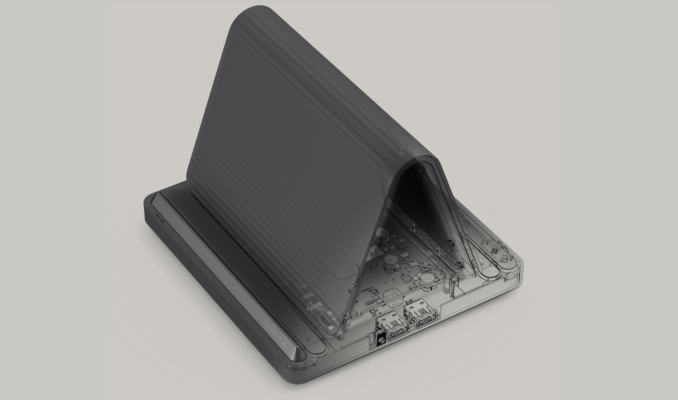
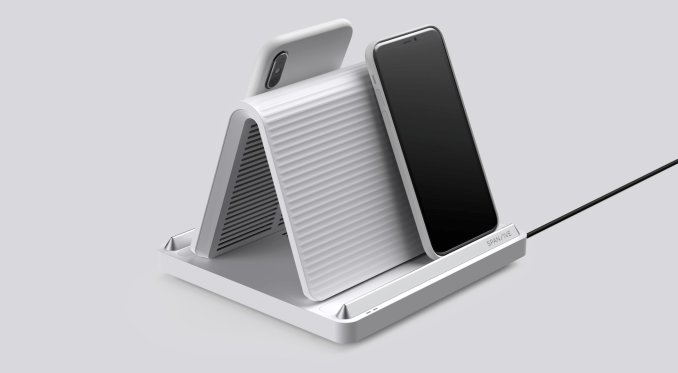
Called the Spansive Source, it’s a base station capable of wirelessly charging four phones at once. Unlike their cone-shaped charger, you’ll need to set your phone pretty much right on top of the Source — but unlike most pad-based wireless chargers, you won’t need to fuss with getting it aligned just right. Built using some of the same concepts they’d figured out with the cone-shaped charger, Spansive tells me that Source can determine where your phone is placed on the pad and adjust its array of magnetic charging coils accordingly. It’s also able to charge right through many brands of phone cases.

Spansive CEO and co-founder John MacDonald brought a few of his chargers to our office — and, while it’s tough to gauge how well something like this works in a short demo, it seemed to do what they promised. He placed one phone after another onto the base station, and each one’s screen lit up, its respective battery percentage ticking upward. He placed a phone with a thick Otterbox on the charger; it started juicing right up. The last phone he added to the pile had an Otterbox and a PopSocket on it, and it seemed to work all the same.

Spansive says Source charges at a rate of up to 5W for each phone being charged wirelessly, while the USB ports push up to 12W. MacDonald tells me that the wireless charging rate isn’t impacted by the number of phones on the pad; in other words, the first phone won’t charge slower just because you’ve added another phone or two to the charger.

John was careful to note that the Source is built to charge phones, specifically. The angled design would make resting something like an Apple Watch on it a bit awkward, for example — so Source also has two USB ports on its side, meant to help charge your various other devices. Even within the phone category, Spansive isn’t promising full compatibility across all Qi phones right off the bat; MacDonald tells me they’ve focused on getting it to work with Samsung’s Galaxy phones (beginning with the S7) and iPhones (beginning with iPhone 8), with certification/compatibility with other phones likely coming down the road via over-the-air software update. It has WiFi built-in for pulling down those updates, with a button on Source’s base for wiping your WiFi credentials with a tap if you don’t want yet another IoT device on your network indefinitely.

Source goes up for sale today at $189, shipping immediately in two colorways: white and charcoal.

Barnes & Noble’s Nook e-reader returns with a larger screen

I’ve always had a soft spot for the Nook. Barnes & Noble’s e-reader was more than just a rare competitor to Amazon’s steamrolling Kindle, it was a nice device with an interesting design — and one of the first in its class to now standard technologies like front lighting.

But good readers never really die, they just go into extended hibernation and people forget all of about them. And also they sometimes die. Anyway, it’s clear that the Nook division ultimately wasn’t the sort of exit strategy Barnes & Noble was hoping for (no one, it seemed, could predict Amazon), but it continues to release products here and there, including the bigger, better Nook GlowLight Plus.

The new reader maintains the classic Nook soft touch style, coupled with a considerably larger 7.8 inch screen featuring the titular front lighting. Bulkiness has always been a bit of an issue with the Nook, and that’s almost certainly more so the case with the larger footprint. It’s a sacrifice for a more comfortable device, and the price is certainly right though, at $199.

That includes 8GB of built in storage and your standard works-for-weeks-at-a-time battery. The physical page buttons, which Amazon has since come back around on are here, as well. Oh, and the new Nook is waterproof for all of those summer reading misadventures.

It his B&N stores on Memorial Day and will available online Wednesday May 29.

eFounders backs Yousign to build a European eSignature company

French startup Yousign is partnering with startup studio eFounders. While eFounders usually builds software-as-a-service startups from scratch, the company is trying something new with this partnership.

eFounders wants to create all the tools you need to make your work more efficient. The startup studio is behind many respectable SaaS successes, such as Front, Aircall or Spendesk. And electronic signatures are a must if you want to speed up your workflow.

Sure, there are a ton of well-established players in the space — DocuSign, SignNow, Adobe Sign, HelloSign, etc. But nobody has really cracked the European market in a similar way.

Yousign has been around for a while in France. When it comes to features, it has everything you’d expect. You can upload a document and set up automated emails and notifications so that everybody signs the document.

Signatures are legally binding and Yousign archive your documents. You can also create document templates and send contract proposals using an API.

The main challenge for Yousign is that Europe is still quite fragmented. The company will need to convince users in different countries that they need to switch to an eSignature solution. Starting today, Yousign is now available in France, Germany, the U.K. and Spain.

Yousign had only raised some money. eFounders is cleaning the cap table by buying out existing investors and replacing them.

“We can’t really communicate on the details of the investment, but what I can tell you is that we bought out existing funds for several millions of euros in order to replace them — founders still have the majority of shares,” eFounders co-founder and CEO Thibaud Elzière told me.

In a blog post, Elzière writes that eFounders has acquired around 50 percent of the company through a SPV (Single Purpose Vehicle) that it controls. The startup studio holds 25 percent directly, and investors in the eFounders eClub hold 25 percent.

Yousign now looks pretty much like any other eFounders company when they start. Of course, founders and eFounders might get diluted further down the road if Yousign ends up raising more money.

Using full-body MRIs, Ezra can now detect 11 cancers in men and 13 in women

When Ezra first launched about six months ago, the company was using magnetic resonance imaging machines to test for prostate cancer in men.

But the company’s founder, Emi Gal, always had a larger goal.

“One of the biggest problems in cancer is that there’s no accurate, fast, painless, way to scan for cancer anywhere in the body” Gal said at the time of his company’s debut.

Now he’s several steps closer to a solution. Rather than having to do painful biopsies which often come with significant side effects, Gal’s software can now be used to slash the cost for a full-body MRI scan designed to screen for 11 different types of cancer in men and another 13 types of cancer in women (who have more organs that are likely to develop cancer).

The scans take about an hour and costs just $1,950, compared with the $5,000 to $10,000 that a full-body MRI scan can cost.

That’s still a steep price for customers to pay out of pocket. Insurance companies won’t pay for Ezra’s screens… yet. The company is in talks with some insurance companies and expects to have some pilot projects up in the last quarter of 2018 and first quarter of 2020. The goal, says Gal, is to have Ezra covered by insurers and self-employed insurers.

It’s hard to overstate how vitally important early cancer screening is for patients.

The American Cancer Society estimates that 1.7 million new cases of cancer diagnosed in the U.S. in 2019. For 600,000 people that diagnosis will be a death sentence. Roughly half of cancer patients are detected in the late stage of the disease and only two out of ten late-stage cancer patients survive longer than five years.

Gal knows the toll that can take on patients and families all too well. The serial entrepreneur, who started his first company at 20 and sold it at 30, volunteered at a hospice in his hometown of Bucharest, and became determined to come up with a screen to detect cancer earlier.

Gal started working on Ezra’s cancer-screening toolkit last year, with patient data taken from the National Institute of Health and supplemented with 150 cancer screens from additional patients.

Ezra initially came to market with a single test to screen for prostate cancer using machine learning to diagnose the screens coming off of an abbreviated MRI scan that takes 20 minutes.

All of the MRI sequences that Gal’s company uses are FDA approved, but the machine learning algorithms the company has developed has not been cleared, yet.

While Ezra can screen for different cancers, the firm’s technology doesn’t offer a diagnosis. That’s still up to a physician and requires additional testing. “We’re turning MRIs from what is a diagnostic test into a screening test,” says Gal.

“What we’ve done is removed the sequences not necessary for screening and brought the liver scan down to 15 minutes [and] the total scanning time down to an hour,” Gal says.

Rather than building out its own network of MRI machines to conduct the tests, Ezra has partnered with the MRI facility network RadNet on testing. The company also offers post-diagnosis consultations to help direct patients who are diagnosed with cancer to seek proper treatment.

The company is currently working in nine centers across New York and intends to expand to San Francisco and Los Angeles later this year.

Gal’s vision for early cancer screening was appealing enough to rake in $4 million in financing from investors including Founders Future, Credo Ventures, Seedcamp, Esther Dyson and other angel investors including SoundCloud co-founder Alex Ljung.

Ultimately, Ezra’s success will hinge on whether it can continue to drive down costs with its direct-to-consumer pitch, or become a diagnostic tool that insurers embrace.

“Over time, our goal is to build different AIs for different organs to decrease the cost even further,” says Gal.

Rotten Tomatoes will start verifying ticket purchases for audience reviews

Review aggregator Rotten Tomatoes is taking additional steps to confirm that audience members actually see a movie before leaving a rating or review.

The site’s Audience Scores — distinct from the Tomatometer, which is based on professional reviews — have become a target for supposed fans looking to voice their discontent around big releases. That’s particularly been the case for movies like “Captain Marvel,” “Black Panther” and “Star Wars: The Last Jedi,” which feature women or people of color as their leads. (Despite the reactionary backlash, each of those films has grossed more than $1 billion worldwide.)

Earlier this year, the site announced that it would not allow users to post comments about a movie until it came out. But that only delayed the debate — if you wanted to rant about a title without seeing it, you just had to wait a little longer.

So starting today, Rotten Tomatoes is taking advantage of the fact that it’s owned by ticketing service Fandango (which in turn is owned by Comcast and WarnerMedia). For all new movies moving forward, users who want to leave a rating or review will be asked to verify their ticket purchase through Fandango.

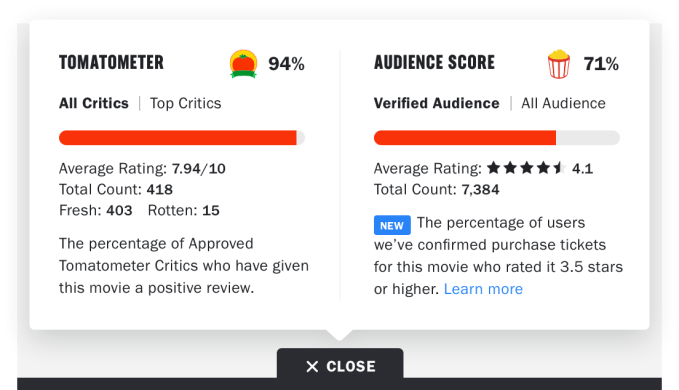
To be clear, you’ll still be able to leave a review without verification, but verified reviews will be clearly marked, and only those reviews will be included when calculating the Audience Score.

Rotten Tomatoes verified score

The Audience Score will also be replacing the user rating system in Fandango, with the service prompting ticket buyers to leave a Rotten Tomatoes review after they’ve seen the film.

“Because of scale that Fandango brings, we expect to get to a critical mass of verified ratings really quickly out of the gate,” said Fandango’s vice president of product Greg Ferris.

He added that Rotten Tomatoes has also partnered with AMC Theatres, Regal and Cinemark Theatres to verify purchases from those theater chains later this year.

It’s also exploring ways to confirm that you watched a movie on streaming or TV. And while the system currently verifies just one review per transaction, Feriss said he’s looking at how to support multiple reviews for group ticket purchases.

FanDuel partners with fuboTV to bring sports betting data to the live streaming service

Live sports streaming service fuboTV today announced a first-of-its-kind partnership with daily fantasy sports provider FanDuel, which will see the latter’s betting data integrated into fuboTV’s streaming platform. The deal also includes a media buy and a carriage agreement that brings FanDuel -owned horse-racing networks TVG and TVG2 to fuboTV, as well. The deal is only live in New Jersey, but fuboTV says it will be able to integrate sports betting data on the platform in other states where betting is legal over time.

The partnership makes FanDuel the exclusive sportsbook, online casino, horse racing, and daily fantasy sports partner, meaning fuboTV won’t be doing similar deals with competitors. And FanDuel will be the exclusive advertiser across all those categories on fuboTV.

This is the first time the sports betting service has formed a strategic partnership with an over-the-top streaming service — but it’s one that makes sense given the likely overlap in both of their user bases.

The TVG network, meanwhile, will be added to fuboTV’s base package ($54.99/mo) and TVG2 will become available in the Sports Plus add-on package that offers a couple dozen more channels for $8.99/mo. The channels will bring horse racing industry coverage, as well as programming on sports betting and fantasy news, which includes TVG’s sports betting-focused show “More Ways to Win.”

The channels are set to launch in the coming weeks.

Also the weeks ahead, FanDuel’s betting data will become integrated into fuboTV — including under fuboTV-branded channels and FanDuel’s TVG channels, plus on content detail pages, in the programming guide, and elsewhere. This same data will later roll out to other U.S. states, where legal, as it’s a national deal.

Other channels will receive the betting data integration over time.

That means, for the time being, the betting data is only displaying on two fuboTV-branded channels — fubo Network and fubo Cycling — in addition to the horse racing channels. This is a fairly limited integration, given that fuboTV’s base package today include 95 channels across a range of sports. It also means the betting data is limited cycling, soccer, and horse racing to start, as those are the only sports covered by the aforementioned channels.

But fuboTV says it expects to expand to other channels and sports in time. Of course, it will need to broker further deals to make that happen.

To be clear, only sports betting data will be provided to fuboTV viewers.

FuboTV is not facilitating the actual betting, nor will the FanDuel ads offer some sort of clickthrough experience that would direct viewers to its own site.

The company declined to share the deal terms, only noting FanDuel’s advertising buy.

“We’re partnering with fuboTV to demonstrate how FanDuel can enhance the live viewing experience by allowing cord-cutting sports fans to view the content that matters to them the most from their TV, phone, tablet or computer,” said Adam Kaplan, FanDuel VP of Content Business & Operations, in a statement. “FuboTV is a sports-centric company, focused on live sports and entertainment content, making them a natural partner. By integrating our odds and data on fuboTV’s platform, we are truly changing the way people watch live sports,” he said.

“We are always looking for ways to add value for consumers and enhance their premium experience with fuboTV,” said Min Kim, fuboTV VP of Business Development, added. “Gaming and sports are natural complements, and fuboTV’s industry-leading product offerings will be further enriched with FanDuel’s innovative entertainment solutions.”