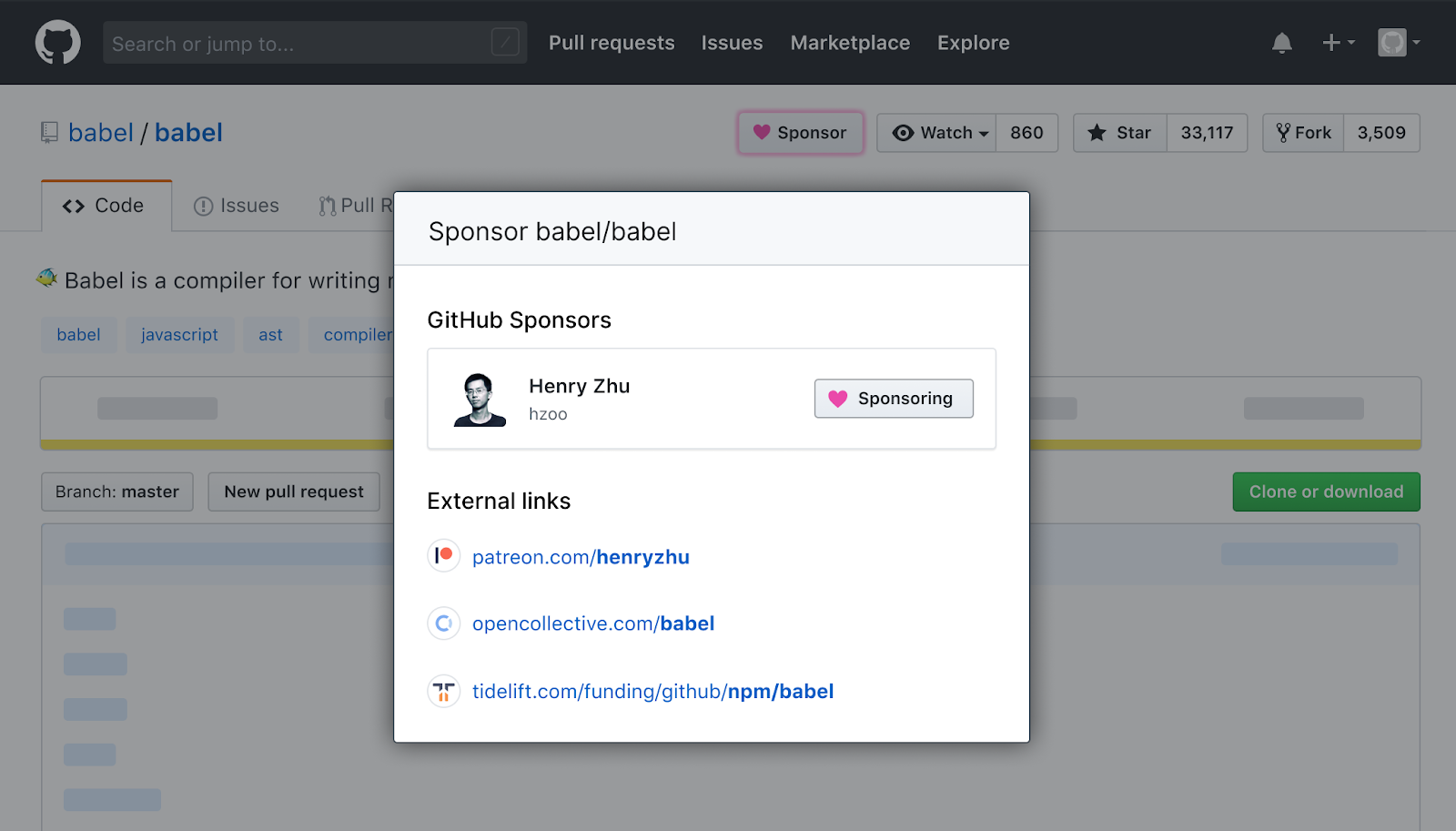
GitHub today launched Sponsors, a new tool that lets you give financial support to open source developers. Developers will be able to opt into having a “Sponsor me” button on their GitHub repositories and open source projects will also be able to highlight their funding models, no matter whether that’s individual contributions to developers or using Patreon, Tidelift, Ko-fi or Open Collective.
The mission here, GitHub says, is to “expand the opportunities to participate in and build on open source.”
That’s likely to be a bit controversial among some open source developers who don’t want financial interests to influence what people will work on. And there may be some truth to that as this may drive open source developers to focus on projects that are more likely to attract financial contributions over more esoteric projects that are interesting and challenging but aren’t likely to find financial backers on GitHub. We asked GitHub for a comment about this but did not receive a response by the time this article went live.
The program is only open to open source developers. During the first year of a developer’s participation, GitHub (and by extension, it’s corporate overlords at Microsoft) will also match up to $5,000 in contributions. For the next twelve months, GitHub won’t charge any payment processing fees either (though it will do so after this time is over).
Payouts will be available in every country where GitHub itself does business. “Expanding opportunities to participate on that team is at the core of our mission, so we’re proud to make this new tool available to developers worldwide,” the company says.
It’s worth noting that this isn’t just about code and developers, but all open source contributors, including those who write documentation, provide leadership or mentor new developers, for example. As long as they have a GitHub profile, they’ll be eligible to receive support, too.
To make this work, GitHub is also launching a ‘Community Contributors’ hovercard to highlight the people who built the code your applications depend on, for example.
It will definitely be interesting to see how the community will react to Sponsors. The idea isn’t completely novel, of course, and there are projects like Beerpay that already integrate with GitHub. Still, the traditional route to get paid for open source is to find a job at a company that will let you contribute to projects, either as a full-time or part-time job.
In addition to Sponsors, GitHub is also launching a number of new security features. The company today announced that it has acquired Dependabot, for example, a tool that ensures that projects use the most up-to-date libraries. GitHub Enterprise is getting improved audit features, which are now generally available, and maintainers will now get beta access to a private space in GitHub to discuss potential security issues so that their public chats don’t tip off potential hackers. GitHub is also taking token scanning into general availability, which is meant to prevent developers from accidentally leaking their credentials from services like Alibaba Cloud, Amazon Web Services, Microsoft Azure, Google Cloud, Mailgun, Slack, Stripe and Twilio.
GitHub’s enterprise edition is also getting a few updates, including more fine-grained permissions, which are now generally available. Also generally available are Enterprise accounts, while new features like internal repos and organizational insights are now in beta.
Savvy early-stage startuppers of every stripe have their sights set on attending TechCrunch Disrupt Berlin 2019 on 11-12 December. Why? This showcase event draws the most innovative startups, technologists, founders and investors across Europe and beyond. Registration doesn’t open until June, but we have a way for you to save big right now.
All you need to do is sign up for our mailing list before the official registration opens, and we’ll knock €200 off the super-early-bird price of any Disrupt Berlin pass. When you sign up, we’ll email you a discount code to use when it’s time to pay for your ticket. That’s some savvy savings right there.
Great ideas and great startups know no boundaries, and neither do Disrupt Berlin participants. It’s a highly diverse startup community representing more than 50 countries, including European Union members, Israel, Turkey, Russia, Egypt, India, China and South Korea and many more. Talk about a world-class networking opportunity.
You’ll find hundreds of incredible early-stage startups exhibiting the latest tech innovations in Startup Alley, the expo hall and the heart of every Disrupt event. It’s a breeding ground of opportunity where you can make connections, find new collaborators, potential investors, employees or even meet the manufacturing contact you need to move your startup forward. In the Alley, the possibilities are endless.
Here’s another great Startup Alley opportunity: the TC Top Picks program. TechCrunch editors shine a bright Disrupt spotlight on a hand-picked cohort of promising startups representing a range of tech categories. They get to exhibit for free in Startup Alley, and they enjoy a ton of media and investor attention. We’ll have information on how you can apply to be a TC Top Pick in the coming weeks.
Be sure to experience the Startup Battlefield, the legendary pitch competition with the $50,000 cash prize. Since 2007, 857 participating Battlefield startups have collectively raised more than $8 billion in funding and generated 109 exits. But then again, maybe you’d rather compete than watch. Go you! We’ll have more info soon on how to apply, so keep checking back.
We’ve barely scratched the surface of the great programming you’ll enjoy at Disrupt Berlin. We’re in the process building the agenda of speakers, panelists, workshops, Q&A Sessions and demos. And of course, there’s also the always-epic TechCrunch After Party.
Disrupt Berlin 2019 takes place on 11-12 December. Remember: When you sign up for our mailing list before the official registration opens, you’ll save €200 off the super-early-bird price of your pass. And you’ll stay up to date on the latest announcements and the multitude of ways you can explore and enjoy Disrupt Berlin.
Is your company interested in sponsoring or exhibiting at Disrupt Berlin 2019? Contact the sponsorship sales team by filling out this form.
Beautystack, the London startup that’s creating a beauty professional booking app with heavy focus on social, has quietly picked up £4 million in seed funding led by Index Ventures.
The company had previously raised pre-seed funding from LocalGlobe (led by Suzanne Ashman) and counts David Rowan (ex-Wired), Julien Codorniou (Facebook Workplace) and Audrey Gelman (The Wing) as angel investors.
Founded by former salon owner and brand consultant Sharmadean Reid in April 2017 before being joined by co-founders Dan Woodbury and Ken Lalobo, Beautystack is part booking platform for independent beauty professionals and part social app. The idea, Reid tells me, is to “close the loop” on seeing the results of a beauty treatment that you like and being able to book it.
“Girls see millions of images of beauty treatments on social media and have no idea about who did it, how much it cost or what it even is,” she says. “We want to close the loop on the journey of seeing what you want, liking it and booking it. With Beautystack we use visual menus so you can search and book what you like.”
Reid says Beautystack’s “see it, like it, book it” approach is also designed to solve a bigger problem that means many beauty services providers are at the bottom of the $450 billion beauty industry and “don’t get the earnings, tech solutions or income or respect they deserve.”
“In my opinion they are the foundation of the industry and with Beautystack our mission is towards gender quality by increasing the earnings of these ‘Beauty Pros.’ I want to turn the beauty professionals into the next beauty influencers and have them earning salaries comparable to beauty bloggers. They always have been influential, but now we want to push them to the forefront.”
She says doing that requires a cultural change as well as a technological one, and that Beautystack, which launched a beta in January, is taking the time to cultivate its supply and promote the beauticians on its app through articles and content, “and nurture their confidence and their careers.” It also provides the tools needed for beauty professionals to work independently and reduce the time spent managing social media, customer support and bookings.
“Our typical supply customer is a millennial or Gen-Z independent beauty professional,” adds Reid, “mainly women, who tend to create a lot of content around their work (images and video), which they then post on social media. After working all day, they then have to respond to Instagram DMs, comments, texts and WhatsApps for their appointment requests, and typically there will be at least 10 exchanges, including screenshots of imagery to close a booking [without payment].”
Beautystack founders
These beauty professionals are typically leaving a salon and either setting up private studios, operating mobile, working from home or renting chairs in a salon as opposed to a commission model. With Beautystack, Reid says the beauty pro’s time is better protected against cancellations, too, with a 50% upfront booking and 50% upon completion. An image of the beauty treatment sought is attached to each booking and the beauty pro can view the client’s profile to gauge their taste before they even walk through the door.
It’s this “networked environment” that in part makes Beautystack stand out from competitors, with the app employing social media mechanics to allow users to see what their friends have booked and to follow and like their posts. “We have a two-sided networked marketplace that has equal functionality. Other beauty scheduling systems operate like a classified directory,” says Reid.
With that said, Beautystack isn’t a walled garden. Initially built as a web app using React, each beauty pro gets their own website accessible through any modern web browser and linked to their profile within the Beautystack mobile app.
“Later down the line I think we will do more with their web profiles and enable partner integrations in finance and accounting to support more experiences for beauty pros,” adds the Beautystack founder.
A San Jose-based semiconductor startup being sued by Huawei for stealing trade secrets has hit back in court documents, accusing the Chinese firm’s deputy chairman of conspiring to steal its intellectual property, reports the Wall Street Journal. In court filings, CNEX Labs, which is backed by the investment arms of Dell and Microsoft, alleges that Eric Xu, who is also one of Huawei’s rotating CEOs, worked with other Huawei employees to steal its proprietary technology.
The lawsuit, set for trial on June 3 in federal court in the Eastern District of Texas, started in 2017 when Huawei sued CNEX and one of its founders, Yiren “Ronnie” Huang, a former employee at Huawei’s Santa Clara office, for stealing its technology and using unlawful means to poach 14 other Huawei employees. CNEX filed a countersuit the following year. Huawei has denied the startup’s allegations in court filings.
The lawsuit is happening at a fraught time for Huawei. Last week, the Chinese telecom equipment maker (and the world’s second-largest smartphone brand), was placed on a trade blacklist by the Trump administration, which also signed an executive order that would make it possible to block American companies from doing business with Huawei and other companies it deems a national security threat. As a result, several companies have suspended business with Huawei, including Google, Qualcomm, Intel and ARM.
Court filings said that after being directed by Xu to analyze CNEX’s technical information, a Huawei engineer met with the startup’s officials in June 2016, pretending to be a potential customer. But then the engineer produced a report about CNEX’s tech and put it into a database of information about competitors run by Huawei’s chip development unit.
CNEX’s lawyers also say that Xu knew about a partnership between Huawei and Xiamen University that was allegedly part of plan to steal the startup’s trade secrets. They claim Xiamen obtained a memory board from CNEX in 2017 under a licensing agreement, saying it would be used for academic research. But CNEX lawyer Eugene Mar said that “what was hidden from CNEX was that Xiamen was working with Huawei and had entered into an agreement separately with Huawei to provide them with all of their research test reports,” according to court transcripts viewed by the Wall Street Journal.
Information from the university’s study was then allegedly used for Huawei chip projects, including one that is expected to be released this year. Huawei’s lawyers refuted CNEX’s charges, claiming that the partnership between Huawei and the university did not involve reverse engineering or CNEX’s trade secrets and was meant to design database software instead of developing chips. A Huawei lawyer said that Xu was part of “the chain of command that had requested” information about CNEX and that a CNEX document had been placed into its chip development unit’s database, but denied allegations that anything was stolen.
CNEX co-founder Huang claimed in court filings that he offered to sell his intellectual property to Huawei when he started working at Futurewei, its research and development unit. Huawei refused his offer, but then later tried to get Huang to give them his IP under an employee agreement, which Huang refused to sign, he claims. Huang left Futurewei in 2013 and founded CNEX Labs soon after.
Fintech startup Revolut is making vaults collaborative. You can now create a vault with someone else and use it like a normal vault.
Originally, vaults were an alternative to savings accounts without any interest rate. You could create vault in any currency (including supported cryptocurrencies) and set some money aside. You can round up your expenses and add change to a vault, program regular transfers to your vault or add money whenever you feel like it.
If vaults are like a Word document, group vaults are like a collaborative document in Google Docs. Multiple persons can now interact with a group vault just like a normal vault.
This will be useful for couples who want a sort of joint account without opening a bank account, parents giving some money to their children, roommates creating a common pot to pay for group expenses, friends going on vacation, etc.
Revolut users have created 1 million normal vaults so far. They currently hold the equivalent of $95 million (£75 million).
In other news, Revolut mentioned a new app for younger customers —Revolut Youth. It's not available yet but the company is working on it.
There are now 4.9 million registered users on Revolut. Every day, 12,000 people sign up. Every month, Revolut processes $5.5 billion in transaction volume.
The Boring Company, Elon Musk’s tunneling and transportation startup, has landed a $48.7 million project to shuttle people in an underground Loop system around the Las Vegas Convention Center.
This is the company’s first commercial contract.
The initial design for the project, dubbed Campus Wide People Mover or CWPM, will focus on the Las Vegas Convention Center, which is currently in the midst of an expansion that is expected to be complete in time for CES 2021. The newly expanded Las Vegas Convention Center will span about 200 acres once completed. The LVCVA estimates that people walking the facility would travel two miles from one end to the other, a distance that prompted officials to find a transportation solution.
The approval comes with numerous strings and requires The Boring Company to achieve specific milestones, details of which The Guardian published earlier this month. The contract withholds over two-thirds of payments until construction is complete and requires The Boring Company to meet specific ridership goals.
The LVCVA estimated an initial $1.2 million outlay to TBC in fiscal year 2019, following by $15 million in 2020 and the final $32.47 million in 2021.
While the project is limited for now, TBC has said in the past project could someday connect downtown, the Las Vegas Convention Center, the Las Vegas Boulevard Resort Corridor and McCarran International Airport.
This underground people mover will involve the construction of twin tunnels for vehicles and one pedestrian tunnel, according to contract documents. The twin tunnels are expected to be less than a mile. There will be three underground stations for passenger loading and unloading and an elevator or escalator system for passenger access to each station.
The people mover, once complete is supposed to whisk people between stops at high speeds in modified electric Tesla vehicles. The contract describes these as autonomous vehicles. (Today, Tesla vehicles are not self driving, and instead have an advanced driver assistance system that handles certain tasks on highways such as lane steering and adaptive cruise control.) Before it opens to the public, the contract dictates that TBC test the system for three months.
As Musk’s Boring Company lands one contract, safety concerns have been raised on the design of another more ambitious Loop system from Washington D.C. to Baltimore.
Details of the 35.3-mile system, which emerged recently in a 505-page draft environmental assessment, reveals a design that fails to meet several key national safety standards. The underground system appears to lack sufficient emergency exits, ignore the latest engineering practices and proposes passenger escape ladders that one fire safety professor calls “the definition of insanity.”
While much of the world remains fixated on the race to build autonomous cars, there’s another race that’s gaining momentum fast. It centers on supersonic jets that can fly faster than the speed of sound, or 767 miles per hour. Indeed, while most commercial airliners today fly at between 400 and 650 miles per hour — largely because it’s more economical to burn fuel more slowly — a spate of startups is borrowing from the age of the legendary Concorde to build planes that they say will fly at 1,000 miles per hour, 1,500 miles per hour, and, even in one case, at more than 3,000 miles per hour.
The last of these, and seemingly the most audacious, is Hermeus, a year-old, Atlanta-based startup that wants to build planes capable of getting from New York to London in 90 minutes. Just last week, it announced that it has raised an undisclosed amount of seed funding from Khosla Ventures. It’s also reportedly being advised by the former president of Jeff Bezos’s Blue Origin space company, where Hermeus’s CTO, Glenn Case, also spent more than four years working on propulsion design and development.
On the other end of the spectrum are Aerion Supersonic and Spike Aerospace, both of which expect to build planes that seat around 12 people and fly at a little more than 1,000 miles per hour. Spike, an eight-year-old, Boston-based outfit, is very much focused on the luxury market. Aerion, a 17-year-old, Reno, Nev.-based concern, meanwhile wants to start with a 12-seater, then graduate to a larger and faster version of the same plane that can serve as a commercial airline.
Aerion seems to have the most momentum of the three. It’s currently collaborating with GE Aviation on its engine, Honeywell for its flight deck, and Boeing on engineering, design, and manufacturing. (Also worth noting: it has seen Lockheed Martin pull out of a partnership, as well as Airbus.)
But there is another company hoping to steal its thunder, and that’s Boom, a roughly five-year-old, Denver-based, 150-person company that has raised $141 million from investors, including Japan Airlines, Emerson Collective, and Y Combinator, and that says the capital is more than enough to begin realizing its vision of creating 55-seat airplanes that fly at twice the speed of sound at prices that compete with today’s business class fares.
In fact, says the company, if all goes as planned, Boom will eventually make and sell planes to airlines that fly just as fast but accommodate many more people — at economy fares.
Is it possible? It’s possible to imagine, at least, for transatlantic flights, such as between New York to London, San Francisco to Tokyo, and Seattle to Shanghai. (Because of the continuous loud “boom” created by the shock waves of any object moving faster than the speed of sound, most countries have banned supersonic jets from flying overhead.)
Of course, there are many, many outstanding questions, including how these startups make the economics work, whether they can be sufficiently fuel efficient, and what it means to make flight around the globe faster — both the good and the bad.
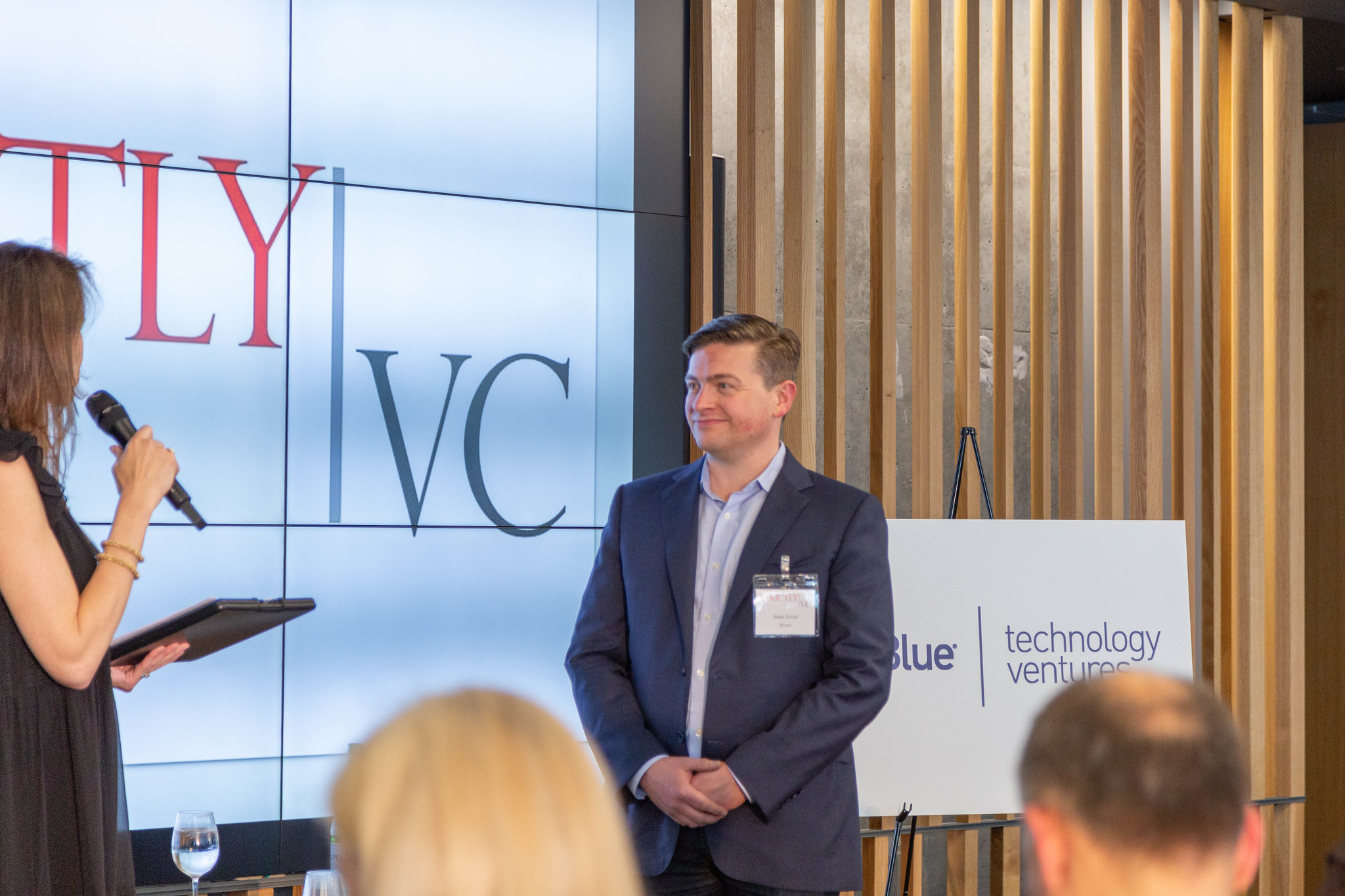
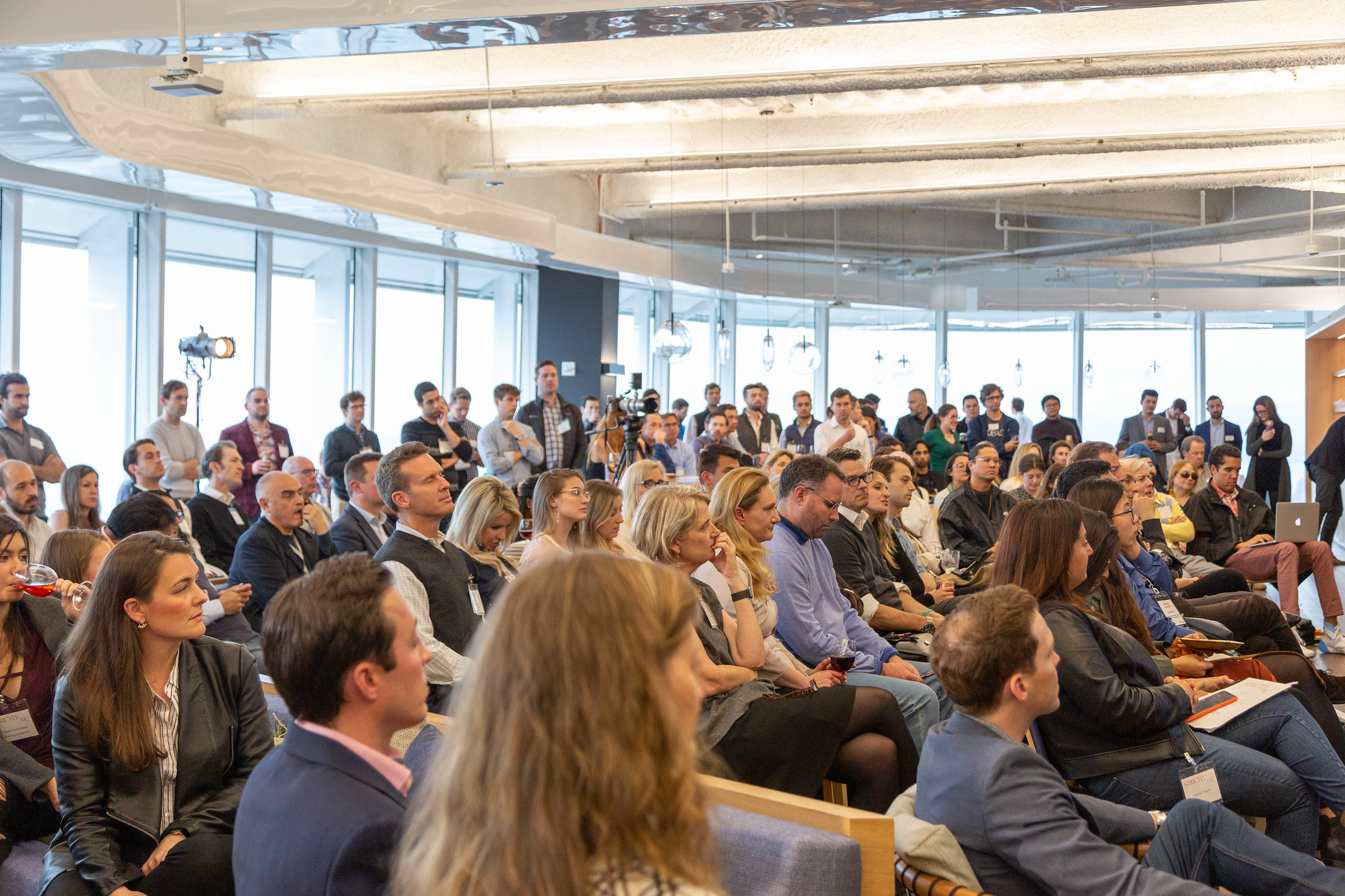
Following, you can find outtakes from a conversation we had with Scholl last week at one of our StrictlyVC events, wherein he addresses many of these same questions. We’re also providing video of the interview, in case you’d like to hear from him directly. We thoroughly enjoyed the conversation; we hope you will, too.
TC: Blake, you [spent a handful of years with Amazon, working on mobile shopping, then Groupon acquired a mobile payment company you’d cofounded, Kima Labs, and you stayed on]. So you’re at Groupon. You don’t have an aerospace background. But you decide that you are the guy to start a supersonic jet company. How did that happen?
BS: It goes back to the decision I made to sell [Kima Labs] . . . I thought, is it worth what I will go through personally for the product we’re building, or should I take the great offer and live to found another day? And so I took the offer, and in reflecting on that, what I realized is, like, all startups are hard. There’s no such thing as an easy startup. And what often makes the difference is what decisions you make in those moments. What happens when you get up in the morning, and it’s a rough day — do you think, Why did I get into this thing? Or do you think, It doesn’t matter — it’s totally worth it?
So after leaving Groupon, I had a whole bunch of startup ideas, everything from rental cars, to some stuff in healthcare, and my personal passion for a long time had been airplanes. And so I put on that lens of, how happy will I be personally if it works? And so I thought, I have to look at the supersonic thing that I’ve been sort of thinking about for a decade and do some research and probably get it out of my system.
TC: And how do you start putting together a plan to create a jet that flies at twice the speed of sound?
BS: The first thing was to understand why it hadn’t been done already. As it turns out, there was a bunch of just false conventional wisdom — that the space is capital intensive, that it’si highly regulated, that there are only two companies on the planet that build long-range commercial aircraft. So it just scares off a lot of entrepreneurs.
[So I went back to] first principles and [thought], the Concorde was created 50 years ago with slide rules and wind tunnels. And half a century later, [I wondered] why is that not working, and what would it take, and the answer was that the fuel economy was the problem. It was too expensive to operate, [so] none of the people could afford to fly on it. And you start to run the numbers and say, well — by the way, all this stuff you can do out of Wikipedia — what would you have to do to make this economically feasible? It turns out the answer is [to make the fuel efficiency] 30 percent [better] versus what was designed a long time ago. And you start to realize, that doesn’t sound impossible. [So] I went off and read some aerospace textbooks, and took a design class, and started to meet everybody I could find in the industry, and I told them to shoot holes in my idea. And eventually, people started saying, ‘No, this actually makes sense.’ And then so we started the company.
TC: How much of what you’re working on is built from scratch, versus building on the work of your predecessors?
BS: We’re really standing on the shoulders of all the work that’s happened in aerospace since literally the Concorde 50 years ago. And we’ve gone from aluminum as the material to carbon fiber composites; we’ve gone from defining aerodynamics in wind tunnels to being able to do it in simulation, through cloud computing; we’ve gone from engines that are loud and very inefficient to modern jet engines that are quiet and sip fuel. And it turns out that if you take all that technology that’s been proven, the big players in the space have been iteratively optimizing the same you’ve had since the 1960s. But you can actually take that same technology and instead of make the machine more efficient, make the human more efficient, and deploy it in service of speed. So the the design of our airplane is very radical, but the fundamental technology is conventional.
TC: So the wings are in the back. And how many jet engines does the plane feature?
BS: It has three, so one under each wing, and the third one on the tail.
TC: And who is building the jet engines?
BS: We haven’t picked a provider yet, but we’re working with two of the three major jet engine companies; they are basically bidding to provide a custom engine for us.
TC: You’re starting with a prototype that’s one third the size of the eventual airplane you plan to produce. Why did you decide on 55 seats for the design of the bigger plane?
BS: If you look at it relative to the Concorde, and you say, ‘Well, it’s not enough just to do something really cool, you have to make the economics work,’ what you need to do is to make the machine efficient enough that more people can afford to fly on it; you’ve gotta get the fares down. Then the second thing you’ve got to do is right-size the airplanes. If you’re in the airline business, you live and die by something called load factor, which is the percentage of seats that are filled. And if you put too many seats on the airplane relative to the price of the seats, you fly around empty. At 55 seats . . . you can fill the seats and make money . . .by charging business class fares . . .on hundreds of routes.
TC: My understanding was that on the Concorde, the cabin was actually quite small and not necessarily very comfortable. I’m sure this is sort of very much a later consideration, but have you put much thought into how the cabin will look? Does it have to be terribly narrow?
BS: The very first thing we built in my cofounder’s garage was a mock-up of the cabin, because it is size sensitive . . . If it’s a three- or four-hour flight, instead of a seven- or eight- or nine-hour flight, you’re still in there long enough that comfort matters. And so you can put a really nice interior in the airplane. So it’ll be sort of business-class style, with nice wide seats, big windows, plenty of room to work or relax. But when the flight is three to four hours, the seat doesn’t have to lay flat the way it does in business class today. By the time to get it down, it’s time to put it back up.
TC: So you said you’re still trying to decide on a jet engine provider. But again, this is highly ambitious. Are there any other partnerships that you’ve struck, maybe with [your investor] Japan Airlines?
BS: [I recognize that] on the face of it, it sounds like something that only big companies can do. I think Boom has [requires] four ingredients to make it successful. Number one is the engineering execution on the airplanes; that’s the one thing we control directly. Number two is the customer demand, so showing that you’re building not just something that seems cool but is something that airlines really want. Number three is the supplier partnerships, so folks that build jet engines, folks that do carbon fiber composites, folks that do avionics. Unless you’re going to build the whole thing soup to nuts yourself, you need those partnerships. And then last but not least, you need a lot of capital.
And each of those components kind of wants the rest, like the investors want to know the airlines are there. The airlines always ask about the engine. The engine companies ask who the airlines are. And so it’s like a four-way chicken-and-egg problem. I often tell the team we’re in the chicken omelet business. [Laughs.] So what you do is incrementally spiral up. The tech on the airplane is actually conventional stuff that’s flying on other airplanes today, [meaning it’s] proven safe and reliable and efficient. But the way you go to market and the way you build partnerships is completely different from the way that Boeing or Airbus would do it. We call it ‘dating engagement marriage.’ And so whether it’s an airline partnership, or a supplier partnership, you start off with something relatively loose, like a letter of intent, that allows you to go off and show credibility to other parties, and you come back and you progressively sharpen those things.
So so where we stand today on the airline side of it is we’ve pre-sold 30 airplanes [to Japan Airlines and Virgin Group] at $200 million apiece . . .
TC: What does that mean, pre-sold? Is that a letter of intent?
BS: It’s a bit more than a letter of intent. This is the part of the go-to-market engineering that turns out to matter. So it’s basically an option agreement with some like cleverly engineered terms that I can’t go into too much. But basically, we achieve some milestones on our first prototype over the next year, and that kicks the options into expiration, and so the airlines, at the maximum point of Boom being credible, have to place an order or lose a bunch of favorable things.
For more on Boom, including how much it will need to raise, how it views its competitors, and how the company realizes its long-range vision to make the fastest flight the cheapest one, do check out our interview with Scholl below. If you’ve read the above interview, you might want to start around the 10-minute mark.
Machine learning researchers have produced a system that can recreate lifelike motion from just a single frame of a person’s face, opening up the possibility of animating not just photos but also of paintings. It’s not perfect, but when it works, it is — like much AI work these days — eerie and fascinating.
The model is documented in a paper published by Samsung AI Center, which you can read it here on Arxiv. It’s a new method of applying facial landmarks on a source face — any talking head will do — to the facial data of a target face, making the target face do what the source face does.
This in itself isn’t new — it’s part of the whole synthetic imagery issue confronting the AI world right now (we had an interesting discussion about this recently at our Robotics+AI event in Berkeley). We can already make a face in one video reflect the face in another in terms of what the person is saying or where they’re looking. But most of these models require a considerable amount of data, for instance a minute or two of video to analyze.
The new paper by Samsung’s Moscow-based researchers, however, shows that using only a single image of a person’s face, a video can be generated of that face turning, speaking, and making ordinary expressions — with convincing, though far from flawless, fidelity.
It does this by frontloading the facial landmark identification process with a huge amount of data, making the model highly efficient at finding the parts of the target face that correspond to the source. The more data it has, the better, but it can do it with one image — called single-shot learning — and get away with it. That’s what makes it possible to take a picture of Einstein or Marilyn Monroe, or even the Mona Lisa, and make it move and speak like a real person.
In this example, the Mona Lisa is animated using three different source videos, which as you can see produce very different results, both in facial structure and behavior.
It’s also using what’s called a Generative Adversarial Network, which essentially pits two models against one another, one trying to fool the other into thinking what it creates is “real.” By these means the results meet a certain level of realism set by the creators — the “discriminator” model has to be, say, 90 percent sure this is a human face for the process to continue.
In the other examples provided by the researchers, the quality and obviousness of the fake talking head varies widely. Some, which attempt to replicate a person whose image was taken from cable enws, also recreate the news ticker shown at the bottom of the image, filling it with gibberish. And the usual smears and weird artifacts are omnipresent if you know what to look for.
That said, it’s remarkable that it works as well as it does. Note, however, that this only works on the face and upper torso — you couldn’t make the Mona Lisa snap her fingers or dance. Not yet, anyway.
Music streaming giant Spotify has notified an unspecified number of users that the company has reset their account password, but has left dozens of users asking why.
In an email, some Spotify users were told their password was reset “due to detected suspicious activity,” but gave no further details.
Anyone else getting emails from Spotify about suspicious activity? No compromise, at least not on my account, just seems to be getting hammered
When reached, Spotify spokesperson Peter Collins said: “As part of our ongoing maintenance efforts to combat fraudulent activity on our service, we recently shared a communication with select users to reset their passwords as a precaution. As a best practice, we strongly recommend users not to use the same credentials across different services to protect themselves.”
In other words, Spotify says this is a credential stuffing attack, where hackers take lists of usernames and passwords from other breached sites and brute-force their way into other accounts.
We asked several people who received the email reset message. Some used the same password across different websites and some used passwords unique to Spotify. Two people who commented on this Hacker News thread also said their passwords were unique, casting doubt on the veracity of a credential stuffing attack.
It’s not uncommon for companies to reset user passwords if they believe they are weak or easily guessed. Companies typically don’t store user passwords in plaintext. Instead, they scramble passwords using a hashing algorithm. By scrambling lists of weak or stolen passwords using the same algorithm, companies can match weak passwords against their own databases and proactively send out password reset emails.
Netflix, Facebook, and Spotify too have all proactively reset account passwords in the aftermath of third-party data breaches by obtaining the dataset and matching exposed passwords against their databases.
Spotify did not respond to our follow-up questions.
Customers of Chipotle, DoorDash, and OkCupid have all reported account hacks in recent months. All three have denied data breaches.
When Google launched Duplex with a demo at I/O last year, the audience was left wondering how much of the call was staged. The AI-based reservation booking service seemed almost too impressive to be a machine. Now that it’s been used for real-world reservations, Google has revealed that it frequently isn’t.
The company recently told The New York Times that Duplex calls are often still made by human operators at call centers. Roughly a quarter of calls start with a live human voice. Of the calls that start with machines, 15 percent require a human to intervene.
Google told us during a demo last year that humans would be monitoring the system, ready to take over if something went haywire. That’s to be expected, of course. This sort of real world testing run into some snags as the company works to iron out the kinks, now that the product is available for both iOS and Android devices. But the 25 percent initiated by people seems a little high for the advanced AI-based system.
Along with initial test driving, Google is very much in a period of data collection for the service. While Duplex is extremely impressive in fits and starts (I’ve tried it, and it’s capable of fooling the listener for a quick reservation, if all goes well), the neural network requires a tremendous amount of data to improve, even though its essentially limited to a single task





 Tech talks of the day