Amazon has turned warehouse tasks into a (literal) game

Working at an Amazon fulfillment center is tough and tedious. Stories of problematic working conditions have plagued the company for years now, and pressure has likely only increased as the retail giant is pushing to get packages out even faster.

To give the company some credit, it has worked to improve conditions, including the addition of a $15 minimum wage and automating certain tasks with the help of its growing robotics offering. Turns out the company has also been, quite literally, gamifying certain tasks.

WaPo (which, incidentally, is also own by Mr. Bezos) has a writeup of an “experimental” video game designed to motivator workers to fill orders. The games, which is apparently optional for employees, live on workstation screens, awarding points for fulfilling orders and pitting teams against one another in the process.

As the story notes, Amazon’s not alone in the idea. Gig-based companies like Uber and Lyft are similarly incentivizing workers with rewards for driving longer. In an age when we’ve gamified our own step counts through Fitbit and the like, it’s probably no surprise that companies are taking similar tacts for their duller positions.

Still, the whole thing is a bit odd — and probably a good indication of how repetitive this tasks can be. As we noted on a recent trip to the company’s massive Staten Island fulfillment center, the “picker” and “stower” gigs work closely with Amazon’s shelf sporting robots to get packages to their destination.

Gender, race and social change in tech; Moira Weigel on the Internet of Women, Part Two

Tech ethics can mean a lot of different things, but surely one of the most critical, unavoidable, and yet somehow still controversial propositions in the emerging field of ethics in technology is that tech should promote gender equality. But does it? And to the extent it does not, what (and who) needs to change?

In this second of a two-part interview “On The Internet of Women,” Harvard fellow and Logic magazine founder and editor Moira Weigel and I discuss the future of capitalism and its relationship to sex and tech; the place of ambivalence in feminist ethics; and Moira’s personal experiences with #MeToo.

Greg E.: There’s a relationship between technology and feminism, and technology and sexism for that matter. Then there’s a relationship between all of those things and capitalism. One of the underlying themes in your essay “The Internet of Women,” that I thought made it such a kind of, I’d call it a seminal essay, but that would be a silly term to use in this case…

Moira W.: I’ll take it.

Greg E.: One of the reasons I thought your essay should be required reading basic reading in tech ethics is that you argue we need to examine the degree to which sexism is a part of capitalism.

Moira W.: Yes.

Greg E.: Talk about that.

Moira W.: This is a big topic! Where to begin?

Capitalism, the social and economic system that emerged in Europe around the sixteenth century and that we still live under, has a profound relationship to histories of sexism and racism. It’s really important to recognize that sexism and racism themselves are historical phenomena.

They don’t exist in the same way in all places. They take on different forms at different times. I find that very hopeful to recognize, because it means they can change.

It’s really important not to get too pulled into the view that men have always hated women there will always be this war of the sexes that, best case scenario, gets temporarily resolved in the depressing truce of conventional heterosexuality.  The conditions we live under are not the only possible conditions—they are not inevitable.

A fundamental Marxist insight is that capitalism necessarily involves exploitation. In order to grow, a company needs to pay people less for their work than that work is worth. Race and gender help make this process of exploitation seem natural.

Image via Getty Images / gremlin

Certain people are naturally inclined to do certain kinds of lower status and lower waged work, and why should anyone be paid much to do what comes naturally? And it just so happens that the kinds of work we value less are seen as more naturally “female.” This isn’t just about caring professions that have been coded female—nursing and teaching and so on, although it does include those.

In fact, the history of computer programming provides one of the best examples. In the early decades, when writing software was seen as rote work and lower status, it was mostly done by women. As Mar Hicks and other historians have shown, as the profession became more prestigious and more lucrative, women were very actively pushed out.

You even see this with specific coding languages. As more women learn, say, Javascript, it becomes seen as feminized—seen as less impressive or valuable than Python, a “softer” skill. This perception, that women have certain natural capacities that should be free or cheap, has a long history that overlaps with the history of capitalism.  At some level, it is a byproduct of the rise of wage labor.

To a medieval farmer it would have made no sense to say that when his wife had their children who worked their farm, gave birth to them in labor, killed the chickens and cooked them, or did work around the house, that that wasn’t “work,” [but when he] took the chickens to the market to sell them, that was. Right?

A long line of feminist thinkers has drawn attention to this in different ways. One slogan from the 70s was, ‘whose work produces the worker?’ Women, but neither companies nor the state, who profit from this process, expect to pay for it.

Why am I saying all this? My point is: race and gender have been very useful historically for getting capitalism things for free—and for justifying that process. Of course, they’re also very useful for dividing exploited people against one another. So that a white male worker hates his black coworker, or his leeching wife, rather than his boss.

Greg E.: I want to ask more about this topic and technology; you are a publisher of Logic magazine which is one of the most interesting publications about technology that has come on the scene in the last few years.

Seven years later, the OUYA is dead for real


Remember the OUYA?

As a cheap Android-powered game console, it was pitched as being able to “open the last closed platform: the TV”. It was one of the first huge Kickstarter campaigns, raising nearly 9 million dollars on the site in 2012. Even half a decade later, it remains one of the biggest campaigns Kickstarter has seen.

Outside of Kickstarter, the $99 console never really found its audience. OUYA was split up by 2015, its software assets and team acquired by Razer.

Razer kept the OUYA store running post-acquisition, a ghost of its former self. On June 25th, 2019, they’ll pull the plug once and for all.

In an FAQ on its site, Razer says that the OUYA store will be shut down by the end of June. The game store for the Forge TV (a similar attempt at an Android-powered console built by Razer itself) will also be shut down.

If you’ve somehow still got funds in your OUYA account, you’ll want to use them quick — the FAQ suggests that come June 25th, those funds will be more or less gone.

But what about the games you’ve already bought? Will those continue to work? That’s a bit more complicated. Writes Razer:

You will be able to play games via the OUYA platform until June 25, 2019. Once it has been shut down, access to the Discover section will no longer be available. Games downloaded that appear in Play, may still function if they do not require a purchase validation upon launch. Contact the game developer for confirmation.

In other words: some games will work, some won’t. They do note that the download servers will also go dark on June 25th — so if there’s a game you want to keep for the long term, make sure you’ve got it saved on the console.

Subscription fatigue hasn’t hit yet

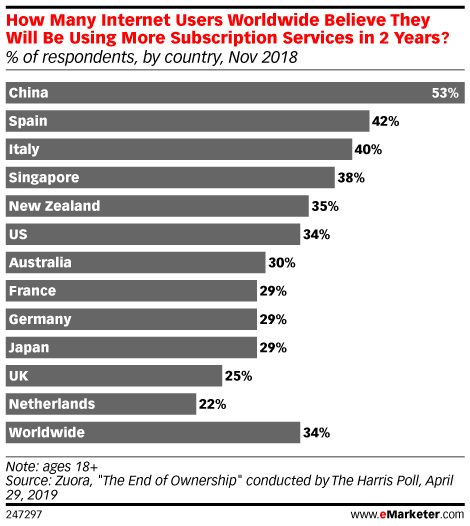
U.S. consumers are still embracing subscriptions. More than a third (34%) of Americans say they believe they’ll increase the number of subscription services they use over the next two years, according to a new report from eMarketer. This is following an increase to 3 subscription services on average, up from 2.4 services five years ago.

The report cited data from subscription platform Zuora and The Harris Poll in making these determinations.

The study also debunks the idea that we’ve reached a point of subscription fatigue.

While only a third is planning to increase the number of subscriptions — a figure that’s in line with the worldwide average — the larger majority of U.S. internet users said they planned to use the same number of subscriptions services within two years as they do now.

In other words, they’re not paring down their subscriptions just yet — in fact, only 7 percent said they planned to subscribe to fewer services in the two years ahead.

However, that’s both good news and bad news for the overall subscription industry. On the one hand, it means there’s a healthy base of potential subscribers for new services. But it also means that many people may only adopt a new subscription by dropping another — perhaps to maintain their current budget.

Subscriptions, after all, may still feel like luxuries. No one needs Netflix, Spotify, groceries delivered to their home or curated clothing selections sent by mail, for example. There are non-subscription alternatives that are much more affordable. The question is which luxuries are worth the recurring bill?

The survey, however, did not define subscription services, which could include news and magazine subscriptions, digital streaming services, subscription box services, and more. But it did ask about consumers’ interest in the various categories.

Over half of U.S. consumers (57%) said they were interested in TV and video-on-demand services (like Netflix) and 38 percent were interested in music services.

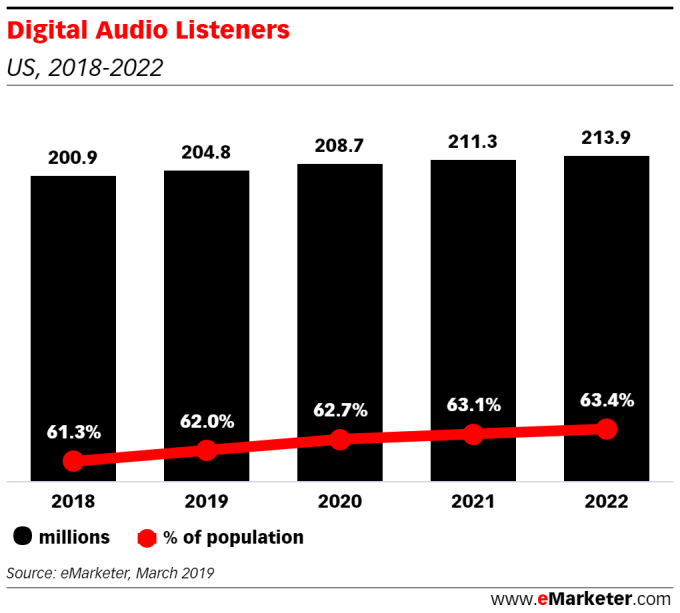
Related to this, eMarketer forecasts U.S. over-the-top video viewers will top 193 million by 2021, or 57.3 percent of the population. Digital audio listeners will top 211 million by the same time, or 63.1 percent of the population.

The next most popular subscriptions in the survey were grocery delivery like AmazonFresh (32%) and meal delivery like Blue Apron (21%). Software and storage services like iCloud and subscription beauty services like Ipsy followed, each with 17 percent.

Consumers were less interested in subscription news and information and subscription boxes — the latter only saw 10 percent interest, in fact.

The figures should be taken with a grain of salt, of course. The meal kit market is actually struggling. The consulting firm NPD Group estimated that only 4 percent of U.S. consumers have even tried them. So there’s a big disconnect between what consumers say they’re interested in, and what they actually do.

Meanwhile, the supposedly less popular news and information services market is, in some cases, booming. The New York Times, for instance, just this month posted a higher profit and added 223,000 digital subscribers to reach 4.5 million paying customers. And Apple now has “hundreds of people” working on Apple News+, it said this week. 

Of course, consumers will at some point reach a limit on the number of services they’re willing to pay for, but for the time being, the subscription economy appears solid.


These startups are locating in SF and Africa to win in global fintech

To become a global fintech player, locate your company in San Francisco and Africa.

That’s the approach of payments company Flutterwave, digital lending startup Mines, and mobile-money venture Chipper Cash—Africa-founded ventures that maintain headquarters in San Francisco and operations in Africa to tap the best of both worlds in VC, developers, clients, and the frontier of digital finance.

This arrangement wasn’t exactly coordinated across the ventures, but TechCrunch coverage picked up the trend and some common motives among these rising fintech firms.

Founded in 2016 by Nigerians Iyinoluwa Aboyeji and Olugbenga Agboola, Flutterwave has positioned itself as a global B2B payments solutions platform for companies in Africa to pay other companies on the continent and abroad.

Clients can tap its APIs and work with Flutterwave developers to customize payments applications. Existing customers include Uber,  Facebook,  Booking.com and African e-commerce unicorn Jumia.com.

The Y-Combinator backed company is headquartered in San Francisco, runs its operations center in Nigeria, and plans to add offices in South Africa and Cameroon.

Flutterwave opened an office in Uganda in June and raised a $10 million Series A round in October. The company also plugged into ledger activity in 2018, becoming a payment processing partner to the Ripple and Stellar blockchain networks.

Google’s lead EU regulator opens formal privacy probe of its adtech

Google’s lead data regulator in Europe has opened a formal investigation into its processing of personal data in the context of its online Ad Exchange, TechCrunch has learnt.

This follows a privacy complaint pertaining to adtech’s real-timing bidding (RTB) system filed under Europe’s GDPR framework last year.

The statutory inquiry into Google’s adtech that’s being opened by the Irish Data Protection Commission (DPC), cites section 110 of Ireland’s Data Protection Act 2018, which means that the watchdog suspects infringement — and will now investigate its suspicions.

The DPC writes that the inquiry is “to establish whether processing of personal data carried out at each stage of an advertising transaction is in compliance with the relevant provisions of the General Data Protection Regulation, including the lawful basis for processing, the principles of transparency and data minimisation, as well as Google’s retention practices”.

We’ve reached out to Google for comment.

As we reported earlier this week complaints about the RTB system used by online advertisers have been stacking up across Europe.

The relevant complaint in this instance was lodged last fall by Dr Johnny Ryan of private browser Brave, and alleges “wide-scale and systemic breaches of the data protection regime” by Google and others in the behavioral advertising industry.

Where Google is concerned the complaint focuses on its DoubleClick/Authorized Buyers ad system.

In a nutshell, the RTB complaints argue the system is inherently insecure — and that’s incompatible with GDPR’s requirement that personal data is processed “in a manner that ensures appropriate security”.

Commenting on the Irish DPC opening an inquiry in a statement, Ryan said: “Surveillance capitalism is about to become obsolete. The Irish Data Protection Commission’s action signals that now — nearly one year after the GDPR was introduced — a change is coming that goes beyond just Google. We need to reform online advertising to protect privacy, and to protect advertisers and publishers from legal risk under the GDPR”.

Similar complaints against RTB have been filed in the UK, Poland, Spain, Belgium, Luxembourg and the Netherlands.

Ireland is leading the investigation of Google’s adtech as the company designates Google Ireland as the data controller for EU users.

Daily Crunch: New MacBook Pros have a keyboard fix

The Daily Crunch is TechCrunch’s roundup of our biggest and most important stories. If you’d like to get this delivered to your inbox every day at around 9am Pacific, you can subscribe here.

1. Apple announces new MacBook Pros with a keyboard fix, oh, and more powerful processors

Apple says it’s taking three steps to remedy the keyboard situation: It will be making a materials change to the MacBook Pro keyboard mechanism, it’s covering all butterfly keyboards across its notebook line in its Keyboard Service program and it’s improving the repair process in Apple Stores to make things faster.

The new laptops have more to offer than improved keyboards: Apple says the 15-inch MacBook Pro will run at double the speed of the previous quad-core models.

2. TransferWise now valued at $3.5B following a new $292M secondary round

While this is a secondary round (so no new cash is entering the TransferWise balance sheet), previous investors aren’t exiting — in fact, Andreessen Horowitz and Baillie Gifford are actually doubling down.

3. ARM halts Huawei relationship following US ban

The dominoes continue to fall for Huawei in the wake of a Trump-led U.S. trade ban.

4. Google says some G Suite user passwords were stored in plaintext since 2005

The search giant disclosed the exposure Tuesday but declined to say exactly how many enterprise customers were affected.

5. London’s Tube network to switch on Wi-Fi tracking by default in July

Transport for London writes that “secure, privacy-protected data collection will begin on July 8” — while touting additional services, such as improved alerts about delays and congestion, which it frames as “customer benefits,” as expected to launch “later in the year.”

6. Apple has a plan to make online ads more private

By taking the identifiable person out of the equation, Apple says its new technology can help preserve user privacy without reducing the effectiveness on ad campaigns.

7. The Exit: Getaround’s $300M roadtrip

Last month, Getaround acquired Parisian peer-to-peer car rental service Drivy. For more details about what lies ahead for Drivy and the Paris startup scene, we spoke to Alven Capital partner Jeremy Uzan, who first invested in Drivy’s seed round in 2013. (Extra Crunch membership required.)

Amazon shareholders reject facial recognition sale ban to governments

Amazon shareholders have rejected two proposals that would have requested the company not to sell its facial recognition technology to government customers.

The breakdown of the votes is not immediately known. A filing with the vote tally is expected later this week.

The first proposal would have requested Amazon to limit the sale of its Rekognition technology to police, law enforcement and federal agencies. A second resolution would have demanded an independent human and civil rights review into the use of the technology.

It followed accusations that the technology has bias and inaccuracies, which critics say can be used to racially discriminate against minorities.

The votes were non-binding, allowing the company to reject the outcome of the vote.

But the vote was almost inevitably set to fail. Following his divorce, Amazon founder and chief executive Jeff Bezos retains 12 percent of the company’s stock as well as the voting rights in his ex-wife’s remaining stake. The company’s top four institutional shareholders, including The Vanguard Group, Blackrock, FMR and State Street, collectively hold about the same amount of voting rights as Bezos.

The resolutions failed despite an effort by the ACLU to back the measures, which the civil liberties group accused the tech giant of being “non-responsive” to privacy concerns.

In remarks, Shankar Narayan, ACLU of Washington, said: “The fact that there needed to be a vote on this is an embarrassment for Amazon’s leadership team. It demonstrates shareholders do not have confidence that company executives are properly understanding or addressing the civil and human rights impacts of its role in facilitating pervasive government surveillance.”

“While we have yet to see the exact breakdown of the vote, this shareholder intervention should serve as a wake-up call for the company to reckon with the real harms of face surveillance and to change course,” he said.

The civil liberties group rallied investors ahead of the Wednesday annual meeting in Seattle, where the tech giant has its headquarters. In a letter, the group said the sale of Amazon’s facial recognition tech to government agencies “fundamentally alters the balance of power between government and individuals, arming governments with unprecedented power to track, control, and harm people.”

“As shown by a long history of other surveillance technologies, face surveillance is certain to be disproportionately aimed at immigrants, religious minorities, people of color, activists, and other vulnerable communities,” the letter added.

The ACLU said investors and shareholders had the power “to protect Amazon from its own failed judgment.”

Amazon pushed back against claims that the technology is inaccurate, and called on the U.S. Securities and Exchange Commission to block the shareholder proposal prior to its annual shareholder meeting. The government agency blocked Amazon’s efforts to stop the vote, amid growing scrutiny of its product.

Amazon spokesperson Lauren Lynch said on Tuesday, prior to the meeting, that the company operates “in line with our code of conduct which governs how we run our business and the use of our products.”

An email to the company following Wednesday’s meeting was unreturned at the time of writing.

Read more:

DuckDuckGo founder Gabriel Weinberg is coming to Disrupt

2019 is the year Facebook announced a ‘pivot to privacy’. At the same time, Google is trying to claim that privacy means letting it exclusively store and data-mine everything you do online. So what better time to sit down at Disrupt for a chat about what privacy really means with DuckDuckGo founder and CEO Gabriel Weinberg?

We’re delighted to announce that Weinberg is joining us at Disrupt SF (October 2-4).

The pro-privacy search engine he founded has been on a mission to shrink the shoulder-surfing creepiness of Internet searching for more than a decade, serving contextual keyword-based ads, rather than pervasively tracking users to maintain privacy-hostile profiles. (If you can’t quite believe the decade bit; here’s DDG’s startup Elevator Pitch — which we featured on TC all the way back in 2008.)

It’s a position that looks increasingly smart as big tech comes under sharper political and regulatory scrutiny on account of the volume of information it’s amassing. (Not to mention what it’s doing with people’s data.)

Despite competing as a self-funded underdog against the biggest tech giants around, DuckDuckGo has been profitable and gaining users at a steady clip for years. It also recently took in a chunk of VC to capitalize on what its investors see as a growing international opportunity to help Internet users go about their business without being intrusively snooped on. Which makes a compelling counter narrative to the tech giants.

In more recent developments it has added a tracker blocker to its product mix — and been dabbling in policy advocacy — calling for a revival of a Do Not Track browser standard, after earlier attempts floundered with the industry, failing to reach accord.

The political climate around privacy and data protection does look to be pivoting in such a way that Do Not Track could possibly swing back into play. But if — and, yes it’s a big one — privacy ends up being a baked in Internet norm how might a pioneer like DuckDuckGo maintain its differentiating edge?

While, on the flip side, what if tech giants end up moving in on its territory by redefining privacy in their own self-serving image? We have questions and will be searching Weinberg for answers.

There’s also the fact that many a founder would have cut and run just half a decade into pushing against the prevailing industry grain. So we’re also keen to mine his views on entrepreneurial patience, and get a better handle on what makes him tick as a person — to learn how he’s turned a passion for building people-centric, principled products into a profitable business.

Disrupt SF runs October 2 – October 4 at the Moscone Center in San Francisco. Tickets are available here.

https://tcprotectedembed.com/protected-iframe/661cf9b1b8f85f5aae09b8946cafadba

( function() {
var func = function() {
var iframe = document.getElementById(‘wpcom-iframe-661cf9b1b8f85f5aae09b8946cafadba’)
if ( iframe ) {
iframe.onload = function() {
iframe.contentWindow.postMessage( {
‘msg_type’: ‘poll_size’,
‘frame_id’: ‘wpcom-iframe-661cf9b1b8f85f5aae09b8946cafadba’
}, “https:\/\/tcprotectedembed.com” );
}
}

// Autosize iframe
var funcSizeResponse = function( e ) {

var origin = document.createElement( ‘a’ );
origin.href = e.origin;

// Verify message origin
if ( ‘tcprotectedembed.com’ !== origin.host )
return;

// Verify message is in a format we expect
if ( ‘object’ !== typeof e.data || undefined === e.data.msg_type )
return;

switch ( e.data.msg_type ) {
case ‘poll_size:response’:
var iframe = document.getElementById( e.data._request.frame_id );

if ( iframe && ” === iframe.width )
iframe.width = ‘100%’;
if ( iframe && ” === iframe.height )
iframe.height = parseInt( e.data.height );

return;
default:
return;
}
}

if ( ‘function’ === typeof window.addEventListener ) {
window.addEventListener( ‘message’, funcSizeResponse, false );
} else if ( ‘function’ === typeof window.attachEvent ) {
window.attachEvent( ‘onmessage’, funcSizeResponse );
}
}
if (document.readyState === ‘complete’) { func.apply(); /* compat for infinite scroll */ }
else if ( document.addEventListener ) { document.addEventListener( ‘DOMContentLoaded’, func, false ); }
else if ( document.attachEvent ) { document.attachEvent( ‘onreadystatechange’, func ); }
} )();

Invites are out for Apple’s June 3 WWDC keynote — there will be unicorns

Apple’s WWDC keynote invites just went out, with only a couple of weeks to spare. The company’s graphic designers appear to be having some fun this time out, with a mind-blown rainbow unicorn, losing the Apple, Swift and App Store icons among others.

iOS 13, watchOS 6 and macOS 10.15 are no doubt on the books for this year’s event. I’d anticipate a lot more from the Apple TV side of things as well, in the wake of the big event earlier in the year.

Last year’s big show was completely devoid of hardware, though that could certainly change. Apple’s interestingly been in the habit of announcing small releases just ahead of its big shows this year, and that continues with this week’s announcement of new MacBook Pros with faster processors and, more importantly, updated keyboards.

The big show starts at 10AM PT on June 3. We’ll be there — though I’m still trying to get my colleagues to bring their unicorn onesies. I’ll keep you posted.