Reserve your demo table for TC Sessions: Mobility 2019

Early-stage startup ingenuity is one of the driving forces shaping the rapid, radical changes taking place in mobility and transportation. Come July 10, TechCrunch will host more than 1,000 movers, shakers and makers in San Jose for TC Sessions: Mobility 2019 for a day-long exploration of the technologies and challenges upending both industries.

Talk about a targeted audience. It’s the perfect place and opportunity to strut your startup stuff. Simply book a demo table to position your company in front of some of the most influential founders, investors, technologists and media. Networking made simple. You’re welcome.

TC Sessions: Mobility is jam-packed with speakers, workshops and demos that showcase an astounding range of topics, technologies, products and insight. We’ll dig deep into the future of transportation and mobility — including new and once-unimaginable technologies that lie ahead. We’ll cover the promises, the problems and the potential. And don’t worry, we’ll cover early-stage startup investing, too.

This lineup strikes a balance between industry powerhouses and smaller, but no less innovative teams working on the forefront. Here’s just a sample of what you can expect to enjoy:

  • Will Venture Capital Drive the Future of Mobility? Michael Granoff (Maniv Mobility), Ted Serbinski (Techstars) and Sarah Smith (Bain Capital) will debate the uncertain future of mobility tech and whether VC dollars are enough to push the industry forward.
  • Delivering the Future with Dave Ferguson. We’ll talk with Nuro co-founder Dave Ferguson to hear all about the strengths and challenges of building a self-driving vehicle with a focus on local deliveries like groceries, food and retail goods.
  • Demo with Jay Giraud. Damon Motorcycles CEO and founder Jay Giraud will bring a motorcycle onstage to demonstrate the company’s rider protection system that combines radar, camera and other sensors to track the speed, direction and velocity of up to 64 objects at a time.

That’s just a taste, but you can see even more at the TC Sessions: Mobility agenda. Keep in mind there are still a few surprise guests to be announced in the next month, so be sure to check back.

TC Sessions: Mobility 2019 takes place July 10 in San Jose, Calif. Don’t miss a prime opportunity to place your early-stage startup in front of influential change agents. Book a demo table today, while you still can. Can’t wait to see what you bring to San Jose!

Looking for sponsorship opportunities? Contact the TechCrunch team to learn about the benefits associated with sponsoring TC Sessions: Mobility 2019.

N26 faces banking regulator order about fraudulent transactions

Fintech startup N26 received an order from BaFin, the German banking regulator. According to the regulator, N26 hasn’t been doing enough when it comes to money laundering and terrorist financing. The company has a specific period of time to implement changes and rectify its internal processes.

“Today, BaFin published an order for N26 Bank GmbH. An order is an instruction from them to improve processes within a certain time frame. The order requires us to optimize existing processes to prevent money laundering and increase N26 staffing levels,” the company says in a blog post.

A few articles have highlighted a handful of cases of fraud in recent weeks. Customers tried to use N26 for money-laundering purposes. It took some time before N26 reacted and closed those accounts.

It’s not that surprising given that literally every bank suffers from this issue. For instance, all the big French banks (BNP Paribas, Société Générale, Crédit Agricole and Crédit Mutuel) have been fined in the past for the same reason.

Banking regulators don’t review suspicious transactions directly. They make sure that banks have the right processes and teams to catch the vast majority of suspicious transactions.

As N26 has more than 2.5 million users, it’s been hard to scale its workforce appropriately. In other words, it has been short-staffed. In recent months, the company has been hiring customer support and anti-money laundering teams like crazy, by hiring more people directly and signing deals with subcontractors.

BaFin asks N26 to catch up with its backlog of flagged transactions. The company plans to be done by the end of next week. BaFin also wants to see written descriptions of processes and workflows. Finally, the regulator says that N26 should recheck the identity of some customers and redo the KYC process (“know your customer”). N26 says that it plans to implement BaFin’s requirements before the deadline.

Creating a startup is hard, but creating a bank with startup-like growth is even harder. Banking regulation is tough, and it’s a good thing for N26 customers that BaFin is keeping an eye out. Let’s hope that today’s order is just a bump in the road.

Google’s new look for mobile search results puts site owners and publishers first

Google today unveiled a new look for its mobile search results which gives sites a way to showcase their own branding, instead of looking like every other blue link. Before, the search results were blue and the source — a publisher’s site, for example — would appear below in a smaller, green font. Now, it’s the publisher who gets top billing. With the refresh, the source for the search result appears on top and includes the site’s own icon.

The revamp is subtle, but one that will likely please publishers as it gives them a way to stand out. After all, web searchers who are already familiar with the publisher’s site may choose to click through (or rather, tap through) to their link out of a personal preference — even if it’s further down on the results page.

In addition, the website branding can help web searchers better understand where the information is coming from — like an official site or well-known news publication, for example.

The update also impacts how Google Search ads appear.

Before, the word “Ad” would display in a small green box ahead of the source link. Now, the word “Ad” appears in a bolded, black font where the website icon would otherwise be. In a way, it’s a bit noticeable that the top search results link is an ad because your eyes are drawn to the blue link — and because the word “Ad” no longer has a box around it.

Google says the new design will help it prepare for the search changes ahead as it enables the company to add more action buttons and previews to the search result cards, while still retaining attribution back to the source.

The company recently announced some of its plans for new search features at Google I/O earlier this month, including AR in search results, as well as better news coverage and support for podcast search. The latter will offer links to listen right in the search results as well as tools to save the podcast to play later.

In the meantime, site owners and publishers who want to customize their icon for their organic search listings can do so here.

Google says this new design is rolling out first to mobile users over the next few days.

Thousands of vulnerable TP-Link routers at risk of remote hijack

Thousands of TP-Link routers are vulnerable to a bug that can be used to remotely take control the device, but it took over a year for the company to publish the patches on its website.

The vulnerability allows any low-skilled attacker to remotely gain full access to an affected router. The exploit relies on the router’s default password to work, which many don’t change.

In the worst case scnario, an attacker could target vulnerable devices on a massive scale, using similar mechanism to how botnets like Mirai worked — by scouring the web and hijacking routers using default passwords like “admin” and “pass”.

Andrew Mabbitt, founder of U.K. cybersecurity firm Fidus Information Security, first discovered and disclosed the remote code execution bug to TP-Link in October 2017. TP-Link released a patch a few weeks later for the vulnerable WR940N router, but Mabbitt warned TP-Link again in January 2018 that another router, TP-Link’s WR740N, was also vulnerable to the same bug because the company reused vulnerable code between devices.

TP-Link said the vulnerability was quickly patched in both routers. But when we checked, the firmware for WR740N wasn’t available on the website.

When asked, a TP-Link spokesperson said the update was “currently available when requested from tech support,” but wouldn’t explain why. Only after TechCrunch reached out, TP-Link updated the firmware page to include the latest security update.

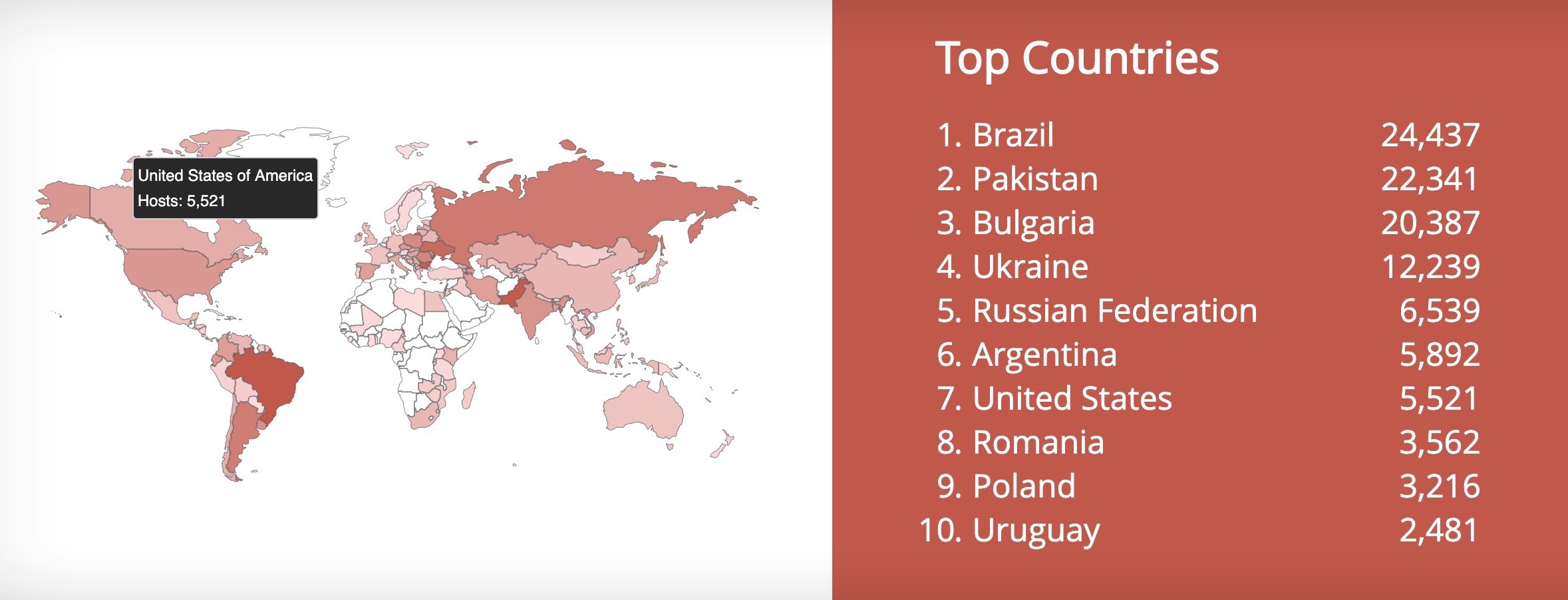
Top countries with vulnerable WR740N routers. (Image: Shodan)

Routers have long been notorious for security problems. At the heart of any network, any flaw affecting a router can have disastrous effects on every connected device. By gaining complete control over the router, Mabbitt said an attacker could wreak havoc on a network. Modifying the settings on the router affects everyone who’s connected to the same network, like altering the DNS settings to trick users into visiting a fake page to steal their login credentials.

TP-Link declined to disclose how many potentially vulnerable routers it had sold, but said that the WR740N had been discontinued a year earlier in 2017. When we checked two search engines for exposed devices and databases, Shodan and Binary Edge, each suggested there are anywhere between 129,000 and 149,000 devices on the internet — though the number of vulnerable devices is likely far lower.

Mabbitt said he believed TP-Link still had a duty of care to alert customers of the update if thousands of devices are still vulnerable, rather than hoping they will contact the company’s tech support.

Both the U.K. and the U.S. state of California are set to soon require companies to sell devices with unique default passwords to prevent botnets from hijacking internet-connected devices at scale and using their collective internet bandwidth to knock websites offline.

The Mirai botnet downed Dyn, a domain name service giant, which knocked dozens of major sites offline for hours — including Twitter, Spotify and SoundCloud.

Read more:

Now at Google, Facebook’s former teen-in-residence launches new social game Emojishot

Facebook’s former teen-in-residence Michael Sayman, now at Google, is back today with the launch of a new game: Emojishot, an emoji-based guessing game for iOS, built over the past ten weeks within Google’s in-house incubator, Area 120.

The game, which is basically a version of charades using emoji characters, is notable because of its creator.

By age 17, Sayman had launched five apps and had become Facebook’s youngest-ever employee. Best known for his hit game 4 Snaps, the developer caught Mark Zuckerberg’s eye, earning him a demo spot on stage at Facebook’s F8 conference. While at Facebook, Sayman built Facebook’s teen app Lifestage — a Snapchat-like standalone project which allowed the company to explore new concepts around social networking aimed at a younger demographic.

Lifestage was shut down two years ago, and Sayman defected to Google shortly afterward. At Google, he was rumored to be heading up an internal social gaming effort called Arcade where gamers played using accounts tied to their phone numbers — not a social network account.

At the time, HQ Trivia was still a hot title, not a novelty from a struggling startup — and the new gaming effort looked liked Google’s response. However, Arcade has always been only an Area 120 project, we understand.

To be clear, that means it’s not an official Google effort — as an Area 120 project, it’s not associated with any of Google’s broader efforts in gaming, social or anything else. Area 120 apps and services are instead built by small teams who are personally interested in pursuing an idea. In the case of Emojishot, it was Sayman’s own passion project.

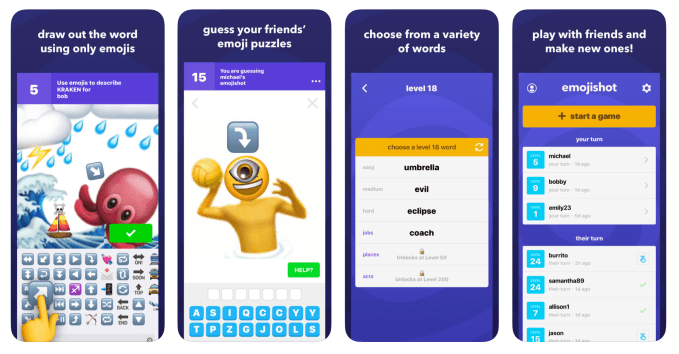
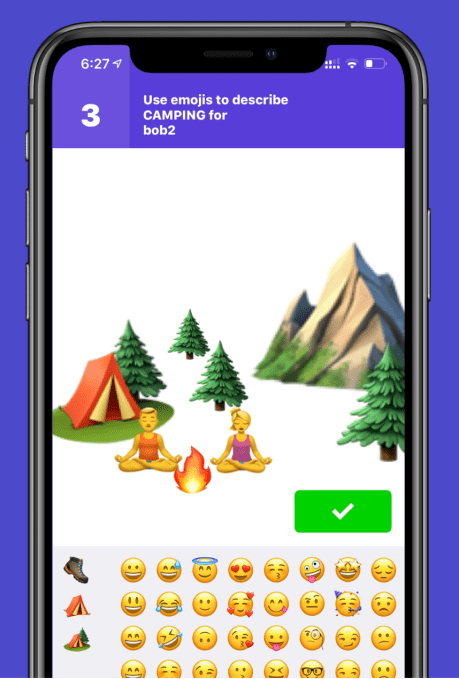
Emojishot itself is meant to be played with friends, who take turns using emoji to create a picture so friends can guess the word. For example, the game’s screenshots show the word “kraken” may be drawn using an octopus, boat and arrow emojis. The emojis are selected from a keyboard below and can be resized to create the picture. This resulting picture is called the “emojishot,” and can also be saved to your Camera Roll.

Players can pick from a variety of words that unlock and get increasingly difficult as you successfully progress through the game. The puzzles can also be shared with friends to get help with solving, and there’s a “nudge” feature to encourage a friend to return to the game and play.

According to the game’s website, the idea was to make a fun game that explored emojis as art and a form of communication.



Unfortunately, we were unable to test it just yet, as the service wasn’t up-and-running at the time of publication. (The game is just now rolling out so it may not be fully functional until later today).

While there are other “Emoji Charades” games on the App Store, the current leading title is aimed at playing with friends at a party on the living room TV, not on phones with friends.

Sayman officially announced Emojishot today, noting his efforts at Area 120 and how the game came about.

“For the last year, I’ve been working in Area 120, Google’s workshop for experimental products. I’ve been exploring and rapidly prototyping a bunch of ideas, testing both internally and externally,” he says. “Ten weeks ago, we came up with the idea for an emoji-based guessing game. After a lot of testing and riffing on the idea, we’re excited that the first iteration — Emojishot — is now live on the iOS App Store…We’ve had a lot of fun with it and are excited to open it up to a wider audience,” Sayman added.

He notes that more improvements to the game will come over time, and offered to play with newcomers via his username “michael.”

The app is available to download from the U.S. iOS App Store here. An Android waitlist is here.


DJI is adding receivers to help drones avoid plane and helicopter collisions

At an event in Washington D.C. today, DJI unveiled plans to help avoid potentially life-threatening drone disasters. At the top of the list is the company’s promise to add AirSense technology to all of its models weighing more than 250 grams (~half a pound), which goes into effect January 1 of next year.

The feature senses Automatic Dependent Surveillance-Broadcast (ADS-B) signals, alerting the drone pilot if the system is within range of a helicopter or airplane. The technology is transmitted from aircrafts, capable of being detected miles away — well before the drone pilot on the ground. DJI says this is the largest deployment of ADS-B to date.

The addition of ADS-B receiver follows a number of drone-related issues are around airports, including January’s Heathrow closure after one was sighted near its runways. The explosion of drone ownership has left many governments scrambling to enact laws aimed at avoid close calls.

It’s the first of a ten-point plan the drone giant is enlisted, designed to help maintain drone safety. The full list is as follows,

  1. DJI will install ADS-B receivers in all new drones above 250 grams

  2. DJI will develop a new automatic warning for drone pilots flying at extended distances

  3. DJI will establish an internal Safety Standards Group to meet regulatory and customer expectations

  4. Aviation industry groups must develop standards for reporting drone incidents

  5. All drone manufacturers should install geofencing and remote identification

  6. Governments must require remote identification

  7. Governments must require a user-friendly knowledge test for new drone pilots

  8. Governments must clearly designate sensitive restriction areas

  9.  Local authorities must be allowed to respond to drone threats that are clear and serious

  10.   Governments must increase enforcement of laws against unsafe drone operation

DJI is being understandably proactive here. The company will no doubt be under scrutiny as the major player in the consumer drone space. The above list manages to split the work between drone manufactures and governments. Of course, adhering to this will also be in the hands of the drone pilots themselves.

ARM halts Huawei relationship following US ban

The dominoes continue to fall for Huawei in the wake of a Trump-led U.S. trade ban. An internal memo from ARM lays out the chip giant’s decision to hit pause on “all active contracts, support entitlements, and any pending engagements,” per the BBC.

While based in Cambridge, England, the company believes itself to be impacted by the trade issue due to its use of technology originating in the States. The move is just another indication of how complex the issue of extracting U.S.-based technology from these devices will ultimately be. If upheld, many believe it could ultimately doom Huawei.

Huawei offered TechCrunch a fairly standard response to the news, once again chalking things up to politics. “We value our close relationships with our partners, but recognize the pressure some of them are under, as a result of politically motivated decisions,” it wrote. “We are confident this regrettable situation can be resolved and our priority remains to continue to deliver world-class technology and products to our customers around the world.”

Google was among the first to respond to Huawei’s inclusion on the U.S. Department of Commerce’s “Entity” trade blacklist, pulling support for Android. Other partners, including Microsoft have remained largely silent on the matter.

Meet Projector, collaborative design software for the Instagram age

Mark Suster of Upfront Ventures bonded with Trevor O’Brien in prison. The pair, Suster was quick to clarify, were on site at a correctional facility in 2016 to teach inmates about entrepreneurship as part of a workshop hosted by Defy Ventures, a nonprofit organization focused on addressing the issue of mass incarceration.

They hit it off, sharing perspectives on life and work, Suster recounted to TechCrunch. So when O’Brien, a former director of product management at Twitter, mentioned he was in the early days of building a startup, Suster listened.

Three years later, O’Brien is ready to talk about the idea that captured the attention of the Bird, FabFitFun and Ring investor. It’s called Projector.

It’s the brainchild of a product veteran (O’Brien) and a gaming industry engineer turned Twitter’s vice president of engineering (Projector co-founder Jeremy Gordan), a combination that has given way to an experiential and well-designed platform. Projector is browser-based, real-time collaborative design software tailored for creative teams that feels and looks like a mix of PowerPoint, Google Docs and Instagram . Though it’s still months away from a full-scale public launch, the team recently began inviting potential users to test the product for bugs.

We want to reimagine visual communication in the workplace by building these easier to use tools and giving creative powers to the non-designers who have great stories to tell and who want to make a difference,” O’Brien told TechCrunch. “They want change to happen and they need to be empowered with the right kinds of tools.”

Today, Projector is a lean team of 13 employees based in downtown San Francisco. They’ve kept quiet since late 2016 despite closing two rounds of venture capital funding. The first, a $4 million seed round, was led by Upfront’s Suster, as you may have guessed. The second, a $9 million Series A, was led by Mayfield in 2018. Hunter Walk of Homebrew, Jess Verrilli of #Angels and Nancy Duarte of Duarte, Inc. are also investors in the business, among others.

O’Brien leads Projector as chief executive officer alongside co-founder and chief technology officer Gordon. Years ago, O’Brien was pursuing a PhD in computer graphics and information visualization at Brown University when he was recruited to Google’s competitive associate product manager program. He dropped out of Brown and began a career in tech that would include stints at YouTube, Twitter, Coda and, finally, his very own business.

O’Brien and Gordan crossed paths at Twitter in 2013 and quickly realized a shared history in the gaming industry. O’Brien had spent one year as an engineer at a games startup called Mad Doc Software, while Gordon had served as the chief technology officer at Sega Studios. Gordan left Twitter in 2014 and joined Redpoint Ventures as an entrepreneur-in-residence before O’Brien pitched him on an idea that would become Projector.

Projector co-founders Jeremy Gordan (left), Twitter’s former vice president of engineering, and Trevor O’Brien, Twitter’s former director of product management

“We knew we wanted to create a creative platform but we didn’t want to create another creative platform for purely self-expression, we wanted to do something that was a bit more purposeful,” O’Brien said. “At the end of the day, we just wanted to see good ideas succeed. And with all of those good ideas, succeeding typically starts with them being presented well to their audience.”

Initially, Projector is targeting employees within creative organizations and marketing firms, who are frequently tasked with creating visually compelling presentations. The tool suite is free for now and will be until it’s been sufficiently tested for bugs and has fully found its footing. O’Brien says he’s not sure just yet how the team will monetize Projector, but predicts they’ll adopt Slack’s per user monthly subscription pricing model.

As original and user-friendly as it may be, Projector is up against great competition right out of the gate. In the startup landscape, it’s got Canva, a graphic design platform valued at $2.5 billion earlier this week with a $70 million financing. On the old-guard, it’s got Adobe, which sells a widely used suite of visual communication and graphic design tools. Not to mention Prezi, Figma and, of course, Microsoft’s PowerPoint, which is total crap but still used by millions of people.

There are many tools scratching at the surface, but there’s not one visual communications tool that wins them all,” Suster said of his investment in Projector.

Projector is still in its very early days. The company currently has just two integrations: Unsplash for free stock images and Giphy for GIFs. O’Brien would eventually like to incorporate iconography, typography and sound to liven up Projector’s visual presentation capabilities.

The ultimate goal, aside from generally improving workplace storytelling, is to make crafting presentations fun, because shouldn’t a corporate slideshow or even a startup’s pitch be as entertaining as scrolling through your Instagram feed?

“We wanted to try to create something that doesn’t feel like work,” O’Brien said.

KaiOS raises $50M more, hits 100M handsets powered by its feature phone OS

While Android and iOS have locked up the market for smartphone operating systems, a feature phone platform that has the distinction of being the world’s third biggest mobile OS is announcing a hefty round of funding to continue its expansion. KaiOS, which makes the OS that powers devices like Nokia’s feature phones and Jio’s devices out of India, has raised $50 million from Cathay Innovation (which led the round) and previous investors Google and TCL Holdings.

The funding takes the total raised by KaiOS — which has now shipped 100 million devices across 100 countries — to $72 million. It comes less than a year after Google invested $22 million in the the business — a strategic round that also marked KaiOS beginning the process of creating native integrations of different Google services like Maps and (more recently) Assistant into the platform.

KaiOS is not disclosing its valuation but Sebastien Codeville, its CEO, confirmed to be that it is “definitely up.” (Pitchbook put it at a very modest $43.75 million last year on the back of Google’s earlier round.)

We actually knew a little about this round back in February, at MWC in Barcelona, when KaiOS announced new handset partners and a raft of new features. A spokesperson for KaiOS told TechCrunch that the delay in closing the deal and making it public was due to a need to coordinate with different stakeholders.

As it turned out, KaiOS’s timing for this announcement turned out to be pretty interesting. The big news this week in mobile is what kind of an impact Huawei will face in the wake of a US regulation barring it from  doing business in the US. One development in that story has been just how serious Huawei is about building its own operating system to replace Google’s Android and its related services.

This is big news because while Huawei is currently the world’s second-biggest mobile phone maker, we haven’t seen any platform gain reasonable mobile phone traction against the hegemony of iOS and Android outside of China — including the failure of Firefox OS, which retreated from the market only to reemerge, phoenix-like, as KaiOS two years ago — in part because of the extensive ecosystems that have coalesced around these two.

But while all eyes are on smartphones, KaiOS’s funding and general growth represents an interesting alternative for markets, carriers and consumers that might be in the market for what KaiOS refers to as “smart feature phones.”

Today, the company counts companies like Reliance Jio, Google, Facebook, Twitter, Orange, MTN and Qualcomm among its partners, and it’s been building an interesting, two-pronged strategy for targeting people both in developed and developing markets.

As Sebastien Codeville, the CEO of KaiOS, describes it, in emerging markets (which are KaiOS’s primary target), its devices are being purchased by first-time phone users, or those that have had very basic, non-data mobile phones and are upgrading without the big step and expense of smartphones. “We are bringing people to internet usage with a device they are familiar with,” he said of the form factor. “Other key characteristics are a long battery life, a keyboard, and a more resistant touch panel.”

The developed market, he added, was an interesting opportunity because of the amount of professionals and others who want pared-down devices for weekend use to unplug from their daily grind.

Many had left feature phones for dead with the growth in popularity of devices like the iPhone, app stores and of course apps themselves. But research from Counterpoint found that feature phones still accounted for almost 25 percent of all handset shipments in Q3 of last year, working out to a $28 billion dollar market opportunity in the years ahead. Today there are some 1.5 billion feature phone users, an interesting number to consider as smartphone sales continue to feel the crunch. 

Roku launches new ad tool to compare linear and streaming audiences

Roku has been getting more serious about its ad business, and today it’s launching a new tool designed to make advertisers comfortable with moving their spending over from traditional TV.

Alison Levin, Roku’s vice president of ad sales and strategy, pointed to data from Magna Global estimating that while over-the-top viewing accounts for 29 percent of all TV watch time, it only represents 3 percent of TV ad budgets. She argued that this is a wasted opportunity for advertisers because they’re struggling to reach cord-cutters and “light TV viewers.”

Why is ad spend lagging? The problem, Levin said, is “a lack of tools to understand that shift.”

“Streaming is mainstream — brands need to shift to OTT to become whole again and find the consumers they’ve lost on linear,” she said. “Roku as a platform is really uniquely positioned to solve this problem. We do understand and know the viewership pattern of the largest streaming platforms, which allows us to not only help brands find an audience, but also understand the landscape.”

The company’s new Activation Insights tool uses data from Roku’s 29 million users to determine the audience that an advertiser is already reaching through linear TV, plus the additional audience that it could be reaching by advertising on OTT and therefore the optimal ad spend on the Roku ad platform (which includes the ad-supported Roku Channel and other apps).

For example, the company says it’s already found that 86 percent of viewers between the ages of 18 and 49 who saw a Baskin Robbins ad on Roku had not seen the ad on linear TV, leading to 10.6 percent incremental reach. Meanwhile, 81 percent of viewers between 25 and 54 who saw a RE/MAX ad on Roku had not seen the ad on linear TV, leading to 9.2 percent incremental reach.

When asked about advertisers who may want someone to independently verify Roku’s data, Levin said the company is “committed to working with third-party research partners.” However, those partners aren’t currently working on Activation Insights because “to date, there hasn’t necessarily been a third-party partner, a sophisticated partner [to help us] understand incremental and unduplicated reach.”