Select Bose smart speakers get Google Assistant

A week after Sonos added long-promised Google Assistant integration to a pair of speakers, Bose is following suit. The company’s bringing the popular smart home AI to a trio of existing models, the Home Speaker 500 and Soundbar 500 and 700. The forthcoming, pint-sized Home Speaker 300 will be hitting the market with the feature built in.

Like Sonos, you’ll get your standard array of Assistant queries, including music playback, Chromecast TV control and the ability to control connected home features like smart lighting. All of that will be accessible through the built-in speaker array. Like Sonos, the aforementioned speakers are also compatible with Alexa.

It’s clearly in the best interest of these third party manufacturers not to have to play sides. For Google and Amazon, it means bringing their respective smart home ecosystems to a pair of well-regarded brands. Also like Sonos, setup happens in the company’s music app, which means, unfortunately, that you won’t have the full suite of setup options you get with Google’s own Home speakers.

The upgrade is available starting today. Additional features, including news and podcasts are coming this summer. Ditto for the Home Speaker 300, which is arriving this summer.

As meal-kit melee stretches on, Sun Basket whips up $30M Series E

Sun Basket, a provider of a healthy meal delivery service, has raised another $30 million in venture capital funding. The round, led by PivotNorth Capital, brings the company’s total raised to $125 million.

The Series E funding delays Sun Basket’s expected initial public offering once again. There’s been unsubstantiated talk of a Sun Basket float for quite some time; in fact, before Blue Apron and Hello Fresh, a pair of fellow meal kit delivery businesses, completed IPOs, Sun Basket was the subject of exit rumors. Alas, we will have to wait a while longer before the company makes the big leap.

After all, Blue Apron has performed very poorly since going public on the New York Stock Exchange two years ago. Sun Basket chief executive has been honest about the difficulties of being a meal kit startup in a post-Blue Apron IPO universe, telling PitchBook his company’s Series D round “was by far the most challenging fundraise” in his company’s history.

Sun Basket, headquartered in San Francisco, was founded in 2014 by award-winning chefs Adam Zbar and Justine Kelly. The company delivers fresh, organic and sustainable ingredients to customers, setting itself apart from the large number of meal-kit providers active in the U.S. Its latest infusion of capital will be used to expand their offerings to include breakfast, lunch and dinner, “personalized for any lifestyle.”

“We’re thrilled to have the strong support of our investors who share our vision for building the leading personalized healthy eating platform,” CEO Zbar said in a statement. “Food is a $1T market ripe for online disruption, and Sun Basket will continue to innovate, focusing on our customers’ top three needs: health, ease, and personalization.”

Sun Basket says its growing fast. In its funding announcement, the business cited a compound annual growth rate of 80 percent over the last three years with “the best unit economics in the space.” Sapphire Ventures, August Capital, Founders Circle, Unilever Ventures, Baseline Ventures, Relevance Capital, Accolade Partners, and Correlation Ventures have also particiated in the round.

Despite known issues in the space, a tough path to profitabliity and high-profile failures (see ‘After Raising $125M, Munchery Fails To Deliver’), venture capital investors continue to make deals in the meal kit/ food delivery space. From large financings like DoorDash’s $400 million Series F to GrubMarket’s recent $25 million deal, food startups continue to attract investment.

Apple announces new MacBook Pros with more powerful processors and, yes, updated keyboards

Apple is updating its 15” MacBook Pro with new 8-core and 6-core generation processors and its 13” MacBook Pro with Touch Bar with 8th gen quad-core processors. Apple says that these boosts mean that the 15” MacBook Pro  will run at double the speed of the previous quad-core models and hit 40% improvements over the 6-core MacBook Pro model.

Apple says that this is its fastest Mac notebook ever.

Oh, and there is that keyboard update.

Speed bump

The $2,399 config of the 15-inch MacBook Pro is getting a 2.6GHz 6-core i7 that boosts to 4.5ghz, a 400 MHz increase in turbo speed. The top end $2,799 config is now standard with an 8-core i9, 2 more cores and 500 MHz increase over the current 6-core config.

The 13-inch MacBook Pro with Touch Bar gets boosted 2.4GHz quad-core processors, standard which will turbo boost to speeds up to 4.7GHz. The configure your own option gets a 200MHz bump, making it a full 2x faster from the dual-core 13”.

The speed boosts of the MacBook Pro and the keyboard changes come after a year of boosts for the flagship notebook. It got an update last July, a graphics update in October and now the i9 update. Amidst a shift in Apple’s business driven by smartphone market saturation, the Mac has continued to grow out-sized to the industry and still acts as a beachhead for Apple in many enterprise businesses.

The new MacBook Pro models will both be available for purchase today.

About the Keyboard

Apple also told me that it is making three announcements about the MacBook Pro keyboard situation. Unless you’ve been under a rock, you’re aware that the current generation of MacBook Pro (and MacBook Air) models have had issues with keys either not firing or firing twice, resulting in no letter or double letters typed. The industry term for this is ‘make or double make’.

Apple had recently revised the MacBook keyboards quietly with the addition of a membrane that seemed intended to prevent dust and particulates from making it under the keys and preventing firing. The updates, though seemingly improvements, still resulted in some malfunctions. And, Apple never really even said they were making the change.

Today, however, they told me that they’re taking three explicit steps to help with the keyboard situation.

  1. The MacBook Pro keyboard mechanism has had a materials change in the mechanism. Apple says that this new keyboard mechanism composition will substantially reduce the double type/no type issue. Apple will not specify what it has done, but doubtless tear-downs of the keyboard will reveal what has been updated.
  2. Though Apple believes that this change will greatly reduce the issue, it is also including all butterfly keyboards across its notebook line into its Keyboard Service Program. This means that current MacBook Pros and even the models being released today will have keyboard repairs covered at no cost, in warranty and out of warranty.
  3. Apple tells me that repair times for keyboards have been longer than they would like. It is making substantial improvements to repair processes in Apple Stores to make repairs faster for customers with issues.

If you bring a MacBook in with an older generation malfunctioning keyboard, it will be replaced with this new 4th-gen MacBook keyboard. So if you have an Air or a Pro that has issues, it will get the new mechanism.

As a note, the changes in the keyboards are ‘under the hood’, meaning that they are not intended to change the look or feel of the keyboard and should result in the same typing experience as current gen keyboards.

The popularity of the MacBook Pro has only been highlighted by the keyboard issues, as no one notices a flaw in their tools more than people who live and die by them. If Apple is able to finally put the issues of this current generation of keyboards to rest it will have plugged a potential hole in MacBook sales and given itself breathing room to introduce a full new generation of the machines.

This speed bump comes in advance of Apple’s WWDC conference where it is anticipated to launch iOS 13 and other software products for consumers and developers. Apple has, at times, used the stage to announce hardware improvements as well. Its decision to announce this speed bump and keyboard fix now could be a result of its desire to ‘clear the decks’ for announcements on stage at the conference, or a desire to address the keyboard fix ‘off air’ — or both.

WWDC is about a week and a bit away, and we’ll be there on the ground to bring you the updates from the scene.

Pro gamer Tfue files lawsuit against esports org over ‘grossly oppressive’ contract

Turner ‘Tfue’ Tenney, one of the world’s premier streamers and esports pros, has filed a lawsuit against esports organization Faze Clan over a ‘grossly oppressive, onerous and one-sided’ contract, according to THR.

The complaint alleges that Faze Clan’s Gamer Agreement relegates up to 80 percent of the streamer’s earnings from branded content (sponsored videos) to Faze Clan, and that the contract hinders Tfue from pursuing and earning money from sponsorship deals that Faze Clan hasn’t approved.

Tfue’s lawyer, Bryan Freedman of Freedman + Taitelman, took the complaint to the California Labor Commissioner with issues that span far beyond financial contracts. Freedman wrote that Faze Clan takes advantage of young artists and actually jeopardizes their health and safety, noting an incident where Tfue was allegedly pressured to skateboard in a video and injured his arm. Freedman also wrote that Faze Clan pressured Tfue to live in one of its homes where he was given alcohol before being 21 years old and encouraged to illegally gamble.

From the complaint:

In one instance, Tenney suffered an injury (a deep wound that likely required stitches) which resulted in permanent disfigurement. Faze Clan also encourages underage drinking and gambling in Faze Clan’s so-called Clout House and FaZe House , where Faze Clan talent live and frequently party. It is also widely publicized that Faze Clan has attempted to exploit at least one artist who is a minor.

Faze Clan issued the following statement on Twitter following the news:

https://platform.twitter.com/widgets.js

Faze Clan claims that it has taken no more than 20 percent of Tfue’s earnings from sponsored content, which amounts to a total of $60,000. The owner of Faze Clan, Ricky Banks, took to Twitter to make his case, showing the incredible growth of Tfue’s popularity across Twitch and YouTube since signing with Faze Clan.

https://platform.twitter.com/widgets.js

As it stands now, Tfue boasts more than 120 million views on Twitch, more than 10 million YouTube subscribers, and 5.5 million followers on Instagram.

Banks also reiterated Faze Clan’s official statement saying that the company has taken 20 percent of Tfue’s earnings from branded deals, totaling $60,000.

https://platform.twitter.com/widgets.js

The Tfue claim, however, seems to take issue with the content of the agreement, not necessarily its execution, and the general legality of these types of gamer agreements across the esports landscape. Moreover, the complaint alleges that Tfue lost potential earnings due to his agreement with Faze Clan and their own conflicts of interest with various brands interested in a sponsorship.

Investors just gave NFX $275 million more to fund seed-stage startups focused on ‘network effects’

It’s the worst kept secret in the world of startup funding. Series A rounds today are the equivalent of what used to be called Series B rounds. The checks are bigger, but so are the expectations around revenue and traction.

That shift has created more of a vacuum for seed-stage companies. While there are plenty of individuals willing to plug money into nascent startups, and no shortage of micro VC funds focused on them, there is a shortage of funds with the kind resources typically reserved for outfits that are picking up momentum. Think recruiting, HR, marketing, community building.

You might not think a budding company would need all of these pieces. But NFX, a now four-year-old, San Francisco-based investment fund, argues that they do. And toward that end, it has persuaded investors — foundations, endowments, and 50 individual investors — to provide it with $275 million in capital commitments for its second fund just one year after closing its debut fund with $150 million.

These investors seem to be buying into a number of things when it comes to NFX, which was originally founded as a kind of accelerator program for startups growing so-called network effects businesses. The idea, broadly, was that the more users a product has, the better the product becomes for future users.

Last year, NFX decided to ditch the accelerator piece and restructure as a more traditional venture firm. But its focus on network effects still very much defines the firm, largely because its founders have all created businesses that have grown via network effects in their own careers. Its three general partners — James Currier, Pete Flint, and Gigi Levy-Weiss — have been involved in the founding of the social network Tickle (sold to Monster.com in 2004), the home buyers’ site Trulia (which went public in 2012), the online travel site Lastminute.com (which sold to Sabre in 2005), and the social casino game publisher Playtika (acquired by a consortium in 2016).

Stad Chudnovsky, who cofounded NFX but is today an advisor (he’s a little busy as the Head of Product for Messaging at Facebook), meanwhile also helped build Tickle and he was more recently the VP of Growth and Global Strategy at PayPal.

Indeed, in addition to helping “get everything in place” for seed-stage startups (the recruiting, the HR), NFX says it also works closely with the startups it funds to figure out their network effects, or tweak their approach in some cases.

As one example, the firm was among the earliest investors in Outdoorsy, a fast-growing platform that allows customers to book the RVs or trucks of their owners. But Outdoorsy looked very different when it came to NFX. It wanted to create a two-sided marketplace. Cofounder Jeff Cavins, a serial entrepreneur, had already invested millions of dollars trying to figure it out. But Outdoorsy was initially focused on the adventurers who would use the platform; NFX helped the company recognize that it was really a supply-side marketplace and that it should develop a SaaS product for the supply side of the market, meaning the RV owners. From there, says Currier, “We came up with a plan about what features to build and how to roll it out.”

Currier says that NFX similarly helped another of its portfolio companies, Mammoth Biosciences, a two-year-old, San Francisco-based CRISPR-based platform for disease detection that looked dramatically different when its founders, Stanford PhD students, first met with NFX. Their initial idea was a kind of platform that would ensure through DNA testing that fish being sold is what it’s being claimed to be (as there’s a lot “imposter” fish being bought and sold every day).

But NFX met with the team every week and they collectively decided over time to look at another technology, CRISPR, the technique that allows scientists to make precision edits to any DNA but that also acts like a search engine for nucleic acids, which has many business applications. In fact, with NFX’s help, the founders decided to go after diagnostics and therapeutics and to develop a kind a two-sided network, so it licensed key CRISPR intellectual property from UC Berkeley biotech labs like that of Dr. Jennifer Doudna, and Doudna herself (widely known as a pioneer of CRISPR) like the idea so much, she co-founded Mammoth. After that NFX co-led the company’s Series A round with the venture firm Mayfield.

“We helped bring all that together,” as Currier told us last week at a local coffee bar.

Of course, both Outdoorsy and Mammoth Biosciences are young companies. It’s too soon to know if they’ll scale up the way that NFX envisions they will. But they look like solid bets in the meantime, as do some of the outfit’s other portfolio companies, including Ribbon, a prop-tech startup that underwrites potential homebuyers using its own data system to predict whether a buyer will be eligible for a mortgage and for what amount. (It gathered up $225 million in Series A equity and debt seven months ago.)

NFX was also among the earliest backers in Lyric, a hospitality platform for business travelers that recently secured $160 million in equity and debt funding; Zeus, a startup that invites homeowner to rent space to business travelers (it just raised $24 million in March), and Firefly, a startup that allows ride-share drivers to make money through digital advertising (it closed a $21.5 million seed round in December).

No doubt, investors are also encouraged by the personal track records of Currier, Flint, and Levy-Weiss, including their bets on Lyft, Patreon, and Poshmark, among others. Flint tells us that over time, the team has invested in more than 300 startups altogether, both as a firm and as individual investors before forming NFX.

As for how the new fund will be spent, the idea is to write initial checks of between $1.7 million and $2 million, with the occasional, bigger check reaching to upwards of $4 million or $5 million.

Many of their bets are on U.S. companies, but because of Levy-Weiss, who is based in Israel, roughly one-third of the fund will be invested in Israeli founders, either living in Israeli or in the U.S. (“Gigi is at the center of everything in Israel,” insists Currier.)

The firm will also continue working closely with startups, typically until they are 18 months old or, if it happens sooner, until the startups raise their Series B rounds.

The idea is to meet with each of them every week for six months “to ensure they get the support they need,” says Flint. After a year-and-a-half, the partners step away to free themselves up for new commitments.

Currier, Flint, and Levy-Weiss also plan to keep networking like mad, through brunches they’ve been hosting for years, dinners for their CEOs and founders, and sector-specific summits, among other initiatives. While NFX prides itself on helping generate network effects for its startups, it very much believes its own chances of surviving and thriving rely on expanding its own network effects at all times.

“It’s a lot of work,” says Currier with a smile, “but venture capital is a networks effects business, too.”

Backed by LG, AmazeVR is hoping to resurrect virtual reality’s consumer dreams

For over 100 years entrepreneurs have come to Hollywood to try their luck in the dream factory and build an empire in the business of storytelling.

Propelled by new technologies, new businessmen have been landing in Los Angeles since the invention of the nickelodeon to create a studio that would dominate popular entertainment. Over the past five years, virtual reality was the latest new thing to make or break fortunes, and the founding team behind the Korean company AmazeVR are the latest would-be dream-makers to take their turn spinning the wheel for Hollywood fortunes.

Despite billions of dollars in investment, and a sustained marketing push from some of the biggest names in the technology industry, virtual reality still doesn’t register with most regular consumers.

But technology companies keep pushing it, driven in part by a belief that maybe this time the next advancement in hardware and services will convince consumers to strap a headset onto their face and stay for a while in a virtual world.

There are significant economic reasons for companies to persist. Sales of headsets in the fourth quarter of 2018 topped 1 million for the first time and new, low cost all-in-one models may further move the needle on adoption. Hardware makers have invested billions to improve the technology, and they’d like that money to not go to waste. At the same time, networking companies are spending billions to roll out new, high speed data networks and they need new data-hungry features (like virtual reality) to make a compelling case for consumers to upgrade to the newer, more expensive networking plans.

Sitting at the intersection of these two market forces are companies like AmazeVR, which is hoping to beat the odds.

Founded by a team of ace Korean technologists who won fame and fortune as early executives of the multi-billion dollar messaging service Kakao (it’s the Korean equivalent of WhatsApp or WeChat), AmazeVR is hoping it can succeed in a marketplace littered with production studios like Baobab Studios, Here Be Dragons, The Virtual Reality Company, and others.

The company was formed and financed with $6.3 million from its founding team of Kakao co-founder and co-chief executive, JB Lee, who serves as Amaze’s chief product officer; its head of strategy, Steve Lee, AmazeVR’s chief executive; Jeremy Nam, the chief technology officer at AmazeVR and the former senior software engineer of Kakao; and finally, Steve Koo, who led KakaoTalk’s messaging team and is now head of engineering at AmazeVR.

“What we saw as the problem is the content creation itself,” says Lee.

Encouraged by the potential uptake of the Oculus Go and spurred on by $7 million in funding led by Mirae Asset Group with participation from strategic investors including LG Technology Ventures, Timewise Investment, and Smilegate Investment, AmazeVR is looking to plant a flag in Hollywood to encourage producers and content creators to use its platform and get a significant library of content up and running. 

For LG, it’s strategically important to get some applications up on its newly launched 5G subscription network back in Korea, and AmazeVR is already rolling up new content for its VR platform.

In fact, AmazeVR has already partnered with LG U+, the telecommunications network arm of LG to produce virtual reality content. LG U+ will host AmazeVR content on its service use the company’s proprietary content generation tools to make VR production easier as it looks to roll out 1500 new pieces of virtual reality “experiences”.

AmazeVR sells its content as a $7 per-month subscription, with 3 month bundles for $18 and 6 month bundles for $24. So far, they’ve got more than 1,000 subscribers and expect to add more as consumers start opening their wallets to pick up more devices. The company already has 20 different interactive virtual reality experiences available and is in Los Angeles to connect with top talent for additional productions, the company said.

“We believe cloud-based VR is the future, and AmazeVR has developed elegant technology that enables users to create and share interactive content very easily,” said Dong-Su Kim, CEO of LG Technology Ventures, in a statement. “We are incredibly excited about how the AmazeVR platform will enable innovative, quality content to be generated at unprecedented scale and speed.”

AmazeVR uses a proprietary backend to stitch 360-degree video and provide editing and production tools for content creators in addition to building its own cameras for video capture, the company said.

As it builds out its library, AmazeVR is giving video creators a cut of the sales from the company’s subscriptions and individual downloads of their virtual reality experiences.

“We see no reason that VR content shouldn’t be compelling enough to support a Netflix model. To get there, we must devise mechanisms to inspire, assist, and reward content creators,” said Steve Lee, CEO of AmazeVR. “Our approach, commitment to quality, industry-leading technology, and strategic investors provide a path forward to make VR/AR the next great frontier for entertainment and personal displays.”

Lyft adds more safety features including in-app emergency assistance, reminders to check the plate

Earlier this spring, both Uber and Lyft introduced new safety features and policies following the death of a university student who was kidnapped and murdered after getting into a vehicle she believed to be her Uber ride. Today, Lyft is announcing an expanded set of safety features and programs, including those that help riders find and identify their ride, alert emergency services if they believe they are in danger, and communicate ride issues back to Lyft support and drivers.

It’s also introducing a new driver and rider education program.

In April, Lyft had begun the process of making its app and service safer with the implementation of continuous background checks for drivers — something Uber had in place since 2018. It also said it was enhancing its identity verification process for drivers to prevent driver identity fraud on its platform.

Uber, meanwhile, had last month introduced new system banners and alerts to remind users to check their ride details — like the license plate, car make and model, as well as the driver’s name and photo. It had previously rolled out its own slate of safety features a year ago, which included its in-app Safety Center and an “Emergency” button.

Today, Lyft is catching up with the announcement of a similar feature set.

In the weeks ahead, Lyft says it, too, will roll out an in-app feature that provides access to 911 from within its app for riders. (Drivers already had this feature in their own app, Lyft notes.)

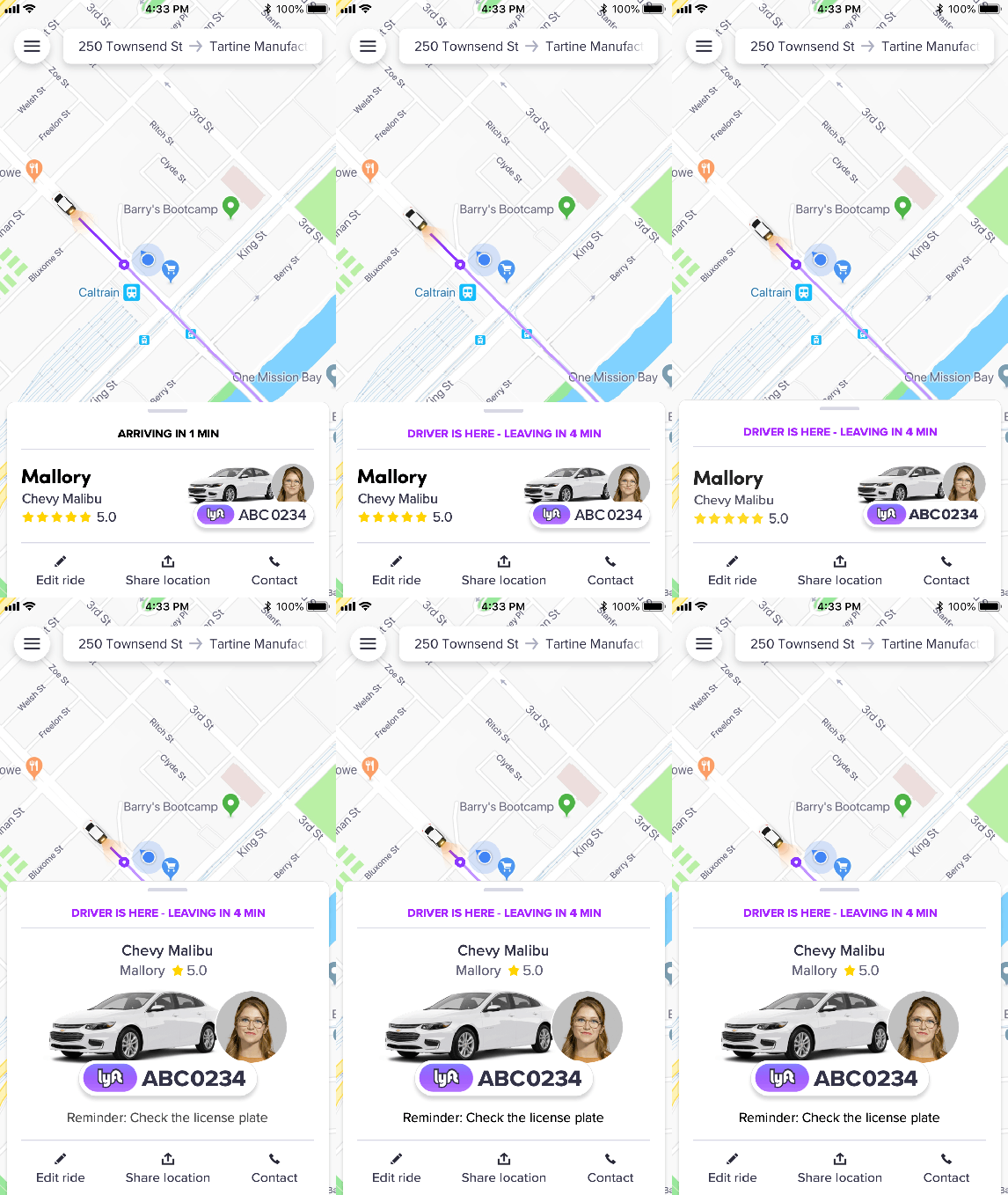
Like Uber, Lyft is also redesigning its app to better highlight the ride details — and specifically, making it easier to see the license plate number. When the car arrives, the driver photo, car photo and license plate appear in a pop-up in the app, alongside a reminder to match the plate to the one on the vehicle.

Some riders may have already seen this change, but it will now roll out to the remaining user base, says Lyft.

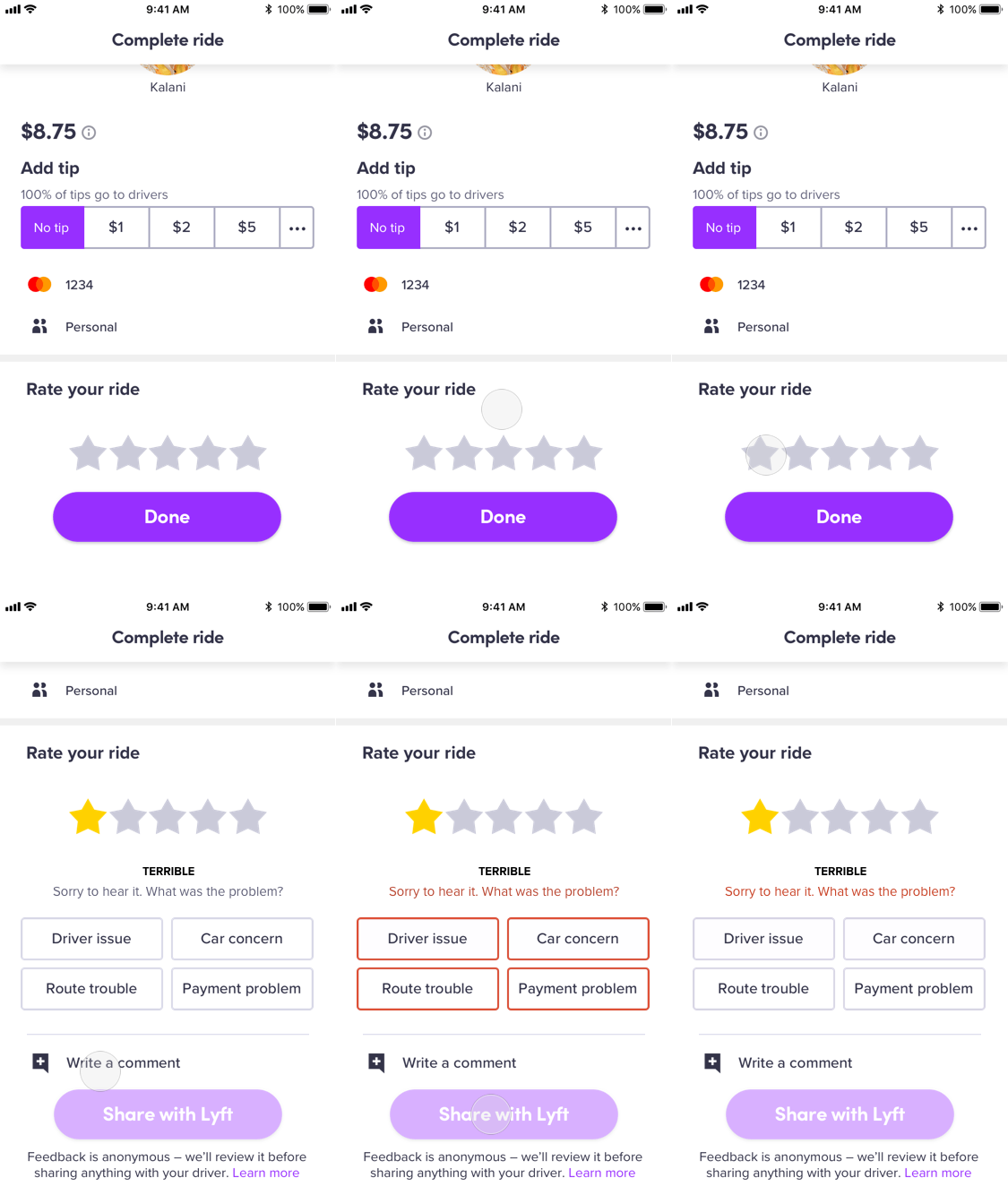
The company is also introducing mandatory feedback that will require riders to explain when a driver receives less than four stars.

This feedback is shared anonymously with the driver in a single location in their app, Lyft says. However, this change may not resolve issues with drivers who behave poorly because many people are uncomfortable leaving feedback when they felt unsafe. Riders, and especially women, often believe the driver would figure out that it’s them, even if it’s anonymous. Plus, if the driver has picked them up from their home, office or another place they frequent, they may feel even less comfortable leaving a review since the driver literally knows where to find them.

Finally, Lyft says it will make sexual harassment prevention education available to all Lyft drivers and riders this year, but didn’t share the details as to how these materials will be rolled out.

The new features join Lyft’s existing line-up of features, programs and policies focused on safety like its background checks on drivers, in-app photos of drivers and vehicles, real-time ride tracking, digital receipts, and two-way rating systems — the majority of which are common to ride-hailing apps.

The company says it expects to expand its efforts in this space over the course of the year and in the future.

The changes arrive soon after both Uber and Lyft saw their IPOs perform poorly, a result of investor concerns around slowing growth, mounting losses, increased global competition, and numerous other factors. Adding to that the fact that their apps may not be safe enough in their present state could have been another big ding against both businesses, had the companies not addressed the problem.

What does ‘regulating Facebook’ mean? Here’s an example

Many officials claim that governments should regulate Facebook and other social platforms, but few describe what it actually means. A few days ago, France released a report that outlines what France — and maybe the European Union — plans to do when it comes to content moderation.

It’s an insightful 34-page document with a nuanced take on toxic content and how to deal with it. There are some brand new ideas in the report that are worth exploring. Instead of moderating content directly, the regulator in charge of social networks would tell Facebook and other social networks a list of objectives. For instance, if a racist photo goes viral and is distributed to 5 percent of monthly active users in France, you could consider that the social network has failed to fulfill its obligations.

This isn’t just wishful thinking as the regulator would be able to fine the company up to 4 percent of the company’s global annual turnover in case of a systemic failure to moderate toxic content.

The government plans to turn the report into new pieces of regulation in the coming months. France doesn’t plan to stop there. It is already lobbying other countries (in Europe, the Group of 7 nations and beyond) so that they could all come up with cross-border regulation and have a real impact on moderation processes. So let’s dive into the future of social network regulation.

Facebook first opened its doors

When Facebook CEO Mark Zuckerberg testified before Congress in April 2018, it felt like regulation was inevitable. And the company itself has been aware of this for a while.

Raisin rides into the U.S. with its savings and investment marketplace

Raisin, the pan-European fintech marketplace for savings and investment products, is headed to the U.S., announcing plans to roll out a similar offering across the pond.

The German company, which is backed by the likes of PayPal, Index Ventures, Ribbit Capital and Thrive Capital, wants to bring greater competition and easier savings and deposit account opening to U.S. customers. The deposits market in the U.S. is said to be $12.7 trillion, and yet Raisin claims most Americans could be getting a much better return on their savings.

Despite the U.S. Federal Reserve raising interest rates and most consumers having ample opportunities to optimise their savings in theory, Raisin says shopping around for a competitive savings rate often involves too many hurdles for many American to bother. This includes finding out where good rates are available, assessing the quality of offers and in some instances switching from your existing primary bank.

In contrast, Raisin’s marketplace model claims to addresses theses issues by making the range of offers transparent, whilst also creating a convenient and simple way to access the best rates on the market. Part of its remedy is that only have to sign up to Raisin once, including regulatory checks, in order to access any of the offers from partner banks on its platform.

To kick off the new U.S. expansion, Raisin has hired Paul Knodel as U.S. CEO. Boasting twenty years financial industry experience, prior to joining Raisin he held executive and senior management positions at Citigroup and Merrill Lynch as well as TD Ameritrade, E-Trade and robo-advisor Wealthfront. Most recently Knodel led Wealthfront’s extension of its product suite into cash savings.

In addition, Raisin’s American expansion is being supported by the German government’s U.S.-based “German Accelerator” program. Each year 12 of Germany’s most promising startups are selected with the aim of helping them break into America.

Meanwhile, back in Europe, Raisin says it has more than 175,000 customers who have invested almost €13 billion into Raisin marketplace deposits. This year has also seen the fintech company acquire Germany’s MHB Bank, and close €100 million in Series D investment.

HolodeckVR raises €3M from Germany’s ProSiebenSat1 to put VR onto dodgems

Consumer VR might not have taken off in the mainstream but it’s still fun to use, and it’s even more fun to use in groups. There is more of an arcade renaissance for VR going on right now, as well as location-based multi-user VR experiences.

That’s the premise behind Munich-based HolodeckVR which is using proprietary tech to blend radio frequency, IR tracking and on-device IMUs to bring multi-user positionally tracked VR to mobile headsets.

How would you like to do VR in a big group, and on fairground dodgems/bumper cars? That’s the kind of this startup is cooking up.

As a spin-off from the prestigious Fraunhofer Institute for Integrated Ciruits IIS, it uses its own technology which allows its visitors to experience virtual reality in groups of up to 20 people and move around in an empty space of 10x20m, all just wearing VR goggles.

Holodeck says it can be used for different types of events (entertainment, birthday parties and corporate team building) and work through several thousands of guests per day.

It’s now raised €3 million from strategic partner ProSiebenSat.1, the leading German entertainment player. This will allow Holodeck to expand its open content platform and extend its network of locations.

The Munich-based media company owns a potential distribution channel for scaling Holodeck VR locations at leisure- and activity parks, while other synergies related to ProSiebenSat.1, including live broadcasting and VR content generation.

With 7Sports, the sports business units of ProSiebenSat.1, Holodeck VR plans eSports events leveraging the Holodeck VR platform.

Jonathan Nowak Delgado says: “With this investment, we’ll aim to become the VR touchpoint for the next generation by offering exciting new experiences that are simple, social, and fun.”

Holodeck VR’s experiences combine the real world and digital world so that you can take a ride in bumper cars or on a rollercoaster.

I hope they will have plenty of sick bags at the ready.