Firefox update is all about speed and fingerprinting protection

Mozilla is currently rolling out Firefox version 67 on Windows, macOS and Linux. And the team is detailing a few changes in a blog post. With today’s new version, users should expect better performances across the board.

Firefox is now better at loading essential content first and delaying non-essential scripts, not loading the auto-fill module if there’s no form on the page, etc.

Mobile web browsers usually clear idle tabs from memory so that you get better performances when you’re doing something else. That’s why you sometimes have to reload the page when you switch to an old tab. Desktop browsers are now doing the same thing, including Firefox. If your memory falls below 400MB, some old tabs will get suspended.

If you have a bunch of add-ons and themes, Firefox is now faster to start when you quit and relaunch your browser. Finally, AV1 videos should perform better thanks to dav1d, a new decoder from the VideoLAN, VLC and FFmpeg communities.

On the privacy front, Firefox 67 is adding cryptomining and fingerprinting blocks. Once again, the team is partnering with Disconnect to include lists of rules and domain names that prevent your browser from loading disingenuous content.

Cryptomining and fingerprinting blocks are disabled by default — at least for now. But you can activate them in a couple of clicks in the browser settings under “Privacy & Security.”

When it comes to private browsing, Firefox now lets you enable or disable some add-ons during private sessions. You can also save passwords in your browser from a private tab now.

Finally, Windows users with an Nvidia GPU will now benefit from WebRender, a GPU-based rendering engine for web content written in Rust. That represents a small subset of the user base, but I’m sure Firefox plans to roll it out to more users in the future.

Adobe brings its Premiere Rush video editing app to Android

Adobe launched Premiere Rush, its newest all-in-one video editing tool that is essentially a pared-down version of its flagship Premiere Pro and Audition tools for professional video editors, in late 2018. At the time, it was only available on iOS, macOS and Windows. Now, however, it is also finally bringing it to Android.

There is a caveat here, though: it’ll only run on relatively new phones, including the Samsung Galaxy S9 and S10 series, Google’s Pixel 2 and 3 phones and the OnePlus 6T.

The idea behind Premiere Rush is to give enthusiasts — and the occasional YouTube who needs to quickly get a video out — all of the necessary tools to create a video without having to know the ins and outs of a complex tools like Premiere Pro. It’s based on the same technologies as its professional counterparts, but its significantly easier to use. What you lose in flexibility, you gain in efficiency.

Premiere Rush is available for free for those who want to give it a try, though this ‘Starter Plan’ only lets you export up to three projects. For full access, you either need to subscribe to Adobe’s Creative Cloud or buy a $9.99/month plan to access Rush, with team and enterprise plans costing $19.99/month and $29.99/month respectively.

SmileDirectClub plans to 3D print 50,000 teeth-straightening molds a day

The medical industry has long been considered one of the most promising sources of growth for industrial 3D printing. It makes sense — getting a good fit requires the sort of exact measurements that can be accommodating by scanning and printing. Dental in particular has been a key driver, perhaps most notably in the case of Invisalign, which houses a warehouse full of printers.

Today at the Rapid 2019 conference in Detroit, SmileDirectClub announced that it’s making a major investment in HP’s industrial Multi Jet Fusion systems.The warehouse of 49 printers marks the largest deployment of the systems in the U.S. They’ll be put work around the clock, churning out teeth straightening molds.

When all is up and running, the systems will be capable of producing up to 50,000 molds a day. If all goes according to plan, that should account for more than 18 million in a year. HP says its machines are currently responsible for around 99 percent of SmileDirect’s 3D printer manufacturing. This latest announcement effectively doubles its investment in the technology.

It’s a space worth watching for anyone with a passing interesting in the technology. After years of experimentation and lofty promises, orthodontics represent a large scale, real world use for the tech.

Payment card startup Marqeta confirms $260M round at close to $2B valuation

Startups that are disrupting and unlocking the lucrative world of financial services continue to unlock big fund funding rounds for themselves.

Today, Marqeta — which helps third parties like Square, Affirm, DoorDash, Kabbage and Instacart build and offer card services to their customers — announced that it has raised a Series E of $260 million led by Coatue Management.

Marqeta plans to use this growth round to to continue building out its platform with an emphasis on global expansion, founder and CEO Jason Gardner said in an interview. He added that the funding values the startup at close to $2 billion.

While the company is not yet profitable, it’s growing fast: Gardner said Marqeta has doubled revenues each year for the last three years, and he expects that the next step for the 9 year-old company is likely an IPO in the next 18 months.

The news today confirms our scoop about the funding two months ago. (When it was still raising, the total was $250 million.)

In addition to Coatue, other new investors include Vitruvian Partners, Spark Capital, Lone Pine and Geodesic, with participation also from several of Marqeta’s existing investors: Visa, ICONIQ, Goldman Sachs, 83North, Granite Ventures, CommerzVentures and CreditEase.

“We’re incredibly excited to be partnering with Marqeta,” said Kris Fredrickson, Partner at Coatue Management, in a statement. “We believe that the company has a world class team, industry leading technology, and the ability to bring about profound change in card issuing and the global payments infrastructure. The company’s momentum over the last several years is a testament to the team’s hard work and the scale of the opportunity at hand.”

The growth of the internet and the use of smartphones for e-commerce has had a big impact on financial transactions: less people and businesses are paying and getting paid in cash, and card usage — both physical and virtual — is on the rise. Citing research from Edgar, Dunn & Company, Marqeta estimates the volume of the card issuing industry — that is, transactions made via cards — to be worth around $45 trillion.

“Visa and MasterCard have interconnected every single merchant that accepts cards, and that is still growing significantly,” Gardner said, but that expansion is coming at the same time that banks have been pricey and slow to move to accommodate the long tail of new opportunities for payment services. That is the opportunity that Marqeta is seizing, by providing quick and flexible options to any kind of commerce company that wants to make the move into issuing cards to its customers, along with supporting services around them such as payment reconciliations, real-time fund transfers and customer interactive voice response services. Gardner notes that while credit remains king, alternatives like debit and virtual cards are growing the fastest.

On the international front, the company opened an office in London recently to start to capitalise on building more inroads to providing card-related services to so-called “challenger banks” (examples include N26, Monese, Starling and Revolut) that have emerged with lower fees and app-friendly interfaces to tap into a growing base of younger working people, and older consumers who have grown tired of bank fees and poor options to move their money digitally.

A recent report from Accenture, cited by Reuters, noted that challenger banks collectively now account for 14 percent of the banking market’s revenues in Europe, or €206 billion ($238 billion) compared to just 3.5 percent of the US market (which is worth $1.04 trillion).

Further afield, Gardner said the company has its eye on Asia, where he says growth in the past year has been “stagnant”, largely because its a “cash-centric culture.” However, government efforts to bring more transactions into the digital 21st century will lead to about 30 percent growth next year — an opportunity Gardner said Marqeta will want to try to cash in on.

Generation closes $1B growth fund targeting sustainable startups

Generation Investment Management, the firm co-founded by environmentalist and former Vice President Al Gore, was built on the premise of backing sustainable startups. Now, as the idea of sustainability starts to gain wider traction, the firm is doubling down on the concept.

Today, Generation is announcing that it has closed a $1 billion Sustainable Solutions Fund for growth investments. As the name implies, it plans to put the $1 billion to work backing later-stage startups that work on sustainability in at least one of three areas — environmental solutions; healthcare; and financial inclusion, including the future of work — and are creating financially sustainable businesses out of that focus.

Typical investments will range from $50 million to $150 million, and there have already been two made out of the fund before it closed, both indicative of the kinds of investments Generation plans to be making.

Andela — the startup that pairs companies needing engineering talent to work on projects with developers based out of Africa — in January announced a $100 million round. Also that month, Sophia Genetics — the company that applies AI to DNA sequencing to help formulate more accurate medical treatments — raised $77 million led by the firm.

Other companies that Generation has backed include Asana, DocuSign, gogoro, CiBO, M-Kopa, Ocado, Optoro and Seventh Generation.

This is Generation’s third growth fund and the largest raised by the firm to date, which itself is a sign of the swing we’ve seen in the tech world.

In general, founders, workers and investors all remain relentlessly focused on growing new ideas. But along with that there has been a rising conscientiousness of the massive role that tech plays in shaping the world, and so some are now trying to make more of an effort to use that for more meaningful outcomes.

“You are seeing how sustainability is attracting high performing entrepreneurs,” said Lilly Wollman, partner and co-head of the Growth Equity platform, in an interview. “They care about the mission, and that is also driving financial performance.”

“We believe that we are at the early stages of a technology-led sustainability revolution,” said Al Gore, Chairman and Co-Founder, in a statement, “which has the scale of the industrial revolution, and the pace of the digital revolution.”

In the case of Generation, it’s also an indication that the firm — which has $22 billion under management today — is providing impressive enough returns on its mission to drive more interest from LPs to grow the commitment to back it.

“There is a recognition of this momentum,” added Lila Preston, a Partner who is the growth platform’s co-head, of the 15 years the firm has already spent on this concept and the work it’s put into it. “We see this as a movement, but one with a roadmap based on research and understanding.”

It’s also notable to me that the two people leading the growth team are women. Wollman noted that 60 percent of the Generation team is female, with the employee base spanning eight nationalities. “The firm believes more diversity leads to better outcomes,” she said.

Consumers are also playing a big role. Of all the good, bad and ugly that have been wrought by the rise of social media, one of the positives has been how social platforms have been used to raise awareness of issues such as climate change and inclusion. We may be getting into more online fights with our distant cousins (and closer friends and relatives), and sometimes issues like trying to curtail emissions gasses seems like an insurmountable challenge. But some will also use what they read about and watch online as inspiration to try to make a change.

“One of the things that is so interesting in this moment is at we are at an inflection point,” said Wollman. “Sustainability is winning on economics alone. You see sustainable products and solutions that are both efficacious and cheap. People are buying electric vehicles not just because they are green, but because they are starting to become cheap enough, and provide better performance.”

That’s bringing in a new wave of investors to the mix, and it’s interesting to see how some more conventional investors are even starting to take a bigger step into making mission-driven investment decisions. (Just yesterday, in the UK, Balderton co-led a large round for Wagestream, a startup aimed at helping promote financial inclusion by creating a way to easily and cheaply draw down money from monthly paychecks. Generation hinted that it too might be making an investment in a startup working in a similar area in the weeks to come.)

“It helps to have a set of coinvestors to ask questions related not only to ‘what are your growth metrics’ but ‘how does what you are doing affect the wider world,’” said Preston. “We are finding an increase of sophistication, which we think is positive recognition. Given the context of our shift, whether it’s a new economic model or climate change, we are going to need masses of capital to drive sustainable solutions and reframe what is successful.”

ZenHub Workspaces make GitHub easier to use across teams

ZenHub, a project management tool for GitHub, today announced the launch of Workspaces, a feature that makes it easier for teams to use its service — and GitHub — by allowing them to tweak the service to the needs of specific teams while still using GitHub as the ground truth for their work.

With Workspaces, teams can create multiple workspaces inside a GitHub repository (ZenHub does this through a Chrome extension) so that a team of developers can get a detailed view of every issue, for example, while other teams only get to see what is relevant to them. This also allows different teams to opt for their own work styles, no matter whether that’s Scrum or Kanban.

“What this will allow teams to do is to work in their own unique ways and build their own unique workflows dependent on how they work,” ZenHub founder and CEO Aaron Upright told me. “So a front end team can have its own board of GitHub issues, that’s more of a Kanban-style of workflow. And the back end team can have its own workflow that’s more of a scrum style.”

Issues are still shared across boards and every team can see what the other teams are working on, which will also allow for more transparency inside the company.

Aaptiv, the workout app, launches a new AI-based personal trainer called Coach

After raising at least $20 million last year from the likes of Amazon, Disney and Bose for a mobile app that offered workouts led by professional, human trainers, Aaptiv is now taking a tech turn. Today, the startup is beginning a pilot of a new service it calls Aaptiv Coach, an AI-based assistant that builds personalised fitness and lifestyle plans based on a user’s goals, current fitness levels, eating habits and data input from external devices like smartwatches and fitness trackers.

Coach will mark a notable departure for the startup. Aaptiv built its name on human-led workouts produced by Aaptiv itself. (“We might the only people willing to acknowledge that we will not use AI to replace trainers,” founder and CEO Ethan Agarwal told TechCrunch last June. “The trainers create the classes and that will be always the same. That relationship and drive and the passion cannot be matched by anyone or anything.”)

Now, while the company is not removing trainers from the platform, it will be reorienting the focus of how it delivers fitness plans to users: Coach will give users an order of what should be done, with the option of using Aaptiv workouts, or alternatively following sessions led by others, or even doing the exercise on their own, using AI to measure progress.

That change, it should be noted, came with some personnel shifts at the company, too: earlier this year, the company laid off employees, including personal trainers, and while it would not confirm the exact amount, several tipsters suggested to us that it was around one-third of staff.

In an interview ahead of today, Agarwal made it clear that the reductions were not about eliminating human coaches altogether but about adding something new to the platform as it continues to scale.

Coach is being released after three years of internal development that was taking place at the same time that the company was building out the data and using it to feed and improve its algorithms. The company has to date streamed 22 million workouts across 20 countries, and all of that translates into data points that both have taught Coach, but also the startup itself about what it is that people want.

“The first phase was spent learning about how people consume classes, where and when they work out,” Agarwal said.

One thing that it learned was that while there are definitely a small and dedicated part of the population that will carve out significant time each day for workouts, there is a larger proportion that will not, and so Coach is about trying to fit fitness into those consumers’ lives.

And maybe more importantly, the rest of how an individual leads his or her life will probably give a better picture of what she or he will need to do to achieve a desired outcome (such as lose weight, or achieve a better running time, or get stronger, or whatever it happens to be).

“The idea is how can we help people achieve their goals, whatever they are?” he said. “If you work out three times a week for 45 minutes, that is basically two percent of your week. But there are a lot of companies out there competing for that two percent: gyms, in-home biking startups, and more. But the way we see it, is that the other 98 percent of your time is where your habits are formed, where you need to start to build structure.”

Aaptiv’s approach with Coach will be to create personalised daily, weekly and monthly plans for getting to a specified goal. “No one will have the same plan,” Agarwal said. For those who are already using Aaptiv, their own data will be used to start to build Coach’s profile of the person. Users will be given the option to add other sources of input, and also add in more information, to further tailor the experience.

Like many a platform, what’s interesting about Coach is how its open-ended structure could be leveraged to help Coach grow.

Today, there is already guidance on food a person should avoid or try to eat regularly, but you could imagine how one might link up the APIs from a particular appliance to inform Aaptiv’s Coach more directly on what a person is eating.

Or, you could imagine also a time when someone might even order the food she should be eating directly from the app, to be delivered by a food delivery partner.

The commerce aspects are an interesting one to consider, given how much people spend on fitness and health already today.

Take running shoes as an example: if you input into Coach what shoes you already own, and it’s tracking where you are running and how much you weigh and so on, it will be able to reasonably determine when it’s time for you to get a new pair of shoes, even if your old ones don’t look like they’re about to fall apart.

All of that will not only extend the amount of time people are spending in the Aaptiv app, but potentially present revenue streams on top of the basin subscription-based one that exists today. (It’s also perhaps a clue as to why Amazon is interested in the company.)

When I covered Aaptiv’s round last year, I wondered about how the model would scale as it expanded, built as it was on personal human connections. Coach provides one possible answer.

The potential of where and how Coach might develop is one way that Aaptiv is filling out its valuation (which last year was $200 million), and also attracting attention. From what I’ve heard, the company has been approached by multiple interested parties hoping to tap into the audience it has built and the engagement that it’s bringing to the world of health and fitness.

Facebook still a great place to amplify pre-election junk news, EU study finds

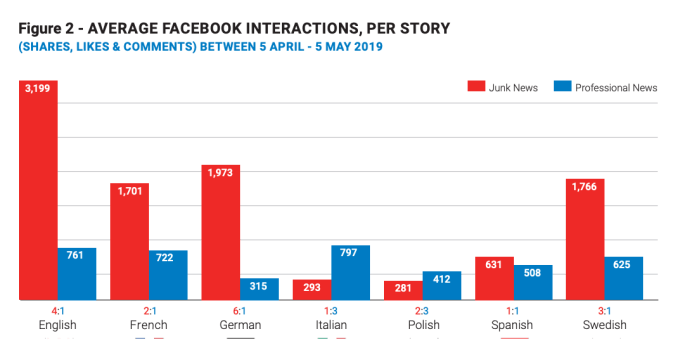
A study carried out by academics at Oxford University to investigate how junk news is being shared on social media in Europe ahead of regional elections this month has found individual stories shared on Facebook’s platform can still hugely outperform the most important and professionally produced news stories, drawing as much as 4x the volume of Facebook shares, likes, and comments.

The study, conducted for the Oxford Internet Institute’s (OII) Computational Propaganda Project, is intended to respond to widespread concern about the spread of online political disinformation on EU elections which take place later this month, by examining pre-election chatter on Facebook and Twitter in English, French, German, Italian, Polish, Spanish, and Swedish.

Junk news in this context refers to content produced by known sources of political misinformation — aka outlets that are systematically producing and spreading “ideologically extreme, misleading, and factually incorrect information” — with the researchers comparing interactions with junk stories from such outlets to news stories produced by the most popular professional news sources to get a snapshot of public engagement with sources of misinformation ahead of the EU vote.

As we reported last year, the Institute also launched a junk news aggregator ahead of the US midterms to help Internet users get a handle on manipulative politically-charged content that might be hitting their feeds.

In the EU the European Commission has responded to rising concern about the impact of online disinformation on democratic processes by stepping up pressure on platforms and the adtech industry — issuing monthly progress reports since January after the introduction of a voluntary code of practice last year intended to encourage action to squeeze the spread of manipulative fakes. Albeit, so far these ‘progress’ reports have mostly boiled down to calls for less foot-dragging and more action.

One tangible result last month was Twitter introducing a report option for misleading tweets related to voting ahead of the EU vote, though again you have to wonder what took it so long given that online election interference is hardly a new revelation. (The OII study is also just the latest piece of research to bolster the age old maxim that falsehoods fly and the truth comes limping after.)

The study also examined how junk news spread on Twitter during the pre-EU election period, with the researchers finding that less than 4% of sources circulating on Twitter’s platform were junk news (or “known Russian sources”) — with Twitter users sharing far more links to mainstream news outlets overall (34%) over the study period.

Although the Polish language sphere was an exception — with junk news making up a fifth (21%) of EU election-related Twitter traffic in that outlying case.

Returning to Facebook, while the researchers do note that many more users interact with mainstream content overall via its platform, noting that mainstream publishers have a higher following and so “wider access to drive activity around their content” and meaning their stories “tend to be seen, liked, and shared by far more users overall”, they also point out that junk news still packs a greater per story punch — likely owing to the use of tactics such as clickbait, emotive language, and outragemongering in headlines which continues to be shown to generate more clicks and engagement on social media.

It’s also of course much quicker and easier to make some shit up vs the slower pace of doing rigorous professional journalism — so junk news purveyors can get out ahead of news events also as an eyeball-grabbing strategy to further the spread of their cynical BS. (And indeed the researchers go on to say that most of the junk news sources being shared during the pre-election period “either sensationalized or spun political and social events covered by mainstream media sources to serve a political and ideological agenda”.)

“While junk news sites were less prolific publishers than professional news producers, their stories tend to be much more engaging,” they write in a data memo covering the study. “Indeed, in five out of the seven languages (English, French, German, Spanish, and Swedish), individual stories from popular junk news outlets received on average between 1.2 to 4 times as many likes, comments, and shares than stories from professional media sources.

“In the German sphere, for instance, interactions with mainstream stories averaged only 315 (the lowest across this sub-sample) while nearing 1,973 for equivalent junk news stories.”
To conduct the research the academics gathered more than 584,000 tweets related to the European parliamentary elections from more than 187,000 unique users between April 5 and April 20 using election-related hashtags — from which they extracted more than 137,000 tweets containing a URL link, which pointed to a total of 5,774 unique media sources.

Sources that were shared 5x or more across the collection period were manually classified by a team of nine multi-lingual coders based on what they describe as “a rigorous grounded typology developed and refined through the project’s previous studies of eight elections in several countries around the world”.

Each media source was coded individually by two separate coders, via which technique they say was able to successfully label nearly 91% of all links shared during the study period. 

The five most popular junk news sources were extracted from each language sphere looked at — with the researchers then measuring the volume of Facebook interactions with these outlets between April 5 and May 5, using the NewsWhip Analytics dashboard.

They also conducted a thematic analysis of the 20 most engaging junk news stories on Facebook during the data collection period to gain a better understanding of the different political narratives favoured by junk news outlets ahead of an election.

On the latter front they say the most engaging junk narratives over the study period “tend to revolve around populist themes such as anti-immigration and Islamophobic sentiment, with few expressing Euroscepticism or directly mentioning European leaders or parties”.

Which suggests that EU-level political disinformation is a more issue-focused animal (and/or less developed) — vs the kind of personal attacks that have been normalized in US politics (and were richly and infamously exploited by Kremlin-backed anti-Clinton political disinformation during the 2016 US presidential election, for example).

This is likely also because of a lower level of political awareness attached to individuals involved in EU institutions and politics, and the multi-national state nature of the pan-EU project — which inevitably bakes in far greater diversity. (We can posit that just as it aids robustness in biological life, diversity appears to bolster democratic resilience vs political nonsense.)

The researchers also say they identified two noticeable patterns in the thematic content of junk stories that sought to cynically spin political or social news events for political gain over the pre-election study period.

“Out of the twenty stories we analysed, 9 featured explicit mentions of ‘Muslims’ and the Islamic faith in general, while seven mentioned ‘migrants’, ‘immigration’, or ‘refugees’… In seven instances, mentions of Muslims and immigrants were coupled with reporting on terrorism or violent crime, including sexual assault and honour killings,” they write.

“Several stories also mentioned the Notre Dame fire, some propagating the idea that the arson had been deliberately plotted by Islamist terrorists, for example, or suggesting that the French government’s reconstruction plans for the cathedral would include a minaret. In contrast, only 4 stories featured Euroscepticism or direct mention of European Union leaders and parties.

“The ones that did either turned a specific political figure into one of derision – such as Arnoud van Doorn, former member of PVV, the Dutch nationalist and far-right party of Geert Wilders, who converted to Islam in 2012 – or revolved around domestic politics. One such story relayed allegations that Emmanuel Macron had been using public taxes to finance ISIS jihadists in Syrian camps, while another highlighted an offer by Vladimir Putin to provide financial assistance to rebuild Notre Dame.”

Taken together, the researchers conclude that “individuals discussing politics on social media ahead of the European parliamentary elections shared links to high-quality news content, including high volumes of content produced by independent citizen, civic groups and civil society organizations, compared to other elections we monitored in France, Sweden, and Germany”.

Which suggests that attempts to manipulate the pan-EU election are either less prolific or, well, less successful than those which have targeted some recent national elections in EU Member States. And logic would suggest that co-ordinating election interference across a 28-Member State bloc does require greater co-ordination and resource vs trying to meddle in a single national election — on account of the multiple countries, cultures, languages and issues involved.

We’ve reached out to Facebook for comment on the study’s findings.

The company has put a heavy focus on publicizing its self-styled ‘election security’ efforts ahead of the EU election. Though it has mostly focused on setting up systems to control political ads — whereas junk news purveyors are simply uploading regular Facebook ‘content’ at the same time as wrapping it in bogus claims of ‘journalism’ — none of which Facebook objects to. All of which allows would-be election manipulators to pass off junk views as online news, leveraging the reach of Facebook’s platform and its attention-hogging algorithms to amplify hateful nonsense. While any increase in engagement is a win for Facebook’s ad business, so er…


Atlassian puts its Data Center products into containers

It’s KubeCon + CloudNativeCon this week and in the slew of announcements, one name stood out: Atlassian . The company is best known as the maker of tools that allow developers to work more efficiently and now as a cloud infrastructure provider. In this age of containerization, though, even Atlassian can bask in the glory that is Kubernetes because the company today announced that it is launching Atlassian Software in Kubernetes (AKS), a new solution that allows enterprises to run and manage its on-premise applications like Jira Data Center as containers and with the help of Kubernetes.

To build this solution, Atlassian partnered with Praqma, a Continuous Delivery and DevOps consultancy. It’s also making AKS available as open source.

As the company admits in today’s announcement, running a Data Center application and ensuring high availability can be a lot of work using today’s methods. With AKS and by containerizing the applications, scaling and management should become easier — and downtime more avoidable.

“Availability is key with ASK. Automation keeps mission-critical applications running whatever happens,” the company explains. “If a Jira server fails, Data Center will automatically redirect traffic to healthy servers. If an application or server crashes Kubernetes automatically reconciles by bringing up a new application. There’s also zero downtime upgrades for Jira.”

AKS handles the scaling and most admin tasks, in addition to offering a monitoring solution based on the open-source Grafana and Prometheus projects.

Containers are slowly becoming the distribution medium of choice for a number of vendors. As enterprises move their existing applications to containers, it makes sense for them to also expect that they can manage their existing on-premises applications from third-party vendors in the same systems. For some vendors, that may mean a shift away from pre-server licensing to per-seat licensing, so there are business implications to this, but in general, it’s a logical move for most.

Self-driving truck startup TuSimple will haul mail for USPS in two-week pilot

TuSimple, the self-driving truck startup that reached unicorn status earlier this year with a $1 billion valuation, is getting two weeks to prove its tech to the United States Postal Service.

The company announced Tuesday that it was awarded a contract to complete five round trips, for a two-week pilot, hauling USPS trailers more than 1,000 miles between the postal service’s Phoenix and Dallas distribution centers. A safety engineer and driver will be on board throughout the pilot.

TuSimple will run a series of its self-driving trucks for 22 hours each, which includes overnight driving, along Interstates 10, 20 and 30 corridors to make the trip through Arizona, New Mexico and Texas.

The pilot is an important milestone for TuSimple. It marks the company’s first foray into Texas; it’s also a chance for TuSimple to validate its system with the U.S. government.

The USPS is just one of many (ahem Amazon) in the logistics and shipping business interested in using autonomous vehicle technology to cuts costs, improve safety and operations.

TuSimple, which launched in 2015 and has operations in San Diego and Tucson, Arizona, has been running daily routes for customers in Arizona. The company recently raised $95 million in a Series D funding round led by Sina Corp. The company is preparing to scale up its commercial autonomous fleet to more than 50 trucks by June.

TuSimple has raised $178 million to date in rounds that have included backers such as Nvidia and ZP Capital. Sina, operator of China’s biggest microblogging site Weibo, is one of TuSimple’s earliest investors.