DNA Script picks up $38.5 million to make DNA production faster and simpler

DNA Script has raised $38.5 million in new financing to commercialize a process that it claims is the first big leap forward in manufacturing genetic material.

The revolution in synthetic biology that’s reshaping industries from medicine to agriculture rests on three, equally important pillars.

They include: analytics — the ability to map the genome and understand the function of different genes; synthesis — the ability to manufacture DNA to achieve certain functions; and gene editing — the CRISPR-based technologies that allow for the addition or subtraction of genetic code.

New technologies have already been introduced to transform the analytics and editing of genomes, but little progress has been made over the past 50 years in the ways in which genetic material is manufactured. That’s exactly the problem that DNA Script is trying to solve.

Traditionally, making DNA involved the use of chemical compounds to synthesize (or write) DNA in chains that were limited to around 200 nucleotide bases. Those synthetic pieces of genetic code are then assembled together to make a gene.

DNA Script’s technology holds the promise of making longer chains of nucleotides by mirroring the enzymatic process through which DNA is assembled within cells — with fewer errors and no chemical waste material. The enzymatic process can accelerate commercial applications in healthcare, chemical manufacturing, and agriculture.

“Any technology that can make that faster is going to be very valuable,” says Christopher Voigt, a synthetic biologist at the Massachusetts Institute of Technology in Cambridge, told the journal Nature. “There is no Nobel prize that needs to happen,” Leproust says. “It’s just hard engineering.”

DNA Script isn’t the only company in the market that’s looking to make the leap forward in enzymatic DNA production. Nucleara, startup working with Harvard University’s famed geneticist, George Church, and Ansa Bio, a startup affiliated with Jay Keasling’s Berkeley lab at the University of California are also moving forward with the technology.

But the Paris-based company has achieved some milestones that would make its technology potentially the first to come to market with a commercially viable approach.

At least, that’s what investors new investors LSP and Bpifrance, through its Large Venture fund, are hoping. They’re joined by previous investors Illumina Ventures, M. Ventures, Sofinnova Partners, Kurma Partners and Idinvest Partners, in backing the company’s latest funding.

The company said the money would be used to accelerate the development of its first products and establish a presence in the United States.

“As we announced earlier this year at the AGBT General Meeting, DNA Script was the first company to enzymatically synthesize a 200mer oligo de novo with an average coupling efficiency that rivals the best organic chemical processes in use today,”  said Thomas Ybert, chief executive and cofounder of DNA Script. “Our technology is now reliable enough for its first commercial applications, which we believe will deliver the promise of same-day results to researchers everywhere, with DNA synthesis that can be completed in just a few hours.”

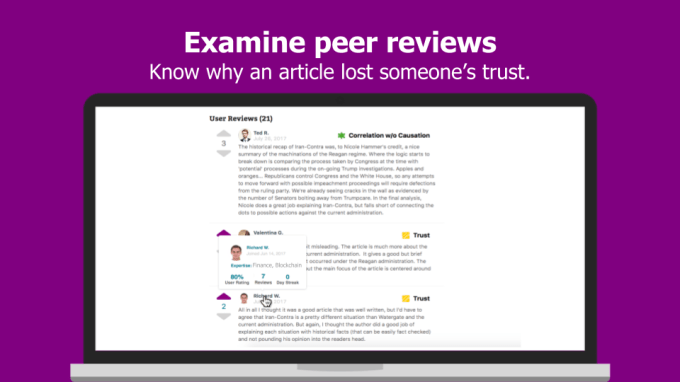
Credder offers Rotten Tomatoes-style ratings for the news

In an age of online misinformation and clickbait, how do you know whether a publication is trustworthy?

Startup Credder is trying to solve this problem with reviews from both journalists and regular readers. These reviews are then aggregated into an overall credibility score (or rather, scores, since the journalist and reader ratings are calculated separately). So when you encounter an article from a new publication, you can check their scores on Credder to get a sense of how credible they are.

Co-founder and CEO Chase Palmieri compared the site to movie reviewe aggregator Rotten Tomatoes. It makes sense, then, that he’s enlisted former Rotten Tomatoes CEO Patrick Lee to his advisory board, along with journalist Gabriel Snyder and former Xobni CEO Jeff Bonforte.

Palmieri plans to open Credder to the general public later this month, and he’s already raised $750,000 in funding from Founder Institute CEO Adeo Ressi, Ira Ehrenpreis, the law firm Orrick, Herrington & Sutcliffe, Steve Bennet and others.

Palmieri told me he started working full-time on the project back in 2016, with the goal of “giving news consumers a way to productively hold the news producers accountable,” and to “realign the financial incentives of online media, so it’s not just rewarding clicks and traffic metrics.” In other words, he wanted to create a landscape where publishing empty clickbait or heavily-slanted propaganda might have actual consequences.

If Credder gets much traction, it will likely to attract its share of trolls — it’s easy to imagine that the same kind of person who leaves a negative review of “Captain Marvel” without seeing the movie (this is a real issue that Rotten Tomatoes has had to face), would be just as happy to smear The New York Times or CNN as “fake news.” And even if a reviewer is offering honest, good-faith feedback, the review might be less influenced by the quality of a publication’s journalism and more by their personal baggage or political leanings.

Palmieri acknowledged the risk and pointed to several ways Credder is trying to mitigate it. For one thing, users can’t just write an overall review of The New York Times or The Wall Street Journal or TechCrunch. Instead, they’re reviewing specific articles, so hopefully they’re engaging with the substance and specifics of the story, rather than just venting their preexisting feelings. The scores assigned to publications and to journalists are only generated when there are enough article ratings to create an aggregated score.

In addition, Palmieri said the reviewers “are also being held accountable,” because users can upvote or downvote their comments. That affects how the reviews get weighted in the overall score, and in turn generates a rating for the reviewers.

“It will take time for the weight of your reviews to be meaningful, and there will be a visible track record,” he said.

While I appreciated Palmieri’s vision, I was also skeptical that a credibility score can actually influence readers’ opinions — maybe it will matter when you encounter a new publication, but everyone already has set ideas about who they trust and don’t trust.

When I brought this up, Palmieri replied, “What we see in today’s media landscape is the left wing media attacks the right wing media, and vice versa. We never get a sense of what our fellow news consumers feel. What’s more likely to change your perspective and make you question yourself? It’s going to a rating page at an article, pointing out a specific problem in that article.”

To be clear, Credder isn’t hosting articles itself, simply crawling the web and creating rating pages for articles, publications and writers. As for making money, Palmieri said he’s considered both a tipping system and an ad system where publications can pay to promote their stories.

TechCrunch readers can check it out early by visiting the Credder website and using the promo code “TCNEWS”.

Rivian debuts a pull-out kitchen for its electric pickup trick

Sometimes you need scrambled eggs. And with that thought, toady at the Overland Expo in Flagstaff, AZ, Rivian announced a major accessory for its electric pickup: A camp kitchen. The unit slides out from the Rivian R1T’s so-called gear tunnel that lives between the bed and cab. The kitchen includes storage and a stove that’s powered by the R1T’s 180kWh battery pack.

This kitchen unit is the first significant concept Rivian has unveiled for the pickup’s unusual gear tunnel. This space provides another locked storage compartment for the pickup — but why have it all, many asked when it was revealed? And now, with this kitchen unit, Rivian is responding to the questions. It seems Rivian wants to make its vehicles the center of an ecosystem of add-ons. The company already revealed racks, vehicle-mounted tents and even a flashlight that hides in the side of the driver’s door. Expect more camping and outdoor gear as Rivian cements its brand image around adventurers.

Rivian is positioning its products for a particular lifestyle. Think Patagonia-wearing, Range Rover-driving, outdoorsy types or at least those who aspire to have that image. It’s a smart play, and so far, Rivian has stayed true to this image. All of its advertisements, social media posts, and appearances make it clear that Rivian is carefully aligning its brand image.

Trucks and SUVs are generally marketed to workman and families. TV commercials feature dusty men hauling bails of hay and women unloading groceries and closing the rear tailgate with her foot. But not Rivian.

So far Rivian has shown its products in the backwoods, running trails and sitting next to campfires. The people in the commercials are on an adventure, wearing coats by The North Face and sleeping in REI tents. With the kitchen from today’s announcements, they can pull a kitchen out of their pickup and make some coffee.

Rivian tells TechCrunch this is just a concept, but the company intends to bring this unit to production. There are likely to be other units for the gear tunnel. I, for one, would love to have a slide-out dog washing and drying station because there’s nothing worse than putting a muddy dog in a truck.

Magic Leap buys Belgian startup building hologram teleconferencing software

Princess Leia’s hologram message to Obi-Wan is getting closer to reality, at least augmented reality.

Magic Leap announced yesterday that they’ve agreed to acquire Belgian startup Mimesys. The team has been working on bringing Star Wars-esque volumetric video calls to the Magic Leap platform, and it seems that the Florida AR startup liked what they were developing. We didn’t get any details on deal terms.

The team is joining Magic Leap but will continue to service their enterprise clients including BNP Paribas and Orange, according to their website. The startup first showed off their video conferencing tech at CES this year, which allows someone in a Magic Leap One headset to visualize a 3D representation of a person during a “video” call.

Volumetric video can be fairly fickle, the solution Mimesys has been going after relied on Intel’s RealSense depth cameras to collect and stitch footage on PCs locally then stream it to a user’s headset. As is the case with almost all volumetric video footage, Mimesys’s early work appeared to suffer from some noisiness, though this acquisition makes one wonders whether Magic Leap will end up creating their own external depth camera hardware to appeal to enterprise customers.

It seems that almost every new platform promises to revolutionize video calls and yet hangups continue because its one of the more high-bandwidth activities we regularly do. This is only going to be more difficult in AR since you’re sending live 3D footage of people through the internet tubes. Like much of what Magic Leap is promising, the feasibility of pulling this off likely relies in no small part to 5G tech proliferating.

“Old Town Road” finally gets the video treatment

From viral TikTok sensation, to music’s number one smash hit, “Old Town Road” has taken the top spot in music’s cultural firmament relying on an incredible Nine Inch Nails sample, some old fashioned controversy (it was barred from country music charts), and a remix with Billy Ray Cyrus.

So it’s only natural that the song that was created virtually and rose to number one through online ubiquity would work its way backward through the traditional music industry’s playbook to finally, after weeks atop the Billboard charts, get its video treatment.

And what a video treatment it is. This video has everything. Horse chases, car races, gunfights, time travel, and bingo.

Joining Lil Nas X is a cornucopia of famous faces from music and film including Billy Ray Cyrus (of course), Chris Rock, Diplo, Vince Staples, and Rico Nasty.

It’s been a long week, so take a break with a trip on the “Old Town Road”. It’s fun.

Blue Origin and SpaceX get million-dollar NASA nod to test moon lander tech

Eleven aerospace companies will share more than $45 million in funds from NASA to design and test prototypes for the Artemis moon missions, the agency has announced. Among the established names like Northrop Grumman and Sierra Nevada are relative newcomers SpaceX and Blue Origin, looking to make a place for themselves on the agency’s biggest push in decades.

The funds are to enable what NASA calls undefinitized contract actions, in which partners get to work before negotiations on the rest of the contract have concluded. It basically shows that time is of the essence and that NASA is willing to pay up front to someone they may not even contract with later, just to get a jump start on the work that needs doing.

And what’s the work? They’ll be cooking up designs and prototypes for the Human Landing System, which as you might guess will take astronauts (and cosmonauts, and perhaps taikonauts) from a high lunar orbit to a low one, then to the surface, then back again. The three elements are called transfer, descent, and ascent respectively — and there’s a refueling one as well.

Each company will have a specific set of mechanisms or designs it will be expected to produce, but none is expected to put together the whole shebang.

“We’re keen to collect early industry feedback about our human landing system requirements, and the undefinitized contract action will help us do that,” said NASA’s Greg Chavers in a press release. “This new approach doesn’t prescribe a specific design or number of elements for the human landing system. NASA needs the system to get our astronauts on the surface and return them home safely, and we’re leaving a lot of the specifics to our commercial partners.”

In other words, this is still an information-gathering phase for NASA, though the contractors must consider it as potentially the first step in producing a major system for Artemis, so they can’t do anything by halves.

None of the companies was assigned design work on the ascender, which suggests the plans for that part aren’t as far advanced as the rest. SpaceX will be producing a study on the descent element, while Blue Origin is taking on studies for the descent and transfer elements, plus a prototype for the latter.

We probably won’t see these prototypes or studies any time soon — if they’re not chosen for production they may remain trade secrets for future bids or on the off chance NASA changes its mind. Even if they are chosen, they may have to go through several more iterations before they can be shown publicly.

Here’s the full list of companies and their responsibilities under the new funding:

  • Aerojet Rocketdyne – Canoga Park, California
    • One transfer vehicle study
  • Blue Origin – Kent, Washington
    • One descent element study, one transfer vehicle study, and one transfer vehicle prototype
  • Boeing – Houston
    • One descent element study, two descent element prototypes, one transfer vehicle study, one transfer vehicle prototype, one refueling element study, and one refueling element prototype
  • Dynetics – Huntsville, Alabama
    • One descent element study and five descent element prototypes
  • Lockheed Martin – Littleton, Colorado
    • One descent element study, four descent element prototypes, one transfer vehicle study, and one refueling element study
  • Masten Space Systems – Mojave, California
    • One descent element prototype
  • Northrop Grumman Innovation Systems – Dulles, Virginia
    • One descent element study, four descent element prototypes, one refueling element study, and one refueling element prototype
  • OrbitBeyond – Edison, New Jersey
    • Two refueling element prototypes
  • Sierra Nevada Corporation, Louisville, Colorado, and Madison, Wisconsin
    • One descent element study, one descent element prototype, one transfer vehicle study, one transfer vehicle prototype, and one refueling element study
  • SpaceX – Hawthorne, California
    • One descent element study
  • SSL – Palo Alto, California
    • One refueling element study and one refueling element prototype

After breach, Stack Overflow says some user data exposed

After disclosing a breach earlier this week, Stack Overflow has confirmed some user data was accessed.

In case you missed it, the developer knowledge sharing site confirmed Thursday a breach of its systems last weekend, resulting in unauthorized access to production systems — the front-facing servers that actively powers the site. The company gave few details, except that customer data was unaffected by the breach.

Now the company said the intrusion on the website began about a week earlier and “a very small number” of users had some data exposed.

“The intrusion originated on May 5 when a build deployed to the development tier for stackoverflow.com contained a bug, which allowed an attacker to log in to our development tier as well as escalate their access on the production version of stackoverflow.com,” said Mary Ferguson, vice president of engineering.

“This change was quickly identified and we revoked their access network-wide, began investigating the intrusion, and began taking steps to remediate the intrusion,” she said.

Although the user database wasn’t compromised, “we have identified privileged web requests that the attacker made that could have returned IP address, names, or emails” for some users.

The company didn’t immediately quantify how many users were affected — we’ve asked for clarification — but affected users will be notified, said Ferguson.

Stack Overflow’s teams, business and enterprise customers are on separate, unaffected infrastructure, said Ferguson, and there’s “no evidence” that those systems were accessed. The company’s advertising and talent business is said to be unaffected.

In response to the incident, the company terminated the unauthorized access and is conducting an “extensive” audit of its logs to gauge the level of access gained by the attacker.

Read more:

Under the hood on Zoom’s IPO, with founder and CEO Eric Yuan

Extra Crunch offers members the opportunity to tune into conference calls led and moderated by the TechCrunch writers you read every day. This week, TechCrunch’s Kate Clark sat down with Eric Yuan, the founder and CEO of video communications startup Zoom, to go behind the curtain on the company’s recent IPO process and its path to the public markets.

Since hitting the trading desks just a few weeks ago, Zoom stock is up over 30%. But the Zoom’s path to becoming a Silicon Valley and Wall Street darling was anything but easy. Eric tells Kate how the company’s early focus on profitability, which is now helping drive the stock’s strong performance out of the gate, actually made it difficult to get VC money early on, and the company’s consistent focus on user experience led to organic growth across different customer bases.

Eric: I experienced the year 2000 dot com crash and the 2008 financial crisis, and it almost wiped out the company. I only got seed money from my friends, and also one or two VCs like AME Cloud Ventures and Qualcomm Ventures.

nd all other institutional VCs had no interest to invest in us. I was very paranoid and always thought “wow, we are not going to survive next week because we cannot raise the capital. And on the way, I thought we have to look into our own destiny. We wanted to be cash flow positive. We wanted to be profitable.

nd so by doing that, people thought I wasn’t as wise, because we’d probably be sacrificing growth, right? And a lot of other companies, they did very well and were not profitable because they focused on growth. And in the future they could be very, very profitable.

Eric and Kate also dive deeper into Zoom’s founding and Eric’s initial decision to leave WebEx to work on a better video communication solution. Eric also offers his take on what the future of video conferencing may look like in the next five to 10 years and gives advice to founders looking to build the next great company.

For access to the full transcription and the call audio, and for the opportunity to participate in future conference calls, become a member of Extra Crunch. Learn more and try it for free. 

Kate Clark: Well thanks for joining us Eric.

Eric Yuan: No problem, no problem.

Kate: Super excited to chat about Zoom’s historic IPO. Before we jump into questions, I’m just going to review some of the key events leading up to the IPO, just to give some context to any of the listeners on the call.

Australia’s design unicorn, Canva, picks up two free image-sharing services, and launches new photo product

Canva, the design and publishing platform taking on Adobe, PowerPoint, and others, has acquired the free stock image providers Pexels and Pixabay and launched a new subscription service for its premium image marketplace, Photos Unlimited.

Taken together, the new strategic moves represent a concerted effort by the company to add more graphic options to its design toolkit.

“With over 1 million images downloaded over 500 million times on their platforms combined, both Pexels and Pixabay have proven that there is a huge demand for free, quality content from small businesses, social media marketers and others — not just from designers and companies with big budgets,” said Canva chief executive Melanie Perkins, in a statement.

Perkins declined to disclose how much Canva spent on the two stock image services.

As a result of the acquisition, Canva users will have access to Pexels and Pixabay’s images through the Canva platform free of charge. Photographs on the respective sites will continue to be free for all users as well, according to Perkins.

“No other design platform truly believes in the mission of empowering the world to design like Canva, and providing free stock content is central to their mission. Today’s announcement signifies a huge step forward in the right direction,” said Pexels co-founder, Ingo Joseph, in a statement. “We’re on our way to put an end to cheesy stock photos and open the doors to more authentic, trending content for free.”

In addition to the free services, Canva is rolling out Photos Unlimited, a subscription service for $12.95 per-month or $120 per-year for the company’s own premium stock photos. That’s in addition to the $1 per-image, per-use, or $20 for lifetime use of images that Canva charges for through its platform.

Canva has over 15 million monthly active users who have made over 1 billion designs since the company launched in 2013.

The Australian company has raised $86.6 million from institutional investors like Australia’s own Blackbird Ventures, Felicis Ventures, Matrix Partners, and Sequoia Capital, alongside celebrity investors including Owen Wilson and Woody Harrelson. Canva’s currently valued at over $1 billion.


Spotify is test driving a car hardware thing called ‘Car Thing’

For anyone following Spotify, this no doubt felt like an inevitably. As the streaming service looks to diversify, the company’s already had some loose partnerships with hardware companies like Mighty. Now it’s looking to build its own thing.

That thing being “Car Thing.”

The piece of automotive hardware isn’t a consumer device exactly. Spotify is actually just using it to study subscribers’ in-car listening happens. The voice controlled product will be offered up to “a small group of invited Spotify Premium users” in the U.S. who will be getting a comped subscription in return.

It’s a voice controlled product that plugs into the car’s cigarette lighter — and it’s apparently just the beginning of this kind of public beta user testing. “We might do similar voice-specific tests in the future,” Spotify explains, “so don’t be surprised if you hear about ‘Voice Thing’ and ‘Home Thing.’ ”

The testing will starting in “the coming weeks,” per The Verge. Spotify is no doubt looking to address rumors about its own hardware ambitions by discussing these tests publicly. If things go well, however, I wouldn’t be too surprised to see these sorts of product being made available in a car or home near you.