Winter is coming for HBO NOW subscriber growth

Fan reaction to Game of Thrones‘ final season may be mixed, but the show has been undeniably good for HBO’s network — and for its over-the-top streaming service, HBO NOW. The Season 8 premiere drew in 11.8 million live viewers and 17.4 million viewers across all platforms on the day of airing, as well as a record number of sign-ups to HBO NOW, which in March was reported to have 8 million subscribers. But the show’s finale airs this Sunday, and HBO is set to see a huge exodus of streaming subscribers, as result.

According to new research from Mintel released this week, HBO NOW users are twice as likely as those from any other streaming service to cancel their subscription when a specific show ends.
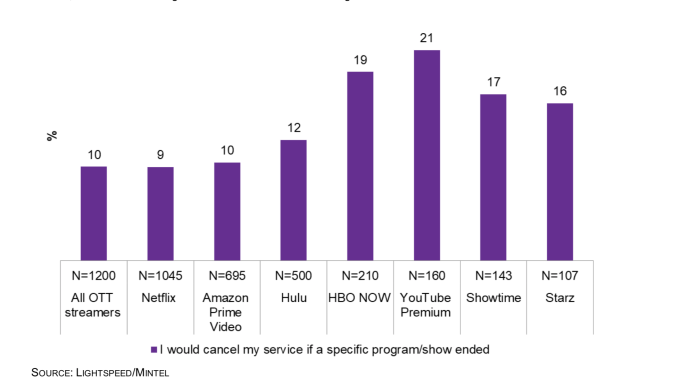
The only service that performed worse on this front was YouTube Premium. And that’s not exactly an apples-to-apples comparison, given that its subscriber base also includes YouTube viewers who want to go ad-free —  not just those who are there for its original content.

The new findings are telling in terms of how heavily HBO has been relying on Game of Thrones to grow its streaming platform over the years. In addition, the metrics indicate potential struggles ahead for HBO parent company WarnerMedia’s forthcoming streaming service. Due to launch into beta later this year, the service will be led by HBO content. But without new episodes of Game of Thrones, it will have to rely on other popular shows, like Westworld, to pull in viewers.

However, even though Westworld is HBO’s second most-watched show, Game of Thrones has triple the number of viewers.  

The network is clearly aware of the negative impacts to its streaming platform the end of Thrones will bring. It already greenlit plans for a Game of Thrones prequel, which is now filming. And it has other spinoffs in the works, too.

The prequel may not attract the same fervor as the original, but it could help bring viewers back. In the meantime, however, HBO NOW is set to see a significant number of subscribers cancelling after Sunday night.

Mintel also found that HBO NOW doesn’t have any significant traction beyond consumers who already subscribe to four or more over-the-top streaming services. These users pay for Netflix, Amazon Prime Video, and Hulu, then threw HBO into the mix in order to gain access to Game of Thrones. They’re not necessarily loyal to the network itself or interested in its other programming. And at $14.99 per month, HBO NOW is a fairly expensive addition.

With new steaming services from Apple and Disney poised to launch in the months ahead, a number of consumers will likely shift their HBO NOW dollars over to the newcomers instead, or simply pocket their savings.

The researchers also believe that smaller, lesser known streaming services could benefit by positioning their offerings as a more affordable alternative to HBO NOW.
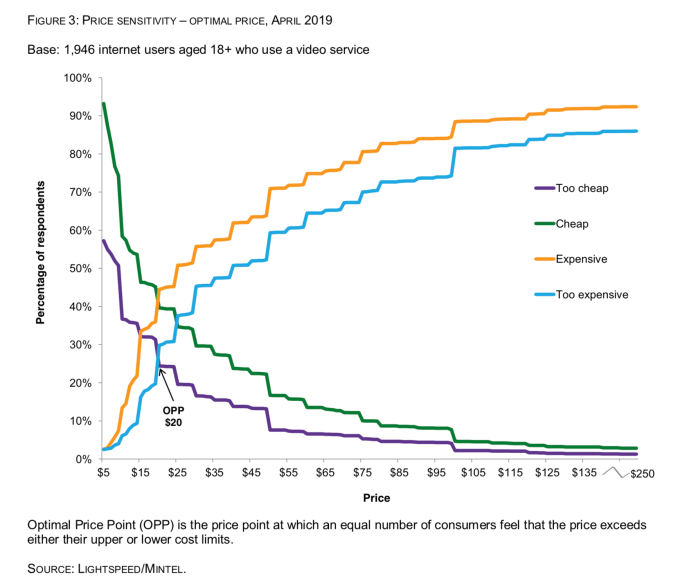
This is especially true because the study found that consumers’ ideal price point for a “perfect” streaming package — one that had everything they want to watch — would be around $20 per month. Today, that number affords them to purchase maybe two or, at the most, three services. A fourth service, like HBO NOW, has been more of a luxury expense — a must-have while Game of Thrones aired, perhaps, but not one consumers will feel comfortable paying for when the show ends.

The new report stops short of making a firm prediction on the number of cancellations HBO NOW will soon see, though.

“I’m hesitant to put a direct number on subscriptions or cancellations,” says Mintel analyst analyst Buddy Lo. “We know from the research that nearly 20 percent of HBO NOW consumers say they would cancel service over a specific program, but we didn’t definitively ask if it was specifically Game of Thrones that they will cancel over,” he tells TechCrunch.

Of course, it’s hard to imagine what other program HBO NOW subscribers would have had in mind when responding.

Mintel isn’t the only firm to dive into the potential impacts to HBO NOW subscriber growth resulting from the end of its flagship series. Last month, Second Measure pointed to historical trends that help to forecast the big subscriber drop ahead.
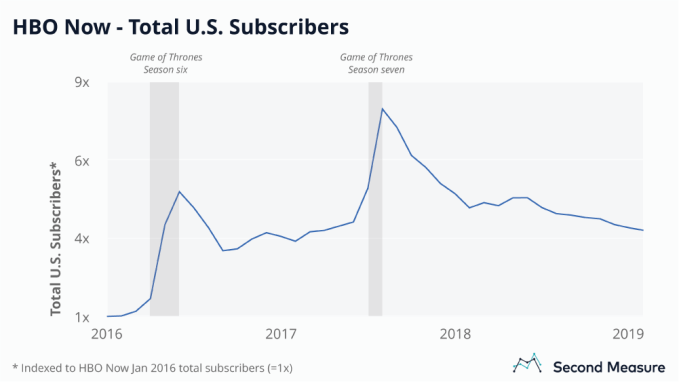
For example, HBO NOW subscribers jumped by 91 percent in the U.S. during Season 7’s airing, but steadily declined over the six months after it ended. Only 26 percent of HBO NOW subscribers who made their first payment during Game of Thrones season 7 were still subscribers six months later, the report said.

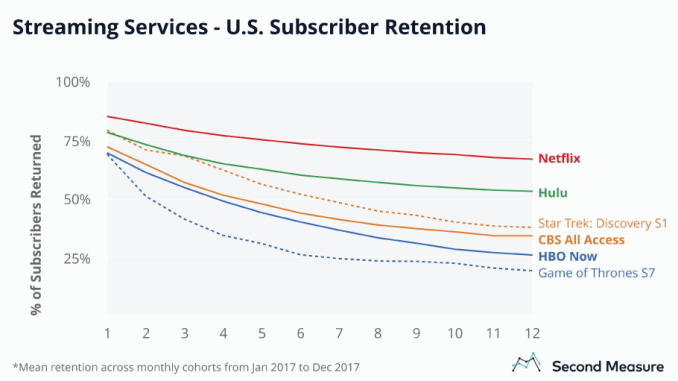
It also found that HBO NOW subscribers were far less loyal than those on other streaming services including, in order, Netflix, Hulu, and even CBS All Access — the latter thanks to the Star Trek: Discovery fan base.

And neither HBO NOW nor CBS All Access came anywhere close to the retention numbers for Netflix and Hulu, which have 6-month retention figures of 74 percent and 60 percent, respectively.
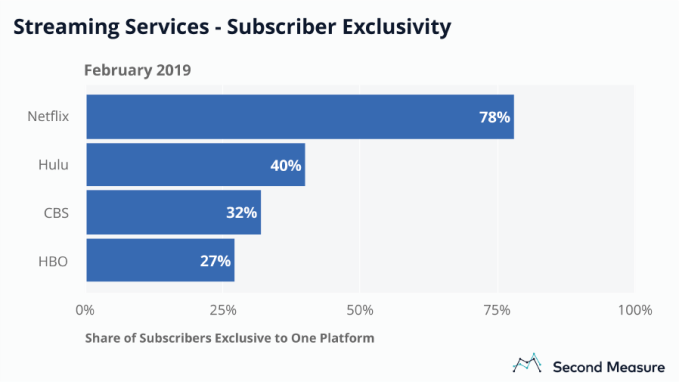
Second Measure also found Netflix and Hulu had far more exclusivity than rivals — meaning, a larger share of subscribers who only paid for their service and no others.

For Netflix, this figure was 78 percent. HBO NOW, by comparison, only had a 27 percent share of subscribers who were exclusive to its platform.
The firm predicts loyalty to a single service will continue to decline in the years ahead as consumer demand for streaming content grows.

The increased competition will make it even harder for HBO to fare well on its own. That’s why it makes sense WarnerMedia is tapping into its other properties to instead create an HBO-led “bundle” that feels more compelling than HBO alone.

Fastly pops in public offering showing that there’s still money for tech IPOs

Shares of Fastly, the service that’s used by websites to ensure that they can load faster, have popped in its first hours of trading.

The company, which priced its public offering at around $16 — the top of the estimated range for its public offering — have risen more than 50% since their debut on public markets to trade at $25.01.

It’s a sharp contrast to the public offering last week from Uber, which is only just now scratching back to its initial offering price after a week of trading underwater, and an indicator that there’s still some open space in the IPO window for companies to raise money on public markets, despite ongoing uncertainties stemming from the trade war with China.

Compared with other recent public offerings, Fastly’s balance sheet looks pretty okay. Its losses are narrowing (both on an absolute and per-share basis according to its public filing), but the company is paying more for its revenue.

San Francisco-based Fastly competes with companies that include Akamai, Amazon, Cisco and Verizon, providing data centers and a content-distribution service to deliver videos from companies like The New York Times, Ticketmaster, New Relic and Spotify.

Last year, the company reported revenues of $144.6 million and a net loss of $30.9 million, up from $104.9 million in revenue and $32.5 million in losses in the year ago period. Revenue was up more than 38% and losses narrowed by 5% over the course of the year.

The outcome is a nice win for Fastly investors, including August Capital, Iconiq Strategic Partners, O’Reilly AlphaTech Ventures and Amplify Partners, which backed the company with $219 million in funding over the eight years since Artur Bergman founded the business in 2011.

At this point, SoftBank Group is really just its Vision Fund

Last week, SoftBank Group Corp. — Masayoshi Son’s holding company for his rapidly expanding collection of businesses — reported its fiscal year financials. There were some major headlines that came out of the news, including that the company’s Vision Fund appears to be doing quite well and that SoftBank intends to increase its stake in Yahoo Japan.

Now that the dust has settled a bit, I wanted to dive into all 80 pages of the full financial results to see what else we can learn about the conglomerate’s strategy and future.

The Vision Fund is just dominating the financials

We talk incessantly about the Vision Fund here at TechCrunch, mostly because the fund seems to be investing in every startup that generates revenue and walks up and down Sand Hill looking for capital. During the last fiscal year ending March 31st, the fund added 36 new investments and reached 69 active holdings. The total invested capital was a staggering $60.1 billion.

Daily Crunch: Amazon backs Deliveroo

The Daily Crunch is TechCrunch’s roundup of our biggest and most important stories. If you’d like to get this delivered to your inbox every day at around 9am Pacific, you can subscribe here.

1. Amazon leads $575M investment in Deliveroo

Amazon is taking a slice of Europe’s food delivery market by leading a $575 million investment in Deliveroo.

London-based Deliveroo operates in 14 countries, including the U.K., France, Germany and Spain, and — outside of Europe — Singapore, Taiwan, Australia and the UAE. Across those markets, it claims it works with 80,000 restaurants with a fleet of 60,000 delivery people and 2,500 permanent employees.

2. A year after outcry, carriers are finally stopping sale of location data, letters to FCC show

Reports emerged a year ago that all the major cellular carriers in the U.S. were selling location data to third-party companies, which in turn sold them to pretty much anyone willing to pay. New letters published by the FCC show that despite a year of scrutiny and anger, the carriers have only recently put an end to this practice.

3. Trump’s Huawei ban ‘wins’ one trade battle, but the US may lose the networking war

While U.S. government officials celebrate what they must consider to be a win in their battle against the low-cost, high-performance networking vendor Huawei and other Chinese hardware manufacturers, the country is at risk of falling seriously behind in the broader competition.

4. Apple & Google celebrate Global Accessibility Awareness Day with featured apps, new shortcuts

Apple celebrated Global Accessibility Awareness Day by rolling out a practical, accessibility focused collection of new Siri Shortcuts, alongside accessibility focused App Store features and collections. Google did something similar for Android users on Google Play.

5. Minecraft Earth makes the whole real world your very own blocky realm

The team at Minecraft is making its biggest leap yet — to a real-world augmented reality game in the vein of Pokémon GO, called Minecraft Earth.

6. Stack Overflow confirms breach, but customer data said to be unaffected

“We discovered and investigated the extent of the access and are addressing all known vulnerabilities,” VP of Engineering Mary Ferguson wrote. “We have not identified any breach of customer or user data.”

7. How startups can use Amazon’s SEO best practices to dominate new shopping verticals

Eli Schwartz argues that retailers in nascent verticals have an opportunity to follow Amazon’s SEO playbook and become the default ranking e-commerce website. (Extra Crunch membership required.)

Postmates CEO Bastian Lehmann is coming to Disrupt SF

It’s a busy time for Postmates — the logistics and delivery company is prepping for its IPO on the back of a fresh $100 million raise in February. However, founder and CEO Bastian Lehmann is still carving some time out of his schedule to join us at Disrupt SF in October.

Before Postmates, Lehmann cofounded Curated.by, a real-time tweet curation platform based out of London. The German native founded Postmates in March 2011 and turned the brand into a household name.

The logistics and food delivery market is clearly growing, particularly when you look at the sheer amount of cash flowing into startups like Postmates ($678 million) and competitors DoorDash ($1.4 billion) and Deliveroo ($1.5 billion). That said, the business of on-demand delivery has its challenges. The fact that humans are delivering real-world products using actual transportation in the physical world creates a lot of opportunity for things to go wrong.

But Postmates has never played it safe.

The startup continues to iterate and experiment with new types of products and models. In 2017, Postmates took on a handful of new competitors with the launch of alcohol delivery. The company tried its hand at grocery delivery in a number of ways, including launching its own grocery delivery service as well as partnerships with Instacart and Walmart.

The company has also continued to evolve its Postmates Unlimited product, a subscription which allows power-users to pay $9.99/month to skip the delivery fees.

Postmates even introduced its own autonomous delivery robot called Serve in December 2018.

But perhaps most impressive is the fact that Postmates was able to keep the product fresh while expanding… rapidly.

Seven months ago, Postmates was available in 550 cities across the country. Now, the service is operational in 3,000 cities nationally, available to 70 percent of the people in the U.S., with more than 500K merchants on the platform.

We’re thrilled to sit down with Lehmann at Disrupt to discuss lessons learned and what happens next. Disrupt SF runs October 2 to October 4 at the Moscone Center in SF. Tickets are available here.

https://tcprotectedembed.com/protected-iframe/661cf9b1b8f85f5aae09b8946cafadba

( function() {
var func = function() {
var iframe = document.getElementById(‘wpcom-iframe-661cf9b1b8f85f5aae09b8946cafadba’)
if ( iframe ) {
iframe.onload = function() {
iframe.contentWindow.postMessage( {
‘msg_type’: ‘poll_size’,
‘frame_id’: ‘wpcom-iframe-661cf9b1b8f85f5aae09b8946cafadba’
}, “https:\/\/tcprotectedembed.com” );
}
}

// Autosize iframe
var funcSizeResponse = function( e ) {

var origin = document.createElement( ‘a’ );
origin.href = e.origin;

// Verify message origin
if ( ‘tcprotectedembed.com’ !== origin.host )
return;

// Verify message is in a format we expect
if ( ‘object’ !== typeof e.data || undefined === e.data.msg_type )
return;

switch ( e.data.msg_type ) {
case ‘poll_size:response’:
var iframe = document.getElementById( e.data._request.frame_id );

if ( iframe && ” === iframe.width )
iframe.width = ‘100%’;
if ( iframe && ” === iframe.height )
iframe.height = parseInt( e.data.height );

return;
default:
return;
}
}

if ( ‘function’ === typeof window.addEventListener ) {
window.addEventListener( ‘message’, funcSizeResponse, false );
} else if ( ‘function’ === typeof window.attachEvent ) {
window.attachEvent( ‘onmessage’, funcSizeResponse );
}
}
if (document.readyState === ‘complete’) { func.apply(); /* compat for infinite scroll */ }
else if ( document.addEventListener ) { document.addEventListener( ‘DOMContentLoaded’, func, false ); }
else if ( document.attachEvent ) { document.attachEvent( ‘onreadystatechange’, func ); }
} )();

Alphabet’s Wing drone deliveries are coming to Finland next month

Slowly but surely, Wing is spreading. Just last month, the one-time Google moonshot started deliveries for select locales in Australia’s capital city, Canberra. Now it’s moving into Finland, taking on that country’s own capital, Helsinki.

Drone deliveries will start just month — which may just make the “spring” timeframe it announced late last year. Like the Australian deliveries, this is considered a “pilot” program, with select goods and limited geography. Specifically things are being test driven in the Vuosaari distract — the city’s most populated.

Wing notes on its Medium page,

Vuosaari is an inspiring locale for Wing in several ways. Helsinki’s most populous district, it is bordered by water on three sides, with significant forestland alongside residential areas and a large international cargo port. The density of Vuosaari’s population makes it a great place to launch our first service to multi-family housing communities as well.

The program will kick off with two partners: gourmet super market, Herkku Food Mark and Cafe Monami. That means everything from salmon sandwiches to pastries delivered via drone.

As Wing notes, the program arrives as Helsinki is making a push to lessen dependence on car ownership by improving public transit citywide.

Amazon now sells flight tickets in India

Indians can already use Amazon to pay for their mobile bills and borrow money to purchase items, but now there’s more. This week, the ecommerce giant quietly introduced an additional feature to its shopping site: flight tickets.

Amazon has partnered with local travel service Cleartrip to add flight booking option to its payment service — Amazon Pay — in India, according to an FAQ posted on its website. The feature, first spotted by news outlet Skift, is available on its Indian website and app.

The addition of plane ticketing underscores Amazon’s growing interest in expanding its payment service in India, which is both one of its fastest-growing markets and a country it uses to test new ideas.

Since launching Amazon Pay in India in late 2016, the company has added a myriad of features to the service. Amazon Pay today allows Indians to top up their phones, cable TV subscriptions, and pay for electricity and water bills. Last month, Amazon announced support for peer-to-peer (P2P) money transfers for users of its Android app. Amazon also plans to soon let users order food from its website, local media reported last month.

The company has also inked deals with other top firms such as movie ticketing site BookMyShow, food delivery startup Swiggy, and bus ticketing startup Redbus to embed Amazon Pay into many popular Indian services. To spur its adoption, the company has offered cashback incentives to those who checkout using Amazon Pay.

The flight ticketing option is not much different. The company is promising a one-time cashback of up to Rs 2,000 ($28.20) for each first booking.

The push comes as many local companies in India and those that operate in the nation begin to mold their apps into so-called super apps. Top mobile wallet service Paytm has expanded to add a number of financial services, including as of this week a credit card, in recent years. India’s ride-hailing service Ola also entered the credit card business this week

Truecaller, an app that lets users screen for spam calls, has added messaging and payment features in India. The bundling often seems big names work together. For example, Paytm recently partnered with Zomato to test food ordering option on the mobile wallet app, a source with knowledge of the partner told TechCrunch.

Amazon’s interest in flight ticketing option in India should also help its partner ClearTrip gain a larger foothold in the nation. The company competes with giant MakeMyTrip, Booking.com, and Paytm . Google also offers flights in India, though, at the moment, that is limited to search. When it comes to transactions, users are directed to ticketing websites to complete their purchase.

Microsoft aims to train and certify 15,000 workers on A.I. skills by 2022

Microsoft is investing in certification and training for a range of A.I.-related skills in partnership with education provider General Assembly, the companies announced this morning. The goal is to train some 15,000 people by 2022 in order to increase the pool of A.I. talent around the world. The training will focus on A.I., machine learning, data science, cloud and data engineering and more.

In the new program’s first year, Microsoft will focus on training 2,000 workers to transition to a A.I. and machine learning role. And over the full three years, it will train an additional 13,000 workers with A.I.-related skills.

As part of this effort, Microsoft is joining General Assembly’s new A.I. Standards Board along with other companies. Over the next six months, the Board will help to define A.I. skills standards, develop assessments, design a career framework, and create credentials for A.I. skills.

The training developed will also focus on filing the A.I. jobs currently available where Microsoft technologies are involved. As Microsoft notes, many workers today are not skilled enough for roles involving the use of Azure in aerospace, manufacturing and elsewhere. The training, it says, will focus on serving the needs of its customers who are looking to employ A.I. talent.

This will also include the creation of an A.I. Talent Network that will source candidates for long-term employment as well as contract work. General Assembly will assist with this effort by connecting its 22 campuses and the broader Adecco ecosystem to this jobs pipeline. (GA sold to staffing firm Adecco last year for $413 million.)

Microsoft cited the potential for A.I.’s impact on job creation as a reason behind the program, noting that up to 133 million new roles may be created by 2022 as a result of the new technologies. Of course, it’s also very much about making sure its own software and cloud customers can find people who are capable of working with its products, like Azure.

“As a technology company committed to driving innovation, we have a responsibility to help workers access the AI training they need to ensure they thrive in the workplace of today and tomorrow,” said Jean-Philippe Courtois, executive vice president and president of Global Sales, Marketing and Operations at Microsoft, in a statement. “We are thrilled to combine our industry and technical expertise with General Assembly to help close the skills gap and ensure businesses can maximize their potential in our AI-driven economy.”

The state of the smartphone

Earlier this month, Canalys used the word “freefall” to describe its latest reporting. Global shipments fell 6.8% year over year. At 313.9 million, they were at their lowest level in nearly half a decade.

Of the major players, Apple was easily the hardest hit, falling 23.2% year over year. The firm says that’s the “largest single-quarter decline in the history of the iPhone.” And it’s not an anomaly, either. It’s part of a continued slide for the company, seen most recently in its Q1 earnings, which found the handset once again missing Wall Street expectations. That came on the tale of a quarter in which Apple announced it would no longer be reporting sales figures.

Tim Cook has placed much of the iPhone’s slide at the feet of a disappointing Chinese market. It’s been a tough nut for the company to crack, in part due to a slowing national economy. But there’s more to it than that. Trade tensions and increasing tariffs have certainly played a role — and things look like they’ll be getting worse before they get better on that front, with a recent bump from a 10 to 25% tariff bump on $60 billion in U.S. goods.

It’s important to keep in mind here that many handsets, regardless of country of origin, contain both Chinese and American components. On the U.S. side of the equation, that includes nearly ubiquitous elements like Qualcomm processors and a Google-designed operating system. But the causes of a stagnating (and now declining) smartphone market date back well before the current administration began sowing the seeds of a trade war with China.

Image via Miguel Candela/SOPA Images/LightRocket via Getty ImagesThe underlying factors are many. For one thing, smartphones simply may be too good. It’s an odd notion, but an intense battle between premium phone manufacturers may have resulted in handsets that are simply too good to warrant the long-standing two-year upgrade cycle. NPD Executive Director Brad Akyuz tells TechCrunch that the average smartphone flagship user tends to hold onto their phones for around 30 months — or exactly two-and-a-half years.

That’s a pretty dramatic change from the days when smartphone purchases were driven almost exclusively by contracts. Smartphone upgrades here in the States were driven by the standard 24-month contract cycle. When one lapsed, it seemed all but a given that the customer would purchase the latest version of the heavily subsidized contract.

But as smartphone build quality has increased, so too have prices, as manufacturers have raised margins in order to offset declining sales volume. “All of a sudden, these devices became more expensive, and you can see that average selling price trend going through the roof,” says Akyuz. “It’s been crazy, especially on the high end.”

HPE is buying Cray for $1.3 billion

HPE announced it was buying Cray for $1.3 billion, giving it access to the company’s high performance computing portfolio, and perhaps a foothold into quantum computing in the future.

The purchase price was $35 a share, a $5.19 premium over yesterday’s close of $29.81 a share. Cray was founded in the 1970s and for a time represented the cutting edge of super computing in the United States, but times have changed, and as the market has shifted, a deal like this makes sense.

Ray Wang, founder and principal analyst at Constellation Research says this is about consolidation at the high end of the market. “This is a smart acquisition for HPE. Cray has been losing money for some time but had a great portfolio of IP and patents that is key for the quantum era,” he told TechCrunch.

While HPE’s president and CEO Antonio Neri didn’t see it in those terms, he did see an opportunity in combining the two organizations. “By combining our world-class teams and technology, we will have the opportunity to drive the next generation of high performance computing and play an important part in advancing the way people live and work,” he said in a statement.

Cray CEO and president Peter Ungaro agreed. “We believe that the combination of Cray and HPE creates an industry leader in the fast-growing High-Performance Computing and AI markets and creates a number of opportunities that neither company would likely be able to capture on their own,” he wrote in a blog post announcing the deal.

While it’s not clear how this will work over time, this type of consolidation usually involves some job loss on the operations side of the house as the two companies become one. It is also unclear how this will affect Cray’s customers as it moves to become part of HPE but HPE has plans to create a high performance computing product family using its new assets.

HPE was formed when HP split into two companies in 2014. HP Inc. was the printer division, while HPE was the enterprise side.

The deal is subject to the typical regulatory oversight, but if all goes well, it is expected to close in HPE’s fiscal Q1 2020.