MP Tom Watson wants UK competition authority to investigate Amazon’s Deliveroo stake

European restaurant delivery giant Deliveroo this morning announced that Amazon would be gobbling up a share in the company, by leading a new $575 million round of funding in it. But it looks like the e-commerce giant may be facing a little indigestion ahead.

Tom Watson, MP and deputy leader of the Labour Party, today announced that he will be asking the UK’s Competition and Markets Authority (CMA) to investigate the investment, opening the door to either imposing stronger conditions on the deal, or blocking it outright.

“It’s called surveillance capitalism,” he said today of Amazon’s approach to how it uses data from customers to build and sell products. “It’s a digital dystopia, and I shall be writing to the Competition and Markets Authority demanding they launch an investigation into this ‘investment.’”

We have contacted Watson directly to elaborate on which violation(s) he would cite in the referral and we will update as and when we hear back. Areas that the CMA might investigate could involve whether the deal would result in unfair competition, or a misuse of data.

Watson’s announcement came via a series of tweets on Twitter, in which he laid out his concerns in more detail. His words are a concise take on the key to Amazon’s business model: its focus on Deliveroo is not just to invest in new services to expand its e-commerce and logistics business, but to leverage the data generated in one operation to grow other parts of its business, too.

“Deliveroo’s CEO Will Shu welcomes a land grab by Amazon because ‘it is such a customer-obsessed organisation,’” he said, citing an interview Shu gave to the BBC about the investment. “He’s right, Amazon is obsessed. Obsessed with tracking tools, micro-targeted ads, extracting billions through monetising our personal data.

“They don’t want to get their mighty claws on a food delivery system. They want Deliveroo’s tech and data. They don’t just want to know how you eat, what you eat, when you eat. They want to know how best to extract your cash throughout your waking and sleeping hours.”

The CMA — and regulators in general — have had a mixed record when it comes to putting the foot down on large deals. On one hand, in the past European reguators approved major takeovers by Facebook of Instagram and Whatsapp — takeovers that now many are now questioning. On the other, it recently moved to block a $10 billion acquisition of Walmart’s ASDA by Sainsbury’s — effectively kicking the deal into touch.

The difference between these past cases and Amazon/Deliveroo is that the latter is an investment rather than an outright acquisition. However, there is an argument to be made that one can lead to the other, specifically in this case.

In September 2018, it was reported that Amazon had made at least two attempts to acquire Deliveroo, around the same time that Uber was also considering a bid for the company to bolster its Uber Eats business. (Deliveroo and Uber Eats have been in protracted competition to dominate higher-end, app-based food delivery services in key cities like London.)

At the time, Deliveroo was valued at around $2 billion; its valuation now is likely to be closer to $3 billion.

It’s worth pointing out too that another major acquisition that Amazon has made in Europe, of LoveFilm (to build eventually its Netflix competitor Amazon Prime Video), also started with an investment.

Amazon has had mixed success so far when it comes to food in London: it launched Amazon Restaurants in 2016 as one of the first markets for its move into food delivery, but closed it in 2018 (this is reportedly around the time that it first started to take an interest in Deliveroo).

Amazon has meanwhile been gradually expanding Amazon Fresh, Amazon Pantry and other grocery delivery in the UK, but has yet to really utilise its relatively recent ownership of Whole Foods to expand that business beyond a few retail locations in London.

In the UK, there have also been rumors that Amazon has considered snapping up real estate from failing brick-and-mortar superstores, although so far nothing has materialised.

In that context, a stake in Deliveroo could well be one development in what is a very long-term play for Amazon, a company known for pulling off tenacious, long-term plays. Whether the CMA chooses to investigate both the deal as well as that wider context will be an interesting one to chew on.

Minecraft Earth makes the whole real world your very own blocky realm

When your game tops a hundred million players, your thoughts naturally turn to doubling that number. That’s the case with the creators, or rather stewards, of Minecraft at Microsoft, where the game has become a product category unto itself. And now it is making its biggest leap yet — to a real-world augmented reality game in the vein of Pokemon GO, called Minecraft Earth.

Announced today but not playable until summer (on iOS and Android) or later, MCE (as I’ll call it) is full-on Minecraft, reimagined to be mobile and AR-first. So what is it? As executive producer Jesse Merriam put it succinctly: “Everywhere you go, you see Minecraft. And everywhere you go, you can play Minecraft.”

Yes, yes — but what is it? Less succinctly put, MCE is like other real-world based AR games in that it lets you travel around a virtual version of your area, collecting items and participating in mini-games. Where it’s unlike other such games is that it’s built on top of Minecraft: Bedrock Edition, meaning it’s not some offshoot or mobile cash-in; this is straight-up Minecraft, with all the blocks, monsters, and redstone switches you desire, but in AR format. You collect stuff so you can build with it and share your tiny, blocky worlds with friends.

That introduces some fun opportunities and a few non-trivial limitations. Let’s run down what MCE looks like — verbally, at least, since Microsoft is being exceedingly stingy with real in-game assets.

There’s a map, of course

Because it’s Minecraft Earth, you’ll inhabit a special Minecraftified version of the real world, just as Pokemon GO and Harry Potter: Wizards Unite put a layer atop existing streets and landmarks.

The look is blocky to be sure but not so far off the normal look that you won’t recognize it. It uses OpenStreetMaps data, including annotated and inferred information about districts, private property, safe and unsafe places, and so on — which will be important later.

The fantasy map is filled with things to tap on, unsurprisingly called tappables. These can be a number of things: resources in the form of treasure chests, mobs, and adventures.

Chests are filled with blocks, naturally, adding to your reserves of cobblestone, brick, and so on, all the different varieties appearing with appropriate rarity.

A pig from Minecraft showing in the real world via augmented reality.Mobs are animals like those you might normally run across in the Minecraft wilderness: pigs, chickens, squid, and so on. You snag them like items, and they too have rarities, and not just cosmetic ones. The team highlighted a favorite of theirs, the muddy pig, which when placed down will stop at nothing to get to mud and never wants to leave, or a cave chicken that lays mushrooms instead of eggs. Yes, you can breed them.

Last are adventures, which are tiny AR instances that let you collect a resource, fight some monsters, and so on. For example you might find a crack in the ground that, when mined, vomits forth a volume of lava you’ll have to get away from, and then inside the resulting cave are some skeletons guarding a treasure chest. The team said they’re designing a huge number of these encounters.

Importantly, all these things, chests, mobs, and encounters, are shared between friends. If I see a chest, you see a chest — and the chest will have the same items. And in an AR encounter, all nearby players are brought in, and can contribute and collect the reward in shared fashion.

And it’s in these AR experiences and the “build plates” you’re doing it all for that the game really shines.

The AR part

“If you want to play Minecraft Earth without AR, you have to turn it off,” said Torfi Olafsson, the game’s director. This is not AR-optional, as with Niantic’s games. This is AR-native, and for good and ill the only way you can really play is by using your phone as a window into another world. Fortunately it works really well.

First, though, let me explain the whole build plate thing. You may have been wondering how these collectibles and mini-games amount to Minecraft. They don’t — they’re just the raw materials for it.

Whenever you feel like it, you can bring out what the team calls a build plate, which is a special item, a flat square that you virtually put down somewhere in the real world — on a surface like the table or floor, for instance — and it transforms into a small, but totally functional, Minecraft world.

In this little world you can build whatever you want, or dig into the ground, build an inverted palace for your cave chickens or create a paradise for your mud-loving pigs — whatever you want. Like Minecraft itself, each build plate is completely open-ended. Well, perhaps that’s the wrong phrase — they’re actually quite closely bounded, since the world only exists out to the edge of the plate. But they’re certainly yours to play with however you want.

Notably all the usual Minecraft rules are present — this isn’t Minecraft Lite, just a small game world. Water and lava flow how they should, blocks have all the qualities they should, and mobs all act as they normally would.

The magic part comes when you find that you can instantly convert your build plate from miniature to life-size. Now the castle you’ve been building on the table is three stories tall in the park. Your pigs regard you silently as you walk through the halls and admire the care and attention to detail with which you no doubt assembled them. It really is a trip.

It doesn’t really look like this but you get the idea.

In the demo, I played with a few other members of the press, we got to experience a couple build plates and adventures at life-size (technically actually 3/4 life size — the 1 block to 1 meter scale turned out to be a little daunting in testing). It was absolute chaos, really, everyone placing blocks and destroying them and flooding the area and putting down chickens. But it totally worked.

The system uses Microsoft’s new Azure Spatial Anchor system, which quickly and continuously fixed our locations in virtual space. It updated remarkably quickly, with no lag, showing the location and orientation of the other players in real time. Meanwhile the game world itself was rock-solid in space, smooth to enter and explore, and rarely bugging out (and that only in understandable circumstances). That’s great news considering how heavily the game leans on the multiplayer experience.

The team said they’d tested up to 10 players at once in an AR instance, and while there’s technically no limit, there’s sort of a physical limit in how many people can fit in the small space allocated to an adventure or around a tabletop. Don’t expect any giant 64-player raids, but do expect to take down hordes of spiders with three or four friends.

Pick(ax)ing their battles

In choosing to make the game the way they’ve made it, the team naturally created certain limitations and risks. You Wouldn’t want, for example, an adventure icon to pop up in the middle of the highway.

For exactly that reason the team spent a lot of work making the map metadata extremely robust. Adventures won’t spawn in areas like private residences or yards, though of course simple collectibles might. But because you’re able to reach things up to 70 meters away, it’s unlikely you’ll have to knock on someone’s door and say there’s a cave chicken in their pool and you’d like to touch it, please.

Furthermore adventures will not spawn in areas like streets or difficult to reach areas. The team said they worked very hard making it possible for the engine to recognize places that are not only publicly accessible, but safe and easy to access. Think sidewalks and parks.

Another limitation is that, as an AR game, you move around the real world. But in Minecraft verticality is an important part of the gameplay. Unfortunately the simple truth is that in the real world you can’t climb virtual stairs or descend into a virtual cave. You as a player exist on a 2D plane, and can interact with but not visit places above and below that plane. (An exception of course is on a build plate, where in miniature you can fly around it freely by moving your phone).

That’s a shame for people who can’t move around easily, though you can pick up and rotate the build plate to access different sides. Weapons and tools also have infinite range, eliminating a potential barrier to fun and accessibility.

What will keep people playing?

In Pokemon GO, there’s the drive to catch ’em all. In Wizards Unite, you’ll want to advance the story and your skills. What’s the draw with Minecraft Earth? Well, what’s the draw in Minecraft? You can build stuff. And now you can build stuff in AR on your phone.

The game isn’t narrative-driven, and although there is some (unspecified) character progression, for the most part the focus is on just having fun doing and making stuff in Minecraft. Like a set of LEGO blocks, a build plate and your persistent inventory simply make for a lively sandbox.

Admittedly that doesn’t sound like it carries the same addictive draw of Pokemon, but the truth is Minecraft kind of breaks the rules like that. Millions of people play this game all the time just to make stuff and show that stuff to other people. Although you’ll be limited in how you can share to start, there will surely be ways to explore popular builds in the future.

And how will it make money? The team basically punted on that question — they’re fortunately in a position where they don’t have to worry about that yet. Minecraft is one of the biggest games of all time and a big money-maker — it’s probably worth the cost just to keep people engaged with the world and community.

MCE seems to me like a delightful thing but one that must be appreciated on its own merits. A lack of screenshots and gameplay video isn’t doing a lot to help you here, I admit. Trust me when I say it looks great, plays well, and seems fundamentally like a good time for all ages.

A few other stray facts I picked up:

  • Regions will roll out gradually but it will be available in all the same languages as Vanilla at launch
  • Yes, there will be skins (and they’ll carry over from your existing account)
  • There will be different sizes and types of build plates
  • There’s crafting, but no 3×3 crafting grid (?!)
  • You can report griefers and so on, but the way the game is structured it should be an issue
  • The AR engine creates and uses a point cloud but doesn’t like take pictures of your bedroom
  • Content is added to the map dynamically, and there will be hot spots but emptier areas will fill up if you’re there
  • It leverages AR Core and AR Kit, naturally
  • The Hololens version of Minecraft we saw a while back is a predecessor “more spiritually than technically”
  • Adventures that could be scary to kids have a special sign
  • “Friends” can steal blocks from your build plate if you’re playing together (or donate them)

Sound fun? Sign up for the beta here.

Health[at]Scale lands $16M Series A to bring machine learning to healthcare

Health[at]Scale, a startup with founders who have both medical and engineering expertise, wants to bring machine learning to bear on healthcare treatment options to produce outcomes with better results and less aftercare. Today the company announced a $16 million Series A. Optum, which is part of the UnitedHealth Group, was the sole investor .

Today, when people looks at treatment options, they may look at a particular surgeon or hospital, or simply what the insurance company will cover, but they typically lack the data to make truly informed decisions. This is true across every part of the healthcare system, particularly in the U.S. The company believes using machine learning, it can produce better results.

“We are a machine learning shop, and we focus on what I would describe as precision delivery. So in other words, we look at this question of how do we match patients to the right treatments, by the right providers, at the right time,” Zeeshan Syed, Health at Scale CEO told TechCrunch.

The founders see the current system as fundamentally flawed, and while they see their customers as insurance companies, hospital systems and self-insured employers; they say the tools they are putting into the system should help everyone in the loop get a better outcome.

The idea is to make treatment decisions more data driven. While they aren’t sharing their data sources, they say they have information from patients with a given condition, to doctors who treat that condition, to facilities where the treatment happens. By looking at a patient’s individual treatment needs and medical history, they believe they can do a better job of matching that person to the best doctor and hospital for the job. They say this will result in the fewest post-operative treatment requirements, whether that involves trips to the emergency room or time in a skilled nursing facility, all of which would end up adding significant additional cost.

If you’re thinking this is strictly about cost savings for these large institutions, Mohammed Saeed, who is the company’s chief medical officer and has and MD from Harvard and a PhD in electrical engineering from MIT, insists that isn’t the case. “From our perspective, it’s a win-win situation since we provide the best recommendations that have the patient interest at heart, but from a payer or provider perspective, when you have lower complication rates you have better outcomes and you lower your total cost of care long term,” he said.

The company says the solution is being used by large hospital systems and insurer customers, although it couldn’t share any. The founders also said, it has studied the outcomes after using its software and the machine learning models have produced better outcomes, although it couldn’t provide the data to back that up at that point at this time.

The company was founded in 2015 and currently has 11 employees. It plans to use today’s funding to build out sales and marketing to bring the solution to a wider customer set.

LG developed its own AI chip to make its smart home products even smarter

As its once-strong mobile division continues to slide, LG is picking up its focus on emerging tech. The company has pushed automotive, and particularly its self-driving capabilities, and today it doubled down on its smart home play with the announcement of its own artificial intelligence (AI) chip.

LG said the new chip includes its own neural engine that will improve the deep-learning algorithms used in its future smart home devices, which will include robot vacuum cleaners, washing machines, refrigerators and air conditioners. The chip can operate without an internet connection thanks to on-device processing, and it uses “a separate hardware-implemented security zone” to store personal data.

“The AI Chip incorporates visual intelligence to better recognize and distinguish space, location, objects and users while voice intelligence accurately recognizes voice and noise characteristics while product intelligence enhances the capabilities of the device by detecting physical and chemical changes in the environment,” the company wrote in an announcement.

To date, companies seeking AI or machine learning (ML) smarts at chipset level have turned to established names like Intel, ARM and Nvidia, with upstarts including Graphcore, Cerebras and Wave Computing provided VC-fueled alternatives.

There is, indeed, a boom in AI and ML challengers. A New York Times report published last year estimated that “at least 45 startups are working on chips that can power tasks like speech and self-driving cars,” but that doesn’t include many under-the-radar projects financed by the Chinese government.

LG isn’t alone in opting to fly solo in AI. Facebook, Amazon and Apple are all reported to be working on AI and ML chipsets for specific purposes. In LG’s case, its solution is customized for smarter home devices.

“Our AI C​hip is designed to provide optimized artificial intelligence solutions for future LG products. This will further enhance the three key pillars of our artificial intelligence strategy – evolve, connect and open – and provide customers with an improved experience for a better life,” IP Park, president and CTO of LG Electronics, said in a statement.

The company’s home appliance unit just recorded its highest quarter of sales and profit to date. Despite a sluggish mobile division, LG posted an annual profit of $2.4 billion last year with standout results for its home appliance and home entertainment units — two core areas of focus for AI.

Unpacking Away’s $1.4B valuation, the startup studio model and CrowdStrike’s S-1

Hello and welcome back to Equity, TechCrunch’s venture capital-focused podcast, where we unpack the numbers behind the headlines.

This week was something a bit special for the team, albeit in a sad way. It marked the last episode in which we’d all be together in the current TechCrunch office. It’s a place we’ve spent so much time in so we were all a bit nostalgic. (TC is moving offices, nothing else is changing!)

Anyway, there was news to discuss!

After Alex went through what he called a “mid-quarter check-in” we got into the meat of things, kicking off with Kate’s recent story on Madrona’s new startup studio. The $11 million that will be spent on spinning up ideas and spinning out companies forms a model that could be exported to other cities. In Kate’s view, there are a few other cities in the nation where the idea could work.

After that, we dug into two different pieces of scooter news (Boo!), namely that you can get a Boosted-branded electric scooter for $1,600 or the new Bird One scooter for around $1,300. You know, if you can’t find one to rent and want to absorb the maintenance and charging headaches yourself.

Next, we turned to Away, a brand you would recognize if we showed you its most famous product. Away has raised another $100 million in Series D funding at a $1.4 billion valuation. Sure, that’s a big jump from its $400 million Series C valuation but we think it makes sense.

After that, we had to get to the latest from Impossible Foods, which is now sitting atop $300 million fresh dollars. This announcement comes hot off the heels of Impossible Foods’ partnership with Burger King.

Finally, we turned to the latest S-1 filing from tech: CrowdStrike . You can read Kate’s notes here, and Alex’s here, but the gist is that this company will go public, the only question is how to price it.

Oh, and Slack is pulling off its direct listing on June 20th. Get hyped!

Equity drops every Friday at 6:00 am PT, so subscribe to us on Apple PodcastsOvercast, Pocket Casts, Downcast and all the casts.

Tutor House, the UK-based tutoring platform, scores £2M from Fuel Ventures

Tutor House, a U.K.-based startup that operates a marketplace to let parents find an online or in-person tutor for their children, has raises £2 million in funding.

Backing the round, the first for the young company, is Fuel Ventures, the London-based VC and startup builder set up by Mark Pearson of MyVoucherCodes fame. Fuel Ventures recently closed its third fund of £20 million to continue investing in early-stage B2B and B2C marketplaces, platforms and SaaS.

Founded by Ex-teacher Alex Dyer in 2012 — and self-funded until now — Tutor House connects parents and families with tutors either in-person or online. The site enables families to search for tutors across an array of subjects and academic levels, and now claims to be the U.K.’s leading tutoring agency offering private home or remote tuition for all Primary, GCSE, A-Level and University subjects.

“The large number of teachers leaving their profession in addition to ever increasing class sizes mean that the market for private tutoring has expanded significantly,” former psychology teacher and now Tutor House CEO Dyer tells me. “In order to improve the quality of each student’s academic experience, our tutors provide personalised learning plans that will help to boost grades and give learners the best chance of success”.

In addition, Dyer says that Tutor House is the only tutoring platform that interviews all tutors and ensures that they have a full DBS check before going live on the platform. “In an unregulated industry this is very important,” he adds. “We are dedicated to providing each and every student with the best level of service possible”.

Typical Tutor House customers fall into four groups. The first is hands-on parents who want the best for their child regardless of price. The second is parents who see education as important but may have to ask relatives for help with costs. The third is students who can’t access education in a mainstream school due to anxiety or other SEN related issues. “These students often need to retake A-level or GCSE exams due to poor teaching/no teacher,” says Dyer. The final group is university students and adult learners who are investing in their future by taking learning into their own hands.

A classic marketplace play, Tutor House charges tutors a 20 percent commission fee for every booking. However, if a tutor books more than twenty hours a month, the commission is reduced. “We also offer A-Level and Pre-U retake courses, in addition to residential courses and homeschooling,” explains Dyer.

Meanwhile, Tutor House says it will use the investment from Fuel Ventures to expand into other countries, and to create a bespoke school in London for students who need intensive tutoring for exam retakes.

Trump’s Huawei ban ‘wins’ one trade battle, but the US may lose the networking war

While U.S. government officials celebrate what they must consider to be a win in their battle against the low-cost, high-performance networking vendor Huawei and other Chinese hardware manufacturers, the country is at risk of falling seriously behind in the broader, global competition for telecom tech and customers.

It may be a race that the U.S. is willing to concede, but it should be noted that Huawei’s sphere of influence on other shores continues to expand, even as the company’s ability to operate in the U.S. is completely proscribed.

Indeed, Huawei’s executive director and chairman of its investment review board, David Wang, told Bloomberg that, “Our U.S. business is not that big. We have global operations. We still will have stable operations.”

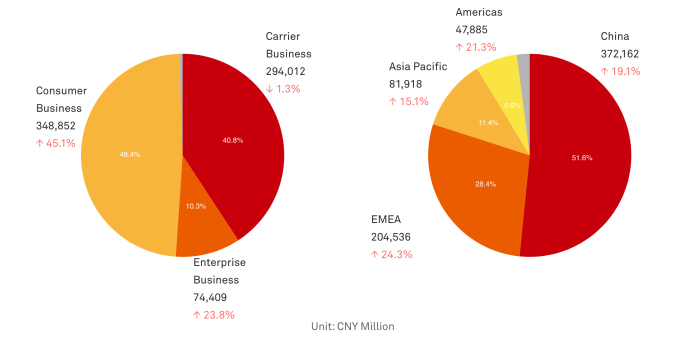
Wang is right… to a point. Huawei derives most of its sales from international markets, according to a 2018 financial report released earlier this year, but it depends heavily on technology from U.S. chip manufacturers for its equipment. Without those supplies, Huawei could find itself in a very difficult spot, indeed.

Huawei’s end of year financials showed its consumer devices business is now its main money-maker, while the majority of its revenue is not derived from the U.S. market

And the U.S. has its reasons for working to stymie Huawei’s efforts to expand the reach of its networking technologies as this excellent Twitter thread from Adam Townsend persuasively argues.

https://platform.twitter.com/widgets.js

Essentially, China has invested its basically limitless capital into subsidizing next-gen wireless technology and buying up next-generation startups and innovators, all while the U.S. has borne early stage risk. Meanwhile, it is also using unlimited money to poach regulators and industry experts who might advocate against it.

Huawei continues to make inroads in nations across the emerging markets of Latin America, Eastern Europe, Southeast Asia and Africa where demand for connectivity is on the rise. Those are regions where the U.S. has plenty of strategic interests, but America’s ability to sway public opinion or entice governments to act against Chinese networking companies could be severely limited by its inability to offer meaningful incentives or alternatives to them.

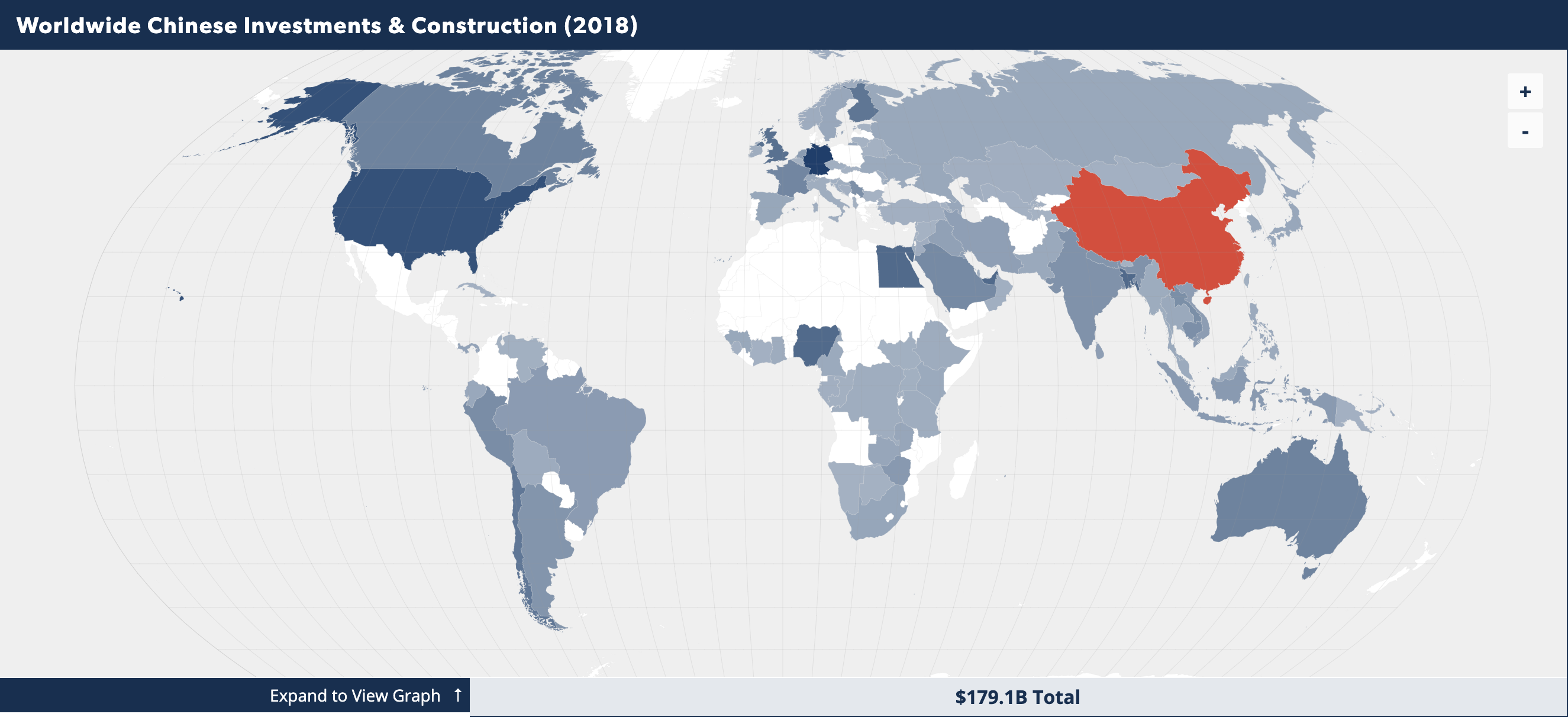
Even with the passage of the BUILD Act in October 2018, which was meant to revitalize U.S. foreign aid and investment with a $60 billion package, it’s worth noting that China spent nearly $47 billion in foreign investment in Europe alone in 2018. Chinese direct investments totaled another $49.45 billion into Africa and the Middle East and $18 billion into South America, according to data from the American Enterprise Institute, compiled by Foreign Policy.

Map courtesy of the American Enterprise Institute.

Those investments have turned nations that should be staunch political allies into reluctant or simply rhetorical backers of the U.S. position. Take the relationship between the U.S. and Brazil, for example — a historically strong partnership going back years and one that seemingly only strengthened given the similarities between the two ultraconservative leaders in power in both nations.

However, as Foreign Affairs reports, Brazil is unlikely to accede to President Trump’s demands that Brazil aids in steps to block China’s economic expansion.

“Brazilian business groups have already begun to defend the country’s deep trade ties to China, rightly pointing out that any hope of containing China and once more turning the United States into Brazil’s most important trading partner is little more than unrealistic nostalgia,” writes Foreign Affairs correspondent, Oliver Stuenkel. “Working alongside powerful military generals, these business associations are mobilizing to avoid any delays that sidelining Huawei in the region could cause in getting 5G up and running.”

The whole article is worth reading, but its refrain is that the attempts by U.S. government officials to paint Huawei and Chinese economic inroads as a national security threat in developing economies are largely falling on deaf ears.

It’s not just networking technologies either. As one venture capitalist who invests in Latin America and the U.S. told TechCrunch anonymously: “It’s interesting how the U.S.-China relationships are going to affect what is happening in Latin America. The Chinese are already being more aggressive on the banking side.”

China’s big technology companies are also taking an interest in South America, both as vendors and as investors on the continent.

In an article in Crunchbase, the South American and Chinese-focused venture capitalist, Nathan Lustig underscored the trend. Lustig wrote:

In both the private and the public sectors, China is swiftly increasing its support for Latin America. Chinese expertise in financial technology, as well as its influence in developing markets around the world, is turning China into a strategic partner for startups and entrepreneurs in Latin America. Most of the Chinese investment in Latin America so far is going to Brazil, although this is likely to spread across the region as Chinese investors become better-acquainted with the local tech ecosystems, most likely to Mexico.

Beyond the Didi Chuxing acquisition of Brazil’s 99 in January, Chinese companies began investing heavily in Brazilian fintech startups, specifically Nubank and StoneCo, this year.

Indeed, China has an entire catalog of low-cost technologies and economic packages from state-owned and privately held investors to support their adoption, backing up its position as the leader for tech across a range of applications in emerging markets.

For the U.S. to compete, it will have to look beyond protectionism at its shores to actual commitments to greater economic development abroad. With lower tax revenues coming in and the prospect of giant deficits building up as far as the eye can see, there’s not much room to promote an alternative to Huawei internationally. That could leave the country increasingly isolated and create far more problems as it gets left behind.

Macron defends his startup-friendly policies

For the third year as president, France’s president Emmanuel Macron talked to the French tech ecosystem at VivaTech in Paris. This time, he used this opportunity to defend his policies so far and say that tech startups have nearly everything they need to succeed

Frichti’s Julia Bijaoui, TransferWise’s Flora Coleman, OpenClassrooms’ Pierre Dubuc, Vinted’s Thomas Plantenga and UiPath’s Daniel Dines shared the stage with Macron and each asked one question about funding, European regulation, talent, the digital single market, etc.

Just like last year, Macron took a strong stance when it comes to corporate taxes. “In order to compete with American giants, you need to make sure that competition is fair. You pay taxes, so the tech giant that is competing against you should pay taxes too,” Macron said.

France recently approved a tax on tech giants. If you generate more than €750 million in revenue globally and €25 million in France, you have to pay 3 percent of your French revenue in taxes, even if your company is registered in Ireland, Luxembourg or the Netherlands.

“It’s a temporary measure because we want a tax at the European level, and more generally at the OECD level,” Macron said.

When it comes to funding, things look much better now than a few years ago. There are now more than a handful of French unicorns. And Macron defended his taxation policies, such as a the flat tax on capital gain and the end of the wealth tax on your shares in public or private companies.

And yet, it’s still complicated when it comes to exits — if you want to go down the public road, you most likely have to IPO in the U.S. “We have to build a European financial capital market,” Macron said. “It’ll require some modifications and deeper European integration,” he added later.

Given that Europe is about to vote for the European Parliament, a lot of Macron’s solutions involved the European Union. It sometimes felt like Macron was campaigning for his own party by saying that he wants to go further, but you need to vote for his party first.

When it comes to talent, Macron emphasized the quality of French universities and engineering schools. “We are competitive in terms of human capital and it’s no coincidence. A few years ago, everybody was saying ‘there are a lot of French people in Silicon Valley’. French people living in France are the same, but they cost much, much less,” Macron said.

He then mentioned the French Tech Visa to attract foreign talent, a special visa for tech talent and their families. The program has been overhauled a couple of months ago.

When it comes to regulation, Macron says that the European Union should follow the GDPR model. “What we did on privacy, one regulation for all, we have to do it for other areas,” he said. “On competition, on taxation, on data, we need to regulate.”

Macron concluded by defending a third way to regulate and foster tech companies, which is different from China and the U.S. “Europe can become the tech leader of tomorrow because we are building a tech ecosystem that is compatible with democracy,” he said.

According to him, China doesn’t do enough when it comes to individual rights and human rights, which could eventually backfire for tech companies. And American companies have become too powerful and out of control for the U.S. government.

China’s Luckin Coffee raises up to $651M in upsized US IPO

Another week, another cash-burning tech IPO in the U.S. Following on from Uber’s high-profile listing, ambitious Chinese startup Luckin Coffee has raised up to $650.8 million on the Nasdaq after it priced its shares at $17.

Despite concern at its high losses and little chance of near-term profitability, Luckin seems to have been greeted positively by investors. The company priced its shares at the top of its $15-$17 range and it upsized the share offering to 33 million, that’s three million more than previously planned. That gives Luckin an initial net raise of $571.2 million, although that could increase to $650.8 million if underwriters take up the full additional allocation of 4.95 million ‘greenshoe’ shares that are on offer.

The company will list on Friday under the ticker ‘LK.’

Luckin filed to go public last month, just weeks after it closed a $150 million Series B+ funding round led by New York private equity firm Blackrock, which interestingly holds a 6.58 percent stake in Starbucks. The deal valued Luckin at $2.9 billion and it took the three-year-old company to $550 million raised from investors to date.

The company has burned through incredible amounts of cash as it tries to quickly build a brand that competes with Starbucks, and the presence that the U.S. firm has built over the last 20 years in China. Through aggressive promotions and coupons, the company posted a $475 million loss in 2018, its only full year of business to date, with $125 million in revenue. For the first quarter of 2019, it carded an $85 million loss with total sales of $71 million.

We recently went in-depth on the business, which you can read here with a subscription to our Extra Crunch service, but we’ve long covered the startup’s ‘money is no object’ approach to building a digital rival to Starbucks in China.

Amazon leads $575M investment in Deliveroo

Amazon is taking a slice of Europe’s food delivery market after the U.S. e-commerce giant led a $575 million investment in Deliveroo .

First reported by Sky yesterday, the Series G round was confirmed in an early UK morning announcement from Deliveroo, which confirmed that existing backers including T. Rowe Price, Fidelity Management and Research Company, and Greenoaks also took part. The deal takes Deliveroo to just over $1.5 billion raised to date. The company was valued at over $2 billion following its previous raise in late 2017, no updated valuation was provided today.

London-based Deliveroo operates in 14 countries, including the U.K, France, Germany and Spain, and — outside of Europe — Singapore, Taiwan, Australia and the UAE. Across those markets, it claims it works with 80,000 restaurants with a fleet of 60,000 delivery people and 2,500 permanent employees.

It isn’t immediately clear how Amazon plans to use its new strategic relationship with Deliveroo — it could, for example, integrate it with Prime membership — but this isn’t the firm’s first dalliance with food delivery. The U.S. firm closed its Amazon Restaurants UK takeout business last year after it struggled to compete with Deliveroo and Uber Eats. The service remains operational in the U.S, however.

“Amazon has been an inspiration to me personally and to the company, and we look forward to working with such a customer-obsessed organization,” said Deliveroo CEO and founder Will Shu in a statement.

Shu said the new money will go towards initiatives that include growing Deliveroo’s London-based engineering team, expanding its reach and focusing on new products, including cloud kitchens that can cook up delivery meals faster and more cost-efficiently.

[Center] Will Shu, Deliveroo CEO and co-founder, on stage at TechCrunch Disrupt London