Demo your tech onstage at TC Sessions: Mobility 2019

Moving anything or anyone from point A to point B will never be the same, thanks to the rapid evolution taking place in mobility technology. And if you’re ready to demo your mobile-focused early-stage startup tech to this community’s top influencers, there’s no better place to do it than onstage at TC Sessions: Mobility 2019.

More than 1,000 of mobility’s top tech makers, founders, investors, engineers and researchers and will descend on San Jose, Calif. on July 10 to learn, teach, share and connect. This is your chance to show the community what you’ve got — submit your application to demo today.

We’re preparing a day-long intensive event that features world-class speakers, interviews, panel discussions, workshops, demos and, of course, networking. We’re not kidding around when we say world-class. Here are just two of the incredible speakers that will step onstage to share their vision, their journey and the lessons they learned along the way:

  • Alisyn Malek, COO and co-founder of May Mobility, an autonomous vehicle company, comes with serious bona fides. The former head of the innovation pipeline at General Motors, Malek also spent time as an investment manager at GM Ventures. Among other notable achievements, she’s been recognized as a top 10 female innovator to watch by Smithsonian in 2018 and named a top automotive professional under 35 to watch by LinkedIn in 2015.
  • Regina Clewlow is the CEO and co-founder of Populus AI, a data platform that helps cities manage the future of mobility. She brings more than a decade of transportation experience, during which she served as a research scientist and lecturer at Stanford, UC Berkeley and UC Davis. Before founding Populus, Clewlow was the director of business development and strategy at RideScout, and she was named a 40 Under 40 by Mass Transit magazine and the San Francisco Business Times.

TC Sessions: Mobility 2019 focuses on one of the most exciting and rapidly evolving tech categories on the planet, and this is your opportunity to place your early-stage startup smack dab in front of the people with the potential to take you and your business to the next level. Apply to demo your tech and join us onstage on July 10 in San Jose, Calif.

Startup Demo packages are also on sale. Demo packages include three (3) tickets and a table space in the exhibition hall for just $1,575. Book your Startup Demo Package here.

Is your company interested in sponsoring or exhibiting at TC Sessions: Mobility? Contact our sponsorship sales team by filling out this form.

Twitch Prime adds its first non-gaming ‘loot’ with access to anime streaming service Crunchyroll

Twitch Prime, the game streaming service’s version of Amazon Prime, has typically focused on offering subscribers free loot and other game-related perks since its debut a few years ago. Now, that’s changing. Twitch Prime is today rolling its first-ever non-gaming “loot” — a 30-day subscription to the anime streaming service Crunchyroll Premium.

Crunchyroll is a top destination for watching anime online, with over 45 million registered users and 2 million paying subscribers who usually pay $7.99 per month for its “Premium” tier. The service’s library includes over 1,000 series and 30,000 episodes. And the wider Crunchyroll brand includes things like mobile games, events, merchandise, and more.

The two companies, Twitch and Crunchyroll, already had a long-term relationship before today. For the past two years, Crunchyroll made the game streaming site the exclusive live streaming home to its annual Anime Awards show, for example, and it operates its own Twitch channel. This past year, Twitch also streamed an exclusive pre-show anime marathon where over 1.3 million online viewers watched a collective nearly 19 million minutes. The official Twitch stream of the Anime Awards show also reached nearly half a million unique viewers.

Given the clear interest from Twitch’s audience in anime, a partnership that could potentially convert some of those fans to paying subscribers makes sense for Crunchyroll.

Meanwhile, for Twitch, the move serves as a way to test expanding Twitch Prime offers to a new category — free trials of subscriptions. The larger subscription market is booming, with some saying how everything from transportation to entertainment to groceries will eventually become subscription-based. Helping those companies reach Twitch’s younger demographic — and specifically those who are already paying for a subscription with Twitch itself — could help a service boost sign-ups.

While most streaming subscriptions today offer a free trial to interested users, smaller players often still struggle with discovery amid a growing number of new entrants on the market ranging from live TV services to video-on-demand and soon, to big-name newcomers like Apple TV+ and Disney+, for example.

Twitch and Crunchyroll didn’t say what sort of revenue share would take place if Twitch Prime members chose to continue with a paid subscription when the free month wrapped.

“While we constantly focus on delighting Crunchyroll fans, we also feel it’s our responsibility to continue to proliferate the popularity of anime to new audiences,” said Eric Berman, head of partnerships at Crunchyroll, in a statement. “We pride ourselves on working with like-minded, fan-focused partners and are excited to offer all Twitch Prime members a free pass to Crunchyroll right in time for the huge spring anime season,” he added.

Amazon Fire TV tops 34 million users, widening its lead over Roku

Amazon Fire TV’s lead over rival streaming platform Roku is widening. In January at the Consumer Electronics Show in Las Vegas, Amazon said it had “well over” 30 million Fire TV users compared with Roku’s then 27 million active users. In roughly four months’ time, Fire TV has grown to over 34 million active users, according to new statements made by Amazon this week. Meanwhile, Roku grew its user base by 2 million in the first quarter of 2019 to reach 29.1 million active users, per its earnings report this month.

The new figures for Amazon Fire TV were shared yesterday by Fire TV GM and Global Head of Marketing, Growth & Engagement, Jen Prenner, at the Pay TV Show during a panel titled “The Battle for Your Living Room: Sticks, Boxes, and Smart TV Platforms.”

Amazon also claims that Fire TV has grown to become the No. 1 streaming media player platform in the U.S., U.K., Germany, India, and Japan, thanks to its strong sales momentum.

When Amazon first announced its user number at CES, there was some question as to how those figures were calculated. Roku typically defines its “active” user as someone who has streamed through its platform over the past 30 days. Amazon, at the time, had only spoken about users more generally, without characterizing them as “actives.”

However, yesterday’s comments referenced “active users,” Amazon says, not just a total number of users.

Roku dominated U.S. streaming player market share last year, but Fire TV has likely gained ground internationally. Today, the Fire TV ships worldwide to a wide range of countries, all of which can use the device to stream Prime Video content. Roku, meanwhile, ships to a couple dozen countries including the U.S., Canada, the U.K., France, and parts of Latin America. However, Roku last year had to stop sales in Mexico until it addressed issues involving access to pirated content, which were only resolved in October.

Fire TV also benefits from Amazon’s frequent and steep discounts on its hardware devices — including those over the holiday shopping period, where Fire TV Stick became a best seller. It’s been known to sell devices at cost or below, in an effort to gain market share. Plus, today’s consumers may be drawn to Fire TV because of its built-in access to Alexa — something that makes it one of the cheapest ways to get the popular voice assistant into the home.

Amazon is focused this year on expanding access to content and Alexa voice controls on Fire TV. On the content front, it recently came to an agreement with Google that allows it to finally bring YouTube to Fire TV, and following that, YouTube TV and YouTube Kids. It also has plans to support both Disney+ and Apple TV+ later this year, the company says.


G7 countries to sign charter on tech regulation in August

Digital ministers of the Group of 7 nations are meeting today to discuss an upcoming charter on toxic content and tech regulation at large. Those countries plan to sign a charter during the annual G7 meeting in Biarritz, France in August.

“Everyone has to deal with hateful content,” France Digital Minister Cédric O said in a meeting with a few journalists. “This industry needs to reach maturity and, in order to do that, we need to rethink the accountability of those companies and the role of governments.”

You may have noticed that G7 countries also announced the Christchurch Call today. It is a nonbinding pledge asking tech companies to improve their moderation processes to prevent terrorist content from going viral.

Those two things are separate. The French government views the Christchurch Call as a way to start a discussion with tech platforms and put the spotlight on a particular issue. But the charter should be broader than the Christchurch Call and mention other issues.

And yet, it’s going to be hard to sign a common agreement between such a diverse group of countries. “There are Nordic countries that are very concerned about free speech and there are Latin countries that are pushing for more regulation,” Cédric O said.

In addition to the Group of 7 nations (Canada, France, Germany, Italy, Japan, the U.K. and the U.S.), officials from Australia, India and New Zealand are also participating in today’s discussions.

The charter won’t define hateful speech too precisely so that countries can interpret that phrase in their own way. But the negotiations should lead to a set of principles that each country can turn into laws.

In particular, officials want to encourage transparency when it comes to moderation processes through audits, as well as increased cooperation between tech companies, governments and civil society.

In December 2018, the Group of 7 nations announced plans to create a global panel to study the effects of AI. Ministers are discussing the implementation of this panel during today’s meeting as well.

Sources working for the French Economy Ministry say that the U.S. might not sign the charter in August. “We won’t compromise too much — either all countries can agree on a strong stance, or some countries don’t sign the charter,” a source said.

Tealium, a big data platform for structuring disparate customer information, raises $55M led by Silver Lake

The average enterprise today uses about 90 different software packages, with between 30-40 of them touching customers directly or indirectly. The data that comes out of those systems can prove to be very useful — to help other systems and employees work more intelligently, to help companies make better business decisions — but only if it’s put in order: now, a startup called Tealium, which has built a system precisely to do just that and works with the likes of Facebook and IBM to help manage their customer data, has raised a big round of funding to continue building out the services it provides.

Today, it is announcing a $55 million round of funding — a Series F led by Silver Lake Waterman, the firm’s late-stage capital growth fund; with ABN AMRO, Bain Capital, Declaration Partners, Georgian Partners, Industry Ventures, Parkwood, and Presidio Ventures also participating.

Jeff Lunsford, Tealium’s CEO, said that the company is not disclosing valuation, but he did say that it was “substantially” higher than when the company was last priced three years ago. (For context, that valuation was $305 million in 2016, according to PitchBook — a figure Lunsford didn’t dispute when I spoke with him about it.)

He added that the company is close to profitability and is projected to make $100 million in revenues this year, and that this is being considered the company’s “final round” — presumably a sign that it will either no longer need external funding and that if it does, the next step might be either getting acquired or going public.

This brings the total raised by Tealium to $160 million.

The company’s rise over the last eight years has dovetailed with the rapid growth of big data. The movement of services to digital platforms has resulted in a sea of information. Much of that largely sits untapped, but those who are able to bring it to order can reap the rewards by gaining better insights into their organizations.

Tealium had its beginnings in amassing and ordering tags from internet traffic to help optimise marketing and so on — a business where it competes with the likes of Google and Adobe.

Over time, it has expanded and capitalised to a much wider set of data sources that range well beyond web and commerce, and one use of the funding will be to continue expanding those data sources, and also how they are used, with an emphasis on using more AI, Lunsford said.

“There are new areas that touch customers like smart home and smart office hardware, and each requires a step up in integration for a company like us,” he said. “Then once you have it all centralised you could feed machine learning algorithms to have tighter predictions.”

That vast potential is one reason for the investor interest.

“Tealium enables enterprises to solve the customer data fragmentation problem by integrating and enriching data across sources,in real-time to create audiences while providing data governance and fidelity” said Shawn O’Neill, Managing Director, of Silver Lake Waterman, in a statement. “Jeff and his team have built a great platform and we are excited to support the company’s continued growth and investment in innovation.”

The rapid growth of digital services has already seen the company getting a big boost in terms of the data that is passing through its cloud-based platform: it has had a 300 percent year-over-year increase in visitor profiles created, with current tech customers including the likes of Facebook, IBM, Visa and others from across a variety of sectors, such as healthcare, finance and more.

“You’d be surprised how many big tech companies use Telium,” Lunsford said. “Even they have a limited amount of bandwidth when it comes to developing their internal platforms.”

People like to say that “data is the new oil”, but these days that expression has taken on perhaps an unintended meaning: just like the overconsumption of oil and fossil fuels in general is viewed as detrimental to the long-term health of our planet, the overconsumption of data has also become a very problematic spectre in our very pervasive world of tech.

Governments — the European Union being one notable example — are taking up the challenge of that latter issue with new regulations, specifically GDPR. Interestingly, Lunsford says this has been a good thing rather than a bad thing for his company, as it gives a much clearer directive to companies about what they can use, and how it can be used.

“They want to follow the law,” he said of their clients, “and we give them the data freedom and control to do that.” It’s not the only company tackling the business opportunity of being a big-data repository at a time when data misuse is being scrutinised more than ever: InCountry, which launched weeks ago, is also banking on this gap in the market.

I’d argue that this could potentially be one more reason why Tealium is keen on expanding to areas like IoT and other sources of customer information: just like the sea, the pool of data that’s there for the tapping is nearly limitless.

Solo.io wants to bring order to service meshes with centralized management hub

As containers and microservices have proliferated, a new kind of tool called the service mesh has developed to help manage and understand interactions between services. While Kubernetes has emerged as the clear container orchestration tool of choice, there is much less certainty in the service mesh market. Solo.io announced a new open source tool called Service Mesh Hub today, designed to help companies manage multiple service meshes in a single interface.

It is early days for the service mesh concept, but there are already multiple offerings including Istio, Linkerd (pronounced Linker-Dee) and Convoy. While the market sorts itself it out, it requires a new set of tools, a management layer, so that developers and operations can monitor and understand what’s happening inside the various service meshes they are running.

Idit Levine, founder and CEO at Solo, say she formed the company because she saw an opportunity to develop a set of tooling for a nascent market. Since founding the company in 2017, it has developed several open source tools to fill that service mesh tool vacuum.

Levine says that she recognized that companies would be using multiple service meshes for multiple situations and that not every company would have the technical capabilities to manage this. That is where the idea for the Service Mesh Hub was born.

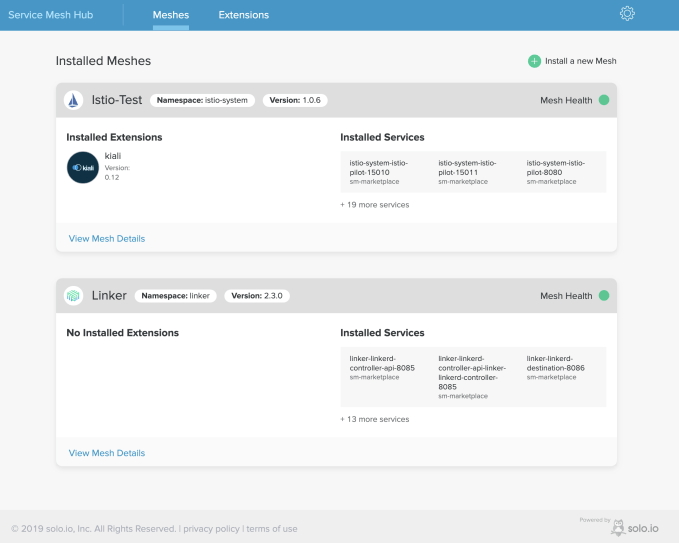
It’s a centralized place for companies to add the different service mesh tools they are using, understand the interactions happening within the mesh and add extensions to each one from a kind of extension app store. Solo wants to make adding these tools a simple matter of pointing and clicking. While it obviously still requires a certain level of knowledge about how these tools work, it removes some of the complexity around managing them.

Solo.io Service Mesh Hub

Solo.io Service Mesh Hub. Screenshot: Solo.io

“The reason we created this is because we believe service mesh is something big, and we want people to use it, and we feel it’s hard to adopt right now. We believe by creating that kind of framework or platform, it will make it easier for people to actually use it,” Levine told TechCrunch.

The vision is that eventually companies will be able to add extensions to the store for free, or even at some point for a fee, and it is through these paid extensions that the company will be able to make money. She recognized that some companies will be creating extensions for internal use only, and in those cases, they can add them to the hub and mark them as private and only that company can see them.

For every abstraction it seems, there is a new set of problems to solve. The service mesh is a response to the problem of managing multiple services. It solves three key issues, according to Levine. It allows a company to route the microservices, have visibility into them to see logs and metrics of the mesh and to provide security to manage which services can talk to each other.

Levine’s company is a response to the issues that have developed around understanding and managing the service meshes themselves. She says she doesn’t worry about a big company coming in and undermining her mission because she says that they are too focused on their own tools to create a set of uber-management tool like these (but that doesn’t mean the company wouldn’t be an attractive acquisition target).

So far, the company has taken over $13 million in funding, according to Crunchbase data.

Madrona Venture Labs raises $11M to build companies from the ground up

In regions where would-be entrepreneurs need a little more support and encouragement before they’ll quit their day job, the startup studio model is taking off.

In Seattle, one of its oldest and most-celebrated venture capital firms, Madrona Venture Group, has raised $11.3 million for its studio, Madrona Venture Labs (MVL). The investment brings the studio’s total funding to $20 million.

Traditional venture capital funds invite founders to pitch their business idea to a line-up of partners. Sometimes that’s a founder with an idea looking for seed capital, other times it’s a more mature company looking to scale. When it comes to startup studios, the partners themselves craft startup ideas internally, recruiting entrepreneurs to lead the projects, then building them from the ground up within their own safe, protective walls. After a project passes the studio’s litmus test, i.e. shows proof of traction, product-market fit and more, it’s spun out with funding from Madrona and other VCs within its large and growing investor network.

For aspiring entrepreneurs deterred by the risk factors inherent to building venture-backed startups, it’s a highly desirable route. In the Pacific Northwest, where MVL focuses its efforts, it’s a chance to lure Microsoft and Amazon employees into the world of entrepreneurship.

“We want to be an onboard for founders in our market,” MVL managing director Mike Fridgen, who previously founded the eBay-acquired business Decide.com, tells TechCrunch. “In Seattle, everyone isn’t a co-founder or an angel investor. Not everyone has been at a startup. A lot of people coming here are coming to work at Amazon, Microsoft or one of the larger satellite offices like Facebook. We want to help them fast-track learning, fundraising and everything else that comes with launching a successful company.”

Fridgen, MVL managing director Ben Elowitz, who co-founded the online jewelry marketplace Blue Nile and chief technology officer Jay Bartot, the co-founder of Hulu-acquired Vhoto, lead Madrona’s studio effort.

The investment in MVL comes in part from its parent company, Madrona, and for the first time, outside investors have acquired stakes in the practice. Alpha Edison, West River Group, Founder’s Co-op partner Rudy Gadre, Zillow co-founder Spencer Rascoff, former GoDaddy CEO Blake Irving, Trinity Ventures venture partner Gus Tai, TCV venture partner Erik Blachford and others participated.

With $1.6 billion in assets under management, Madrona is known for investments in Seattle bigwigs like Smartsheet, Rover and Redfin. The firm, which recently closed on another $100 million for an acceleration fund that will expand its geographic reach beyond the Pacific Northwest, launched its startup studio in 2014. Since then, it’s spun-out seven companies with an aggregate valuation of $140 million.

“There are some 85 VCs that have $300 million-plus funds,” Fridgen said. “In Seattle, we have two of the most valuable companies in the world and we have just one [big fund], Madrona; it’s the center of gravity for Seattle technology innovation.”

Companies created within MVL include Spruce Up, an AI-powered personal shopping platform, and Domicile, a luxury apartment rental service geared toward business travelers. Domicile was co-founded by Ross Saario, who spent the three years ahead of launching the startup as a general manager at Amazon. The company recently raised a $5 million round, while Spruce Up, co-founded by serial founder Mia Lewin, closed a $3 million round in May.

Other spin-outs include MightyAI, which was valued at $71 million in 2017; Nordstrom-acquired MessageYes, Chatitive and Rep the Squad. The latter, a jersey rental business, was a failure, shutting down in 2018 after failing to land necessary investment, according to GeekWire.

MVL’s latest fundraise will be used to invest in operations. Though MVL does provide its spin-outs with some capital, between $100,000 to $200,000 Fridgen said, it takes a back seat when it comes time to raise outside capital and doesn’t serve as the lead investor in deals.

New FCC proposal would make it easier for carriers to block robocalls

The current FCC commissioners’ stances haven’t always made them the most popular with consumers (see: net neutrality), but new, stricter robocall rules could help them win over some fans. Ajit Pai this morning proposed new rules that would let mobile carriers block the unwanted calls by default.

The Chairman explained that current rules have left many phone companies unsure of the legality of tools that could be used to block these sorts of calls.

“Allowing call blocking by default could be a big benefit for consumers who are sick and tired of robocalls,” Pai said in a statement tied to the announcement. “By making it clear that such call blocking is allowed, the FCC will give voice service providers the legal certainty they need to block unwanted calls from the outset so that consumers never have to get them. And, if this decision is adopted, I strongly encourage carriers to begin providing these services by default—for free—to their current and future customers.”

The full commission is set to vote on the propose during a June 6 meeting. In addition to making these options available to phone companies by default, the proposal would also give consumers the ability to opt out of blocking tools, should they want to be targeted by robocalls for any reason. As Reuters notes, the volume of unwanted calls is fairly enormous. In Spain, for example, roughly one quarter of all calls fall into that category. Here in the States, that number is closer to around 10 percent.

BookingBug relaunches as JRNI, as founder Shoosmith switches to Chief Architect role

It’s been a long road for BookingBug, a software platform originally conceived because its founder had trouble coordinating dates for a squash match.

Born out of the evergreen problem companies have in scheduling staff, since 2008 it’s gradually become a full-blown SaaS solution for a variety of customer journeys, of which scheduling is only one part.

And as founder and CEO Glenn Shoosmith admits to me, he gradually learned that the name BookingBug just didn’t fit the company anymore.

“For many years I’ve known that in enterprise, you cannot be standard. It’s not about being a social media management tool or a scheduling tool or whatever tool. Customer engagement is different. You need a flexible, platform-based approach. Long ago we stepped out of the SME/consumer space and we are now in B2B and we’ve become all about the customer journey. It became clear we had to change our name because our story had changed,” he says.

Which is why today BookingBug rebrands as JRNI (pronounced ‘journey’), and they even got the four-letter domain name.

The startup is also shifting gears in management, with a new CEO based out of Boston. JRNI’s new CEO, John Federman, a SaaS veteran with deep roots in the retail and financial services industries, joined from Webcollage, a cloud-based content management platform for the publishing of rich product information, and syndication across retail sites globally, through its acquisition into the Syndigo platform. He also serves as an advisor to Boston-based Salsify and sits on the Board of New York’s T-Ink.

“Companies strive to leverage every customer interaction for maximum conversion,” says Federman. “With so much research and purchase activity starting online, JRNI’s ability to guide prospects and customers from the Web to a physical location or across any channel throughout their full journey is an exciting prospect. I’m thrilled to be joining such a dynamic company at this time.”

Shoosmith is now stepping into the role of Chief Architect, but he emphasized to me that this does not mean he’s taking a back seat. The role means Shoosmith will focus on what he calls his “passion”: building stuff.

The new JRNI will continue to offer its appointments, events, and queuing applications, along with products designed to help organizations drive online traffic in-store/in-branch through conversion.

The idea behind its platform is to enable companies to interact with customers, online to offline, and across lines of business, while providing a 360-degree view of the full customer journey.

With $20M raised to date, and with largely US investors, Shoosmith says JRNI will be able to serve US customers better, and this adds to its story as a global company with offices no in Boston, London and Sydney.

“US companies like to buy from companies in the US, so this helps us enormously when as we tackle the US market. We also deliberately raised our Series C in the US for this reason, and in Boston, not San Francisco. UK startups can become too obsessed with Silicon Valley, when in practice is it far easier to run a company with a US base on the East Coast, as we have done,” said Shoosmith.

“We have the ambition to build a far bigger platform – something closer to the kind of thing Salesforce or Oracle does,” he added.

Measured promises a smarter approach to ad attribution

Measured is giving advertisers a new way to determine whether their ads are actually working.

Many of those advertisers currently rely on multi-touch attribution, an approach designed to measure how each channel and each ad contributed to a purchase decision. In fact, that’s what Measured CEO Trevor Testwuide offered at his last startup, Conversion Logic.

But Testwuide (who co-founded Measured with CTO Madam Bharadwaj) said this approach has serious limitations, particularly when it comes to measuring channels like Facebook, as well as offline channels like direct mail.

“I would say that multi touch attribution, for nine out of the 10 brands that we see, is a fool’s errand because it measures such a small percentage of media,” he said.

Instead, Measured employs what it calls “steady-state test-and-control experimentation.” Testwuide described it as a sophisticated form of A/B testing that measures whether an ad will actually provide an incremental improvement in consumer behavior. He said this kind of testing is relatively straightforward when it comes to analyzing existing customers, but is “really, really hard” for finding new customers.

“How we deploy and manage a clean control for prospecting experiments without any bias — that’s where a lot of our breakthrough technology has been,” he said.

And while Measured is only coming out of stealth now, Testwuide said the company was founded back in February 2017 and is already working with 15 brands, including FabFitFun, Johnny Was, Hint, AB InBev, J.Jill, AARP and Soft Surroundings. In a statement, Johnny Was CEO Rob Trauber said the technology allows his team to “have a laser focus on the incremental contribution of paid media, providing us the data to make smarter investment decisions.”

Testwuide added that he and Bharadwaj intially funded the company with their own money, and that it’s now profitable.

“We have no plans to raise outside capital,” he said. “I won’t rule it out, raising some growth capital, but we’re a well-funded, organically-growing business.”