In travel tech, 4 rivals merge in Europe to form Altido for property management of Airbnb-style homes

The growth of Airbnb and other big travel startups has given a fillip to the wider travel industry, and today several smaller startups in the short-term property sector are announcing that they have merged to tackle the opportunity with more scale.

The UK’s BnbBuddy and The London Residents Club, along with both Hintown from Italy and RentExperience from Portugal — all companies that help manage properties that are listed on platforms like Airbnb — have combined to form a new startup called Altido.

Going into the merger, all four were profitable, having all been boostrapped from day one. But Michael Allen, the MD of the BnbBuddy, said that now the combined entity is using its scale and raising outside funding to grow the business. Altido is looking to raise a Series A in the tens of millions of dollars. It is not disclosing its valuation currently although the fact that it already has an international presence and profitability have helped it in this area, Allen said.

The combined company will have about 1,700 properties under management in 21 European destinations, which it will be using as the anchor for an aggressive push both on existing markets as well as other parts of Europe and beyond. There is a long way to go: as a point of comparison, when Guesty — which provides services to manage rentals of private homes on Airbnb and other services — announced $35 million in funding in March, the number of properties managed on its platform had reached 100,000 across 70 countries.

Other competitors will include the platforms themselves where these properties are getting listed: as Airbnb inches to an IPO, it’s adding ever more services and features to its platform to diversify its revenue streams and also bring in more revenues per customer. (As we’ve said before, that could also make Altido and others like it acquisition targets.)

The growth of Altido’s individual businesses up to now has been on the back of the massive growth surge we’ve seen around platforms — marketplaces, to be more precise — that help people easily list and rent out travel accommodation in private homes as an alternative to hotels; and would-be visitors to find, book and pay for these in an efficient and reliable way, alongside a wider growth of self-catering accommodations that exist as alternative to traditional hotels.

The wider market for “homesharing”, as the first of these categories is sometimes called, has become massive — with Airbnb, the outsized startup leading the charge, now valued at $35 billion — and it now accounts for some 20 percent of the supply of rooms globally by Altido’s estimate.

Some property owners are happy to play host and run and manage their own listings on these platforms — which include the likes of Airbnb, Homeaway and VRBO, and many others — but a big part of the scaling of these services has come by way of third-party management companies that handle different aspects of those listings, from cleaning before and after guests and stocking kitchens and bathrooms with consumables; to managing the relationship with the visitors; to managing the listings themselves.

Altido provides an end-to-end service for those who do not want to play host, alongside a business where it also helps maintain and manage service apartments and aparthotels and guesthouses.

Today the companies that make up Altido rely on third-party platforms to disseminate all those listings, but longer-term, the plan will be to build out more services to offer listings directly as well, alongside more technology to help hosts and other management companies optimise pricing and details around the properties themselves to make them more attractive.

“We see tech as a big enabler,” Goncalo Ribeiro, the founder of RentExperience, said in an interview. He said that his company already has proprietary algorithms that it uses to help calculate property risk factors, which it already uses and will roll out across the whole of the merged company, and the different operations have already been building technology to help onboard properties more efficiently. Areas that it hopes to address include “regulation risk, potential growth rates, historic market data, marketing calculations and more. Any decision we take we want to be proven by data.”
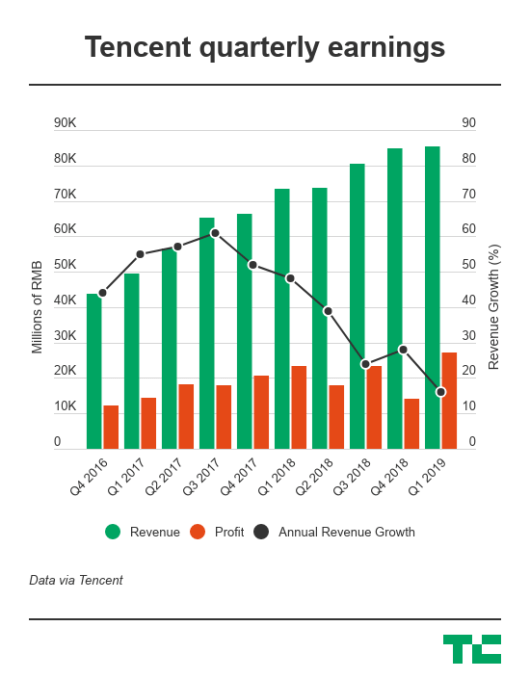
Tencent’s mixed bag for Q1: record profit despite weakest revenue growth yet

Tencent, Asia’s largest tech firm, had a horrific 2018 on account of a country-wide freeze on new game monetization in China, but there’s evidence it has turned the corner.

The company’s new mobile gaming hit Game for Peace has yet to kickstart the company’s recovery from a few weakening quarters, but its booming financial technology division has helped to neutralize the brunt to some degree.

The Chinese social media and gaming titan ended the first quarter of 2019 with its slowest revenue growth since going public to $12.69 billion, a 16 percent increase year-over-year.

Profit attributable to equity holders, however, logged a record $4 billion that beat analyst estimates.

Though most famous for WeChat, video games have fuelled Tencent’s earnings and stock prices for many years. The lucrative segment took a hit during a prolonged licensing freeze last year that prevented Tencent from monetizing a few blockbuster titles like PlayersUnknown Battleground, and the impact was still felt in the latest quarter.

Online games revenue for Q1 dropped to 28.51 billion yuan ($4.1 billion), compared to 28.78 billion yuan a year before.

The sluggish period may end soon as Tencent recently secured the official green light to start charging for its PUGB substitute Game for Peace, a less violent version than its predecessor. The new game grossed $14 million within the first three days of release, beating the $4 million Fortnite pocketed in the same duration, data provider Sensor Tower shows.

Fintech and enterprise-facing services made up Tencent’s second-largest revenue bucket with 21.79 billion yuan ($3.16 billion), a 44 percent growth year-over-year. In recent quarters, the firm began to single out its earnings for its booming fintech unit that contains its popular payments service WeChat Pay.

Unlike Facebook, Tencent hasn’t aggressively monetized its social media empire for advertising inventory until recently. Online ad revenues grew 25 percent to 13.38 billion yuan ($1.94 billion), accounting for 15.7 percent of total revenues.

That’s thanks to increased ad revenues from Weixin. All told, WeChat and its Chinese version Weixin crossed the 1.1 billion monthly active user benchmark. Its 20-year-old QQ, a legacy chatting app from the Chinese PC era, continued to grow and reached 823 MAUs.

Tencent’s Netflix -style video streaming service also contributed to increased ad earnings. Tencent Video, which has poured vast sums of money to license content in a bid to outrace Baidu’s iQiyi and Alibaba’s Youku, reached 89 million subscribers in the season.

Online grocery startup Grofers lands $200M led by SoftBank’s Vision Fund

Hot on the heels of Indian delivery startup BigBasket raising $150 million — at a unicorn valuation, no less — so its close rival Grofers has also pulled in capital after it announced a $200 million raise to battle its local competition and international giants Amazon and Walmart.

The round is the largest in India’s online grocery sector to date, and it was led by SoftBank’s Vision Fund, which continues to make major bets on the nation’s growing internet economy. KTB, and existing investors Tiger Global and Sequoia Capital also took part.

Five-year-old Grofers works with more than 5,000 stores in 13 cities in India. In an interview with TechCrunch, Albinder Dhindsa, cofounder and CEO of Grofers, said the startup will use the fresh capital to expand to new markets and bring its service to “hundreds of millions of Indian consumers,” although he didn’t specify exact launch cities.

Dhindsa said that Grofers does not want to expand to new cities for the heck of it. Instead the startup focused on entering a city and growing its business profitable there. Grofers is already profitable in Delhi and will soon be profitable in Kolkata, he said. In Southern Indian markets such as Bengaluru, the startup is working to gain foothold.

The startup is rivaled by a number of players, including BigBasket, which raised its round earlier this month from Mirae Asset-Naver Asia Growth Fund, the U.K.’s CDC Group and Alibaba. The duo also faces competition from hyperlocal player Dunzo, and delivery startup Swiggy, which recently entered this grocery delivery space.

However, more concerning for them is the growing ambitions of Amazon India and Walmart’s Flipkart, both of which are quickly expanding their businesses in India. Amazon’s Pantry and Prime Now services jointly have a presence in more than 100 cities, while Flipkart Group CEO Kalyan Krishnamurthy has publicly expressed an intention to pilot a fresh foods business in the nation. Dhindsa argued that these players are not really a significant competitor to Grofers yet.

The foods and grocery market is growing in India. According to some estimates, it will reach $869 billion in sales in 2023 with digital-based services seen as an important vector for growth. This is likely only the start now that SoftBank’s Vision Fund has entered the space through this deal with Grofers.

Other investments in India from the near-$100 billion fund include budget hotel startup OYO, which has now ventured into Europe, Flipkart — although the fund exited after the Walmart sale — Paytm, and PolicyBazaar. With reports suggesting the fund will open a dedicated office in India, you can bet that there’s a lot more to come.

India’s ride-hailing firm Ola is now in the credit card business, too

A day after India’s largest wallet app Paytm entered the credit cards business, local ride-hailing giant is following suit. Ola has inked a deal with state-run SBI bank and Visa to issue as many as 10 million credit cards in next three and a half years, it said today.

The move will help Visa and SBI bank acquire more customers in India, where most transactions are still bandied out over cash. For Ola, which rivals Uber in India, foray into cards business represents a new avenue to monetize its customers, as TechCrunch previously reported.

With about 150 million users availing more than 2 million rides on its platform each day, Ola is sitting on a mountain of data about its users’ financial power and spends. With the card, dubbed Ola Money-SBI Credit Card, the mobility firm is also offering several discounts and savings to retain its loyal customer base.

Ola, which is nearing $6 billion in valuation and counts SoftBank and Naspers among its investors, said it will offer its credit card holders “highest cashback and rewards” in form of Ola Money that could be redeemed for Ola rides, and flight and hotel bookings. There will be seven percent cashback on cab spends, five percent on flight bookings, 20 percent on domestic hotel bookings (six percent on international hotel bookings), 20 percent on over 6,000 restaurants, and one percent on all other spends.

“Mobility spends form a significant wallet share for users and we see a huge opportunity to transform their payments experience with this solution. With over 150 million digital-first consumers on our platform, Ola will be a catalyst in driving India’s digital economy with cutting edge payment solutions,” Bhavish Aggarwal, cofounder and CEO of Ola, said in a statement.

Why credit cards?

Ola appears to be following the playbook of Grab and Go-Jek, two ride-hailing services in Southeast Asian markets that have ventured into a number of businesses in recent years. Both Grab and Go-Jek offer loans, remittance and insurance to their riders, while the former also maintains its own virtual credit card. Interestingly, Uber, which also offers a credit card in some markets, has no such play in India.

The move will allow Ola to look beyond ride-hailing and food delivery, two businesses that appear to have hit a saturation point in India, said Satish Meena, an analyst with research firm Forrester.

In recent years, Ola has started to explore financial services. It offers riders “micro-insurance” that covers a range of risks including loss of baggage and medical expenses. The company said earlier this year, it has sold over 20 million insurances to customers. Using Ola Money to facilitate cashbacks also underscores Ola’s push to increase the adoption of its mobile wallet, which according to estimates, lags Paytm and several other wallet and UPI payment apps.

The company has also made major push in electric vehicles business, which it spun off as a separate company earlier this year. In March, its EV business raised $300 million from Hyundai and Kia. The company has said that it plans to offer one million EVs by 2022. Its other EV programs include a pledge to add 10,000 rickshaws for use in cities.

Last call: Sign up for the TC Hackathon at VivaTech 2019

This one’s dedicated to all the genius hackers, coders and creators who also happen to be inveterate procrastinators. Right here, right now — this is your final opportunity to participate in the TechCrunch Hackathon at VivaTech 2019 in Paris on 17-18 May. The application is free and the process couldn’t be easier, so drop whatever you’re doing and sign up today.

If you snooze, you lose — lose the chance to flex your mighty coding skills and build something creative and amazing from scratch in 24 hours. Don’t be that person. A rich, exciting — and potentially lucrative — experience awaits. Here’s what goes down at the TC Hackathon at VivaTech.

Teams of 4-6 people will select one of the five sponsored hack challenges. Don’t worry if you arrive solo, we’ll help you find a team once you’re onsite. Our sponsors include EDHECErametSanofiCegedimIBM, Galeries Lafayette / Publicis Sapient and Corvid by Wix. Specifics on the challenges are below:

EDHEC Challenge

Making an impact can have different meanings, and we believe that one of them is about improving how we support students’ careers. Have you ever asked yourself “have I chosen the right studies and the right career for me?” According to the French Ministry of Higher Education, 150,000 french students decide to change their degree course. Participating in VivaTech is a great way to solve this issue through innovation. So let’s help them find the path that suits them best for their future career! The winner of this challenge will receive a €5,000 prize.

Eramet Challenge

In the 21st century, metal alloys are everywhere, e.g. computers, electric cars, satellites. You can find up to 20 different alloys in a single computer. The quality requirements of customers are extremely tight nowadays. Eramet, a global mining and metallurgical group, challenges you to find a solution that can provide our customers with 100% transparency on our supply chains, from the extraction of ore from the mine to the final product, with a heavy focus on the quality, environmental, social and ethical aspects. The winner of this challenge will receive a €5,000 prize.

Sanofi-Cegedim-IBM Challenge

Collective intelligence can help to find smart solutions to make healthcare professionals’ (HCPs) practice easier and bring better care to people living with cardio-metabolic challenges like diabetes. Sanofi, Cegedim and IBM will provide anonymized electronic health records for you to design data-driven solutions for HCPs and their patients. How to optimize time and effort? How to better predict and personalize care? How can we avoid health complications and allow better decision making? The best product that addresses this challenge will receive €5,000 in prize money.

Galeries Lafayette Publicis Sapient Predictive Mode Challenge

Discovering emerging brands and proposing an offer aligned with consumer expectations is a permanent challenge. Data can help us identify major upcoming trends and measure the potential of a brand or collection by uncovering fashion trends of tomorrow through text mining algorithms and pattern recognition in images and videos. If you wish to put your creativity and data analysis skills to link fashion and deep learning algorithms, this challenge is made for you! The best product that addresses this challenge will receive a prize worth €5,000.

Corvid by Wix Challenge

There are plenty of community, collaboration and project management tools available for developers to use. But how do we make these essential assets better? In this challenge, the team with the best hack that uses Corvid—an open development platform that lets you build, manage, deploy and scale advanced web applications—will receive a €5,000 prize.

Teams will then spend roughly 24 intense, focused and caffeine-fueled hours designing, building and creating the best working solution possible. Don’t worry, we’ll have food and drink to keep you going (at no charge!) Once the proverbial whistle blows, teams will have a mere 60 seconds to pitch their project in front of the sponsors and TechCrunch judges.

Not only will the sponsors choose a winner and award prizes for their specific challenges, but the TechCrunch judges will also award each team a score ranging from 1-5. The team that scores the highest combined score wins €5,000 in cash as the overall winner of the TC Hackathon. Plus, all teams that receive a TechCrunch score of three or higher will win two free tickets to both TechCrunch Disrupt Berlin 2019 and VivaTech 2020.

If you’re a stickler for details, you’ll find all you need in the TC Hackathon at VivaTech FAQ.

Dear procrastinators, this is it. Your last chance to pit your skills — for free — against the very best of the best at the TechCrunch Hackathon at VivaTech 2019 on 17-18 May. Don’t snooze. Don’t lose. Sign up right here, and we’ll see you in Paris!

Facebook introduces ‘one strike’ policy to combat abuse of its live-streaming service

Facebook is cracking down on its live streaming service after it was used to broadcast the shocking mass shootings that left 50 dead at two Christchurch mosques in New Zealand in March. The social network said today that it is implementing a ‘one strike’ rule that will prevent users who break its rules from using the Facebook Live service.

“From now on, anyone who violates our most serious policies will be restricted from using Live for set periods of time — for example 30 days — starting on their first offense. For instance, someone who shares a link to a statement from a terrorist group with no context will now be immediately blocked from using Live for a set period of time,” Facebook VP of integrity Guy Rosen wrote.

The company said it plans to implement additional restrictions for these people, which will include limiting their ability to take out ads on the social network. Those who violate Facebook’s policy against “dangerous individuals and organizations” — a new introduction that it used to ban a number of right-wing figures earlier this month — will be restricted from using Live, although Facebook isn’t being specific on the duration of the bans or what it would take to trigger a permanent bar from live-streaming.

Facebook is increasingly using AI to detect and counter violent and dangerous content on its platform, but that approach simply isn’t working.

Beyond the challenge of non-English languages — Facebook’s AI detection system has failed in Myanmar, for example, despite what CEO Mark Zuckerberg had claimedthe detection system wasn’t robust in dealing with the aftermath of Christchurch.

The stream itself was not reported to Facebook until 12 minutes after it had ended, while Facebook failed to block 20 percent of the videos of the live stream that were later uploaded to its site. Indeed, TechCrunch found several videos still on Facebook more than 12 hours after the attack despite the social network’s efforts to cherry pick ‘vanity stats’ that appeared to show its AI and human teams had things under control.

Acknowledging that failure indirectly, Facebook said it will invest $7.5 million in “new research partnerships with leading academics from three universities, designed to improve image and video analysis technology.”

Early partners in this initiative include The University of Maryland, Cornell University and The University of California, Berkeley, which it said will assist with techniques to detect manipulated images, video and audio. Another objective is to use technology to identify the difference between those who deliberately manipulate media, and those who so “unwittingly.”

Facebook said it hopes to add other research partners to the initiative, which is also focused on combating deepfakes.

“Although we deployed a number of techniques to eventually find these variants, including video and audio matching technology, we realized that this is an area where we need to invest in further research,” Rosen conceded in the blog post.

Facebook’s announcement comes less than one day after a collection of world leaders, including New Zealand Prime Minister Jacinda Ardern, called on tech companies to sign a pledge to increase their efforts to combat toxic content.

According to people working for the French Economy Ministry, the Christchurch Call doesn’t contain any specific recommendations for new regulation. Rather, countries can decide what they mean by violent and extremist content.

“For now, it’s a focus on an event in particular that caused an issue for multiple countries,” French Digital Minister Cédric O said in a briefing with journalists.

Huawei launches AI-backed database to target enterprise customers

China’s Huawei is making a serious foray into the enterprise business market after it unveiled a new database management product on Wednesday, putting it in direct competition with entrenched vendors like IBM, Oracle and Microsoft.

The Shenzhen-based company, best known for making smartphones and telecom equipment, claims its newly minted database uses artificial intelligence capabilities to improve tuning performance, a process that traditionally involves human administrators, by over 60 percent.

Called the GaussDB, the database works both locally as well as on public and private clouds. When running on Huawei’s own cloud, GaussDB provides data warehouse services for customers across the board, from the financial, logistics, education to automotive industries.

The database launch was first reported by The Information on Tuesday citing sources saying it is designed by the company’s secretive database research group called Gauss and will initially focus on the Chinese market.

The announcement comes at a time when Huawei’s core telecom business is drawing scrutiny in the West over the company’s alleged ties to the Chinese government. That segment accounted for 40.8 percent of Huawei’s total revenues in 2018, according to financial details released by the privately-held firm.

Huawei’s consumer unit, which is driven by its fast-growing smartphone and device sales, made up almost a half of the company’s annual revenues. Enterprise businesses made up less than a quarter of earnings, but Huawei’s new push into database management is set to add new fuel to the segment.

Meanwhile, at Oracle, more than 900 employees, most of whom worked for its 1,600-staff research and development center in China, were recently let go amid a major company restructuring, multiple media outlets reported earlier this month.

Data provided to TechCrunch by Boss Zhipin offers clues to the layoff: The Chinese recruiting platform has recently seen a surge in newly registered users who work at Oracle China. But the door is still open for new candidates as the American giant is currently recruiting for more than 100 positions through Boss, including many related to cloud computing.

Trump is reportedly preparing to sign an executive order that would enable a ban on Huawei in the US

As the trade war with China intensifies again, President Donald Trump is expected to sign an executive order that would make possible a ban on American companies from using telecommunications equipment from Huawei and other companies that the government believes pose a national security risk, Reuters reports.

The executive order cites the International Emergency Economics Power Act, a law enacted in 1977 that gives the President broad power to control trade in response to a national emergency. The order has been under consideration for a year, but repeatedly delayed, and may be delayed yet again, says Reuters. The Wall Street Journal first reported that the administration was considering executive actions in May 2018.

Specific companies are not named in the executive order, but it would likely affect Huawei because of longstanding concerns that the Chinese government can use its telecommunications equipment for spying. A House committee first labeled Huawei and ZTE as national security threats in 2012, accusations they have repeatedly denied. U.S. government agencies and contractors have already been banned from Huawei equipment since last year.

Huawei has come under even more scrutiny during the trade war, with Chinese officials accusing the U.S. of using Huawei as a bargaining chip. Chief financial officer Meng Wanzhou, the daughter of Huawei founder and CEO Ren Zhengfei, was arrested last year in Canada at the behest of the U.S. government and faces up to 30 years in prison on accusations of fraud. U.S. federal prosecutors have also charged Huawei with stealing trade secrets from T-Mobile.

Huawei is retaliating by suing the U.S. government, arguing that the ban on using its equipment by federal agencies and contractors violated due process and is unconstitutional.

A ban on American companies from using telecommunications equipment made by Huawei would impact wireless carriers as they prepare to launch 5G networks, in particular smaller, rural carriers that may have to spend millions of dollars to replace equipment that they have already installed.

Volvo inks battery supply agreements with LG Chem and CATL for Polestar and its upcoming EVs

Just three months after unveiling its first all-electric vehicle design, Polestar, the joint venture between European automaker Volvo and China’s Geely car manufacturer has inked battery supply agreements with CATL and LG Chem.

The deals are part of multi-billion dollar agreements signed by Volvo Car Group, the company said.

The deals between Polestar and the battery makers cover the supply of lithium ion battery modules for the entire portfolio of Polestar vehicles over the next ten years, starting with its first fully electric car, the Polestar 2, in early 2020.

The suppliers will also be providing batteries for Volvo’s future electric vehicles, the company said.

“With these suppliers in place we have the secure knowledge that our electric performance cars will be powered by high-quality batteries that our customers can rely on,” comments Thomas Ingenlath, Chief Executive Officer of Polestar.

This battery supply agreement comes as roadblocks have emerged to Polestar’s plans to sell its new electric vehicle in the U.S. as a direct competitor to Tesla’s Model 3.

Ingenlath told the Los Angeles Times that if the U.S. trade war with China lengthens, the company may have to scrap plans to sell in the U.S.

“We would embrace free trade as in the interests of the consumer,” Ingenlath told the LA Times in an interview. He said that the company wouldn’t export cars to countries where tariffs would make selling the vehicle impossible because it couldn’t be priced competitively.

Polestar would look to expand or contract its sales presence in the U.S. based on where tariffs land, the executive said. At current levels tariffs on cars manufactured in China are set at 25%.

Twitter launches new search features to stop the spread of misinformation about vaccines

As measles outbreaks in the United States and other countries continue to get worse, Twitter is introducing new search tools meant to help users find credible resources about vaccines. It will also stop auto-suggesting search terms that would lead users to misinformation about vaccines.

In a blog post, Twitter vice president of trust and safety Del Harvey wrote “at Twitter, we understand the importance of vaccines in preventing illness and disease and recognize the role that Twitter plays in disseminating important public health information. We think it’s important to help people find reliable information that enhances their health and well-being.”

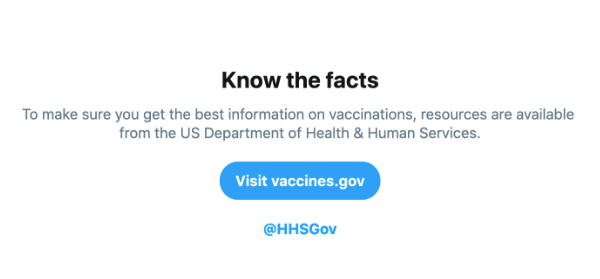
When users search for keywords related to vaccines, they will see a prompt that directs them to resources from Twitter’s information partners. In the U.S., this is Vaccines.gov, a website by the Department of Health and Human Services. A pinned tweet from one of Twitter’s partners will also appear.

One of Twitter's new tools to stop the spread of vaccine misinformation

One of Twitter’s new tools to stop the spread of vaccine misinformation

In addition to the U.S., the vaccine information tools will also appear on Twitter’s iOS and Android apps and its mobile site in Canada, the United Kingdom, Brazil, Korea, Japan, Indonesia, Singapore and Spanish-speaking Latin American countries.

Harvey wrote that Twitter’s vaccine information tools are similar to ones it launched for suicide and self-harm prevention last year. The company plans to launch similar features for other public health issues over the coming months, she added.

Earlier this week, the Centers for Disease Control and Prevention said measles cases in the U.S. had increased to 839. Cases have been reported in 23 states this year, with the majority—or almost 700—in New York.

Social media platforms have been criticized for not doing more to prevent the spread of misinformation about vaccines and, as measles cases began to rise, started taking measures. For example, YouTube announced earlier this year that it is demonetizing all anti-vaccine videos, while Facebook began downranking anti-vaccine content on its News Feed and hiding it on Instagram.