New Relic takes a measured approach to platform overhaul

New Relic, the SaaS applications performance management platform, announced a major update to that platform today. Instead of ripping off the band-aid all at once, the company has decided to take a more measured approach to change, giving customers a chance to ease into it.

The new platform, called New Relic One has been designed to replace the original platform, which was developed over the previous decade. The company says that by moving slowly to the new platform, customers will be able to take advantage of new features that it couldn’t have built on the old platform without having to learn a new a way of working.

Jim Gochee, chief product officer at New Relic says that all of the existing tooling and functionality will eventually be ported over or reimagined on top of New Relic One.”What it is under the covers for us is a new technology stack and a new platform for our offering. We are still running our existing technology stack with our existing products. So we’re [essentially] running two platforms in two stacks in parallel, but all of the new stuff is going to be built on New Relic One over time,” he explained.

By redesigning the existing platform from scratch, New Relic created a new, modern, more extensible model that will allow it to plug in new functionality more easily over time, and eventually even allow customers to do the same thing. For now, it’s about changing what’s happening under the hood and providing a new user experience in a redesigned user interface.

“New Relic One is very pluggable and extensible, which makes it easier for our own teams to build on, and to extend and expand, and also down the road we will eventually get to the point where partners and customers will be able to extend our UI themselves, which is something that we’re very excited about,” he said.

Among the new features is support for AWS Lambda, the company’s serverless offering. It also enables users to search across multiple accounts. It’s not unusual for customers to be monitoring multiple accounts and sub-accounts. With New Relic One, customers can now search across these accounts and find if issues have cascaded more easily.

In a blog post introducing the new platform, CEO Lew Cirne acknowledged the growing complexity of the monitoring landscape, something the new platform has been specifically designed to address.

“Unlike today’s fragmented tools that can deliver a bag of charts and metrics with a bunch of seemingly unrelated numbers, New Relic One is designed to cut through complexity, provide context, and let you see across artificial organizational boundaries so you can quickly find and fix problems,” Cirne wrote.

Nancy Gohring, a senior analyst at 451 Research says this flexibility is a key strength of the new approach. “One of the most important updates here is the reworked data model which allows New Relic to offer customers more flexibility in how they can search the operations data they’re collecting and build dashboards. This kind of flexibility is more important in modern app environments that are more complex and dynamic than they used to be. Everyone’s environment is different and digging for the cause of a problem is more complicated than it used to be,” Gohring told TechCrunch. The new ability to search across accounts should help with that.

She concedes that having parallel platforms is not ideal, but sees why the company chose to go this route. “Having two UIs is never great. But the approach New Relic is taking lets them get something totally new out all at once, rather than spending time gradually introducing it. It will let customers try out the new stuff at their own pace,” she said.

New Relic One goes live tomorrow, and will be available at no additional cost to New Relic subscribers.
SpaceX kicks off its space-based internet service tomorrow with 60-satellite Starlink launch

As wild as it sounds, the race is on to build a functioning space internet — and SpaceX is taking its biggest step yet with the launch of 60 (!) satellites tomorrow that will form the first wave of its Starlink constellation. It’s a hugely important and incredibly complex launch for the company — and should be well worth launching.

A Falcon 9 loaded to the gills with the flat Starlink test satellites (they’re “production design” but not final hardware) is vertical at launchpad 40 in Cape Canaveral. It has completed its static fire test and should have a window for launch tomorrow, weather permitting.

Building satellite constellations hundreds or thousands strong is seen by several major companies and investors as the next major phase of connectivity — though it will take years and billions of dollars to do so.

OneWeb, perhaps SpaceX’s biggest competitor in this area, just secured $1.25 billion in funding after launching the first six satellites in March of a planned 650. Jeff Bezos has announced that Amazon will join the fray with the proposed 3,236-satellite Project Kuiper. Ubiquitilink has a totally different approach. And plenty of others are taking on smaller segments, like lower-cost or domain-specific networks.

Needless to say it’s an exciting sector, but today’s launch is a particularly interesting one because it is so consequential for SpaceX. If this doesn’t go well, it could set Starlink’s plans back long enough to give competitors an edge.

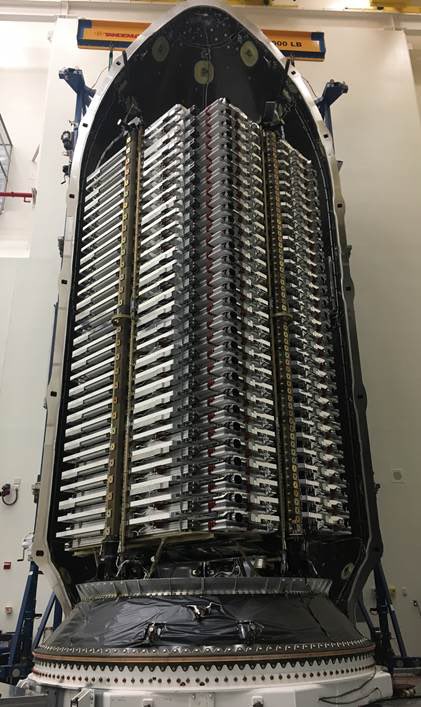
The satellites stacked inside the Falcon 9 payload fairing. “Tight fit,” pointed out CEO Elon Musk.

SpaceX hasn’t explained exactly how the 60 satellites will be distributed to their respective orbits, but founder and CEO Elon Musk did note on Twitter that there’s “no dispenser.” Of course there must be some kind of dispenser — these things aren’t going to just jump off of their own accord. They’re stuffed in there like kernels on a corncob, and likely each have a little spring that sends them out at a set velocity.

A pair of prototype satellites, Tintin-A and B, have been in orbit since early last year, and have no doubt furnished a great deal of useful information to the Starlink program. But the 60 aboard tomorrow’s launch aren’t quite final hardware. Although Musk noted that they are “production design,” COO Gwynne Shotwell has said that they are still test models.

“This next batch of satellites will really be a demonstration set for us to see the deployment scheme and start putting our network together,” she said at the Satellite 2019 conference in Washington, D.C. — they reportedly lack inter-satellite links but are otherwise functional. I’ve asked SpaceX for more information on this.

It makes sense: If you’re planning to put thousands (perhaps as many as 12,000 eventually) of satellites into orbit, you’ll need to test at scale and with production hardware.

And for those worried about the possibility of overpopulation in orbit — it’s absolutely something to consider, but many of these satellites will be flying at extremely low altitudes; at 550 kilometers up, these tiny satellites will naturally de-orbit in a handful of years. Even OneWeb’s, at 1,100 km, aren’t that high up — geosynchronous satellites are above 35,000 km. That doesn’t mean there’s no risk at all, but it does mean failed or abandoned satellites won’t stick around for long.

Just don’t expect to boot up your Starlink connection any time soon. It would take a minimum of 6 more launches like this one — a total of 420, a happy coincidence for Musk — to provide “minor” coverage. This would likely only be for testing as well, not commercial service. That would need 12 more launches, and dozens more to bring it to the point where it can compete with terrestrial broadband.

Even if it will take years to pull off, that is the plan. And by that time others will have spun up their operations as well. It’s an exciting time for space and for connectivity.

No launch time has been set as of this writing, so takeoff is just planned for Wednesday the 15th at present. As there’s no need to synchronize the launch with the movement of any particular celestial body, T-0 should be fairly flexible and SpaceX will likely just wait for the best weather and visibility. Delays are always a possibility, though, so don’t be surprised if this is pushed out to later in the week.

As always you’ll be able to watch the launch at the SpaceX website, but I’ll update this post with the live video link as soon as it’s available.

Federal labor lawyer says Uber drivers are not employees

There has been an ongoing debate regarding whether or not gig-economy drivers for Uber and Lyft are independent contractors or employees, who would be eligible for benefits. The National Labor Relations Board recently ruled Uber drivers, specifically between 2015 and 2016, were independent contractors, Bloomberg Law first reported.

“Drivers’ virtually complete control of their cars, work schedules, and log-in locations, together with their freedom to work for competitors of Uber, provided them with significant entrepreneurial opportunity,” the memo states. “On any given day, at any free moment, UberX drivers could decide how best to serve their economic objectives: by fulfilling ride requests through the App, working for a competing rideshare service, or pursuing a different venture altogether. The surge pricing and other financial incentives Uber utilized to meet rider demand not only reflect Uber’s “hands off” approach, they also constituted a further entrepreneurial opportunity for drivers.” 

This decision aligns with a similar one from the Department of Labor, which determined gig-economy workers are independent contractors and therefore not eligible for minimum wage and overtime pay.

This decision, however, does not mean there won’t be statewide lawsuits targeting the likes of Uber and Lyft regarding employment classification. What this does mean is the NLRB will maintain a position that Uber drivers are not eligible for federal protections around unionizing. Drivers will also have a harder time to file unfair labor practices charges at the federal level.

The release of this decision comes just days after Uber made its lackluster debut on the NYSE. Ahead of the IPO, drivers protested outside of the company’s San Francisco headquarters, seeking better wages, benefits, transparent policies and a voice. Drivers also went on strike all over the world with similar demands.

Game Of Thrones’ showrunners are making the next Star Wars movie


Love it or hate it, Game of Thrones ends this week. The series finale will air this upcoming Sunday, capping a final season that has been criticized for being too short, too rushed, and, at times, too damned hard to see. Seemingly immune to the ires of the Internet, the series’ showrunners are moving right from one heavily-debated property to another: Star Wars.

We’ve known for a while now that GoT showrunners D.B. Weiss and David Benioff were working on at least one Star Wars movie, but details thus far had been pretty light. Where would their movie fit into the release schedule?

Thanks to a talk from Walt Disney CEO Bog Iger at the MoffettNathanson Media & Communications summit today, we now know a bit more: it’ll be the next Star Wars movie released after 2019’s Episode IX — The Rise of Skywalker.

TheWrap quotes Iger here as saying:

We did a deal with David Benioff and Dan Weiss, who are famous for ‘Game of Thrones’ and the next movie that we release will be theirs, and we’re not saying anything more about that.

It’s worth noting, however, that “next” doesn’t mean it’s coming right away.

As Lucasfilm president Kathleen Kennedy confirmed a few weeks ago, Disney is taking a bit of a hiatus on Star Wars movies after Episode IX to spend some time figuring out how it all plays out from here. According to the release schedule that Disney/Fox published earlier this month, we likely won’t be seeing this one until the end of 2022 at the earliest.

Beyond costs, what else can we do to make housing affordable?

This week on Extra Crunch, I am exploring innovations in inclusive housing, looking at how 200+ companies are creating more access and affordability. Yesterday, I focused on startups trying to lower the costs of housing, from property acquisition to management and operations.

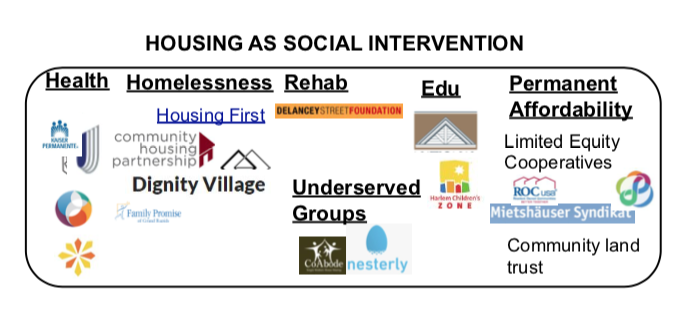
Today, I want to focus on innovations that improve housing inclusion more generally, such as efforts to pair housing with transit, small business creation, and mental rehabilitation. These include social impact-focused interventions, interventions that increase income and mobility, and ecosystem-builders in housing innovation.

Nonprofits and social enterprises lead many of these innovations. Yet because these areas are perceived to be not as lucrative, fewer technologists and other professionals have entered them. New business models and technologies have the opportunity to scale many of these alternative institutions — and create tremendous social value. Social impact is increasingly important to millennials, with brands like Patagonia having created loyal fan bases through purpose-driven leadership.

While each of these sections could be their own market map, this overall market map serves as an initial guide to each of these spaces.

Social impact innovations

These innovations address:

VR’s best game is getting more features (and more expensive)

VR’s most popular game is getting a price bump later this month as it expands the amount of headsets that it’s playable on.

We did a big deep-dive last week on Beat Saber, the best seller from a tiny Prague VR studio that’s pulling in big revenues. The game is part Guitar Hero, part Fruit Ninja and you’ve got some light sabers to guide you through EDM tunes. It’s sold over 1 million copies.

This week, the company Beat Games shared some updates that are likely to increase those revenues further as the company grows more confident that they’ve ironed out most of the game’s bugs.

On May 21, Beat Games is bumping the price from $20 to $30 on Valve’s Steam store and the Oculus Home platform, bringing the price in line with the PS VR version. This price bump comes as the company abandons the “Early Access” title, a classifier that has long signified that a game is in beta and hasn’t had all of the kinks ironed out. With this, the studio detailed in a Medium post, they feel the game has reached a “stable version,” and that it is now a “full game.”

When the game exits early access, it will be picking up a long-promised level editor so that gamers can create custom levels for their own audio tracks.

The price change on May 21 isn’t an arbitrary date, that’s when Oculus will be releasing both of its new headsets, the Rift S and Quest.

Speaking of the Quest, Oculus had introduced a feature called cross-buy that would enable users who already owned a copy of a game on Rift to let users download that game for free on Quest. On Twitter, Beat Games noted today that they won’t be supporting this for the base game so Quest users will still have to pay up, though the studio said they will enable the feature for add-ons like additional music packs.

Beat Saber is going to be unified across all platforms moving forward, meaning you won’t see certain versions getting updates that the others won’t pick up that functionality for a long time. This opens up the potential for cross-platform multiplayer as the studio continues to work on a mode for multiple concurrent users.

The price jump comes next week, you’ll still be able to score the game at the Early Access price before May 21.

After year-long lockout, Twitter is finally giving people their accounts back

Twitter is finally allowing a number of locked users to regain control of their accounts once again. Around a  year after Europe’s new privacy laws (GDPR) rolled out, Twitter began booting users out of their accounts if it suspected the account’s owner was underage — that is, younger than 13. But the process also locked out many users who said they were now old enough to use Twitter’s service legally.

While Twitter’s rules had stated that users under 13 can’t create accounts or post tweets, many underage users did so anyway thanks to lax enforcement of the policy. The GDPR regulations, however, forced Twitter to address the issue.

But even if the Twitter users were old enough to use the service when the regulations went into effect in May 2018, Twitter still had to figure out a technical solution to delete all the content published to its platform when those users were underage.

https://platform.twitter.com/widgets.js

The lock-out approach was an aggressive way to deal with the problem.

By comparison, another app favored by underage users, TikTok, was recently fined by the FTC for being in violation of U.S. children’s privacy law, COPPA. But instead of kicking out all its underage users for months on end, it forced an age gate to appear in the app after it deleted all the videos made by underage users. Those users who were still under 13 were then redirected to a new COPPA-compliant experience.

Although Twitter was forced to address the problem because of the new regulations, lest it face possible fines, the company seemingly didn’t prioritize a fix. For example, VentureBeat reported how Twitter emailed users in June 2018 saying they’d be in touch with an update about the problem soon, but no update ever arrived.

The hashtag #TwitterLockOut became a common occurrence on Twitter and cries of “Give us back our accounts!” would be found in the Replies whenever Twitter shared other product news on its official accounts. (Well, that and requests for an Edit button, of course.) 

Twitter says that it’s now beginning — no, for real this time! — to give the locked out users control of their accounts. The process will roll out in waves as it scales up, with those who have waited the longest getting their emails first.

It also claims the process “was a lot more complicated” than anticipated, which is why it took a year (or in some cases, more than a year) to complete.

https://platform.twitter.com/widgets.js

https://platform.twitter.com/widgets.js

https://platform.twitter.com/widgets.js

However, there are some caveats.

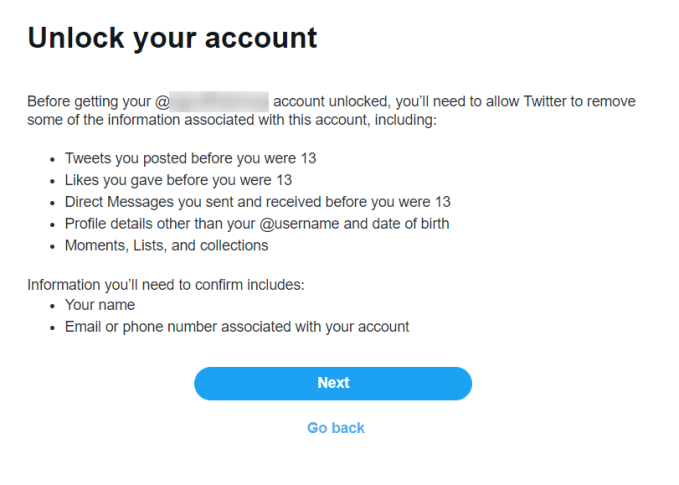
The users will first need to give Twitter permission to delete any tweets posted before they were 13, as well as any likes, DMs sent or received, moments, lists, and collections. Twitter will also need to remove all profile information besides the account’s username and date of birth.

In other words, the company is offering users a way to reclaim their username but none of their content.

Though many of these users have since moved on to new Twitter accounts, they may still want to reclaim their old username if it was a good one. In addition, their follower/following counts will return to normal after up to 24 hours after they take control of their account once again.

Twitter says it’s beginning to email those who are eligible starting today with these details. If the user doesn’t have an email address, they can instead log into the account where they’ll see a “Get Started” button to kick off the process instead.

To proceed, users will have to confirm their name and either the email or phone number that was associated with the account.

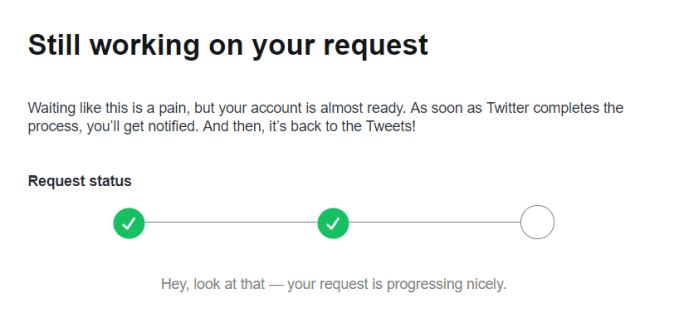
The account isn’t immediately unlocked after the steps are completed, users report. But Twitter’s dialog box informs the users they’ll be notified when the process is finalized on Twitter’s side.

Hopefully, that won’t take another year.

Image credits (of the process): Reddit user nyuszika7h, via r/Twitter 

D2C underwear brand TomboyX raises $18 million from Craftory

TomboyX, a direct to consumer, gender-neutral underwear brand, has today announced the close of an $18 million Series B funding round led by Craftory. With this deal, Craftory becomes TomboyX’s majority shareholder.

TomboyX develops gender-neutral, size inclusive underwear at a relatively affordable price point.

The company started when cofounder Fran Dunaway struggled to find herself a Robert Graham-style button down shirt. Tomboy X originally started selling fun, dress shirts that fit all body types, and eventually transitioned to underwear and swimwear.

The D2C startup offers sizes from XS to 4XL and the classic TomboyX briefs start at $20/pair.

The company raised $4.3 million in Series A financing last year, which brings total funding to more than $25 million.

Here’s what cofounders Fran Dunaway and Naomi Gonzalez had to say in a prepared statement:

We are very excited to collaborate with the team at The Craftory as we continue in our mission to design inclusive and gender-neutral underwear for our diverse global audience. We are confident that their expertise in branding and consumer goods will complement our own creativity and disruption of traditional products.

As part of the deal, Craftory directors will join the board of directors alongside Pauline Brown, lead investor for TomboyX’s Series A round.

NASA gives its new Moon mission a name: Artemis

Cool missions need cool names, and NASA’s new plan to establish a permanent lunar presence and put an American on the Moon again now has one: Artemis. It’s nod both to Apollo, the 50th anniversary of the culmination of which is this year, and to the fact that the program is likely to send the first woman to the Moon.

The name was announced on NASA’s social media channels, and casually mentioned by Administrator Jim Bridenstine in a call with reporters yesterday.

“It turns out that Apollo had a twin sister, Artemis. She happens to be the goddess of the moon. Our astronaut office is very diverse and highly qualified. I think it is very beautiful that 50 years after Apollo, the Artemis program will carry the next man — and the first woman — to the moon,” Bridenstine said.

Those familiar with Greek mythology will spot the hint NASA already placed in its nomenclature: Artemis was the Moon goddess, yes, but also goddess of the hunt. And her faithful hunting companion was named Orion — just like the multi-purpose spacecraft the agency is developing right now.

Being associated with the Moon, Artemis naturally already has a few associations with astronomy and spaceflight: More than one satellite or mission has used the name, and there are features on both Venus and the Moon itself that are named after her. But this would be by far the highest-profile application of the moniker.

Artemis would refer, presumably (I’ve asked NASA for clarification), to the major upcoming missions concerned with establishing a permanent presence on the Moon. That likely includes any major missions to explore the lunar surface, as well as any constructing infrastructure there or in lunar orbit, for example the planned Lunar Orbital Platform-Gateway.

The femininity of the name is a deliberate choice as well: The Apollo missions were crewed exclusively by men, though they relied on many women for their success. This time around things are different: Both women and men have now explored and set records in space, and no doubt those of other identifications will do so soon as well.

Bridenstine said he’s counting on this for the next generation: “I have an 11 year old daughter, and i want her to be able to see herself in the same way that our current very diverse astronaut corps sees itself.”

“If we look at the history of moon landings, it was test pilots from the 1960s and 1970s, fighter pilots, and there were no opportunities for women back then. This program is going to enable a new generation of young girls like my daughter to see themselves in a way that maybe they wouldn’t otherwise see themselves,” he said at a Q&A after the announcement.

Expect Artemis to stick around for a decade or more — going to the moon is no simple affair, and even initial successes will only be laying the foundation for larger, more ambitious missions going forward.

(NB: NASA recommends that Moon be capitalized when it’s ours, and lowercase when referring to another moon or moons in general. The more you know!)

Musk’s new lawyer fights ‘pedo guy’ defamation lawsuit claims, questions motive

SpaceX and Tesla CEO Elon Musk’s lawyer argued Tuesday in a court filing that the British cave diver who became embroiled in a public spat with his client and later sued for defamation can’t recover damages because his reputation was not harmed.

In court documents filed Tuesday, Musk’s new lawyer Alex Spiro of Quinn Emmanuel questioned the motive of Vernon Unsworth, the British cave diver, who filed a defamation lawsuit in September 2018 in the U.S. District Court for the Central District of California. The suit was filed after Musk called him a “pedo guy” and made other statements insinuating he was a pedophile in a public attack on Twitter. The fight erupted last summer after the rescue of youth soccer players trapped in a cave in Thailand.

Musk denies the allegations of defamation in the latest response. Spiro became Musk’s lawyer earlier this month.

“One has to question Mr. Unsworth’s motive in turning this into a federal case,” Spiro wrote in a response to Unsworth’s complaint. “The libel laws exist to protect those whose reputations have been harmed by false assertions of fact. In the case of Mr. Unsworth, who made himself a public figure, those assertions have to be made with constitutional malice. Mr. Musk has already retracted what he said publicly. Mr. Unsworth’s claim is thus confined to what Mr. Musk said in private conversation. Regardless, Mr. Unsworth and his reputation are no worse off.”

Musk’s lawyer argues that Unsworth was motivated by a “desire to milk the media coverage over what he instigated to reap a financial windfall from Mr. Musk, despite the absence of any injury.” Musk will fight that, Spiro wrote.

U.S. District Judge Stephen V. Wilson recently denied a motion to dismiss the case and instead scheduled a date for trial. The trial is scheduled to begin October 22. The decision means that Unsworth’s case is strong enough to go to trial.

Musk’s lawyers argued that statements on the internet, and more specifically on unmoderated forums like Twitter, are presumptively opinion, not objective fact. Defamation law doesn’t apply to opinions or insults. But Wilson rejected Musk’s argument, in part because of an email interaction he had with BuzzFeed reporter Ryan Mac.

The lawsuit alleges that between July 15 and August 30, Musk periodically used Twitter and emails to the media to publish false and defamatory accusations against Unsworth, including accusations of pedophilia and child rape.

The initial “pedo guy” attack came after Unsworth gave a critical interview to the media saying Musk’s mini sub “had absolutely no chance of working.” The diving expert ended an interview segment by suggesting Musk should “stick his submarine where it hurts.”