Spotify launches voice-enabled ads on mobile devices in a limited U.S. test

Spotify is increasing its investment in voice technology, as hinted at earlier this week on the company’s earnings call with investors. The streaming service today is announcing the launch of voice-enabled advertisements, which will encourage the listener to say a verbal command in order to take action on the ad’s content. Initially, the audio ads will direct listeners to a sponsored Spotify playlist or a podcast, the company says.

One of the first voice ads being tested starting today comes from Unilever’s Axe and Spotify Studios.This ad will direct users to the Spotify Original podcast, Stay Free: The Story of the Clash. Another will promote a branded playlist on Spotify related to a Unilever Axe ad campaign.

For now, Spotify is only focused on content promotion within its own service — not anything outside of its app.

These voice ads will only be available to a subset of Spotify’s free mobile listeners in the U.S. during the test period, and only to those who have already enabled Spotify’s voice controls. These may have already been turned on, in those cases where the listener uses Spotify’s in-app voice assistant technology to search for music and podcasts.

Users can choose to opt out of voice ads in the Settings menu, if they prefer, under “Voice-Enabled Ads.” (A “Manage Ad Settings” button also displays on the ad while it’s running to make this setting easier to find.) Listeners can also choose to entirely disable the microphone access in the mobile device’s Settings.

When the ad runs, it will encourage users to check out the content by saying “Play Now” and gives the listener time to respond. If the user says anything else except “Play Now,” a tone will sound and the mic is turned off. The ad break then continues as usual.

Spotify believes voice ads will allow it to capitalize on consumers’ growing interest in using voice commands and smart assistants — areas where all the major tech companies are investing with their on-device assistants and smart speakers for the home.

“We believe voice — really across all platforms — are critical areas of growth, particularly for music and audio content,” Spotify co-founder and CEO Daniel Ek told investors on Monday. “And we’re investing in it, and we’re testing ways to explore and refine our offering in this arena,” he noted.

In addition, the company believes voice ads can help marketers reach their audience at a time when people are being more conscious about how much time they’re looking at their phone’s screen — and attempting “screen detoxes” where they aren’t picking up their device as often. Before, they may have otherwise seen a visual, could have tapped a link to learn more, or could have searched for the advertiser’s content in some other fashion.

The current test is live in the U.S. only for free users of the Spotify app on iOS or Android. It uses ad technology Spotify built in-house, the company says.

Spotify isn’t the only music streaming service to test voice-enabled ads.

Last month, Pandora confirmed it would also begin testing interactive voice ads later in 2019. In its case, the voice ads will ask listeners if they’d like to hear more about a product or service, and allow time for them to respond “yes” or “no.”

Voice technology is nearly ubiquitous these days — a recent report from Juniper Research said there are now 2.5 billion digital voice assistants in use, and that figure will grow to 8 billion by 2023. However, voice assistants today are doing our bidding by setting alarms and timers, playing music and news, controlling our smart home, or delivering information we request — not trying to push us to do something the company wants us to do. It’s unclear, then, how consumers will respond to voice ads — that is, whether they’ll largely ignore these ads’ demands, hate them enough to disable them, or if they’ll actively engage.

These early tests will help to uncover some of those insights, which could later inform how voice ads should work on other platforms, like our voice-enabled smart speakers.
 

Frozen food gets its turn in the meal delivery game

Mosaic, founded by Blue Apron’s former senior director of operations Matt Davis and Sam McIntire, is entering the next phase of direct-to-consumer meal services with frozen foods.

Phase one of meal kits entailed prepared ingredients (Blue Apron) or pre-made meals that went into the refrigerator (Munchery). Blue Apron has since gone public, albeit experiencing a rocky road on the public market, while Munchery was forced to cease operations.

Launching today in select East Coast cities, Mosaic’s first line of products entails six vegetarian bowls made with fresh ingredients. Mosaic cooks those ingredients via roasting, grilling or sauteing, and then freezes them.

“We decided to do it because there’s so much potential in frozen food that’s untapped,” Davis told TechCrunch. “There’s an opportunity to make amazing frozen foods.”

Davis, who spent almost four years at Blue Apron, said he realized frozen food is a last frontier within the food category.

“Frozen food is an amazing way to work at scale, preserve food and reduce food waste,” Davis said. “What we offer is a cut above anything you see in the aisles today.”

Each bowl comes with packaged sauces and garnishes. They range in price from $8.99 per meal to $12.49 per meal, depending on the size box you get. A four-meal box costs $12.49 per meal while a 12-meal box costs $8.99 per meal. Customers can subscribe for deliveries every one, two, four or eight weeks.

Mosaic is trying to serve the needs of two types of customers: the ones who already shop in the frozen food aisle and those looking for a convenient solution but have yet to try frozen.
“Frozen is this crazy category that sits in the middle of the grocery store,” McIntire said. “And it’s sort of a broken category. We’ve talked about food being full of preservatives, but frozen is also not really cooked. Most frozen food is a bunch of veggies that are boiled but not roasted or seasoned. No one has thought about how to change these processes for a really long time. Our mantra is real ingredients, actual cooking using real techniques like ovens and seasoning, and rethinking the packaging food comes in. We’re reclaiming this category and we want to bring it back into good standing.”
Mosaic, which raised a seed round of funding last summer, plans to launch in additional cities throughout the country. Currently, Mosaic is available via one-day shipping in New York City, Philadelphia, Baltimore, the Washington D.C. area and parts of Connecticut, Delaware and New Jersey.

Details emerge of China’s ‘Big Brother’ surveillance app targeting Muslims

It’s long been known that China is developing a dystopian surveillance system in Xinjiang, the Northwest province that’s home to China’s Uyghur Muslim population. Among the evidence includes poorly managed database and now we have details of a mobile app used by police in the region to track Uyghur citizens.

Human Rights Watch today published a detail report into Integrated Joint Operations Platform (IJOP), the system used to the population of Xinjiang. The organization got hold of an IJOP app and reverse engineered it to shed light on the kind of data that is being sucked up about Uyghur people.

The details gathering vary from obvious information like name, height and blood type, to information on whether a person uses a VPN or specific apps — chat services like WhatsApp, Signal and Telegram — whether they leave their house via the backdoor, how much electricity they use, and more.

The system pairs data entered by officers on the ground — both roaming and at specific checkpoints — with information pulled by a mesh of surveillance cameras to root out apparent suspicious people. China is reported to have locked up around one million Uyghur in so-called “re-education” camps and this system, and in turn app, play a major role in that selection process.

If there’s any consolation here, it’s that China’s system isn’t particularly cutting-edge or efficient. The app, for example, relies heavily on manual input from officers while alerts to check on ‘suspicious’ individuals requires an office to be dispatched to their home, place of work, etc.

“It’s important to note that this system, though intrusive, is also crude and labor-intensive. I don’t think they are very sophisticated, and they require a huge number of police and resources to operate,” noted Human Rights Watch senior China researcher Maya Wang in the report.

Still, in spite of inefficiencies, the intention of the state is enough to cause havoc. China’s operation in Xinjiang is breaking up families by disappearing people and installing fear in those who remain. More widely, the clampdown has seen Muslim architecture and culture destroyed in what is a devastating and under-reported onslaught again an ethnic group.

Human Rights Watch added his voice, once again, to those calling for international intervention.

“Concerned governments need to think seriously about export controls and targeted sanctions, such as the U.S. Global Magnitsky Act, including visa bans and asset freezes, against senior Chinese officials linked to abuses in Xinjiang. They should set the bar higher on privacy protections so that companies like the one that produced this app don’t succeed in setting the standards,” wrote Wang.

Grainchain, a blockchain-based platform for commodity sales, launches in Mexico

In the two years since GrainChain launched its distributed ledger-based transaction platform for bulk dry goods the company has brokered thousands of contracts on everything from corn, sorghum, wheat, and soybeans to even sand from its headquarters in McAllen, Tex.

Now the company is expanding its services to Mexico, partnering with the government of Tamaulipas, to help farmers and grain elevators with commodity management and settlement.

Integrating with existing grain elevator equipment, GrainChain will deploy its sensors and software to automate the certification of inventory, invoice settlement and reporting to buyers and sellers, according to a statement from the company.

Although the company’s blockchain adoption is new, GrainChain began developing its technology six years ago as an inventory supply chain management toolkit for farmers.

The company’s founder and chief executive Luis Macias had sold his previous software business Verge Data to an insurance company in 2005 and took some time off before wading back into the software development business in McAllen.

In 2012, Macias says he was approached by Hi Star Grain about developing software to manage the sales process for bulk dry goods.

The company spend the next five years working on the technology.

Before a commodity is ever shipped GrainChain sets up a contract between a buyer and a farmer for their supply negotiated through GrainChain’s digital portal. That contract is submitted to the chain along with an agreed upon payment that’s held in escrow until delivery.

In the field and at the silo GrainChain’s system consists of a logistics toolkit to monitor and track harvests coming out fo the fields and through individual silos. The goods are certified for quality assurance using the company’s sensor technology and that certification is recorded onto a HyperLedger-based blockchain.

Once the shipment is verified then payment is released to the farmer in the form of a dollar-backed GrainPay stablecoin that allows instant settlement of the transaction. The asset-backed token is burned once the contract is filled and the tokens are converted into whatever fiat currency was agreed upon in the initial contract.

GrainChain makes its money by charging a commission on every transaction that moves through its platform.

The company raised $2.5 million from Medici Ventures — the investment arm of Overstock — back in October and is now expanding into international markets.

“We’re giving the farmer the ability to work with a higher risk customer because they’re getting guaranteed payment,” says Macias. “Sometimes, they can’t go past the normal broker they go through.”

Currently the company has 14 different commodities including: corn, soybeans, sesame seeds, sunflower seeds, sorghum, coffee, cocoa, and sand.

“We have the ability to do any dry commodity that has the ability to be graded,” says Macias. “What we really found is that when there’s a contract that’s built and it’s slow-pay or no-pay or arbitration that comes through on the contract, it’s devastating to the farmer. This gives them the security to take on what would otherwise be riskier customers.”

Toyota AI Ventures launches $100M fund to invest in robotics and autonomous tech

Toyota AI Ventures, a subsidiary of Toyota Research Institute, has a new $100 million fund that will focus on finding and investing in early-stage robotics and autonomous technology startups.

This second fund, aptly dubbed Fund II, brings the firm’s total assets under management to more than $200 million.

“The growing interest in automated systems has created great opportunities to improve human lives using AI and next-generation mobility technology,” said Dr. Gill Pratt, chief executive officer at TRI and Toyota AI Ventures investment committee member.

Toyota AI Ventures is a newcomer to the scene. Still, it’s managed to invest in 19 startups since launching in 2017, including Nauto, autonomous shuttle company May Mobility, social companion cognitive AI startup Intuition Robotics and Joby Aviation, the electric vertical takeoff and landing passenger aircraft service.

Since its inception, Toyota AI Ventures has targeted early-stage startups and its investments have been directed at companies applying AI, data, and cloud technologies to autonomous mobility and robotics.

That primary aim isn’t changing. However, the firm is also interested in what Jim Adler, managing director of Toyota AI Ventures, described as “unbundling mobility.”

“One of the things that we want to explore with Fund II is the unbundling of mobility,” Adler told TechCrunch. “The personally-owned vehicle has provided tremendous safety, freedom, convenience, and fun. What we’re now seeing is a phase of unbundling such as ride hailing, micromobility, etc. There are investment opportunities where autonomous technologies might accelerate these unbundled mobility products and services.”

Capital has poured into the autonomous vehicle technology industry in recent years. Hundreds of companies, including full-stack AV developers, mapping startups and sensor companies, now exist in an industry that was empty a decade ago.

While a handful of companies appear to control the looming robotaxi business, Adler contends that “profitable business models are still being proven.” He also believes there’s still space in the related sensor industry for startups.

“For the various operating design domains, there’s no clear winning mix of cameras, radar, lidar and ultrasound,” Adler said. “There’s still room to run.”

Tesla is raising up to $1.5 billion through convertible note and share sale

Tesla is raising up to $1.5 billion through the sale of notes and shares, according to a filing made by the EV maker today.

The document outlines that Tesla will sell up to $1.35 billion in convertible senior notes. The number could increase further: Tesla is giving underwriters the chance to buy a further $202.5 million for over-allotments. In share numbers, that’s an initial 2,723,198 shares that could expand to 3,131,677.

The notes are due in 2024 and, already, Tesla founder and CEO Elon Musk is committed to buying $10 million in the offering, that’s 41,896 shares.

As is often the case in such offerings, the plans for the funds raised are fairly vague at this point.

“We intend to use the net proceeds from this convertible notes offering and our concurrent common stock offering to further strengthen our balance sheet, as well as for general corporate purposes,” it said in the prospectus.

The offer comes a week after Tesla reported a $702 million loss for Q1 2019.

The results reported Wednesday follow two consecutive quarters of profitability that were fueled by sales of the Model 3. Tesla reported a $139 million profit in the fourth quarter and in October posted its first profit after seven consecutive quarters of losses.

Tesla reported that its cash position decreased by $1.5 billion from the end of 2018 to $2.2 billion mainly due to the repayment of convertible notes, of which $188 million negatively impacted operating cash flow. Tesla paid off its $920 million convertible bond obligation in cash in March.

More to follow

Adtech veteran Quantcast is latest tech giant to face GDPR privacy probe

Another tech giant is under investigation in Europe for potential privacy breaches of the General Data Protection Regulation (GDPR), TechCrunch has learnt.

The Irish Data Protection Commission (DPC), which is the lead data protection regulator for most multinational tech giants in Europe, has opened a formal probe into Quantcast’s business — adding +1 to the 17 investigations it already had up and running into Facebook, WhatsApp, Instagram, Apple, Twitter and LinkedIn. 

In a statement about the new statutory inquiry into Quantcast the DPC told us:

Since the application of the GDPR significant concerns have been raised by individuals and privacy advocates concerning the conduct of technology companies operating in the online advertising sector and their compliance with the GDPR. Arising from a submission to the Data Protection Commission by Privacy International, a statutory inquiry pursuant to section 110 of the Data Protection Action 2018 has been commenced in respect of Quantcast International Limited. The purpose of the inquiry is to establish whether the company’s processing and aggregating of personal data for the purposes of profiling and utilising the profiles generated for targeted advertising is in compliance with the relevant provisions of the GDPR. The GDPR principle of transparency and retention practices will also be examined

We’ve reached out to Quantcast for comment.

The full Privacy International submission to the DPC can be found here.

The privacy advocacy group raises a number of concerns about Quantcast’s products — including behavioral ad targeting tech and its consent management tool for publishers and advertisers. (The complaint also names two other “adtech brokers”, Criteo and Tapad.)

The DPC’s head of communications, Graham Doyle, told us it’s not releasing information on the number of complaints it received about Quantcast specifically.

As we reported in February, Facebook and Facebook-owned companies still account for the lion’s share of the Irish regulator’s probes of big tech — with another added to its tally just last week (into the breach of “hundreds of millions” of Facebook and Instagram user passwords which had been stored in plaintext).

But Quantcast is an interesting addition to the DPC’s investigation list given that it’s not a consumer-facing tech giant but rather an adtech veteran which sits behind the scenes, selling ‘marketing intelligence’ tools to other brands so they can sift and mine Internet users’ personal data.

The addition of Quantcast shows the value of GDPR enabling campaign organizations such as Privacy International to make complaints on EU citizens’ behalf. Few consumers know the half of how adtech works.

A 2017 AdAge article described Quantcast’s technology as “almost woven into the fabric of the internet” — on account of how it got started providing measurement capabilities to publishers. (It was founded in San Francisco, back in 2006.)

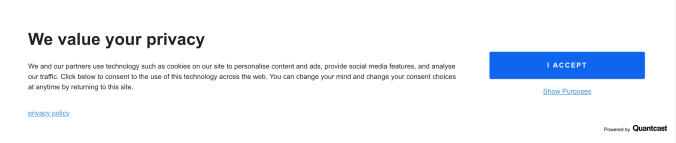
But since the GDPR came into force last May Quantcast’s b2b brand has become increasingly visible to web users — with its branded technology powering many of the consent pop-ups used by online publishers to claim GDPR ‘compliance’.

These pop ups typically feature a big blue ‘I agree’ button that nudges Internet users to agree to their personal data being processed by the website they’re visiting — and any ad/analytics partners it wants to share it with.

Clicking the almost invisible and gnomically named ‘Show Purposes’ link opens a fuller menu of consent options — where users are able to toggle on/off any fields that the tool’s user has not deemed ‘required’.

Flume Health is an insurance administrator cutting costs by pre-approving prices and paying on-demand

Cedric Kovacs-Johnson launched Flume Health after watching his own family struggle with payments for his sister’s surgery.

When we looked at who was calling the shots [on prices] it was this litany of service providers that was unknown to us and the cost was unknown to us until we got the bill weeks later,” says Kovacs-Johnson. 

The family had thought that their medical bills would be covered by one insurance provider, but as bills kept rolling in, they realized that what had been promised as one insurance company was actually an insurance plan managed by a benefits manager whose plan was not as extensive — and that the insurer was only managing the relationship with the benefits manager.

So the former Makerbot employee launched Flume in February 2017 to make the payment process more transparent for the hundreds of companies that are self-insuring their employees to cope with rising healthcare premiums.

Roughly 80% of companies with over 500 employees are providing their own insurance plans, or outsourcing the administration of insurance coverage to plan administrators and startups, seeing the woefully poor service these companies provide, are jumping into the fray.

Collective Health is one of the best funded, with $300 million in capital committed to the company, including a $110 million round last year. Another startup, Limelight Health has raised $40 million in financing as it tries to grab market share by providing tools to make the self-insured health management process easier for companies.

Those companies and upstarts like Flume, Apostrophe and Eden Health are all tackling services and support for companies providing self-insurance.

“We become the independent administrator [and] instead of buying a whole bundle of services from a carrier we let them buy it from independent providers.”

Flume is able to offer lower prices for procedures than competitors by offering payment on the day of an operation or within three days of a visit.

“Our difference is that you have an ability to change the fundamental relationship between payer and provider,” said Kovacs-Johnson. “We pay for a bundle. We know ahead of time that a procedure is pre-authorized… when we give them the approval on this estimated date of service… now that we know we’ve authorized the service we are going to pay that before or at the time of service. So we get discounts because providers hate the billing process.”

Traditional insurance administrators usually offer a bundled package of services that companies just pay for. Instead, Flume offers companies transparent pricing for independent services that allows patients and providers to pick and choose — cutting out much of the claims processing that creates additional administrative overhead for care providers, according to the company.

To navigate the world of third party administrators, Flume hired one. The company’s chief operating officer was the chairman of the board of third party administrators, Kevin Schlotman.

“As SPBA chairman, I am constantly looking at the future of our industry and have been frustrated by the lack of transparency in the cost and quality of healthcare, and the structural barriers in place that restrict flexibility in plan design and reimbursement methods that our clients are demanding,” Schlotman said in a statement when he joined the company in September.

So far, Flume has eight customers who’ve signed on to its digital health plan administration service pulling its first clients from unions and school districts across five states.

The New York-based company has also managed to attract a few investors, raising $4 million from New York investors including Primary Venture Partners, Accomplice, Founder Collective, and Entrepreneurs Roundtable Accelerator.

By working directly with providers to get cash prices for services, patients avoid surprise bills and know what they’re paying before an appointment, according to the company.

“Cedric and team have created a solution to one of the most crippling problems facing America right now, and their early success is strong evidence that employers are desperate for change. What they’re doing has huge implications for the future of healthcare in our country,” said TJ Mahoney, partner at Accomplice .

FreightHub, the European digital freight forwarder, collects $30M Series B

FreightHub, the European digital freight forwarder, has raised $30 million in Series B financing. Leading the round is Rider Global — a venture fund said to be founded by logistics experts — along with Maersk Growth, the corporate venture arm of container shipping giant A.P. Moller-Maersk.

Existing investors Northzone, Rocket Internet’s Global Founders Capital (GFC), and Cherry Ventures also participated. I’m told the London-based investment firm Unbound, founded by Shravin Mittal, significantly expanded its stake too.

Operating in the freight industry, an antiquated market that is ripe for digitalisation and as a result has attracted a plethora of well-funded startups, FreightHub is setting out to compete with and replace traditional freight forwarding companies who typically rely on legacy IT systems and cumbersome and manual processes.

Described as a fully-fledged freight forwarder, the Berlin and Hamburg-based startup offers transport services for sea, air and rail freight, built on digitized processes – from booking, communication, data exchange and document management to supply chain optimization.

Last year, off the back of its $20 million Series A, FreightHub says it heavily invested in solutions for digital collaboration between customers, partners and suppliers and expanded the interface functions for its system integration capabilities. The company also expanded its service portfolio, including obtaining an IATA license for air freight services.

“Our forwarding solution offers more transparency, reliability and ultimately time and cost advantages for large and mid-sized organisations,” says FreightHub CCO Michael Wax in a statement. “Today, we serve some of the most well-known German brands and grew our volumes again 3x year over year”.

Claiming more than 1,500 customers – including well-known companies such as Home24, Miele and Viessmann – in addition to existing locations in Berlin and Hamburg, the FreightHub recently opened its first Asian office in Hong Kong and acquired a sea freight forwarder specialised in Asian imports.

“Our recent growth trajectory has confirmed the potential that our digital solutions can realize for both our customers and FreightHub’s internal processes,” adds FreightHub founder and CEO Ferry Heilemann. We will use the fresh capital to further develop our digital service offering and to expand our presence in Asia”.

Check out the latest challenge of the TC Hackathon at VivaTech 2019

Dépêche-toi et ne tarde pas! Roughly translated that means “hurry up and don’t delay!” You can still register to participate in the TC Hackathon at VivaTech to hack for some great prizes. It won’t cost you a thing to join the fun — tickets are free, and they also give you access to all three days of VivaTech 2019. Get yours now while you still can.

The TC Hackathon takes place May 17-18 — on days two and three of VivaTech. Come and join more than 500 hackers, coders, developers, UX/UI designers and other creative geniuses to build, pitch and present something incredible in less than two days. Enjoy the competition, the community, the camaraderie — and win cold, hard cash, prizes and swag in the process.

If you’re not familiar with how this hackathon works, here’s what you need to know. Teams, which can range from 4-6 people, will choose one of several sponsored hack contests (more on those in a minute) when they register. If you don’t have a team, you can find one when you get onsite.

When the hackathon starts, your team has just 24 hours to build a working solution for the challenge you selected. It’ll take all your focus, skills and stamina to get the job done. Then it’s time to present and pitch your product to the TechCrunch judges onstage — in 60 seconds.

The esteemed TechCrunch judges assign each team a score between one and five, and the team with the highest score wins the prize associated with the sponsored hack. Depending on the challenge you select, you could win €5000, incubation, other cash prizes and hardware. All teams that receive a combined score of three or higher also win tickets to TechCrunch Disrupt Berlin 2019 and VivaTech 2020.

In addition, TechCrunch will select one team as the overall best hack and award them with a €5000 grand prize. Last year, CommerceDNA earned that honor. Will it be you this time?

If you’re detailed-oriented or just plain curious, check out the TC Hackathon FAQ. Wondering about the sponsored contests we have lined up so far? Here’s the latest info:

Galeries Lafayette Publicis Sapient Predictive Mode Challenge
Discovering emerging brands and proposing an offer aligned with consumer expectations is a permanent challenge. Data can help us identify major upcoming trends and measure the potential of a brand or collection by uncovering fashion trends of tomorrow through text mining algorithms and pattern recognition in images and videos. If you wish to put your creativity and data analysis skills to link fashion and deep learning algorithms, then this challenge is made for you! The best product that addresses this challenge will receive €5000 in prize money.

The TechCrunch Hackathon at VivaTech 2019 takes place in Paris on May 17-18. Don’t miss out on this exhilarating, exhausting and fun event. Register for your free ticket now. Dépêche-toi et ne tarde pas!