Plum, the money management chatbot, raises another $4.5M and lands on iOS

Plum, the chatbot-based app that helps you manage your money, is disclosing $4.5 million in further funding.

The round, which quietly closed in the summer, was led by venture firm VentureFriends and the European Bank for Reconstruction and Development (EBRD). It brings total funding for the London and Athens-based fintech to $6.3 million.

Founded in 2016 by early TransferWise employee Victor Trokoudes and Alex Michael, Plum is described as an AI-powered online money management tool.

Similar to U.K. competitors Cleo and Chip and a host of other PFM-styled apps, you link the app to your bank accounts and gain access to a range of functionality spanning savings, investments and finding ways of saving money based on analysis of your regular outgoings.

This includes helping you save based on what Plum’s algorithm’s deem you can afford — in the form round-ups and/or regular savings — and other budgeting tools.

You can also open an ISA investment account and invest based on themes, such as only in “ethical companies” or technology.

Launched last month, a related feature dubbed “Splitter” lets you split your automatic savings between Plum savings and investments, selecting the percentage amounts to go into each pot from 0-100 percent.

Lastly, if Plum spots you are overpaying on various household bills it will offer to help you switch supplier.

Meanwhile, the fintech startup is making its chatbot available beyond Facebook Messenger with the launch of Plum for iOS. A version for Android is said to be available “in the coming months”.

Africa Roundup: Jumia’s IPO, DHL launches Africa e-Shop, Cathay’s $168M VC fund, ConnectMed acquired

The biggest news in a month of weighty African headlines was Jumia listing on the New York Stock Exchange.

After filing SEC IPO docs in March, the Pan-African e-commerce company’s shares began trading on the NYSE April 12, opening at $14.50 under ticker symbol JMIA. Jumia stock rose north of 70 percent on its first day of trading and started this week at $46.

With the public listing, Jumia became the first startup from Africa to list on a major global exchange. The IPO raised nearly $200 million for the internet venture.

The listing created another milestone for Jumia.  In 2016 the company became the first African startup unicorn, achieving a $1 billion valuation after a funding round that included Goldman Sachs and MTN.

Founded in Lagos in 2012 with Rocket Internet backing, Jumia now operates multiple online verticals in 14 African countries—from consumer retail to travel bookings.

Jumia has also opened itself up to Africa’s traders with more than 80,000 active sellers on the platform.

Like Amazon, Jumia brings its own mix of supporters and critics. On the critical side, there are questions of whether it’s actually an African startup. The parent for Jumia Group is incorporated in Germany and current CEOs Jeremy Hodara and Sacha Poignonnec are French.

On the flipside, original Jumia co-founders (Tunde Kehinde and Raphael Afaedor) are Nigerian. The company is headquartered in Africa (Lagos) and incorporated in each country in which it operates (under ECART Internet Services in Nigeria). Jumia pays taxes on the continent, employs 5,128 people in Africa (page 125 of K-1) and the CEO of its largest country operation Juliet Anammah is Nigerian.

The Jumia authenticity and diversity debates will no doubt continue. But the biggest question — the driver behind the VC, the IPO, and demand for Jumia’s shares — is whether the startup can produce profits. The company has generated years of losses, including negative EBITDA of €172 million in 2018 compared to revenues of €139 that same year.

DHL Africa e-Shop

Call it coincidence or competition, but the day before Jumia’s IPO, DHL partnered with another e-commerce startup—MallforAfrica.com—to launch its DHL Africa eShop app for global retailers to sell goods to Africa’s consumers markets.

The platform brings more than 200 U.S. and U.K. retailers — from Neiman Marcus to Carters — online in 11 African countries.

DHL Africa eShop operates using startup MallforAfrica.com’s white label service, Link Commerce.

The new online platform takes advantage of the shipping giant’s existing delivery structure on the continent to get goods to doorsteps near and far.

DHL’s partner for the new app, MallforAfrica, was founded in 2011 to solve challenges global consumer goods companies face when entering Africa.

On a B2C level, DHL Africa eShop brings distinct advantages on a transaction cost basis (i.e. the cost of delivery) given it is connected to one of the world’s logistics masters, DHL.

Another component of DHL and MallforAfrica’s partnership is the market for offering e-commerce fulfillment services through MallforAfrica’s white label Link Commerce service.

This could put the duo on a footing to compete with (or work with) big e-commerce names entering Africa and adds another layer of competition with Jumia, which offers its own fulfillment services vertical in Africa.

Cathay Africinvest Innovation Fund

There’s a new $100 million plus African VC fund in the works. Tunisia-based private equity firm Africinvest teamed up with Cathay Innovation to announce the Cathay Africinvest Innovation Fund, with a target raise of $168 million.

Details are still forthcoming, but the fund will focus primarily on Series A to C-stage investments in startups across several countries in the areas of fintech, logistics, AI, agtech and edutech. Investments could begin as early as 2019, fund co-founder Denis Barrier told TechCrunch.

He expects to see strong local showing for startups from across Africinvest’s 10 country offices in North and Sub-Saharan African. The firm will open an office in Johannesburg in the near future, according to a company release.

Zipline expands in Ghana

Zipline, the San Francisco-based UAV manufacturer and logistics services provider, launched a program in Ghana for drone delivery of medical supplies.

Working with the Ghanaian government, Zipline will operate 30 drones out of four distribution centers to distribute vaccines, blood and life-saving medications to 2,000 health facilities across the West African nation daily. Speaking to TechCrunch, the company’s CEO Keller Rinaudo described the Ghana operation as “the largest drone delivery network on the planet,”

The Ghana program adds a second country to Zipline’s live operations. Zipline got off the ground in Rwanda and has leveraged its experience in East Africa to begin testing medical delivery services in the United States. Zipline plans to move from pilot-phase to live-delivery of medical supplies in the U.S. sometime this summer.

ConnectMed acquired by Merck

And finally, German pharmaceutical company Merck KGaa acquired the technology of Kenya based online healthtech company ConnectMed. A 2017 Startup Battlefield Africa competitor, ConnectMed paired up telehealth kiosks to local pharmacies—turning them into online clinics where patients use the startup’s tablet based app to connect live to doctors for evaluation and prescriptions. The startup had received grant and seed funds from UK based Entrepreneur First and Norway’s Katapult Accelerator.
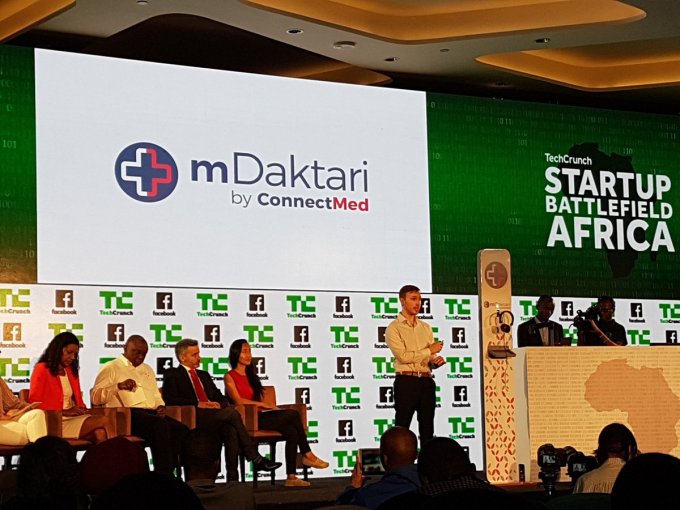
Merck KGaa (not be confused with U.S. pharmaceutical company Merck) took over ConnectMed’s telehealth applications. “Following the handover of the company’s telehealth solutions to Merck…ConnectMed will cease operations,” said a company release on the deal. Merck will integrate ConnectMed’s platform into its own CURAFA clinic network in Kenya.

More Africa Related Stories @TechCrunch

African Tech Around The Net

Sign up for our mailing list and save €200 off passes to Disrupt Berlin 2019

It’s lucky number seven as the TechCrunch posse returns yet again to Berlin, Europe’s vibrant international hub, to host Disrupt Berlin 2019 on 11-12 December. We just can’t get enough of this city’s startup spirit and, apparently, neither can you. Our Disrupt Berlin events have attracted participants from more than 50 countries, including European Union members, Israel, Turkey, Russia, Egypt, India, China and South Korea, to name a few.

Consider this a clarion call to save the date, but it’s so much more than that. We believe in rewarding action with savings, and this year we have a sweet deal available well before the official registration opens in late May. Simply sign up for our mailing list before registration opens and we’ll knock an extra €200 off the super-early-bird ticket price.

Imagine experiencing all that Disrupt Berlin has to offer knowing that you got in at the lowest possible price. That’s some serious ROI right out of the gate. Take in the Startup Battlefield — our legendary pitch-off with $50,000 cash at stake. The competition is always fierce and fascinating. Case in point: last year, Legacy earned the title of reigning champion by tackling the problem of reduced sperm motility. No, really.

Explore the hundreds of dynamic early-stage startups exhibiting a wide range of tech products, services and platforms — not to mention a ton of talent — in Startup Alley, the heart of every Disrupt event. Startup Alley is networking on steroids, where opportunity awaits at every table.

Of course, we’ll have an incredible roster of speakers, panelists, demos, workshops and Q&A Sessions. We’re talking leading founders, technologists, investors and tech icons. Last year, speakers included Frank Salzgeber from the European Space Agency, Lizzie Chapman from ZestMoney, an Indian fintech startup, and Rafal Modrzewski from satellite company ICEYE — to name a few. We’ll announce this year’s lineup over the weeks running up to Disrupt Berlin 2019, so keep checking back.

Disrupt Berlin 2019 takes place on 11-12 December — that’s two full days of intense programming and curated networking. There’s no better place to gain focused, in-person exposure to the European and international startup scene. And now you can save an extra €200 off passes just by signing up for our mailing list. Do it today, save a bundle and we’ll see you in December.

Once a major name in smartphones, LG Mobile is now irrelevant — and still losing money

LG was once a stalwart of the smartphone industry — remember its collaboration with Facebook back in the day? — but today the company is swiftly descending into irrelevance.

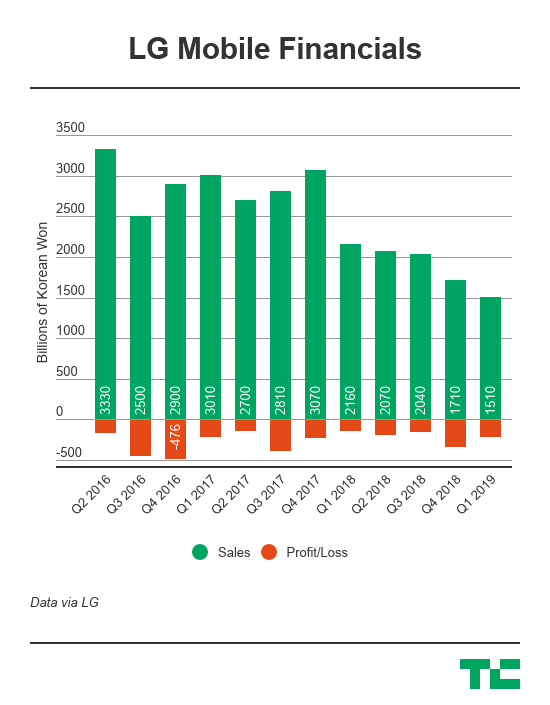
The latest proof is LG’s Q1 financials, released this week, which show that its mobile division grossed just KRW 1.51 trillion ($1.34 billion) in sales for the quarter. That’s down 30 percent year-on-year and the lowest income for LG Mobile for at least the last eight years. We searched back eight years to Q1 2011 — before that LG was hit and miss with releasing specific financial figures for its divisions.

To give an indication of its decline, LG shipped over 15 million phones in Q4 2015 when its revenue was 3.78 trillion RKW, or $3.26 billion. That 2.5 times higher than this recent Q1 2019 period.

Regular readers will be aware that LG mobile is a loss-making division. That’s the reason its activities — and consequently sales — have scaled down in recent years. But the losses are still coming.

LG put Brian Kwon, who leads its lucrative Home Entertainment business, in charge of its mobile division last November and his task remains ongoing, it appears.

LG Mobile recorded a loss of 203.5 billion KRW ($181.05 million) for Q1 which it described as “narrowed.”

It is true that LG Mobile’s Q1 loss is lower than the 322.3 billion KRW ($289.8 million) loss it carded in the previous quarter, but it is wider than one year previous. Indeed, the mobile division lost 136.1 billion KRW ($126.85 million) in Q1 2018.

LG said Mr Kwon is presiding over “a revised smartphone launch strategy” which is why the numbers are changing so drastically. Going forward, it said that the launch of its G7 ThinQ flagship phone and a new upgrade center — first announced last year — are in the immediate pipeline, but it is hard to see how any of this will reverse the downward trend.

LG Mobile is increasingly problematic because the parent company is seeing success in other areas, but that’s being countered by a poor performing smartphone business. Last quarter, mobile dragged LG to its first quarterly loss in two years, for example.

Just looking at the Q1 numbers, LG’s overall profit was 900.6 billion KRW ($801.25 million) thanks to its home appliance business ($647.3 million profit) and that home entertainment business, which had a profit of $308.27 million. Its automotive business — which is, among other things, focused on EVs — did bite into the profits, but that is at least a business that is going places.

Acast launches Acast Access to make paywalled podcasts available on any player

Podcast monetization company Acast is launching a new way for publishers to put their podcasts behind a paywall.

Until now, podcasts have not been well-suited to subscription paywalls, due to the fact that they’re distributed via RSS feeds that can be accessed by any podcast player. So instead we’ve seen workarounds like Substack building a web-based audio player and TechCrunch releasing all our podcasts free while putting transcripts behind the Extra Crunch paywall.

And then there’s Luminary, the subscription podcast app that’s faced serious backlash for including unaffiliated podcasts in a way that some podcasters suspect it was re-hosting their audio files. (The company says it wasn’t doing that.)

With Acast Access, on the other hand, publishers should be able to create versions of their podcasts that are only available to subscribers, but are still accessible from any app.

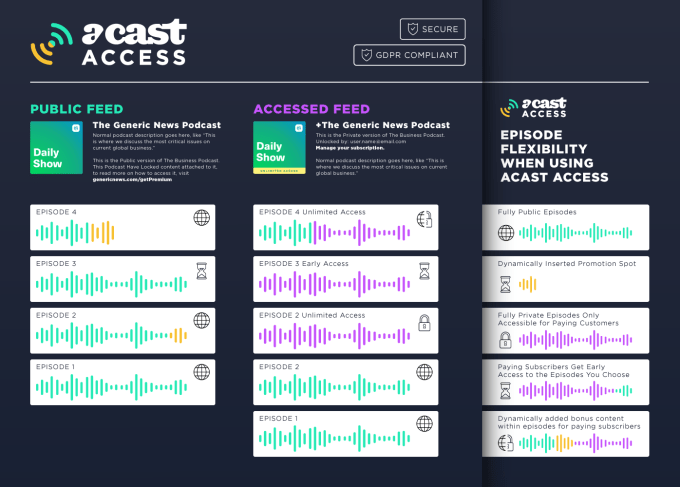
Chief Product Officer Johan Billgren said that Acast works with a publisher to create two different podcast feeds — the public feed, which is available to everyone for free, and the “accessed-RSS” feed, which should include all the public content but also extra episodes, episodes released early or episodes with additional bonus content inserted.

Acast Access infographic

Billgren demonstrated the listener process for me, showing how a subscriber could log onto a publisher’s site, visit the podcast page and then click a button that will allow them to subscribe to the paid version of the podcast, choosing the podcast app of their choice. Once you’ve subscribed, you should be able to download and play episodes anytime you want, without any additional login.

Behind the scenes, Billgren said Acast is checking anonymized user data against the publisher’s API to confirm that you really do have permission to access the feed. And apparently it can still cut you off after you cancel your subscription.

Initial Acast Access partners include the Financial Times and The Economist. While it makes sense to launch with larger publishers who can incorporate this into their existing subscription paywalls, Billgren said Acast will also be making this available to smaller partners in the comings months — they’ll be able to release podcasts behind Acast’s own subscription paywall. (The company has already been experimenting with paid content through its Acast+ app.)

“Basically, we want to reach the point where it’s a natural thing to say, ‘This is the public version [of a podcast], press the link to get access to the accessed version,’” he said.

A 30-mph e-bike to compete with cars in cities? Investors just bet $20 million on it

Bird and Lime are scooting along, backed by hundreds of millions in venture capital. But there are still plenty of companies hoping to dominate the still-nascent micro mobility market, given what huge financial opportunity it promises. Among them: Bond Mobility, a three-year-old Palo Alto, Calif.- and Zurich, Switzerland-based startup that says its “high-performance” dockless electric bikes will leave e-scooters in the dust.

Investors think the company might be right — at least, they think it might be right for a certain type of customer who wants to get to where she is going faster. DENSO’s New Mobility Group, which includes Toyota and Softbank, just provided $20 million in Series A funding to the upstart, whose vehicles can travel at up to 30 miles per hour. That’s twice what electric scooter companies have decided is a safe speed.

Electric mopeds like that of Scoot have a top speed of 30 miles per hour and they only require a bit of in-app instruction. Yet Bond doesn’t see these as direct competitors, either, perhaps because they must be parked in legal parking spaces, whereas dockless electric bikes can be left nearly anywhere.

Whether or not it’s a good idea to travel so fast on a bike in an urban environment is apparently up to the customer to decide. Though Bond’s bikes are only available for now in Zurich and in Bern, Switzerland, they are coming to the U.S. soon, says the company, and a loophole in California law may help. To wit, any motor bike that can’t go more than 30 miles per hour can be rented with just a car license in the golden state. Some states are even more lax when it comes to motorized vehicles.

It’s perhaps no coincidence that Bond’s founder, Kirt McMaster, has shown himself to be a bit of a risk taker in the past. McMaster previously founded Cyanogen, a now discontinued open-source operating system for mobile devices that was based on the Android mobile platform and which burned through at least $115 million in venture capital, including from Andreessen Horowitz,  Tencent, and Benchmark, before shutting down in December of 2016.

By then, McMaster – –  who famously boasted once of Cyanogen, “We’re putting a bullet through Google’s head” —  was already gone, having been ousted months earlier and replaced by a new CEO for whom it was apparently too late to turn things around.

Whether Bond — which operates in Switzerland as Smide and uses hardware from the Swiss e-bike company Stromer — can compete on U.S. soil, let alone elsewhere in Europe, is something it has yet to prove. McMaster seemingly hasn’t lost his penchant for talking up his products in the meantime, however.  As he told Business Insider earlier today, in his view, the “speed e-bike is the apex predator” that may just kill better-funded “scooter guys” if all goes as planned.

McMaster is smart to try.  According to a recent McKinsey study, by 2030, the micro-mobility market in expected to reach $200 billion to $300 billion in the United States, $100 billion to $150 billion in Europe, and $30 billion to $50 billion in China.

It’s also a lot easier to scale up micro-mobility assets than any kind of car-based sharing business, notes the same McKinsey brief. Besides, Bond’s new backers have plenty of those types of bets already.

Facebook pivots to what it wishes it was

In Facebook’s dreams, it’s a clean and private place. People spend their time having thoughtful discussions in “meaningful” Groups, planning offline meetups with Events, or laughing together in a Facebook Watch party.

In reality, Facebook is a cluttered mess of features that seem to constantly leak user data. People waste their time viewing inane News Feed posts from “friends” they never talk to, enviously stalking through photos of peers, or chowing on click-bait articles and viral videos in isolation. Facebook will never shake this reputation if it just keeps polishing its old features.

That’s why Facebook is rolling out what could be called an “aspirational redesign” known as FB5. Rather than polishing what Facebook was, it tries to spotlight what it wants to be. “This is the biggest change we’ve made to the Facebook app and site in five years” CEO Mark Zuckerberg said to open Facebook’s F8 conference yesterday.

The New Facebook

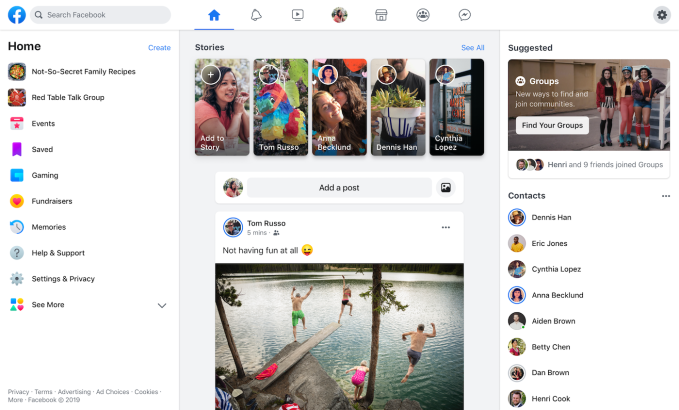
Most noticeably, that starts with sucking much of the blue out of the Facebook interface to making it look sparse and calming — despite a More button that unveils the social network’s bloat into dozens of rarely used features. A new logo features a brighter blue bubble around Facebook’s distinctive white f, which attempts to but a more uplifting spin on a bruised brand.

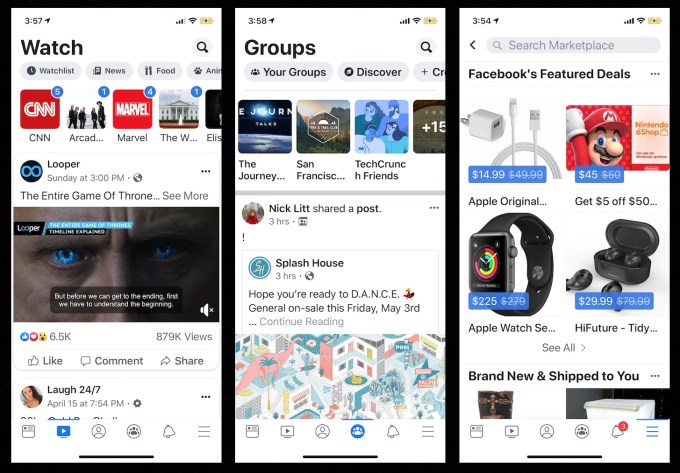
Functionally, FB5 means placing Groups near the center of a freshly tabbed interface for the both Facebook’s website and app, and putting suggestions for new ones to join across the service. “Everywhere there are friends, there should be Groups” says the head of the Facebook app Fidji Simo. Groups already has 1 billion monthly users, so Facebook is following the behavior pattern and doubling down. But Facebook’s goal is not only to have 2.38 billion people using the feature — the same number as use its whole app — but to get them all into meaningful Groups that emblematize their identity. 400 million already are. And now Groups for specific interests like gaming or health support will get special features, and power users will get a dashboard of updates across all their communities.

Groups will be flanked by Marketplace, perhaps the Facebook feature with the most latent potential. It’s a rapidly emerging use case Facebook wants to fuel. Just a a year and a half after launch, Marketplace had 800 million monthly users. Zuckerberg took Craigslist, added real identity to thwart bad behavior, and now is bolting it to the navigation bar of the most-used app on earth. The result is a place where it’s easy to put things up for sale and get tons of viewers. I once sold a couch on Marketplace in 20 minutes. Now sellers can take payments directly in the app instead of with cash or Venmo, and they can offer to ship items anywhere at the buyer’s expense. By following Zuckerberg’s mandate that 2019 focus on commerce, Facebook has become a viable Shopify competitor.

If Groups is what’s already working about Facebook’s future, Watch is the opposite. It’s a product designed to capture the video viewing bonanza Facebook observes on Netflix and YouTube. But without tent pole content like a “Game Of Thrones” or “Stranger Things”, it’s failed to impact the cultural zeitgeist. The closest thing it has to must-see video is Buffy The Vampire Slayer re-runs and a docuseries on NBA star Steph Curry. Facebook claims 75 million people now Watch for at least one minute per day though those 60 seconds don’t have to be  sequential. That’s still just 4 percent of its users. And a Diffusion study found 50 percent of adult US Facebook users had never even heard of Watch. Sticking it front and center demonstrates Facebook commitment to making Watch a hit even if it has to cram it down our throats.

Not The Old Facebook

The products of the past got little love on stage at F8. Nothing new for News Feed, Facebook’s mint but also the source of its misinformation woes. In the age of Snapchat and Zuckerberg’s newfound insistence on ephemerality to prevent embarrassment, the Timeline profile chronicling your whole Facebook life got nary a mention. And Pages for businesses that were the center of its monetization strategy years ago didn’t find space in the keynote, similar to how they’ve been butted out of the News Feed by competition and Facebook’s philosophical shift from public content to friends and family.

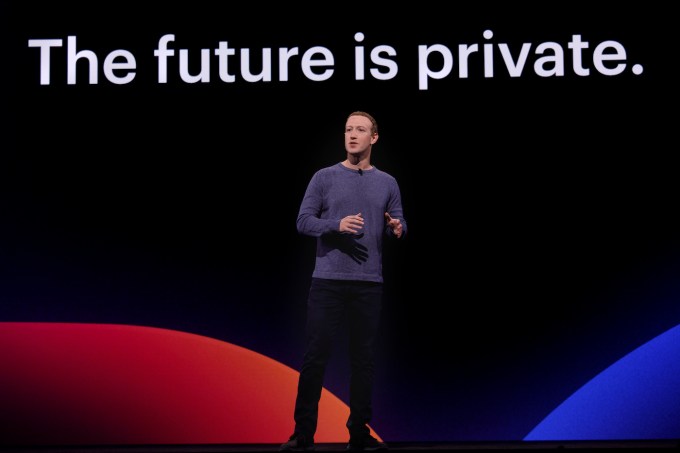
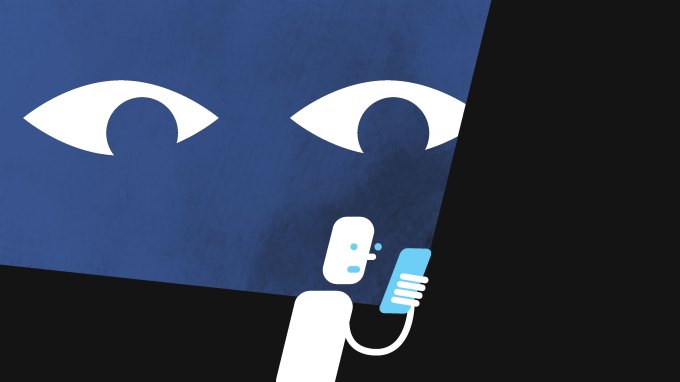
The one thing we heard a lot about but didn’t actually see much of was privacy. Zuckerberg started the conference declaring “The future is private!” He spoke about how Facebook plans to make its messaging apps encrypted, how it wants to be a living room rather than just a town hall, and how it’s following the shift in user behavior away from broadcasting. But we didn’t see any new privacy protections for the developer platform, a replacement for its Chief Security Officer that’s been vacant for nine months, or the Clear History feature Zuckerberg announced last year.

“I get that a lot of people aren’t sure that we’re serious about this. I know that we don’t exactly have the strongest reputation on privacy right now, to put it lightly” Zuckerberg joked without seeming to generate a single laugh. Combined with having little to show to enhance privacy, making fun of such a dire situation doesn’t instill much confidence. When Zuckerberg does take things seriously, it quickly manifests itself in the product like with Facebook’s 2012 shift to mobile, or in the company like with 2018’s doubling of security headcount. He knew mobile and content moderation failures could kill his network. But does someone who told Time magazine in 2010 that “What people want isn’t complete privacy” truly see a loose stance on privacy as an existential threat?

Interoperable, encrypted messaging will boost privacy, but it’s also just good business logic given Zuckerberg’s intention to own chat — the heart of your phone. Facebook’s creepiness stems from it sucking in data to power ad targeting. Nothing new was announced to address that. Despite his words, perhaps Zuckerberg doesn’t aspire to make Facebook as private as he aspired to make it mobile and secure. 

Wired reported that Zuckerberg authored a strategy book given to all employees ahead of the IPO that noted “If we don’t create the thing that kills Facebook, someone else will.” But F8 offered a new interpretation. Maybe given the lack of direct competitors in its league, and the absence of a mass exodus over its constant privacy scandals, it was the outdated product itself that was killing Facebook. The permanent Facebook. The all-you-do-is-scroll Facebook. The bored-of-my-friends Facebook. Users were being neglected rather than pushed away or stolen. By ignoring the past and emphasizing the products it aspires to have dominate tomorrow — Groups, Marketplace, Watch — Facebook can start to unchain itself from the toxic brand poisoning its potential.

Google opens Android Automotive OS to Spotify, other media app developers

Google is opening its Android Automotive operating system up to third-party developers to bring music and other entertainment apps into vehicle infotainment systems, starting with the Polestar 2, an all-electric vehicle developed by Volvo’s standalone electric performance brand.

Google announced Wednesday that media app developers will be able to create new entertainment experiences for Android Automotive OS and the Polestar 2, starting at Google I/O 2019, the annual developer’s conference that kicks off May 7.

Google is starting with media app developers such as Spotify and other entertainment sites. However, the company plans to expand into other categories of apps as well such as navigation, Haris Ramic, Google’s product lead for Android Automotive told TechCrunch in a recent interview.

Android Automotive OS shouldn’t be confused with Android Auto, which is a secondary interface that lies on top of an operating system. Android Automotive OS is modeled after its open-source mobile operating system that runs on Linux. But instead of running smartphones and tablets, Google modified it so it could be used in cars.

Polestar  introduced in February its first all-electric vehicle, a five-door fastback called the Polestar 2, ahead of the Geneva Motor Show. The Polestar 2’s infotainment system is powered by Android Automotive OS and, as a result, brings into the car embedded Google services such as Google Assistant, Google Maps and the Google Play Store.

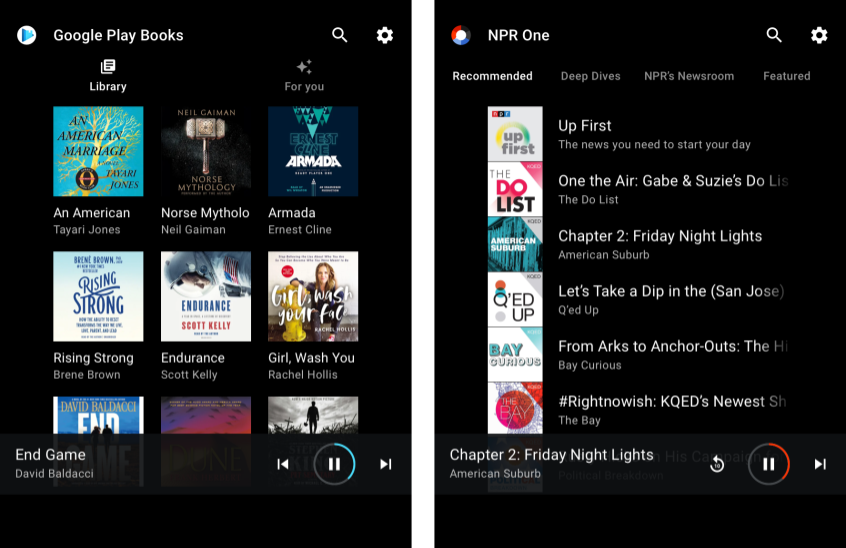
Ramic noted that the system shown in Geneva has improved and now has updated Google Maps and a media center that allows third-party applications like Spotify, NPR and YouTube Music to function more seamlessly in the vehicles. These applications will be ready when the vehicle goes into volume production, which is slated to begin in early 2020 at its Chengdu, China factory. The company is initially targeting sales in China, the U.S., Canada and a handful of European countries that include Belgium, Germany, the Netherlands, Norway, Sweden and the U.K.

Polestar isn’t the only company with plans to incorporate a version of its Android operating system into its car infotainment systems. Volvo announced in 2017 that it would use the Android OS and a year later said it would embed voice-controlled Google Assistant, Google  Play Store, Google Maps and other Google services into its next-generation Sensus infotainment system. lvo.

Fiat Chrysler Automobiles announced Tuesday that it will use tech from Harman and Google to build out its connected-car services. Google’s Android Automotive OS will power FCA’s next version of its Uconnect infotainment system, while Samsung-owned Harman’s Ignite cloud platform will handle the out-of-car services.

Renault-Nissan-Mitsubishi Alliance has also publicly announced plans for Android Automotive OS as well as other automakers that Google can’t reveal at this time, Ramic said.

“Interest is very high,” Ramic said, noting that a growing number of companies have come to see the value in leveraging Google’s expertise.

That’s a shift from the traditionally protective stance of automakers intent of keeping Google out of the car. But as the divide between the capabilities of smartphones and in-car infotainment systems grows, automakers have been more willing to turn to Google.

Pluralsight will acquire GitPrime for $170M

Pluralsight, an online training platform focusing on subjects like web development, IT certification, and security training, announced today that it will acquire GitPrime, a dev team productivity tool, for $170M in cash.

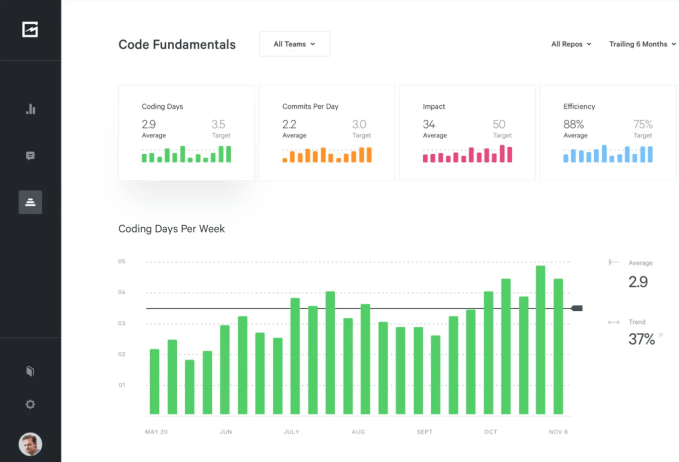
GitPrime is like an analytics dashboard for code projects. It watches your team’s code repositories on services like GitHub or Bitbucket, tracking things like user-by-user code commits over time, ticket activity, and how different team members tackle things like pull requests. The idea is that by providing this data in a visual/at-a-glance way, it helps to identify bottlenecks and highlight where your teams are most efficient.

The company was a part of Y Combinator’s Winter 2016 class, and CrunchBase indicates their most recent round was a $10.5M Series A.

Pluralsight went public in May of last year. The company says this is its first acquisition post-IPO, and that they expect the deal to close by the end of next week.

https://platform.twitter.com/widgets.js

Epic Games is buying the studio behind Rocket League

Epic Games is in the process of acquiring the studio behind one of the most popular cross-platform games out there, Rocket League.

The studio behind Fortnite is buying Psyonix for an undisclosed sum and bringing its 132 employees onboard. There doesn’t appear to be a ton changing at the San Diego game studio, Epic says the company will continue to support the game on all platforms.

The real competitive advantage seems to rely on Rocket League coming to the Epic Games store in “late 2019” and ceasing new downloads on Valve’s Steam store at that time, though Epic specifically notes that users that have already downloaded the title on Steam will continue to have support.

The whimsical title has been an unlikely smash success. Rocket League has more than 57 million players, the studio says.

Epic owning two of the biggest cross-platform gaming titles is obviously a major boon to the company and a sign that they’re committed to ensuring that the studio’s success continues long after Fortnite downloads slow. This is one of their most important acquisitions to date and brings a cash cow exclusive to their games store which is continuing to aggressively pursue exlclusives as it tries to take down one of gaming’s biggest powerhouses.