Fanduel is now charging inactive users $3 per month for not playing

You expect to lose money gambling, but you don’t really expect to lose it abstaining from gambling. But if you’re Fanduel user who hasn’t made any bets or deposits for two years, the site will now deduct $3 per month until you put some money on the table. You have to play to win, it seems, but not to lose.

In an email sent to such lapsed (or perhaps recovering) users, including Engadget’s Richard Lawler, Fanduel wrote:

It appears your account has been inactive for over two years, which means you have neither deposited nor entered a contest during that time. We’ve recently updated our Terms of Use to impose a monthly inactivity fee of $2.99 for any accounts that have no play or deposit activity for a period of 24+ months. Per our terms, we are providing you with 30 days notice prior to imposing this fee.

How many inactive accounts do you think you have at random sites you signed up for and never ended up using? Dozens, maybe even a hundred for some? Has any one of these sites ever attempted to charge you for not using their service? Not a monthly fee you have to pay whether you use it or not — literally charging you money because you didn’t use the site. Can’t say I’ve ever heard of it.

In a statement, Fanduel explained that “inactive account fees are a common practice amongst other companies that maintain online account balances in the U.S and Europe. In some of those cases, entire account balances are forfeited after a defined period of inactivity.”

I checked a few gambling and fantasy sites and did find one (wsop.com) that imposes an inactivity fee, though many don’t. So it’s not unprecedented. And indeed depending on the state your account balance may be forfeit after as little as a year, or as many as five or six.

The rules will naturally apply to a lot of people who, for instance, tried the site out but not for a long time, and perhaps even sent Fanduel notifications to spam. Can you blame them? It’s been safe with every other site, and when they signed up there was no inactivity fee. It was added in a recent terms of service update.

But how many of these people will have heard of and agreed to those updated terms. Can people who didn’t agree to the terms be held to them? Exactly how binding EULAs and such truly are is an open legal question. But Fanduel’s approach here seems beyond the pale.

The terms do mention that the company may “modify or replace the Terms of Use at any time.” But they also state that “Use of the Services by you after any modification to the Terms constitutes your acceptance of the Terms of Use as modified.” So if the users haven’t used the service post modification, they haven’t accepted the terms. How can the new fee be applied? I’ve asked Fanduel about this.

To be clear, the money comes out of your Fanduel account balance, and once that bottoms out it’s done — they’re not going to reach out and ding your actual bank account. The fees will continue until the account is empty or the inactivity reaches the state-determined limit defining abandonment, at which point the remaining funds are remitted to the proper authorities as “unclaimed property.” The idea, I suppose, is to let as little go unclaimed as possible.

Naturally anyone can delete your account, withdraw your balance, or play a free game on the site to avoid the fee. And they’ve got a month to do it — assuming they even see the email Fanduel sent. And in its statement the company also said that “if any user asks to reactivate their account prior to December 31, 2019 we will reimburse all fees charged and the user may withdraw that money from their account.”

Of course there is a certain amount of personal responsibility a user must bear for leaving their money in what amounts to a privately operated lock box. But they did so with the understanding that the operator wouldn’t change the policies and then sneak a few bills out.

I’ll update this post if I hear back from Fanduel as to how the terms can apply to people who haven’t agreed to them, implicitly or explicitly. In the meantime if you have an account there, you should check the balance — you’ll have to use it, move it, or lose it.
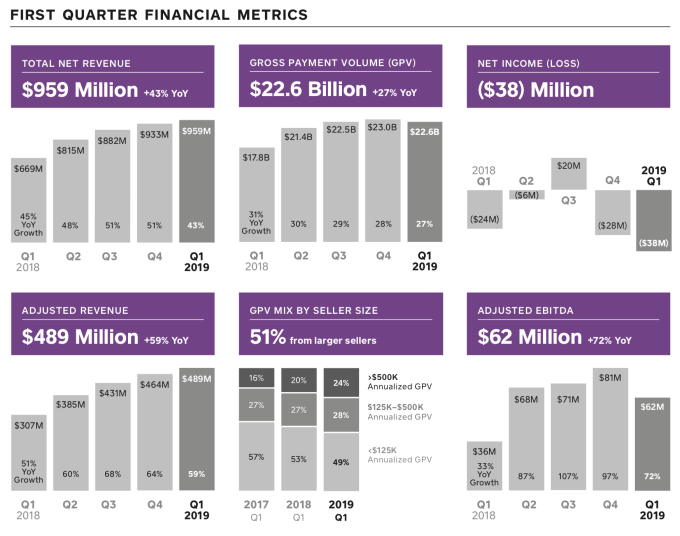

Square reports Q1 sales of $489M, up 59%, but net loss widens to $38M

After Square issued weak guidance in Q4, all eyes were on the payments company to see what kind of growth it really had in Q1. Results reported today underscored some of the challenges the company is facing.

Square’s adjusted revenues were $489 million, up 59 percent year-on-year, with adjusted earnings per share of $0.11. Both figures beat analysts’ estimates. The company had been expected to report earnings per share of $0.08 and revenues of $479.63 million, respectively up 33.3 percent and 56.2 percent on a year ago.

But on the other hand, they were also a signal of a continued slowdown: in the last quarter, Square’s revenues of $464 million represented a rise of 64 percent. It also posted a widening net loss of $38 million, versus $28 million last quarter and $24 million a year ago. (It noted that its “mark-to-market valuation of our Eventbrite investment” accounted for $14 million of that loss.)

The company’s stock is down nearly six percent in after-hours trading.

Since going public in November 2015, the company has seen strong growth and has generally beaten expectations. But Square has reported a net loss for four of the last five quarters, and so any kind of slowdown in growth poses a challenge for turning that around.

Square continued to grow business operations like Square Cash — its instant money transfer service — and its core payments business (subscription and services revenue). The latter was up 126 percent to $219 million.

But in the last quarter the company started to make some moves into one of the newer areas of fintech, cryptocurrencies, with CEO Jack Dorsey announcing that it was hiring engineers to work on open source contributions to the crypto and bitcoin ecosystems, its first effort to do so “independent of its business objectives.”

The last quarter it also started to make more moves into pure e-commerce and for people who are not physically taking payments with its dongles. That included launching the Square Online Store to complement brick-and-mortar transactions, and the Square Invoices app, for those who are not taking payments in person.

More to come

Fitbit beats Q1 revenue expectations as smartwatch growth continues

Fitbit’s financial rebound continued in the first quarter, as the company generated $271.9 million in revenue, beating Wall Street expectations of $259.7 million. The good news is almost exclusively the domain of the company’s increased focus on smartwatches, which grew 117 percent year over year.

That, in turn, is thanks to this year’s debut of the Versa Lite, a version of Fitbit’s best smartwatch that’s focused on cost, one of the company’s primary selling point against the dominant Apple Watch. It’s a continued payoff of Fitbit’s purchase of Pebble, Vector and Coin — a hail Mary designed to put the company back on track after initially ceding the smartwatch space to Apple, Samsung, Garmin and the like.

Interestingly, while revenue has been shifting from trackers to smartwatches, the tracker side of things also saw modest year on year gains of 17 percent (bringing the total number of devices sold up 36 percent y-o-y), courtesy of the launch of the Inspire, which consolidates several of Fitbit’s trackers into a single line. While the category is generally believed to have plateaued, CEO James Park tells TechCrunch the company is predicting continued growth on that side — albeit at a significantly slower pace than watches.

“We’re continuing to forecast growth in the tracker business, and even faster growth and smartwatch business — but group growth in both segments,” the executive explains.

Forward momentum will require continued innovation on Fitbit’s part and while Park wouldn’t comment directly on plans to release successors to the standard Versa and Ionic, he says the company has “a pretty predictable spring fall launch cadence. And it just really depends on where things are in our product roadmap and market conditions.”

Park’s sentiments echoed those of Apple’s on its own earnings call yesterday, as the company increasingly looks to services for revenue growth. In Fitbit’s case, the plan involves a premium offering launching later this year that will straddle the line between its consumer and growing healthcare business.

“At a very high level, the vision for our premium offering is a service that uses and gathers Fitbit data and data from other sources to screen and diagnose different disease and health conditions for users, that analyzes this data to give people richer and deeper insights about their health, and also provides coaching and guidance,” says Park. “Next steps are for people to address their health conditions or to reach their fitness and wellness goals.”

Final Niantic EC-1 lessons, F8 call, Slack, WeWork, and TED

Live Conference Call: Josh Constine and Frederic Lardinois talk all things F8 in just a bit

Facebook’s annual F8 conference is in full swing, with major redesigns of the company’s apps and all sorts of news trickling out of San Jose. We have Josh Constine and Frederic Lardinois on the ground talking to everyone, and now we invite all EC members to join us for a live conference call today at 5pm EST / 2pm PST (i.e. about an hour or so from now).

Dial-in information will be sent an hour before the call to all Extra Crunch members.

Niantic EC-1, Part 4: Nine lessons on growth

Greg Kumparak warps up his massive dive into the (virtual) world of Niantic, the producer behind Pokémon GO and Harry Potter: Wizards Unite. In this final conclusion, he takes stock of all the lessons learned from the company and how Niantic’s methods turned it into a $4 billion AR behemoth:

Job recruitment site Ladders exposed 13 million user profiles

Ladders, one of the most popular job recruitment sites in the U.S. specializing in high-end jobs, has exposed more than 13.7 million user records, following a security lapse.

The New York-based company left an Amazon -hosted Elasticsearch database exposed without a password, allowing anyone to access the data. Sanyam Jain, a security researcher and a member of the GDI Foundation, a non-profit aimed at securing exposed or leaking data, found the database and reported the findings to TechCrunch in an effort to secure the data.

Within an hour of TechCrunch reaching out, Ladders had pulled the database offline.

Marc Cenedella, chief executive, confirmed the exposure in a brief statement. “AWS confirms that our AWS Managed Elastic Search is secure, and is only accessible by Ladders employees at indicated IP addresses. We will look into this potential theft, and would appreciate your assistance in doing so,” he said.

TechCrunch verified the data by reaching out to more than a dozen users of the site. Several confirmed their data matched their Ladders profile. One user who responded said they are “not using the site anymore” following the breach.

Each record included names, email addresses, and their employment histories, such as their employer and job title. The user profiles also contain information about the industry they’re seeking a job in and their current compensation in U.S. dollars.

Many of the records also contained detailed job descriptions of their past employment, similar to a résumé.

Although some of the data was publicly viewable to other users on the site, much of the data contained personal and sensitive information, including email addresses, postal addresses, phone numbers and their approximate geolocation based off their IP address.

The database contained years’ worth of records.

Some records included their work authorizations, such as whether they are a U.S. citizen or if they are on a visa, such as an H1-B. Others listed their U.S. security clearance alongside their corresponding jobs, such as telecoms or military.

More than 379,000 recruiters information was also exposed, though the data wasn’t as sensitive.

Security researcher Jain recently found a leaking Wi-Fi password database and an exposed back-end database for a family tracking app, including the real-time location data of children.

Read more:

Nine lessons on how Niantic reached a $4B valuation

We’ve captured much of Niantic’s ongoing story in the first three parts of our EC-1, from its beginnings as an “entrepreneurial lab” within Google, to its spin-out as an independent company and the launch of Pokémon GO, to its ongoing focus on becoming a platform for others to build augmented reality products upon.

It’s not an origin story that serves as an easily replicable blueprint — but if we zoom out a bit, what’s to be learned?

A few key themes stuck with me as I researched Niantic’s story so far. Some of them – like the challenges involved with moving millions of users around the real world – are unique to this new augmented reality that Niantic is helping to create. Others – like that scaling is damned hard – are well-understood startup norms, but interesting to see from the perspective of an experienced team dealing with a product launch that went from zero to 100 real quick.

The reading time for this article is 16 minutes (5,150 words).

Build on top of what works best

Everything Niantic has built so far is an evolution of what the team had built before it. Each major step on Niantic’s path has a clear footprint that precedes it; a chunk of DNA that proved advantageous, and is carried along into the next thing.

Looking back, it’s a cycle we can see play out on repeat: build a thing, identify what works about it, trim the extra bits, then build a new thing from that foundation.

Madrona Venture Group launches $100M acceleration fund

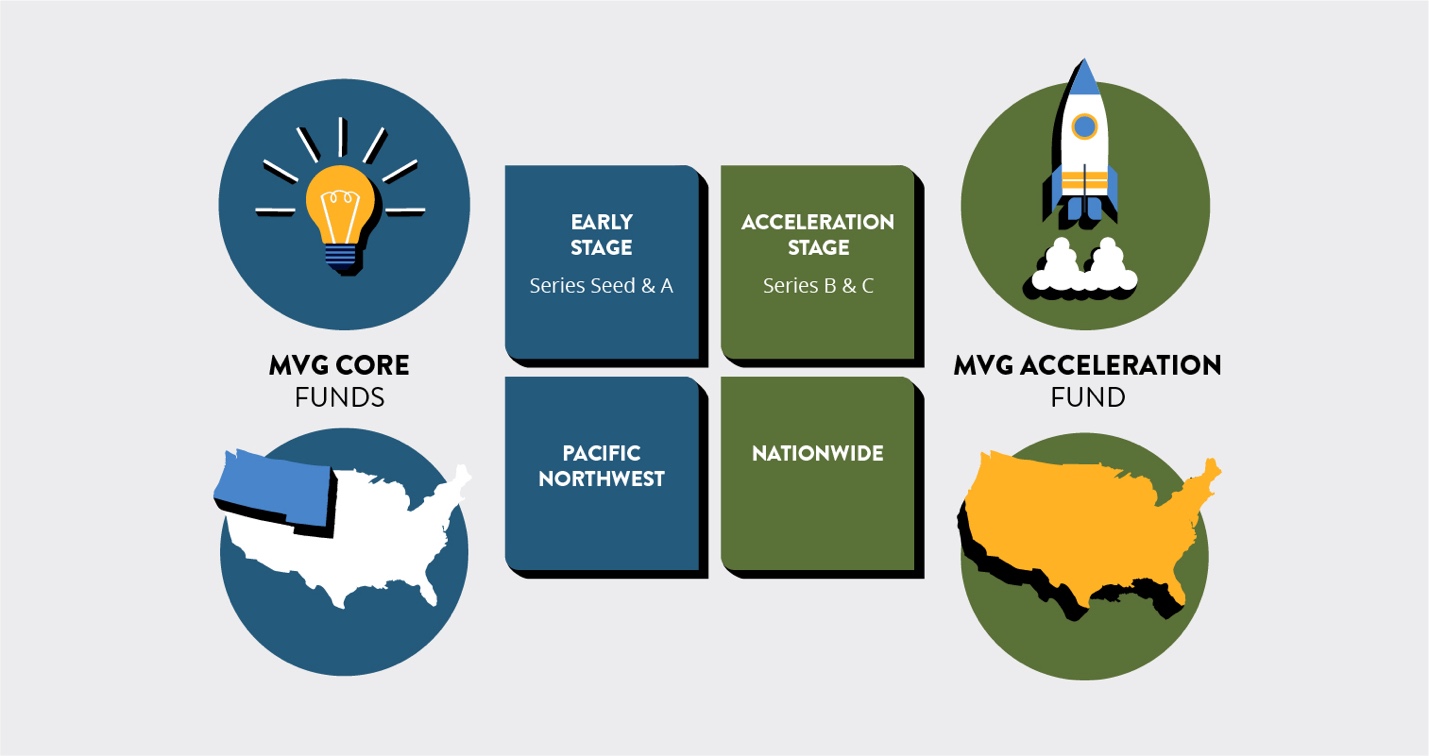
Seattle’s Madrona Venture Group has long been one of the most prominent early-stage funds in the backyard of Amazon and Microsoft. Now, however, the firm is starting to look beyond the Pacific Northwest with the launch of its $100 million Acceleration Fund, which will expand its geographic reach to the entire U.S. and give it a vehicle to invest in later rounds.

The new fund will see Madrona make more investments at the Series B and C stage. While Madrona has made a wide variety of investments over the years, including some into consumer services, its focus has long been on enterprise cloud companies, ranging from Apptio to Smartsheets and Heptio (which VMware recently acquired). We’ll see a similar focus with this new fund, as Madrona managing director Matt McIlwain told me, with an emphasis on cloud and applied machine learning companies. Unlike Madrona’s current focus on the Pacific Northwest — and Seattle in particular — this fund will also invest in companies across the country.

“Our long-time strategy has been early stage, broad-based technology, Pacific Northwest,” McIlwain told me. “We call it an acceleration fund because we want to differentiate it from what some people call opportunity funds, which is more of a ‘put more money into my existing company.’ This is not that. This is new money into great companies that have reached that initial product-market fit and that want to accelerate their growth.”

Madrona also expects that these companies have reached product differentiation and founders and key executives that can sell those products.

McIlwain noted that Madrona has selectively made some of these investments in companies like Tigera, Snowflake and Accolade over the years already. This new fund gives the firm a dedicated vehicle to invest in companies where it believes it can add more value at this later stage.

“When I joined Accolade almost four years ago – the mission was to accelerate the company’s growth by finding the best talent to build a world-class product and distribution team,” said Accolade CEO Raj Singh “To do that, you need world-class partners. Having worked with Matt McIlwain and Madrona on both the Apptio and Amperity board of directors, reaching out to Madrona was high on my priority list on day one. And they have lived up to my expectations – helping with customer acquisition, critical hires, key partnerships, and invaluable counsel.”

McIlwain told me that Madrona has yet to make its first investment from the new fund. “But we’re eager to find that first one that’ll be special enough,” he said.

Tesla sued in wrongful death lawsuit that alleges Autopilot caused crash

The family of Walter Huang, an Apple engineer who died after his Tesla Model X with Autopilot engaged crashed into a highway median, is suing Tesla. The State of California Department of Transportation is also named in the lawsuit.

The wrongful death lawsuit, filed in in California Superior Court, County of Santa Clara, alleges that errors by Tesla’s Autopilot driver assistance system caused the crash that killed Huang on March 23, 2018. Huang, who was 38, died when his 2017 Tesla Model X hit a highway barrier on Highway 101 in Mountain View, California.

The lawsuit alleges that Tesla’s Autopilot driver assistance system misread lane lines, failed to detect the concrete media, failed to brake and instead accelerated into the median.

A Tesla spokesperson declined to comment on the lawsuit.

“Mrs. Huang lost her husband, and two children lost their father because Tesla is beta testing its Autopilot software on live drivers,” B. Mark  Fong, a partner at law firm Minami Tamaki said in a statement.

Other allegations against Tesla include product liability, defective product design, failure to warn, breach of warranty, intentional and negligent misrepresentation and false advertising. California DOT is also named in the lawsuit because the concrete highway median that Huang’s vehicle struck was missing its crash attenuator guard, according to the filing. Caltrans failed to replace the guard after an earlier crash there, the lawsuit alleges.

The lawsuit aims to “ensure the technology behind semi-autonomous cars is safe before it is released on the roads, and its risks are not withheld or misrepresented to the public,” said Doris Cheng, a partner at Walkup, Melodia, Kelly & Schoenberger, who is also representing the family.

In the days following the crash, Tesla released two blog posts and ended up scuffling with the National Transportation Safety Board, which had sent investigators to the crash scene.

Tesla’s March 30 blog post acknowledged Autopilot had been engaged at the time of the crash. Tesla said the driver had received several visual and one audible hands-on warning earlier in the drive and the driver’s hands were not detected on the wheel for six seconds prior to the collision.

Those comments prompted a response from the NTSB, which indicated it was “unhappy with the release of investigative information by Tesla.” The NTSB requires companies who are a party to an agency accident investigation to not release details about the incident to the public without approval.

Tesla CEO Elon Musk would soon chime in via Twitter to express his own disappointment and criticism of the NTSB.

Three weeks after the crash, Tesla issued a statement placing the blame on Huang and denying moral or legal liability for the crash.

“According to the family, Mr. Huang was well aware that Autopilot was not perfect and, specifically, he told them it was not reliable in that exact location, yet he nonetheless engaged Autopilot at that location. The crash happened on a clear day with several hundred feet of visibility ahead, which means that the only way for this accident to have occurred is if Mr. Huang was not paying attention to the road, despite the car providing multiple warnings to do so.”

The relationship between NTSB and Tesla would disintegrate further following the statement. Tesla said it withdrew from its party agreement with the NTSB. Within a day, NTSB claimed that it had removed Tesla as a party to its crash investigation.

A preliminary report from the NTSB didn’t make any conclusions of what caused the crash. But it did find that the vehicle accelerated from 62 mph to 70.8 mph in the final three seconds before impact and moved left as it approached the paved gore area dividing the main travel lane of 101 and Highway 85 exit ramp.

The report also found that in the 18 minutes and 55 seconds prior to impact, the Tesla provided two visual alerts and one auditory alert for the driver to place his hands on the steering wheel. The alerts were made more than 15 minutes before the crash.

Huang’s hands were detected on the steering wheel only 34 seconds during the last minute before impact. No pre-crash braking or evasive steering movement was detected, the report said.

The case is Sz Hua Huang et al v. Tesla Inc., The State of California, no. 19CV346663.


Blue Origin lofts NASA and student experiments in New Shepard tomorrow morning

The 11th mission for Blue Origin’s New Shepard suborbital launch vehicle is slated for takeoff Tuesday morning. The craft will be carrying 38 (!) experimental payloads from NASA, students, and research organizations around the world. You’ll be able to watch the launch live tomorrow at about 6 AM Pacific time.

New Shepard, though a very different beast from the Falcon 9 and Heavy launch vehicles created by its rival SpaceX, is arguably a better platform for short-duration experiments that need to be exposed to launch stresses and microgravity. Launching satellites — that’s a job for Falcons and Deltas, or perhaps Blue Origin’s impending New Glenn, and they’re welcome to it. But researchers around the country are clamoring for spots on suborbital flights and Blue Origin is happy to provide them.

https://platform.twitter.com/widgets.js

Tomorrow’s launch will be carrying several dozen, some of which will have been waiting years for their chance to board a rocket. Here are a few examples of what will be tested during the short flight:

  • Evolved Medical Microgravity Suction Device: As more people go into space, we have to be prepared for more and graver injuries. Lots of standard medical tools won’t work properly in microgravity, so it’s necessary to redesign and test them under those conditions. This one is about providing suction, as you might guess, which can be used for lung injuries, drawing blood, and other situations that call for negative air pressure.

This little guy will be doing microgravity test prints using metal.

  • 3D printing with metal in microgravity: Simply everyone knows we can 3D print stuff in space. But just as on Earth, you can’t always make your spare parts out of thermoplastic. Down here we use metal-based 3D printers, and this experiment aims to find out if a modified design will allow for metal printing in space as well.
  • Suborbital centrifuge: It sounds like something the Enterprise would deploy in Star Trek, but it’s just a test bed for a new type of centrifuge that could help simulate other gravities, such as that of the Moon or Mars, for purposes of experiments. They do this on the ISS already but this would make it more compact and easier to automate, saving time and space aboard any craft it flies on.

The suborbital centrifuge, looking as cool as it sounds.

  • BioChip SubOrbitalLab: The largest ever study of space-based health and the effects of microgravity on the human body was just concluded, but there’s much, much more to know. Part of that requires monitoring cells in real time — which like most things is easier to do on the surface. This lab-on-a-chip will test out a new technique for containing individual cells or masses and tracking changes to them in a microgravity environment.

It’s all made possible through NASA’s Flight Opportunities program, which is specifically all about putting small experiments aboard commercial spacecraft. The rest of the many gadgets and experiments awaiting launch are listed here.

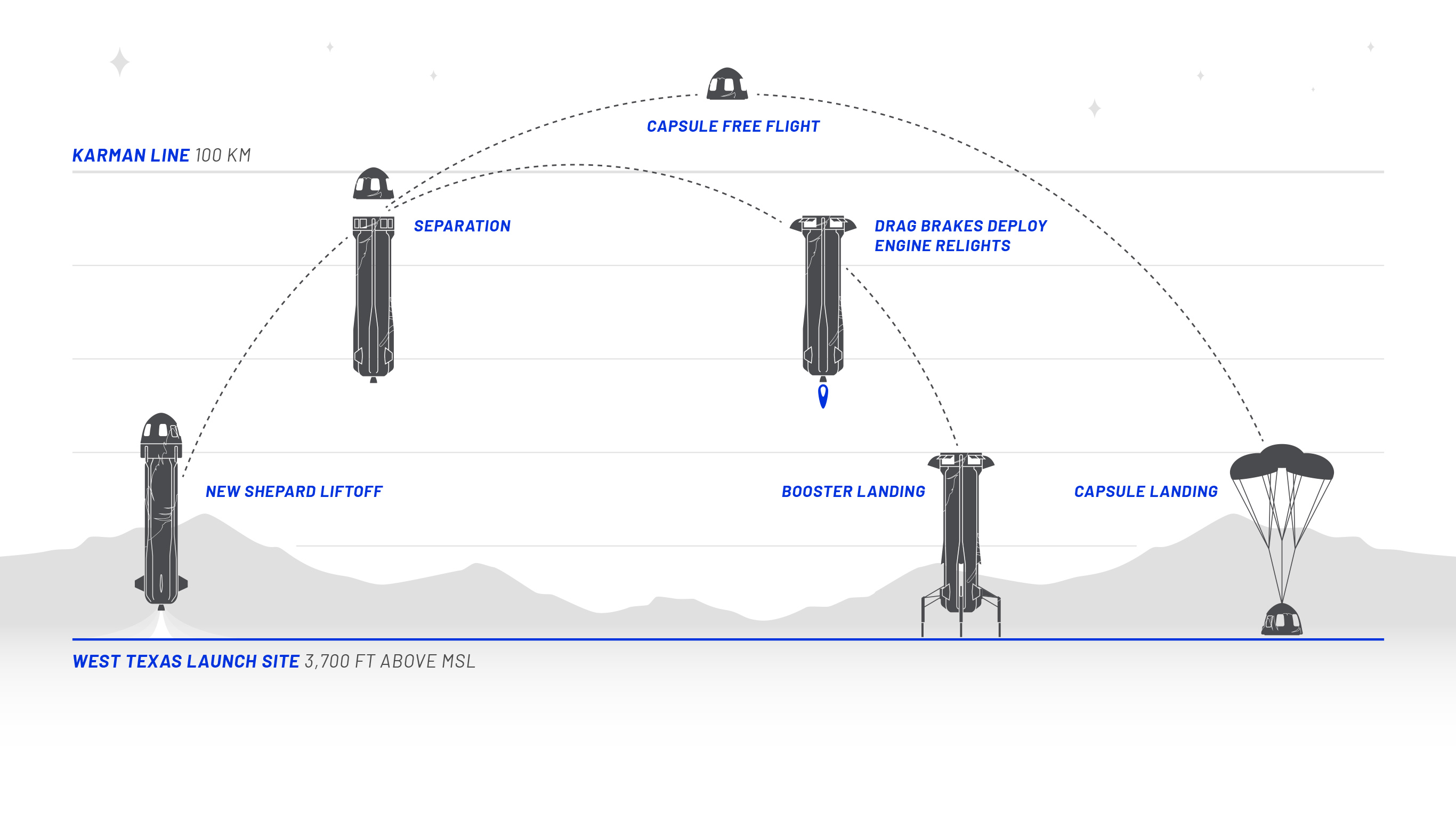
The launch itself should be very similar to previous New Shepards, just like one commercial jet takeoff is like another. The booster fires up and ascends to just short of the Karman line at 100 kilometers, which (somewhat arbitrarily) marks the start of “space.”

At that point the capsule will detach and fly upwards with its own momentum, exposing the payloads within to several minutes of microgravity; after it tops out, it will descend and deploy its parachutes, after which it will drift leisurely to the ground. Meanwhile the rocket will have descended as well and made a soft landing on its deployable struts.

The launch is scheduled for 6:30 AM Pacific time — 8:30 AM Central in Texas, at Blue Origin’s launch site. You’ll be able to watch it live at the company’s site.

The Daily Crunch: Apple stock jumps after earnings

The Daily Crunch is TechCrunch’s roundup of our biggest and most important stories. If you’d like to get this delivered to your inbox every day at around 9am Pacific, you can subscribe here.

1. Apple’s stock jumps 5 percent after beating expectations

Apple released earnings for its fiscal second quarter yesterday, reporting revenue of $58 billion, a decline of 5% from the year-ago quarter. It also reported quarterly earnings per diluted share of $2.46, down 10%.

The market seems to approve, with shares jumping after the numbers were released.

2. Facebook Dating opens to friends with Secret Crush

Facebook announced at its F8 conference that Dating is opening in 14 more countries, bringing the total to 19. It will launch in the U.S. before the end of the year.

3. Eric Schmidt and Diane Greene are leaving Alphabet’s board of directors

Along with the departures, Alphabet is also announcing the appointment of Robin L. Washington to its board.

LONDON, ENGLAND – MAY 01: Wikileaks Founder Julian Assange leaves Southwark Crown Court in a security van after being sentenced on May 1, 2019 in London, England. (Photo by Jack Taylor/Getty Images)

4. Julian Assange jailed for 50 weeks for breaching UK bail conditions

WikiLeaks founder Julian Assange was jailed to 50 weeks for violating his U.K. bail conditions in 2012 at a sentencing hearing at Southwark Crown Court.

5. Hulu tops 28 million customers, unveils new shows and a ‘binge watch’ ad experience

The streaming service also unveiled its new slate of shows and original programming, alongside other content deals and a new “binge advertising experience” that’s designed to be less intrusive.

6. A16z ushers in new fund strategy with $2.75B

Axios reported that Andreessen Horowitz, the storied venture capital firm with investments in Airbnb, BuzzFeed and Coinbase, has closed on $2.75 billion for two new funds.

7. YouTube sets a goal of having half of trending videos coming from its own site

YouTube wants to have half of the featured videos in its trending tab come from streams originating on the company’s own site going forward, according to the latest quarterly letter from chief executive Susan Wojcicki.