Alexa in-skill purchasing, which lets developers make money from voice apps, launches internationally

A year after Amazon opened up in-skill purchasing to all Alexa developers in the U.S., the company is launching the service internationally. Initially, the capability will roll out to developers in the U.K., Germany and Japan, and then developers elsewhere in the world. With in-skill purchasing, developers are able to generate revenue from voice apps in a number of ways: through the sale of digital goods as a one-time purchase, subscriptions, or consumables.

Digital goods can include things like expansion packs for a trivia skill, while consumables are one-time-use purchases — like hints for a trivia game. Subscriptions, meanwhile, give developers a more consistent revenue stream, and can be used for things like a premium, upgraded app experience, or a voice app that regularly updates with new content, for example.

The larger idea is that publishers need to make money from voice apps, in order to make their continued development worth their while. As it’s still early days for voice, many developers are still seeing what sort of skills work and which don’t, and how customer loyalty plays out over the long-term.

There are now over 80,000 skills for Alexa, which means there’s a long tail of developers whose apps aren’t getting much traction and only a few hits.

But Amazon today highlighted a couple of skills finding some success. One is the game skill Escape the Airplane from developer Gal Shenar who reports a 34 percent conversion rate. Nick Schwab’s ambient sound skills, meanwhile, have attracted nearly 2 million monthly active users. He offers those customers free trials and monthly subscriptions, and 30 percent convert to trials. A further 90 percent of the free trials then convert to paid subscriptions.

In both cases, the developers present the premium experience as an option — not a hard sell. And they make their skills engaging and habit-forming.

Other top skills include Jeopardy, Escape the Room, Beat the Intro, Big Sky, Would You Rather for Family, Question of the Day, and Yes Sire.

With the international expansion, developers will be able to monetize their skills with localized content that’s relevant to customers in different countries. They can do so using either the Alexa Command-Line Interface or the Alexa Developer Console.

Interested developers are asked to sign up by way of a form, in order to connect with a member of the Alexa team about their idea.

Google’s Wear OS gets tiles

Google announced an interesting new Wear OS feature today that makes a number of highly used features more easily available. Google calls this feature ’tiles’ and it makes both information like the local weather forecast, headlines, your next calendar event, goals and your heart rate, as well as tools like the Wear OS built-in timer available with just a few swipes to the left.

In the most recent version of Wear OS, tiles also existed in some form, but the only available tile was Google Fit, which opened with a single swipe. Now, you’ll be able to swipe further and bring up these new tiles, too.

There is a default order to these tiles, but you’ll be able to customize them, too. All you have to do is touch and hold a given tile and then drag it to the left or right. Over time, Google will also add more tiles to this list.

The new tiles will start rolling out to all Wear OS smartwatches over the course of the next months. Some features may not be available on all devices, though (if your watch doesn’t have a heart rate monitor, you obviously won’t see that tile, for example).

Overall, this looks like a smart update to the Wear OS platform, which now features four clearly delineated quadrants. Swiping down brings up settings, swiping up brings up your notifications, swiping right brings up the Google Assistant and swiping left shows tiles. Using the left swipe only for Google Fit always felt oddly limited, but with this update, that decision makes more sense.

SeatGeek names former Tumblr and NYT exec Brian Murphy as CTO

Ticketing startup SeatGeek has a new CTO.

Brian Murphy previously held the same position at Tumblr (which, like TechCrunch, is owned by Verizon Media) and has also served as vice president of engineering at The New York Times and senior director of technology at Condé Nast.

“Brian is an incredible leader and team-builder who has overseen engineering teams for some remarkable companies,” said SeatGeek co-founder and CEO Jack Groetzinger in a statement. “He is a perfect fit for this role at SeatGeek and embodies the values we hold – he loves building great products, is humble yet aggressive in how he approaches opportunities, and is focused on creating experiences live event fans will love.”

Murphy told me that his career started out in consulting, but he’s been attracted to technology roles in media companies because he was “drawn to all the smart creative folks who want to use their technology in that medium.”

As for SeatGeek, Murphy described it as a “very consumer-oriented, very mobile-focused” company that’s now moving into the enterprise business by working with teams and venues to sell tickets. He also said he’ll be working on international expansion and on helping Lyft build a broader live event experience.

“You’ve sort of started to see it with partnerships with Lyft and Snapchat and Spotify,” he said.”There’s definitely an opportunity how we bring our Starbucks-esque experience to the stadium.”

Murphy added that he’ll be “very, very busy with recruiting.”

Meanwhile, SeatGeek’s outgoing CTO Eric Waller isn’t leaving the company — instead, he’s becoming chief product officer.

A16z ushers in new fund strategy with $2.75B

Axios reported this morning that Andreessen Horowitz, the storied venture capital firm with investments in Airbnb, BuzzFeed and Coinbase, has closed on $2.75 billion for two new funds.

The firm has raised 2 billion for a growth fund led by their most recent hire and 15th general partner David George. Additionally, a16z has lassoed $750 million for early stage deals. We’ve reached out to the firm to confirm.

This comes about a month after Forbes explained a16z new status as a financial advisor rather than a venture capital fund.

The a16z model, one that couples capital with agency-like services, has for years been replicated by other big venture firms. Ow, a16z expects to lead the charge again by turning itself into a registered investment advisor.

The move will allow a16z to experiment I. New areas, including the public markets, other VC funds, and cryptocurrencies.

George is investing across industries, offering up his knowledge of late-stage economics, valuations and underwriting to a16z’s large and growing team of deal-makers. George is the at least the fourth high-level addition to the team in the last year, including Katie Haun, who joined in June to lead a16z’s cryptocurrency investment effort. Angela Strange and Connie Chan, additionally, were promoted to GP last summer.

This is a market where entrepreneurs have lots of choices and they are making choices on the expertise of the individual partner,” a16z managing director Scott Kupor told TechCrunch. “The purpose of having more GPs is about having the appropriate domain expertise and coverage so we can be in front of the most opportunities out there.”

A16z’s fifth flagship venture fund closed on $1.5 billion in 2016. The firm also deploys capital out of a crypto fund, a bio fund and a cultural fund, which boasts limited partners including Sean “Diddy” Combs, Shonda Rhimes and Jada Pinkett Smith.

Sean Parker’s Brigade/Causes acquired by govtech app Countable

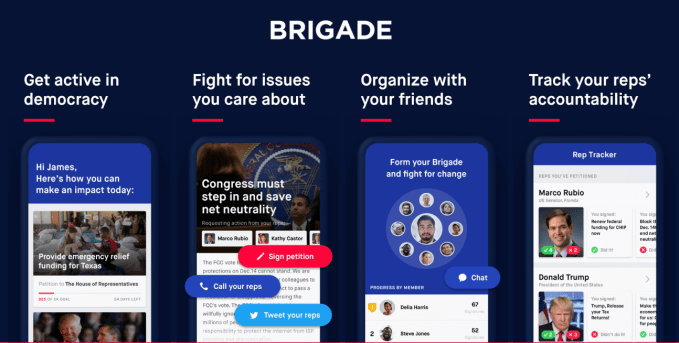
Causes grew to a jawdropping 186 million users as one of the first ten Facebook platform apps. Started by Facebook co-founder Sean Parker, it was meant to turn a generation into activists and philanthropists. Causes acquired Votizen to augment shallow clicktivism with a way to remind friends to vote. But after Facebook went mobile and the web platform waned, Parker arranged Causes’ sale to his newer civic tech effort Brigade, for which he’d led a $9.3 million Series A and later fed more money. Brigade’s ballot guide was used by 250,000 people in the 2016 election leading to 5 million Get Out The Vote messages sent, but the startup’s apps for connecting with campaigns or debating political issues never went viral like Causes.

Now both Causes’ and Brigade’s stories are coming to an end. In February, we caught wind of Brigade selling off its high-grade engineering team to Pinterest in an acquihire while it sought a home for its IP. Today, Brigade announces its technology and data have been acquired by politician tracking service Countable. Terms of the deal were not disclosed but it’s unlikely that Brigade’s Series A investors earned a return.

“While we didn’t reach the ultimate mountaintop, I think we moved the entire civic tech space forward” Brigade CEO Matt Mahan tells me.

Countable lets people view summaries of upcoming legislation, contact their representatives about their opinion, and then track the officials’ votes. “Brigade was founded with the non-partisan mission to reinvent how Americans participate in politics. When they decided to bring their journey to a close, Matt and Brigade’s leadership team sought out a mission-aligned company to acquire their technology, and a responsible place to point any members of their community who were eager to remain civically active and engaged” says Countable CEO Bart Myers. “They approached Countable–an obvious fit for our commitment to lowering barriers to civic entry and empowering meaningful action, and we’re excited to provide a home for their technology moving forward.”

To further their contribution to the democracy innovation community, Countable has agreed to open source Brigade’s voter matching software. This allows apps to tie a user to their official voting record to offer personalized features like reminders of upcoming elections, petitions for local issues, and ways to contact their elected officials. Seth Flaxman, the CEO of civic tech software developer Democracy Works that built TurboVote, says “This is extremely difficult technology to build and can help TurboVote determine which of our 6 million users needs more help registering to vote. They are passing the baton, making it possible for nonprofits like ours to build off their progress.”

We’ll have more analysis shortly

Early-stage US VC Joyance to scout for health and wellness startups in Europe

Good news for European startups with a health or wellness bent. Joyance Partners, a $20M US VC firm that invests in early-stage startups in the health and ‘better living’ space is launching into the European market with a dedicated European partner.

The move could be seen as taking advantage of leaps in the capability of European startups, especially in the health and AI space.

To lead its European efforts, the fund has appointed Paolo Pio as managing director of Joyance Partners Europe. Paolo was most recently head of product and business development at Cisco for Europe, and then Asia/Pacific. He has also been an active angel investor.

“The European startup scene is growing rapidly, and it needs funds like Joyance to provide the kind of support and capital necessary at the very early stages,” said Pio.

“We’re extremely pleased with the companies we’ve seen in the US and are excited to expand our search for companies that contribute to individual health and happiness to Europe,” said Mike Edelhart, managing partner of Joyance Partners in a statement.

Joyance launched in 2017 and has since made over 50 investments related to the emerging science of health and happiness. These include personal thermostat Embr Labs; on-body fluidics lab Epicore Biosystems; microbiome leader DermBiont; medical AI innovators Gyant and Lark Health; NeoSensory, which lets one human sense stand in for another; female pleasure products maker Unbound; and Wynd Technologies, which delivers pure air to individuals or groups.

Another investment, NeoSensory, raised $14.2M, and focuses on sending a variety of data streams to the brain via the sense of touch.

Joyance is also adding two other new team members to bolster its activity. Holly Jacobus (Investment Partner, NY) and Jun Deng, PhD (Investment Partner, Silicon Valley).

The firm has a particular description for these types of investments. They call them “delightful moments — the small quanta of time that brings greater joy, confidence, calm, control, and absence of anxiety or pain.”

So far so hippie, but Joyance says that research increasingly notes a connection between happiness and health, such as the long-noted effects of job stress on health, and the coloration between positive emotions and longer and healthier life.

In a 2010 study released in the European Heart Journal, for each one-point increase in positive emotions a patient had expressed, their heart disease risk was 22 percent lower.

So get being happy, people.

Hulu tops 28 million customers, unveils new shows and a ‘binge watch’ ad experience

Hulu has now grown over 28 million U.S. customers, including 26.8 million monthly paid subscribers and 1.3 million promotional accounts, the company announced this morning as part of its annual presentation at the digital Newfronts in New York. In January, Hulu had 25 million total users, including both paid and promo accounts, and 20 million this time last year. The streaming service also today unveiled its new slate of shows and original programming, alongside other content deals and a new “binge advertising experience” that’s designed to be less intrusive.

On the content front, Hulu announced an expanded partnership with Marvel to bring two new live-action series to its service in 2020.

Though Marvel owner Disney is preparing to launch its own direct-to-consumer streaming service later this year, Disney’s majority ownership of Hulu is proving to be an advantage as it can shift some of the more adult-oriented Marvel properties to Hulu, instead of the more family-focused Disney+ streaming service.

That seems to be the case for the new Marvel series Marvel’s Ghost Rider, aka Robbie Reyes, who’s described as a “quintessential antihero, consumed by hellfire and supernaturally bound to a demon.” The other, Marvel’s Helstrom, features Daimon and Ana Helstrom, the son and daughter of a powerful serial killer, who tracks down the worst of humanity.

Ghost Rider is exec-produced by Ingrid Escajeda, who will serve as showrunner, along with Paul Zbyszewski and Marvel’s Jeph Loeb. Helstrom is exec-produced by Loeb and Zbyszewski, who will also serve as showrunner. 

The two new series join existing Marvel properties on Hulu, including Marvel’s Runaways, and other more adult-oriented fare like Marvel’s M.O.D.O.KMarvel’s Hit-MonkeyMarvel’s Tigra & Dazzler Show, Marvel’s Howard The Duck, and the planned special event, Marvel’s The Offenders.

Hulu also today announced a new multi-year, multi-show partnership with Vox Media Studio, (Momofuku founder) David Chang’s Majordomo Media, and Chrissy Teigen’s Suit & Thai Productions, to develop premium food-centric programming. One of the first shows will feature Chang and Teigen and will focus on family cooking; another documentary series will tap into Vox’s Eater, and its knowledge of the best restaurants in the world.

Tiegen also scored her own two-year deal with Hulu to create original programming that could range from scripted content to original talk shows. (In other words, what Oprah is to Apple TV+, Tiegen is to Hulu, in terms of having free reign.)

Meanwhile, with the newly greenlit series Nine Perfect Strangers, Hulu hopes to have a hit like HBO did with Big Little Lies, as the series adapts another of author Liane Moriarty’s novels for the screen.

Also like Big Little Lies, David E. Kelley and Nicole Kidman are again involved, the former as co-showrunner and co-writer along with John Henry Butterworth, and the latter starring in a lead role as the director of a boutique health-and-wellness resort promising healing and transformation to the aforementioned nine strangers. Kidman’s production company, Blossom Films, which exec-produced the first season of Big Little Lies, is also involved along with Made Up Stories and Endeavor Content.

As previously reported, Hulu is running its own take on the Theranos scandal, with The Dropout, starring Kate McKinnon as Theranos CEO Elizabeth Holmes. And it’s renewing two freshman comedies, Pen15 and Ramy for second seasons.

Hulu’s Newfronts are really about the advertisers, of course. And this year, Hulu is pitching them a way to better target and cater to binge watchers — the viewers who are tuning in to watch for long stretches at a time. This “binge ad experience” is the second non-intrusive format Hulu has developed — the first being the “pause ad” that only appears when you press pause.

Binge ads will instead allow advertisers to target just binge watchers with creatives that are “situationally relevant” to their viewing behavior. (More on this as Hulu takes the stage later this morning.)

“This is a monumental time for Hulu’s advertising business and for brands who are looking to reach the most valuable audience in television,” said Peter Naylor, SVP and Head of Advertising Sales at Hulu, in a statement released alongside today’s event. “Because of our viewer-first advertising principles, we’re scaling rapidly. We’re offering advertisers the most sophisticated targeting, the largest addressable footprint in on-demand television, robust measurement solutions, and new ad models,” he added. “Hulu is future-proofing TV advertising and transforming the way brands connect with consumers.”

Hulu’s efforts in trying to figure out how to balance advertising with a quality TV experience, where viewers aren’t continually interrupted by repetitive ads, could be an advantage. Its focus on the user experience could help it better compete amid a growing range of free, ad-supported streaming services — a market that today includes the likes of Roku, Amazon (IMDb), Sinclair, Viacom (Pluto TV), Tubi, Google (YouTube), Walmart (Vudu), and others.

And it could give it a head’s start on competing with Netflix, if and when Netflix decides to run ads at some point in the future — a topic that was discussed earlier this week at the NewFronts, when an ad exec hinted that Netflix’s recruiters were already working towards a future that included advertising.

“In today’s direct-to-consumer world, viewers are demanding better when it comes to TV — from the user experience to their content choices to the advertising,” said Hulu CEO Randy Freer, in a statement. “Hulu’s continued growth, as well as the shows and initiatives announced today, reflect our deep investment in product, programming, brand, customer experience and business strategy to ensure that with Hulu, consumers can connect with the stories they love, at the right time and price, on any device,” he said.


Shellbot malware now shuts down other cryptominers

When hackers want to make a quick buck, mining cryptocurrency seems to be the way to go.

New research out Wednesday by Boston-based security firm Threat Stack shared exclusively with TechCrunch reveals a new variant of the Shellbot malware is taking a leaf out of the other cryptocurrency mining by breaking into computers and using their resources to make money.

Shellbot, first written about by Jask in February, now uses an old but reliable SSH brute force technique to break into internet-connected Linux servers with weak passwords to infect a system and mine cryptocurrency.

But now Threat Stack says the malware has new capabilities allowing it to spread through a network and shut down other cryptominers on infected computers, allowing the malware to free up more processing power for its own cryptomining operation.

“The main goal of this campaign appears to be monetary gain via cryptomining and propagating itself to other systems on the internet,” the research said.

The researchers found the malware on a customer’s Linux server, but declined to name the customer — only that it’s a U.S.-based company with a a global footprint. The system was shut down after it was found to be used to targeting other vulnerable machines.

The malware has three components. Although it’s not known exactly how the malware is delivered, the researchers found the dropper script used to install the malicious payload from the malware’s command and control server, an IRC chat server, which the hackers can use to check the status of the malware and remotely run commands. Using a 272-line script, the malware checks to see if any other cryptominers are on the system and installs its own. Then, the cryptominer begins mining Monero, a privacy-focused cryptocurrency, and sends the proceeds back to a MoneroHash server.

According to the MoneroHash campaign, the malware was making about $300 a day — or $8,000 in total. But the more servers infected, the greater the cryptomining returns will be.

“The threat actors behind this campaign have shown the ability and willingness to update this malware with new functionality after it has gained a foothold on an infected system,” Sam Bisbee, chief security officer at Threat Stack, told TechCrunch.

“They are fully capable of using this malware to exfiltrate, ransom, or destroy data,” he said.

Shellbot is the latest malware to put a premium on mining cryptocurrency rather than just exfiltrating files. It emerged last week a new malware, Beapy, was using leaked National Security Agency hacking tools to burrow into corporate networks to mine cryptocurrency at the file level.

Bisbee said the company is continuing to investigate Shellbot, but that the malware was likely “being used broadly based on its capabilities.”

Julian Assange jailed for 50 weeks for breaching UK bail conditions

Wikileaks founder Julian Assange has been jailed for 50 weeks for violating his U.K. bail conditions in 2012 at a sentencing hearing at Southwark Crown Court today.

A spokeswoman for the court confirmed the almost-year long custodial sentence via email — which falls just short of the 12-month maximum carried by the offence.

In a tweet following sentencing Wikileaks branded it “shocking” and “vindictive”.

Assange had already been found guilty of breaching his bail conditions at a hearing last month which followed his arrest in the Ecuadorian Embassy — after the country withdrew the diplomatic asylum it had previously granted him.

He fled to the Ecuadorian embassy in London in 2012, seeking to evade extradition to Sweden where he was facing rape accusations, claiming he was afraid the country would extradite him to the U.S.

What followed was almost seven years of self-imposed incarceration in the embassy — until his host’s patience finally wore thin. 

During this time Swedish prosecutors also dropped their cases against him, seeing no prospect of extracting him from the diplomatic asylum he was being shielded by.

In a letter read out by his lawyer in court, The Guardian reports that Assange apologized “unreservedly to those who consider that I have disrespected them by the way I have pursued my case”, claiming he had been afraid of the “terrifying circumstances” he found himself in — and saying he now regrets his decision to flee.

Once in U.K. police custody last month Assange was immediately rearrested on behalf of the U.S. — which has charged him with conspiracy to hack into a classified computer, and is seeking his extradition.

The 50-week jail sentence means he will remain behind bars in the U.K. as he begin his fight against extradition to the U.S.

The U.S. charge relates to the leak, almost a decade ago, of classified military information that was passed by former army intelligence analyst and whistleblower, Chelsea Manning, to Wikileaks.

Documents leaked by Manning and published by Wikileaks included hundreds of thousands of battlefield reports from Afghanistan and Iraq which showed, among other unflattering revelations, that the U.S. military had killed more civilians than had been officially reported.

Assange has sought to claim ‘journalist’ status and First Amendment free speech protections for publishing the classified information. But U.S. prosecutors are alleging the WikiLeaks’ founder helped Manning crack a password which allowed her to gain access to classified information she otherwise would not have been able to leak.

If extradited to the U.S. and convicted on these charges Assange faces up to five years in prison.

He’s due back in U.K. court on Thursday for a hearing on the U.S.’ extradition request.

In parallel, Manning is also behind bars in the U.S. — having been jailed for refusing to testify to a grand jury investigating WikiLeaks.

Her original 35-year sentence for leaking classified military documents was commuted to seven years by former US president Barack Obama.

BenevolentAI starts AI collaboration with AstraZeneca to accelerate drug discovery

BenevolentAI, is an AI company where AI actually means something. Founded in 2013, it focuses on ‘accelerating the journey from data to medicines.’ To achieve that, it’s raised a whopping $202 million to look at early drug discovery to late-stage clinical development and has a research facility in Cambridge, UK where there is plenty of AI talent to be had.

Today it’s inked a long-term collaboration with Pharma giant AstraZeneca to use AI and machine learning for the discovery and development of new treatments for chronic kidney disease (CKD) and idiopathic pulmonary fibrosis (IPF).

The two organizations will begin collaboration between their respects teams to combine AstraZeneca’s genomics, chemistry and clinical data with BenevolentAI’s target identification platform and biomedical knowledge graph. This is designed to create a “network of contextualised scientific data” (genes, proteins, diseases and compounds) and to look at the relationship between them.

It’s a very big market. Global Market Insights estimates the global healthcare AI market will exceed $10 billion by 2024.

Joanna Shields, CEO of BenevolentAI, said: “Millions of people today suffer from diseases that have no effective treatment. The future of drug discovery and development lies in bridging the gap between AI, data, and biology. We are thrilled to be joining forces with AstraZeneca to develop new insights and identify promising new treatments for chronic kidney disease and idiopathic pulmonary fibrosis.”

Mene Pangalos, EVP and President, R&D BioPharmaceuticals, AstraZeneca, said: “The vast amount of data available to research scientists is growing exponentially each year. By combining AstraZeneca’s disease area expertise and large, diverse datasets with BenevolentAI’s leading AI and machine learning capabilities, we can unlock the potential of this wealth of data to improve our understanding of complex disease biology and identify new targets that could treat debilitating diseases.”

CKD and IPF are complex diseases in which the underlying disease biology is not well understood. As a result, the disease complexity requires the interrogation of vast, rich datasets. Hence which this partnership comes at such an opportune time.

BenevolentAI has previously signed an exclusive license agreement with Johnson & Johnson subsidiary Janssen Pharmaceutica for a series of clinical-stage drug candidates. It also discovered a drug that could delay the onset of motor neurone disease.