India’s BlackBuck raises $150 million to digitize freight and logistics across India

India’s trucking system has a big inefficiency problem that continues to drag the economy. BlackBuck, one of the handful logistics startups that is trying to overhaul this system, just raised $150 million in Series D round to further pursue its mission.

The new round was led by Goldman Sachs Investment Partners and Accel at a valuation just shy of $1 billion, according to a person familiar with the matter. Wellington, Sequoia Capital, B Capital, LightStreet, and existing investors Sands Capital and World Bank’s investment arm International Finance Corporation also participated in the round.

The four-year-old B2B startup, which connects businesses with truck owners and freight operators, has raised about $230 million in equity financing and another $100 million in debt financing to date, CEO Rajesh Yabaji told TechCrunch in an interview.

Yabaji said the startup will use the fresh capital to expand and improve its technology stack that enables truck drivers to find more work, and grow its fleet of driver partners. As of today, BlackBuck has 300,000 trucks on its platform and about 10,000 clients including big names such as soft drinks manufacturer Coca Cola, consumer goods giant Unilever, and automotive conglomerate Tata .

BlackBuck has developed a simplified app for truck drivers in India, who are typically not very literate, to help them easily navigate to the destination using Google Maps and accept work. On the client side, businesses can fire up a similar app to place orders. Recently it also tied up with insurance company Acko to cover all the trucks on its network.

So as things work at the moment, truck drivers in India often struggle to find any work on their way back from a drop. Yabaji says BlackBuck enables them to find 25% to 30% more work opportunities. The startup takes between 15% to 20% cut of that and this is how it makes money.

India’s logistics market, valued at $160 billion, has attracted major VC funds in recent years. Delhivery, a supply chain startup, has raised north of $670 million from SoftBank, and Tiger Global among others. Rivigo, a startup that rotates drivers to improve efficiency, has raised north of $215 million from SAIF Partners and Warburg Pincus.

It’s a capital-heavy business. BlackBuck, which employs about 2,000 people, generated $135.5 million in revenue at a loss of $17 million in fiscal year 2018, according to regulatory filings. Yabaji says the startup aims to aggressively grow its business, so profitability is not something it is hoping to go after in the immediate future.

“Given the market we are in today, in terms of private capital being available, we do not have to do IPO for a really long time. It is all about optimizing for the objective,” he said.

BlackBuck said it will also give about 200 of its employees an option to liquidate up to 25% of their vested shareholding in the company at the current price.

Airbnb-backed OYO moves into Europe, acquires @Leisure from Axel Springer for $415M

OYO, the fast-growing budget hotel startup out of India that’s backed by Airbnb, SoftBank, Grab and Didi, has made an acquisition to expand its footprint into Europe, specifically around self-catering home rentals. The company has picked up @Leisure Group from Axel Springer for about $415 million (€369.5 million).

@Leisure sees traffic and business from some 2.8 million travellers annually from across 118 countries. Its European footprint covers some 115,000 homes, and some 300,000 rooms globally

It operates through various sub-brands, including Belvilla, DanCenter, Danland and Traum-Ferienwohnungen, and last year it posted Ebitda of more than €24 million, Axel Springer said.

The German media company, which acquired @Leisure four years ago for an undisclosed sum, also said the divestment is expected to close in June 2019, and will see it focusing more on its jobs and classifieds business as a result.

The deal is the latest big move for OYO, which is now valued at $5 billion, as it continues to expand its footprint outside of its home market, after launches in Japan in recent weeks and China last year.

While companies like Airbnb have expanded into higher end homes and business services, what OYO has been doing is focusing on expanding budget offerings. That’s a strategy that has appeared to pay off in spades. OYO says it is now the world’s sixth-largest chain of hotels, a place it hopes to advance on the back of raising more than $1 billion in funding since September last year, first in a tranche of $1 billion that included SoftBank’s Vision Fund, and later through a strategic investment from Airbnb, which sources tell us was between $150 million and $200 million.

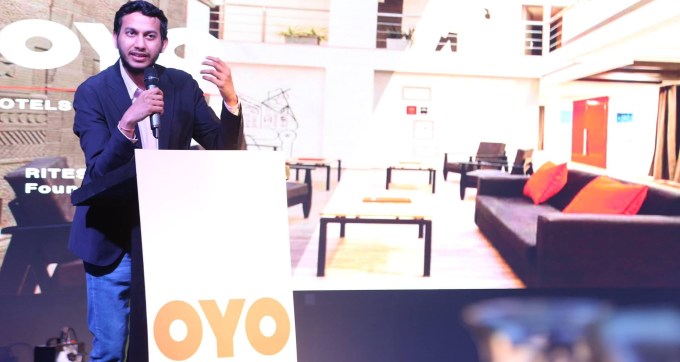
OYO founder and CEO Ritesh Agrawal

“We see vacation homes as a unique opportunity with 115,000 units of homes now getting added to our already growing count of beautiful homes and we are excited to continue maintaining our global industry leadership,” OYO’s founder and CEO Ritesh Agarwal (pictured above) said in a statement. “Our focus, however, will remain to be a beloved consumer brand that has the ability to create a perfect space in every place. The @Leisure Group is a great partner and we are excited to broad base their offerings. @Leisure Group has proven capabilities in helping develop Europe into a vacation rentals hotspot and we are keen to leverage their competencies towards ensuring beautiful vacation rental and urban homes experience for millions of tourists from every part of the world.”

Tobias Wann, the CEO @Leisure, is becoming CEO of Vacation Homes at OYO as part of the acquisition.

“We are delighted to join forces with OYO in its mission of creating quality and beautiful spaces,” he said in a statement. “@Leisure Group was started with a similar mission to identify and service all forms of vacation & urban home rentals, focusing on delivering a hassle-free experience to both homeowners and guests. I am delighted to share that we’ve successfully achieved that over the past few years, and now aspire to leverage our synergies to deepen our presence in Europe and look to expand globally.”

Europe’s vacation rental market will be worth some $18.6 billion this year, according to estimates, growing at between four and eight percent annually. Now that we are heading into the travel season we are seeing a number of deals emerging to capitalise on the opportunity both within the borders of the region, as well as to tap interest from international tourists coming to Europe. Earlier this week, we confirmed that GetYourGuide, a startup from Berlin that offers listings for tours and other travel experiences, is raising between €300 million and €500 million in funding at a valuation of about $1.6 billion.

Europe has also been an important type of market, in that it’s been one of the big leaders in self-catering vacation home rentals, so for OYO to break into Europe, having a network like this, ready-made rather than built from scratch, is one way to make the move quickly — a sentiment echoed by OYO itself:

“With Europe spearheading the vacation and urban home rental trend globally, @Leisure Group is uniquely positioned to capitalize on its experience and insights aided with OYO’s full stack approach towards building the world’s largest global vacation rentals business,” said OYO chief strategy officer Maninder Gulati in a statement. “If one were to look at Europe alone, there is an ever-increasing demand for vacation homes with an increasing trend of booking an entire home. Further, in such a market of largely fragmented small and independent players, and a handful of established players, of which @Leisure Group, is one of the largest, we feel travelers will be excited with what @Leisure Group can offer. Through this acquisition, the size and scale of the opportunity can be immediately unlocked for OYO’s Homes business.”

The deal will give OYO a big boost from its existing footprint, which had covered 800 cities in 24 countries, including the UK, US, India, China, Malaysia, Nepal, UAE, Indonesia, Saudi Arabia, the Philippines and Japan. It already had 18,000 buildings and 636,000 units under management, along with  40,000-holiday homes. Other investors in it include Sequoia Capital, Lightspeed Ventures, Hero Enterprise, and China Lodging Group. 

Struggling grocery startup Honestbee fires its CEO

The changes continue to roll at Honestbee. Fresh from pausing operations in four countries and announcing plans to lay off 10 percent of staff, the Singapore-based online grocery startup has let CEO Joel Sng go, two sources with knowledge of his exit told TechCrunch.

Sng, who co-founded Honestbee back in 2015 and previously served as an advisor with its investor Formation 8, cleared his desk and vacated his office yesterday, according to sources.

Honestbee declined to comment.

Isaac Tay, another co-founder, left the company last year while the last remaining co-founder is Jonathan Low, who leads Honestbee’s engineering team.

Sng’s apparent exit comes after we reported that Honestbee had told staff that it is in the process of securing funding that it claims will provide an additional year of runway for the business. Sources who spoke to TechCrunch said it has not been announced how much that funding is, or which investor is providing it.

Honestbee had held acquisition talks with Grab, Go-Jek and others in recent weeks.

Honestbee co-founder Joel Sng [Image via LinkedIn]

It isn’t immediately clear who will take over from Sng. Sources previously told TechCrunch that Sng’s right man is Roger Koh, whose LinkedIn lists his current job as a principal with Formation 8. Formation 8 led Honestbee’s $15 million Series A round in 2015. The fund has since shut down and its stake appears to have transferred to Formation Group, according to the firm’s website.

Filings show that Honestbee has raised at least $46 million since that Series A. Its high burn rate suggests it may have raised even more, but nothing has been announced or filed while former staff have told TechCrunch that only Sng and Koh have access to financial details.

The company is going through some turbulent times. We reported last week that a cash crash — not helped by a burn rate of $6.5 million per month — had left suppliers unpaid, payroll for April uncertain and morale low among Honestbee’s estimated 1,000 staff.

The company said yesterday announced a series of cost-cutting measures that will see it temporarily cease business in Hong Kong, Indonesia, Japan and the Philippines while it conducts a review. It has also stopped offering food delivery, an additional service it launched in recent years, in Thailand and Hong Kong.

Samsung Ventures’ first investment in Southeast Asia is HR startup Swingvy

Samsung Ventures, the VC arm of the Korean electronics giant, has made its first investment in Southeast Asia after it backed HR startup Swingvy.

Singapore-based Swingy’s service provides HR services, payroll and insurance for SMEs on a freemium basis. The company announced this week that it raised $7 million that was led by the Samsung arm with participation from Aviva Ventures — from insurance firm Aviva — and Bass Investment. Existing investors Walden International and Big Basin Capital, which financed a previous $1.6 million round, also took part.

Founded in 2016, Swingvy claims to work with over 5,100 companies across Singapore, Malaysia and Taiwan. Those customers, some of which do not pay, have a cumulative user base of over 100,000 employees.

“Our target customer is SMEs not enterprise,” Jin Choeh, who is CEO and one of three Swingvy co-founders, told TechCrunch in an interview. “There are some local players, some legacy players and some startup competitors, but generally we saw that there’s no market leader for HR tech in Southeast Asia.”

The service itself covers areas such as an employee directory, processes for leave, performance management, company calendar, HR reporting, payroll and benefits. On the latter, Swingvy offers health insurance through partnerships with third-parties — Choeh said it is a licensed insurance agent. He said that new features coming soon include claims (for expenses and payments) while further down the line will be monthly insurance and corporate cards.

It is quite common for HR and other ‘base-level’ SME services to develop marketplaces that match their customers with third-party providers — we’ve seen that in Japan among very mature players, for example — but Swingvy isn’t going down that route. Choeh explained that it will consider offering its own services in areas where it believes it can give value to customers and control the quality and experience directly.

More broadly, the startup is aiming to triple its customer base to 15,000 this year thanks to this new injection of capital.

The initial focus is on hiring — Swingy plans to grow its headcount of 23 to over 60 this year — and more “aggressive” sales growth. That’ll mean bringing in a dedicated sales team, increasingly online advertising spend to reach new customers and being more visible around event marketing.

“Sales and marketing has been less than 10 percent of our spend,” said Choeh. “We’ve proved our model is quite cost efficient and we believe it is time to raise sales and marketing efforts.”

There’s no immediate plan to expand to new markets, but the Swingvy CEO said his company is eyeing potential expansions in 2020. Potential countries include Thailand, Vietnam and Japan, he said. Indonesia — Southeast Asia’s largest economy and the world’s fourth most populous country — is also under review, but Choeh said his team is aware that it is hyper-competitive while the market for paid SME products is particularly challenging.

What of the relationship with Samsung? For now, the relationship is financial rather than strategic, but Choeh admitted that there could be opportunities to work closely together in the future.

A mini-series on the Thai cave rescue is heading to Netflix

The rescue of a boys soccer team from caves in Thailand captivated the world last year, and now a mini-series chronically the incredible scenes is headed to Netflix .

The streaming giant announced this week that it has secured the rights from 13 Thumluang Company, which represents the boys and their coach, “to tell the true story of how they were rescued after being trapped for two weeks inside of the flooded Tham Luang caves.”

Netflix has partnered with Crazy Rich Asians team SK Global Entertainment and Jon M. Chu, the production house and director behind the smash film, to bring the as-yet-unnamed series to its platform. Thai director Nattawut “Baz” Poonpiriya, whose credits include Bad Genius, will also help lead the project.

There’s no word on how much Netflix has paid for the project, but Thai newspaper The Nation reported that the team plans to donate 20 percent of their earnings to charity “because the families and the boys recognize they have been helped and supported by so many people.”

“This is an opportunity for me as a filmmaker — and also a Thai citizen — to write a Thank you
letter to the rest of the world,” said Poonpiriya in a statement.

“The story combines so many unique local and universal themes which connected people from all walks of life, from all around the world. Thailand is a very important country for Netflix and we are looking forward to bringing this inspiring local, but globally-resonant story of overcoming seemingly insurmountable odds to life, once again, for global audiences,” added said Erika North, who is director of international originals at Netflix.

Indeed, the story is one that fits snuggly inside Netflix’s strategy of telling local stories to the world. With nearly 150 million subscribers worldwide, it is a formidable outlet for storytelling.

The company often plays up how popular local content in markets like Korea, Latin America and other places is with its viewers across the world. The Thai cave story already has a global backdrop, so we can expect that’ll get big numbers when it is released.

On that, there’s no date right now but it’ll be some time since the production team has only just been confirmed.

That gives us plenty of time to ponder how perennial tech genius/panto villain Elon Musk, who waded into the saga and proceeded to insult one of the rescuing divers, will be portrayed. Answers on a postcard, please.

India’s Times Internet isn’t ceding ground to US rivals Facebook and Google

The aggressive push by Silicon Valley companies and Chinese firms to win India, one of the last great growth markets, has decimated many local businesses in recent years. With each passing day, Amazon is closing in on Walmart-owned Flipkart’s lead on the e-commerce space. Uber is fighting with Ola for the tentpole position of the ride-hailing market; and Google and Facebook dominate the ads business, to name a few. But a handful of companies in India have not only survived the growing competition, but they have built businesses that are positively thriving.

Media conglomerate Times Internet, one such company, says that its properties now reach 110 million users each day and 450 million users each month. To put this in context: Facebook and Google have about 300 million monthly active users in India. Facebook, which is mired in controversy over the spread of misinformation on WhatsApp in India (and other regions), has not revealed its growth in the nation in last two years. But in a marketing pitch, the juggernaut says its family of apps (marquee Facebook, WhatsApp, and Instagram) reach 350 million users in the nation each month.

In a rare industry move, Satyan Gajwani, vice chairman of Times Internet, shared an overview of the conglomerate’s business on Tuesday, revealing the ever growing tentacles of its ambitions.

If the numbers are so huge, why self-publish? Gajwani declined to comment but his company is in a unique situation. For all its scale, Times Internet remains one of the least talked about conglomerates of its size in the country. Most news organizations in India compete with its media outlets, which may explain why it is under-reported in the press.
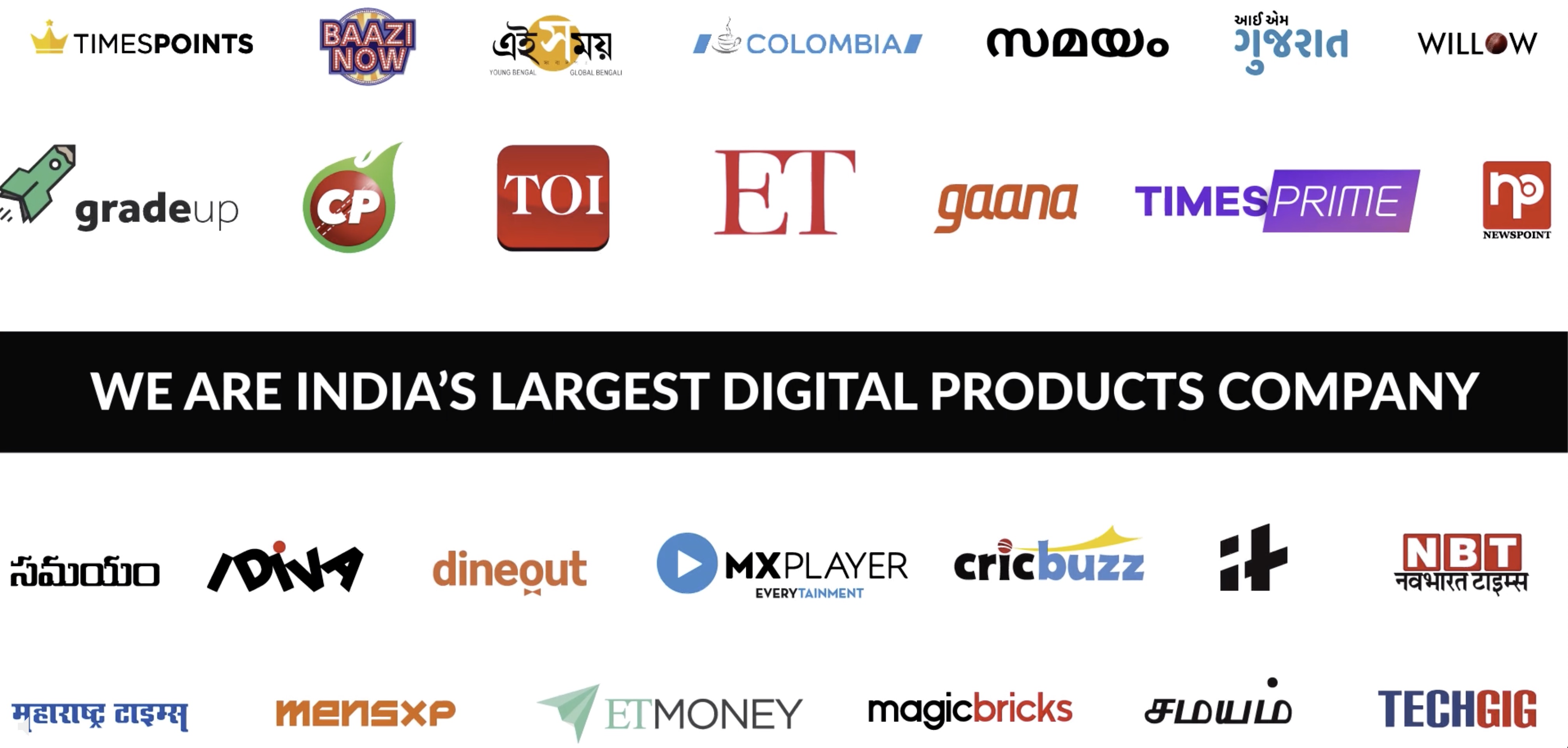
The ever-growing portfolio of Times Internet companies

The subsidiary of 181-year-old Bennett Coleman and Company Limited (popularly known as Times Group) operates more than three dozen properties, including newspaper Times of India, online outlet Indiatimes, advertisement business Colombia, venture arm Tventures, and streaming services Gaana and MX Player . And nearly all of these properties are growing, Gajwani said.

For instance, Times Internet’s news outlets have amassed 265 million monthly active users. The Times of India, the country’s most read newspaper and news website, alone has 212 million monthly active users, up by 44% since last year. Times Internet’s regional digital periodicals such as NewsPoint, Navbharat Times, Maharashtra Times, Vijay Karnataka now have 122 monthly active users, he said.

Music streaming service Gaana, which raised $115 million from Tencent and others last year, reached 100 monthly active users in March this year, the service announced last week. MX Player, a video playback app that doubles as a streaming service that Times Internet acquired for some $140 million last year, is one of the most popular Android apps in emerging markets.

During the first month of ongoing IPL cricket tournament, one of the hottest events in India, 118 million users tuned into Times Internet’s Cricbuzz, a news and entertainment service dedicated to sports. As the ecosystem of mobile gaming begins to gain major traction in India, Times Internet says it is building a portfolio of apps in this space, too.

Its lifestyle properties such as MenXP, iDiva, and Whats Hot have 40 million monthly active users and its videos clock more than 200 million views each month. These properties are exploring an additional revenue channel by selling products directly to customers, Gajwani told TechCrunch in an interview.
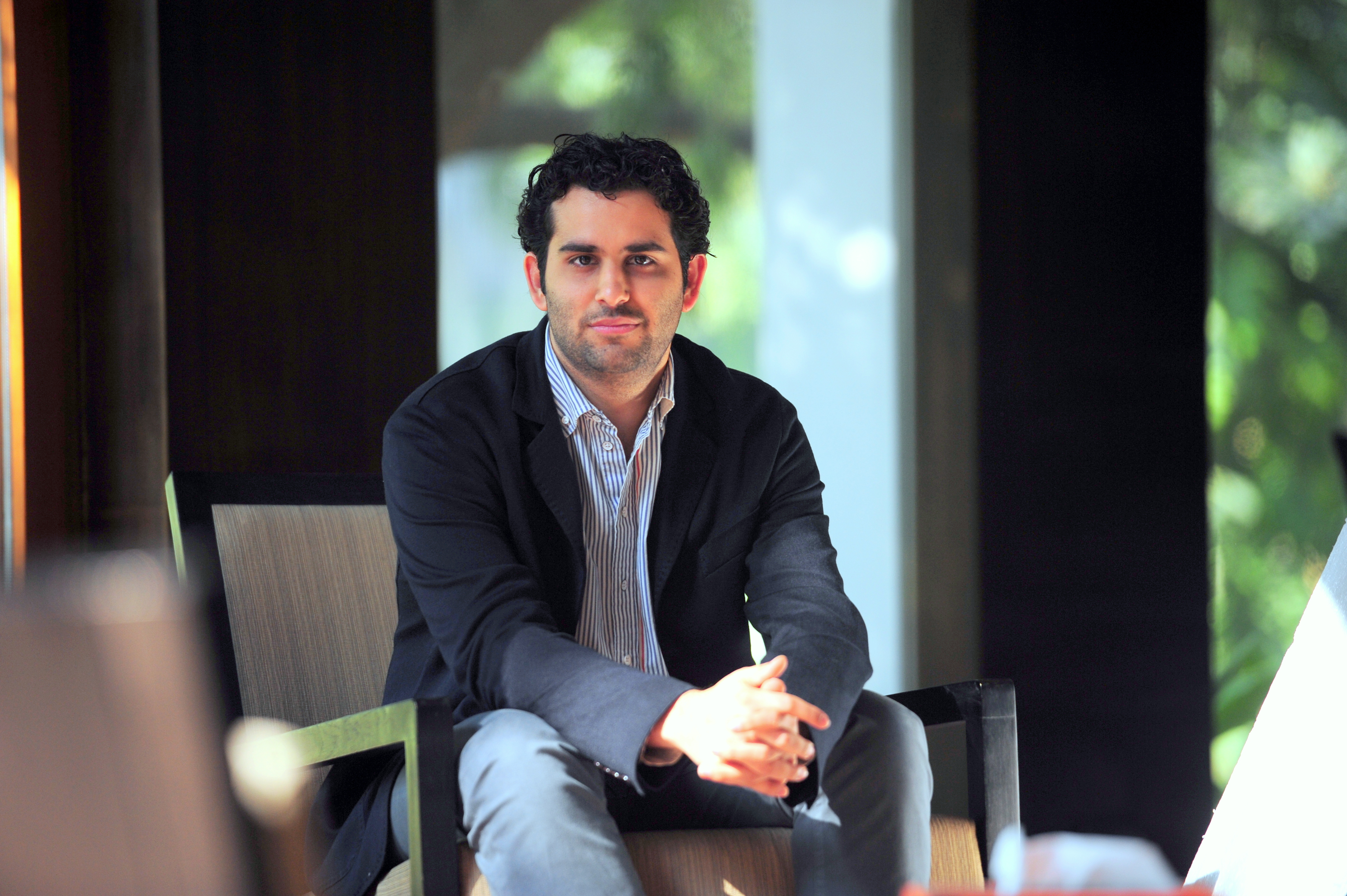
Times Internet vice chairman Satyan Gajwani

Moving beyond ads

Chasing that avenue illustrates Times Internet’s growing push to grow its business beyond ads. Most of Times Internet’s properties are built on top of ads and don’t cost users anything for access. Its own advertising business, called Colombia, now supplements some advertisement on its network and is used by more than a dozen outside brands including Ola, ABP News, and Hotstar.

But online advertising still can’t compete with those of TV and print in India, Satish Meena, an analyst with research firm Forrester told TechCrunch. So in recent years, Times Internet has announced a number of subscription services across many of its properties.

“Especially for premium publishers, an ads-only business model is not likely to last or sustain in the long run,” Gajwani said. Last year, Times Internet announced Times Prime, a subscription bundle that includes access to premium version of Gaana, an ad-free experience on Times of India, and discounts on a number of third-party services such as food delivery Swiggy, retailer BigBasket, and theatre chain PVR Cinemas. Gajwani said Times Internet has hit a million customers across its subscription services.

Part of Times Internet’s push to expand its revenue channels is its growing focus on Tventures, its VC fund that made early investments in a number of startups including edtech startup Byju’s and logistics startup Delhivery, two unicorns. It has also invested in ride-hailing service Shuttl, and cricket fantasy app MPL among others.

Gajwani said Tventures looks at “use cases that can benefit from its growing network.” And that’s one of the big advantages of Times Internet’s scale. The properties they own enjoy great advertisement benefits across its sprawling network. “There are very few companies — with exception of Google and Facebook — that have our level of scale,” Gajwani said.

https://platform.twitter.com/widgets.js

Times Internet, which employs over 5,000 people, also operates Times Bridge, an investment firm that ties with international brands to help them launch in India. Some of its strategic partners include Uber, Airbnb, and Coursera. It also partnered with a number of news outlets including Business Insider, TechRadar, Huffington Post (which, like TechCrunch, is owned by Verizon Media Group), AdAge, PCMag, and Gizmodo Media properties Lifehacker and Gizmodo to launch them in India.

But it isn’t all success, there have been less successful ventures particularly in the media segment.

The Indian versions of Lifehacker, Gizmodo, TechRadar, and PCMag failed to attract significant audiences in the nation and have already closed shops. Huffington Post ended its partnership with Times Internet in 2017 and it now wholly controls Huffington Post India.

Gajwani admitted that Times Internet realized working with some niche publishers isn’t so sustainable. “We have some partnerships that we maintain that are doing well such as Business Insider,” he added. Today, Times Internet is no longer primarily looking at publishers for future partnerships, and instead focusing on “platforms and technologies.”

A couple of hiccups aside, the biggest challenge for Times Internet going forward is generating sufficient revenue from ads and convincing enough users to become paying customers. Times Internet generated $202 million in fiscal year 2018 at a loss of $23 million, according to regulatory filings. In an interview last week, Gaana CEO Prashan Agarwal said his music streaming service, which dominates the market but is not profitable, will introduce a number of premium plans across a wide range of price tiers to attract users.

Gajwani said he also hopes to build Colombia into one of the biggest ad networks in India and tap 20 million paying subscribers by 2023. He said some properties within Times Network could raise additional cash from outside investors in the coming future.  These are ambitious goals, but Times Internet is one of the few firms in India that realistically has a shot at co-existing with dominant overseas tech platforms.

AWS opens up its managed blockchain as a service to everybody

After announcing that they were launching a managed blockchain service late last year, Amazon Web Services is now opening that service up for general availability.

It was only about five months ago that AWS chief executive Andy Jassy announced that the company was reversing course on its previous dismissal of blockchain technologies and laid out a new service it would develop on top of open source frameworks like Hyperledger Fabric and Ethereum.

“Customers want to use blockchain frameworks like Hyperledger Fabric and Ethereum to create blockchain networks so they can conduct business quickly, with an immutable record of transactions, but without the need for a centralized authority. However, they find these frameworks difficult to install, configure, and manage,” said Rahul Pathak, General Manager, Amazon Managed Blockchain at AWS, in a statement. “Amazon Managed Blockchain takes care of provisioning nodes, setting up the network, managing certificates and security, and scaling the network. Customers can now get a functioning blockchain network set up quickly and easily, so they can focus on application development instead of keeping a blockchain network up and running.”

Already companies like AT&T Business, Nestlé and the Singaporean investment market, the Singapore Exchange, have signed on to use the company’s services.

With the announcement, AWS joins other big enterprise players like Azure from Microsoft and IBM in the blockchain as a service game.

SoftBank Vision Fund says its team will balloon to a whopping 800 people by late next year

SoftBank Vision Fund has its pedal to the metal in more ways than one. On stage at the Milken Institute Global Conference yesterday, the CEO of SoftBank Investment Advisors, Rajeev Misra, reportedly disclosed plans to double the size of the investment arm from 400 employees to 800 employees over the next 18 months.

That’s a lot of people  — especially when considering that last September, one of SoftBank Vision Fund’s managing directors, Jeffrey Housenbold, told this editor that the organization employed 86 people across across offices in Tokyo, London, and San Carlos, Ca.

Then again, much has happened in the seven months since that sit-down. For one thing, SoftBank — which had been flying its managing directors back and forth to China to kick the tires on potential deals — decided to start assembling an investment team to be based in China and managed by Eric Chen, a former Hong Kong-based managing director at private equity firm Silver Lake who’d joined the firm in March of last year.

The firm also announced in November plans to open an office in Mumbai, India, where it has already amassed enormous stakes in some of the company’s highest-flying startups, including the hospitality group OYO and the digital payments company Paytm. Heading up that office: Sumer Juneja, who SoftBank poached from Norwest Venture Partners.

According to numerous Reuters’ reports last year, the Vision Fund was also planning to open an office in Saudi Arabia, home to its biggest backer – the sovereign wealth fund PIF . —  which committed $45 billion to its debut fund and told Bloomberg in early October that it planned to commit $45 billion to a second massive Vision Fund.

It isn’t clear whether those plans remain in place. Shortly after Bloomberg ran that interview, the world learned that a dissident Saudi journalist, Jamal Khashoggi, went missing at Saudi Arabia’s embassy in Turkey days earlier and never left the building. As it became clearer that Khashoggi had been murdered — the CIA believes Saudi Arabia’s Crown Prince Mohammed bin Salman ordered the 59-year-old to be killed — SoftBank’s relationship with the country came under strain. Specifically, SoftBank CEO Masayoshi Son decided to steer clear of the kingdom’s major investment summit later in October, opting instead to meet with the prince privately on the eve of the event.

The move, timid as it may have seemed to the other business heads who expressed more outrage at the time with the Saudi regime, might have been construed otherwise by the prince. At the very least, the dynamic between the two seems to have shifted. In December, Saudi Arabia and another major Vision Fund backer — the government-backed fund of Abu Dhabi — rejected the Vision Fund’s planned $16 billion investment in the co-working startup WeWork, forcing Son to make a smaller investment in the New York-based outfit, in which it was already an investor. (SoftBank has still managed to funnel $10 billion altogether into WeWork, which disclosed yesterday that it confidentially filed to go public in December.)

SoftBank is meanwhile making other moves. Last month, it announced the launch of a $5 billion fund that it will invest in technology start-ups across Latin America.

Notably, the vehicle is not a part of the Vision Fund. Instead, it’s called the SoftBank Innovation Fund, and it’s being run by former Sprint CEO and Bolivian native Marcelo Claure. Still, in the swashbuckling fashion that has become a hallmark of SoftBank deals, the firm just today confirmed that its newest fund will participate in a $1 billion round of funding for the Colombian delivery app Rappi.

SoftBank Group Corp and and SoftBank Vision Fund are splitting the $1 billion investment evenly for now, but SoftBank reportedly plans to offer its stake in the company to its Latin America-focused fund.

Altogether, as of last month, the Vision Fund had invested “probably $70 billion or so,” Son told CNBC. He added that “we have banks who are wishing to support us for extending leverage because the value of our assets has grown.”

WeWork and Uber, the ride-share giant that has also filed to go public, are among the Vision Fund’s biggest investments to date.

Possibly, the companies’ upcoming IPOs emboldened Misra yesterday to announce the firm’s own growth plans.

According to Business Insider, Misra also said at the Milken event that SoftBank will begin raising its second Vision Fund in the next several months. Whether or not it will include more funding from Saudi Arabia will be interesting to see.

SoftBank makes a huge bet on Latin America

Rappi represents a new era for Latin American technology startups.

Based in Bogotá, Colombia, the on-demand delivery startup has taken the region by storm, attracting a record amount of venture capital funding in mere months. Today marks the beginning of a new round of explosive growth as SoftBank, the Japanese telecom giant and prolific Silicon Valley tech investor, has confirmed a $1 billion investment in the business.

The king-sized financing comes two months after SoftBank announced its Innovation Fund, a new pool of capital committed to spending billions on the growing tech ecosystem in Central and South America.

VC funding in Latin America catapulted to new heights in 2018. Startups located across Argentina, Brazil, Chile, Colombia and more have secured nearly $2.5 billion since the beginning of 2018, according to PitchBook, up from less than $1 billion invested in 2017.

SoftBank plans to transfer the Rappi investment to the Innovation Fund “upon the fund’s establishment,” according to a press release. For now, the SoftBank Group and affiliated Vision Fund will each invest $500 million in the company. Jeffrey Housenbold, a managing director at SoftBank responsible for investments in Brandless, Opendoor and DoorDash, will join Rappi’s board of directors.

“SoftBank’s vision of accelerating the technology revolution deeply resonated with our mission of improving how people live through digital payments and a super-app for everything consumers need,” Rappi co-founder Sebastian Mejia said in a statement. “We will continue to focus on building innovations for couriers, restaurants, retailers and start-ups that translate into new sources of growth.”

The latest round, the largest ever for a Latin American tech startup, brings Rappi’s total raised to date to a whopping $1.2 billion. The company was valued at more than $1 billion last year with a $200 million financing.

Rappi is among few venture-backed ‘unicorns’ based in Latin America. São Paulo-based Nubank, a fast-growing fintech startup, garnered a $4 billion valuation last year with a $180 million investment.

Rappi didn’t immediately respond to a request for comment.

YouTube sets a goal of having half of trending videos coming from its own site

YouTube wants to have half of the featured videos in its trending tab come from streams originating on the company’s own site going forward, according to the latest quarterly letter from chief executive Susan Wojcicki.

The letter, directed to YouTube’s users, is meant to help ease concerns the site’s biggest stars have over copyright challenges, advertising policies and video monetization — along with their shrinking presence on the site’s trending feature.

It’s been a rough quarter for YouTube. The company had to deal with yet another child predator scandal, which prompted the company to completely shut down comment sections on most videos featuring minors. 

The Alphabet-owned video company was also forced to wrestle with its role in the spread of a global anti-vaccination campaign that has helped foster a resurgence in Measles cases around the world — creating a new epidemic in the U.S. of a disease that had been largely eradicated in the country.

Beyond monetizing anti-vaccination videos, YouTube’s role in the dissemination of videos taken by the white supremacist mass-murderer who killed scores of people in attacks on mosques in Christchurch, New Zealand has created a backlash against the company in capitals around the world.

Wojcicki addressed both incidents in the letter, writing:

In February, we announced the suspension of comments on most YouTube videos that feature minors. We did this to protect children from predatory comments (with the exception of a small number of channels that have the manpower needed to actively moderate their comments and take additional steps to protect children). We know how vital comments are to creators. I hear from creators every day how meaningful comments are for engaging with fans, getting feedback, and helping guide future videos. I also know this change impacted so many creators who we know are innocent—from professional creators to young people or their parents who are posting videos. But in the end, that was a trade-off we made because we feel protecting children on our platform should be the most important guiding principle.

The following month, we took unprecedented action in the wake of the Christchurch tragedy. Our teams immediately sprung into action to remove the violative content. To counter the enormous volume of uploaded videos showing violent imagery, we chose to temporarily break some of our processes and features. That meant a number of videos that didn’t actually violate community guidelines, including a small set of news and commentary, were swept up and kept off the platform (until appealed by its owners and reinstated). But given the stakes, it was another trade-off that we felt was necessary. And with the devastating Sri Lankan attacks, our teams worked around the clock to make sure we removed violative content. In both cases, our systems triggered authoritative news and limited the spread of any hate and misinformation.

Given those examples, the commitment that Wojcicki is making to ensure that half of the videos in the company’s trending tab come from YouTube itself seems… risky.

The company needs to do something, though. The talent on which it depends to bring in advertisers and an audience is very worried about a number of recent steps YouTube has taken.

From the perspective of YouTube’s top talent, the company is abandoning them even as regulators restrict the ways in which they’re able to make the videos that have defined the site throughout its history.

In Europe, meme culture is under attack by lawmakers who have passed legislation muddying the waters around what constitutes fair use — and YouTube’s users are worried that the company may start restricting the distribution of their videos on flimsy copyright claims.

“[We] are also still very concerned about Article 13 (now renamed Article 17) — a part of the Copyright directive that recently passed in the E.U.,” Wojcicki wrote. “While we support the rights of copyright holders—YouTube has deals with almost all the music companies and TV broadcasters today—we are concerned about the vague, untested requirements of the new directive. It could create serious limitations for what YouTube creators can upload. This risks lowering the revenue to traditional media and music companies from YouTube and potentially devastating the many European creators who have built their businesses on YouTube.”

In many ways the letter is just a continuation of themes that Wojcicki laid out in her first address to the company’s core user base.

It’s a pivotal moment for YouTube as public pressures mount for the company to take more responsibility for the videos it distributes and the users that make up the bulk of its creative community start chafing under their increasing constraints.

The company appears to be responding with a commitment to be more transparent going forward, but it’s going to be increasingly difficult for the company to navigate between the pressures of advertisers for “safe” videos and producers for greater creative freedoms — all with traditional media putting the company increasingly in its crosshairs and new players like TikTok commanding greater attention.