AR will mean dystopia if we don’t act today

The martial arts actor Jet Li turned down a role in the Matrix and has been invisible on our screens because he does not want his fighting moves 3D-captured and owned by someone else. Soon everyone will be wearing 3D-capable cameras to support augmented reality (often referred to as mixed reality) applications. Everyone will have to deal with the sorts of digital-capture issues across every part of our life that Jet Li avoided in key roles and musicians have struggled to deal with since Napster. AR means anyone can rip, mix and burn reality itself.

Tim Cook has warned the industry about “the data industrial complex” and advocated for privacy as a human right. It doesn’t take too much thinking about where some parts of the tech industry are headed to see AR ushering in a dystopian future where we are bombarded with unwelcome visual distractions, and our every eye movement and emotional reaction is tracked for ad targeting. But as Tim Cook also said, “it doesn’t have to be creepy.” The industry has made data-capture mistakes while building today’s tech platforms, and it shouldn’t repeat them.

Dystopia is easy for us to imagine, as humans are hard-wired for loss aversion. This hard-wiring refers to people’s tendency to prefer avoiding a loss versus an equal win. It’s better to avoid losing $5 than to find $5. It’s an evolutionary survival mechanism that made us hyper-alert for threats. The loss of being eaten by a tiger was more impactful than the gain of finding some food to eat. When it comes to thinking about the future, we instinctively overreact to the downside risk and underappreciate the upside benefits.

How can we get a sense of what AR will mean in our everyday lives, that is (ironically) based in reality?

When we look at the tech stack enabling AR, it’s important to note there is now a new type of data being captured, unique to AR. It’s the computer vision-generated, machine-readable 3D map of the world. AR systems use it to synchronize or localize themselves in 3D space (and with each other). The operating system services based on this data are referred to as the “AR Cloud.” This data has never been captured at scale before, and the AR Cloud is 100 percent necessary for AR experiences to work at all, at scale.

Fundamental capabilities such as persistence, multi-user and occlusions outdoor all need it. Imagine a super version of Google Earth, but machines instead of people use it. This data set is entirely separate to the content and user data used by AR apps (e.g. login account details, user analytics, 3D assets, etc.).

The AR Cloud services are often thought of as just being a “point cloud,” which leads people to imagine simplistic solutions to manage this data. This data actually has potentially many layers, all of them providing varying degrees of usefulness to different use cases. The term “point” is just a shorthand way of referring to a concept, a 3D point in space. The data format for how that point is selected and described is unique to every state-of-the-art AR system.

The critical thing to note is that for an AR system to work best, the computer vision algorithms are tied so tightly to the data that they effectively become the same thing. Apple’s ARKit algorithms wouldn’t work with Google’s ARCore data even if Google gave them access. Same for HoloLens, Magic Leap and all the startups in the space. The performance of open-source mapping solutions are generations behind leading commercial systems.

So we’ve established that these “AR Clouds” will remain proprietary for some time, but exactly what data is in there, and should I be worried that it is being collected?

AR makes it possible to capture everything…

The list of data that could be saved is long. At a minimum, it’s the computer vision (SLAM) map data, but it could also include a wireframe 3D model, a photo-realistic 3D model and even real-time updates of your “pose” (exactly where you are and what you are looking at), plus much more. Just with pose alone, think about the implications on retail given the ability to track foot traffic to provide data on the best merchandise placement or best locations for ads in store (and at home).

The lower layers of this stack are only useful to machines, but as you add more layers on top, it quickly starts to become very private. Take, for example, a photo-realistic 3D model of my kid’s bedroom captured just by a visitor walking down the hall and glancing in while wearing AR glasses.

There’s no single silver bullet to solving these problems. Not only are there many challenges, but there are also many types of challenges to be solved.

Tech problems that are solved and need to be applied

Much of the AR Cloud data is just regular data. It should be managed the way all cloud data should be managed. Good passwords, good security, backups, etc. GDPR should be implemented. In fact, regulation might be the only way to force good behavior, as major platforms have shown little willingness to regulate themselves. Europe is leading the way here; China is a whole different story.

A couple of interesting aspects to AR data are:

  • Similar to Maps or Streetview, how “fresh” should the data be, and how much historical data should be saved. Do we need to save a map with where your couch was positioned last week? What scale or resolution should be saved. There’s little value in a cm-scale model of the world, except for a map of the area right around you.
  • The biggest aspect that is difficult but doable is no personally identifying information leaves the phone. This is equivalent to the image data that your phone processes before you press the shutter and upload it. Users should know what is being uploaded and why it is OK to capture it. Anything that is personally identifying (e.g. the color texture of a 3D scan) should always be opt-in and carefully explained how it is being used. Homomorphic transformations should be applied to all data that leaves the device, to remove anything human readable or identifiable, and yet still leave the data in a state that algorithms can interpret for very specific relocalization functionality (when run on the device).
  • There’s also the problem of “private clouds” in that a corporate campus might want a private and accurate AR cloud for its employees. This can easily be hosted on a private server. The tricky part is if a member of the public walks around the site wearing AR glasses, a new model (possibly saved on another vendor’s platform) will be captured.

Tech challenges the AR industry still needs to solve

There are some problems we know about, but we don’t know how to solve yet. Examples are:

  • Segmenting rooms: You could capture a model of your house, but one side of an inner apartment wall is your apartment while the other side is someone else’s apartment. Most privacy methods to date have relied on something like a private radius around your GPS location, but AR will need more precise ways to detect what is “your space.”
  • Identifying rights to a space is a massive challenge. Fortunately, social contracts and existing laws are in place for most of these problems, as AR Cloud data is pretty much the same as recording video. There are public spaces, semi-public (a building lobby), semi-private (my living room) and private (my bedroom). The trick is getting the AR devices to know who you are and what it should capture (e.g. my glasses can capture my house, but yours can’t capture my house).
  • Managing the capture of a place from multiple people, and stitching that into a single model and discarding overlapping and redundant data makes ownership of the final model tricky.
  • The Web has the concept of a robots.txt file, which a website owner can host on their site, and the web data collection engines (e.g. Google, etc.) agree to only collect the data that the robots.txt file asks them to. Unsurprisingly this can be hard to enforce on the web, where each site has a pretty clear owner. Some agreed type of “robots.txt” for real-world places would be a great (but maybe unrealistic) solution. Like web crawlers, it will be hard to force this on devices, but like with cookies and many ad-tracking technologies, people should at least be able to tell devices what they want and hopefully market forces or future innovations can require platforms to respect it. The really hard aspect of this attractive idea is “whose robots.txt is authoritative for a place.” I shouldn’t be able to create a robots.txt for Central Park in NYC, but I should for my house. How is this to be verified and enforced?

Social contracts need to emerge and be adopted

A big part of solving AR privacy problems will come from developing a social contract that identifies when and where it’s appropriate to use a device. When camera phones were introduced in the early 2000s, there was a mild panic about how they could be misused; for example, cameras used secretly in bathrooms or taking your photos in public without a person’s permission. The OEMs tried to head off that public fear by having the cameras make a “click” sound. Adding that feature helped society adopt the new technology and become accustomed to it pretty quickly. As a result of having the technology in consumers hands, society adopted a social contract — learning when and where it is OK to hold up your phone for a picture and when it is not.

… [but ] the platform doesn’t need to capture everything in order to deliver a great AR UX.

Companies added to this social contract, as well. Sites like Flickr developed policies to manage images of private places and things and how to present them (if at all). Similar social learning took place with Google Glass versus Snap Spectacles. Snap took the learnings from Glass and solved many of those social problems (e.g. they are sunglasses, so we naturally take them off indoors, and they show a clear indicator when recording). This is where the product designers need to be involved to solve the problems for broad adoption.

Challenges the industry cannot predict

AR is a new medium. New mediums come along only every 15 years or so, and no one can predict how they will be used. SMS experts never predicted Twitter and Mobile Mapping experts never predicted Uber. Platform companies, even the best-intentioned *will* make mistakes.

These are not tomorrow’s challenges for future generations or science fiction-based theories. The product development decisions the AR industry is making over the next 12-24 months will play out in the next five years.

This is where AR platform companies are going to have to rely on doing a great job of:

  1. Ensuring their business model incentives are aligned with doing the right thing by the people whose data they capture; and
  2. Communicating their values and earning the trust of the people whose data they capture. Values need to become an even more explicit dimension of product design. Apple has always done a great job of this. Everyone needs to take it more seriously as tech products become more and more personal.

What should the AR players be doing today to not be creepy?

Here’s what needs to be done at a high level, which pioneers in AR believe is the minimum:

  1. Personal Data Never Leaves Device, Opt In Only: No personally identifying data required for the service to work leaves the device. Give users the option to opt in to sharing additional personal data if they choose for better apps feedback. Personal data does NOT have to leave the device in order for the tech to work; anyone arguing otherwise doesn’t have the technical skills and shouldn’t be building AR platforms.

  2. Encrypted IDs: Coarse Location IDs (e.g. Wi-Fi network name) are encrypted on the device, and it’s not possible to tell a location from the GPS coordinates of a specific SLAM map file, beyond generalities.

  3. Data Describing Locations Only Accessible When Physically at Location: An app can’t access the data describing a physical location unless you are physically in that location. That helps by relying on the social contract of having physical permission to be there, and if you can physically see the scene with your eyes, then the platform can be confident that it’s OK to let you access the computer vision data describing what a scene looks like.

  4. Machine-Readable Data Only: The data that does leave the phone is only able to be interpreted by proprietary homomorphic algorithms. No known science should be able to reverse engineer this data into anything human readable.

  5. App Developers Host User Data On Their Servers, Not The Platforms: App developers, not the AR platform company, host the application and end user-specific data re: usernames, logins, application state, etc. on their servers. The AR Cloud platform should only manage a digital replica of reality. The AR Cloud platform can’t abuse an app user’s data because they never touch or see it.

  6. Business Models Pay for Use Versus Selling Data: A business model based on developers or end users paying for what they use ensures the platform won’t be tempted to collect more than necessary and on-sell it. Don’t create financial incentives to collect extra data to sell to third parties.

  7. Privacy Values on Day One: Publish your values around privacy, not just your policies, and ask to be held accountable to them. There are many unknowns, and people need to trust the platform to do the right thing when mistakes are made. Values-driven companies like Mozilla or Apple will have a trust advantage over other platforms whose values we don’t know.

  8. User and Developer Ownership and Control: Figure out how to give end users and app developers appropriate levels of ownership and control over data that originates from their device. This is complicated. The goal (we’re not there yet) should be to support GDPR standards globally.

  9. Constant Transparency and Education: Work to educate the market and be as transparent as possible about policies and what is known and unknown, and seek feedback on where people feel “the line” should be in all the new gray areas. Be clear on all aspects of the bargain that users enter into when trading some data for a benefit.

  10. Informed Consent, Always: Make a sincere attempt at informed consent with regard to data capture (triply so if the company has an ad-based business model). This goes beyond an EULA, and IMO should be in plain English and include diagrams. Even then, it’s impossible for end users to understand the full potential.

Even apart from the creep factor, remember there’s always the chance that a hack or a government agency legally accesses the data captured by the platform. You can’t expose what you don’t collect, and it doesn’t need to be collected. That way people accessing any exposed data can’t tell precisely where an individual map file refers to (the end user encrypts it, the platform doesn’t need the keys), and even if they did, the data describing the location in detail can’t be interpreted.

There’s no single silver bullet to solving these problems.

Blockchain is not a panacea for these problems — specifically as applied to the foundational AR Cloud SLAM data sets. The data is proprietary and centralized, and if managed professionally, the data is secure and the right people have the access they need. There’s no value to the end user from blockchain that we can find. However, I believe there is value to AR content creators, in the same way that blockchain brings value to any content created for mobile and/or web. There’s nothing inherently special about AR content (apart from a more precise location ID) that makes it different.

For anyone interested, the Immersive Web working group at W3C and Mozilla are starting to dig further into the various risks and mitigations.

Where should we put our hope?

This is a tough question. AR startups need to make money to survive, and as Facebook has shown, it was a good business model to persuade consumers to click OK and let the platform collect everything. Advertising as a business model creates inherently misaligned incentives with regard to data capture. On the other hand, there are plenty of examples where capturing data makes the product better (e.g. Waze or Google search).

Education and market pressure will help, as will (possibly necessary) privacy regulation. Beyond that we will act in accordance with the social contracts we adopt with each other re: appropriate use.

The two key takeaways are that AR makes it possible to capture everything, and that the platform doesn’t need to capture everything in order to deliver a great AR UX.

If you draw a parallel with Google, in that web crawling was trying to figure out what computers should be allowed to read, AR is widely distributing computer vision, and we need to figure out what computers should be allowed to see.

The good news is that the AR industry can avoid the creepy aspects of today’s data collection methods without hindering innovation. The public is aware of the impact of these decisions and they are choosing which applications they will use based on these issues. Companies like Apple are taking a stand on privacy. And most encouragingly, every AR industry leader I know is enthusiastically engaged in public and private discussions to try to understand and address the realities of meeting the challenge.
USV closes on $450M for new funds, adds two partners

Union Square Ventures, a venture capital firm known for early bets in Twitter, Etsy and Tumblr, has $450 million in capital commitments to plow into the next generation of technology startups.

The capital, which comes in just above the $429 million USV filed to raise earlier this year, is divided across two new funds: $200 million for its 2019 Core Fund and $250 million for the 2019 Opportunity Fund. The two funds are larger than their predecessors, which both closed on $175 million in 2016.

USV is expanding its partnership to manage the new funds. The firm announced today the hiring of Gillian Munson as a partner. Munson was most recently the chief financial officer at XO Media, a business responsible for several brands including wedding planning site The Knot. Additionally, USV has promoted Nick Grossman, the firm’s former general manager of special projects, to partner. Grossman focuses on cryptonetworks and blockchain technology.

Founded in 2003 by Fred Wilson and Brad Burnham, USV has been careful in expanding its partnership. Munson and Grossman mark the seventh and eighth additions to its team of partners in its 15-year history. Most recently, Rebecca Kaden joined from Maveron to become USV’s first female partner.

Services really are becoming a bigger part of Apple’s business


We’ve known for a while now that Apple was going to be putting more of an emphasis on services. As the technical leaps from one iPhone/iPad/Mac generation to the next become less dramatic, product revenue has started to shrink; in response, the company is focusing on driving forward on things like the App Store, iCloud, Apple Pay, Apple Music, and its soon-to-launch games and video offerings.

This shift is already playing out in the company’s financials. While product sales dipped a bit year-over-year — down from $51.3B in the quarter that ran from January to March 2018 to $46.6B in the same quarter of 2019 — revenue from the services business climbed from $9.9B to $11.5B.

In this fiscal Q2 quarter of 2018, Apple’s total revenue came in at roughly $61.1B; in the same quarter of 2019, it dipped to $58B. This works out to services accounting for 16.1% of Apple’s revenue in fiscal Q2 2018, but nearly 20% in fiscal Q2 2019. Apple CFO Luca Maestri says services now account for “one third” of the company’s gross profits.

A big part of Apple’s services business is monthly subscriptions — the things like iCloud, Apple Music, and Apple News that make money each month from the hardware they’ve already sold. Tim Cook says Apple now has 390 million paid subscriptions across its services. Cook didn’t dive into how that breaks down service-by-service, but that’s up roughly 30 million subscribers over last quarter. The company says it expects paid subscribers to surpass half a billion by 2020 (presumably fueled by the launch of its gaming/video services.)

The curious case of Slack’s missing $162 million

Slack has filed its S-1 registration statement with the SEC in preparation for its direct listing. One interesting dataset that usually comes out of these S-1s is the company’s actual fundraising history. Slack has raised eight main rounds (series A-H), and 15 rounds total when including individual tranches since it incorporated on February 25, 2009 according to Delaware records.

Now that we have data, we can ask: how did the tech press do in covering the company?

Arman and I investigated by looking at coverage of Slack’s individual rounds of capital on startup news sites and comparing those reported numbers to the data now offered in the S-1. For the most part, the tech press did decently well, except for one curious, $162 million gap.

The missing Form D

First, though, a note about Form Ds.

Spot.IM raises $25M to help publishers engage with readers

Spot.IM announced today that it has raised $25 million in Series D funding.

We’ve written about the company’s commenting platform before, but CEO Nadav Shoval said it’s now building a broader “community platform.”

That platform goes beyond commenting and moderation to also include community pages and other ways to highlight and monetize user generated content. Its customers include Hearst, Refinery29, Fox News and our corporate siblings at Engadget and AOL.com.

Shoval argued that these tools are particularly important as digital media businesses models are struggling — regardless of whether those publishers are focused on advertising, subscriptions or other business model, the key is to focus on loyal users rather than “random users that come in and disappear.

Spot.IM can make a big difference in this area by keeping users engaged, and by providing data to help publishers understanding the behavior and value of their users. In fact, Shoval said that for some publishers, a Spot.IM user will provide five times as much lifetime revenue as a non-Spot.IM user.

“We do believe it’s about better understanding: Who are our users, what do they want and how can we provide them with more value?” he added.

The company has now raised a total of $63 million, according to Crunchbase. The new funding was led by previous investor Insight Venture Partners with participation from Norma Investments (representing businessman Roman Abramovich), AltaIR Capital, Cerca and WGI Group (founded by Noah Goodhart, Jonah Goodhart and Mike Walrath).

Spot.IM is also announcing that it has appointed tech and media executive Itzik Ben-Bassat as president and as a member of its board of directors.

Apple Q2: iPads up, iPhones down

Today’s big story for Apple revenue was once again focused on services. That’s likely to be the tale for the foreseeable future, as the company continues to pump billions into products offerings like Apple TV+.

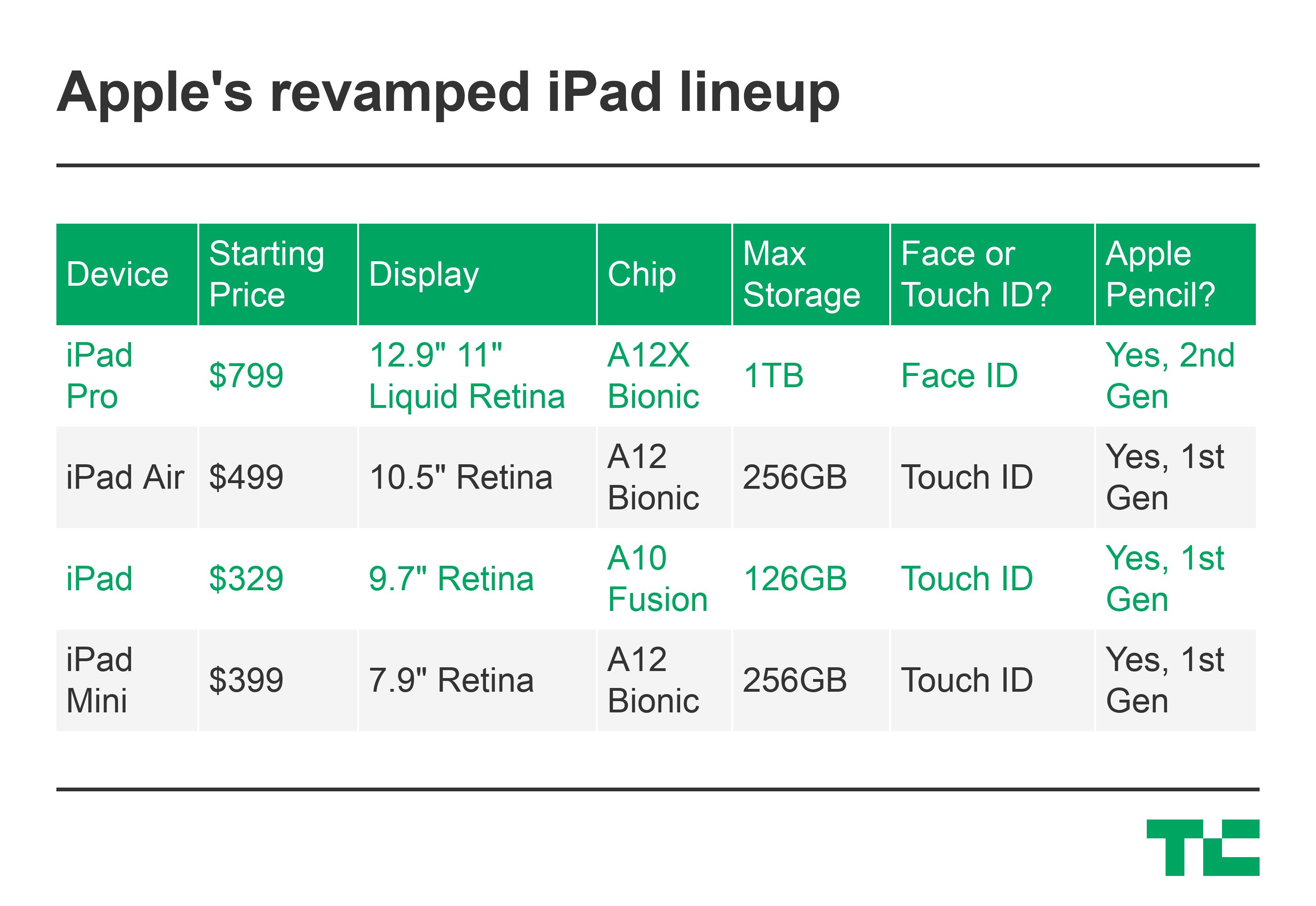
As predicted, hardware was more of a mixed bag for the company. The iPad, a bright spot in an otherwise stagnant tablet market also marked a key highlight the quarter, as revenue jumped 22 percent year over year. Notably, the company now offers its largest range of slates, with recent quiet refreshes to the Air and Mini following last year’s big Pro update.

Revenue for Mac dipped slightly, in spite of a recent refreshes to the MacBook Pro and iMac and last year’s milestone of 100 million Macs in use. iPhones missed expectations slightly, maintaining the recent downturn in handset sales.

Last quarter was a rough one for Apple devices, as iPhone revenue dropped 15 year over year. Tim Cook attempted to soften that blow with lowered guidance, pointing specifically to a less than spectacular showing in China. That, in turn, was the result of several factors, including a slowing Chinese economy and plateauing global smartphone numbers.

Yesterday’s Alphabet earnings took a similar line, as CEO Sundar Pichai noted “headwinds” in year on year sales of its Pixel device. Google is expected to follow in Apple’s footsteps with its own budget smartphone, the Pixel 3a next week at I/O.

Many analysts have pointed to 5G as the next major factor in kickstarting phone sales for both Apple and the rest of the industry. However, all signs currently point to a 2020 arrival for a 5G iPhone — putting the device more than a year out, and well behind releases from chief competition like Samsung and Huawei.

That said, a recent deal with Qualcomm finally ended the long time feud between the two hardware powerhouses could hasten the arrival of the technology on the iPhone. Though it seems equally likely the company will focus on other features and simply wait until next year, when 5G has had an opportunity for a much wider roll out.

In a statement, Cook lauded iPads sales, while attempting to set the stage for future announcements. “Our March quarter results show the continued strength of our installed base of over 1.4 billion active devices, as we set an all-time record for Services, and the strong momentum of our Wearables, Home and Accessories category, which set a new March quarter record,” Cook said. “We delivered our strongest iPad growth in six years, and we are as excited as ever about our pipeline of innovative hardware, software and services. We’re looking forward to sharing more with developers and customers at Apple’s 30th annual Worldwide Developers Conference in June.”

Last year’s WWDC was notably devoid of any sort of hardware announcements, with most coming toward the end of the year. This year’s could be different, as the company looks to shake loose some of the hardware cobwebs. Apple TV, HomePod and other home devices seem prime for an upgrade as it continues to pump money into the services that fuel those products, along with increased competition to HomeKit from the likes of Amazon and Google.

Apple’s stock jumps 5 percent after beating expectations

Apple released earnings for its fiscal second quarter today, reporting revenue of $58 billion, a decline of 5 percent from the year-ago quarter, and quarterly earnings per diluted share of $2.46, down 10 percent. International sales accounted for 61 percent of the quarter’s revenue.

The market apparently approves. Apple’s shares have jumped $10 apiece since the earnings were released, putting the company in spitting distance of the $1 trillion market cap it has been flirting with since last August.

The earnings are also in line with the guidance that Apple had provided during its last earnings call. In late January, per Apple’s guidance for the second quarter, it had estimated that its revenue would fall between $55 billion and $59 billion, its gross margins between 37 and 38 percent; its operating expenses between $8.5 billion and $8.6 billion; and that it would see other income of $300 million.

In a release, the company did not break out iPhone sales, which have come under pressure. Instead, CEO Tim Cook tried focusing attention on other aspects of the company’s business. “Our March quarter results show the continued strength of our installed base of over 1.4 billion active devices, as we set an all-time record for services, and the strong momentum of our wearables, home and accessories category, which set a new March quarter record,” said Cook in the release. “We delivered our strongest iPad growth in six years, and we are as excited as ever about our pipeline of innovative hardware, software and services. We’re looking forward to sharing more with developers and customers at Apple’s 30th annual Worldwide Developers Conference in June.”

Apple had a tough 2018, iPhone sales in the last quarter of the year falling 15 percent from where they’d been at the end of 2917 owing in part to stalled demand in China. Overall, sales in China fell a whopping 27 percent between the end of 2017 and the end of 2018, from $18 billion in revenue in the fourth quarter of 2017, or 20 percent of the company’s total revenue during the period, to $13.2 billion, or 16 percent of the total.

Apple has blamed softening consumer demand in China’s market for its woes, but it hasn’t given up on the country; it can’t afford to given its potential. In fact, earlier this month, to goose demand, Apple trimmed prices on the iPhone, iPad, and other products it sells in China by up to 6 percent, according to Xinhua, the state-run news agency. The move was ostensibly triggered by China reducing its value-added tax, which is akin to sales tax in the U.S., to 13 percent from 16 percent.

Devices have been tough for everyone. As we reported yesterday, Alphabet’s Q1 earnings were a disappointment for Wall Street primarily because of the company’s ad revenue shortcomings but also because of a stagnating global smartphone market that has impacted virtually all players. (CEO Sundar Pichai cited “year over year headwinds” when referring to the company’s smartphone line.)

In the meantime, Apple has dramatically increased its focus on its services business. Roughly a month ago, the company announced a credit card in partnership with Goldman Sachs and Mastercard that’s designed for the iPhone and works with the Wallet app. It also officially unveiled it streaming initiative, Apple TV+, which is coming this fall and will be supported through an ad-free subscription.

Apple announced last year that its fiscal fourth quarter of 2018 was the last quarter in which it would report detailed iPhone figures, which may frustrate current and potential shareholders.

As famed VC Bill Gurley noted in a series of tweets earlier today, “Interesting to see very large companies get away with a lack of segment disclosure. AWS for a long time was not broken out. Mixing search and YouTube revenues makes no sense for $GOOG, and is quite unhelpful to investors trying to understand the company . . .Our much smaller companies are routinely told by their auditors and the SEC that they need to provide segment analysis, but it seems remarkably unfair when a company the size of Google with a segment as large as YouTube (~$20B) are not held to same standard.”

We’ll have more on Apple’s earnings for you soon.

Eric Schmidt and Diane Greene are leaving Alphabet’s board of directors

Google’s parent company Alphabet announced that two board members, Eric Schmidt and Diane Green, will not be seeking re-election when their terms expire on June 19.

Schmidt has been on the company’s board since 2001, and also served as CEO for a decade, until April 2011. Alphabet said he will continue to serve as a “technical advisor” to the company.

Greene, meanwhile, was the CEO of Google’s cloud business from 2015 until her departure earlier this year. She’s been on the board since 2012.

Along with the departures, Alphabet is also announcing the appointment of Robin L. Washington to its board. Washington is the executive vice president and chief financial officer of biopharmaceutical company Gilead Sciences. She previously held executive roles at Hyperion Solutions and PeopleSoft.

“Robin’s incredible business and leadership experience will be hugely valuable to our Board and company in the years ahead,” said Board Chairman John Hennessy in a statement.

Updating

FireEye Q1 earnings in-line with expectations, but outlook light

FireEye, one of the largest and most prominent security companies on the market, reported its fiscal first quarter earnings after the bell Tuesday.

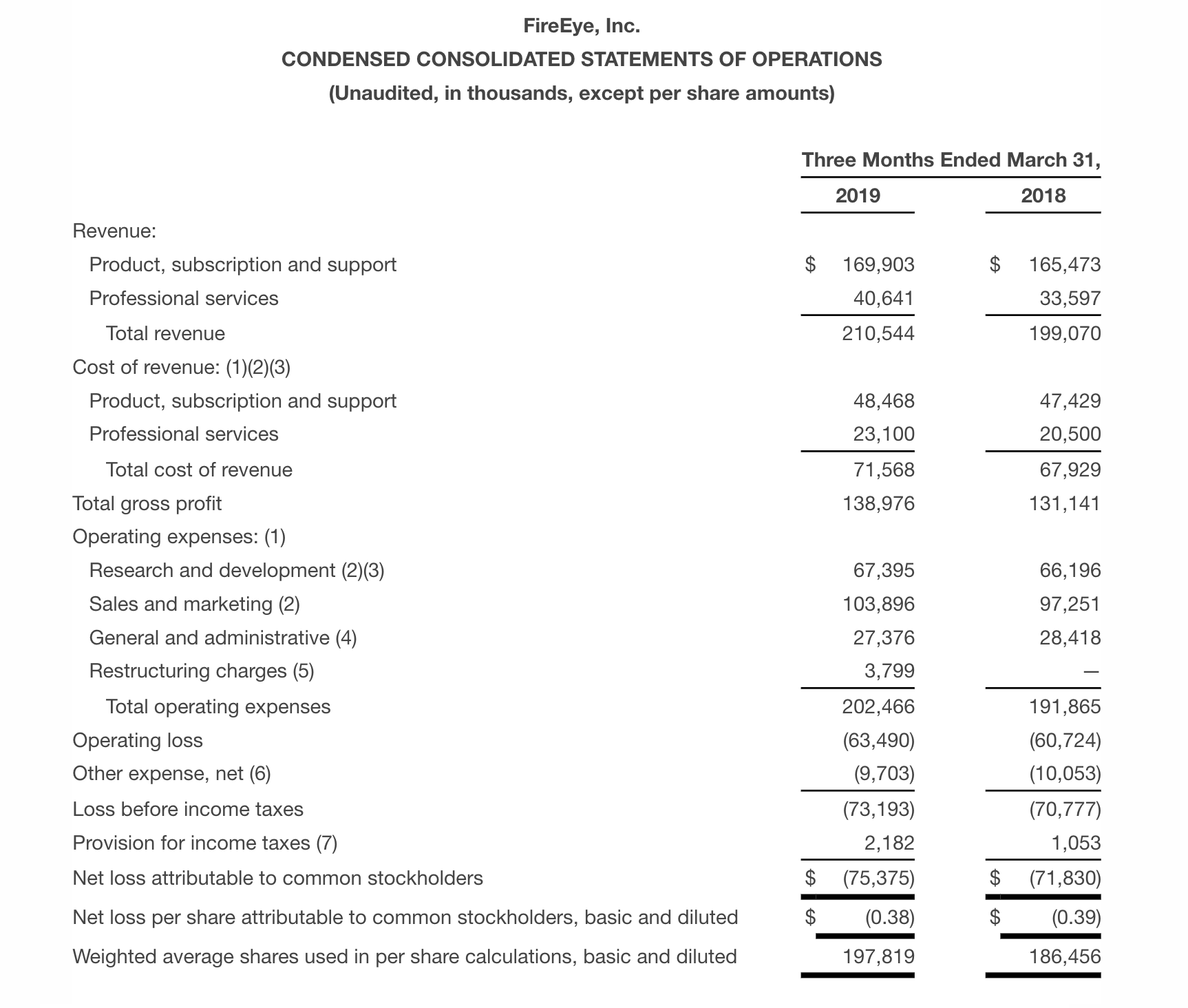
The cybersecurity giant reported first quarter loss of $78.3 million, or 38 cents a share, on revenues of $210 million (statement). FireEye reported a loss of 3 cents per share on an non-GAAP basis, in line with Wall Street expectations

FireEye’s chief executive Kevin Mandia said the company “met or exceeded our guidance ranges for all key financial metrics” for the quarter.

The company had a good quarter news-wise. In March, the company debuted its secure email gateway, released its new Windows virtual machine-based malware analysis platform, and continued to publish groundbreaking new research on prominent threat groups as well as keeping on top of global cyberattack efforts.

And, just after the quarter closed earlier this month, the company revealed a second intrusion from a nation-state backed hacker group it calls Triton.

Looking ahead, FireEye said it expects to report second quarter non-GAAP earnings between 1 cent and 3 cents with revenue between $212 and 216 million. Wall Street was expecting a second quarter outlook of 4 cents per share on revenues of $216 million.

For the full year, FireEye is expecting revenues between $880 million and $890 million.

FireEye closed the day at $16.02, up more than 1 percent. In after-hours trading, the company was trending up.

Golden unveils a Wikipedia alternative focused on emerging tech and startups

Jude Gomila, who previously sold his mobile advertising company Heyzap to RNTS Media, is taking on a new challenge — building a “knowledge base” that can fill in Wikipedia’s blind spots, particularly when it comes to emerging technologies and startups.

While Gomila is officially launching Golden today, it’s already full of content about things like the latest batch of Y Combinator startups and morphogenetic engineering. And it’s already raised $5 million from Andreessen Horowitz, Gigafund, Founders Fund, SV Angel, Liquid 2 Ventures/Joe Montana, plus a long list of individual angel investors including Gomila’s Heyzap co-founder Immad Akhund.

To state the obvious: Wikipedia is an incredibly useful website, but Gomila pointed out that notable companies and technologies like SV Angel, Benchling, Lisk and Urbit don’t currently have entries. Part of the problem is what he called Wikipedia’s “arbitrary notability threshold,” where pages are deleted for not being notable enough. (Full disclosure: This is also what happened year ago to the Wikipedia page about yours truly — which I swear I didn’t write myself.)

Perhaps that threshold made sense when Wikipedia was just getting started and the infrastructure costs were higher, but Gomila said it doesn’t make sense now. In determining what should be included in Golden, he said the “more fundamental” question is more about existence: “Does this company exist? Does Anthony Ha exist?” If so, there’s a good chance that it should have a page on Golden, at least eventually.

In his blog post outlining his vision for the site, Gomila wrote:

We live in an age of extreme niches, an age when validation and completeness is more important than notability. Our encyclopedia on Golden doesn’t have limited shelf space — we eventually want to map everything that exists. Special relativity was not notable to the general public the moment Einstein released his seminal paper, but certainly was later on — could this have been the kind of topic to be removed from the world’s canon if it was discovered today?

Golden homepage

Gomila said he’s also bringing some new technologies and fresh approaches to the problem. Some of this is pretty straightforward, like allowing users to embed video, academic appears and other multimedia content onto Golden pages.

At the same time, he’s hoping to make it much easier to write and edit Golden pages. You do so in a WYSIWYG editor that doesn’t require you to know any HTML, and the site will help you with automated suggestions, for example pulling out author and title information when you’re adding a link to another site.

Gomila said that this will allow users to work much more quickly, so that “one hour spent on Golden is effectively 100 hours on other platforms.”

There’s also an emphasis on transparency, which includes features like “high resolution citations” (citations that make it extra clear which statement you’re trying to provide evidence for) and the fact that Golden account names are tied to your real identity — in other words, you’re supposed to edit pages under your own name. Gomila said the site backs this up with bot detection and “various protection mechanisms” designed to ensure that users aren’t pretending to be someone they’re not.

“I’m sure there will always be trolls up their usual tricks, but they will be on the losing side,” he told me.

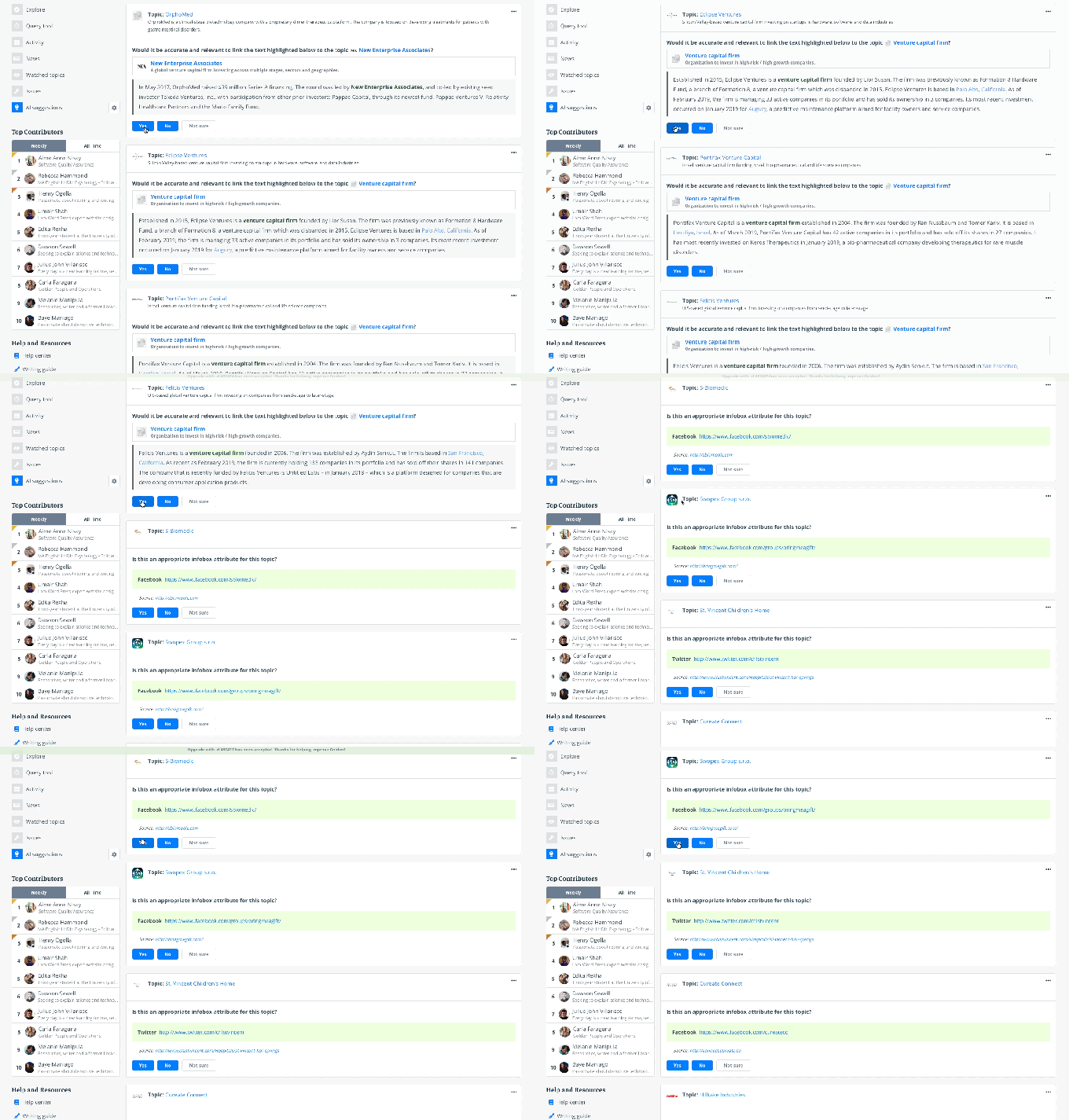
AI Suggestions

If you think someone has added incorrect or misleading information to a page, you can flag it as an issue. Gomila suggested AI could also play a more editorial role by pointing out when someone is using language that’s biased or seems too close to marketing-speak.

“AI can have bias and humans can have bias,” he acknowledged, but he’s hoping that both elements working together can help Golden get closer to the truth. He added that “rather than us editorially changing things, our team will act like normal users” who can edit and flag issues.

Golden is available to users for free, without advertising. Gomila said his initial plan for making money is charging investment funds and large companies for a more sophisticated query tool.