Altice USA buys digital news network Cheddar for $200M

Cable television provider Altice USA has confirmed plans to pay $200 million for the millennial-focused, digitally-native news network Cheddar in all-cash, or all-cheddar, rather, deal. The price tag comes at a 25 percent premium to the media startup’s $160 million Series D valuation.

Jon Steinberg, the co-founder and chief executive officer of Cheddar and former president and chief operating officer of BuzzFeed, will become president of Altice News. Altice, an existing Cheddar investor, plans to leverage Cheddar’s broadcasts and CheddarU, a growing network of 1,600 screens on 600 college campuses, to expand its portfolio of news businesses.

“Our goal is to make Altice News a leader in local, business, national and international news everywhere,” Steinberg said in a statement. “The Altice team and Altice Way are as entrepreneurial as it gets with amazing markets, world-class local and international news, an amazing broadband network, and a soon to launch mobile offering.”

Cheddar declined to provide further comment.

Altice News, a new unit born out of the Cheddar acquisition, will include Cheddar, News 12 Networks and international and current affairs news network i24NEWS.

Founded in 2016, the New York-headquartered business operates its flagship business newscast on the trading floor of the New York Stock Exchange, as well as three other programs at its studio in New York’s Flatiron Building, WeWork Vine in Hollywood and the White House.

The company, dubbed the ‘CNBC of the internet,’ focuses on business news and the top headlines with 19 hours of programming per day. In a short time, the “fast-paced, young, non-partisan general and headline news network” has inked key partnerships to become widely available across platforms. Currently, its programs are viewable in 40 million homes on Sling TV, DirecTV NOW, Hulu, YouTube TV, Sony PlayStation Vue, Snapchat, fuboTV, Philo, Amazon, Twitch, Twitter, Facebook and 60 percent of smart TVs in the U.S. Cheddar attracts 400 million video views per month.

Cheddar had raised a total of $54.5 million in equity funding across four financings. Its investors include Lightspeed Venture Partners, Raine Ventures, Goldman Sachs, Liberty Global, Comcast Ventures, AT&T, Amazon, Antenna Group, Ribbit Capital, The New York Stock Exchange, Altice USA, 7 Global Capital, and Dentsu Ventures. Here’s a closer look at Cheddar’s funding history, per PitchBook:

  • February 2016 Series A: $3 million at a $15 million valuation
  • September 2016 Series B: $10 million | $40 million
  • May 2017 Series C: $19 million | $84 million
  • March 2018 Series D: $22.5 million | $160 million

The transaction is expected to close in the next two months.

“Cheddar has demonstrated an innovative approach to live news while building an engaged audience, solid followership and a strong brand,” Altice CEO Dexter Goei said in a statement. “As one of Cheddar’s early investors, we have enjoyed our partnership with Jon and admire the entrepreneurial spirit, energy and smart disruptive mentality that he brings to the news business.”

The deal represents a rare outcome for a digital media startup, a sector plagued by sudden shutdowns and slipping revenue figures. Mic, a similarly millennial-focused news outlet, laid off most of its staff last year before being acquired by Bustle for peanuts. The business was well-funded by venture capitalists, raising a total of $60 million before falling victim to Facebook’s 2017 algorithm change.

There’s more where that came from. Vice earlier this year confirmed plans to cut 250 jobs, BuzzFeed is laying off 15 percent of its staff and Verizon Media Group (TechCrunch’s parent company) laid off 10 percent of its workforce in January. Just this week Brit&Co, a digital media brand catering to young women, began laying off a majority of its staff after an M&A deal failed to come together at the last moment, according to Recode.


Docker looks to partners and packages to ease container implementation

Docker appears to be searching for ways to simplify the core value proposition of the company — creating, deploying and managing containers. While most would agree it has revolutionized software development, like many technology solutions, it takes a certain level of expertise and staffing to pull off. At DockerCon, the company’s customer conference taking place this week in San Francisco, Docker announced several of ways it could help customers with the tough parts of implementing a containerized solution.

For starters, the company announced a Beta of Docker Enterprise 3.0 this morning. That update is all about making life simpler for developers. As companies move to containerized environments, it’s a challenge for all but the largest organizations like Google, Amazon and Facebook, all of whom have massive resource requirements and correspondingly large engineering teams.

Most companies don’t have that luxury though and Docker recognizes if it wants to bring containerization to a larger number of customers, it has to create packages and programs that make it easier to implement.

Docker Enterprise 3.0 is a step toward providing a solution that lets developers concentrate on the development aspects, while working with templates and other tools to simplify the deployment and management side of things.

The company sees customers struggling with implementation and how to configure and build a containerized workflow, so it is working with Systems Integrators to help smooth out the difficult parts. Today, the company announced Docker Enterprise as a Service with the goal of helping companies through the process of setting up and managing a containerized environment, using the Docker stack and adjacent tooling like Kubernetes.

The service provider will take care operational details like managing upgrades, rolling out patches, doing backups, and undertaking capacity planning — all of . those operational tasks, which require a high level of knowledge around enterprise container stacks.

Capgemini will be the first go-to-market partner. “Capgemini has a combination of automation, technology tools, as well as services on the back end that can manage the installation, provisioning and management of the enterprise platform itself in cases where customers don’t want to do that, and they want to pay someone to do that for them,” Scott Johnston, chief product officer at Docker told TechCrunch.

The company has released tools in the past to help customers move legacy applications into containers without a lot of fuss. Today, the company announced a solution bundle called Accelerate Greenfield, a set of tools designed to help customers get up and running as a container-first development companies.

“This is for those organizations that may be a little further along. They’ve gone all in on containers committing to taking a container-first approach to new application development,” Johnston explained. He says this could be cloud native microservices or even a LAMP stack application, but point is that they want to put everything in containers on a container platform.

Accelerate Greenfield is designed to do that. “They get the benefits where they they know that from the developer to the production end point, it’s secure. They have a single way to define it all the way through the lifecycle. They can make sure that it’s moving quickly, and they have that portability built into the container format, so they can deploy [wherever they wish.],” he said.

These programs and products are all about providing a level of hand-holding, either by playing a direct consultative role, working with a systems integrator or providing a set of tools and technologies to walk the customer through the containerization lifecycle. Whether they provide a sufficient level of help that customers require is something we will learn over time as these programs mature.

Docker updates focus on simplifying containerization for developers

Over the last five years, Docker has become synonymous with software containers, but that doesn’t mean every developer understands the technical details of building, managing and deploying them. At DockerCon this week, the company’s customer conference taking place in San Francisco, it announced new tools that have been designed to make it easier for developers, who might not be Docker experts, to work with containers.

As the technology has matured, the company has seen the market broaden, but in order to take advantage of that, it needs to provide a set of tools that make it easier to work with. “We’ve found that customers typically have a small cadre of Docker experts, but there are hundreds, if not thousands, of developers who also want to use Docker. And we reasoned, how can we help them get productive very, very quickly, without them having to become Docker experts,” Scott Johnston, chief product officer at Docker told TechCrunch.

To that end, it announced a Beta of Docker Enterprise 3.0, which includes several key components. For starters, Docker Desktop Enterprise lets IT set up a Docker environment with the kind of security and deployment templates that make sense for each customer. The developers can then pick the templates that make sense for their implementations, while conforming with compliance and governance rules in the company.

“These templates already have IT-approved container images, and have IT-approved configuration settings. And what that means is that IT can provide these templates through these visual tools that allow developers to move fast and choose the ones they want without having go back for approval,” Johnston explained.

The idea is to let the developers concentrate on building applications, and the templates provide all the Docker tooling pre-built and ready to go, so they don’t have to worry about all of that.

Another piece of this is Docker Applications, which allows developers to build complex containerized applications as a single package and deploy them to any infrastructure they wish — on-prem or in the cloud. Five years ago when Docker really got started with containers, they were a simpler idea, often involving just a single one, but as developers broke down those larger applications into microservices, it created a new level of difficulty, especially for operations who had to deploy these increasingly large sets of application containers.

“Operations can now programmatically change the parameters for the containers, depending on the environments without having to go in and change the application. So you can imagine that ability lowers the friction of having to manage all these files in the first place,” he said.

The final piece of that is the orchestration layer and the popular way to handle that today is with Kubernetes. Docker has created its own flavor of Kubernetes, based on the open source tool. Johnston says, as with the other two pieces, the goal here is to take a powerful tool like Kubernetes and reduce the overall complexity associated with running it, while making it fully compatible with a Docker environment.

For that, Docker announced Docker Kubernetes Service (DKS), which has been designed with Docker users in mind including support for Docker Compose, a scripting tool that has been popular with Docker users. While you are free to use any flavor of Kubernetes you wish, Docker is offering DKE as a Docker-friendly version for developers.

All of these components have one thing in common besides being part of Docker Enterprise 3.0. They are trying to reduce the complexity associated with deploying and managing containers and to abstract away the most difficult parts, so that developers can concentrate on developing without having to worry about connecting to the technical underpinnings of building and deploying containers. At the same time, Docker is trying to make it easier for the operations team to manage it all. That is the goal, at least. In the end, DevOps teams will be the final judges on how well Docker has done, once these tools become generally available later this year.

The Docker Enterprise 3.0 Beta will be available later this quarter.

Purchase a Startup Alley exhibitor package for Disrupt SF 2019

We’re in hot pursuit of bold exhibitionists. It’s time to show the world your stuff. By that we mean it’s time to secure your spot in Startup Alley, the exhibition floor at the very heart of Disrupt San Francisco 2019, which takes place on October 2-4. Simply buy a Startup Alley Exhibitor Package to place your early-stage startup in the path of more than 10,000 influential technologists, founders, investors and media.

Startup Alley epitomizes world-class networking and opportunity. It’s where hundreds of early-stage startups showcase their tech and talent to an enthusiastic, targeted audience. And it’s where people make connections that can potentially change the course of their future.

Here’s just one example. While exhibiting in Startup Alley, TestCard received media coverage from several different outlets. Luke Heron, the company’s CEO, said that the article helped to push TestCard in the right direction:

The coverage we received while exhibiting in Startup Alley — among all these other fantastic startups — has a hugely positive impact when you’re fundraising.

He should know, because the company went on to secure $1.7 million in funding. That’s some hefty ROI right there.

What do you get with a Startup Alley Exhibitor Package? Excellent question. It starts with three Founder Passes, one day to exhibit in Startup Alley and access to the Startup Alley Exhibitor lounge. Your early-stage startup can represent any tech category, like AI/Machine Learning, Biotech/Healthtech, Blockchain, Fintech, Mobility, Privacy/Security, Retail/E-commerce, Robotics/IoT/Hardware, SaaS, Social Impact/Education and more.

Your passes are good for the three full days of Disrupt and provide access to all content (including the Startup Battlefield competition), more than 1,000 startups and sponsors in Startup Alley, interactive workshops and the full attendee list (through the Disrupt mobile app), along with a list of attending media outlets.

Hold on, startup fans, there’s more. You can use CrunchMatch to set up meetings with investors or other attendees, attend networking parties, have a shot at being our Startup Battlefield Wild Card winner and get fantastic discounts on hotel rooms in San Francisco. After the show ends, you’ll be able to access exclusive Disrupt video content. Note: You must be a verified early-stage (pre-series A) startup to exhibit in Startup Alley.

One more thing. If you think your startup’s the best in one of our featured categories, why not apply to be in the TC Top Pick program? You’ll get to exhibit for free — and who doesn’t love free?

Disrupt San Francisco 2019 takes place October 2-4. This is your chance to stake your claim in Startup Alley and take your company to the next level. Go ahead and buy your Startup Alley Exhibitor Package now — while you still can.

Is your company interested in sponsoring or exhibiting at Disrupt SF? Contact the sponsorship sales team by filling out this form.

Glovo, the on-demand ‘deliver anything’ local app, raises $169M Series D

Glovo, the Spain-headquartered on-demand delivery app that has similarities to Postmates in the U.S., has raised $169 million (€150m) in Series D funding. Lakestar led the round alongside Drake, owner of global pizza franchise Papa John’s.

Idinvest Partners and Korelya Capital also participated, bringing total raised to approximately $322 million. The company last raised funding ten months ago: a $134 million Series C round from Seaya Ventures, Cathay Innovation and Rakuten Capital.

Founded in January 2015 by Oscar Pierre and Sacha Michaud, Glovo offers a ‘shop on your behalf’ app that promises to let you order anything locally on-demand and have it delivered “within minutes”. This includes food items — the company is known for its McDonald’s deliveries in Spain — and non-takeout food and other verticals, such as groceries and pharmaceuticals.

The fast-growing company claims more than 5.5 million unique users and 16,000 associated partners, and now operates in 124 cities across 21 countries, including EEMEA, LATAM, and most recently in Sub Saharian Africa.

The startup says it currently employs over 1,000 people globally, with over 400 people in its Barcelona HQ. A classic gig worker setup: Glovo has 35,000 active “Glovers” on its platform (that’s “self-employed” couriers, to you and me).

Glovo says it will use this injection of funding to bolster global growth, which has been dramatically picking up pace (although, with some reported bumps in the road). CEO Oscar Pierre tells me the company launched in 18 new countries in 2018. There are also plans to further innovate around on-demand groceries, including creating “dark supermarkets” that operate alongside the app’s marketplace of local supermarket chains.

Explains Pierre: “Our Darkstores are urban micro-fulfillment centers located in central areas of a city. They allow us to fully control the value chain and offer the best UX, with a delivery of around 20 minutes. They are run 24 hours a day by Glovo employees whose role is to pick and pack customer orders and have them ready for when the courier arrives. We have launched the offering in Barcelona and Madrid so far and we are still learning and analyzing the results”.

In addition, Glovo will continue to throw more engineers and technology at the problem of optimising on-demand delivery. The company recently hired VP of engineering Mustafa Sezgin, who was an engineering leader at Uber prior to joining.

Pierre says tech is being developed to continue improving the efficiency of Glovo’s “delivery and dispatching capabilities to building a world-class mobile product that exposes everything in a city at the push of a button”. To support this, he intends to grow the tech and data team to over 300 engineers in the next 18 months.

“Today, more than 70 percent of our business is food, followed by groceries, courier and pharmacy,” adds Pierre. “Our vision is to make everything in a city instantly available through the app, and we want to expand into other areas beyond delivery (services, reservations, etc) soon”.

Meanwhile, I’m told Glovo’s most successful markets in terms of orders are Spain (Madrid & Barcelona), Argentina (Buenos Aires), Peru (Lima) and Italy (Milan). Its most successful markets in terms of growth last month (ie new customer acquisition) outside of the above were Costa Rica (San José), Guayaquil (Ecuador), Ukraine (Kiev), Turkey (Istanbul) and Romania (Bucharest).

Daily Crunch: The end of Anki

The Daily Crunch is TechCrunch’s roundup of our biggest and most important stories. If you’d like to get this delivered to your inbox every day at around 9am Pacific, you can subscribe here.

1. Cozmo maker Anki is shutting its doors

No one ever said consumer robots were easy. But Anki’s actually made a pretty strong go of it, all things considered.

“We’ve shipped millions of units of product and left customers happy all over the world while building some of the most incredible technologies pointed toward a future with diverse AI and robotics driven applications,” the company said. “But without significant funding to support a hardware and software business and bridge to our long-term product roadmap, it is simply not feasible at this time.”

2. Alphabet misses on Q1 revenues of $36.3B; EPS of $9.50 weighed down by the $1.7B European fine

Overall, it was a tough quarter for the company, indicating struggles with its growth.

3. Why did last night’s ‘Game of Thrones’ look so bad? Here comes the science!

For what it’s worth, I didn’t have any trouble watching Sunday’s climactic battle episode of “Game of Thrones” — but it seems plenty of other viewers did.

4. Samsung sees Q1 profit plummet 60 percent

Samsung said that sales of its new Galaxy S10 smartphone were “solid,” but it admitted that its memory chip and display businesses — so often the most lucrative units for the company — didn’t perform well.

5. Utah’s Divvy raises $200M to eliminate expense reports

Divvy only launched its platform, which allows customers to send and request funds, create virtual credit cards, manage team spending and more, in January 2018. Its valuation has grown 1,000 percent since then, across three rounds of equity funding.

6. Twitter announces new content deals with Univision, The Wall Street Journal and others

The spotlight has moved on from Twitter’s video strategy, but the company is still making deals.

7. What we want to know in the We Company (WeWork) S-1

With news that the We Company (formerly known as WeWork) has officially filed to go public, there’s a big question on everyone’s mind: Is this the next massive startup win or a house of cards waiting to be toppled by the glare of the public markets? (Extra Crunch membership required.)

GM’s electric future includes a pickup truck

GM will make a full-size electric pickup truck as part of an “all-electric future” that will include a complete range of EVs, CEO Mary Barra said during the automaker’s quarterly earnings call Tuesday.

GM reported Tuesday higher-than-expected profit in the first quarter, a result fueled by cost cutting and sales of its more expensive trucks and SUVs. GM also benefitted from its stake in ride-hailing company Lyft and French automaker PSA Group.

GM revenue fell 3.4 percent to $34.88 billion compared with the same period last year.

“GM has an industry-leading truck franchise and industry-leading electrification capabilities,” Barra said.
I assure you we will not cede our leadership on either front. We intend to create an all-electric future that includes a complete range of EVs, including full-size pickups.”

GM already produces the all-electric Chevy Bolt, a small hatchback that is also used by its self-driving car unit GM Cruise. But it doesn’t have any EV crossovers, SUVs and trucks.

Barra’s EV comments come on the heels of reported talks to invest in Rivian, an electric vehicle startup that debuted an all-electric R1T pickup and R1S SUV in November. The deal with GM never materialized.

Instead, Ford swooped in and announced in April that it was investing $500 million into the EV startup. Along with the cash, Ford plans to build a vehicle on Rivian’s electric vehicle platform.

Amazon is also a Rivian investor and earlier this year led a $700 million round into the automotive startup.

It’s unclear if GM will develop an electric pickup on its own or seek another partner like Rivian. Barra didn’t reveal when such a vehicle would become available. She only said the company would share more “when competitively appropriate.”

In the meantime, upstart Rivian is pushing forward with its SUV and truck-focused plans. Deliveries of Rivian’s first two vehicles are expected to begin in late 2020.

GM has been undergoing a transformation over the past four to five years, getting rid of expensive, money-losing programs like the Opel brand in Europe, and investing more into electrification and autonomous vehicle technology.

GM ramped up its belt-tightening measures last November with cuts to factory and white-collar workers, plant closures in North America and the elimination of several car models as it tries to transform into a nimble company focused on high-margin SUVs, crossovers and trucks, and investments in future products like electric and autonomous vehicles.

The actions are meant to safeguard the automaker from an expected downturn in the U.S. market and increase its annual free cash flow by about $6 billion

At the same time, GM has said it will continue to increase investments in key areas such as engineering resources allocated to electric and autonomous vehicle programs.

The automaker announced in January that it will turn Cadillac into its lead electric vehicle brand. The company is developing a new battery electric vehicle architecture that will be the foundation for an advanced family of “profitable EVs,” a word choice that suggests the company will focus on higher margin vehicles such as luxury cars as well as crossovers and SUVs.

Social media firms agree to work with UK charities to set online harm boundaries

Social media giants, including Facebook -owned Instagram, have agreed to financially contribute to UK charities to fund them making recommendations that the government hopes will speed up decisions about removing content that promotes suicide/self-harm or eating disorders on their platforms.

The development follows the latest intervention by health secretary Matt Hancock, who met with representatives from the Facebook, Instagram, Twitter, Pinterest, Google and others yesterday to discuss what they’re doing to tackle a range of online harms.

“Social media companies have a duty of care to people on their sites. Just because they’re global doesn’t mean they can be irresponsible,” he said today.

“We must do everything we can to keep our children safe online so I’m pleased to update the house that as a result of yesterday’s summit, the leading global social media companies have agreed to work with experts… to speed up the identification and removal of suicide and self-harm content and create greater protections online.”

However he failed to get any new commitments from the companies to do more to tackle anti-vaccination misinformation — despite saying last week that he would be heavily leaning on the tech giants to remove anti-vaccination misinformation, warning it posed a serious risk to public health.

Giving an update on his latest social media moot in parliament this afternoon, Hancock said the companies had agreed to do more to address a range of online harms — while emphasizing there’s more for them to do, including addressing anti-vaccination misinformation.

“The rise of social media now makes it easier to spread lies about vaccination so there is a special responsibility on the social media companies to act,” he said, noting that coverage for the measles, mumps and rubella vaccination in England decreased for the fourth year in a row last year — dropping to 91%.

There has been a rise in confirmed measles cases from 259 to 966 over the same period, he added.

With no sign of an agreement from the companies to take tougher action on anti-vaccination misinformation, Hancock was left to repeat their preferred talking point to MPs, segwaying into suggesting social media has the potential to be a “great force for good” on the vaccination front — i.e. if it “can help us to promote positive messages” about the public health value of vaccines.

For the two other online harm areas of focus, suicide/self-harm content and eating disorders, suicide support charity Samaritans and eating disorder charity Beat were named as the two U.K. organizations that would be working with the social media platforms to make recommendations for when content should and should not be taken down.

“[Social media firms will] not only financially support the Samaritans to do the work but crucially Samaritans’ suicide prevention experts will determine what is harmful and dangerous content, and the social media platforms committed to either remove it or prevent others from seeing it and help vulnerable people get the positive support they need,” said Hancock.

“This partnership marks for the first time globally a collective commitment to act, to build knowledge through research and insights — and to implement real changes that will ultimately save lives,” he added.

The Telegraph reports that the value of the financial contribution from the social media platforms to the Samaritans for the work will be “hundreds of thousands” of pounds. And during questions in parliament MPs pointed out the amount pledged is tiny vs the massive profits commanded by the companies. Hancock responded that it was what the Samaritans had asked for to do the work, adding: “Of course I’d be prepared to go and ask for more if more is needed.”

The minister was also pressed from the opposition benches on the timeline for results from the social media companies on tackling “the harm and dangerous fake news they host”.

“We’ve already seen some progress,” he responded — flagging a policy change announced by Instagram and Facebook back in February, following a public outcry after a report about a UK schoolgirl whose family said she killed herself after being exposed to graphic self-harm content on Instagram.

“It’s very important that we keep the pace up,” he added, saying he’ll be holding another meeting with the companies in two months to see what progress has been made.

“We’ll expect… that we’ll see further action from the social media companies. That we will have made progress in the Samaritans being able to define more clearly what the boundary is between harmful content and content which isn’t harmful.

“In each of these areas about removing harms online the challenge is to create the right boundary in the appropriate place… so that the social media companies don’t have to define what is and isn’t socially acceptable. But rather we as society do.”

In a statement following the meeting with Hancock a spokesperson fo Facebook and Instagram said: “We fully support the new initiative from the government and the Samaritans, and look forward to our ongoing work with industry to find more ways to keep people safe online.”

The company also noted that it’s been working with expert organisations, including the Samaritans, for “many years to find more ways to do that” — suggesting it’s quite comfortable playing the familiar political game of ‘more of the same’.

That said, the UK government has made tackling online harms a stated aim and policy priority — publishing a proposal for a regulatory framework intended to address a range of content risks earlier this month, when it also kicked off a 12-week public consultation.

Though there’s clearly a load road ahead to agree a law that’s enforceable, let alone effective.

Hancock resisted providing MPs with any timeline for progress on the planned legislation — telling parliament “we want to genuinely consult widely”.

“This isn’t really issue of party politics. It’s a matter of getting it right so that society decides on how we should govern the Internet, rather than the big Internet companies making those decisions for themselves,” he added.

The minister was also asked by the shadow health secretary, Jonathan Ashworth, to guarantee that the legislation will include provision for criminal sentences for executives for serious breaches of their duty of care. But Hancock failed to respond to the question. 

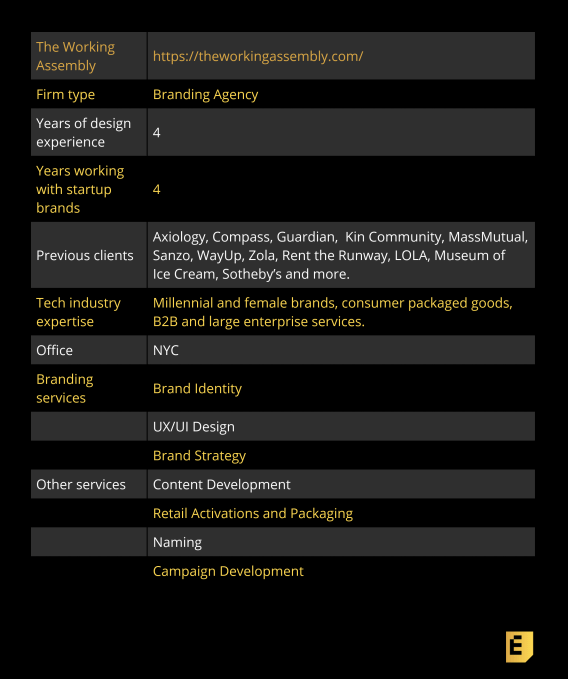
Verified Expert Brand Designer: The Working Assembly

The Working Assembly began as a side hustle. Jolene Delisle and Lawrence O’Toole juggled full-time jobs while collaborating on projects for startup clients, and they eventually realized there was an opportunity to help companies with branding, marketing, and advertising. In the past four years, TWA has grown from a team of two to a team of twenty in NYC’s Flatiron district. We spoke with Creative Director and Partner Jolene Delisle about their start, their new initiative 24-Hour Assembly—a branding program for minority and women founders, what makes an ideal TWA client, and why she’s excited about the new frontier of experiential and immersive branding.   

On common founder mistakes:

“Clients often come to us and say, “I love the branding of this.” And we’re like, “Well, that’s not really your target. It doesn’t really make sense for you as a brand.” And I think it can be hard for founders to separate their own personal aesthetic from what is actually going to be most effective for their business.”

On TWA’s core values:

“There’s an opportunity when you start your own business to be able to pick your clients, and we started working with a lot of female-founded startups right away. Zola and TheSkimm are both led by women founders. We developed a natural passion for working with these types of companies. It helps that our team is also comprised of mostly women, which I think is really outside the norm. For us, we really focus on diversity and inclusivity. It’s a core tenet of our company and an integral part of the conversation.”

“TWA is great at collaborating, ideating, and executing brand identities. They have outstanding taste, beautiful design skills and understand the marketplace well.” Michael Wayne, LA, CEO, Kin

Below, you’ll find the rest of the founder reviews, the full interview, and more details like pricing and fee structures. This profile is part of our ongoing series covering startup brand designers and agencies with whom founders love to work, based on this survey and our own research. The survey is open indefinitely, so please fill it out if you haven’t already.

Interview with TWA’s Creative Director and Founder Jolene Delisle

Yvonne Leow: Tell me a little bit about your backstory. What led you down this path of design and branding?

Jolene Delisle: So, I have more of a background in advertising and communications, and my founding partner, Lawrence, has a background in branding. In the beginning, we were both working full time, but we would collaborate on projects for startup clients. We eventually realized that there was a need to create branding elements before we could ever develop a marketing strategy so that became the impetus for starting Working Assembly

We’re a relatively new studio. We have about 20 people full time. We’re based in the Flatiron district in NYC. And we work with emerging and evolving brands. The emerging brands are startups. About 40% of our clients are early-stage companies that have either received some kind of angel investment or are pre-series A. Sometimes, founders come to us when they don’t even have a name yet, but they have a great idea and a core MVP. Other times, startups are growing very quickly, and we’ll build out their brand and create additional assets.

Small Door raises $3.5 million in seed funding to rethink veterinary care

Millennials are opting out of marriage and kids and instead opting for pet ownership, opening the door for pet-centric businesses to grow.

Small Door is one such company. The startup has raised $3.5 million in seed funding to rethink veterinary services from the ground up. The funding was led by Lerer Hippeau Ventures and Primary Venture Partners, with participation from Foundry Ventures, Flatiron Health cofounders Nat Turner and Zach Weinberg, Warby Parker cofounders Dave Gilboa and Neil Blumenthal, among others.

Small Door operates on a membership model, not unlike OneMedical. The company gives members a certain number of annual check-ups, priority access to specialists, and virtual access to vets based on their membership tier.

By generating revenue through a membership model, the company can ensure that vets have enough time with each patient and simultaneously minimize wait times in the waiting room.

Moreover, Small Door was founded as a Public Benefit Corporation, identifying Small Door vets and pets as key stakeholders in the business. Suicide is a growing problem among vets, who often deal with mounting debt, compassion fatigue, difficult hours and even more difficult customers.

Small Door is looking to build a business that invests in the success and wellbeing of the vets as well as the shareholders.

The company plans to use the new funding to further build out the team and the product. Small Door also has plans to open its first Small Door clinic in the fall in NYC. (The above pic is a 3D rendering of the new clinic.)