Energizer’s massive battery/phone proves a viral hit ≠ crowdfunding success

Oof. This isn’t the sort of thing you want to see when you’re rounding the corner of your crowdfunding campaign:

There are long shots and then there’s coming up with $15,000 of your $1.2 million goal. The Indiegogo page for the Energizer Power Max P18K Pop understandably focused on the viral sensation the ridiculously beefy phone with the 18,000mAh battery spurred at Mobile World Congress this year. There are even photos of the scrum of journalists elbowing to take a shot of the thing at the event.

Understandable that its creators took that approach. Heck, the thing may have outshined all of the foldable and 5G phones that were set to take center stage at the event. We wrote about it. Lucas rightfully called it “basically a giant battery with a smartphone built into it.”

The takeaway seems clear, though. Just because everyone’s talking about a product doesn’t mean that anyone intends to buy it. If anything, the devices seemed more a comment on the state of smartphone battery life than actual enticing product.

And honestly, there’s been a shift in recent years among many smartphone manufacturers to provide power saving options and larger capacity batteries, so this has become less of a problem (though 5G’s approach could aversely impact that). Also, there are eight million power banks, and you can get them pretty cheap these days, making the P18K Pop any even sillier proposition. Not to mention all the things that can go wrong when you buy a phone based on a single feature.

Even so, the product’s creators closed the campaign out on a hopeful note, writing, “Although it didn’t reach its goal, we will work on further improvement on the P18K (design, thickness, etc.) as we do believe there is a rising interest for smartphones with incredible battery life, which can also be used as power banks.”

Certainly features from companies like Samsung and Huawei have proven that power sharing is a compelling feature. It just probably won’t come with Energizer’s name attached.

Creative Commons launches its search engine out of beta, with over 300M images indexed

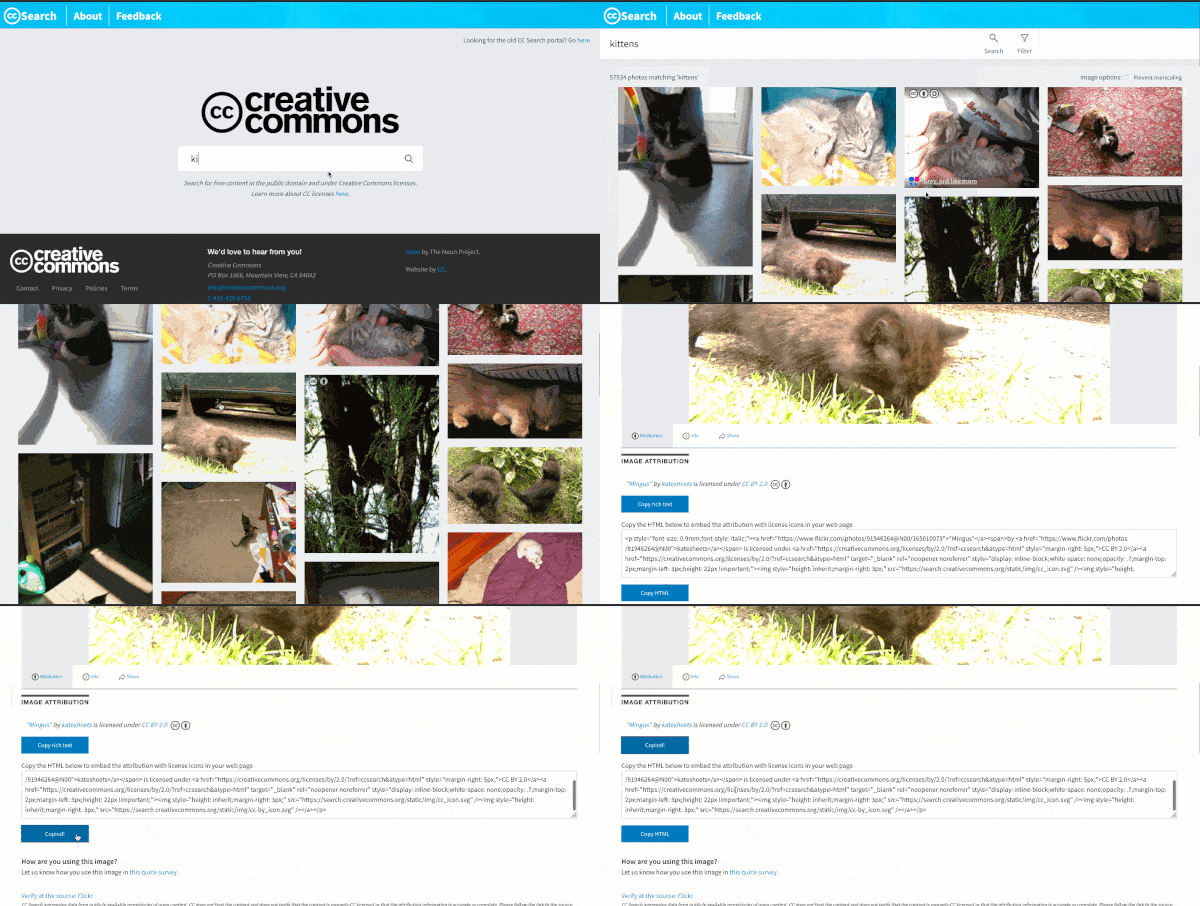
Nonprofit organization Creative Commons is today publicly launching its search engine, after over two years of beta testing. The new service is designed to offer an easy way to search the commons’ archive of free content available in the public domain, that’s available to use under Creative Commons licenses. At launch, this includes over 300 million images indexed from multiple collections, the organization says.

The service engine itself has also been updated with a major redesign and faster, more relevant search.

While the larger photo search engines, including Google and Flickr, have for a long time offered tools that let you filter for CC-licensed images, the Creative Commons’ website also sees a good bit of traffic itself. The organization in February 2017 said it was seeing nearly 60,000 users search its site per month, which is why it wanted to create an improved search experience.

“There is no ‘front door’ to the commons, and the tools people need to curate, share, and remix works aren’t yet available,” said Ryan Merkley, Creative Commons  CEO, when announcing the plans for the new CC search engine. “We want to make the commons more usable, and this is our next step in that direction,” he explained.

When the beta version of the search engine launched, there were some 9.5 million images available, including those from Flickr, 500px, Rijksmuseum, the New York Public Library and the Metropolitan Museum of Art, which served as its initial sources.

Today, CC Search has over 300 million images pulled from 19 collections including also the Cleveland Museum of Art, Behance, DeviantArt, and even a set of CC0 3D designs from Thingiverse, among others. The organization says the image catalog will continue to grow, with prioritization given to significant collections like Europeana and Wikimedia Commons.

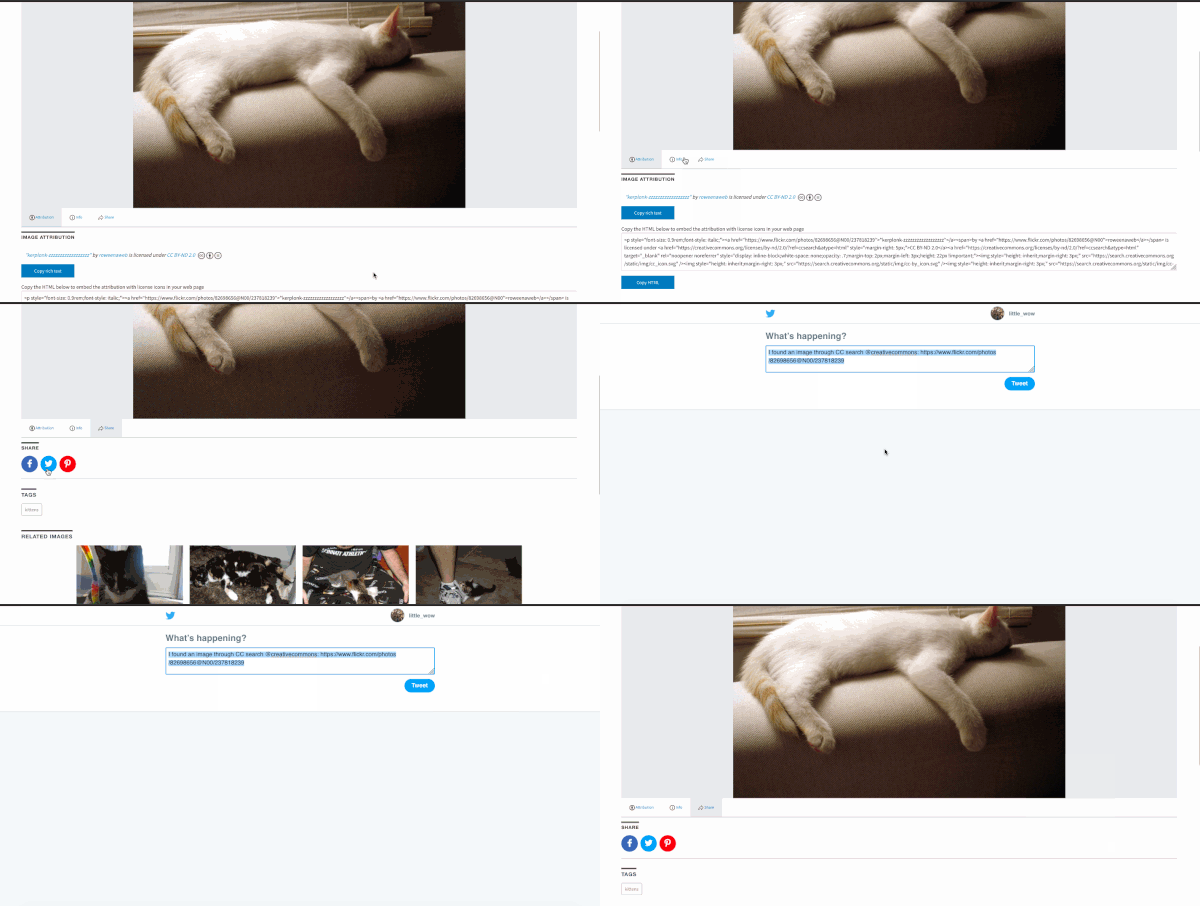
With today’s launch, the engine itself has also had an update. It now features a cleaner home page, improvements to its navigation and filters, design alignment with creativecommons.org, streamlined attribution options, and clearer channels for providing the organization with feedback. Under the hood, the engine has seen improvements to things like loading times and search phrase relevance, and added analytics to help the team understand how it’s being used, the organization said.

In addition, the engine is now directly linked to the Creative Commons homepage where it replaces the old search portal. (The latter remains online, however, at oldsearch.creativecommons.org).

This quarter, Creative Commons plans to add advanced filters to the homepage, the ability to browse collections without entering search terms, and improvements to accessibility and the user experience on mobile devices. Some of this work will be done by Google Summer of Code students starting next month, it notes.

Longer-term, Creative Commons plans to grow the engine to index more than just photos. Later this year, it plans to begin indexing other CC-licensed works, like open textbooks and audio. Eventually, it wants this new portal to provide access to all 1.4 billion works in the commons — but that could take time, given that its work relies on a community of volunteer developers who work alongside the engineering team at Creative Commons.

On that front, the organization is open to community contribution and makes all its code — including the code behind CC Search — open source (e.g. CC SearchCC Catalog APICC Catalog). It also runs the #cc-usability channel on CC Slack where you can keep up with the new releases.

The public launch of CC Search follows other recent, good news for a sizable Creative Commons collection. In March, Flickr announced that all the Creative Commons images hosted on its site would remain protected — including those uploaded in the past, and any added in the future.

There had been some concern over the future of Flickr’s CC repository, following the company’s move to a new business model which put an end to Flickr’s free terabyte of storage in favor of a subscription-based service. Had it decided to delete the CC-licensed photos it hosted, millions of photos would have been lost. Now those photos will continue to be available, and discoverable through the new CC Search.

The full 2019 CC Search roadmap is available here.


After account hacks, Twitch streamers take security into their own hands

Twitch has an account hacking problem.

After the breach of popular browser game Town of Salem in January, some 7.8 million stolen passwords quickly became the weakest link not only for the game but gamers’ other accounts. The passwords were stored using a long-deprecated scrambling algorithm, making them easily cracked.

It didn’t take long for security researcher and gamer Matthew Jakubowski to see the aftermath.

In the weeks following, the main subreddit for Amazon-owned game streaming site Twitch — of which Jakubowski is a moderator — was flooded with complaints about account hijacks. One after the other, users said their accounts had been hacked. Many of the hijacked accounts had used their Town of Salem password for their Twitch account.

Jakubowski blamed the attacks on automated account takeovers — bots that cycle through password lists stolen from breached sites, including Town of Salem.

“Twitch knows it’s a problem — but this has been going on for months and there’s no end in sight,” Jakubowski told TechCrunch.

Credential stuffing is a security problem that requires participation from both tech companies and their users. Hackers take lists of usernames and passwords from other breached sites and brute-force their way into other accounts. Customers of DoorDash and Chipotle have in recent months complained of account breaches, but have denied their systems have been hacked, offered little help to their users or shown any effort to bolster their security, and instead washed their hands of any responsibility.

Jakubowski, working with fellow security researcher Johnny Xmas, said Twitch no longer accepting email addresses to log in and incentivizing users to set up two-factor authentication would all but eliminate the problem.

The Russia connection

In new research out Tuesday, Jakubowski and Xmas said Russian hackers are a likely culprit.

The researchers found attackers would run massive lists of stolen credentials against Twitch’s login systems using widely available automation tools. With no discernible system to prevent automated logins, the attackers can hack into Twitch accounts at speed. Once logged in, the attackers then change the password to gain persistent access to the account. Even if they’re caught, some users are claiming a turnaround time of four weeks for Twitch support to get their accounts back.

On the accounts with a stored stored payment card — or an associated Amazon Prime membership — the attackers follow streaming channels run by the attackers or pay for for a small fee, which Twitch takes a cut. Twitch also has its own virtual currency — bits — to help streamers solicit donations, which can be abused by the attackers to funnel funds into their coffers.

When the attacker’s streaming account hits the payout limit, the attacker cashes out.

The researchers said the attackers stream prerecorded gameplay footage on their own Twitch channels, often using Russian words and names.

“You’ll see these Russian accounts that will stream what appears to be old video game footage — you’ll never see a face or hear anybody talking but you’ll get tons of people subscribing and following in the channel,” said Xmas. “You’ll get people donating bits when nothing is going on in there — even when the channel isn’t streaming,” he said.

This activity helps to cloak the attackers’ account takeover and pay-to-follow activity, said Xmas, but the attackers would keep the subscriber counts low enough to garner payouts from Twitch but not to draw attention.

“If it’s something easy enough for [Jakubowski] to stumble across, it should be easy for Twitch to handle,” said Xmas. “But Twitch is staying silent and users are constantly being defrauded.”

Two-factor all the things

Twitch, unlike other sites and services with a credential stuffing problem, already lets its 15 million daily users set up two-factor authentication on their accounts, putting much of the onus to stay secure on the users themselves.

Twitch partners, like Jakubowski, and affiliates are required to set up two-factor on their accounts.

But the researchers say Twitch should do more to incentivize ordinary users — the primary target for account hijackers and fraudsters — to secure their accounts.

“I think [Twitch] doesn’t want that extra step between a valid user trying to pay for something and adding friction to that process,” said Jakubowski.

“The hackers have no idea how valuable an account is until they log in. They’re just going to try everyone — and take a shotgun approach.”
Matthew Jakubowski, security researcher and Twitch partner

“Two-factor is important — everyone knows it’s important but users still aren’t using it because it’s inconvenient,” said Xmas. “That’s the bottom line: Twitch doesn’t want to inconvenience people because that loses Twitch money,” he said.

Recognizing there was still a lack of awareness around password security and with no help from Twitch, Jakubowski and Xmas took matters into their own hands. The pair teamed up to write a comprehensive Twitch user security guide to explain why seemingly unremarkable accounts are a target for hackers, and hosted a Reddit “ask me anything” to let users to ask questions and get instant feedback.

Even during Jakubowski’s streaming sessions, he doesn’t waste a chance to warn his viewers about the security problem — often fielding other security-related questions from his fans.

“Every ten minutes or so, I’ll remind people watching to set-up two factor,” he said.

“The hackers have no idea how valuable an account is until they log in,” said Jakubowski. “They’re just going to try everyone — and take a shotgun approach,” he said.

Xmas said users “don’t realize” how vulnerable they are. “They don’t understand why their account — which they don’t even use to stream — is desirable to hackers,” he said. “If you have a payment card associated with your account, that’s what they want.”

Carrot and the stick

Jakubowski said that convincing the users is the big challenge.

Twitch could encourage users with free perks — like badges or emotes — costing the company nothing, the researchers said. Twitch lets users collect badges to flair their accounts. World of Warcraft maker Blizzard offers perks for setting up two-factor, and Epic Games offers similar incentives to their gamers.

“Rewarding users for implementing two-factor would go a huge way,” said Xmas. “It’s incredible to see how effective that is.”

The two said the company could also integrate third-party leaked credential monitoring services, like Have I Been Pwned, to warn users if their passwords have been leaked or exposed. And, among other fixes, the researchers say removing two-factor by text message would reduce SIM swapping attacks. Xmas, who serves as director of field engineering at anti-bot startup Kasada — which TechCrunch profiled earlier this year — said Twitch could invest in systems that detect bot activity to prevent automated logins.

Twitch, when reached prior to publication, did not comment.

Jakubowski said until Twitch acts, streamers can do their part by encouraging their viewers to switch on the security feature. “Streamers are influencers — more users are likely to switch on two-factor if they hear it from a streamer,” he said.

“Getting more streamers to get on board with security will hopefully go a much longer way,” he said.

Read more:

Cushion wants to negotiate bank service fees on your behalf

Out-of-network ATM fees. Monthly service fees. Card replacement fees. Foreign exchange fees. Wire transfer fees. Overdraft fees. Check fees. Fees, fees, fees, fees, fees.

Oh and interest, of course.

Banking used to be built on a simple economic premise: tuck money away from customers into deposit accounts that pay interest, and then lend that money back out as loans at a higher interest rate. Today though, the modern bank — much like the airline industry — thrives on fees tacked on to basic services. JP Morgan Chase made about $77.44 billion on interest income, but $50 billion on non-interest income (i.e. fees) according to MarketWatch.

As the pressure builds on banks to increase that income, consumers can be bamboozled into paying all kinds of fees they didn’t even know they were expected to pay.

That’s where Cushion comes in. The San Francisco-based fintech startup offers a consumer app that sucks in the transaction history from its users’ bank accounts, determines what fees have been assessed, and then conducts negotiations on their behalf to get a refund. It’s designed to be incentive-aligned with consumers by only taking a commission on any returned cash.

The company has had early success so far, and (officially) announced today that it raised $2.8 million in seed capital from Afore Capital, which also invested in the company’s pre-seed round, as well as from 9Yards Capital, Flourish, Green Cow Venture Capital, and Vestigo Ventures. Its original Form D filing indicated the firm was targeting $2.5 million, and its amended filing in February showed $2.8 million.

Why Cushion rebuilt Plaid from the ground up

Founder Paul Kesserwani got the idea for Cushion after leaving his job at Twitter. While taking some time off to think about what he wanted to do next, he was helping his parents manage their bank accounts while they were living in Lebanon. Due to bank security policies, his parents weren’t able to login to their accounts from Lebanon, and eventually, they faced a mountain of banking fees as their accounts went unattended. As Kesserwani investigated, he turned to his own accounts, and realized he had also been paying fees to the tune of $400 that he had no memory of agreeing to.

That sparked the idea for Cushion, which he formed in late 2016, and he launched an alpha product built on Plaid, the well-known banking API platform. But he soon got kicked off the service for holding on to users’ credentials, which violated Plaid’s policies. Cushion uses the credentials to negotiate on your behalf by accessing the secure messaging systems available at many large banks, and so it is a critical feature to make the product work as intended.

Kesserwani decided to get around these restrictions by simply building his own Plaid infrastructure. “If we build our own infrastructure, then we can offer a whole suite of services that no one else can offer,” he explained to me. The new platform launched in early January 2018.

With the infrastructure, Cushion can now securely download a user’s transaction history, and also initiate and conduct requests for refunds and fee reductions directly with banks automatically.

Surprisingly, many banks are quite amenable to these negotiations. Kesserwani told me the story of a user who was driving around looking for a payday loan, ended up downloading Cushion, and “by dinner had $500 in her pocket.” The company said that more than $1 million of fees have been returned to customers since its founding.

Building personal financial (active) management

The personal financial management space has been a hot one, with market leaders like Mint and Credit Karma offering products that paint a picture of a user’s finances and directing users to sign up for credit card offers and other financial products as a business model.

Kesserwani sees a distinction between what those sorts of companies have done and what he wants to do with Cushion. “A lot of folks are focusing on very sexy problems like investing, but we feel that there are a lot of foundational problems” that no one is solving, he explained.

Rather than just offering a financial snapshot with some recommendations, he wants Cushion to be able to actively manage a users’s financial accounts to maximize their financial health. That might mean switching to a cheaper bank account offering with lower fees, or hypothetically, working with a utility company to change the deadline of a heating bill so that a user doesn’t need a payday loan to pay it in the first place.

“If we do our job properly, we are introducing this whole new concept of managing your finances for you,” Kesserwani explained. He believes that the enormous complexity of the U.S. consumer banking and financial world lends itself to more activist software intervention.

That mission is what attracted Emmalyn Shaw of Flourish Ventures, an economic resilience-focused firm spinout of the Omidyar Network that has raised $300 million in new capital and also merged in a $200 million existing portfolio. What attracted her to Cushion is the incentive alignment between the company and its users. It only makes money when its customers make money, unlike with advertising-driven products. Plus, it can democratize finance by making fee negotiations accessible to all.

Will banks continue to negotiate though?

Cushion says it already has “onboarded tens of thousands” of users on the platform. But what happens if millions of people use AI to reach out to their banks to get fee reductions? Eventually, won’t the banks stop negotiating and just give their AI interlocutors the middle finger?

Kesserwani appreciates that perspective, but repeatedly mentioned in our interview that banks face extremely high customer service costs in working with customers. He sees an opportunity for Cushion to potentially work directly with banks and offer them far more affordable mechanisms to interact with their customers.

Plus, the cost of acquiring a new banking customer is extreme, and Cushion could help direct customers to lower-fee banking accounts. Without the high marketing costs required to make such programs profitable, Cushion might be able to make lower fee accounts more viable for banks.

That trajectory is all in the future though. For now, the company is looking to hire more engineers and data scientists, and continue to build out its AI recommendations, hoping to one day turn its overly fee’d customers into freed customers.

Fabletics, the activewear brand from Kate Hudson, launches NYC pop-up shop

Fabletics, the digital-first activewear brand founded by Kate Hudson, Adam Goldenberg and Don Ressler, has recently opened up a physical store in Soho as part of its 2019 expansion plans.

The company has plans to open up 12 new permanent retail stores over the course of this year alongside the Soho pop up shop, all of which will include a heavy tech element.

For one, Fabletics has built its own POS system that connects offline and online sales. The system, called OmniShop, allows Fabletics to track the conversion of every item that goes into a dressing room, by size color and style all the way down to each individual customer.

Co-CEO and cofounder Adam Goldenberg said that the company invested more than $150 million in OmniShop.

But the system doesn’t just make the product easier to buy; it actually informs the product itself. The system allows Fabletics to see when a certain size of a particular SKU isn’t converting well and investigate if there is a fit/sizing issue.

“From a creative perspective, it allows design team to actually test out new things in a way that creates less waste,” said cofounder Kate Hudson . “We know that when we test something we know exactly what that buy is going to be. We’re able to get this information so quickly.”

Hudson explained that these insights allow Fabletics to both maintain quality and move quickly to address exactly what the customer wants.

Fabletics can also use OmniShop to understand what’s trending, which helps with how the store is merchandized and gives designers insights to create new products.

It also allows shopping carts to be connected in store and online, which means customers can try on clothes they’ve already put in their shopping cart at home and sales clerks can pass a customer between stores quickly and easily. It also means that the relationship that begins in a store can be tracked online, which gives the company a more wholistic view of its own performance with customers.

The new Soho pop-up, located at 577 Broadway, has iPads in each of the dressing rooms that are personalized to the customer and also offer a single-tap button that calls an associate for a new size or some other question. Fabletics is also testing heat maps in store to measure interest in certain products and combinations.

Beyond the use of tech in physical stores, Fabletics has also carved a path for itself through a unique membership-based business model. Fabletics VIP members receive hand-picked outfits each month that start at $49.95, and are expected to opt out of any month where they don’t want a new outfit. If they don’t actively opt out, that $49.95 is credited to the account to be used toward future outfits.

This model feeds heavily into the OmniShop data set. Because users must come back to the Fabletics site each month, either to approve their new outfit or opt out for the month, Fabletics has a steady stream of information about its 1.5 million VIP members.

When asked about Fabletics’ greatest challenge, Hudson identified two.

“When you’re a name coming into a business and you have success,” said Hudson. “You hae one of those names that people would like putting in a headline, you have to be incredibly transparent about everything that you’re doing. Anything that might be considered negative feedback becomes a headline.”

She explained that, as an entertainer, it was a personal challenge and transition for Hudson to realize that you can’t make everyone happy in business.

“Being an entertainer, you want everyone to like you,” said Hudson. “In big business, there are moments where you aren’t going to please everybody. But that’s made us a very vigilant company with everything we do.”

The other challenge for Fabletics is simply keeping up with demand, which Hudson sees as a good problem to have.

MLB to exclusively stream 13 live games to YouTube & YouTube TV

YouTube today announced a new partnership with the MLB which will allow the site to exclusively live stream 13 MLB games to both YouTube and YouTube TV during the second half of the regular baseball season. While YouTube TV had previously partnered with MLB — it’s currently serving as the presenting partner for the World Series, for example — this is YouTube’s first-ever exclusive live game partnership with the league.

The company says the schedule of the games and dates will be announced in a few weeks’ time, but will include 13 games that will be exclusively available to viewers in the U.S., Canada, and Puerto Rico for free on the MLB YouTube channel, and on a dedicated channel that will come to YouTube TV.

The games will also include a pre-game and post-game show, and will contain MLB and YouTube-themed content from popular YouTube creators, who have yet to be announced. The games will be produced and enhanced for the YouTube platform by the MLB Network’s production team.

Deal terms were not disclosed.

“It’s incredible to team up with Major League Baseball for this first-of-its-kind deal together to provide both diehard baseball fans and our YouTube community with live games exclusively on YouTube and YouTube TV,” said Timothy Katz, YouTube’s Head of Sports and News Partnerships, in a statement. “With Major League Baseball’s expanding international fanbase, we are confident YouTube’s global audience will bring fans around the world together in one place to watch the games and teams they love.”

In addition to YouTube TV’s presenting sponsorship of the World Series (2017-2019), the two organizations have a history of working together. MLB has been live streaming games since 2002 on MLB.tv, and started its YouTube channel back in 2005. Today, MLB content and that from its 30 Clubs are available on YouTube, where the audience generated 1.25 billion YouTube channel views in 2018 — up 25 percent over the year prior.

YouTube TV also added the MLB Network to its channel lineup, and created baseball-themed content as part of its marketing campaign promoting the live TV streaming service.

“YouTube is an enormously popular video platform with impressive global reach and has served as a great environment for baseball fans to consume the game they love,” said Chris Tully, MLB Executive Vice President, Global Media, in the announcement. “We are excited to expand our partnership with YouTube to provide fans with an exclusive, customized live game viewing experience. With the media consumption habits of our fans continuing to evolve, MLB is committed both to expanding our roster of national broadcast platforms and to presenting live games in new ways to our fans,” Tully added.

MLB’s deal with YouTube comes on the heels of last month’s news that Facebook was significantly trimming the number of MLB games it would stream to just six non-exclusive games, down from the 25 exclusive games it streamed on Facebook Watch in 2018. Twitter, meanwhile, announced a deal with MLB last month that focused on more interaction between fans and the league on its social network.

For example, fans can vote for which players’ at-bats they want to watch live on Twitter every day, and the @MLB account will broadcast live shows around key events — like the London Series, Home Run Derby, All-Star Game from Cleveland, trade deadline, and the Postseason — as well as near real-time game video highlights.

The games’ arrival to a forthcoming channel on YouTube TV could entice more of the streaming service subscribers to upgrade to the full MLB Network add-on, which was made available last year alongside the news of the World Series sponsorship. YouTube TV doesn’t disclose subscriber numbers, but a March report from Bloomberg claims it has grown quickly and has now topped 1 million.

Ford to offer Amazon in-car delivery and on-demand car washes in connected services push

Ford is now part of Amazon’s free in-car delivery service, the latest automaker to partner with the ecommerce and logistics giant.

Amazon will bring its Key by Amazon In-Car delivery service to eligible Ford and Lincoln vehicles. The service will initially launch in 50 U.S. metro areas, according to Lorin Kennedy, who leads the FordPass business venture at the automaker.

For now, only Amazon Prime members who own select 2017 model year or newer Ford and 2018 or newer Lincoln vehicles can participate in the service. Those vehicles must be equipped with modems that connect to the automaker’s connected car cloud services, FordPass Connect and Lincoln Way. 

There are restrictions on packages as well and will require a signature if they weigh more than 50 pounds or are larger than 26 x 21 x 16 inches in size.

Amazon has been moving into the car for a few years now. When Amazon Key initially started, customers could give delivery drivers access to their house with the help of a compatible keypad on their door and a smart security camera.

The service was expanded last year to in-car delivery for Prime members. GM and Volvo were the first to offer the Amazon Key In-Car delivery service.

The ecommerce and logistics giant has also partnered with several automakers, beginning with Ford in 2017, to bring Alexa, its intelligent voice-enabled assistant into the vehicle. Audi, Hyundai, Toyota, and Volkswagen also have equipped some of its newer models with Alexa.

Last year, Amazon introduced Echo Auto, a device that plugs into the car’s infotainment system, giving drivers the smart assistant and voice control for hands-free interactions. Users can interact with the product’s mic array in standard fashion and ask for things like traffic reports, add products to shopping lists and play music through Amazon’s entertainment system.

But the announcement illustrates more than Amazon’s ambitions; it also shows how Ford is looking for new ways to make the car — or truck — an essential asset that does more than provide the means to get around.

FordPass is a big part of the company’s connected car plans. Ford also announced Tuesday that other businesses are able to integrate their apps with Ford and Lincoln connected vehicles to offer additional new services.

One of the first will be car washing services. FordPass and Lincoln Way customers can now buy car washes from SpiffyRub A Dub and Sparkl wherever these services are available.

“Through modem capability with connected vehicles, we’re able to leverage a lot more technology,” Kennedy said. “We see this is really just the beginning of what we can deliver to our customers using a connected vehicle.”

Ready or not, the first Sonic the Hedgehog trailer is here

It’s been 28 years since Sonic the Hedgehog first arrived on home gaming consoles. In some senses, a feature film is long overdue. But if history has taught us anything, that might be for the best. Take Sonic’s semi-contemporary, Mario, who was given the large screen treatment two years after Sonic debuted on Sega’s consoles.

It’s tough not to see echos of that Hoskins/Leguizamo adaptive train wreck in the first trailer for the upcoming live action Sonic, and yet here we are. It’s another furry fish out of water in a real world setting. This time it’s decked out in fuzzy blue CGI and voiced by the very funny Ben “Jean-Ralphio” Schwartz, who also “consulted” on BB-8’s bleeps and bloops.

Mercifully, the movie also gives Jim Carrey a reprieve from his political painting career, to mug like he hasn’t mugged in, well, decades, honestly as Doctor Ivo “Eggman” Robotnik.

Also James “Cyclops” Marsden, for some reason.

It’s hard to say what any of the thinking is here, right down to the inclusion of “Gangsta’s Paradise” (itself released a few years after the first Sonic), but at least Coolio’s getting some residuals, I guess. It’s nice to see a $90 million budget well spent.

The film and all it entails arrive in November.

Watch Facebook’s F8 2019 keynote right here

Facebook’s yearly developer conference kicks off today. The keynote starts at 1PM / 10AM with opening remarks from Facebook’s chief Mark Zuckerberg. As in past years, the event will last several hours and feature updates from various Facebook departments.

This year’s event comes as Facebook is attempting an ambitious transition to a privacy-focused messaging platform. It’s a tough sell given the company’s recent history and a consumer base increasingly becoming jaded to Facebook’s data-harvesting ways. But the show must go on.

We’ll be onsite but you can follow along with Facebook’s official video feed here or through Oculus Venues, Facebook’s VR live platform.

Bird scooters are coming back to San Francisco

While San Francisco only allows Skip and Scoot to operate as part of the city’s shared electric scooter pilot program, Bird has found a way to claim some market share. Bird has obtained a business permit to introduce monthly personal rentals in San Francisco. The program enables people to rent a scooter for $24.99 a month with no cap on the number of rides.

Once you place an order for the scooter, someone from Bird will get in touch to arrange the delivery of the scooter, charger and lock. After your month is up, Bird will pick up everything from you. Bird is able to do this because the law in San Francisco pertains to companies that park the scooters on sidewalks and in other public spaces.

“Renting a Bird for an entire month of unlimited use will cost less than just a couple of ride hail trips or parking garage days in most cities,” Bird CEO Travis VanderZanden said in a statement. “With personal rentals, we are providing greater access to a sustainable form of transportation that people can depend upon for more affordable and convenient daily commuting needs.”

Soon, Bird will also bring rentals to Barcelona, another market where Bird does not offer shared electric scooters. Scooter-sharing in SF and Barcelona is highly regulated, so Bird’s delivery program is a very neat way to not be hindered by regulation. By dropping off the scooters directly to individuals, it’s akin to simply owning your own scooter — from the city’s perspective, that is. The bigger barrier for Bird, however, may be how many people have already decided to simply by their own scooters.

Bird first introduced its delivery product in October. At the time, the idea was to offer riders scooters on a daily basis. For now, Bird will offer one-month rental periods but may explore other durations in the future. Similar to other subscription products, people can renew or cancel whenever they want.