Sending severed heads, and even more PR DON’Ts

This week, I published a piece called the “The master list of PR DON’Ts (or how not to piss off the writer covering your startup).” The problem, of course, with writing a “master list” is that as soon as you publish it, everyone takes the opportunity to point out all the (hopefully) long-tail stories that you didn’t include the first time.

And wow, startup founders and PR folks find some funky ways to pitch journalists.

That original master list had 16 entries, ranging from not using pressure tactics to force a story to not changing your company’s name capitalization multiple times.

Now, here is a list of 12 more PR DON’Ts from the TechCrunch staff, who have turned our Slack thread on this subject into a form of work therapy.

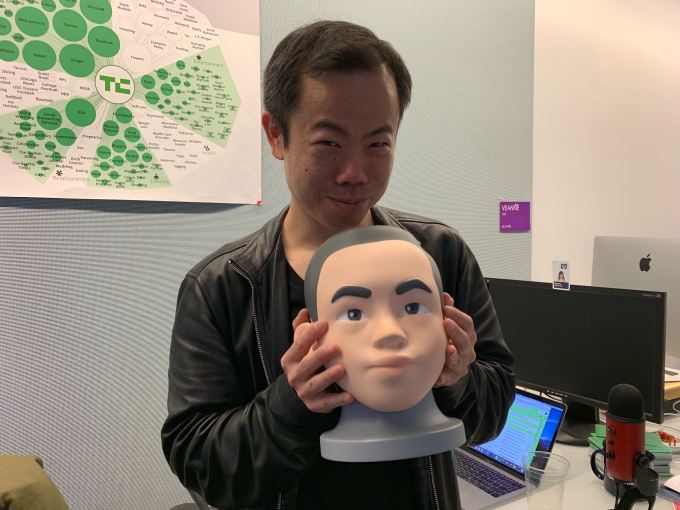
DON’T send severed heads of the writer you want to cover your story

TechCrunch writer Anthony Ha holds his future (and his head) in his own hands.

Heads up! It’s weird to send someone’s cranium to them.

This is an odd one, but believe it or not, severed heads seem to roll into our office every couple of months thanks to the advent of 3D printing. Several of us in the New York TechCrunch office received these “gifts” in the past few days (see gifts next), and apparently, I now have a severed head resting on my desk that I get to dispose of on Monday.

Let’s think linearly on this one. Most journalists are writers and presumably understand metaphors. Heads were placed on pikes in the Middle Ages (and sadly, sometimes recently) as a warning to other group members about the risk of challenging whoever did the decapitation. Yes, it might get the attention of the person you are sending their head to, in the same way that burning them in effigy right in front of them can attract eyeballs.

Now, I get it — it’s a demo of something, and maybe it might even be funny for some. But, why take the risk that the recipient is going to see the reasonably obvious metaphorical connection? Use your noggin — no severed heads.

DON’T send gifts

Journalists have a job to do: we cover the most interesting stories and write them up for our readers. That’s what we are paid to do after all.

Original Content podcast: ‘Game of Thrones’ delivers one of its best episodes yet

We’re barely more than 24 hours away from what’s widely expected to be the most spectacular and devastating battle that we’ve seen on “Game of Thrones,” but before then, <a href=”http://”https://itunes.apple.com/podcast/original-content/id1271763098″>the Original Content podcast revisits last weekend’s episode, “A Knight of the Seven Kingdoms.”

In the past, we’ve tended to discuss TV shows in a more general way, covering entire seasons in a single segment of the podcast. But given the general obsession over “Game of Thrones” (and we’re certainly among the obsessed), it seemed worthwhile to give ourselves the time to get as detailed as we wanted.

“A Knight of the Seven Kingdoms” is certainly worthy of that discussion — we both felt it was one of the show’s best episodes thus far. While it may even cover less ground plot-wise than the season premiere, the episode gives us haunting moments with virtually all of the surviving cast members as they wrestle with their likely death in the battle to come.

Speaking of that battle, we also join in the speculation over who will live and who will die.

And before the spoiler-heavy “Game of Thrones” discussion, we also talk about what’s new in the streaming world, namely Beyoncé’s new concert film “Homecoming.” Both of us talk about how the critically-acclaimed film changed our perception of Beyoncé, who we’d admired without being full-blown fans of beforehand.

You can listen in the player below, subscribe using Apple Podcasts or find us in your podcast player of choice. If you like the show, please let us know by leaving a review on Apple. You can also send us feedback directly. (Or suggest shows and movies for us to review!)

‘The Division 2’ is the brain-dead, antipolitical, gun-mongering vigilante simulator we deserve

In The Division 2, the answer to every question is a bullet. That’s not unique in the pervasively violent world of gaming, but in an environment drawn from the life and richly decorated with plausible human cost and cruelty, it seems a shame; and in a real world where plentiful assault rifles and government hit squads are the problems, not the solutions, this particular power fantasy feels backwards and cowardly.

Ubisoft’s meticulous avoidance of the real world except for physical likeness was meant to maximize its market and avoid the type of “controversy” that brings furious tweets and ineffectual boycotts down on media that dare to make statements. But the result is a game that panders to “good guy with a gun” advocates, NRA members, everyday carry die-hards, and those who dream of spilling the blood of unsavory interlopers and false patriots upon this great country’s soil.

There are two caveats: That we shouldn’t have expected anything else, from Ubisoft or anyone; and that it’s a pretty good game if you ignore all that stuff. But it’s getting harder to accept every day, and the excuses for game studios are getting fewer. (Some spoilers ahead, but trust me, it doesn’t matter.)

To put us all on the same page: The Division 2 (properly Tom Clancy’s The Division 2, which just about sums it up right there) is the latest “game as a service” to hit the block, aspiring less towards the bubblegum ubiquity of Fortnite and than the endless grind of a Destiny 2 or Diablo 3. The less said about Anthem, the better (except Jason Schrier’s great report, of course).

From the bestselling author of literally a hundred other books…

It’s published by Ubisoft, a global gaming power known for creating expansive gaming worlds (like the astonishingly beautiful Assassin’s Creed: Odyssey) with bafflingly uneven gameplay and writing (like the astonishingly lopsided Assassin’s Creed: Odyssey).

So it was perhaps to be expected that The Division 2 would be heavy on atmosphere and light on subtlety. But I didn’t expect to be told to see the President snatch a machine gun from his captors and mow them down — then tell your character that sometimes you can’t do what’s popular, you have to do what’s necessary.

It would be too much even if the game was a parody and not, as it in fact is, deeply and strangely earnest. But I’m getting ahead of myself.

EDC Simulator 2

The game is set in Washington, D.C.; its predecessor was in New York. Both were, like most U.S. cities in this fictitious near future, devastated by a biological attack on Black Friday that used money as a vector for a lethal virus. That’s a great idea, perhaps not practical (who pays in cash?), but a clever mashup of terrorist plots with consumerism. (The writing in the first Division was considerably better than this one.)

Your character is part of a group of sleeper agents seeded throughout the country, intended to activate in the event of a national emergency, surviving and operating on your own or with a handful of others, procuring equipment and supplies on the go, taking out the bad guys and saving the remaining civilians while authority reasserts itself.

You can see how this sets up a great game: exploring the ruins of a major city, shooing out villains, and upgrading your gear as you work your way up the ladder.

And in a way it does make a great game. If you consider the bad guys just types of human-shaped monsters, your various guns and equipment the equivalent of new swords and wands, breastplates and greaves, with your drones and tactical launchers modern spells and auras, it’s really quite a lot like Diablo, the progenitor of the “looter” genre.

Moment to moment gameplay has you hiding behind cover, popping out to snap off a few shots at the bad guys, who are usually doing the same thing 10 or 20 yards away, but generally not as well as you. Move on to the next room or intersection, do it again with some more guys, rinse and repeat. It sounds monotonous, and it is, but so is baseball. People like it anyway. (I’d like to give a shout-out to the simple, effective multiplayer that let me join a friend in seconds.)

But the problem with The Division 2 isn’t its gameplay, although I could waste your time (instead) with some nitpicking of the damage systems, the mobs, the inventory screen, and so on. The problem with The Division 2 isn’t even that it venerates guns. Practically every game venerates guns, because as Tim Rogers memorably paraphrased CliffyB once: “games are power fantasies — and it’s easy to make power fantasies, because guns are so powerful, and raycasting is simple, and raycasting is like a gun.” It’s difficult to avoid.

No, the problem with The Division 2 is the breathtaking incongruity between the powerfully visualized human tragedy your character inhabits and the refusal to engage even in an elementary way with the themes to which it is inherently tied: terrorism, guns, government and anti-government forces, and everything else. It’s exploitative, cynical, and absurd.

The Washington, D.C. of the game is a truly amazing setting. Painstakingly detailed block by block and containing many of the most notable landmarks of the area, it’s a very interesting game world to explore, even more so I imagine if you are from there or are otherwise familiar with the city.

The marks of a civilization-ending disaster are everywhere. Abandoned cars and security posts with vines and grass creeping up between them, broken and boarded up windows and doors, left luggage and improvised camping spots. Real places form the basis for thrilling setpiece shootouts: museums, famous offices, the White House itself (which you find under limp siege in the first mission). This is a fantasy very much based in reality — but only on the surface. In fact all this incredibly detailed scenery is nothing more than cover for shootouts.

I can’t tell you how many times my friend and I traversed intricately detailed monuments, halls, and other environments, marveling at the realism with which they were decorated (though perhaps there were a few too many gas cans), remarking to one another: “Damn, this place is insane. I can’t believe they made it this detailed just to have us do the same exact combat encounter as the entire rest of the game. How come nobody is talking about the history of this place, or the bodies, or the culture here?”

When fantasy isn’t

Now, to be clear, I don’t expect Ubisoft to make a game where you learn facts about helicopters while you shoot your way through the Air and Space Museum, or where you engage in philosophical conversation with the head of a band of marauders rather than lob grenades and corrosive goo in their general direction. (I kind of like both those ideas, though.)

But the dedication with which the company has avoided any kind of reality whatsoever is troubling.

We live in a time when people are taking what they call justice into their own hands by shooting others with weapons intended for warfare; when paramilitary groups are defending their strongholds with deadly force; when biological agents are being deployed against citizenry; when governments are surveilling and tracking people via controversial AI systems; when the leaders of that government are making unpopular and ethically fraught decisions without the knowledge of their constituency.

Ultimate EDC simulator

This game enthusiastically endorses all of the previous ideas with the naive justification that you’re the good guys. Of course you’re the good guys — everyone claims they’re the good guys! But objectively speaking, you’re a secret government hit squad killing whoever you’re told to, primarily other citizens. Ironically, despite being called an agent, you have no agency — you are a walking gun doing the bidding of a government that has almost entirely dissolved. What could possibly go wrong? The Division 2 certainly makes no effort to explore this.

The superficiality of the story I could excuse if it didn’t rely so strongly on using the real world as set dressing for its paramilitary dress-up-doll fantasy.

Basing your game in a real world location is, I think, a fabulous idea. But in doing so, especially if as part of the process you imply the death of millions, a developer incurs a responsibility to do more than use that location as level geometry.

The Division 2 instead uses these deaths and the most important places in D.C. literally as props. Nothing you do ever has anything to do with what the place is except in the loosest way. While you visit morgues and improvised mass graves piled with body bags, you never see anyone dead or dying… unless you kill them.

It’s hard to explain what I find so distasteful about this. It’s a combination of the obvious emphasis on the death of innocents, in a brute-force attempt to create emotional and political relevance, with the utterly vacuous violence you fill that world with. It feels disrespectful to itself, to the setting, to set a piece of media so incredibly dumb and mute in a disaster so credible and relevant.

This was a deliberate decision, to rob the game of any relevance — a marketing decision. To destroy D.C. — that sells. To write a story or design gameplay that in any way reflects why that destruction resonates — that doesn’t sell. “We cannot be openly political in our games,” said Alf Condelius, the COO of the studio that created the game, in a talk before the game’s release. Doing so, he said, would be “bad for business, unfortunately, if you want the honest truth.” I can’t be the only one who feels this to be a cop-out of pretty grand proportions, with the truth riding on its coattails.

Perhaps you think I’m holding game developers to an unreasonable standard. But I believe they are refusing to raise the bar themselves when they easily could and should. The level of detail in the world is amazing, and it was clearly designed by people who understand what could happen should disaster strike. The bodies piled in labs, the desolation of a city overtaken by nature, the perfect reproductions of landmarks — an enormous amount of effort and money was put into this part of the game.

On the other hand, it’s incredibly obvious from the get-go that very, very little attention was paid to the story and characters, the dialogue, the actual choices you can make as a player (there are none to speak of). There is no way to interact with people except to shoot them, or for them to tell you who to shoot. There is no mention of politics, of parties, of race or religion. I feel sure more time was spent modeling the guns — which, by the way, are real licensed models — than the main “characters,” though it must have been time-consuming to so completely to purge those characters of any ideas or opinions that could possibly reflect the real world.

One tragedy please, hold the relevance

This is deliberate. There’s no way this could have happened unless Ubisoft, from the start, made it clear that the game was to be divorced from the real world in every way except those that were deemed marketable.

That this is what they considerable marketable is a sad sort of indictment of the people they are selling this game to. The prospect of inserting oneself into a sort of justified vigilante role where you rain hot righteous lead on these generic villains trampling our great flag seems to be a special catnip concoction Ubisoft thought would appeal to millions — millions who (or more importantly, whose wallets) might be chilled by the idea of a story that actually takes on the societal issues that would be at play in a disaster like this one. We got the game we deserved, I suppose.

Say what you will about the narrative quality of campaigns of Call of Duty and Battlefield, but they at least attempt to engage with the content they are exploiting to sell the game. World War II is marketable because it’s the worst thing that ever happened and destroyed the lives of millions in a violent and dramatic way. Imagine building a photorealistic reproduction of wartime Stalingrad, or Paris, or Berlin, and then filling it not with Axis and Allied forces but simplified and palatable goodies and baddies with no particular ethos or history.

I certainly don’t mean to equate the theoretical destruction of D.C. with the Holocaust and WWII, but as perhaps the most popular period and venue for shooters like this, it’s the obvious comparison to make thematically, and what one finds is that however poor the story of a given WWII game, it inevitably attempts to emphasize and grapple with the enormity of the events you are experiencing. That’s the kind of responsibility I think you take on when you illustrate your game with the real world — even a fantasy version of the real world.

Furthermore Ubisoft has accepted that it must take some political stances, such as the inclusion of same-sex player-NPC relationships in Assassin’s Creed: Odyssey — not controversial to me and many others, certainly, but hardly an apolitical inclusion in the present global political landscape. (I applaud them for this, by the way, and many others have as well.) It’s arguable this is not “overt” in that Kassandra and Alexios don’t break the first wall to advocate for marriage equality, but I think it is deliberately and unapologetically espousing a stance on a politically and societally charged issue.

It seems it is not that the company cannot be overtly political, but that it decided in this case that to be political on issues of guns, the military, terrorism, and so on was too much of a risk. To me that is in itself a political choice.

I do think Ubisoft is a fantastic company and makes wonderful games — but I also think the decision to completely divorce a game with fundamentally political underpinnings from the real politics and humanitarian conditions that empower it is a sad and spineless decision that makes them look both avaricious and inhumane. I know they can do better because others already have and do.

The Division 2 is a good game as far as games go. But games, like movies, TV, and other media, are very much art now, deserving of criticism as to their ideas as well as their controls and graphics; and as art, The Division 2 is as much a barren wasteland scoured of humanity as the D.C. it depicts.

As measles returns, Indiegogo joins other tech platforms in banning Anti-Vaccine campaigns

The last year has been the worst on record in the US for measles outbreaks since the disease was declared ‘eradicated’ in 2000. Even though vaccination rates across the country are still high, (according to the CDC) there remains some communities where disinformation campaigns which claim that ‘vaccines are dangerous’ (often called ‘anti-vaxx’ campaigns) have led to parents refusing to vaccinate their children. Sadly, this can lead to a deadly outbreak when members of the public are exposed to someone who has picked up the disease, often overseas. Measles is highly contagious and can be fatal, especially amongst children.

And despite President Trump telling Americans to “get their shots”, 45 has previously appeared to link vaccines and autism. Public health experts say there is no link.

At the same time, over half a million children in Britain have been left unprotected against measles in the past decade and Unicef has called for a renewed focus on immunization.

It’s with this background that some tech companies are starting to realize they may have been part of the problem.

Yesterday Crowdfunding site Indiegogo said it would no longer allow anti-vaccine fundraisers or similarly unscientific, so-called “health campaigns”, to use its platform.

The move came after $86,543 was raised for a documentary, called Vaxxed II, based on the false claim that vaccines cause autism. Although the organization behind it, The People’s Truth, will still get their cash, minus the site’s 5% fee, Indiegogo said it was now planning a new policy to keep similar anti-vaccine projects off its site, a company spokesperson told BuzzFeed News Friday.

The fundraiser did not violate IndieGoGo’s existing policies on untruthful campaigns, but Indiegogo never promoted it on its site, said a company spokesperson. Executive directors of the “documentary”, Polly Tommey and Brian Burrowes, have criticized tech companies’ ‘de-platforming’ of their film as “censorship”.

Indiegogo is the latest in a line of tech companies coming round to the idea of cutting off the oxygen of publicity and cash to such campaigns.

Last month, Facebook said it would be removing anti-vaxx groups from ads and recommendations and making it harder for users to find anti-vaxx pages and posts using Facebook search. Instagram (owned by Facebook) said it would also do something similar to stop recommending inaccurate information about vaccines on its hashtags and in search. YouTube has also reiterated a previous pledge to stop anti-vaxx content from generating advertising cash on its platform.

Meanwhile, Amazon has looked to remove books promoting an unscientific connection made between vaccines and autism, and anti-vaccine documentaries like Vaxxed. Furthermore, GoFundMe has banned fundraising campaigns from anti-vaxxers.

Samantha Bee: Canadian, comedian, and defender of the free press

The only job named in and protected by the U.S. constitution is journalism. But when it’s under attack from fake news, misinformation, and the supposed defender-of-the-constitution-in-chief, who looks out for the press?

Reporters have an unlikely ally in the late night comedy circuit.

Late night television has a steady stream of male comedians ready to cursorily pick apart the news of the day, often mocking the dispatches of the press — typically the government — before they turn to a light hearted interview with a celebrity to round off the night.

But not Samantha Bee. The Canadian-born comedian and former ‘Daily Show’ correspondent, is the only female comedian with a late-night show, Full Frontal, and doesn’t waste a second not holding the powers to account. Her show, which films and airs on TBS every Wednesday, offers a weekly record of the abuses of the government by bringing both the big stories and the little-read reports to her massive viewing audience.

It’s no surprise that President Trump, an ardent critic of the press, declined for the third consecutive year to attend Saturday’s White House Correspondent’s Dinner, an annual gala for the White House press corps that “celebrates” the First Amendment’s protections of free speech — often by taking comical potshots at the commander-in-chief himself. The only saving grace for the president’s would-be roasting is the dinner’s organizers, the White House Correspondents’ Association, dropped the traditional comedy set altogether after Michelle Wolf’s pointed if not controversial set last year — which Bee herself defended.

Enter Bee with her own rival event, the aptly named Not The White House Correspondent’s Dinner, a party in its third year for “the free press… while we still have one,” said Bee.

“We’re throwing the party they should be having,” she said.

WASHINGTON, DC – APRIL 26: Samantha Bee speaks onstage during “Full Frontal With Samantha Bee” Not The White House Correspondents Dinner – Show on April 26, 2019 in Washington, DC. (Photo by Tasos Katopodis/Getty Images for TBS) 558325

A free meal and an hour of comedy aside, support for the press is as important as ever. With more frequent attacks on the press, the murder of Jamal Khashoggi, and the regular insults of “fake news,” press freedom is in a vice.

“Journalists are critical to creating an informed citizenry, to make sure we’re hold public officials account, and to get basic information about the world around us,” said Courtney Radsch, advocacy director at the Committee to Protect Journalists, a non-profit dedicated to promoting press freedom and advocating the rights of reports across the world.

“By labeling journalists as ‘enemies of the people’,” said Radsch, a term repeatedly used by Trump, including days prior to a newsroom shooting at Baltimore’s Capital Gazette newspaper, “it creates conditions that make it less safe for reporters to work.”

Last year, the CPJ’s Press Freedom Tracker database logged over a hundred incidents — from murders to physical attacks, border searches and legal orders — involving the press.

“This constant denigration of the media as ‘fake news’ has a really detrimental impact,” she said.

Bee isn’t alone in her efforts to support the free press. Other fellow comedians like John Oliver and Hasan Minhaj use their platform to educate and inform about “fundamental issue that concern more than just journalists,” said Radsch.

Bee’s weekly half-hour show is a journalistic effort in its own right. But as a comedy show, it’s largely shielded from the near-constant attacks that the press face from the Trump administration and its allies.

With all proceeds from the dinner going to the Committee to Protect Journalists, Bee has shown to not only serve as an ally for reporters but also a staunch defender of the free press.

“No-one needs the press more than me and my show,” said Bee at the dinner. “We spend all day reading and watching and thinking about the news.”

“Journalism is essential,” she said. And then she broke into song.

Samantha Bee’s Not The White House Correspondent’s Dinner airs Saturday at 10pm ET on TBS. TechCrunch was invited as a guest.

Here’s everything you missed at TC Sessions: Robotics + AI

Last week we held our third annual robotics event at UC Berkeley. It’s my favorite TechCrunch event, and this year’s was our best show to date. We had some amazing conversations with a number of the top names in robotics and artificial intelligent, demoed some incredible robots and broke some exciting news about the future of the category.

You can check out a full rundown of all the robots we had onstage:

And here’s a talk Lucas and I gave about learnings from the event and what they say about the future of robotics:

For those who were unable to join us at the event — or just want a refresher — here’s a breakdown of the programming and the big news that came out of the event.

Building a Better Robotics Company with Nima Keivan (Canvas), Manish Kothari (SRI International), and Melonee Wise (Fetch Robotics)


Little did we know when programming the event that we would have a member of Amazon Robotics’ team onstage. A week ahead of the event, Canvas was acquired by the online retail giant, making for a fascinating conversation on the state of robotics startups.

Can’t We All Just Get Along? with Anca Dragan (UC Berkeley), Rana el Kaliouby (Affectiva) and Matt Willis (SoftBank Robotics)


As automation becomes more prominent in our lives, the subject of human-robotic interaction (HRI) will become increasingly important. A number of experts in the field discuss the ways in which robotics and AI experts are making that transition more seamless.

This Reality Does Not Exist: Trust in an Age of Synthetic Media with Alexei Efros (UC Berkeley) and Hany Farid (Dartmouth College)


The panel kicks off with a fascinating demo featuring a CGI Barack Obama. What follows is a fascinating conversation about digital fakery.

Building a Better Driver with Sterling Anderson (Aurora) and Raquel Urtasun (Uber)


As car companies make a push into autonomous driving, AI and other underlying tech will play an important role in keeping both passengers and pedestrians safe.

What happens after the Industrial Robot-lution with Dr. Kiyonori Inaba (FANUC)


Industrial robotics giant Fanuc joined us onstage to discuss how the company will use its new AI tool to increase productivity with its bin picking system.

Artificial Intelligence: Minds, Economies and Systems that Learn with Ken Goldberg (UC Berkeley) and Michael Jordan (UC Berkeley)


Two of UC Berkeley’s leading thinkers discuss the recent growth of the AI and robotics sector and what companies and research need to do in order to continue that innovation.

AI Startups that Enable AI with Daniela Braga (DefinedCrowd), Ali Farhadi (Xnor.ai) and Daryn Nakhuda (Mighty AI)


Some of the top companies in the industry joined us to discuss what it takes to build a successful AI startup.

Greener Pastures with Colin Angle (iRobot)


iRobot’s CEO joined us to show off its new lawn-mowing robot, Terra. He also discussed the company’s early struggles and offered advice for startups looking to make their way in robotics.

Investing in Robotics and AI: Lessons from the Industry’s VCs with Peter Barrett (Playground Global), Helen Liang (FoundersX Ventures), Eric Migicovsky (Y Combinator) and Andy Wheeler (GV)


This panel was straight-up packed with Silicon Valley’s top robotics VCs. Moderator Connie Loizos has a rundown of some of the top takeaways from the event.

Putting Drones to Work with Grant Canary (DroneSeed) and Arnaud Thiercelin (DJI)


Drone popularity has skyrocketed in recent years, among hobbyists and professionals alike. But we’re just beginning to scratch the surface of what they can do. One startup and a rep from the world’s largest drone company discuss what comes next.

The Best Robots on Four Legs with Marc Raibert (Boston Dynamics)


Last year, Marc Raibert announced the company’s plans to commercialize Spot Mini. This year he returned to debut the production model and show off some of the robot’s new tricks.

Fireside Chat with Anthony Levandowski (Pronto.AI)


A controversial star in the world of autonomous driving, the former Google engineer joined us to discuss his new startup, Pronto.AI.

Building the Robots that Build with Noah Ready-Campbell (BUILT Robotics) and Saurabh Ladha (Doxel AI)


Beyond the factories and warehouses, robotics are beginning to play an increasingly important role in the world of construction.

How a blockchain startup with 1M users is working to break your Google habit

The antitrust argument that says big tech needs breaking up to stop platforms abusing competition and consumers in a two-faced role as seller and (manipulative) marketplace may only just be getting going on a mainstream political stage — but startups have been at the coal face of the fight against crushing platform power for years.

Presearch, a 2017-founded, pro-privacy blockchain-based startup that’s using cryptocurrency tokens as an incentive to decentralize search — and thereby (it hopes) loosen Google’s grip on what Internet users find and experience — was born out of the frustration, almost a decade before, of trying to build a local listing business only to have its efforts downranked by Google.

That business, Silicon Valley-based ShopCity.com, was founded in 2008 and offers local business search on Google’s home turf — operating sites like ShopPaloAlto.com and ShopMountainView.com — intended to promote local businesses by making them easier to find online.

But back in 2011 ShopCity complained publicly that Google’s search ranking systems were judging its content ‘low quality’ and relegating its listings pages to the unread deeps of search results. Listings which, nonetheless, had backing and buy in from city governments, business associations and local newspapers.

ShopCity went on to complain to the U.S. Federal Trade Commission (FTC), arguing Google was unfairly favoring its own local search products.

Going public with its complaint brought it into contact with sceptical segments of the tech press more accustomed to cheerleading Google’s rise than questioning the agency of its algorithms.

“We have developed a very comprehensive and holistic platform for community commerce, and that is why companies like The Buffalo News, owned by Berkshire Hathaway, have partnered up with us and paid substantial licensing fees to use our system,” wrote ShopCity co-founder Colin Pape, responding to a dismissive Gigaom article in November 2011 by trying to engage the author in comments below the fold.

“The fact that Google recently began copying our multi-domain model… and our in-community approach, is a good indication that we are onto something and not just a ‘two-bit upstart’,” Pape went on. “Google has stated that the local space is of great importance to them… so they definitely have a motive to hinder others from becoming leaders, and if all it takes to stop a competitor from developing is a quick tweak to a domain profile, then why not?”

While the FTC went on to clear Google of anti-competitive behavior in the ShopCity case, Europe’s antitrust authorities have taken a very different view about Mountain View’s algorithmic influence: The EU fined Google $2.73BN in 2017 after a lengthy investigations into its search comparison service which found, in a scenario similar to ShopCity’s contention, Google had demoted rival product search services and promoted its own competing comparison search product.

That decision was the first of a trio of multibillion EU fines for Google: A record-breaking $5BN fine for Android antitrust violations fast-followed in 2018. Earlier this year Google was stung a further $1.7BN for anti-competitive behavior related to its search ad brokering business.

“Google has given its own comparison shopping service an illegal advantage by abusing its dominance in general Internet search,” competition commissioner Margrethe Vestager said briefing press on the 2017 antitrust decision. “It has harmed competition and consumers.”

Of course fines alone — even those that exceed a billion dollars — won’t change anything where tech giants are concerned. But each EU antitrust decision requires Google to change its regional business practices to end the anti-competitive conduct too.

Commission authorities continue monitoring Google’s compliance in all three cases, leaving the door open for further interventions if its remedies are deemed inadequate (as rivals continue to complain). So the search giant remains on close watch in Europe, where its monopoly in search puts special conditions on it not to break EU competition rules in any other markets it operates in or enters.

There are wider signs, too, that increasing antitrust scrutiny of big tech — including the idea of breaking platforms up that’s suddenly inflated into a mainstream political talking point in the U.S. — is lifting a little of the crushing weight off of Google competitors.

One example: Google quietly added privacy-focused search rival DuckDuckGo to the list of default search engines offered in its Chrome browser in around 60 markets earlier this year.

DDG is a veteran pro-privacy search engine Google rival that’s been growing usage steadily for years. Not that you’d have guessed that from looking at Chrome’s selective lists prior to the aforementioned silent update: From zero markets to ~60 overnight does look rather 🤨.

Rising antitrust risk could help unlatch more previously battened down platform hatches in a way that’s helpful to even smaller Google rivals. Search startups like Presearch . (On the size front, it’s just passed a million registered users — and says monthly active users for its beta are ~250k. Early adopters skew power user + crypto geek.)

Google’s dominance in search remains a given for now but a fresh wind is rattling tech giants thanks to a shift in tone around technology and antitrust, fuelled by societal concern about wider platform power and impacts, that’s aligned with fresh academic thinking.

And now growing, cross-spectrum political appetite to regulate the Internet. Or, to put it another way, the tech backlash smells like a vote winner.

That may seem counterintuitive when platforms have built massive consumer businesses by heavily marketing ‘free’ consumer-friendly services. But their shiny freebies have sprouted a hydra of ugly heads in recent years — whether it’s Facebook-fuelled, democracy-denting disinformation; YouTube-accelerated hate speech and extremism; or Twitter’s penchant for creating safe spaces for nazis to make friends and influence people.

Add to that: Omnipresent creepy ads that stalk people around the Internet. And a fast-flowing river of data breach scandals that have kept a steady spotlight on how the industry systematically plays fast and loose with people’s data.

European privacy regulations have further helped decloak adtech via an updated privacy legal framework that highlights how  very many faceless companies are lurking in the background of the Internet, making money by selling intelligence they’ve gleaned by spying on what web users are browsing.

And that’s just the consumer side. For small businesses and startups trying to compete with platform goliaths engineered and optimized to throw their bulk around, deploying massive networks and resources to tractor-beam and data mine anything — from product development; to usage and app trends; to their next startup acquisition — the feeling can be one of complete impotence. And, well, burning injustice.

“That was actually the real genesis moment behind [Presearch] — the realization of just how big Google is,” Pape tells TechCrunch, recounting the history of the ShopCity FTC complaint. “In 2011 we woke up one day and found out that 80-90% of our Google traffic had disappeared and all of these sites, some of which had been online for more than a decade and were being run in partnership with city governments and chambers of commerce, they were all basically demoted onto page eight of Google.

“Even if you typed them by name… Google had effectively, in their own backyard, shut down this local initiative.”

“We ended up participating in this [FTC] investigation and ultimately it cleared Google but we’ve been really aware of the market power that they have — and certainly what could be perceived as monopolistic practices,” he adds. “It’s a huge challenge. Anybody trying to do any sort of publishing or anything really on the web, Google is the gatekeeper.”

Now, with Presearch, Pape and co are hoping to go after Google in its techie backyard — of search.

Search, decentralized

Breaking the “Google habit” and opening up web users to a richer and more diverse field of search alternatives is the name of the game.

Presearch’s vision is a community-owned, choice-rich online playing field in the place where the Google search box normally squats; a sort of pluralist, collaborative commons that welcomes multiple search providers and rewards and surfaces community-curated search results to further diversity — encouraging Internet users to discover a democratized multiplicity of search results, not just the things big tech wants them to see.

Or as Pape puts it: “The ultimate vision is a fully decentralized search engine where the users are actually crawling the web as they surf — and where there’s kind of a framework for all of the participants within the ecosystem to be rewarded.”

This means that Presearch, which is developing a community-contributed search engine in addition to the federated search tool platform, is competing with the third party search providers it offers access to.

But from its point of view it’s ‘the more the merrier’; Call it search choices for customizable courses.

“Or as we like to think of it, like a ‘Switzerland of search’,” says Pape, adding: “We do want to make sure it’s all about the user.”

Presearch’s startup advisor roster includes names that will be familiar to the wider blockchain community: Ethereum co-founder and founder of Decentral, Anthony Di Iorio; Rich Skrenta, founder and CEO of startup search engine Blekko (acquired by IBM Watson back in 2015); and industry lawyer, Addison Cameron-Huff.

“When you’re a producer on the web you realize how much control Google does really have over user traffic. Yet there are thousands of different search resources that are out there that are subsisting underneath of Google,” continues Pape. “So we’re really trying to give them more of a platform that a lot of these different providers — including DuckDuckGo, Qwant — could get behind to basically break that Google dependency and make it easier for them to have a direct relationship with the their audience.”

Of course they’re nowhere near challenging Google’s grip yet.

And like so many startups Presearch may never make good on the massive disruptive vision. It’s certainly got its work cut out. Being a startup in the Google-dominated search space makes the standard hostile success odds exponentially harsher.

“Presearch is a highly-ambitious project,” the startup admits in its WhitePaper. “Google is one of the best companies in the world, and #1 on the Internet. Improving on their results, experience, and integrations will be no small feat — many even say it’s impossible. However, we believe that collectively the community can creatively and elegantly fulfill its own search needs from the ground up and create an amazing and open search engine that is aligned with the interests of humanity, not just one company.”

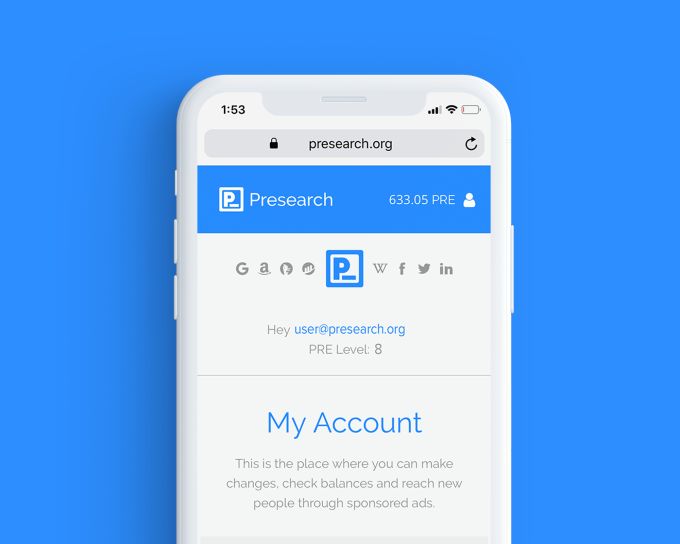
For now the beta product is, by Pape’s ready admission, more of a “search utility” — offering a familiar search box where users can type their queries but atop a row of icons that allow them to quickly switch between different search engines or services.

As well as offering Google search (the default search engine for now), DuckDuckGo is in the list, as is French search engine Qwant. Social platforms like Facebook and LinkedIn are also there to cater to people-focused queries. As is stuff like Wikipedia for community-edited authority. In all Pape says the beta offers access to around 80 search services.

The basic idea for now is to let users select the most appropriate search tool for whatever bit of info they’re trying to locate. Aka that “level playing field for a whole bunch of different search resources” idea.

This does look like a power tool with niche appeal — Pape says about a quarter of active users are actively switching between different engines; so ~75% are not — but which is being juiced, and here comes the crypto, by rewarding users for searching via the federated search field with a token called PRE.

Pape says users are provided with a quarter token per presearch performed — up to a cap of eight tokens per day. The current market value of the PRE token is around $0.05. (So the hardest working Presearchers could presumably call themselves ’40cents’.)

While there are ways for users to extract PRE from the platform if they wish, converting it to another cryptocurrency via community built exchanges, Pape says the intent is to create more of “a closed loop ecosystem”. Hence he says they’re busy building a portal for users to be able to sell PRE tokens to advertisers.

“We will be promoting this closed loop ecosystem but it is an open standardized currency,” he notes. “It is tradable on various exchanges that community members have set up so there is the ability for people to convert the Presearch token to bitcoin which can then be converted to any local currency.”

“We see as well as opportunity to really build out an ecosystem of places for people to spend the token as well,” he adds. “So that they can exchange it directly for either digital goods or material goods through an online platform. So that’s also in the works.”

As things stand Pape says most early adopters are ‘hodlers’. Which is to say they’re holding onto their PRE — speculating on as yet unknown token economics. (As it so often goes in the blockchain space — until, well, it suddenly doesn’t.)

“There is, as throughout the entire cryptocurrency space, an element of speculation,” he agrees. “People do tend to let their imaginations run wild so there’s kind of this interesting confluence of that core base utility — where you basically have a token that is backed by advertising, something that you can really convert it to. And then there is this potential concept of the value of the network, and of having essentially some time of stake in the value of that network.

“So there’s going to be this interesting period over the next couple of years as the token economics change as we go from this nascent startup mode into more of a full on operating mode. Where the value will likely change.”

For advertisers the PRE token buys targeted ad impressions placed in front of Presearch users by being linked to keywords used by searchers (or “targeted, non-intrusive, keyword sponsorships” as the website explainer puts it).

This is the virtuous, privacy-respecting circle Presearch is hoping to create.

Pape makes a point of emphasizing there is “no tracking” of users’ searches. Which means there’s no profiling of Preseachers by Presearch itself — ads are being targeted contextually, per the current keyword search.

But of course if you’re clicking through to a third party like Google or Facebook that’s a whole other matter; and the standard tracking caveats apply.

Presearch’s claim not to be storing or otherwise tracking users’ searches has to be taken on trust for now. However it intends to fully open source the platform to ensure truly accountable transparency in the near future. (Pape says they’re hoping they’ll be able to do so in a year.)

In the meantime he notes that the founders make themselves available to users via a messaging group on Telegram — contrasting that accessibility with the perfect unreachability of Google’s founders to the average (or really almost any) Google user.

In the modern age of messaging apps, and with their ecosystem’s community-building imperatives, these founders are most certainly not operating in a vacuum.

Currently one PRE token buys an advertiser four ad impressions on the platform — which is one lever Presearch will be able to pull on to influence the value of the token as the ecosystem develops.

“Ultimately [impressions per token] could go to ten, a hundred,” suggests Pape. “That’s obviously going to change the token — and we’ll basically do that as we see the market forces at work and how many people are actually willing to sell their tokens.

“We’ve currently got a pretty strong demand side equation right now. It’s like three to one demand to supply. A lot of the people that are earning tokens are not choosing to redeem them; they’re choosing to keep them in a wallet and hold onto them for the future. So it’s an interesting experiment in tokenomics.”

“It’s super volatile, there’s so much sentiment that’s involved, that’s really the core driver of the value,” he adds. “There’s no real fundamentals yet. Nobody has established any correlation between anything.”

Presearch began life as an internal search tool built for use at the founders’ other company to reduce time tracking down information online. And then the crypto boom caught their eye — and they saw an possible incentive structure to encourage Google users to switch.

“We didn’t really see a go to market strategy with it — search is a very challenging industry. But then when we really started looking at the cryptocurrency opportunity and the ability to potentially denominate an advertising platform in a token that could be utilized to incentivize people to switch we started thinking that it was viable; we put it out to the community, we got really good feedback on the need and on the messaging.”

A token sale followed, between July and November 2017, to raise funds for developing the platform — the obvious route for Presearch to grow a blockchain-based, community-sustaining, closed-loop ecosystem.

“One of the keys was really the ownership structure and making sure that all the participants within the ecosystem are aligned under one unit of account — which is the token. Vs having conflicting interests where there’s an equity incentive as well that may run counter to that token,” notes Pape.

The token sale raised an initial $7M but lucky timing meant Presearch was riding the cryptocurrency rollercoaster during an upward wave which meant funds appreciated to around $21M by the end of the sale period.

The first version of the platform was also launched in November of 2017, with the token itself launching at the end of the month.

Since then Pape says several hundred advertisers have participated in testing phases of the platform. A new version of the platform is pending for launch “shortly” — with a different ad unit which will arrive with a dozen “curated sponsors” on board. “There’s more brand exposure so we really want to be selective in the early days and making sure that we’re only partnering with aligned projects,” he adds.

Almost a year and a half on from the original platform launch Presearch has just made good on the number one community ask: Browser extensions to make the platform easier to use for search.

User surveys showed the biggest reason people dropped out was ease of use, according to Pape.

The new extension is available for Chrome, Brave and Firefox browsers, and works to shave off usability friction. Previously beta users had to set Presearch as their homepage or remember to type its address into the URL bar before searching.

“There’s a really good alignment of the core community but ultimately it does come down to changing user habit and behavior and that is always challenging,” he adds. “This new browser extension enables them to use the browser URL field or the search field and basically access Presearch through the UI that they’re used to and that they’ve been demanding.

Around a quarter of sign-ups stick around and become active users, according to Pape — who dubs that “already really high”. The team is expecting the new browser extensions to fuel “significant” further growth.

“We are getting ready to push it out to the users through email — [and anticipate] that we’re going to see a significant increase in the percentage of users utilizing it. And if that assumption holds through and everything really holds out we’re going to do a much more active push to grow the user base.”

They also launched an iOS Presearch app last year which taps into the voice search trend. Users can speak to search specific services with a library of sites that can be added to the app to enable deep searching of web resources, as well as apps running locally on the device. (So, for example, you could tap and tell it to ‘presearch Google Maps for London’ or ‘Spotify for Taylor Swift’.)
Competition concerns attached to the convenience of voice search — which risks further flattening consumer choice and concentrating already highly concentrated market power given its focus on filtering options to return just one search result — is an area of interest for antitrust regulators.

Europe’s antitrust chief Vestager said in an interview earlier this year that she was trying to figure out “how to have competition when you have voice search”. So perhaps Presearch’s federated platform approach offers a glimpse of a possible solution.

Global community vs Google

Pape sums up the overall competitive positioning that Presearch is shooting for as “Google for usage, DuckDuckGo for positioning”.

“We have been focused on the cryptocurrency community but there’s a really big opportunity to help all these other content providers, internet service providers,” he argues. “There’s all this traffic that is happening and it’s currently defaulting over to Google with really no compensation to the publishers — or to the tech provider. And so we’re going to be going after those opportunities pretty aggressively to get people to basically replace Google as the default that they use if they’re linking in an article to some more information or if they are an ISP and they have an error page that shows up if somebody types in a URL wrong or types in a strange query or something. Rather than have it go to Google, have it go to Presearch.”

Trying to make crypto more accessible is another focus. So there’s a built-in wallet to store PRE tokens — meaning users don’t have to have their own wallet set up to start earning crypto. (Though of course they can move PRE into a different wallet if/when they want.)

“As far as geographies go it’s a global audience but there’s a pretty heavy contingent of users in Central and South America… Mexico, Brazil, Venezuela,” he adds, discussing where early interest has been coming from. “There’s a lot of crypto adoption that’s happening down there due to this [combination] where they’re super tech savvy, they’ve got really great infrastructure, but they are still in a developing nation. So any of these types of crypto opportunities are very significant to them.”

While Google remains the staple default search option Presearch does offer its own search engine — leaning on third party APIs for search results.

Pape says the plan is to switch from Google to this engine as the default down the line. Albeit they can’t justify the switch yet.

“We want to provide users with the best search results to start,” he concedes, before adding: “Up until just recently Google’s results were certainly superior; now we think we’ve got something that is actually quite competitive.”

He couches the Presearch engine as “very similar to DuckDuckGo” but with a couple of “unique features” — including an infinite scroll view, rather than having search results paginated. (“As you’re scrolling it will automatically refresh the results.”)

“But the biggest thing really is that we have these open source community packages so anybody can submit to us a package that would get triggered by certain keywords and basically show up with results at the top of the search.”

An example of one of these community packages can be seen by conducting a Presearch for “bitcoin” — which returns the below block of curated info related to the cryptocurrency above the rest of the search results:
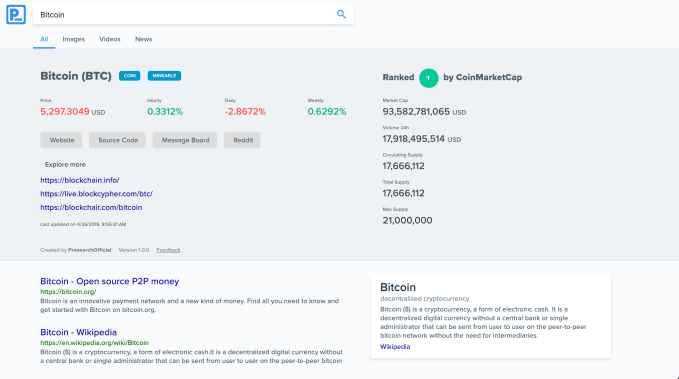
Another example is currency conversions. When a currency conversion is typed into Presearch as a search query in the correct format (using relevant acronyms like USD and CAD) the query will surface a currency converter built by community members.

“It’s basically enabling anybody who knows HTML or Javascript to participate within the search ecosystem and add value to Presearch,” adds Pape.

The ultimate goal with the Presearch engine is to offer fully community-powered search where users not only create content packages and build out wider utility that can be served for particular keywords/searches but also curate these packages too.

The aim is also to have the community manage the entire process — such as by voting on what package should be the default where there are conflicting packages; and/or voting to approve package updates — much like Wikipedia editors work together on editing the online encyclopedia’s entries.

Pape notes that users would still be able to customize their own search results, such as by browsing the full suite of approved packages and selecting those that best meet their needs.

“The whole concept of the search engine is really more about user choice and giving them the ability to actively personalize their search results, and choose which contributors within the ecosystem they want to support,” he adds.

Of course Presearch is a very long way off that grand vision of wholly-community-powered search. So for now community packages are being curated by its core dev team.

Nor is it the first startup to dream big of community-powered and owned search. Not by a long, long chalk. It’s an idea that’s been kicked around the block many times before, even as Google’s dominating grip on search has cemented itself into place.

The level of crowdsourced effort required to generate differentiating value in the Google-dominated search space has proved a stumbling block for similarly minded startups wanting to compete head to head with Mountain View. And, clearly, Presearch will need a much larger user base if it’s to build and sustain enough community contributions to make its engine a compellingly useful product vs the usual search giant suspects.

But, as with Wikipedia, the idea is to keep building utility and momentum in growing increments. With — in its case — crypto rewards, backed by $21M in initial token sales, as the carrot to encourage community participation and contribution. So the founder logic sums to: ‘If we build it and pay people they’ll come’.

It’s worth noting that despite the community-focused mission Presearch’s current corporate structure is a Canadian corporation.

It does have a plan to transition to a foundation in future — with Pape envisaging distributing ~90%+ of the revenue that flows through the ecosystem to the various constituents and participants (searchers; node operators; curators; subject matter experts contributing to information indexes etc, etc), and retaining around 10% to fund operating the platform entity itself.

This is a structure familiar to many blockchain projects. Though Presearch is perhaps a bit unusual by being initially incorporated as a business.

“A lot of the crypto projects have done this foundation route [right off the bat] but really it’s more about taxes and it’s more about jurisdictional arbitrage and trying to minimize the potential regulatory risk,” Pape suggests. “For us, because of the way that we launched it, and our legal advisor [Cameron-Huff] — the founding lawyer for Ethereum — he gave us some really good guidance right out of the gate. And we’ve treated it as a business.

“We think we’ve got a really strong legal position and so we really didn’t need to do the offshore stuff at first. We figured we would get the usage and build up the core token economics. And then switch to an actual truly community-governed foundation, rather than a foundation in name which is governed by all the insiders — which is really what most of the crypto projects currently have done.”

For now Pape remains the sole shareholder of Presearch. Transitioning that sole ownership into the future foundation structure is likely a year out by his reckoning. 

“One of the key concepts behind the project is ultimately providing an open source, transparent resource that is treated like more of a utility, that the community can provide input on and manage,” he adds. “So we’re looking at all the different government options.

“There’s a lot of technology being developed within the blockchain space right now. And some best practices that are starting to emerge. So we figured that we would give it a little while for that technology and those practices to mature and then we would be able to do that transition.”

Some reassuring data for those worried unicorns are wrecking the Bay Area

The San Francisco Bay Area is a global powerhouse at launching startups that go on to dominate their industries. For locals, this has long been a blessing and a curse.

On the bright side, the tech startup machine produces well-paid tech jobs and dollars flowing into local economies. On the flip side, it also exacerbates housing scarcity and sky-high living costs.

These issues were top-of-mind long before the unicorn boom: After all, tech giants from Intel to Google to Facebook have been scaling up in Northern California for over four decades. Lately however, the question of how many tech giants the region can sustainably support is getting fresh attention, as Pinterest, Uber and other super-valuable local companies embark on the IPO path.

The worries of techie oversaturation led us at Crunchbase News to take a look at the question: To what extent do tech companies launched and based in the Bay Area continue to grow here? And what portion of employees work elsewhere?

For those agonizing about the inflationary impact of the local unicorn boom, the data offers a bit of reassurance. While companies founded in the Bay Area rarely move their headquarters, their workforces tend to become much more geographically dispersed as they grow.

Headquarters ≠ headcount

Just because a company is based in Northern California doesn’t mean most workers are there also. Headquarters, our survey shows, does not always translate into headcount.

“Headquarters location can often be the wrong benchmark to use to identify where employees are located,” said Steve Cadigan, founder of Cadigan Talent Ventures, a Silicon Valley-based talent consultancy. That’s particularly the case for large tech companies.

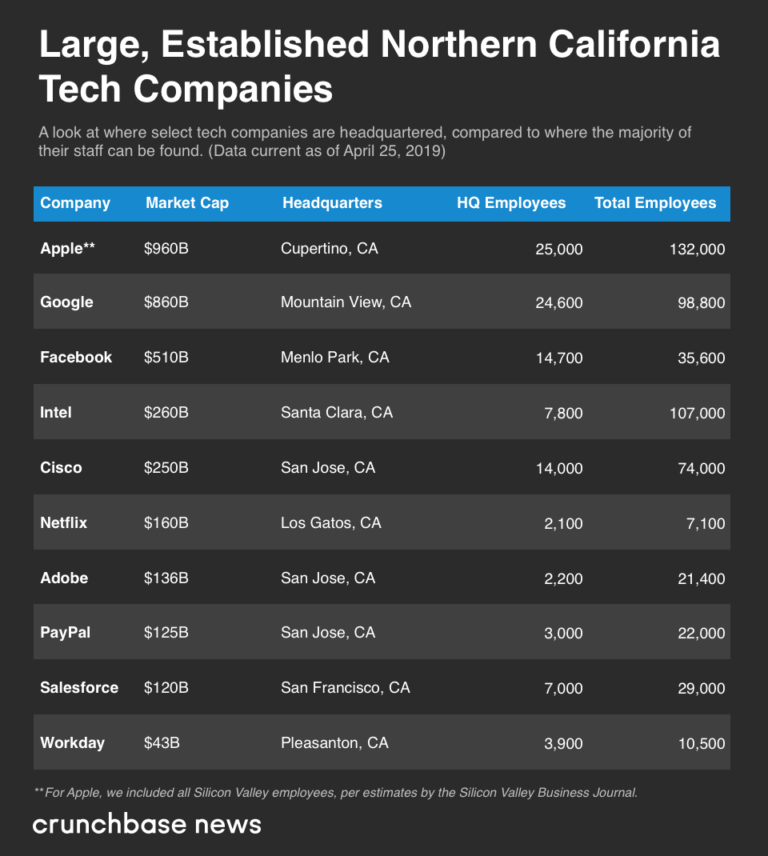
Among the largest technology employers in Northern California, Crunchbase News found most have fewer than 25 percent of their full-time employees working in the city where they’re headquartered. We lay out the details for 10 of the most valuable regional tech companies in the chart below.

With the exception of Intel, all of these companies have a double-digit percentage of employees at headquarters, so it’s not as if they’re leaving town. However, if you’re a new hire at Silicon Valley’s most valuable companies, it appears chances are greater that you’ll be based outside of headquarters.

Tesla, meanwhile, is somewhat of a unique case. The company is based in Palo Alto, but doesn’t crack the city’s list of top 10 employers. In nearby Fremont, Calif., however, Tesla is the largest city employer, with roughly 10,000 reportedly working at its auto plant there.(Tesla has about 49,000 employees globally.)

Unicorns flock to San Fran, workers less so

High-valuation private and recently public tech companies can also be pretty dispersed.

Although they tend to have a larger percentage of employees at headquarters than more-established technology giants, the unicorn crowd does like to spread its wings.

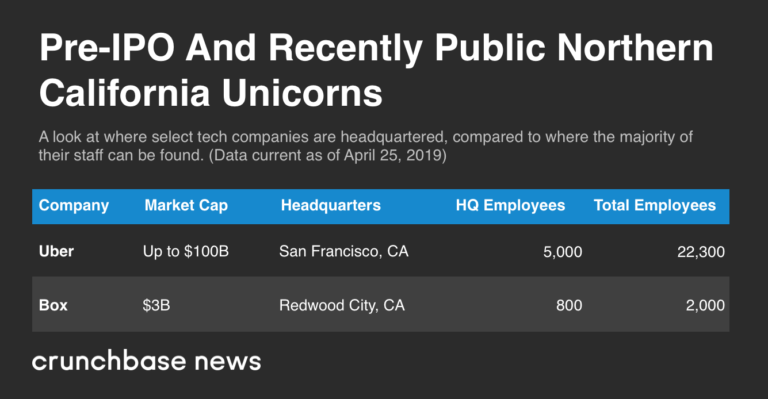
Take Uber, the poster child for this trend. Although based in San Francisco, the ride-hailing giant has fewer than one-fourth of its employees there. Out of a global workforce of around 22,300, only about 5,000 are SF-based.

It’s unclear if that kind of breakdown is typical. We had trouble assembling similar geographic employee counts at other Bay Area unicorns, mainly because cities break out numbers only for their 10 largest employers. The lion’s share of regional unicorns are San Francisco-based, and of them only Uber made the Top 10.

That said, there is another, rougher methodology for assessing who works at headquarters: job postings. At a number of the most valuable Bay Area-based unicorns — including Airbnb, Juul, Lime, Instacart, Stripe and the now-public Lyft —  a high number of open positions are far from the home office. And as we wrote last year, private companies have been actively seeking out cities to set up secondary hubs.

Even for earlier-stage startups, it’s not uncommon to set up headquarters in the San Francisco area for access to financing and networking, while doing the bulk of hiring in another location, Cadigan said. The evolution of collaborative work tools has also enabled more companies to add staff working remotely or in secondary offices.

Plus, of course, unicorn startups tend to be national or global in focus, and that necessitates hiring where their customers are located.

Take our jobs, please

As we wrap up, it’s worth bringing up how unusual it once was for denizens of a metro area to oppose a big influx of high-skill jobs. In the past couple of years, however, these attitudes have become more common. Witness Queens residents’ mixed reactions to Amazon’s HQ2 plans. And in San Francisco, a potential surge of newly minted IPO millionaires is causing some consternation among locals, along with jubilation among the realtor crowd.

Just as college towns retain room for new students by graduating older ones, however, it seems reasonable that sustaining Northern California’s strength as a startup hub requires locating jobs out-of-area as companies scale. That could be good news for other cities, including Austin, Phoenix, Nashville, Portland and others, which have emerged as popular secondary locations for fast-growing unicorns.

That said, we’re not predicting near-term contraction in Bay Area tech employment, particularly of the startup variety. The region’s massive entrepreneurial and venture ecosystem keeps on producing valuable newcomers well-capitalized to keep hiring.

Methodology

We looked only at employment at company headquarters (except for Apple) . Companies on the list may have additional employees based in other Northern California cities. For Apple, we included all Silicon Valley employees, per estimates by the Silicon Valley Business Journal.

Numbers are rounded to the nearest hundred for the largest employers. Most of the data is for full-time employees only. Large tech employers hire predominantly full-time for staff positions, so part-time, whether included or not, is expected to reflect only a very small percentage of employment.

Cities list their 10 largest employers in annual reports. We used either the annual reports themselves or data excerpted in Wikipedia, using calendar year 2017 or 2018.

This startup just raised more than $10 million to take on Autodesk, with the help of Autodesk’s former CEO

Most of us don’t know what a geometric modeling kernel or solid modeling kernel is, but every CAD or design application uses one to do create shapes. It’s the underlying infrastructure that allows someone to do the math of CAD design. Just putting a hole in an object or blending lines or removing a corner requires calculating new edge curves that you wouldn’t want to do without the help of sophisticated algorithms. A kernel, which is a library of core mathematical functions that define and store 3D solid objects to support product modeling, makes it a relatively seamless process.

Interestingly, because building a kernel requires a lot of time — not to mention mathematicians and PhDs and computer scientists —the last geometry kernels to be built were rolled out in the late ’80s and early ’90s. Among the most popular is a the 3D ACIS modeler (ACIS), a geometric modeling kernel that was developed by Spatial Corporation and is now part of the French 3D design and engineering software giant Dassault Systèmes. The kernel is used in industries for everything from computer-aided design to 3D animation to and shipbuilding.

Another is Parasolid, a geometric modeling kernel that was originally developed by a company called Shape Data Limited and is now owned by Siemens, which licenses it to other companies for use in their 3D computer graphics software products. Meanwhile, Autodesk began developing its own 3D modeling kernel called ShapeManager back in 2002.

The companies’ virtual triopoly has enabled them to carve up what’s become a $50 billion between themselves, selling their licenses for steep prices and under terms that many find to be onerous.

Indeed, despite occasional attempts by other companies to change the marketplace, none has yet managed to gain traction. But a three-year-old, Seattle-based company called Dyndrite that’s been quietly working away on its own kernel for four years, suggests things are about to change.

“A big part of [what has foiled other upstarts] is they’ve gone head first after [these three giants], but trying to build something with all the features of a 30-year-old product is hard when you’re a startup,” says Dyndrite’s 26-year-old founder and CEO, Harshil Goel, who has one mathematics and three mechanical engineering degrees from UC Berkeley, including a PhD.

Dyndrite has “taken a different tack,” he adds, “one that takes advantage of modern computer architectures, algorithms and languages and that’s completely GPU native.” Its kernel is build for the new world of 3D printing, says Goel. More specifically, he says, it’s capable of representing all current geometry types, including higher-order geometries, as well as can handle additive specific computations like lattice, support, and slice generation. In the process, says Voel, the kernel can reduce processing times from hours or days to minutes — even seconds.

As Goel explains it, innovative manufacturing hardware has outpaced its software counterparts, and Dyndrite helps close the gap,

Whether Dyndrite will break through is an open question, but early indicators are promising. The 15-person company just landed a little more than $10 million in Series A funding led by Gradient Ventures, Google’s AI-focused investment fund, which had also given the company earlier seed funding. Other investors in the round include Cota Capital and other earlier backers like Amplify Ventures, The House Fund, Flexport CEO Ryan Petersen, and former Autodesk CEO Carl Bass, whose relationship with Goel dates back nine years.

They’d met when Goel was a freshman at Berkeley and Bass was on campus, talking with students and looking for new ideas to support. Says Goel, “I was a pure math major and spent all my time in machine shops. I met him one day and gave him a demonstration of what I was working on, and he was like, ‘Do I get to invest or what?’” He’s been Goel’s mentor since, says Goel, who says he aspires to have a similar career trajectory.

“Carl just wants to be our worst end user by breaking everything,” he says, laughing.

Startups Weekly: All these startups are raising big rounds

TechCrunch’s Connie Loizos published some interesting stats on seed and Series A financings this week, courtesy of data collected by Wing Venture Capital. In short, seed is the new Series A and Series A is the new Series B. Sure, we’ve been saying that for a while, but Wing has some clean data to back up those claims.

Years ago, a Series A round was roughly $5 million and a startup at that stage wasn’t expected to be generating revenue just yet, something typically expected upon raising a Series B. Now, those rounds have swelled to $15 million, according to deal data from the top 21 VC firms. And VCs are expecting the startups to be making money off their customers.

“Again, for the old gangsters of the industry, that’s a big shift from 2010, when just 15 percent of seed-stage companies that raised Series A rounds were already making some money,” Connie writes.

As for seed, in 2018, the average startup raised a total of $5.6 million prior to raising a Series A, up from $1.3 million in 2010.

Now on to IPO updates, then a closer look at all the companies raising big rounds. Want more TechCrunch newsletters? Sign up here. Contact me at kate.clark@techcrunch.com or @KateClarkTweets.

Slack iOS logo (2019)

IPO corner

Slack: The workplace communication software provider dropped its S-1 on Friday ahead of a direct listing. That’s when companies sell existing shares directly to the market, allowing them to skip the roadshow and minimize the astronomical fees typically associated with an initial public offering. Here’s the TLDR on financials: Slack reported revenues of $400.6 million in the fiscal year ending January 31, 2019, on losses of $138.9 million. That’s compared to a loss of $140.1 million on revenue of $220.5 million for the year before. Slack’s losses are shrinking (slowly), while its revenues expand (quickly). It’s not profitable yet, but is that surprising?

https://platform.twitter.com/widgets.js

Uber: The ride-hail giant is fast approaching its IPO, expected as soon as next week. On Friday, the company established an IPO price range of $44 to $50 per share to raise between $7.9 billion and $9 billion at a valuation of approximately $84 billion, significantly lower than the $100 billion previously reported estimations. The most likely outcome is Uber will price above range and all the latest estimates will be way off course. Best to sit back and see how Uber plays it. Oh, and PayPal said it would make a $500 million investment in the company in a private placement, as part of an extension of the partnership between the two.

There are a lot of fascinating companies raising colossal rounds, so I thought I’d dive a bit deeper than I normally do. Bear with me.

Carbon: The poster child for 3D printing has authorized the sale of $300 million in Series E shares, according to a Delaware stock filing uncovered by PitchBook. If Carbon raises the full amount, it could reach a valuation of $2.5 billion. Using its proprietary Digital Light Synthesis technology, the business has brought 3D-printing technology to manufacturing, building high-tech sports equipment, a line of custom sneakers for Adidas and more. It was valued at $1.7 billion by venture capitalists with a $200 million Series D in 2018.

Canoo: The electric vehicle startup formerly known as Evelozcity is on the hunt for $200 million in new capital. Backed by a clutch of private individuals and family offices from China, Germany and Taiwan, the company is hoping to line up the new capital from some more recognizable names as it finalizes supply deals with vendors, according to reporting from TechCrunch’s Jonathan Shieber. The company intends to make its vehicles available through a subscription-based model and currently has 400 employees. Canoo was founded in 2017 after Stefan Krause, a former executive at BMW and Deutsche Bank, and another former BMW executive, Ulrich Kranz, exited Faraday Future amid that company’s struggles.

Starry: The Boston-based wireless broadband internet startup has authorized the sale of Series D shares worth up to $125 million, according to a Delaware stock filing. If Starry closes the full authorized raise it will hold a post-money valuation of $870 million. A spokesperson for the company confirmed it had already raised new capital, but disputed the numbers. The company has already raised more than $160 million from investors, including FirstMark Capital and IAC. The company most recently closed a $100 million Series C this past July.

Selina & Sonder: The Airbnb competitor Sonder is in the process of closing a financing worth roughly $200 million at a $1 billion valuation, reports The Wall Street Journal. Investors including Greylock Partners, Spark Capital and Structure Capital are likely to participate. Sonder is four years old but didn’t emerge from stealth until 2018. The startup, which turns homes into hotels, quickly attracted more than $100 million in venture funding. Meanwhile, another hospitality business called Selina has raised $100 million at an $850 million valuation. The company, backed by Access Industries, Grupo Wiese and Colony Latam Partners, builds living/co-working/activity spaces across the world for digital nomads.

Fresh funds: Mary Meeker has made history with the close of her new fund, Bond Capital, the largest VC fund founded and led by a female investor to date. Bond has $1.25 billion in committed capital. If you remember, Meeker ditched Kleiner Perkins last fall and brought the firm’s entire growth team with her. Kleiner said it was a peaceful split that would allow the firm to focus more on its early-stage efforts, leaving the growth investing to Bond. Fortune, however, reported this week that a power struggle of sorts between Meeker and Mamoon Hamid, who joined recently to reenergize the early-stage side of things, was a larger cause of her exit.

Plus, SOSV, a multi-stage venture firm that was founded as the personal investment vehicle of entrepreneur Sean O’Sullivan after his company went public in 1994, has raised $218 million for its third fund. The vehicle has a $250 million target that SOSV expects to meet. Already, the fund is substantially larger than the firm’s previous vehicle, which closed with $150 million.

A grocery delivery startup crumbles: Honestbee, the online grocery delivery service in Asia, is nearly out of money and trying to offload its business. Despite looking impressive from the outside, the company is currently in crisis mode due to a cash crunch — there’s a lot happening right now. TechCrunch’s Jon Russell dives in deep here.

Extra Crunch: When it comes to working with journalists, so many people are, frankly, idiots. I have seen reporters yank stories because founders are assholes, play unfairly, or have PR firms that use ridiculous pressure tactics when they have already committed to a story.” Sign up for Extra Crunch for a full list of PR don’ts. Here are some other EC pieces to hit the wire this week:

Equity: If you enjoy this newsletter, be sure to check out TechCrunch’s venture-focused podcast, Equity. In this week’s episode, available here, Crunchbase News editor-in-chief Alex Wilhelm and I chat about Kleiner Perkins, Chinese IPOs and Slack & Uber’s upcoming exits.