Amazon Prime’s dominance is spurring new startup opportunities

E-commerce is one of the economy’s bright spots; U.S. e-commerce sales have nearly doubled in five years, and now exceed $500 billion. Unsurprisingly, Amazon has swooped in to claim a disproportionate share of the riches, gobbling up nearly 50 percent of the market share, driving competitors out of business and solidifying its position as one of the world’s most valuable companies.

As part of its complete transformation of the e-commerce landscape, Amazon has made two-day shipping the new industry standard — a standard which most would-be competitors can’t meet on their own without either investing millions in infrastructure or partnering with their greatest competitive threat. Fortunately for merchants, some exciting new logistics startups are emerging to help them compete with Amazon.

Amazon’s chokehold

In classic coopetition form, Amazon now enables more than a million merchants to sell through  Amazon Marketplace. It offers these merchants two-day shipping via a cheap flat fee per package — a fee so cheap, in fact, that no shipping provider can come close to matching it. Amazon is doubling down on its advanced fulfillment network by investing $700 million in Rivian, an electric truck company; augmenting its fleet of 50+ delivery planes; and rolling out 20,000 Mercedes-Benz delivery vans.

Two-day delivery is so compelling, often doubling sales, that many merchants are becoming increasingly dependent on Amazon despite the obvious risks of partnering with the juggernaut. This in itself is spurring startups that help merchants thrive on Amazon. Amazon forces those merchants who work with them to compete side-by-side with other brands, including the company’s own private-label collection that it promotes aggressively. Amazon also pressures merchants to provide their lowest prices on Amazon — despite the fact that Amazon takes a significant revenue percentage. Even then, Amazon still might suddenly kick merchants off its platform without prior notice.

Once merchants sell on Amazon, they often find it impossible to diversify to other platforms with higher margins and more control because they become reliant on Amazon’s unbeatable two-day delivery price. This pressure is making merchants increasingly nervous as Amazon squeezes them from all sides. Merchants are desperately seeking solutions to help them get out of Amazon’s chokehold. A new batch of startups is seizing the opportunity to provide just that.

Aggregated delivery routes

Transportation accounts for more than 75 percent of delivery costs. Merchants can save millions by pooling together their shipping, trucking and last-mile delivery costs. Traditionally, this pooling was done by expensive freight brokers on pen and paper. Today, companies like Flexport, which just raised $1 billion, and Convoy, which was just valued at more than $1 billion, can more effectively match shippers and carriers to combine packages and lower costs.

Addicted to convenience, consumers keep demanding that their merchandise arrive ever more quickly.

Last-mile delivery companies like ShipBob, which recently closed a $40 million investment round, are also beginning to offer Amazon-like two-day shipping solutions. Deliv* takes an even more aggressive approach by offering same-day shipping for retailers via its couriers. By combining volume, these startups allow merchants to save more than 20 percent by negotiating for larger bulk discounts with carriers and by optimizing routes.

Distributed warehousing

To deliver within two days, merchants must have access to warehouses located near their customers. While companies like Walmart and Amazon might be able to invest billions in multiple distribution centers located throughout the U.S., smaller merchants and distributors can rely on startups like Flexe and Darkstore to provide on-demand storage in pooled warehouses across the country. Rather than keeping everything in a central warehouse thousands of miles away, merchants can use artificial intelligence to predict consumer demand and ship inventory to nearby distribution centers. These startups will become increasingly important as retailers seek to go beyond two-day shipping and offer one-day and even same-day shipping.

Robotics and automation

Despite the heavy upfront costs, robotics offer a cheaper long-term alternative to manual labor in many distribution centers. RightHand Robotics, which just landed $23 million, uses a robotic arm to help pick and place items at warehouses. Each arm can operate at the same speed as an experienced packer, while working around the clock. Other startups use automation to reduce last-mile delivery costs through a variety of methods, ranging from self-driving cars to delivery drones. Starship Technologies, for instance, is building a fleet of small self-driving robots to deliver locally. Although individual merchants may not purchase robotic arms, they can leverage logistics startups to reduce costs and improve efficiencies via these new automation techniques.

Addicted to convenience, consumers keep demanding that their merchandise arrive ever more quickly. Amazon is king of convenience and is constantly pushing the bar higher — or faster in this case. Merchants are struggling to keep up. Fortunately for them, a new generation of logistics startups are helping them compete. By creating solutions for the logistics infrastructure of the future, these startups are helping merchants stay in the race against Amazon.

* Denotes Trinity portfolio company

Zwift CEO Eric Min on fitness-gaming and bringing esports into the Olympics

The rumored IPO plans of $4 billion spinning brand Peloton marks the rise of a wave of interactive fitness startups like Mirror, Tonal, Hydrow, and At Home 360 that combine a monthly subscription to recorded and/or live video classes with workout hardware.

There’s opportunity beyond this initial “Peloton for X” model, however, when you look at where the gamification of at-home workout experiences can overlap with actual games. We’re in the midst of rapid growth in the gaming industry, the rise of esports, the mainstream-ing of socializing within games due to Fortnite

The virtual cycling business Zwift is a five-year-old startup that has raised over $170 million as a pioneer of fitness-gaming ― physical sport carried out in a virtual world. Athletes join together for group rides and races within a cycling game that hooks up to their own bike trainers at home in order to reflect their movements and physical exertion. Since users are represented as players within a social game, there is the benefit of network effects, opportunities for a in-game commerce, and audience viewing of the competition.

I recently sat with Eric Min, Zwift’s CEO and co-founder, at the company’s London office. We discussed why he founded Zwift and how the product has evolved, the potential revenue streams available to an interactive fitness brand, and Zwift’s rise as an esport with ambitions to enter the Olympics. Here’s the transcript:

Eric Peckham (TechCrunch): Do you view Zwift as a fitness company or as a gaming company where the bike trainer is just a controller?

Eric Min (Zwift): We’re the fitness company born out of gaming. While we’re a fitness brand, we’re also a game and social network, two things that are converging rapidly right now. What we’re trying to do, though, is build this social network around real-time experiences, physical experiences, and I think that’s far more interesting. Crucial to that is being hardware agnostic though. We work with a lot of equipment out there so our users can come to the game easily.

Luminary ‘retooling’ after podcasters request removal from service

Last month, a New York Times piece heralded the arrival of Luminary. The story focused on the startup’s healthy funding (almost $100 million) and its “subscription-based business model that it hopes will push the medium into a new phase of growth.” You’d be hard-pressed to find a better circumstances under which to launch your startup.

A month and half later, Luminary is live, and most of that good will seems to have evaporated. A number of prominent podcast hosts have requested that their shows be pulled from the “Netflix of podcasts.”

https://platform.twitter.com/widgets.js

The $8 a month premium service has added shows to its walled off network without the permission of creators. There are several TechCrunch shows up there, including Original Content, Mixtape, Equity and several now defunct titles. My personal podcast somehow mad it on there, as well.

In some ways, it’s not entirely dissimilar from the way services like iTunes provide podcasts, but many have complained about a key issue with how shows are served up. The service clarified on Twitter today that it’s not re-hosting files as initially suspected. “Luminary is not caching any audio content for any open feed podcast,” it writes. “The Luminary audio link is simply a reference link that is marking audio metadata as the file is called through our proxy.”

The company says it’s using this method to save download/streaming time, routing traffic through their own proxy servers is a good way to deprive creators of important metrics they use to attract sponsors. Others have complained that the service clips out links to fundraising campaigns in the body of the show notes.

Popular podcast The Joe Rogan Experience is among the growing number of shows that have been pulled from the service. “There was not a license agreement or permission for Luminary to have The Joe Rogan Experience on their platform,” a rep for the show told Nieman Lab.

After being pulled, the show’s artwork was replaced with a bold white on black lettering reading “This content is unavailable at this time. Learn why.” That explanation can be found in the show description, which reads,

The Joe Rogan Experience is not available on the Luminary service at this time. At Luminary, we’re investing in technology to improve podcast listening for fans like you so we built a free app that welcomes hundreds of thousands of public RSS feed podcasts. This publisher has chosen not to take advantage of this free distribution. Head to our homepage for other great podcasts we recommend. Thank you for choosing to listen with us.

That’s a bad look from Luminary. A simple “The Joe Rogan Experience is not available on the Luminary service at this time” would have sufficed here. Instead the service chose to grind its axe on the page of a show that never asked to be there in the first place. As a new startup in the space, Luminary would be well suited to listen to podcasters, as it hopes to draw in more talent for original content.

A statement that has since been offered to TechCrunch strikes a more consolatory tone,

Luminary appreciates the feedback we’ve received today about how our technology works. We’ve heard you and want to explain what we have done in response. To be absolutely clear: Luminary has never hosted or cached audio content for any open RSS feed podcast. We used a pass-through approach purely because we believed it would improve performance and speed for our users when listening to public feed audio files, particularly from smaller hosts. We now see that this approach caused some confusion. We have spoken with multiple hosting providers who suggested changes we could make to clarify that public feed audio is not being hosted or cached by Luminary, and ensure that hosts receive the data to which they are accustomed. We have already implemented those changes for iOS and Android, and are working to retool web player settings.

No specifics have been given for the changes, but there are likely to be some more growing pains as the company navigates its service around the medium’s highest profile creators.

A quick look at how fast Series A and seed rounds have ballooned in recent years, fueled by top investors

Wing, a nine-year-old, Silicon Valley venture firm co-founded by veteran VCs Peter Wagner and Gaurav Garg, produces interesting research about its own industry every now and then, based on a smaller data set than firms like Pitchbook or CB Insights tend to use. Instead of looking at funding activity broadly, the firm tracks deal-making at the top 21 venture firms in the U.S. to “really focus on the signal,” as Wagner has explained to us in the past. Last year, for example, the firm determined that the funding pullback that everyone was worried about had actually happened in 2016.

More recently, Wing has been tracking deal sizes, capturing the details of 6,205 financings of 2,982 companies invested in by one of those 21 firms over the last nine years to discern the ways in which rounds sizes are changing, and the results, while not shocking, are still eye-opening.

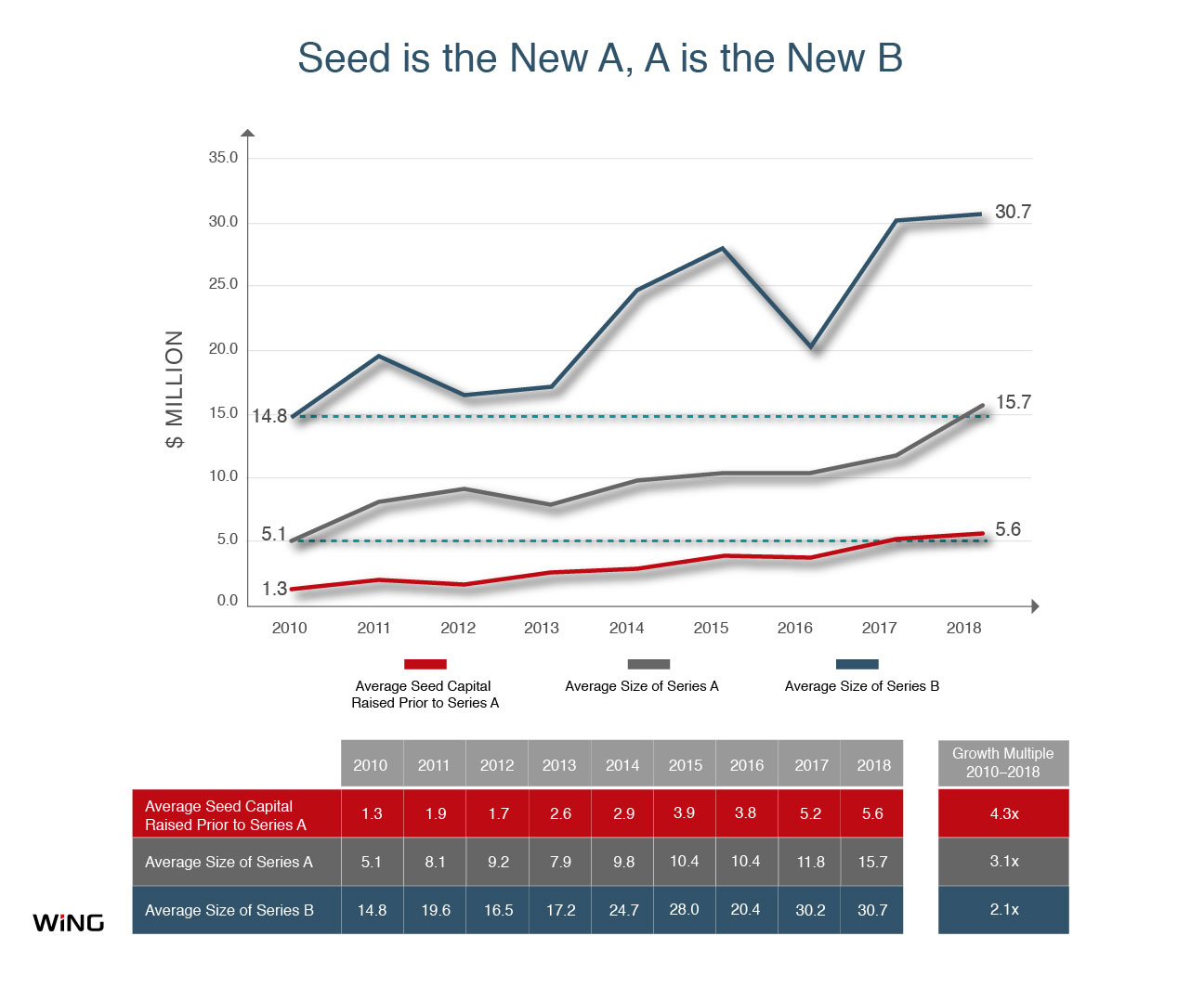
Starting with seed rounds, last year, says Wing, the average company had raised a total of $5.6 million prior to raising a Series A, up from $5.2 million in 2017. That’s a lot of seed capital, especially for people in the industry who might have been investing in 2010, when the average amount of seed funding for a startup before it moved on to its Series A round was $1.3 million.

With greater money comes greater expectations. According Wing’s analysis, the days of raising a Series A round without first generating revenue are almost over entirely, with 82 percent of companies that raised Series A rounds from top investors last year selling something or other to their customers. Again, for the old gangsters of the industry, that’s a big shift from 2010, when just 15 percent of seed-stage companies that raised Series A rounds were already making some money. Even in 2016, says Wing, just 56 percent of the startups to nab Series A funding were generating revenue.

It isn’t merely a matter of nomenclature, says Wager. Yes, he acknowledges, Series A rounds are now more like Series B rounds, a point at which startups have long been expected to generating revenue. And yes, companies are also operating as “seed-funded” operations longer than they used to be. (On average, companies now live off so-called seed funding for three years.)

But Wagner theorizes that VCs have changed, too, influenced in part by information they’ve gleaned from firms like Bessemer Venture Partners that produce data on SaaS metrics and and events like SaaStr Annual that are laser-focused on ways to measure growth. “We now have a whole cohort of investors who’ve come into the business and been trained to make investments based on ratios around growth potential and expansion factors, among many other things.”

There is also much more metrics-driven criteria being applied to the Series A rounds in part because the Series A has grown so much bigger, notes Wagner. Many of the top performing firms have raised bigger funds than ever before in recent years, and that has changed their “investment strike zone,” notes Wagner. This “battalion of metrics” gives them greater confidence that the great amounts of money they are putting to work is safe.

How much more money, exactly? Among these top firms, says Wing, the average Series A reached $15.7 million last year, up from $11.8 million in 2017 and way, way up from the $5.1 million that went into the average Series A round in 2010.

What does it mean and why does it matter? There are many implications, some of which will take years to play out, but most immediately, it would seem that the very definition of seed investor has or will need to change. Whereas angel investing was long a more casual endeavor, often for operators with other pursuits, the burden is now on seed-stage investors and funds to not only handle due diligence, help with early hiring, and find early syndicate partners, but to whip their portfolio companies into fighting, revenue-generating shape, as well. The bar is clearly moving higher; their skills sets need to evolve along with that shift.

MuseNet generates original songs in seconds, from Bollywood to Bach (or both)

Have you ever wanted to hear a concerto for piano and harp, in the style of Mozart by way of Katy Perry? Well, why not? Because now you can, with OpenAI’s latest (and blessedly not potentially catastrophic) creation, MuseNet. This machine learning model produces never-before-heard music basic on its knowledge of artists and a few bars to fake it with.

This is far from unprecedented — computer-generated music has been around for decades — but OpenAI’s approach appears to be flexible and scalable, producing music informed by a variety of genres and artists, and cross-pollinating them as well in a form of auditory style transfer. It shares a lot of DNA with GPT2, the language model “too dangerous to release,” but the threat of unleashing unlimited music on the world seems small compared with undetectable computer-generated text.

MuseNet was trained on works from dozens of artists, from well-known historical figures like Chopin and Bach to (comparatively) modern artists like Adele and the Beatles, plus collections of African, Arabic, and Indian music. Its complex machine learning system paid a great deal of “attention,” which is a technical term in AI work for, essentially, the amount of context the model uses to inform the next step in its creation.

Take, for instance, a piece by Mozart. If the model only attended to a couple seconds at a time, it would never be able to learn the larger musical structures of a symphony as it grew and receded, switched tones and instruments. But the model was given enough virtual brainspace to hold onto about four full minutes of sound, more than enough to grasp something like a slow start to a big finish, or a basic verse-chorus-verse structure.

You’re telling me Haydn didn’t directly influence Shania? Get real.

Theoretically, that is. The model doesn’t actually understand music theory, just that this note followed this note, which followed this note, which tends to come after this type of chord, and so on. Its creations are elementary in their structure, but it’s pretty clear listening to them that it is indeed successfully aping the songs it ingested.

What makes it impressive is that a single model does this reliably across so many types of music. AIs have been created, like the Google Doodle for Bach’s birthday a couple weeks back, that focus on a specific artist or genre. And as a comparison I’ve been listening to Generative.fm, which creates just the type of sparse ambient music I like to listen to while I work (If you like it too, check out one of my favorite labels, Serein). But both those models have their limits very strictly defined. Not so with MuseNet.

In addition to being able to belt out infinite bluegrass or baroque piano pieces, MuseNet can apply a style transfer process to combine the characteristics of both. Different parts of a work can have different attributes — in a painting you might have composition, subject, color choice, and brush style to start. Imagine a Pre-Raphaelite subject and composition but with Impressionist execution. Sounds fun, right? AI models are great at doing this because they sort of compartmentalize these different aspects. It’s the same type of thing in music: The note choice, cadence, and other patterns of a pop song can be drawn out and used separately from its instrumentation — why not do Beach Boys harmonies on a harp?

It’s a little hard, however, to get a sense of the likes of Adele without her distinctive voice, and the rather basic synths the team has chosen cheapen the effect overall. And after listening to the “live concert” the team gave on Twitch for a bit, I wasn’t convinced that MuseNet is the next hit machine. On the other hand, it pretty regularly hit a good stride, especially in jazz and classical improvisations, where a bit of an off note can be played off and the rhythms don’t feel so contrived.

What’s it for? Your idea is as good as anyone’s, really. This field is quite new. MuseNet’s project lead, Christine Payne, is pleased with the model and has already found someone to use it:

As a classically trained pianist, I’m particularly excited to see that MuseNet is able to understand the complex harmonic structures of Beethoven and Chopin. I’m working now with a composer who plans to integrate MuseNet into his own compositions, and I’m excited to see where the future of Human/AI co-composing will take us.

MuseNet will be available for you to play with through mid-May, at which point it will be taken offline and adjusted based on feedback from users, and later it will be at least partially open sourced. I imagine popular combinations and ones that people listened to all the way through will get a bit more weight in the tweaks. Here’s hoping they add a bit more expression to the MIDI execution as well — it does often feel like these pieces are being played by a robot. But it’s testament to the quality of OpenAI’s work that they frequently sound perfectly good as well.

The Markup faces staff exodus and funder scrutiny following ouster of Julia Angwin

The Markup appears to be facing a staff revolt — and its financial backers may be reconsidering their support — following the firing of Editor in Chief Julia Angwin.

When the site was announced last fall, it was backed by $20 million from Craigslist founder Craig Newmark, with additional funding from the John S. and James L. Knight Foundation, the Ford Foundation and the John D. and Catherine T. MacArthur Foundation. The goal was to do data-driven journalism about the impact of technology on society.

Angwin and her co-founder Jeff Larson seemed particularly well-suited for the job — both of them are award-winning journalists who worked together at ProPublica, where they did impactful reporting around topics like Facebook’s ad practices.

However, Angwin was fired on Monday, a move she blamed in interviews on executive director Sue Gardner’s plan to turn the site into “a cause, not a publication,” with headlines like “Facebook is a dumpster fire.”

This, Angwin said, was at odds with her own dedication to “evidence-based, data-driven journalism.”

Larson, who’s now become editor-in-chief, offered a different account on Medium, where he said work had fallen “far, far behind” by the end of 2018: “Hiring was slow. Recruitment was slow. Even as of this month, we didn’t have stories banked. We didn’t have editorial processes in place to accept and develop pieces.”

He said that he and Angwin were both asked to take management classes, but she refused. (Angwin acknowledged that she may have had things to learn about being editor-in-chief, but she noted that she’s led investigative teams in the past, and she said, “There was never any attempt to guide me into that learning.”)

Larson also alluded to other issues that led to “a breakdown in trust between the three of us as co-founders.” He said there were attempts to find other roles for Angwin, but she “refused to discuss any role other than Editor in Chief, and would not consider any other configuration. So unfortunately we made the decision to remove her from that role.”

https://platform.twitter.com/widgets.js

The editorial team has sided with  Angwin, with all of them posting a statement supporting her and praising her “effectiveness as a manager and an editor.” Five of the seven editorial team members also resigned in protest.

As a result of all the controversy, Newmark and the other funders of The Markup have issued a statement of their own, saying that while they’re still “committed to the mission of The Markup,” they’ve also decided “it is necessary to reassess our support and we are taking steps to do so.”

https://platform.twitter.com/widgets.js

The venture firm SOSV has already raised its biggest fund to date, and it isn’t quite closed

SOSV, a sprawling, multi-stage venture firm that was founded as the personal investing vehicle of entrepreneur Sean O’Sullivan after his company went public in 1994, then re-launched as a traditional venture firm with outside backers in 2015, has raised $218 million for its third fund.

The vehicle has a $250 million target that SOSV expect to meet by year end, but already, it’s substantially larger than the firm’s previous fund, which closed with $150 million.

SOSV is best-known for the numerous accelerators it has created and oversees, including hardware-focused HAX, and IndieBio for life sciences startups. Yesterday, we were in touch with SOSV partner Daniel Eichner — who’s in charge of raising capital for the outfit, as well as introducing its portfolio companies to potential future investors — to learn more what else is new at its eight offices around the world, including in Cork, Ireland; Princeton, N.J.; New York; San Francisco; London; Shenzhen; Shanghai; and Tapei.

Among the many things we learned: the firm now has eight senior partners who ultimately decide where capital gets invested, and a whopping 110 people across the U.S., Europe and China, including support staff that to help its startups go from lab to market.

The firm has also earned some bragging rights, including as the lead investor in the electric bike company Jump Bikes, acquired last year for an undisclosed amount to Uber. It also some highly valued companies in its portfolio currently, including the 3D printing “unicorn” FormLabs; the peer-to-peer ride-sharing company GetAround, which just acquired a French company yesterday to extend its reach into Europe; and Makeblock, a Shenzhen, China-based company that sells robot kits for kids and most recently raised $44 million in Series C funding.

The firm hasn’t shied from some more ambitious bets, either including one on BitMEX, a crypto exchange based in Hong Kong that’s focused on cryptoderivatives and in which SOSV is the only institutional investor.

Most of the founders it backs — 80 percent, says Eichner — are first-timers, though “many have years and sometimes decades of work experience,”  he adds.

As for the size of the checks SOSV writes, its accelerator deals are standardized for each program, but the smallest check is for $100,000 for software startups or $250,000 for hardware and life sciences startups. Meanwhile, the most it will invest is up to $2 million, across multiple rounds, with its biggest bet to date being SyntheX, a designer therapeutics company in which SOSV owns a 20 percent stake.

Eichner explains that SOSV aims for between 8 percent and 16 percent ownership at the accelerator phase, then looks to either establish or maintain a 15 percent stake in the top 20 percent to 30 percent of its companies.

Despite its many far-flung offices, we asked if SOSV tends to support more founders in the U.S. than elsewhere, or vice versa. Eichner says that about half of SOSV’s portfolio companies are in North America, with another quarter in Asia, and the rest split between Europe and the rest of the world.

Pictured above: Firm founder Sean O’Sullivan.

Apple patches iOS App Store bug that was preventing app downloads

Apple is rolling out a fix for an App Store bug that was preventing users from downloading new iOS apps or app updates. The issue, which impacted an unknown number of users, involved a Terms & Conditions dialog box that would continue to pop up even when users tapped the “Agree” button.

The issue had frustrated users who took to Twitter in an attempt to get help from Apple Support.

9to5Mac and AppleInsider previously reported on the problem, citing the social media complaints. The Apple Support account had not responded publicly to those who reached out, beyond asking customers to get in touch on DM with more details or pointing those with more vague complaints to a support doc about connection issues.

The bug was affecting a small percentage of Apple’s iOS user base worldwide, we understand from people familiar with the problem at Apple. However, even a “small number” can be large, when you’re dealing with something like the iPhone install base.

In addition, the bug wasn’t limited to an unreleased developer or beta build of iOS, 9to5Mac had noted — but was also showing up on the public release (iOS 12.2).

There was no workaround that would allow users to skip the Terms & Condition pop-up in order to download apps and updates. All users could do was to tap “Cancel” to get out of the loop, so they could continue to use their phone.

https://platform.twitter.com/widgets.js

https://platform.twitter.com/widgets.js

We understand that Apple has now deployed a fix for the bug that should finish rolling out in a matter of hours.

The bug fix won’t require impacted users to take any steps on their own — like downloading an update or patch, for example. It will instead be resolved on the App Store’s backend.

AWS expands cloud infrastructure offerings with new AMD EPYC-powered T3a instances

Amazon is always looking for ways to increase the options it offers developers in AWS, and to that end, today it announced a bunch of new AMD EPYC-powered T3a instances. These were originally announced at the end of last year at re:Invent, AWS’s annual customer conference.

Today’s announcement is about making these chips generally available. They have been designed for a specific type of burstable workload, where you might not always need a sustained amount of compute power.

“These instances deliver burstable, cost-effective performance and are a great fit for workloads that do not need high sustained compute power but experience temporary spikes in usage. You get a generous and assured baseline amount of processing power and the ability to transparently scale up to full core performance when you need more processing power, for as long as necessary,” AWS’s Jeff Barr wrote in a blog post.

These instances are build on the AWS Nitro System, Amazon’s custom networking interface hardware that the company has been working on for the last several years. The primary components of this system include the Nitro Card I/O Acceleration, Nitro Security Chip and the Nitro Hypervisor.

Today’s release comes on top of the announcement last year that the company would be releasing EC2 instances powered by Arm-based AWS Graviton Processors, another option for developers, who are looking for a solution for scale-out workloads.

It also comes on the heels of last month’s announcement that it was releasing EC2 M5 and R5 instances, which use lower-cost AMD chips. These are also built on top of the Nitro System.

The EPCY processors are available starting today in seven sizes in your choice of spot instances, reserved instances or on-demand, as needed. They are available in US East in northern Virginia, US West in Oregon, Europe in ireland, US East in Ohio and Asia-Pacific in Singapore.

Kiwi’s food delivery bots are rolling out to 12 new colleges

If you’re a student at UC Berkeley, the diminutive rolling robots from Kiwi are probably a familiar sight by now, trundling along with a burrito inside to deliver to a dorm or apartment building. Now students at a dozen more campuses will be able to join this great, lazy future of robotic delivery as Kiwi expands to them with a clever student-run model.

Speaking at TechCrunch’s Robotics/AI Session at the Berkeley campus, Kiwi’s Felipe Chavez and Sasha Iatsenia discussed the success of their burgeoning business and the way they planned to take it national.

https://techcrunch.com/wp-content/themes/techcrunch-2017/features/shortcodes/vidible-callback-js.php?id=0

In case you’re not aware of the Kiwi model, it’s basically this: When you place an order online with a participating restaurant, you have the option of delivery via Kiwi. If you so choose, one of the company’s fleet of knee-high robots with insulated, locking storage compartments will swing by the place, your order is put within, and it brings it to your front door (or as close as it can reasonably get). You can even watch the last bit live from the robot’s perspective as it rolls up to your place.

The robots are what Kiwi calls “semi-autonomous.” This means that although they can navigate most sidewalks and avoid pedestrians, each has a human monitoring it and setting waypoints for it to follow, on average every five seconds. Iatsenia told me that they’d tried going full autonomous and that it worked… most of the time. But most of the time isn’t good enough for a commercial service, so they’ve got humans in the loop. They’re working on improving autonomy but for now this is how it is.

That the robots are being controlled in some fashion by a team of people in Colombia (where the co-founders hail from) does take a considerable amount of the futurism out of this endeavor, but on reflection it’s kind of a natural evolution of the existing delivery infrastructure. After all, someone has to drive the car that brings you your food as well. And in reality most AI is operated or informed directly or indirectly by actual people.

That those drivers are in South America operating multiple vehicles at a time is a technological advance over your average delivery vehicle — though it must be said that there is an unsavory air of offshoring labor to save money on wages. That said, few people shed tears over the wages earned by the Chinese assemblers who put together our smartphones and laptops, or the garbage pickers who separate your poorly sorted recycling. The global labor economy is a complicated one, and the company is making jobs in the place it was at least partly born.

Whatever the method, Kiwi has traction: it’s done more than 50,000 deliveries and the model seems to have proven itself. Customers are happy, they get stuff delivered more than ever once they get the app, and there are fewer and fewer incidents where a robot is kicked over or, you know, catches on fire. Notably, the founders said on stage, the community has really adopted the little vehicles, and should one overturn or be otherwise interfered with, it’s often set on its way soon after by a passerby.

Iatsenia and Chavez think the model is ready to push out to other campuses, where a similar effort will have to take place — but rather than do it themselves by raising millions and hiring staff all over the country, they’re trusting the robotics-loving student groups at other universities to help out.

For a small and low-cash startup like Kiwi, it would be risky to overextend by taking on a major round and using that to scale up. They started as robotics enthusiasts looking to bring something like this to their campus, so why can’t they help others do the same?

So the team looked at dozens of universities, narrowing them down by factors important to robotic delivery: layout, density, commercial corridors, demographics, and so on. Ultimately they arrived at the following list:

  • Northern Illinois University
  • University of Oklahoma
  • Purdue University
  • Texas A&M
  • Parsons
  • Cornell
  • East Tennessee State University
  • Nebraska University-Lincoln
  • Stanford
  • Harvard
  • NYU
  • Rutgers

What they’re doing is reaching out to robotics clubs and student groups at those colleges to see who wants to take partial ownership of Kiwi administration out there. Maintenance and deployment would still be handled by Berkeley students, but the student clubs would go through a certification process and then do the local work, like a capsized bot and on-site issues with customers and restaurants.

“We are exploring several options to work with students down the road including rev share,” Iatsenia told me. “It depends on the campus.”

So far they’ve sent out 40 robots to the 12 campuses listed and will be rolling out operations as the programs move forward on their own time. If you’re not one of the unis listed, don’t worry — if this goes the way Kiwi plans, it sounds like you can expect further expansion soon.