Walmart unveils an A.I.-powered store of the future, now open to the public

Walmart this morning unveiled a new “store of the future” and test grounds for emerging technologies, including A.I.-enabled cameras and interactive displays. The store, a working concept called the Intelligent Retail Lab — or “IRL” for short — operates out of a Walmart Neighborhood Market in Levittown, New York.

The store is open to customers and is one of Walmart’s busiest Neighborhood Market stores containing over 30,000 items, the retailer says, which allows it to test out technology in a real world environment.

Similar to Amazon Go’s convenience stores, the store has a suite of cameras mounted in the ceiling. But unlike Amazon Go, which is a grab-and-go store with smaller square footage, Walmart’s IRL spans 50,000 square feet of retail space and is staffed by over 100 employees.

Plus, in Walmart’s case, these A.I.-powered cameras are not being used to determine what items customers are buying in order to automatically charge them. It still has traditional checkout stations. Instead, the cameras will monitor inventory levels to determine, for example, if staff needs to bring out more meat from the backroom refrigerators to restock the shelves, or if some fresh items have been sitting too long on the shelf and need to be pulled.

The idea is that the A.I. will help the store associates know more precisely where and when to restock products. And this, in turn, means customers will know the produce and meat is always fresh and in stock when they arrive.

Using technology to do this is not simple, Walmart says. It means the automated system will need to be able to detect products on the shelf, recognize the exact product it sees (1 lb of ground beef vs. 2 lbs., e.g.), and then compare the quantities on the shelf to upcoming sales demand.

For store associates, the system allows them to stop constantly walking the store to replace inventory — instead, they’ll know what to bring out from the back room before the doors even open to customers that day.

The cameras and other sensors in the store pump out 1.6 TB of data per second, or the equivalent of three years’ worth of music, which necessitates a big data center on site. At the IRL store, it’s glass-encased, bathed in blue light, and on display to the public.

This could seem a little intimidating — A.I. cameras and giant servers. But Walmart says the data is only stored for less than a week.

There are also informational stations in the store where customers can learn more about the technology in use. A Welcome Center in the store is available too, for customers who want to learn more about the technical specifications and get answers to common questions.

An interactive wall lets customers have fun with A.I. — it demonstrates how an A.I. system can estimate body positioning. But really it’s meant to make all this new technology seem less intimidating.

“Technology enables us to understand so much more – in real time – about our business.” says Mike Hanrahan, CEO of IRL. “When you combine all the information we’re gathering in IRL with Walmart’s 50-plus years of expertise in running stores, you can create really powerful experiences that improve the lives of both our customers and associates.”

There’s an interest at Walmart for using A.I. for more practical purposes in retail  — and the CEO makes what is perhaps a veiled reference to Amazon Go, in a statement.

“You can’t be overly enamored with the shiny object element of AI,” Hanrahan said. “There are a lot of shiny objects out there that are doing things we think are unrealistic to scale and probably, long-term, not beneficial for the consumer.”
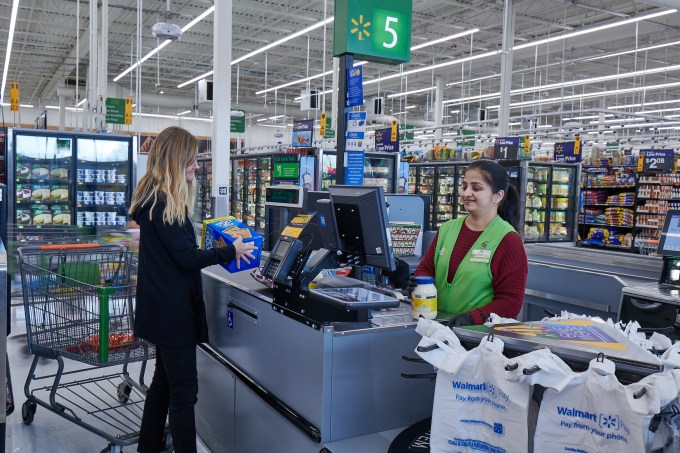
Instead of focusing on automated checkout solutions, the future concepts Walmart will test at IRL after meat inventory levels, are using the A.I. system to ensure that there are shopping carts available at all times and that registers are open and staffed.

The company insists that the tech isn’t replacing jobs, but instead frees up staff to interact with customers. That’s the same claim it made as it rolled out more robots to its stores. But it’s hard to see how, over time, more efficiently run stores would require as many associates as they do now.

IRL is a concept designed by Walmart’s tech incubator Store N8, which runs several ventures to test new ideas in retail. Earlier this year, it launched a startup which offers VR tours to enhance the shopping experience, and in 2017 it began testing a personal shopping service called Code Eight in NYC.
The Google Assistant can now tell you a story on your phone

For the last year or so, you could ask the Google Assistant on your Google Home device to read your kids a story. Today, just in time for National Tell a Story Day, Google is bringing this feature to Android and iOS phones, too. It’ll be available in English in the U.S., U.K., Canada, Australia and India.

When you asked the Assistant on your phone to tell you a story before, you’d get a short inspirational quote or maybe a bad joke. Having two different experiences for the same command never really made much sense, so it’s good to see Google consolidate this.

The available stories range from tales about Blaze and the Monster Machines to more classic bedtime stories like ‘Sleeping Beauty’ and ‘Little Red Riding Hood.’

That’s in addition to other story features like ‘read along,’ which automatically plays sound effects as you read from a number of Disney Little Golden Books. That’s obviously the cooler feature overall, but the selection of supported books remains limited. For longer stories, there’s obviously audiobook support.

Or you could just sit down with your kids and read them a book. That’s also an option.

Verizon announces 20 5G markets for 2019, as Samsung Galaxy S10 5G preorders open

Analysts have been all too happy to discuss 5G’s cart and horse problem, even as they wax poetic about the wireless technology’s future. Networks require devices and devices require networks. And while many have positioned 2019 as the year of 5G, both seem to be trickling out at a 2G rate.

Verizon (disclosure: our parent company’s parent company) just revealed a one-two punch, opening up preorders for the Galaxy S10 5G and announcing a list of 20 cities that will be getting the technology before year’s end.

The markets run coast to coast in the continental United States, including: Atlanta, Boston, Charlotte, Cincinnati, Cleveland, Columbus, Dallas, Des Moines, Denver, Detroit, Houston, Indianapolis, Kansas City, Little Rock, Memphis, Phoenix, Providence, San Diego, Salt Lake City and Washington DC.

That bunch join Minneapolis and Chicago, which had 5G turned on in certain areas earlier this month.

The S10 5G, meanwhile is the first of two 5G phones announced by Samsung this year. The company will also be selling a 5G version of the Fold in certain markets — assuming it gets to the bottom of the base model’s screen issues. One assumes that a 5G version of the Note is also in the works.

At $1,300 for the 256GB model and $1,400 for the 512GB version, the 5G model is a downright bargain compared to the Fold, which starts at $1,980. We can probably expect 5G models to be priced north $1,000 for a little while, at least. There are also carrier contracts available if renting to own is your thing.

When I interacted with the S10 5G earlier this year, there wasn’t much to discuss, as it was a dummy model that wouldn’t actually turn on. But you can expect something like a premium version of the Samsung flagship with a larger battery to deal with that extra 5G power consumption.

Online learning startup Coursera picks up $103M, now valued at $1B+

Coursera, an online learning startup that offers free and paid short courses, skills certifications, and complete degrees in partnership with universities and businesses, has raised another $103 million to scale out its business into new geographies, subject areas and products — a Series E led by a strategic investor, the Australian online recruitment and course directory provider SEEK Group, with participation from Future Fund and NEA.

Coursera currently offers 3,200 courses and 310 specializations with partners including Columbia University, Johns Hopkins and the University of Michigan. Some 40 million people have now taken online classes through the startup — a significant jump on the 26 million figure Coursera noted when it last raised money, in 2017, a $64 million Series D.

Also jumping is Coursera’s valuation, which had been around $800 million and is now ‘well over’ $1 billion, according to a source close to the company.

Coursera’s growth is coming at a key time in the e-learning sector.

Online education has, overall, become a increasingly viable alternative and complement to in-person learning — bolstered by improvements in technology and methodology, demand for skills that hasn’t been met by more traditional channels, and the economic challenges posed by higher education for a large number of people.

On one side, there have been some significant consolidations that speak to the opportunity. Just two weeks ago, 2U (which, like Coursera, works with universities to build online degree programs) acquired Trilogy — which provides training and bootcamps primarily for tech skills — for $750 million.

On the other, there have also been some significant stumbles. Udacity, another online education startup valued at $1 billion, recently laid off 20 percent of its staff as part of a wider restructuring, with the aim of curbing costs while still expanding its business focused on “nano degrees”.

Coursera’s aim, said CEO Jeff Maggioncalda (who joined the company in 2017), is to steer a course that offers a range of learning alternatives, as diverse as the mass market it’s hoping to continue targeting.

“We long ago realised that having a range of learning options, from open, free courses to masters degrees and everything in between such as microcredentials, bacheleors degrees and certifications, is the way to go,” Maggioncalda said. “We look at that as our product portfolio.”

Coursera had its start by opening up the world of university learning to a wider population by putting courses online, it’s more recently moved into working with companies and other organizations to build courses for them, and to build courses to help train people in specific vocational areas, such as this program it developed with Google for IT certifications last year, and the health vertical that it introduced in January of this year. That is something it plans to continue developing, too.

“Beyond the nobility of providing great access to higher education to a world of people who otherwise wouldn’t have it, there is another imperative,” he said. “The future of work and learning are converging, and companies are realising that there are a lot of jobs that are getting automated, so finding an inexpensive but high quality way to retrain is turning out to be a historic challenge. We need to get better at making high quality education accessible.”

The SEEK investment is coming at a timely moment as a complement to this mission. Maggioncalda notes that Coursera is going to start working more directly on developing what you might think of as the next step after you learn something on its platform, which will be getting a job.

“This investment reflects our commitment to online education, which is enabling the up-skilling and re-skilling of people and is aligned to our purpose of helping people live fulfilling working lives,” said SEEK Co-Founder and CEO Andrew Bassat in a statement.

He noted that to date, some 190 million people have posted resumes on SEEK, with some 900,000 organizations using the platform to recruit for job openings. “It’s not coincidental that we think they’re a great investment partner,” he said.

But the first steps, Maggioncalda noted, will be working with the companies that are already turning to Coursera to build training programs.

“We absolutely see an opportunity to expand what we are doing with them,” he said. “If we are teaching skills to students, it’s not too hard to imagine us saying to that company or related employers, ‘we can introduce you to people with these skills.’ And you can imagine us doing this with others courses that we teach.” That could mean, for example, offering help with job placement for those paying Coursera to get their Masters’ or Bachelors’ degrees.

That in itself could prove to be an interesting way of luring in more students as online learning starts to get more competitive in itself — not unlike how universities today are partly evaluated by students based on how helpful it will be to leverage those names when looking for jobs.

There are also other areas where we may see Coursera developing ahead is in its efforts to add a more diverse range of types of courses to its offering. The Trilogy acquisition by 2U highlights a rising demand for “bootcamps” to learn specific skills to enhance one’s work prospects. The growth of Triplebyte (itself also recently raising money) highlights how there is yet another bridge to be built between education and job hunting, in the form of “tests” to help screen and place the right people with the right job opportunities. And Lambda School has had a strong run so far in its model of offering nine-month, very career focused online training sessions in a variety of coding areas.

“It reinforces that people learning different skills need different environments,” Maggioncalda said. Given the right business model, cyberspace has no boundary, and the same might be said for online education.

Snapchat is bringing its Bitmoji avatars into video games

Want your video game character to look just like you? Soon you’ll be able to scan an in-game code with Snapchat to play as your personlized Bitmoji avatar on PC, console, and mobile games. Today Snapchat announced is new Bitmoji For Games SDK that will let hand-selected partners integrate 3D Bitmoji as a replacement for their character skins. With support for Unity, Unreal, and the Play Canvas engine behind Snap’s new Bitmoji Party game inside Snapchat, the SDK should make it easy for developers to pipe in life-like avatars that give people a stronger emotional connection to the game.

“It’s kind of a no0brainer to bring Bitmoji into games. Games can be so much more engaging with you…in the game” Bitmoji co-founder Ba Blackstock tells me.

Shopify unveils a new lineup of retail hardware

Shopify is expanding its efforts in brick-and-mortar retailer with the launch of its new retail hardware collection.

The company is best-known as a platform for building online stores, but it also offers point-of-sale software for physical stores, and it launched a credit card reader a couple years ago. With the new collection — which includes a redesigned Tap & Chip Reader, as well as the Dock and Retail Stand — Shopify has created a more comprehensive solution for offline retail.

Chief Product Officer Craig Miller told me that Shopify is taking advantage of an “industry-wide trend,” where online retailers hit a “tipping point” and realize that “the next step to scale your business is opening an offline store.” He pointed to bedding and home decor company Parachute as an example — after all, Miller and his team were demonstrating the hardware in Parachute’s New York City store.

He suggested that Shopify’s biggest advantage is the ability to bridge a retailer’s online and offline businesses — among other things, allowing them to track all their inventory in one place, or to offer customers the ability order a product online and pick it up in-store.

“Consumer expectations are just going through the roof,” Miller said. And while these kinds of capabilities “might be available at some of the larger stores, when you think about smaller retail, they don’t have access to that enterprise stuff. We’ve been able to create one package that does it all.”

Shopify Tap and Chip Reader

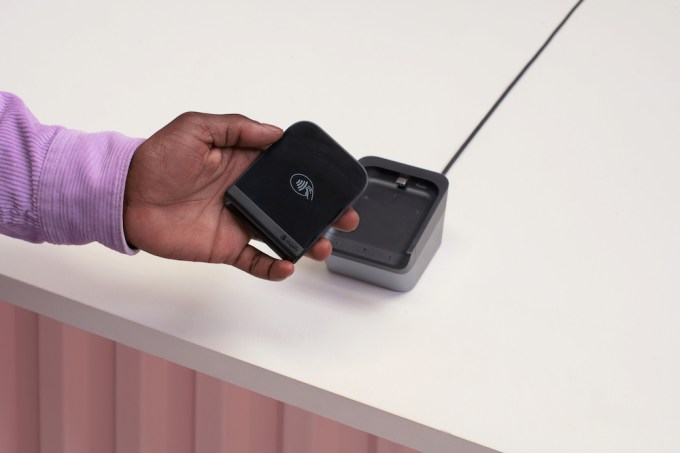
A bit more about the hardware itself: The Stand allows retailers mount and charge a tablet, which can also swivel across a counter to allow the customer to check out. The Tap & Chip Reader, meanwhile, has been redesigned to fit in with the rest of the new hardware lineup, and it can be mounted and charged on the Dock.

The whole setup can be placed on a traditional checkout counter, or simply carried and used around the store.

As a shopper, the experience might feel similar to paying at one of those familiar Square stands and card readers. While Miller didn’t mention Square specifically, he acknowledged that Shopify isn’t the first company to create this kind of product.

“We’ve always been a believer that first-to-market is not always the winner,” he said. “Just as a company, we’re philosophically inclined to taking our time just to understand what the market is looking for, to challenge some assumptions — like whether there even needs to be a checkout counter.”

The new hardware can be purchased individually, in a combined retail kit that costs $229.

The Switch has now outsold the N64, but Nintendo sees growth slowing

Nintendo’s Switch has now outsold its N64 console on lifetime sales, but prospects for the portable gaming system look mixed for the next year following a conservative sales forecast.

Nintendo just announced its end of year financials, and in doing so it revealed that it sold 16.95 million Switch consoles in the last year, taking it to 34.7 million sales to date and therein surpassing the N64. That annual sales figure is about on par with Nintendo’s target of 17 million — which was revised from an initial (and very ambitious) 20 million — but what happens over the next twelve-month period is less clear.

The Japanese company is predicting that it will shift 18 million Switch units over the next financial year, and there are positive and less positive signals to back that up. It would be hard to imagine that demand for the same device continuing for another year without changes.

Will be there new things?

That seems likely, we just don’t know exactly what and when.

“As a general rule, we’re always working on new hardware and we will announce it when we are able to sell it,” Nintendo CEO Shuntaro Furukawa told Bloomberg, although he refused reports that a new, lower-priced model will be unveiled at the E3 show in June.

Beyond new models, there will also be new markets. Nintendo is poised to enter China after it last week secured a key approval to sell the Switch in the country in partnership with Tencent.

Gaming in China is currently in flux — last year was a dismal one for companies like Tencent, but new regulations are incoming — but Nintendo’s catalog of family-friend and cute titles are likely to fare better than more edgy content in terms of approval. Even though the Switch is over two years old, opening China as a market will create a lot of new demand if it is marketed right.

Meanwhile, on the software side, the Switch is performing well with more than 23 titles now at one million sales or more, while Super Smash Bros. Ultimate and Pokemon: Let’s Go have generated 13.81 million and 10.63 million sales, respectively.

More broadly, Nintendo’s general financial update disappointed investors.

Annual operating profit of 250 billion yen ($2.2 billion) rose by 41 percent but revenue grew just 14 percent to 1.2 trillion yen ($10.7 billion). For the fourth quarter, operating profit came in at 29.7 billion JPY ($266 million) which was below the 36 billion JPY average for analysts polled by Bloomberg.

Nintendo’s annual forecast was also seen by many as tepid, perhaps because the company was burned by those aggressive Switch sales targets set last year.

“Nintendo is being extra cautious as it wouldn’t want to miss its target again,” games consultant and former TechCruncher said Serkan Toto told the Wall Street Journal in a statement.

SalesLoft nabs $70M at $500M valuation for its sales engagement platform

Artificial intelligence and other tech for automating some of the more repetitive aspects of human jobs continues to be a growing category of software, and today a company that builds tools to address this need for salespeople has raised a tidy sum to grow its business.

SalesLoft, an Atlanta-based startup that has built a platform for salespeople to help them engage with their clients — providing communications tools, supporting data, and finally analytics to ‘coach’ salespeople to improve their processes — has raised $70 million in a Series D round of funding led by Insight Venture Partners with participation from HarbourVest.

Kyle Porter, SalesLoft’s co-founder and CEO, would not disclose the amount of funding in an interview but he did confirm that it is double its valuation from the previous round, a $50 million Series C that included LinkedIn among the investors (more on that below). That round was just over a year ago and would have valued the firm at $250 million. That would put SalesLoft’s current valuation at about $500 million.

While there are a number of CRM and sales tools out in the market today, Porter believes that many of the big ones might better be described as “dumb databases or repositories” of information rather than natively aimed at helping source and utilise data more effectively.

“They are not focused on improving how to connect buyers to sales teams in sincere ways,” he said. “And anytime a company like Salesforce has moved into tangential areas like these, they haven’t built from the ground up, but through acquisitions. It’s just hard to move giant aircraft carriers.”

SalesLoft is not the only one that has spotted this opportunity, of course. There are dozens of others that are either competing on single or all aspects of the same services that SalesLoft provides, including the likes of Clari, Chorus.ai, Gong, Conversica, Afiniti and not least Outreach — which is seen as a direct competitor on sales engagement and itself raised $114 million on a $1.1 billion valuation earlier this month.

One of the notable distinctions for SalesLoft is that one of its strategic investors is LinkedIn, which participated in its Series C. Before Microsoft acquired it, LinkedIn was seen as a potential competitor to SalesForce, and many thought that Microsoft’s acquisition was made squarely to help it compete against the CRM giant.

These days, Porter said that his company and LinkedIn have a tight integration by way of LinkedIn’s Sales Navigator product, which SalesLoft users can access and utilise directly within SalesLoft, and they have a hotline to be apprised of and help shape LinkedIn’s API developments. SalesLoft is also increasingly building links into Microsoft Dynamics, the company’s CRM business.

“We are seeing the highest usage in our LinkedIn integration among all the other integrations we provide,” Porter told me. “Our customers find that it’s the third most important behind email and phone calls.” Email, for all its cons, remains the first.

The fact that this is a crowded area of the market does speak to the opportunity and need for something effective, however, and the fact that SalesLoft has grown revenues 100 percent in each of the last two years, according to Porter, makes it a particularly attractive horse to bet on.

“So many software companies build a product to meet a market need and then focus purely on selling. SalesLoft is different. This team is continually innovating, pushing the boundaries, and changing the face of sales,” said Jeff Horing, co-founder and MD of Insight Venture Partners, in a statement. “This is one reason the company’s customers are so devoted to them. We are privileged to partner with this innovative company on their mission to improve selling experiences all over the world.”

Going forward, Porter said that in addition to expanding its footprint globally — recent openings include a new office in London — the company is going to go big on more AI and “intelligence” tools. The company already offers something it calls its “coaching network” which is not human but AI-based and analyses calls as they happen to provide pointers and feedback after the fact (similar to others like Gong and Chorus, I should note).

“We want to give people a better way to deliver an authentic but ultimately human way to sell,” he said.

A new cryptocurrency mining malware uses leaked NSA exploits to spread across enterprise networks

Two years after highly classified exploits built by the National Security Agency were stolen and published, hackers are still using the tools for nefarious reasons.

Security researchers at Symantec say they’ve seen a recent spike in a new malware, dubbed Beapy, which uses the leaked hacking tools to spread like wildfire across corporate networks to enslave computers into running mining code to generate cryptocurrency.

Beapy was first spotted in January but rocketed to more than 12,000 unique infection across 732 organizations since March, said Alan Neville, Symantec’s lead researcher on Beapy, in an email to TechCrunch. The malware almost exclusively targets enterprises, host to large numbers of computers, which when infected with cryptocurrency mining malware can generate sizable sums of money.

The malware relies on someone in the company opening a malicious email. Once opened, the malware drops the NSA-developed DoublePulsar malware to create a persistent backdoor on the infected computer, and uses the NSA’s EternalBlue exploit to spread laterally throughout the network. These are the same exploits that helped spread the WannaCry ransomware in 2017. Once the computers on the network are backdoored, the Beapy malware is pulled from the hacker’s command and control server to infect each computer with the mining software.

Not only does Beapy use the NSA’s exploits to spread, it also uses Mimikatz, an open-source credential stealer, to collect and use passwords from infected computers to navigate its way across the network.

According to the researchers, more than 80 percent of Beapy’s infections are in China.

Hijacking computers to mine for cryptocurrency — known as cryptojacking — has been on the decline in recent months, partially following the shutdown of Coinhive, a popular mining tool. Hackers are finding the rewards fluctuate greatly depending on the value of the cryptocurrency. But cryptojacking remains a more stable source of revenue than the hit-and-miss results of ransomware.

In September, some 919,000 computers were vulnerable to EternalBlue attacks — many of which were exploited for mining cryptocurrency. Today, that figure has risen to more than a million.

Typically cryptojackers exploit vulnerabilities in websites, which, when opened on a user’s browser, uses the computer’s processing power to generate cryptocurrency. But file-based cryptojacking is far more efficient and faster, allowing the hackers to make more money.

In a single month, file-based mining can generate up to $750,000, Symantec researchers estimate, compared to just $30,000 from a browser-based mining operation.

Cryptojacking might seem like a victimless crime — no data is stolen and files aren’t encrypted, but Symantec says the mining campaigns can slow down computers and cause device degradation.

The startup behind that deep-fake David Beckham video just raised $3M

The recent global campaign showing Malaria survivors speaking through David Beckham to help raise awareness around the Malaria Must Die initiative spooked a lot of people:

The campaign has already exceeded 400 million impressions globally.

But a behind-the-scenes video explains how the video was made:

The campaign was a joint collaboration between RG/A, Ridley Scott Associates and the clever video startup Synthesia, for Malaria No More.

And it turns out there’s a huge commercial imperative over this cool technology.

Video production today is highly unscaleable. It’s a physical process with many cameras, many studios and many actors. Once a marketing, product or entertainment video has been shot it’s very difficult to quickly and affordably edit the creative or translate into different languages.

As co-founder Victor Riparbelli Rasmussen tells me: “We believe generating semi or fully artificial video is more efficient. This digital creation process is already the industry standard with images through applications like PhotoShop. We’re enabling the same for video.”

Synthesia says it can reduce the need to go on set to produce video content. Rather than shooting a new video, it can edit existing assets to create derivative international and personalized videos.

Rasmussen says: “Our solution allows companies to 10x their video output for a tenth of the costs of conventional production. A simple interview-style video can easily involve many people and extensive production costs across the organization. With our solution, a marketing manager at an Advertising Agency, a Fortune 1000 company or small business can create a new video from behind her screen and have it delivered back within 48 hrs.”

The UK based startup has now raised $3.1 million, with the financing led by LDV Capital, early investor Mark Cuban, and new investors MMC Ventures, Seedcamp, Martin Varsavsky’s VAS Ventures, TransferWise co-founder Taavet Hinrikus, Tiny VC, and advertising executive Nigel Morris.

“Video production is exponentially increasing but it is extremely challenging to internationalize and easily personalize advertising, marketing, and e-learning videos across cultures,” says Evan Nisselson, General Partner at LDV Capital. “Synthesia is leveraging computer vision and artificial intelligence to revolutionize video production for brands and creators.”

Synthesia was founded by a team of researchers and entrepreneurs from UCL, Stanford, TUM and Foundry. Notably, Prof Matthias Niessner, one of the co-founders of the company, is behind some of the most well-recognized research projects in the field Deep Video Portraits and Face2Face.

The London based startup came out of stealth in November 2018, airing their first public demo with the BBC, showcasing Synthesia technology by enabling newsreader Matthew Amroliwala speak three different languages.

Their customers already include global brands such as Accenture, McCann Worldgroup, Dallas Mavericks and Axiata Group.

But what about deep fakes and the potential for disinformation?

Synthesia says it has strong ethical guidelines and aims to ensure that all the content created is consensual and that actors are in control of their likeness.

So this is not software that you can just download from the web and apply to Bernie Saunder’s face.

Rasmussen says the company is actively working with governments and media organizations to create public awareness and develop technological security mechanisms to ensure that society gets to harness the benefits and reduce potential negative effects from synthetic media technologies.

Well, let’s hope so…