LEGO Braille bricks are the best, nicest, and in retrospect most obvious idea ever

Braille is a crucial skill for children with visual impairments to learn, and with these LEGO Braille Bricks kids can learn through hands-on play rather than more rigid methods like Braille readers and printouts. Given the naturally Braille-like structure of LEGO blocks, it’s surprising this wasn’t done decades ago.

The truth is, however, that nothing can be obvious enough when it comes to marginalized populations like people with disabilities. But sometimes all it takes is someone in the right position to say “You know what? That’s a great idea and we’re just going to do it.”

It happened with the BecDot (above) and it seems to have happened at LEGO. Stine Storm led the project, but Morten Blonde, who himself suffers from degenerating vision, helped guide the team with the passion and insight that only comes with personal experience.

In some remarks sent over by LEGO, Blonde describes his drive to help:

When I was contacted by the LEGO Foundation to function as internal consultant on the LEGO Braille Bricks project, and first met with Stine Storm, where she showed me the Braille bricks for the first time, I had a very emotional experience. While Stine talked about the project and the blind children she had visited and introduced to the LEGO Braille Bricks I got goose bumps all over the body. I just knew that I had to work on this project.

I want to help all blind and visually impaired children in the world dare to dream and see that life has so much in store for them. When, some years ago, I was hit by stress and depression over my blind future, I decided one day that life is too precious for me not to enjoy every second of. I would like to help give blind children the desire to embark on challenges, learn to fail, learn to see life as a playground, where anything can come true if you yourself believe that they can come true. That is my greatest ambition with my participation in the LEGO Braille Bricks project

The bricks themselves are very like the originals, specifically the common 2×4 blocks, except they don’t have the full 8 “studs” (so that’s what they’re called). Instead, they have the letters of the Braille alphabet, which happens to fit comfortably in a 2×3 array of studs, with room left on the bottom to put a visual indicator of the letter or symbol for sighted people.

It’s compatible with ordinary LEGO bricks and of course they can be stacked and attached themselves, though not with quite the same versatility as an ordinary block, since some symbols will have fewer studs. You’ll probably want to keep them separate, since they’re more or less identical unless you inspect them individually.

All told the set, which will be provided for free to institutions serving vision-impaired students, will include about 250 pieces: A-Z (with regional variants), the numerals 0-9, basic operators like + and =, and some “inspiration for teaching and interactive games.” Perhaps some specialty pieces for word games and math toys, that sort of thing.

LEGO was already one of the toys that can be enjoyed equally by sighted and vision-impaired children, but this adds a new layer, or I suppose just re-engineers an existing and proven one, to extend and specialize the decades-old toy for a group that already seems already to have taken to it:

“The children’s level of engagement and their interest in being independent and included on equal terms in society is so evident. I am moved to see the impact this product has on developing blind and visually impaired children’s academic confidence and curiosity already in its infant days,” said Blonde.

Danish, Norwegian, English, and Portuguese blocks are being tested now, with German, Spanish and French on track for later this year. The kit should ship in 2020 — if you think your classroom could use these, get in touch with LEGO right away.

Mary Meeker raises $1.25B for Bond, her debut growth fund

As the Kleiner Perkins empire crumbles, Mary Meeker builds her own.

The author of the Internet Trends Report has $1.25 billion in capital commitments for her debut growth fund, Bond Capital, as first reported by Axios and confirmed to TechCrunch by a source close to the firm.

Bond Capital has declined to comment.

Meeker spun-out from the Kleiner Perkins growth investing practice in September 2018 to form Bond after an internal power struggle between her and Mamoon Hamid, who joined Kleiner in 2017 from Social Capital, left no other option. According to a recent Fortune feature on the formerly revered venture capital firm, Kleiner recruited Hamid to refuel the firm’s early-stage efforts but his purported plan to increase the size of the early-stage funds’ stakes was a step too far onto Meeker’s turf.

“Hamid, say Kleiner insiders, saw himself as helping; Meeker’s team viewed Hamid’s offers as meddling,” Fortune writes.

Meeker, in her Kleiner tenure, was responsible for several of the firm’s most-prized investments, including Airbnb, Uber, Houzz, Slack, Peloton and, more recently, fintech platform Plaid and subscription lifestyle brand FabFitFun. She holds stakes in those high-performing companies via Kleiner’s funds, not through Bond, which has yet to deploy capital, per a source.

Meeker continues to invest out of Kleiner Perkins’ Digital Growth Fund III, a $1 billion vehicle that closed in 2016. Now that Bond has the capital to invest too, Meeker will be busy backing startups with capital from both investment vehicles.

In her new effort, Meeker is joined by Kleiner’s entire former growth practice: Mood Rowghani, Noah Knauf and Juliet de Baubigny, all of whom are general partners in the debut fund.

With Bond, Meeker makes history in launching the first female-founded, female-led venture capital fund to cross the billion-dollar threshold. She is, however, one of several former Kleiner GPs to raise her own fund. Aileen Lee stepped out on her own to form Cowboy Ventures in 2012, Trae Vassallo launched Defy Partners in 2016 and last year Beth Seidenberg raised $320 million in September for Westlake Village BioPartners.

Meeker joined Kleiner Perkins in 2010 after two decades as a managing director at Morgan Stanley. As a well-established Wall Street tech analyst, she quickly rose the Silicon Valley ranks to become one of the few women to earn a GP title at Kleiner in an industry where women have traditionally been shut out from the highest roles.

Her exit from Kleiner, a firm that has been for decades worshipped by founders, damages a brand already suffering from a slew of high-profile exits and a pivot to renewable energies from which the firm never fully recovered.

Kleiner, however, continues to double down on its early-stage efforts under Ilya Fushman, a former investor at Index Ventures, and Hamid’s lead. Earlier this year, the firm closed on $600 million for seed, Series A and Series B-focused funds.

“The environment for venture has evolved — with larger checks being written for seed and A rounds and more support from partners required to build companies — demanding a high degree of specialization and extreme focus to excel,” a spokesperson for Kleiner Perkins said in a statement provided to TechCrunch following Meeker’s exit. “The changes in both areas have led to less overlap between venture and growth and creating two separate firms with different people and operations now makes sense.”

Pinterest employee #1 launches blockchain art market MakersPlace

Pinterest is a great place to find digital art but a terrible place to sell it. The fact that anything online is infinitely copyable makes it tough for artists to establish a sense of scarcity necessary for their work to be perceived as valuable. Yash Nelapati saw this struggle up close as Pinterest’s first employee. Now he’s started MakersPlace, where creators can generate a blockchain fingerprint for each of their artworks that proves who made it and lets it be sold as part of a limited edition.

Similar to Etsy, MakersPlace allows artists to sell their creations while the startup takes a 15 percent cut. Collectors receive a non-fungible cryptocurrency token connoting ownership of a limited edition digital print of the artwork that they can store in their own crypto wallet or in one on MakersPlace. The MakersPlace site officially launches today after a year of beta testing.

“At Pinterest, we noticed that there are millions of digital creators that are spending countless hours creating digital artwork, but they struggle with basic things like attribution” says MakersPlace co-founder Dannie Chu who spent six years leading growth engineering at Pinterest. “Their work is getting printed, copied, shared, and ultimately they make very little money from it being put online. If you can’t create a sustainable model for digital creators to create, you’re not going to have art.”

If software is eating art, Uncork Capital wants a seat at the dinner table. It’s led a $2 million seed round for MakersPlace joined by Draper Dragon Fund and Abstract Ventures plus angels from Pinterest, Facebook, Zillow and Coinbase. They see the crypto-tokenized digital photo of a rose that sold for $1 million last year as just the start of a thriving blockchain art market. “That was a lightbulb moment for us. People are actually valuing digital creations like physical creations” says Chu.

Hiscox estimates there were $4.64 billion in online art sales (though mostly of traditional offline art) in 2018 compared to Art Basel’s estimate of $67.4 billion in total art sales for the year. MakersPlace could be well-positioned as more art is sold online and more of it becomes truly digital. “MakerPlace has already partnered with thousands of incredible digital artists selling their unique artwork, a testament to the easy-to-use platform they’ve built” said Uncork Managing Partner Jeff Clavier. “They’ve also created a seamless and fun, one-stop-shop for discovering and collecting digital artwork,”

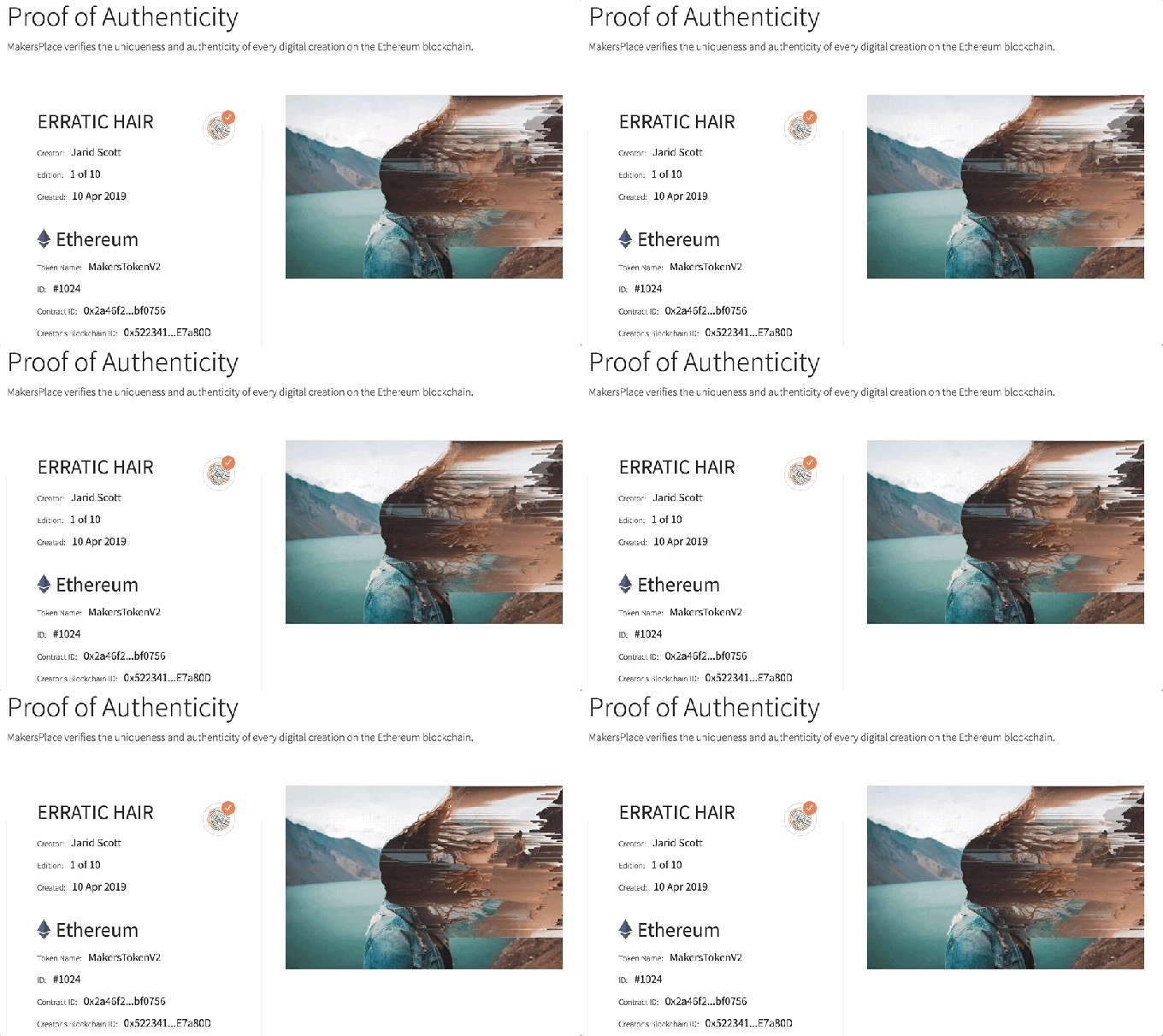
The startup’s technology is designed so artists fingerprinting their work don’t need extensive blockchain experience. They just upload it to MakersPlace before sharing it elsewhere, verify their identity through an integration with Civic where they take a photo holding their driver’s license, and an Ethereum-based token is generated with the creator’s name, the art’s name, its impression and edition number, and the date. An Ethereum token name, ID, contract ID, and creator’s ID are all assigned so there’s a permanent record of authorship.

Art collectors can browse MakersPlace’s categories for animation, photography, drawings, pixel art, and 3D creations; explore recent and popular uploads; or search by specific artist or art piece. They can buy art with a credit card or with Ether; use, display, or distribute it for non-commercial purchases; or resell it on the secondary market. MakersPlace assumes no ownership of the art it hosts.

One major concern is that artists unaware of MakersPlace might have their works fraudulently fingerprinted and attributed to a thief. Chu says that “We use a mix of website, email and identity verification services to do this (we use civic.com) . This is a strong deterrent to uploading and establishing attribution for stolen digital creations.” But you could still imagine the headache for less tech savvy artists if their creative identity gets hijacked.

There’s plenty of other blockchain entrants into the art world, from Blockchain Art Collective‘s NFC stickers for registering physical art to artist tipping platform ArtByte. Many startups are trying to solve the art attribution problem including Monegraph, KnownOrigin, Bitmark, CodexProtocol, Artory, and more. MakersPlace will have to hope its talent, Silicon Valley funding, and focus on digital works will differentiate it from the pack.

As we move to a culture where so many of things that represent our identity from photographs to music have become endlessly replicable, the concept of possession has lost its meeting. Yet we’re still hoarders deep down, scared not having enough. “Collecting is an innate human behavior, but as people become more urban, mobile, and minimalist, physical keepsakes have become less appealing,” said  Nelapati concludes. “Our mission is to create a platform that incentivizes creators by giving them ownership over the work they produce.”

[Featured Image: bunny style by Chocotoy]

It’s now easier to find work-from-home jobs in Google Search

Over the course of the last year or so, Google started adding more job search features to its search engine. Today, it’s expanding this program by also making it easier to find work-from-home jobs.

Typically, when you searched for a job like that, chances are you’ll be bombarded with a bunch of low-quality or even potentially malicious sites. Now, when you search for a job in Google Search using a query like ‘customer support jobs,’ you’ll be able to set the location to ‘work from home’ to find remote and telecommute jobs. Google says that a number of job listing sites, including Working Nomads, We Work Remotely and ZipRecruiter already support this feature. To filter these jobs, Google looks at the standard Schema.org markup that most job sites use to push their listings to Google Jobs.

“Through a number of user studies, we learned that most remote jobs were not clearly labeled as such,” Google product manager Jennifer Su writes in today’s announcement. “And our customers have told us it is difficult to accurately detect and return remote opportunities when users enter ‘work from home’ or related queries into their search box. By offering this capability to our customers, we hope to make remote work opportunities more discoverable to job seekers who need them.”

Google already lets job searchers filter by commute times and type of transit, so it makes sense to add this work-from-home option, too, especially now that more employees are looking for this kind of flexibility.

Bumble’s ‘Private Detector’ uses AI to detect dick pics

Dating apps are finally leveraging AI to clean up users’ chat messages. Badoo has introduced a new feature coming to its network of dating apps, including most notably, Bumble.

The penile detecting “Private Detector” feature will leverage deep learning to identify dick pics and other inappropriate photos and label them as such in chat, giving users the option to view the photo or report the user.

It’s great that they’ve introduced this but this isn’t exactly a cutting edge deep learning application here, this is something that realistically could have introduced a while ago, but Badoo CEO Andrey Andreev opted to have his team build the tech in-house. The company claims 98% accuracy in detecting illicit pics.

The company already had a low-tech option in place here where any photo being sent in chat would be blurred and the receiving user had to manually open the picture. While the context of the conversation could be a guide to whether they wanted to open the photos, sometimes context isn’t very strong when it comes to unsolicited dick pics.

The new feature does very much fit into something Bumble CEO/founder Whitney Wolfe Herd has been promoting when it comes to making a dating app that’s safe for women and leads to less harassment. Wolfe Herd has started approaching the issue of unsolicited illicit photos from a legislative track as well. Wolfe Herd has been working with the Texas state legislature to pass a bill that makes it illegal to send clearly unsolicited lewd photos. Bumble is based in Austin, Texas.

The company says that since this is largely leaning on their tech stack, they don’t foresee any need to add more people to their content review team.

The “Private Detector” functionality goes live in June on Bumble as well as on Badoo, Chappy and Lumen.

Microsoft is considering dropping its Windows password expiration policy

Microsoft has proposed scrapping a policy in Windows that requires users to periodically change their login password.

In a blog post, the software giant said its new draft security configuration baseline settings would no longer force users whose accounts are controlled by a network’s group policy to change their passwords every few weeks or months.

Microsoft’s draft security baseline documents includes recommended policies that affect entire groups of users on a corporate network, including rules that limit certain features and services to prevent misuse or abuse, as well as locking down certain functions that could be used by malware to attack the system or network.

The company said that the existing password change policy is an “ancient and obsolete mitigation of very low value,” and the company doesn’t “believe it’s worthwhile” any longer.

Here’s what Microsoft’s Aaron Margosis said:

Periodic password expiration is a defense only against the probability that a password (or hash) will be stolen during its validity interval and will be used by an unauthorized entity. If a password is never stolen, there’s no need to expire it. And if you have evidence that a password has been stolen, you would presumably act immediately rather than wait for expiration to fix the problem.

If it’s a given that a password is likely to be stolen, how many days is an acceptable length of time to continue to allow the thief to use that stolen password? The Windows default is 42 days. Doesn’t that seem like a ridiculously long time? Well, it is, and yet our current baseline says 60 days – and used to say 90 days – because forcing frequent expiration introduces its own problems. And if it’s not a given that passwords will be stolen, you acquire those problems for no benefit. Further, if your users are the kind who are willing to answer surveys in the parking lot that exchange a candy bar for their passwords, no password expiration policy will help you.

By removing it from our baseline rather than recommending a particular value or no expiration, organizations can choose whatever best suits their perceived needs without contradicting our guidance. At the same time, we must reiterate that we strongly recommend additional protections even though they cannot be expressed in our baselines.

In other words, Microsoft wants to put a premium on using strong, long, and unique passwords and not on regularly changing them.

Not only does changing passwords every few weeks or months frustrate the regular user, it’s been suggested that it actively do more harm than good. Former Federal Trade Commission chief technologist Lorrie Cranor said in a 2016-dated blog post that forcing users to change their passwords every so often can result in weaker passwords.

“Researchers also point out that an attacker who already knows a user’s password is unlikely to be thwarted by a password change,” she wrote. “Once an attacker knows a password, they are often able to guess the user’s next password fairly easily.”

Not long after, the National Institute of Standards and Technology (NIST), which advises the federal government on cybersecurity practices and policies, revised its own advice to remove policies that mandate periodic password changes.

Bill Burr, the since-retired NIST manager who developed the 2003-dated policy that recommended password expiration policies, expressed regret in a 2017 interview about the policy, saying the rule “actually had a negative impact on usability.”

Although Microsoft’s proposals are still in draft, if passed they could be rolled out in Windows 10’s May Update, expected next month.

Mark Zuckerberg has a podcast

In the future, everyone will have a podcast — and by “future,” I mean like mid-2020. But one step at a time, starting with Facebook founder, CEO and definite human person, Mark Zuckerberg .

Facebook announced the podcast’s Spotify link on Twitter. How’s that for platform synergy? The rather dryly named “Tech and Society With Mark Zuckerberg” will feature, well, conversations on tech and society with Mark Zuckerberg. Honestly, folks, it’s right there in the name.

https://platform.twitter.com/widgets.js

“Hey everyone,” Zuck says, opening the second of two posted episodes. “This year I am doing a series of public discussions on the future of internet and society,” referring to what looks to be a finite lineup of episodes. The executive explains in the first episode that show constitutes this year’s “personal challenge,” an annual homework assignment that has resulted in things like Zuckerberg learning Mandarin and writing a home AI.

The first episode features an interview with Harvard professor Jonathan Zittrain about technology and the law, while the second conversation with Mathias Dopfner of Axel Springer SE explores journalism. Obviously both have become key points for Facebook in the previous year — though not always under the most ideal circumstances.

At very least, it offers a rare and sustained look at one of technology’s top executives that doesn’t involve drinking glasses of water in front of Congress. And who knows, maybe Zuckerberg and Facebook will learn a little about themselves along the way.

Vue.ai raises $17M to equip online retailers with AI smarts

Vue.ai, a U.S/India startup that develops an AI platform to help online retailers work more efficiently and sell more, has announced a $17 million Series B round.

The investment is led by Falcon Edge Capital with participation from Japan’s Global Brain and existing backer Sequoia Capital India. Parent company Mad Street Den was founded in 2014 and it raised $1.5 million a year later, Sequoia then bought into the business via an undisclosed deal in 2016. Vue.ai is described as an “AI brand” from Mad Street Den and, all combined, the two entities have now raised $27 million from investors.

In an interview with TechCrunch, Vue.ai CEO and co-founder Ashwini Asokan — who started Mad Street Den with her husband Anand Chandrasekaran — explained that Vue.ai is a “retail vertical” of Mad Street Den that launched in 2016, she said that the company may add “another vertical in a year or two.”

Vue.ai is solely focused on working with online retailers, predominantly in the fashion space, and it does so in a number of ways. That includes expected areas such as automating product tagging and personalized recommendations (based on that tag library), as well as visual search using photos as input and tailored product discovery.

Areas that Vue.ai also plays in which surprised me, at least, include generating human models who wear clothing items — thus saving considerable time, money and effort on photo shoots — and an AI stylist that doesn’t take human form but does learn a user’s style and help them outfit themselves accordingly.

Tagging and visuals may appear boring, but these are hugely important areas for retailers who have huge amounts of SKUs, items for sale, on their site. Making sure the right person finds the right item is critical to making a sale, and Vue.ai’s goal is to automate as much of that heavy-lifting as possible. Even tagging is essential because it needs to be done consistently if it is to work properly.

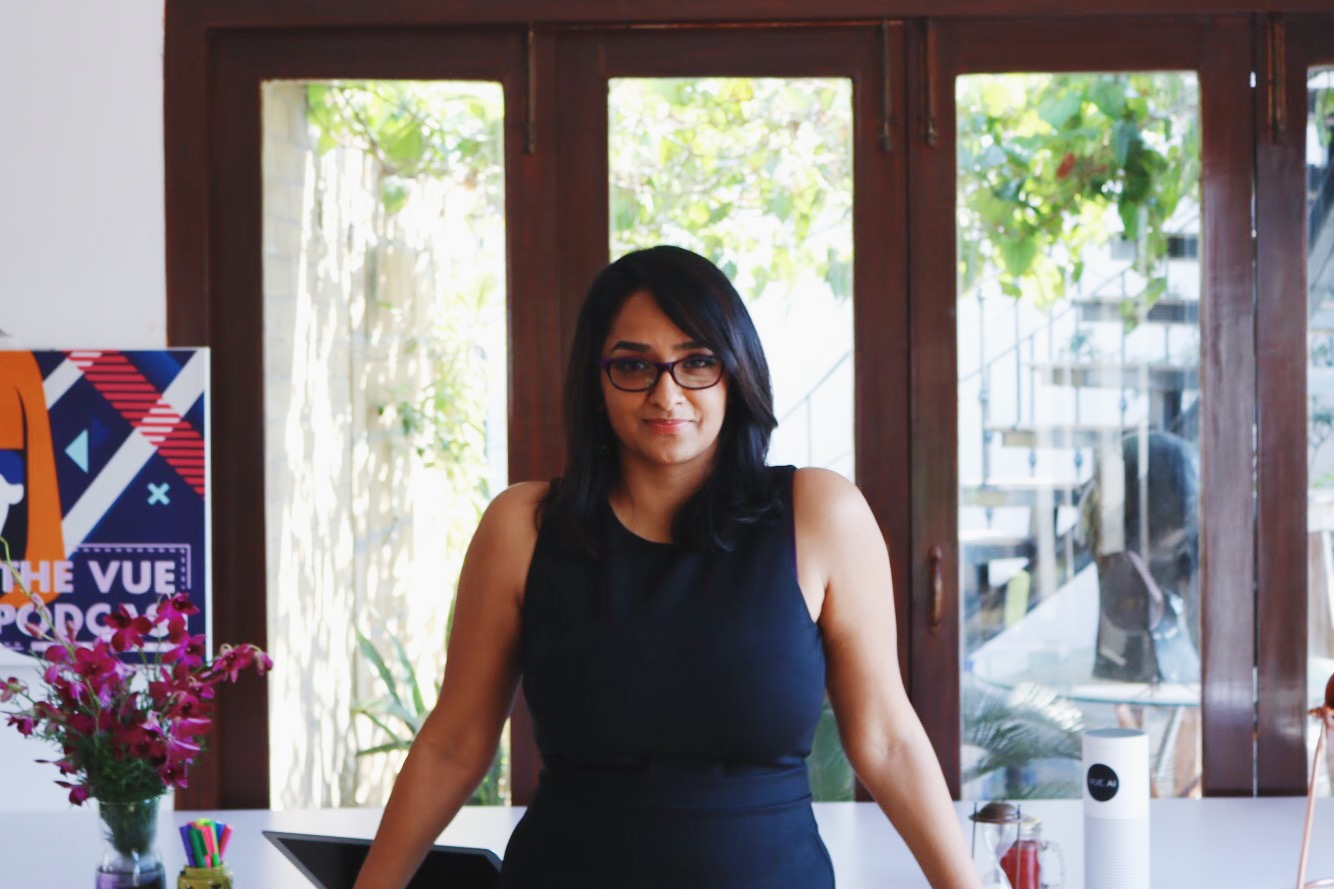
Ashwini Asokan, CEO and Founder of Vue.ai

More than just working correctly, Vue.ai aims to help online retailers, who often run a tight ship in terms of profitability, save money and get new product online and in front of consumer eyeballs quickly.

“These are solutions that optimize the bottom line for retail companies,” said Asokan, who spent over a decade working in the U.S before returning home in India in 2015. “We are digitizing products 10X faster than you did before… you cannot afford to lose productivity and efficiency, online retail is not somewhere you can lose money.”

“We want to be that data brain mapping digital products,” she added.

Vue.ai is now pushing into new areas, which include advertising and development of videos and marketing content.

“The future of retail is entertainment and the experience economy is the small start of that era,” Asokan said, reflecting on the trend of social media buying through platforms like Instagram and the rise of live-streaming e-commerce in China.

“The electricity that powers all of these complicated retail interactions is content; we need to understand content and every customer style profile and merchandise,” she added.

Some of Vue.ai’s public customers include Macy’s and Diesel in the U.S, Latin American e-commerce firm Mercadolibre and Indian conglomerate Tata .

Vue.ai is headquartered in Redwood City with an office in Chennai, India. Asokan said it is planning to expand that presence with new locations in Seattle, for tech hires, and Japan and Spain to help provide closer support for customers. The company doesn’t disclose raw numbers, but it said that annual revenue grew by four hundred percent in 2018, which was its third year since incorporation.

Are women better gamers than men? This startup’s AI-driven research says yes

Last year the Gosu.ai startup, which has developed an AI assistant to help gamers play smarter and improve their skills, raised $1.9M. Using machine learning, it analyzes their matches and makes personal recommendations, and allows the gamer to be taught by a virtual assistant.

Because they have this virtual assistant they can now do some interesting research. For the first time ever, we can actually peer over the shoulder of a gamer, and find out what makes them good of not. The findings are fascinating.

Gosu.ai surveyed nearly 5,000 gamers playing Dota 2 to understand what factors separate successful and less successful gamers.

They found that although only 4 percent of respondents to the survey were women, it turned out that those women that responded had a 44 percent higher win rate on average than the men.

Does this suggest women are better gamers than men? This isn’t a scientific study, but it is a tantalizing idea…

The study also found that the higher your skills in foreign languages, the slower your skills improve. They also found that people without a university degree, people who don’t travel, and people who play sports increase their game ratings faster. Similarly, having a job also slows growth. Well, duh.

Gosu.ai’s main competitors are Mobalytics, Dojomadness and Moremmr. But the main difference is that these competitors make analytics of raw statistics, and find the generalized weak spots in comparison with other players, giving general recommendations. Gosu.ai analyzes the specific actions of each player, down to the movement of their mouse, to cater direct recommendations for the player. So it’s more like a virtual assistant than a training platform.

The startup is funded by Runa Capital, Ventech and Sistema_VC. Previously, the startup was backed by Gagarin Capital.

The Brave browser launches ads that reward users for viewing

With the latest desktop version of the Brave browser, users can now opt-in to the Brave Ads program.

Brave is an ad-blocking web browser startup led by Brendan Eich, creator of JavaScript programming language and former Mozilla CEO. He’s long maintained that the vision is “bigger than an ad blocker,” with a goal of finding new ways to compensate online publishers.

Brave Ads are a crucial part of that vision. The company says users who choose to participate in the program will receive 70 percent of the revenue generated by the ads they see. Their rewards will take the form of Basic Attention Tokens (BAT), a cryptocurrency that the users can, in turn, share with the creators of the content that they’re watching.

Eich told me that the browser is set by default to donate a user’s BAT at the end of the month to their most-visited sites, but the company also plans to let users exchange BAT for rewards like hotel rooms and restaurant vouchers (through the TAP Network created by the startup Hooch). They should also, eventually, be able to cash out with regular “fiat currency” through exchanges like Coinbase.

Brave has been testing ads since January, and Eich said that more than 40 percent of desktop users have been opting in. Certainly, some Brave users may simply want to use the browser for its ad-blocking capabilities, but he suggested that the more “ecologically minded ones” will want to participate, rather than getting a “free ride.”

Brave ads

“A lot of users don’t want to cash out [when they receive BAT],” he added. “It’s not a huge amount of value for most people, so they may prefer to just use it to give back. And that’s the real idea: A browser with the user steering it is replacing the ad tech complex.”

The ads are also supposed to protect user privacy. There is a degree of targeting, but Eich said all the data and “decision-making” happens on the device, so Brave and the advertiser never get access to it. (Brave does aggregate anonymized, high-level data so that advertisers can see who viewed their campaigns.)

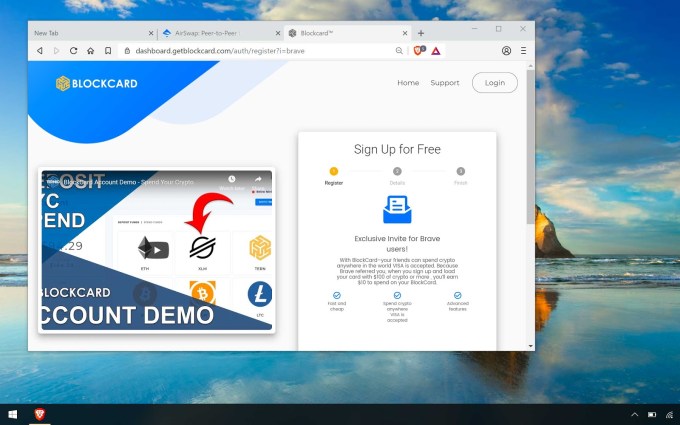
The ads appear in the browser and don’t replace a previously blocked ad. Brave says the ads are coming from partners like Vice, Home Chef, ConsenSys, Ternio BlockCard, MyCrypto, eToro and Vimeo.

The company also has plans to work with publishers who want to run ads when their site is viewed on the browser, with the revenue then split between Brave, the publisher and the user.