New Sesame Street-themed PSA encourages kids to reduce mobile device use

Device addiction plagues us all — even Apple CEO Tim Cook. But children with phones and tablets are even more susceptible to the lures of apps and games, which often use psychological tricks keep users logging in and regularly returning. A new PSA from Sesame Workshop and advocacy organization Common Sense aims to address kids’ unhealthy use of mobile devices by focusing on one particular problem: devices at the dinner table.

This is not the first time the #DeviceFreeDinner campaign has run — previous years’ spots featured Will Ferrell as a “distracted dad” on his phone at the table, ignoring his family’s conversations.

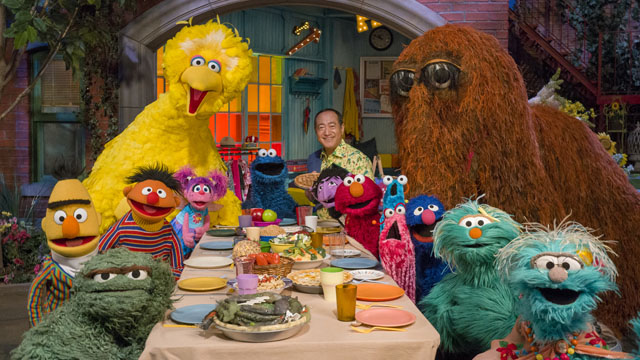
But this time around, the organization is teaming up with Sesame Workshop, which is lending its characters to a new PSA. The spot will feature the Sesame Street muppets modeling healthy mobile phone behavior by putting their devices away.

Phones are shut up in drawers, tablets placed on shelves, other devices are put in handbags — and, you know, thrown into garbage cans and stashed in pumpkins, as the case may be.

The muppets then gather around a table and happily chatter until they notice Cookie Monster is still on his phone, texting. (Don’t worry, their disapproval sees him eating the device in the end.)

The idea, explains kids advocacy organization Common Sense, is to raise awareness around media balance and encourage families to make the most of their time together.

It comes at a time when now one-third of kids ages 0 to 8 “frequently” use mobile devices, the nonprofit explains. But taking a break from devices is shown to have positive benefits, ranging from better nutrition and focus at home to fewer problems at school, Common Sense says.

Plus, it notes, simply putting the phone down is not enough — it shouldn’t be at the table at all, as research has shown that even the presence of a phone on the table can hurt the quality of conversations.

While Common Sense puts out a lot of material for children and families like this, Sesame Workshop’s involvement on the new PSA is particularly interesting given the company’s recent connection with Apple.

A new Sesame Workshop-produced show set to air on Apple’s soon-to-launch streaming service will teach kids coding basics — an agenda Apple regularly pushes to get its programming language, Swift, into the hands of the next generation of coders. 
In the show, the same Sesame Street characters who today are telling kids to put down their phones will instead tout the joys of coding to the preschool set.

The juxtaposition of a programming-focused Apple kids’ show and the new PSA are a perfect example of how complicated the issues around kids on devices have become. On the one hand, parents want to encourage their children to pursue STEM subjects — which often requires kids to regularly use computers and other devices to practice new skills, like coding with MIT’s Scratch or building for Minecraft. But on the other hand, parents see that when kids are given devices, addiction soon follows.

The real question for parents may be, instead, whether kids should have devices at all — or whether they should take their cues from tech billionaires and Silicon Valley parents who are ripping devices from their own children’s’ hands like they’re the modern-day equivalent of sugary breakfast cereal.

Perhaps Sesame Workshop should have chosen a side on this issue, rather than teaming with the billion-dollar company that’s now trying to distance itself from fault with regard to the device addiction problem at the same time it runs PSAs about kids’ device addiction.

Or maybe it’s just as confused at the rest of us are over where to draw the line.

The new Sesame Street-themed PSAs will be distributed starting today across networks and platforms including NBC, Fox, Xfinity, Comcast, Charter, Cox, National Geographic, NCM, PBS, Univision, Telemundo, HITN, and Xfinity Latino.

The master list of PR DON’Ts (or how not to piss off the writer covering your startup)

When it comes to working with journalists, so many people are, frankly, idiots. I have seen reporters yank stories because founders are assholes, play unfairly, or have PR firms that use ridiculous pressure tactics when they have already committed to a story.

There is so much bad behavior that I thought that it might be time to write up a list of “DON’Ts” on how not to work with journalists.

I compiled this list by polling TechCrunch’s entire writing staff for their pet peeves when it comes to working with PR folks and founders around startup pitches. The result was this list of 16 obnoxious annoyances.

The interesting thread that connects all of them is that these DON’Ts are almost universal across the staff — few of these annoyances seemed to be merely personal preference. Avoiding these behaviors won’t guarantee coverage of your startup, but they certainly will help you avoid killing your news story before it even gets considered for publication.

DON’T change the capitalization of your startup multiple times

SEO is important, and so there are rules about how to capitalize things to maximize your exposure on Google and DDG. That’s important to get right, but for the love of god, figure out what the hell you want your startup’s name to be before you reach out to the press.

How to pitch to a (tech) journalist

Startup growth comes from many places, but one option is through “earned media” — stories and mentions in the press. Earned media is great, because the channel is nominally free, and it can often get many more of the right eyeballs than advertising. Minus some sleazy behavior in the journalism world, you should never have to pay a dime to get a story into print other than the work it takes to manage PR (and yes, of course, that can be very expensive, although it doesn’t have to be).

For these reasons, startups pitch writers a lot on stories about everything from their latest fundraise to new features in their apps. Yet despite that frequency, some founders (and PR folks) are extraordinarily good at pitching and find great success, while others seem to never get the attention of even the most workaholic writers.

The job of writers is to write stories, but writing your story is not their job.

Therefore, learning how to pitch a journalist, how to build a relationship with writers covering your startup, and how not to mess up a story already in production is a critical skill for anyone looking to grow their business.

This guide is designed to help bridge the gap by covering relationship building, how to determine newsworthiness, and the logistics of exclusives and embargoes. In addition, we’ve published a companion piece lists and analyzes 16 DON’Ts that can suddenly find your committed story in the trash can.

Building relationships should always take precedent

The single greatest secret of building any venture, actually, the greatest secret of life is that relationships are everything. We live in a free world, and no one is obligated to do anything for anyone. Venture capitalists aren’t obligated to write a check, partners aren’t obligated to sign a deal, and customers never have to buy your product.

Squarespace makes its first acquisition with Acuity Scheduling

Squarespace is announcing its first acquisition today, a 13-year-old company called Acuity that allows businesses to manage their online appointments.

Squarespace CEO Anthony Casalena noted that the company has been expanding beyond website building already — he said he now wants to provide tools around online presence (i.e., building a website), commerce and marketing.

To do that, Squarespace has been building its own products, but in this case, Casalena said it made more sense to just bring Acuity on-board, particularly since the there already an integration between Acuity’s scheduling software and Squarespace’s page-building tools.

“What [CEO Gavin Zuchlinski] had built at Acuity is a great business,” he said. “It’s been growing pretty organically up until this point, with 45 employees who really understand the space and a very customer-centric culture. They have a great product. That would just be faster for us [to acquire them], versus building our own product.”

Acuity Scheduling logo

The plan is to build more integrations over time, while also continuing to support Acuity as a standalone product. The entire Acuity team is joining Squarespace, with Zuchlinski become vice president of Acuity within the larger company.

Asked whether this means we can expect Squarespace to make more acquisitions in the future, Casalena said, “I think we just are able to look at things that are going to be a little more meaningful right now … Our size kind opened our perspective to what’s possible.”

This also comes as the email marketing product that Squarespace launched last year is coming out of beta with new features like campaign scheduling and improved analytics.

Group Nine hires Brian Lee to lead its commerce business

Group Nine Media has hired Brian Lee to as its first executive vice president of commerce.

Lee held a similar role at Maker Studios before its acquisition by Disney, and he also founded the New York-based accelerator SKIG. Group Nine — which was created by the merger of Thrillist, NowThis Media, The Dodo and Discovery-owned Seeker — says Lee’s job will include licensing, merchandising, affiliate advertising and direct-to-consumer products.

“Group Nine has some of the most loved and impactful brands, coupled with the ability to leverage a host of deeply powerful insights,” said Lee said in a statement. “I believe we are uniquely positioned to make huge strides in this space and can’t wait to get started.”

When I met with Group Nine CEO Ben Lerer earlier this year, he laid out his vision for the company moving forward.

“We’re successfully building brands — not to be distributed over a paid TV pipe, not to sit back and watch on your TV passively,” Lerer said. “Instead, we’re building brands for the kind of content consumption that someone who’s grown up with a smartphone in their pocket patronizes. What we’re doing is shows and characters and telling stories that are meant to be delivered via Facebook, via YouTube, via Snapchat, via Twitter.”

That kind of strategy, where a publisher relies on third-party platforms to reach their audience, has been disastrous for other digital media companies, but Lerer sounded pretty confident, particularly as the company gets smarter about which shows to invest in: “We’re making less and less content that is disposable every month than we did the month before.”

That approach seems to tie into Group Nine’s commerce strategy. In today’s announcement, Lerer said, “We have some of the most engaging brands on mobile, built around deeply dedicated communities of loyal fans so it’s imperative that we make the most of the opportunities that presents.”

Citing Nielsen, Group Nine says its content reaches nearly 45 million Americans every day. Business Insider also reported recently that the company is in talks to merge with women’s lifestyle media company Refinery29.

Luxury consignment e-tailer The RealReal to enter the unicorn club with new funding

The RealReal, an online retailer for authenticated luxury consignment, has authorized the sale of up to $70 million in new shares, per a Delaware stock authorization filing discovered by the Prime Unicorn Index. If the company raises the entire amount, it would reach a valuation of $1.06 billion, cementing its status as the newest e-commerce unicorn.

The filing doesn’t guarantee The RealReal will sell the full amount of authorized shares. The company declined to comment on its fundraising plans.

The RealReal is led by founder and chief executive officer Julie Wainwright (pictured), the former CEO of Pets.com, a company now synonymous with the dot-com bust. It has raised quite a bit of capital to date — a total of $288 million from venture capital and private equity backers, including Great Hill Partners, Sandbridge Capital, PWP Growth Equity, Industry Ventures, Greycroft Partners and Canaan Partners. Most recently, The RealReal closed a Series G financing of $115 million in July 2018 that valued the business at $745 million, per PitchBook.

The RealReal has recently expanded its brick-and-mortar footprint and added additional e-commerce fulfillment centers as demand increased for its supply of second-hand luxury items. Founded in 2011, the company operates eight luxury consignment offices, where customers can receive free valuations of their luxury items. The RealReal is headquartered in San Francisco.

In a conversation with TechCrunch in 2017, Wainwright confirmed the company’s intent to go public at some point. With this upcoming round, The RealReal would be well placed for a 2020 initial public offering.

“That’s the goal,” Wainwright said during the interview. “We really aren’t in the mood to sell the business, we’re in the mood to go public at some point in the future.”

The RealReal competes with fellow second-hand e-tailers ThredUp and Poshmark . The latter is gearing up for a fall IPO, according to The Wall Street Journal. The online marketplace has tapped Morgan Stanley and Goldman Sachs to lead its offering after closing in on $150 million in revenue in 2018. ThredUp, another major player in the fashion retail market, hasn’t raised capital since 2015, but did begin opening physical stores in 2017 as part of its greater effort to compete with fellow venture-backed second-hand e-tailers.

The RealReal would also be the latest in a series of high-profile female-founded companies to gain unicorn status. Glossier tripled its valuation to $1.2 billion with a $100 million round earlier this year, followed by Rent the Runway, which attracted a $125 million investment at a $1 billion valuation, to name a few.

Locus Robotics raises $26 million for warehouse automation

Warehouse automation is all the rage in robotics these days. No surprise then, that another emerging player just got a healthy slice of venture funding. Massachusetts-based Locus Robotics this week announced that it’s secured a $26 million Series C. The round, led by Zebra Ventures and Scale Venture Partners, brings the startup’s total funding up to around $66 million.

The five year old company produces robotic shelving designed to transfer bins inside of warehouse. Founder Bruce E. Welty was on stage at our robotics event back in 2017 demonstrating the technology.

It’s a similar principle to many other players in the space, including Amazon’s Kiva and Bay Area-based Fetch. And like those companies, Locus has garnered interest from some big players — most notably delivery giant, DHL.

The robotics automation space has heated up quite a bit in 2019. Colorado-based Canvas, which makes autonomous warehouse delivery carts, was acquired by Amazon last week. Even Boston Dynamics is looking at the category as a way forward for its own impressive technologies, putting its robot Handle to work in a fulfillment center.

“We have seen a massive uptick in demand for the flexible automation incorporated into Locus’s multi-bot solution, which is uniquely suited to address these challenges,” CEO Rick Faulk says in a release tied to the news. “Not only is our solution proven to dramatically improve productivity and drive down costs, but it is also a source of scalable labor that can be adapted to meet the demands of numerous product and customer profiles. This new funding will enable us to scale to meet growing demand for our revolutionary solution worldwide.”

Alphabet’s Wing gets FAA permission to start delivering by drone

Wing Aviation, the drone-based delivery startup born out of Google’s X labs, has received the first FAA certification in the country for commercial carriage of goods. It might not be long before you’re getting your burritos sent par avion.

The company has been performing tests for years, making thousands of flights and supervised deliveries to show that its drones are safe and effective. Many of those flights were in Australia, where in suburban Canberra the company recently began its first commercial operations. Finland and other countries are also in the works..

Wing’s first operations, starting later this year, will be in Blackburg and Christiansburg, VA; obviously an operation like this requires close coordination with municipal authorities as well as federal ones. You can’t just get a permission slip from the FAA and start flying over everyone’s houses.

“Wing plans to reach out to the local community before it begins food delivery, to gather feedback to inform its future operations,” the FAA writes in a press release. Here’s hoping that means you can choose whether or not these loud little aircraft will be able to pass through your airspace.

Although the obvious application is getting a meal delivered quick even when traffic is bad, there are plenty of other applications. One imagines quick delivery of medications ahead of EMTs, or blood being transferred quickly between medical centers.

I’ve asked Wing for more details on its plans to roll this out elsewhere in the U.S., and will update this story if I hear back.

China is reportedly using US satellite technologies to bolster its surveillance capabilities

The Chinese government has been using a private company jointly owned by a U.S. investment firm and its Chinese counterpart to expand its surveillance and telecommunications capabilities using American technology, The Wall Street Journal reports.

At the center of the Journal’s reporting is a company called Asia Satellite Telecommunications (AsiaSat). It’s a satellite operating company acquired back in 2015 by U.S. private equity firm The Carlyle Group and Chinese private equity firm CITIC Group. Both Carlyle and CITIC are known for their ties to government in their respective home nations.

While the U.S. government basically bans American companies from exporting satellite technology to foreign governments like China, there have been no controls put in place on how bandwidth from launched satellites is used once those satellites are in orbit.

Based in Hong Kong, AsiaSat isn’t subject to the same sort of export controls and regulations that the U.S. places on companies headquartered in mainland China, which has allowed the company to acquire U.S. satellites.

The Chinese government, through its connections with CITIC, has leveraged that loophole to bolster its surveillance and telecommunications capabilities for security activities, the Journal reports.

At issue are satellites bought by AsiaSat from Boeing and Maxar Technologies subsidiary SSL, a Palo Alto, Calif. We’ve reached out to Maxar and AsiaSat for comment.

“Boeing follows the lead of the U.S. Government with respect to the use of export controlled items,” the company said in a statement to TechCrunch.

The U.S. and China are in a highly public contest over who will control the future of networking technologies — with the U.S. accusing China’s leading commercial telecommunications vendors of collaborating with the Chinese government to spy on partners.

U.S. officials also accuse their counterparts in Beijing of using physical and cyber espionage to acquire American technology. However, in this case, China was able to use corporate interests and profit-seeking to gain access to core U.S. satellite technologies, the Journal reports.

Since at least 2011, Citic has touted Chinese intelligence branches and armed services as customers of its satellite company’s services, according to the Journal’s reporting.

In other marketing materials, Citic’s satellite company has touted its link to government agencies — as a tool to link national broadcasters to far flung towns and cities across the sprawling nation. Meanwhile, China’s Ministry of Public Security has documented how it used AsiaSat 5 — a satellite made by SSL — to develop rapid-response forces with audio and video capabilities provided in real-time, the Journal is reporting.

Citic’s ownership stake in AsiaSat predates the Carlyle Group’s acquisition. The company previously was a joint venture between the Chinese private equity firm and General Electric and its surveillance activities extend back to that period as well.

In 2008 and 2009, AsiaSat assets were used to help authorities communicate and coordinate efforts to put down antigovernment protests over religious and ethnic persecution in Tibet and Xinjiang — a mineral-rich region in Northwestern China populated mainly by an ethnic minority called Uighurs, a group comprised predominantly of practicing Muslims.

In a statement provided to the Journal, AsiaSat disputed the company’s reporting, saying that the Chinese military wasn’t a direct customer, but used capacity for disaster relief. Several cities in the Chinese province of Sichuan were decimated by an earthquake that hit in 2008.

AsiaSat also declined to comment on whether its bandwidth was being used in Xinjiang currently or whether it had been used in the Tibet and Xinjiang uprisings that occurred roughly ten years ago. In the past few years, Chinese authorities have built a pervasive surveillance network in Xinjiang and sent as many as one million ethnic Uighurs to internment camps, according to multiple reports.

In statements to The Wall Street Journal Carlyle said that AsiaSat’s equipment supports internet and phone communications for Chinese telecommunications carriers.

“It is effectively a pipe,” Carlyle said in a statement to the Journal, “and AsiaSat, because of privacy issues, doesn’t monitor or regulate the content that flows through it.”

Tim Cook wants you to put down your iPhone

Tim Cook thinks people should get off their iPhones and decrease their engagement with apps. The Apple CEO, speaking at the TIME 100 Summit today, was discussing the addictive nature of our mobile devices and Apple’s role in the matter when he made these comments. He said the company hadn’t intended for people to be constantly using their iPhones, and noted he himself has silenced his push notifications in recent months.

“Apple never wanted to maximize user time. We’ve never been about that,” Cook explained.

It’s certainly an interesting claim, given that Apple designed a platform that allowed app developers to constantly ping their users with the most inane notifications — from getting a new follower on a social app to a sale in a shopping app to a new level added to a game and so much more.

The very idea behind the notification platform, opt-in as it may be, is that developers should actively — and in real-time — try to capture users’ attention and redirect them back to their apps.

This is not how such an alert mechanism had to be designed.

An app notification platform could have instead been crafted to allow app developers to notify users in batches, at designed intervals within users’ control. For example, users could have specified that every day at noon they’d like to check in on the latest from their apps.

Or, in building out the iOS App Store, Apple could have implemented a “news feed” of sorts — somewhere users could opt to check in on all the latest news from the installed apps in a dedicated channel.

Or perhaps Apple could have structured a notification platform that would have allowed users to pick between different classes of notifications. Urgent messages — like alerts about a security breach — could have been a top-level tier; while general information could have been sent as a different type of notification. Users could have selected which types of alerts they wanted, depending on how important the app was to them.

These are just a few of many possible iterations. A company like Apple could have easily come up with even more ideas.

But the fact of the matter is that Apple’s notification platform was built with the idea of increasing engagement in mind. It’s disingenuous to say it was not.

At the very least, Apple could admit that it was a different era back then, and didn’t realize the potential damage to our collective psyche that a continually buzzing iPhone would cause. It could point out how it’s now working to fix this problem by putting users back in control, and plans to do more in the future.

Instead, it created a situation where users had to turn to the only defense left to them: switching off push notifications entirely. Today, when users install new apps they often say “No” to push notifications. And with Apple’s new tools to control notifications, users are now actively triaging which apps can get in touch.

In fact, that’s what Tim Cook says he did, too.

“If you guys aren’t doing this — if you have an iPhone and you’re not doing it, I would encourage you to really do this —  monitor these [push notifications],” the CEO suggested to the audience.

“What it what has done for me personally is I’ve gone in and gutted the number of notifications,” Cook said. “Because I asked myself: do I really need to be getting thousands of notifications a day? It’s not something that is adding value to my life, or is making me a better person. And so I went in and chopped that.”

Yep. Even Apple’s CEO is done with all the spammy and noisy iPhone apps.

The comment, of course, was supposed to be a veiled reference to the addictive nature of some apps — social media apps in particular, and especially Facebook. Today, Apple throws barbs at Facebook any time it can, now that the company has fallen out of public favor due to its ongoing data privacy violations and constant scandals.

But a more truthful telling of the iPhone’s past would recall that Facebook’s app — and all its many notifications — was originally a big selling point for Apple’s mobile device.

When the App Store first launched in 2008, Facebook proudly sat in the top row in a featured position. It was heavily promoted to users because it was a prime example of the iPhone’s utility: here was this popular social network you could now get to right from your phone. Amazing! 

The fact that Facebook — and every other app — later leveraged the iOS push notification platform to better its own business without regard to how that would impact users, isn’t entirely app developers’ collective fault. The notification platform itself had left the door wide open for that sort of psychological abuse, simply due to its lack of user-configured, user-friendly controls.


A decade after the App Store launched, Apple finally started to dial back on the free-for-all on user attention.

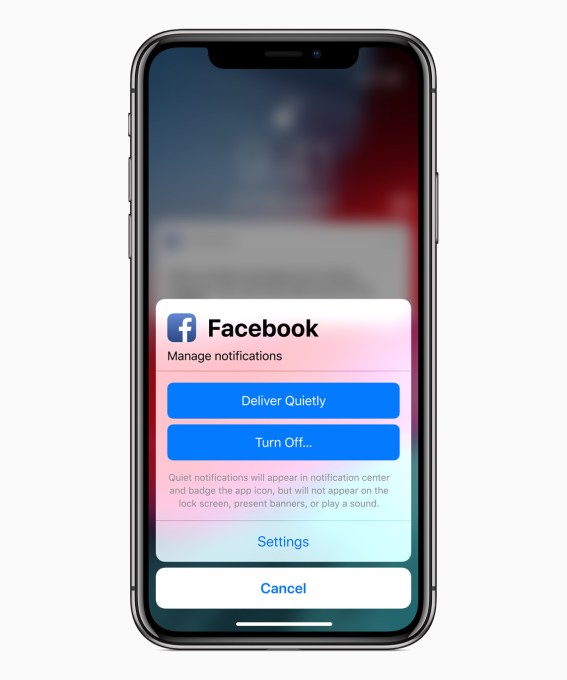
It announced its suite of digital wellness tools at WWDC 2018, which included Screen Time (a dashboard for tracking and limiting usage); increased parental controls; and finally a way to silence the barrage of notifications, without having to dig around in iOS Settings.

Now Tim Cook wants to have us believe that Apple had never wanted to cause any of this addiction and distraction.

But isn’t it telling that the exec has had to silence his own iPhone using these new tools? Isn’t that something of an admission of culpability here?

“Every time you pick up your phone, it means you’re taking your eyes off whoever you’re dealing with are talking with, right?,” Cook continued. “And if you’re if you’re looking at your phone more than you’re looking at somebody else’s eyes, you’re doing the wrong thing,” he said.  “We want to educate people on what they’re doing. This thing will improve through time, just like everything else that we do. We’ll innovate there as we do in other areas.”

“But basically, we don’t want people using their phones all the time. This has never been an objective for us,” said Cook.

Except, of course, for those 10 years when it was.