Facebook has quietly removed three bogus far right networks in Spain ahead of Sunday’s elections

Facebook has quietly removed three far right networks that were engaged in coordinated inauthentic behavior intended to spread politically divisive content in Spain ahead of a general election in the country which takes place on Sunday.

The networks had a total reach of almost 1.7M followers and had generated close to 7.4M interactions in the past three months alone, according to analysis by the independent group that identified the bogus activity on Facebook’s platform.

The fake far right activity was apparently not picked up by Facebook.

Instead activist not-for-profit Avaaz unearthed the inauthentic content, and presented its findings to the social networking giant earlier this month, on April 12. In a press release issued today the campaigning organization said Facebook has now removed the fakes — apparently vindicating its findings.

“Facebook did a great job in acting fast, but these networks are likely just the tip of the disinformation iceberg — and if Facebook doesn’t scale up, such operations could sink democracy across the continent,” said Christoph Schott, campaign director at Avaaz, in a statement.

“This is how hate goes viral. A bunch of extremists use fake and duplicate accounts to create entire networks to fake public support for their divisive agenda. It’s how voters were misled in the U.S., and it happened again in Spain,” he added.

We reached out to Facebook for comment but at the time of writing the company had not responded to the request or several questions we also put to it.

Avaaz said the networks it found comprised around thirty pages and groups spreading far right propaganda — including anti-immigrant, anti-LGBT, anti-feminist and anti-Islam content.

Examples of the inauthentic content can be viewed in Avaaz’s executive summary of the report. They include fake data about foreigners committing the majority of rapes in Spain; fake news about Catalonia’s pro independence leader; and various posts targeting leftwing political party Podemos — including an image superimposing the head of its leader onto the body of Hitler performing a nazi salute.

One of the networks — which Avaaz calls Unidad ​Nacional Española (after the most popular page in the network) — was apparently created and co-ordinated by an individual called ​Javier Ramón Capdevila Grau, who had multiple personal Facebook accounts (also) in contravention of Facebook’s community standards. 

This network, which had a reach of more than 1.2M followers, comprised at least 10 pages that Avaaz identified as working in a coordinated fashion to spread “politically divisive content”.

Its report details how word-for-word identical posts were published across multiple Facebook pages and groups in the network just minutes apart, with nothing to indicate they weren’t original postings on each page. 

Here’s an example post it found copy-pasted across the network:

Translated the posted text reads: ‘In Spain, if a criminal enters your house without your permission the only thing you can do is hide, since if you touch a hair on his head or prevent him from being able to rob you you’ll spend more time in prison than him.’

Avaaz found another smaller network targeting leftwing views, called Todos Contra Podemos, which included seven pages and groups with around 114,000 followers — also apparently run by a single individual (in this case using the name Antonio Leal Felix Aguilar) who also operated multiple Facebook profiles

A third network, Lucha por España​, comprised 12 pages and groups with around 378,000 followers.

Avaaz said it was unable to identify the individual/s behind that network. 

While Facebook has not publicized the removals of these particular political disinformation networks, despite its now steady habit of issuing PR when it finds and removes ‘coordinated inauthentic behavior‘ on its platform (though of course there’s no way to be sure it’s disclosing everything it finds), test searches for the main pages identified by Avaaz returned either no results or what appear to be other unrelated Facebook pages using the same name.

Since the 2016 U.S. presidential election was (infamously) targeted by divisive Kremlin propaganda seeded and amplified via social media, Facebook has launched what it markets as “election security” initiatives in a handful of countries around the world — such as searchable ad archives and political ad authentication and/or disclosure requirements.

However these efforts continue to face criticism for being patchy, piecemeal and, even in countries where they have been applied to its platform, weak and trivially easy to workaround.

Its political ads transparency measures do not always apply to issue-based ads (and/or content), for instance, which punches a democracy-denting hole in the self-styled ‘guardrails’ by allowing divisive propaganda to continue to flow.

In Spain Facebook has not even launched a system of political ad transparency, let alone launched systems addressing issue-based political ads — despite the country’s looming general election on April 28; its third in four years. (Since 2015 elections in Spain have yielded heavily fragmented parliaments — making another imminent election not at all unlikely.)

In February, when we asked Facebook whether it would commit to launching ad transparency tools in Spain before the April 28 election, it offered no such commitment — saying instead that it sets up internal cross-functional teams for elections in every market to assess the biggest risks, and make contact with the relevant electoral commission and other key stakeholders.

Again, it’s not possible for outsiders to assess the efficacy of such internal efforts. But Avaaz’s findings suggest Facebook’s risk assessment of Spain’s general election has had a pretty hefty blindspot when it comes to proactively picking up malicious attempts to inflate far right propaganda.

Yet, at the same time, a regional election in Andalusia late last year returned a shock result and warning signs — with the tiny (and previously unelected) far right party, Vox, gaining around 10 per cent of the vote to take 12 seats.

Avaaz’s findings vis-a-vis the three bogus far right networks suggest that as well as seeking to slur leftwing/liberal political views and parties some of the inauthentic pages were involved in actively trying to amplify Vox — with one bogus page, Orgullo Nacional España, sharing a pro-Vox Facebook page 155 times in a three month period. 

Avaaz used the Facebook-owned social media monitoring tool Crowdtangle to get a read on how much impact the fake networks might have had. And it found that while the three inauthentic far right Facebook networks produced just 3.7% of the posts in its Spanish elections dataset, they garnered an impressive 12.6% of total engagement over the three month period it pulled data on (between January 5 and April 8) — despite consisting of just 27 Facebook pages and groups out of a total of 910 in the full dataset. 

Or, to put it another way, a handful of bad actors managed to generate enough divisive politically charged noise that more than one in ten of those engaging in Spanish election chatter on Facebook at very least took note.

It’s a finding that neatly illustrates that divisive content being more clickable is not at all a crazy idea — whatever the founder of Facebook previously said.

Canoo, the electric vehicle startup formed from Faraday Future’s ashes, seeks $200 million

Less than a month after rebranding as Canoo, the startup electric vehicle company formerly known as Evelozcity is on the hunt for $200 million in new capital.

The startup, which is backed by a clutch of private individuals and family offices hailing from China, Germany, and Taiwan, is hoping to line up the new capital from some more recognizable names as it finalizes supply deals with vendors, according to a person with knowledge of the company’s plans.

Canoo is locking in final contracts with its vendors and is going to be in production with prototypes before the end of the year. The company, which will make its vehicles available through a subscription-based model, already has 400 employees and just announced new key hires along with its rebranding.

It’s a quick ramp for a company that only two years ago was struggling to extricate itself from the morass that was Faraday Future.

Canoo began life as EVelozcity back in 2017. It was formed after Stefan Krause, a former executive at BMW and Deutsche Bank, and another former BMW executive Ulrich Kranz absconded from Faraday Future amid that company’s struggles.

Reportedly, Krause and Kranz left over repeated clashes with the Faraday’s founding team of Jia Yueting, the main investor and shareholder, and Chaoying Deng, according to the Verge.

The situation at EVelozcity became so toxic that after the two men left, Jia accused them of “malfeasance and dereliction of duty”.

The company was launched in secret, but news of its existence came to light after Faraday Future filed a lawsuit accusing the new company of the theft of trade secrets.

Now, Canoo is rounding out its executive team and pushing forward with plans to bring prototype vehicles to market by the end of the year.

Olivier Bellin joined the company as its head of operations from STMicroelectronics, a Geneva-based semiconductor company where he served as chief financial officer of the company’s U.S. operations.

Former President of BMW manufacturing, Clemens Schmitz-Justen also joined the company as its head of manufacturing — overseeing the contract manufacturing strategy, which will see the company outsource production of vehicles in the U.S. and China.

Canoo said that it intends to use a modular “skateboard” approach to its vehicle design where different form factors can rest atop its chassis. The company touts that its different cabins can be tailored to suit the needs of different customers — ranging from commuter vehicles, public or group transportation, delivery vehicles, and private cars.


The company is also crafting its user interface and subscription services around its passengers and renters. To that end, Canoo has brought on James Cox, a former Uber executive in charge of product operations for the ride-hailing business’ rider application, who will be developing digital products for the company’s initial customers, according to a March statement.

Initially, Canoo will target customers in Los Angeles and the Bay Area, with additional plans to expand to San Diego and Seattle when the company brings its commercial vehicles to market in 2021.

Canoo plans to use blockchain technology to secure its subscription services and ensure an asset light approach to development by outsourcing its manufacturing in the U.S. and China, according to one person with knowledge of the company’s plans.

With the development of that subscription model, the car company is taking a page from the playbook other automakers are beginning to toy with. Despite the fact that Cadillac cancelled its Book subscription service late last year, companies like BMW, Volvo and Porsche have all pressed on with their experiments with subscriptions.

As it rolls out its subscription service, Canoo is targeting a lower pricepoint than its competitors for its fully electric and “autonomous-ready” vehicles.

At the end of the day the company believes that there are more than 35 cities around the world that are suitable for its offering.

And now that the lawsuits are now over and Faraday Future continues to wobble, it seems that plans for Canoo are gathering steam.

The rebranding effort, and the company’s new name itself is indicative of its goals.

“We picked Canoo because it sounds distinctive, looks cool and creates a feeling of both relaxation and movement,” said Krause, in a statement. “For thousands of years, a canoe has been a simple, sustainable transportation device used all over the world.”

Waymo picks Detroit factory to build self-driving cars

Waymo, the self-driving vehicle technology startup under Alphabet, is setting up shop in a Detroit factory on American Axle & Manufacturing’s campus.

Waymo said Tuesday it will partner with American Axle & Manufacturing to repurpose the existing facility, which was most recently used as a sequencing center for a local parts supplier. The goal is to begin moving into the facility by mid-2019 and begin preparing the site for manufacturing Level 4 autonomous vehicles. Level 4 is a designation by SAE that means the vehicle handles all of the driving under certain conditions.

“By choosing to establish its new facility in Detroit, Waymo is continuing the city’s momentum and further cementing Michigan as a leader in mobility and the epicenter of advanced automotive manufacturing,” Governor Gretchen Whitmer said in a statement.

In January, the Michigan Economic Development Corporation voted to approve Waymo’s plan to set up a manufacturing facility in the state to build its self-driving vehicles. The MEDC approved an $8 million grant for the project.

Waymo has partnered with Magna to build thousands of self-driving cars at the factory, including autonomous versions of the all-electric Jaguar I-PACE and Chrysler Pacifica Hybrid minivan, in a bid to deploy its ride-hailing service at scale.

In December, Waymo launched a limited commercial robotaxi service in the Phoenix area, dubbed Waymo One.

The Waymo One self-driving car service, and accompanying app, still has Waymo-trained test drivers behind the wheel. The safety driver will eventually be removed from the vehicle. The service has slowly opened up to more people.

You can now take your Amazon returns to all Kohl’s stores

It’s one thing to be able to get everything delivered to your doorstep, it’s another to then have to actually have to leave your home, brace the elements and return those things that just didn’t work out (or work at all). Typically, that means a run to your local FedEx or UPS store. For the last two years, Amazon and department store chain Kohl’s had a limited partnership that allowed you to bring your return to 100 Kohl’s stores across the country. Today, the two companies announced that they’d expand this program to all 1,150 Kohl’s locations in the U.S.

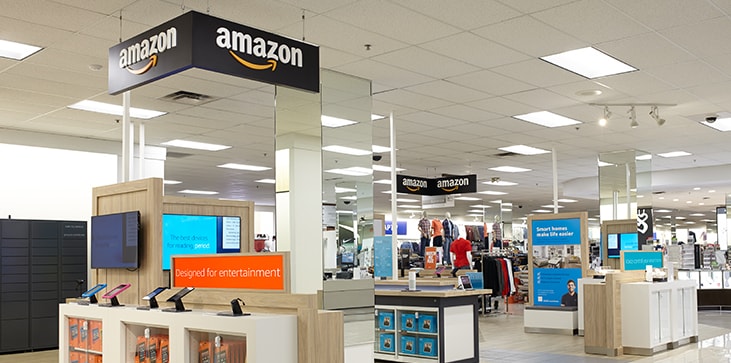
Only last month, Kohl’s and Amazon also announced that the store would start carrying Amazon products in about 200 of its stores. In a few stores, Kohl’s also features a special “Amazon Smart Home Experience.” If Amazon ever bought Kohl’s, nobody would be all that surprised, I guess.

One nice feature of this program is that the returns are free and that nobody will ask you why you returned an item. These regretful Amazon purchases also don’t have to be packaged. Kohl’s employees will handle all that for you.

What’s in it for Kohl’s? As people walk into Kohl’s to return the Bluetooth speaker they finally decided they really didn’t need, they’ll not only become familiar with the brand but maybe pick up a shirt or an Amazon Echo, too. Since it started taking Amazon returns, foot traffic to the stores that participated in its test is up and revenue in those stores increased as well (and well beyond what the company experienced in other stores), so this concept seems to be working out alright for Kohl’s.

Amazon expands partnership with retail company Casino Group in France

Casino Group and Amazon announced that they're expanding their partnership in France. In particular, there will be Amazon lockers in 1,000 supermarkets and smaller grocery stores across France.

Casino Group partnered with Amazon last year to launch Monoprix on Amazon Prime Now. Prime members in Paris can order groceries and other products you'd regularly find in Monoprix supermarkets and get them delivered in just a couple of hours.

And it sounds like this offering is working well as you'll find Monoprix on Prime Now in other big cities in France.

In addition to Monoprix, Casino Group is adding Casino-branded items to Amazon as well as wine sourced by Casino. It's unclear if those products will be limited to Prime Now or not.

Amazon will take advantage of Casino Group’s large network of stores to add Amazon lockers in 1,000 locations. If you live near a Monoprix, Monop’, Géant, Hyper Casino, Casino Supermarché, Leader Price, Casino shop, Vival or Spar, you can expect to see a locker pretty soon.

Surprisingly, Franprix is not part of the deal even though they have a ton of stores in dense urban areas.

Digging into key takeaways from our 2019 Robotics+AI Sessions Event

Extra Crunch offers members the opportunity to tune into conference calls led and moderated by the TechCrunch writers you read every day. This week, TechCrunch’s Brian Heater and Lucas Matney shared their key takeaways from our Robotics+AI Sessions event at UC Berkeley last week.

The event was filled with panels, demos and intimate discussions with key robotics and deep learning founders, executives and technologists. Brian and Lucas discuss which companies excited them most, as well as which verticals have the most exciting growth prospects in the robotics world.

“This is the second [robotics event] in a row that was done at Berkeley where people really know the events; they respect it, they trust it and we’re able to get really, I would say far and away the top names in robotics. It was honestly a room full of all-stars.

I think our Disrupt events are definitely skewed towards investors and entrepreneurs that may be fresh off getting some seed or Series A cash so they can drop some money on a big ticket item. But here it’s cool because there are so many students. robotics founders and a lot of wide-eyed people wandering from the student union grabbing a pass and coming in. So it’s a cool different level of energy that I think we’re used to.

And I’ll say that this is the key way in which we’ve been able to recruit some of the really big people like why we keep getting Boston Dynamics back to the event, who generally are very secretive.”

Brian and Lucas dive deeper into how several of the major robotics companies and technologies have evolved over time, and also dig into the key patterns and best practices seen in successful robotics startups.

For access to the full transcription and the call audio, and for the opportunity to participate in future conference calls, become a member of Extra Crunch. Learn more and try it for free. 


A week with the Samsung Galaxy Fold

I know, I know.

I will say this about the Galaxy Fold, however: it’s been a hell of a conversation piece. I’ve had a LOT of dialogues with strangers since I started using it as my day-to-day. And let’s be honest, that’s a big part of being an early adopter.

The Galaxy Fold is also the most polarizing device I can recall have used. Everyone who sees the thing wants to play with it, but reaction has been very mixed. I was at a Fedex store the other day and ended up handing it off to two of the four employees during the five minutes I was waiting to get a package.

Interestingly, they all seemed to be aware of the screen issues. Foldables have captured the public imagination like few recent consumer electronics. That’s going to be a mixed bag for Samsung. On the upside, it means a larger potential user base. On the downside, it more people are looking on as the company figures out what to do with a malfunctioning product.

On the whole, people at the FedEx store and the various TSA/airline employees I’ve interacted with have been impressed by the product. One said it was smaller than she expected, which took me back a bit, after so many have commented on how bulky it is. I suppose she was expecting me to unfold an iPad.

Some of the TechCrunch writers/editors were a bit less impressed when I had the product with me at our robotics event last week. Tough crowd, obviously.

I’ve fallen somewhere between the two. The fold is undoubtedly an impressive bit of engineering when it’s working. For now, it seems our early suspicions that the device wasn’t ready for prime time appear to have been on the mark, as the company has shifted from “a limited number of early Galaxy Fold samples” to pushing back the launch indefinitely.

It opens up the field the number of other already announced foldable devices (assuming they don’t experience similar problems). Of course, Samsung’s product lines, it should be noted, have bounced back from worse.

Anyway, this marks the end of my daily notes. I still plan to have a review this week, in spite of, well, everything.

N26 opens tech hub in Vienna with a focus on security

Fintech startup N26 is opening its fourth office in Vienna. Eventually, the company plans to hire 300 software engineers, product managers and IT specialists.

N26 is building a mobile bank and has managed to attract 2.5 million users over the past few years. It raised a $300 million round back in January.

This is interesting news as the company says that the new tech hub will focus on security and in particular detecting fraudulent activity. N26 plans to use artificial intelligence to develop a sort of real-time risk scoring system. The company will compare card transactions with your smartphone location as well.

Multiple articles have highlighted a handful of cases of fraud in recent weeks. Customers tried to use N26 for money-laundering purposes. It took some time before N26 reacted and closed those accounts.

Every bank suffers from this kind of issues. In France, BNP Paribas, Société Générale, Crédit Agricole and Crédit Mutuel have all been fined in the past for instance. But it’s interesting to see how N26 is reacting to those risks.

N26 has experienced tremendous growth, and the startup wants to scale its workforce appropriately so that it’s not short-staffed when faced with those issues. Similarly, it creates challenges when it comes to customer support and average response time.

It’s in the company’s best interest to follow strict rules when it comes to fraudulent activity. As a company with a banking license, N26 is regularly audited. N26 sent me the following statement a couple of weeks ago regarding audits:

N26, as all licensed banks, is subject to regular internal and external independent audits, including those by regulatory bodies such as BaFin, the German Financial Authority. Since we have a German bank license, we’re supervised by BaFin and audited on a regular basis. Any findings are promptly reviewed, implemented and monitored in coordination with the BaFin. We strive to meet all requirements consistently and take any required measures as quickly as possible.

As a bank it is imperative to continuously evaluate and improve all our structures, safety measures and service. We continuously invest in our security systems, customer support, and in hiring the right talent. To ensure we have the right talent to handle our responsibilities as a bank, we’ve increased our company size to more than 1,000 employees. The number of employees in customer service alone has tripled in the last year, and we will continue to grow across all departments to ensure regulatory compliance and serve our customers in the best way.

That’s why today’s news makes a ton of sense. There are already hundreds of people working for N26 in Berlin. Opening a new office in Vienna is a way to reach a new talent pool.

The team in Vienna will also work on shared Spaces and peer-to-peer payment improvements so that you can create sub-accounts and share them with other N26 users. The startup also launched local IBANs for new users in Spain today. The company currently has offices in Berlin, Barcelona and New York.

Oracle turns to innovation hubs to drive cultural and business shift to cloud

Oracle was founded in 1977. While it’s not exactly IBM or GE, both of which date back to the late 19th and early 20th centuries respectively, it is old enough to be experiencing a fair bit of disruption in its own right. For a good part of its existence, it sold databases to some of the biggest companies in the world, but today as the market changes and shifts from on-prem data centers to the cloud, how does a company like Oracle make that transition?

Of course, Oracle has been making the shift to the cloud for the last several years, but it would be fair to say that it came late. Plus, it takes more than building some data centers and pushing out some products to change a company the size of Oracle. The company leadership recognizes this, and has been thinking at the highest levels of the organization about how to successfully transform into a cloud company from a cultural and business perspective.

To that end, Oracle has opened 5 innovation hubs over the last several years with locations in Austin, Texas; Reston, Virginia; Burlington, Massachusetts; Bangalore, India and Santa Monica, California. What are these centers hoping to achieve, and how will it extend the lessons learned to the rest of the company? Those are big questions Oracle must answer to make some headway in the cloud market.

Understanding the problem

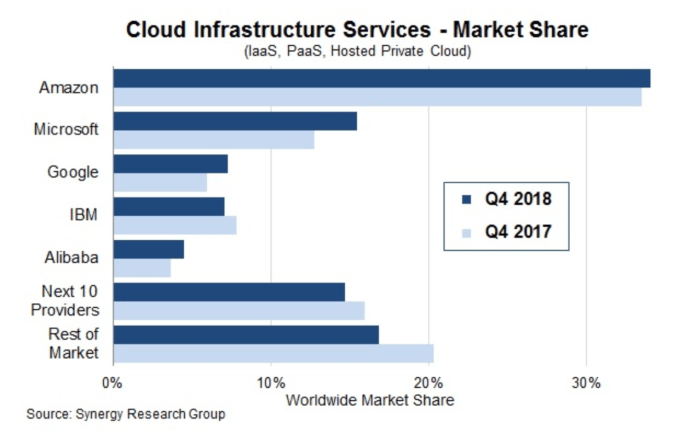
Oracle seems to understand it has to do something different to change market perception and its flagging market position. Synergy Research, a firm that tracks cloud marketshare reports that the company is struggling

“For cloud infrastructure services (IaaS, PaaS, hosted private cloud services) — Oracle has a 2 percent share,” John Dinsdale, chief analyst and managing director at Synergy told TechCrunch. He added, “It is a top ten player but it is nowhere near the scale of the leading cloud providers; and its market share has been steadily eroding.”

The news is a bit better when it comes SaaS. “Along with SAP, Oracle is one of the leaders in the ERP segment. But enterprise SaaS is much broader than ERP and across all of enterprise SaaS it is the number 4 ranked provider behind Microsoft, Salesforce and Adobe. Oracle worldwide market share in Q4 was 6 percent,” Dinsdale said.

The company knows that it will take a vast shift to change from an organization that mostly sold software licenses and maintenance agreements. It pushed those hard, sometimes so hard that it left IT pros with a sour taste in their mouths. Today, with the cloud, the selling landscape has changed dramatically to a partnership model. The company knows that it must change too. The question is, how?

That will take an entirely new approach to product development, sales and marketing; and the innovation hubs have become a kind of laboratory where engineers can experiment with more focussed projects, and learn to present their ideas with goal of showing instead of telling customers what they can do.

And the young shall lead

One way to change the culture is to infuse it with fresh-thinking, smart young people and that’s what Oracle is attempting to do with these centers, where they are hiring youthful engineers, many right out of college, to lead the change with the help of more seasoned Oracle executives.

They are looking for ways to rethink Oracle’s cloud products, to pull the services together into packages of useful tools that helped solve a specific business problems from prescription opioid abuse to predicting avocado yields. The idea isn’t just to have a some section of the company where people work on dream projects. They want them to relate to real business problems that results eventually in actual sales and measurable results.

Hamza Jahangir, group vice president for the cloud solution hubs at Oracle says they look for people who want to dig into new solutions, but they want a practical streak in their innovation hub hires. “We don’t want just tinkerers. If the only problem you’re solving is that of your own boredom, that’s not the type of person we are looking for,” he said.

Executive buy-in

The idea of the innovation center actually began with co-CEO Mark Hurd, according to Jahangir. He had been working for several years to change the nature of the sales force, the one that had a reputation of strong-arming IT pros, with a new generation by hiring people right out of college with a fresh approach.

Hurd didn’t want to stop with sales though. He began looking at taking that same idea of hiring younger employees to drive that cultural shift in engineering too. “About two years ago, Mark challenged us to think about how can we change the customer-facing tech workforce as the business model was moving to the cloud,” Jahangir said.

Hurd gave him some budget to open the first two centers in Austin and Reston and he began experimenting, trying to find the right kinds of employees and projects to work on. The funding came without of a lot of strings or conditions associated with it. Hurd wanted to see what could happen if they unleashed a new generation of workers and gave them a certain amount of freedom to work differently than the traditional way of working at Oracle.

Changing expectations

Jahangir was very frank when it came to assessing customer’s expectations around Oracle moving to the cloud. There has been a lot of skepticism and part of the reason for the innovation centers was to find practical solutions that could show customers that they actually had modern approaches to computing, given a chance.

The general customer stance has been, “We don’t believe you have anything real, and we need to see true value realized by us before we pay you any money,” he said. That took a fundamental shift to focussing on actual solutions. It started with the premise that the customers shouldn’t believe any of the marketing stuff. Instead it would show them.

“Don’t bother watching a Powerpoint presentation. Ask us to show you real solutions and use cases where we have solved real material problems — and then we can have a discussion.”

Even Chairman and company founder Larry Ellison recognizes the relationship and selling model needed to change as the company moves to the cloud. Jahangir relayed something he said in a recent internal meeting, “In the cloud we are now no longer selling giant monolithic software. Instead we are selling small bites of the apple. The relationship between the vendor and the buyer is becoming more like a consumer model.” That in turn requires a new way of selling and delivering solutions, precisely what they are trying to figure out at the innovation hubs.

Putting the idea to work

Once you have a new way of thinking, you have to put it to work, and as the company has created these various hubs, that has been the approach. As an example, one that isn’t necessarily original, but that puts Oracle features together in a practical way, is the connected patient. The patient wears a Fitbit-like monitor, uses a smart blood pressure cuff and a smart pill box.

The patient can then monitor his or her own health with these tools in a consolidated mobile application that pulls this data together for them using the Internet of Things cloud service, Oracle Mobile Cloud and Oracle Integration Cloud. What’s more, that information gets shared with the patient’s pharmacy and doctor, who can monitor the patient’s health and get warnings when there is a serious issue, such as dangerously high blood pressure.

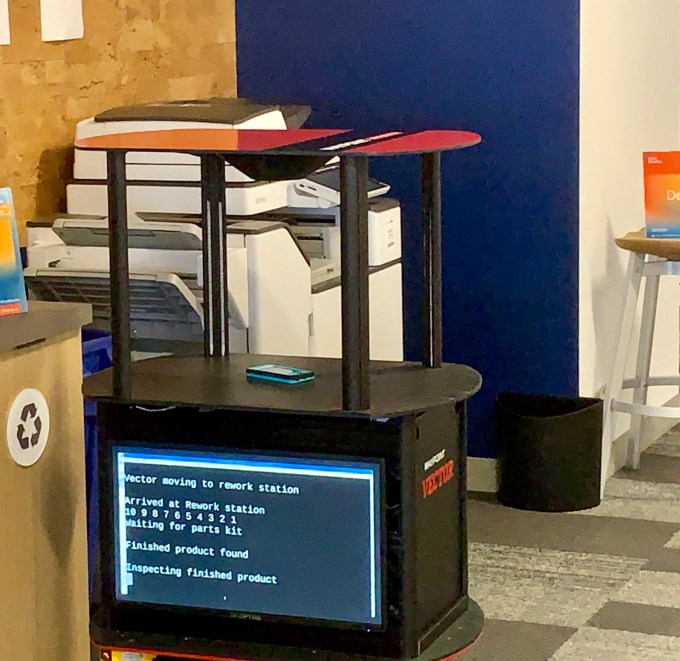
Another project involved a partnership with Waypoint Robotics, where they demonstrated a robot that worked alongside human workers. The humans interacted with the robots, but the robot moved the goods from workstation to workstation acting as a quality control agent along the way. If it found defects or problems, it communicated that to the worker via a screen on the side of the unit, and to the cloud. Every interaction between the humans, goods and robot was updated in the Oracle cloud.

Waypoint Robotics Robot inspecting iPhones. Information on the display shows it communicating with the Oracle cloud. Photo: Ron Miller

One other project worked with farmers and distributors to help stores stay stocked with avocados, surely as good a Gen Z project as you are likely to find. The tool looks at weather data, historical sales and information coming from sensors at the farm, and it combines all of that data to make predictions about avocado yields, making use of Oracle Autonomous Data Warehouse, Oracle Analytics Cloud and other services from Oracle cloud stack.

Moving beyond the hubs

This type of innovation hub has become popular in recent years as a way to help stave off disruption, and Oracle’s approach is actually in line with this trend. While companies sometimes isolate them to protect them from negativity and naysayers in an organization, leaving them isolated often prevents the lessons learned from being applied to the broader organization at large, essentially defeating the very purpose of creating them in the first place.

Jahangir says that they are attempting to avoid that problem by meeting with others in the company and sharing their learnings and the kinds of metrics that they use in the innovation center to measure success, which might be different from the rest of the company.

He says to put Oracle on the customer agenda, they have to move the conversation from from religious battles, as he calls how people support or condemn tech from certain companies. “We have to overcome religious battles and perceptions. I don’t like to fight religion with more religion. We need to step out of that conversation. The best way we have seen for engaging developer community is to show them how to build really cool things, then we can hire developers to do that, and showcase that to the community to show that it’s not just lip service.”

The trick will be doing that, and perhaps the innovation centers will help. As of today, the company is not sharing its cloud revenue, so it’s hard to measure just how well this is helping contribute to the overall success of the company, but Oracle clearly has a lot of work to do to change the perception of the enterprise buyer about its cloud products and services, and to increase its share of the growing cloud pie. It hopes these innovations hubs will lead the way to doing that.

Jahangir recognizes that he has to constantly keep adjusting the approach. “The Hub model is still maturing. We are finding and solving new problems where we need new tooling and engagement models in the organization. We are still learning and evolving,” he said.

Netflix offers $2 billion more in debt to fund its content spending

Netflix is raising another $2 billion in debt to fund its content spending and other expenses, the company announced this morning. The news comes ahead of the launches of new streaming service competitors from Disney, Apple, and AT&T’s WarnerMedia. It also follows Netflix’s offer of another $2 billion in debt back in October 2018.

The streaming service says it plans to use the debt funding for general purposes, including “content acquisitions, production and development, capital expenditures, investments, working capital and potential acquisitions and strategic transactions.”

The funds will be raised through unsecured notes that will be issued in two series in both U.S. dollars and euros, it says.

Netflix spends a lot of cash to stay ahead of the competition and acquire subscribers. It believes that its investment in original content — shows and movies that users can’t find anywhere else, and that it owns the rights to — will help the company to generate revenues in the years ahead.

In January, Netflix said its cash burn would peak in 2019, and its free cash flow deficit for 2019 will end up around $3.5 billion, CNBC notes.

This year, its content budget is expected to reach $15 billion, Variety reported earlier.

The additional $2 billion in debt will bring Netflix’s long-term debt to around $12.3 billion, Variety now points out. It also says Netflix hasn’t paid down any significant amount of that debt to date. Instead, its interest on that debt is increasing — $135.5 million in interest expense in Q1 2019, or around 3% of revenue. That’s up 67% from the $81.2 million a year ago, the report adds.

In a letter to shareholders earlier this year, Netflix warned investors it would continue to raise debt.

“As long as we judge our marginal  after-tax cost of debt to be lower than our marginal cost of equity, we’ll continue to finance our working capital needs through the high yield market,” it read.

The additional funds come just ahead of several notable streaming service launches, including Apple TV+ which is smaller on the content side but will tap into Apple’s massive iPhone user base; AT&T’s WarnerMedia service; and perhaps most significantly, Disney+.

The latter could even end up being a low-cost alternative to Netflix for families, who are looking for more kid-friendly content as well as programming that parents and kids can watch together. There’s not as much of that out there today, as so many shows are now either adult-oriented or only for children, with no middle ground. Disney+, however, will include a range of family fare from Star Wars, Marvel, National Geographic, and Pixar, in addition to its Disney animation. And at $6.99 per month, Disney+ is a big step down in price from Netflix’s entry-level plan, $12.99 per month.