Verizon and Google ink deal to offer YouTube TV to Verizon wireless and Fios subscribers

Just days after Google and Amazon buried the hatchet over their longstanding streaming feud, Google has made another interesting inroad in its bid to bring yet more ubiquity to its YouTube-based premium video efforts. Today, Verizon (which owns TechCrunch) and the search giant announced a new partnership where Verizon customers will be able to subscribe to YouTube TV through their accounts to watch “on whatever platform they choose,” in the words of Erin McPheron, Verizon’s head of content strategy and acquisition.

That will mean, in Verizon terms, getting a YouTube TV stream if you are a 5G wireless home customer as part of an internet bundle, or as part of your Fios subscription if you are a customer of Verizon’s fiber-optic TV, telephone and internet service. It sounds like there will be other options to come. “Verizon will also offer unique, high-value YouTube TV promotions to customers across platforms,” the company added.

YouTube TV is an all-in-one bundle that essentially replaces the kinds of packages offered by cable TV providers that includes some 70 networks such as ABC, CBS, FOX and NBC, cable channels like HGTV, Food Network, TNT, TBS, CNN, ESPN, FX and on-demand video, which also includes DVR options for each of the six accounts that comes with a subscription, along with recommendation algorithms (similar to Netflix’s) for each viewer. It looks like the YouTube TV offer will sit alongside other bundles that Verizon already offers to users, for example see these action/entertainment, kids and sports/news bundles of channels on Fios. Fios also offers new customers one free year of Netflix.

The deal underscores Verizon’s ongoing efforts to play nice with third-party content providers to continue enhancing the array of services that consumers have to choose from at Verizon. More options helps sweeten the deal and keep people from moving to other services, or away from any bundles at all and opting to create their own a la carte selections, cord-cutter style.

This is especially important as it continues to build out its next-generation 5G wireless network and looks for more subscribers and usage of it. In its earnings report earlier today, Verizon reported that it was investing some $4.3 billion in capex in the first quarter of the year to build out that 5G network, which is in part meant to help optimise video traffic over wireless networks.

“Our network and technology leadership uniquely positions us to lead the content revolution, which centers around choice for our customers,” said McPherson in a statement. “As we pave the path forward on 5G, we’ll continue to bring our customers options and access to premium content by teaming up with the best providers in the industry and leveraging our network as-a service strategy. We were first in the world to bring commercial 5G to our customers and now another first on the content front as we offer our customers access to YouTube TV on whatever platform they choose.”

For Google, it gives the company — in hot competition with a number of other over-the-top streaming providers like Amazon and Netflix and Apple — one more route to reaching consumers wherever they happen to be already, and whether they are watching on a mobile phone or a TV in their living rooms. It’s not clear in the release, but it would be interesting to know if Verizon provides preferred bandwidth to a service as part of the partnership that would improve the quality of the stream.

As a point of comparison, last week Google said that YouTube users on Fire TV will be able to sign in, have full access to their library and play videos in 4K HDR at 60 fps on supported devices.

It’s not clear what kind of pricing Verizon will offer for YouTube TV, which costs $49.99 per month in the US for new customers.

“YouTube TV has become known for its best-in-class user experience that enhances the way users watch live TV today,” said Heather Rivera, global head of product partnerships at YouTube, in a statement. “With this partnership, we’re making it simple and seamless for Verizon’s customers to sign up to enjoy YouTube TV on-the-go on their mobile phones or tablets or at home on their big screen devices.”

We’ll update this post as we learn more.
Led by LA-based March Capital, Astound raises $15.5 million for employee help desk automation services

Astound, a company selling automated employee help desk services, has raised a new round of $15.5 million from investors led by the Los Angeles investment firm March Capital Partners.

Previous investors Vertex Ventures, Pelion Venture Partners, Moment Ventures, and the Slack Fund also participated in the funding, which brings Astound’s total capital raised to $27 million.

The company’s software integrates with ServiceNow, BMC, Jira, Cherwell, and Workday, among others.

For co-founder and chief product officer Dan Turchin, the company is the culmination of decades of work spent developing tools for human resources and employee services. It’s the seventh company that Turchin has been involved in around applying technology to help employees, he says. Most recently Turchin worked at ServiceNow, which he left in 2014 to launch Astound.

Astound said it would use the financing to increase its product development and sales and marketing efforts, according to a statement.

Taking information from structured and unstructured data sources across different information silos within a business and offering it up to employees via automated messages (it’s a chatbot) frees human resources and helpdesk staff to engage at a higher level with employees, companies like Astound say.

Automation is certainly coming to businesses, whether employees like it or not. A study from McKinsey indicates that 70 percent of companies will bring in at least one automation technology by 2030. And those technologies could contribute up to $120 billion in increased economic value, according to the McKinsey study cited by Astound.


The company behind Laundroid files for bankruptcy

At the end of the day, Laundroid amounted to little more than a fun show demo. The device was a bit silly and prohibitively large and expensive for most  to consider actually purchasing. All in all, it was a lot of work for the relatively simple task of folding laundry.

Seven Dreamers, which has been a staple at trade shows in recent years, has filed for bankruptcy in Japan. No official word yet on whether the dream is fully dead, but things certainly look bleak for the company, which has racked up in the roughly $22 million in debt as it’s struggled to actually ship its laundry folding machine.

And while Laundroid was reportedly still on track for a 2019 release, according to Seven Dreamers, the product had too many rough edges left to smooth out, struggling with even basic tasks according to hands-on reports.

With Laundroid’s future in doubt, California-based Foldimate seems reasonably well positioned to dominate whatever market might actually exist for such a product. The company got fairly good marks for its own robotic folding technology back at CES.

The automation of household tasks has been a holy grail for consumer robotics in recent years. Aside from the Roomba, however, it’s so far proven an impossible nut to crack.

India’s Mfine raises $17.2M for its digital healthcare service

Mfine, an India-based startup aiming to broaden access to doctors and healthcare using the internet, has pulled in a $17.2 million Series B funding round for growth.

The company is led by four co-founders from Myntra, the fashion commerce startup acquired by Flipkart in 2014. They include CEO Prasad Kompalli and Ashutosh Lawania who started the business in 2017 and were later joined by Ajit Narayanan and Arjun Choudhary, Myntra’s former CTO and head of growth, respectively.

The round is led by Japan’s SBI Investment with participation from sibling fund SBI Ven Capital and another Japanese investor Beenext. Existing Mfine backers Stellaris Venture Partners and Prime Venture Partners also returned to follow on. Mfine has now raised nearly $23 million to date.

“In India, at a macro-level, good doctors are far and few and distributed very unevenly,” Kompalli said in an interview with TechCrunch. “We asked ‘Can we build a platform that is a very large hospital on the cloud?’, that’s the fundamental premise.”

There’s already plenty of money in Indian health tech platforms — Practo, for one, has raised over $180 million from investors like Tencent — but Mfine differentiates itself with a focus on partnerships with hospitals and clinics, while others have offered more daily health communities that include remote sessions with doctors and healthcare professionals who are recruited independently of their day job.

“We are entering a different phase of what is called health tech… the problems that are going to be solved will be much deeper in nature,” Kompalli said in an interview with TechCrunch.

Mfine makes its money as a digital extension of its healthcare partners, essentially. That means it takes a cut of spending from consumers. The company claims to work with over 500 doctors from 100 ‘top’ hospitals, while there’s a big focus on tech. In particular, it says that an AI-powered ‘virtual doctor’ can help in areas that include summarising diagnostic reports, narrowing down symptoms, providing care advice and helping with preventative care. There are also other services, including medicine delivery from partner pharmacies.

To date, Mfine said that its platform has helped with over 100,000 consultations across 800 towns in India during the last 15 months. It claims it is seeing around 20,000 consultations per month. Beyond helping increase the utilization of GPs — Mfine claims it can boost their productivity 3/4X — the service can also help hospitals and centers increase their revenue, a precious commodity for many.

Going forward, Kompalli said that the company is increasing its efforts with corporate companies, where it can help cover employee healthcare needs, and developing its insurance-style subscription service. Over the coming few years, that channel should account for around half of all revenue, he added.

A more immediate goal is to expand its offline work beyond Hyderabad and Bangalore, the two cities where it currently is.

“This round is a real endorsement from global investors that the model is working,” he added.

Voiceflow, which allows anyone to make voice apps without coding, raises $3.5 million

The market for voice apps has opened up — Amazon Alexa’s platform alone has over 80,000 skills as of earlier this year — and there’s little sign of that growth slowing now that smart speakers have hit critical mass in the U.S. To capitalize on this trend, Voiceflow, a startup making it easier for product teams to build voice applications for Alexa and Google Assistant, has raised $3 million in seed funding.

The round was led by True Ventures, and includes participation from ProductHunt founder Ryan Hoover, Eventbrite founder Kevin Hartz, and InVision founder Clark Valberg. The company has previously raised $500,000 in pre-seed funding.

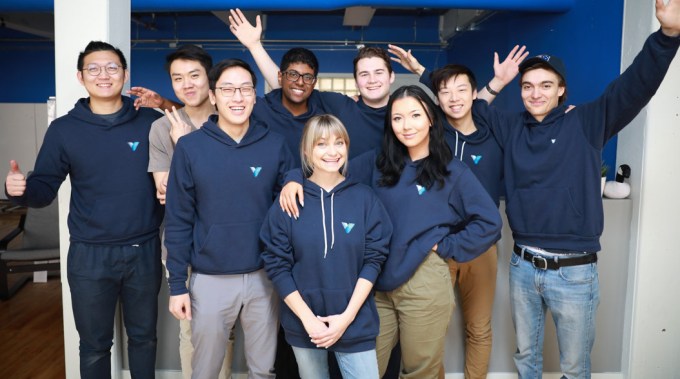
Explains Voiceflow CEO and co-founder Braden Ream, the idea for a collaborative platform for building voice apps came from direct experience as a voice app developer.

The team — which also includes Tyler Han, Michael Hood, and Andrew Lawrence — had decided to build a voice application offering interactive children’s stories for Alexa, called Storyflow.

But as the team began to build out its library of these choose-your-own-adventure stories, they realized the process wasn’t scaling fast enough to serve their user base — they simply couldn’t build the storyboards with all their branches fast enough.

“At some point, we had the idea to just do a drag-and-drop,” says Ream. “I wished I could build the flow chart, the scripting and the actual coding — I wished this was all one step. That led us to build a really early iteration of what is now Voiceflow. It was sort of an internal tool,” he continues. “And being the nerds that we are, we kept making the platform better by adding logic, variables, and modularity.”

The original plan was to make Storyflow’s platform a “YouTube of voice” so anyone could build their stories easily.

But when the Storyflow community got ahold of what the team had built, they very quickly wanted to use it to build their own voice apps — not just interactive stories.

“That’s when the lightbulb went off for us,” notes Ream. “This could easily be the central platform for building voice apps, and not necessarily interactive children’s stories. The pivot was very easy,” he says. “All we had to do was change our name from Storyflow to Voiceflow.”

The platform, officially launched in November, and today has over 7,500 customers who have published some 250 voice apps using its tools.

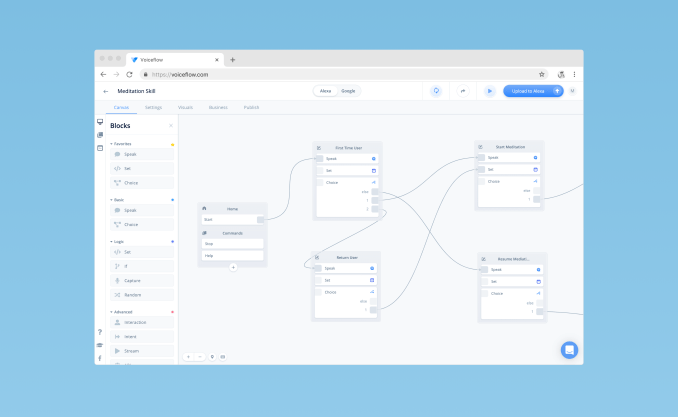
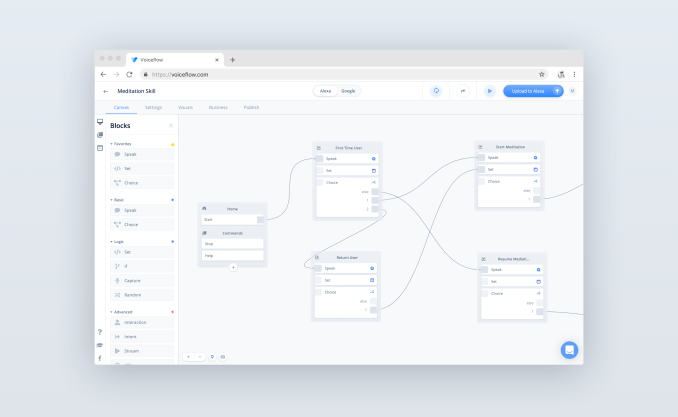
Voiceflow is designed to be non-technical for those who don’t know how to code. For example, its two basic block types are “speak” and “choice.” Its blocks are organized on the screen through drag-and-drop, as users design the flow of their app. For more technical users, an advanced section allows you to add logic and variables — but it’s still entirely visual.

For enterprise customers, there’s also an API block in Voiceflow that allows the customer to integrate the business’s own API into their voice app.

What’s also interesting about the product is its collaborative features. While Voiceflow is free for individuals, its business model is focused on allowing teams to work together to build voice apps. Priced at $29 per month in its paid workspaces, voice agencies that have a larger staff — including linguists, voice user interface designers, and developers, for example —  can all work together on one board, share projects, and hand of assets more easily.

With the seed funding, Voiceflow plans to grow the team by hiring more engineers, and continue to develop the platform.

Longer-term, the company wants to help people design better, more human-sounding voice apps through its platform.

“The problem right now is you have documentation and best practices by Google. Then you have the exact same on the Alexa side, but there’s no coherent industry standard. And there’s certainly no tangible base of examples, or easy way to put these into practice,” Bream explains. “If we can help spawn another 10,000 voice user interface designers — we can help train them and give them a platform that’s accessible, where they can collaborate with each other — I think you’re going to see a tremendous uplift in the quality of conversations.”

On this front, Voiceflow has started a program called Voiceflow University, which today includes video tutorials but will later become a more standardized training course.

In addition to the videos, Voiceflow networks with its community directly on Facebook, where over 2,500 developers, linguists, educators, designers, and entrepreneurs actively discuss the voice app design and development process.

This interaction between Voiceflow and its user base was one of the key selling points for True Ventures’ Tony Conrad.

“After I left the [pitch] meeting and I started digging around a little bit, the thing that blew me away was the engagement of the community of developers. That’s unlike anybody else. The single biggest differentiator of this platform is actually Braden and the team’s engagement with the community,” Conrad says. “It reminds me of early WordPress.”

Voiceflow also recently worked with another visual design tool Invocable, which has shut down, to allow its users to transition to Voiceflow’s platform.

There is, perhaps, a cautionary tale in there — Invocable, in its farewell blog post, points out that people continue to use smart speakers mainly for things like music, news, reminders and simple commands. It also says that Natural Language Processing and Natural Language Understanding haven’t developed to the point where they can support higher-quality voice apps. That day will likely come to pass, but there’s a bit of a timing issue when it comes to betting on the right platform to support the voice app development market in the meantime, ahead of widespread consumer adoption.

Toronto-based Voiceflow is a team of twelve today and looking to grow.


Amazon opens Key delivery to garages

Starting today, Amazon can drop off packages to your garage. Assuming, of course, you’re cool with that. The massively multiplayer online retailer just expanded its Key delivery options to include garage, a feature it announced at the beginning of the year at CES.

Customers will have to opt-in, of course. And the whole thing requires a specific kind of garage door that uses myQ technology. Coincidentally (not really, though), the company’s offering a deal on the myQ Smart Garage Hub right now, which makes doors Key compatible.

Once that’s squared, eligible Amazon Prime customers can tick the “In-Garage delivery” box on check out. The Key app can also be used to remotely monitor the status of the door.

Amazon’s also using the occasion to announce that Key is available for customers in a number of news cities, including Charlotte, NC; Columbus, OH; Fresno, CA; Grand Rapids, MI; Hartford, CT; Las Vegas, NV; Norfolk, VA; Oklahoma City, OK; Omaha, NE; Rochester, NY; Stockton, CA; Virginia Beach, VA and and Wilmington, DE.

This first expansion of the service brings the total number of Key locations to 50. The company has added a number of new delivery options in addition to home and garage, including businesses and cars.

Chive Media’s out-of-home TV spinoff Atmosphere raises $10M

When Chive Media Group spun out its out-of-home TV business last year, co-founder and CEO Leo Resig said the structure should help the new company, called Atmosphere, raise venture capital.

Looks like those fundraising efforts were successful, with Atmosphere announcing that it has raised $10 million in Series A funding led by S3 Ventures, with participation from Capstar Capital.

“I have yet to meet someone who enjoys watching closed-captioning or talking heads at their favorite establishments,” said S3 Ventures Partner Charlie Plauche in a statement. (Plauche is joining Atmosphere’s board of directors.) “Yet, that is the best option most businesses have to entertain patrons. That all changes with Atmosphere, who offers engaging content to viewers of all ages with no audio needed.”

Chive Media Group is known for its namesake website, theChive, which focuses on funny and viral content. Chive co-founders (and brothers) Leo and John Resig told me that when the company decided to move into video, it didn’t have the money to create a big production arm.

“We stuck to our roots of what we do best: Seek out and curate and package existing content,” John said. As a result, the company was able to license “a pretty large IP library of short form, mostly amateur viral videos,” which it then offered to bars and other out-of-home locations as Chive TV.

Chive TV still exists, but it’s now just one of the channels that Atmosphere offers, with Leo noting that Atmosphere now includes more polished videos from partners like Red Bull and GoPro.

“Everyone’s creating content these days,” John added. “We’re a shiny new distribution vessel for a lot of that content.”

In general, Leo argued that Atmosphere content is better tailored than regular TV to the needs of (say) a restaurant or a doctor’s office.

“It’s ambient TV,” he said. “It’s not episodic, it’s not character-driven, you can pick it up and leave it without missing a touchdown.”

Plus, as Plauche mentioned, it’s designed to be watchable without audio.

The company says Chive TV is already streamed in 4,300 bars, restaurants, gyms and other locations. And it’s adding around 450 venues every month.

At the same time, the Resigs said Atmosphere has been building up a technology backend, with the analytics and ad serving that you get with online video.

Until now, Chive and Atmosphere have been giving the content away for free while monetizing with ads, but Leo said they’ll soon start charging a monthly subscription fee of around $10 or $20, which he suggested is “not a lot of money for what the venues are getting,” particularly compared to their cable bill. There’s an additional product that venues can pay for to insert their own messages and house ads.

The Resigs actually hold the same title at both companies, but Leo (CEO) suggested that he’ll be spending more time on Atmosphere, while John (President) said he’ll be “straddling” the two organizations.

Leo said Atmosphere has around 20 employees — with another 20 who are currently splitting their work between Chive Media and Atmosphere, but will ultimately go work for one of the two organizations.

Blueshift announces $15M Series B to expand AI-fueled cross-channel marketing tool

Blueshift is startup founded by tech industry veterans, who saw first-hand how difficult cross-channel marketing was. They decided to launch a company and build a cross-channel marketing platform from the ground up that uses AI and machine learning to make sense of the growing amount of customer data. Today, the startup announced a $15 million Series B round to keep it going.

The round was led by Softbank Ventures Asia, a fund focused on AI startups like Blueshift . Previous investors Storm Ventures and Nexus Venture Partners also participated. Today’s investment brings the total raised to $30 million, according the company.

Company co-founder and CEO Vijay Chittoor says the marketing landscape is changing, and he believes that requires a new approach to allow marketers to take advantage of the multiple channels where they could be engaging with customers from a single tool.

“If you thought about the world of customer engagement at Walmart or Groupon [or any other retailer] 10 years ago, it was primarily an email problem. Today, we as customers, we’re interacting with these brands on not just email, but also on mobile notifications, Facebook custom audiences and WeChat [and across multiple other channels],” he explained.

He says that this has created a lot more data, which it turns out is a double-edged sword for marketing pros. “I think on one end, it’s exciting for a marketer or a CMO to have more data and more channels. It gives them more ways to connect. But at the same time, it’s also more challenging because now you have to make sense of thousand times more data. And you have to use it intelligently on not just one channel like email, but you’re now trying to make sense of data across 15 different channels,” Chittoor said.

This a crowded field with big players like Adobe, Salesforce and Oracle, among others, offering similar cross-channel, AI-fueled solution. In addition startups are attracting huge chunks of money to attack this problem, including Klayvio pulling in $150 million a couple of weeks ago and Iterable, which landed $50 million last month.

He says his company’s differentiator is the AI piece, and it is this piece that the company’s lead investor in this round has been focusing on in its investments. The company plans to use this round to continue building out its marketing platform and show marketers how to communicate intelligently across channels wherever the consumer happens to be. Customers include LendingTree, Udacity and BBC.

$35M-funded Omni pivots from storage to rentals via retailers

Omni simply couldn’t scale storing stuff in giant warehouses while dropping it and off picking it up from people on demand. Storage was designed to bootstrap Omni into peer-to-peer rentals of the goods in its care. But now it’s found a better way by partnering with retailers which will host and rent out goods for Omni that users will pick up themselves.

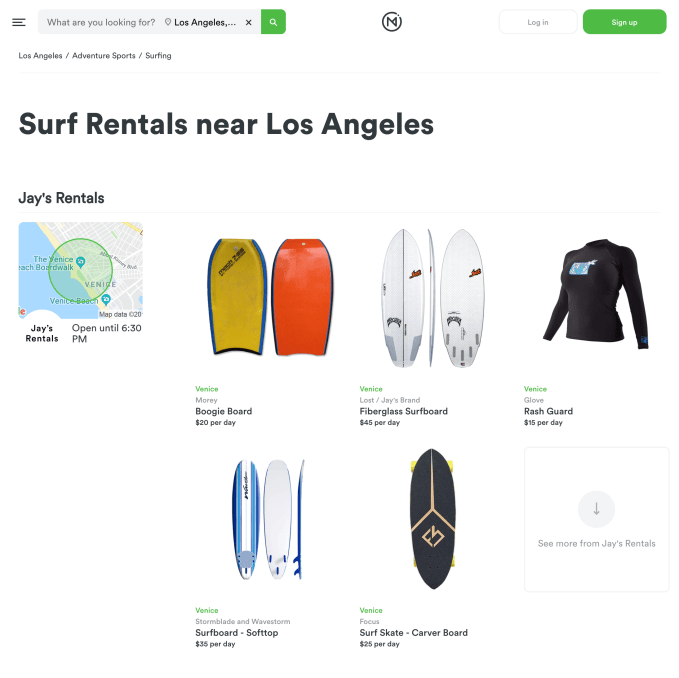
With that strategy, Omni is now formally pivoting from storage alongside its expansion from San Francisco and Portland into Los Angeles and New York. In SF and its new markets starting today, users can rent GoPros, strollers, drills, guitars, and more for pick up and drop off at local storefronts which will receive 80 percent of the revenue while Omni keeps 20 percent.

“Storage was always meant to supply a rentals marketplace. We launched storage in an Uber-for everything era and now it’s no secret that physical operations are tough to scale” Omni’s COO Ryan Delk telss me. “This new model gives our users more supply, local entrepreneurs a new revenue stream, and us the ability to launch new markets much more quickly than the old model of building rentals on top of the storage business.”

LA Omni users will be able to rent surf equipment for pickup and dropoff from local surf shop Jay’s

To that end, storage won’t come to any more markets, though storage services with delivery will continue in San Francisco. Users there and in Portland will also be able to pick up and drop off rental items from a few Omni-owned locations including its SF headquarter office. Omni will add retailer pickups in Portland and more in San Francisco soon.

“Ownership has a bit of a burden associated with it” Delk tells me, referencing the shifting attitudes highlighted by Marie Kondo and the tidyness movement. Ownership requires you to pay up front for tons of use down the line that may never happen. “Paying for access when you need it unlocks all these amazing experiences.”

Omni discovered the potential for the model when it ran an experiment. “What if we could pick up items directly from Omni?” Delk explains. Omni learned that many people “can’t afford to pay for transit both ways. It was pricing out a lot of people.” But pick-ups unlocked a new price demographic.

Meanwhile, Omni noticed some semi-pro renters had cropped up on its platform whowere buying tons of a popular item like chairs on Amazon, shipping them to its warehouse, then renting them out and quickly recouping their costs. It saw an opportunity to partner with local retailers who could give it instant supplies of items in new markets while handling all the pick up and drop off logistics. Those  businesses can choose black-out dates, pause for vacations, and sell items like normal and let Omni know to restock them so rentals don’t cannibalize their sales.

Verizon Q1 beats analyst expectations with earnings per share of $1.22

Verizon just released its first quarter earnings report, with earnings per share that came in significantly ahead of analyst expectations, while revenue was right in line with predictions.

The company reported EPS of $1.22 per share (or $1.20 when adjusted to exclude a 2 cent benefit due to a pension re-measurement triggered by its recent voluntary redundancy program) and revenue of $32.1 billion, which was up 1.1 percent year-over-year. Analysts had predicted EPS of $1.17 and revenue of $32.15 billion.

Verizon also saw 61,000 net additions to its postpaid retail wireless business, including 174,000 net additions on the postpaid smartphone side.

The Verizon Media division (which owns TechCrunch) reported revenue of $1.8 billion, down 7.2 percent year-over-year. The company blames this decline on falling desktop ad revenue.

The report comes as Verizon begins its 5G rollout in  Chicago and Minneapolis, with the company saying that the 5G network buildout was part of its $4.3 billion in capital expenditures.

“2019 is shaping up to be an exciting year for Verizon,” said chairman and CEO Hans Vestberg in a statement. “We are leading the world in the development of new technologies with the launch of our 5G Ultra Wideband network. Our ambition remains unchanged to provide the most advanced next-generation networks in the world.”

As of 8am Eastern, Verizon shares are up 0.72 percent in pre-market trading.