Samsung reportedly pushes back Galaxy Fold launch

Can’t say we didn’t see this coming. Four days out from the Galaxy Fold’s official launch date, Samsung is pushing things back a bit, according to a report from The Wall Street Journal that cites “people familiar with the matter.”

There’s no firm timeframe for the launch, though the phone is still expected “in the coming weeks,” at some point in May. We’ve reached out to Samsung for comment and will update accordingly. When a number a reviewers reported malfunctioning displays among an extremely small sample size, that no doubt gave the company pause.

I’ve not experienced any issues with my own device yet, but this sort of thing can’t be ignored. Samsung’s initial response seemed aimed at mitigating pushback, writing, “A limited number of early Galaxy Fold samples were provided to media for review. We have received a few reports regarding the main display on the samples provided. We will thoroughly inspect these units in person to determine the cause of the matter.”

https://platform.twitter.com/widgets.js

It also went on to note that the problems may have stemmed from users attempting to peel back a “protective layer.” Things took a turn to the more cautious over the weekend, however, when it was reported that the phone’s launch events in parts of Asia would be delayed (we reached out about that, as well, but haven’t heard back). Since then, a larger delay has seemed all but inevitable.

SiriusXM’s new streaming-only ‘Essential’ plan targets smart speaker owners

Last week, Amazon and Google rolled out free music streaming services to cater to the growing base of smart speaker owners. Now, SiriusXM is going after this market, too. The company has launched a new plan called SiriusXM Essential which targets those who listen in-home and on mobile devices, but not in cars. The streaming-only plan is also more affordable — $8 per month, versus the $15.99 per month (and up) plans for SiriusXM’s satellite radio service for cars.

With a subscription to Essential, customers can stream to in-home devices including Amazon Alexa, Amazon Fire TV, Chromecast, Apple TV, Roku, Sonos speakers, Xbox, Sony PlayStation and others, as well as to phones, tablets, and desktops.

The plan offers SiriusXM’s full lineup of over 300 channels, including 200+ channels of commercial-free music stations, and its new Pandora NOW station. There are also 100+ of the newer SiriusXM Xtra channels that offer more music and the ability to skip through songs. Beyond music, listeners can access sport talk channels, as well as entertainment, news and comedy stations.

“The strength of SiriusXM’s programming is evident in the tens of millions of people who subscribe and listen in their cars year after year. We’ve now created the Essential subscription as an appealing option for the many people, particularly younger consumers, who don’t have a car or don’t spend a lot of time in their car,” said Matt Epstein, Vice President of Marketing, SiriusXM Outside the Car, in a statement. “The Essential plan offers an attractive bundle of content at a competitively low price among streaming services,” he added.

The launch comes at a time when several markets are adjusting to better serve a younger demographic that often lives more urban, and doesn’t own a car — or waits until later in life to get one, having also delayed things like marriage, home ownership, and starting a family. That cuts into SiriusXM’s core business of offering in-car subscription radio.

The new plan also arrives just as smart speaker ownership has hit critical mass in the U.S. That’s led to increased competition from streaming music providers, who have now launched entry-level free services to reach listeners in the home. Amazon and Google, for instance, both launched ad-supported free music services last week for their respective smart speakers — the Amazon Echo and Google Home. These free tiers serve as funnels to the companies’ premium, paid subscriptions. Similarly, SiriusXM’s lower-cost subscription plan could later send its users over to pricier plans, if they later on do acquire a vehicle.

But it also caters to those who want a more radio-like experience, with news, sports, and entertainment, not just music; plus always-on streams of curated music, not playlists programmed by A.I.

SiriusXM Essential is $1 per month for three months before converting to the full price of $8 per month.

A hotspot finder app exposed 2 million Wi-Fi network passwords

A popular hotspot finder app for Android exposed the Wi-Fi network passwords for more than two million networks.

The app, downloaded by thousands of users, allowed anyone to search for Wi-Fi networks in their nearby area. The app allows the user to upload Wi-Fi network passwords from their devices to its database for others to use.

But that database of more than two million network passwords, however, was left exposed and unprotected, allowing anyone to access and download the contents in bulk.

Sanyam Jain, a security researcher and a member of the GDI Foundation, found the database and reported the findings to TechCrunch.

We spent more than two weeks trying to contact the developer, believed to be based in China, to no avail. Eventually we contacted the host, DigitalOcean, which took the database down within a day of reaching out.

“We notified the user and have taken the hosting the exposed database offline,” a spokesperson told TechCrunch.

Each record contained the Wi-Fi network name, its precise geolocation, its basic service set identifier (BSSID), and network password stored in plaintext.

Although the app developer claims the app only provides passwords for public hotspots, a review of the data showed countless home Wi-Fi networks. The exposed data didn’t include contact information for any of the Wi-Fi network owners, but the geolocation of each Wi-Fi network correlated on a map often included networks in wholly residential areas or where no discernible businesses exist.

The app doesn’t require users to obtain the permission from the network owner, exposing Wi-Fi networks to unauthorized access. With access to a network, an attacker may be able to modify router settings to point unsuspecting users to malicious websites by changing the DNS server, a vital system used to convert web addresses into the IP addresses used to locate web servers on the internet. When on a network, an attacker can also read the unencrypted traffic that goes across the wireless network, allowing them to steal passwords and secrets.

Tens of thousands of the exposed Wi-Fi passwords are for networks based in the U.S.

Corporations and private investors are backing new “green” deals as climate worries mount

In the nine years since private equity and venture capital investments into sustainable technologies last crossed the $6 billion threshold, the problems caused by global carbon emissions have only intensified.

Now, as the world confronts the reality that there’s not much time left to reverse course on carbon emissions and the impact they will have on life on earth, both corporate and private investors are once again stepping up their commitments to startups in the space.

In 2018 global venture capital investment into startups focused on sustainability jumped 127% to $9.2 billion, the highest since 2010, according to a January report from Bloomberg New Energy Finance. Powering that boost was a $1.1 billion investment in the smart window maker, View, and another $795 million for Chinese electric vehicle firm Youxia Motors. In fact, there were no fewer than eight VC/PE financings of Chinese EV specialist companies in 2018, totaling some $3.3 billion.

That stark assessment is coming from more corners of the scientific community and the reality of the danger is being emphasized by politicians and concerned citizens around the globe.

The simple truth is that things are getting worse. And for the past two years, emissions have been increasing as countries continue to use oil and gas and coal to fuel economic growth, even as the global community realizes that carbon emissions are an increasing threat.

A recent assessment by the U.S. government put the cost of climate change caused by carbon emissions at $500 billion annually by the end of the century. And the financial toll doesn’t begin to assess the cost to the quality of human life and the potential lives that will be lost because of climate-related disasters.

This isn’t the first time that the world has realized the threat climate change poses. It’s not even the second. Back in 1979 — and throughout the next decade —  the U.S. grappled with how to craft an appropriate response to the coming climate-related crisis. Perhaps unsurprisingly, the government failed, and the issue of imminent climate disaster was set aside.

Former Vice President Al Gore, picked up the thread in the mid-2000s in the wake of his defeat in the contested 2000 Presidential election by the Connecticut yankee turned Texas oilman George W. Bush. Through advocacy work and the popular climate-focused documentary “An Inconvenient Truth”, Gore was able to proselytize among a group of technocrats looking for the next big thing in the wake of the Internet explosion that had transformed professional and personal lives.

Venture capital investors flocked to invest in renewable technologies — from biofuels to new solar energy generating technologies to new battery chemistries and beyond.

Over the next seven years billion dollar companies would rise and fall on the back of speculative investment in the promise of a cleaner energy future that would disrupt the oil industry and turn billionaires into multi-billionaires — all while saving the world.

It didn’t work out.

Problems with scaling technologies beyond a controlled laboratory setting; global economic pressures wrought by an explosion of manufacturing capacity in countries like China; and the hubris of investors who thought that their investment acumen in picking winners of the information age could work just as well in centuries-old industries like oil and gas, or electricity, found themselves floundering in complicated, regulated markets with deep-pocketed incumbents and entrenched interests in promoting the status quo.

In the process investors lost hundreds of millions of dollars in the U.S. alone and destabilized some of the oldest firms in the investment industry.

Now, companies and investors are returning to the market in a major way. Some of the largest businesses in teh food and agriculture industry are investing in new companies that are developing protein replacements and novel cultivation technologies; utilities are investing more heavily in smart grid technologies as electrification and microgrids become more real; automakers and battery manufacturers are backing new energy storage technologies; and frontier investors are backing companies tackling everything from biologically based chemical manufacturing to new construction technologies for smart homes and cities, to new kinds of nuclear power that could transform how the world conceives of energy abundance (along with geo-engineering tech to remove carbon from the atmosphere).

“In the last few years, the number of technologies ripe for investment has expanded dramatically,” Ravi Manghani, research director for energy storage at Wood Mackenzie, an energy research and consultancy firm, told CNBC in March. “It’s no longer just three or four technology verticals.”

While none of these technological advancements are a guaranteed solution to the threats carbon emissions pose, or are surefire commercially viable businesses, the fact that investors are once again looking at sustainability as a viable investment thesis — capable of producing multiple billion dollar businesses is a good step forward.

Any plan to address decarbonization has to confront industries as diverse as agriculture, construction, transportation, chemicals and consumer goods from clothes to chemicals.

Failure to confront these challenges would be catastrophic. Even if global warming is restricted to just the 2 degree Celsius target set at the Paris climate agreement, that could mean the extinction of the world’s tropical reefs and several meters of sea-level rise, as The New York Times reported last August. Already the impacts of climate change have meant tens of billions of dollars in damage for the U.S. in 2018 alone.

“The era of incrementalism on climate change is over,” said Massachusetts Senator Ed Markey, one of the architects of the “Green New Deal” legislation, in an interview with Vox. “We are now in the era of the Green New Deal. It’s not going away. It is creating an incentive for governors to do more, for mayors to do more, for companies to do more. The polling says it has political legs that will drive it right into the election of 2020, and when that cycle is done, I think we’re going to see a much greater capacity for us to take the kind of action that we need.”

Tencent’s latest investment is an app that teaches grannies in China to dance

Besides churning out video games for China’s young generations, Tencent has also been attuned to the need of silver-haired users: its latest bet is an app that teaches middle-age and elderly users, most of whom are female, how to dance.

Called Tangdou, or “sugar beans” in Chinese, the app announced on Monday that it’s raised a Series C funding round led by Tencent with participation from existing investors GGV Capital and Xiaomi founder Lei Jun’s Shunwei Capital, as well as IDG Capital.

The financial infusion makes for an interesting move for Tencent, whose WeChat messenger counts users over the age of 55 as its fastest-growing group. In fact, Tangdou has piggybacked off WeChat to acquire users by creating lite-apps that are designed for ease of use and run within the ubiquitous chatting tool, which is many senior users’ first taste of the internet.

While Tangdou did not disclose the size of the round, the new proceeds brought its total funds raised to date to nearly $100 million. It last inked $15 million (in Chinese) from a Series B funding round in 2016 and another $5 million from a B-plus round in 2017.

“As [China’s] mobile internet enters the ‘second half’ of its development phase, the markets for maternal and child care, middle-age and elderly users have become the new red-hot verticals,” said GGV’s managing partner Jenny Lee in a statement.

Of China’s 829 million online users, 12.5 percent were above 50 years old in 2018, up from 10.4 percent in the year-earlier period, according to data collected by the government-run China Internet Network Information Center.

tangdou

Screenshots of the Tangdou app / Source: Tangdou

Clad in color-coordinated costumes, the so-called demographic of “square-dancing aunties,” a term that sometimes carries derogatory color for the dancers are lashed for blasting deafening music, shimmy in parks, squares and when public space is in short supply, on sidewalks. Dancing in the public is now a daily routine for hundreds of millions of female retirees in China, a phenomenon that’s fueling an emerging market, and Tangdou is one of the players who got in early.

Founded four years ago, Tangdou began by offering video tutorials that teach grannies and aunties how to dance but has over time morphed into a one-stop app fulfilling news reading, networking and other needs for its senior users. The app’s content now touches on a wide variety of topics, from fashion, food, health to skin care, and it’s dabbled offline to host meetups for those craving a sense of camaraderie.

All told, the company claims it serves 200 million users across its range of products. More than 4,000 offline events take place each month attracting over 500 thousand attendees. 400 thousand users consume videos and articles on the Tangdou app each month and spend an average of 33 minutes on it every day. That level of user loyalty makes Tangdou an ideal destination for advertising, which is indeed one of the company’s major revenue sources. Tangdou is also mulling an ecommerce business and other forms of offline services, including dance classes and tours for its dance enthusiasts.

Go-Jek brings in Misfit co-founder and ex-Facebook head to lead Vietnam business

Ambitious ride-hailing startup Go-Jek’s Southeast Asia expansion plan suffered a blow when it lost the leadership team behind its business in Vietnam, but now it has replaced them with the former head of Facebook in the country.

Christy Trang Le, who led Facebook’s business in Vietnam for nine months before quitting for family reasons in early 2019, has become general manager of Go-Viet, which is the name of Go-Jek business in the country. Le is best known as a co-founder of Misfit, the U.S-Vietnam wearable startup that was acquired by Fossil for $260 million in 2015 — indeed, Misfit CEO Sonny Vu is her husband.

Le, who was previously CFO/COO of Misfit before becoming head of Fossil Vietnam, replaces Nguyen Vu Duc and Nguyen Bao Linh who left their positions as general director and deputy general director, respectively, at the end of March. Go-Jek said that the duo are staying on as “advisors” but their exit sparked suggestions that Go-Jek’s expansion to Vietnam, the first market it moved into beyond its Indonesia homeland, isn’t going as well as had been assumed.

Go-Jek is valued at $9.5 billion and it has also expanded to Thailand and Singapore with the Philippines in its plans. The startup has been pretty boastful of the apparent market share it has picked up in Vietnam, where $14 billion-valued Grab is its main competitor. Go-Jek said in February that it estimated it had gained 40 percent of the two-wheeled taxi market within three months of its launch in August and that its food service became “the leading player among comparable food delivery services.”

Go-Jek said in a statement today that Go-Viet has “completed millions of trips” and is growing at 50 percent per month.

Take all those numbers with a pinch of salt since it isn’t clear where the figures originate from and Go-Jek is in ‘fundraising mode’ right now. Even giving it the benefit of the doubt, any market share it gained on arrival would likely be down to the generous subsidies that are typically dolled out when a new company comes to town.

Still, bringing in a new leader — and one with the background of Le — looks like a coup, although her role building out Go-Viet’s on-demand business will be quite different from that of anchoring Facebook or running Misfit/Fossil.

“I’ve seen how the success of Go-Jek’s multi-service platform has transformed the lives of so many people in Indonesia and want to see the same happen in Vietnam,” Le said in a statement.

Confirmed: Pax Labs raises $420 million at a valuation of $1.7 billion

Pax Labs, the popular vape maker, has today confirmed the close of a $420 million equity round, including from existing investors Tiger Global Management and Tao Capital Partners, and new investors including Prescott General Partners.

A Pax Labs spokesperson confirmed to TechCrunch that the post-money valuation for Pax Labs is $1.7 billion.

The Information first reported the round but we’ve confirmed the specific details, including funding amount and valuation.

Pax Labs launched in 2007 with the hopes of creating a cannabis vaporizer. Since, the company has created vaporizers for just about every corner of the space, including the PAX Era for concentrates and the PAX 3 for flower.

Here’s what CEO Bharat Vasan said in a prepared statement:

PAX is investing heavily in growing its brand as well as developing innovative new products to scale and capture an enormous opportunity. This financing round allows us to invest in new products and new markets, including international growth in markets like Canada and exploring opportunities in hemp-based CBD extracts. We aspire to be the gold standard for safety and good stewards of a product that enhances many people’s lives. We are hiring and investing heavily in our people, who power PAX’s mission of establishing cannabis as a force for good.

It’s worth noting that Juul, the popular e-cigarette brand, and Pax Labs used to live under the same corporate umbrella before Pax Labs spun out of Juul in 2017.

Looking forward, Pax has plans to give users more insight into taking the guesswork out of cannabis. As cannabis becomes legal in more areas, the demographic seeking products in the space continues to grow. Pax wants to help, and believes it can do so through a combination of hardware and software, though Vasan wasn’t willing to go into details on the company’s forthcoming products and features.

“People know about different kinds of alcohol,” said Vasan. “They may know that they’re a beer person or a wine person. But none of that exists within cannabis. They see names like ‘Lemon Haze’ and ‘Cherry Fizz’ and they don’t know what that is. These are all really awesome names for a band but not great to let you know what you’re consuming. We want to provide more clarity around what that means.”

As I said, Vasan was not keen on offering more, but this sounds like more of a data play than a combo software/hardware play, which leads me to believe that we may see an acquisition in Pax Labs’ future. (To be clear, this fictional acquisition is based strictly on my conjecture and not based on any evidence at all.)

“Our biggest challenge is safe consumer access,” said Vasan. “Regulation is a good thing in this space. It makes standards higher and products more transparent.”

Huawei says it shipped 59M smartphones in Q1 as revenue jumped 39% to $27B

Fresh from an $8.8 billion profit last year, much-maligned Chinese tech giant Huawei is touting yet more growth. The firm said today that revenue in the first quarter of 2019 grew 39 percent year-on-year to reach $26.78 billion, or 179.7 billion CNY.

The company claims it is owned by its employees — although a recent academic paper challenged that. While it isn’t listed publicly, it declares yearly business figures which are audited by KPMG and now, for the first time, it has given out quarterly numbers. These appear unaudited and they are certainly provided selectively.

For Q1, Huawei didn’t reveal a net profit but it said that its net profit margin was eight percent which is “slightly higher” than the same time in the previous year. During the quarter, Huawei said it shipped 59 million smartphones while it added that, as of the end of March, it had signed 40 commercial 5G contracts and shipped over 70,000 base stations to support 5G networks worldwide.

“2019 will be a year of large-scale deployment of 5G around the world, meaning that Huawei’s Carrier Business Group has unprecedented opportunities for growth,” the company said.

That’s about all it is saying about its top end figures. You can refer back to those 2018 numbers to get an idea of where the company is headed, in short: further into the consumer device space.

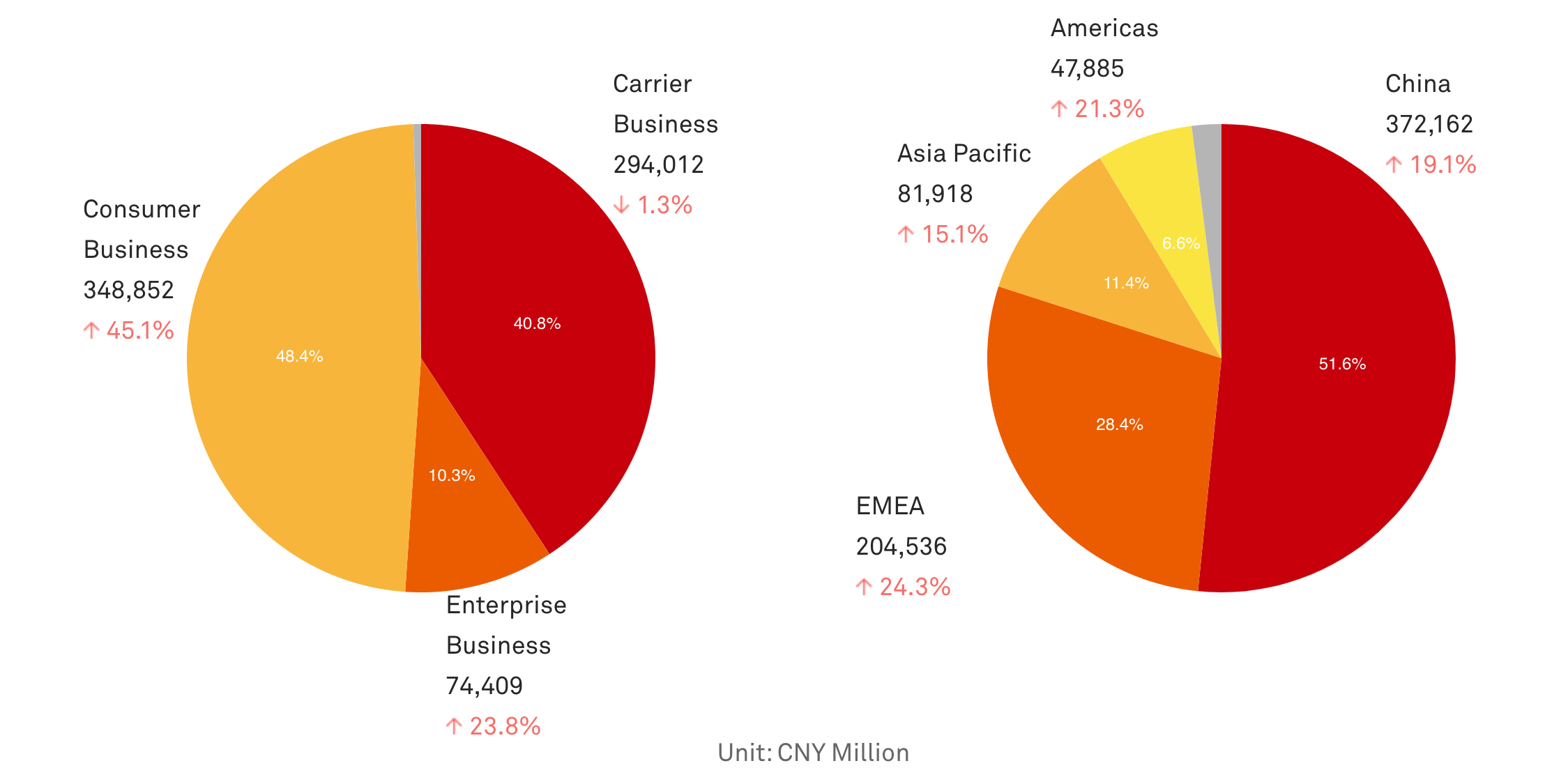
Huawei’s annual revenue increased by 19.5 percent year-on-year to 721 billion CNY, or $107.4 billion, in 2018 as smartphones and other devices became its largest source of income.

Huawei said revenue from the consumer business rose by 45 percent to reach 349 billion CNY ($52 billion), while sales from its carrier business dropped 1.3 percent to 294 billion CNY, or $43.8 billion. Enterprise services accounted for the remaining 74.4 billion CNY.

Huawei’s end of year financials show its consumer devices business is now its main money-maker

That consumer push isn’t a huge surprise given the hostility to Huawei’s traditional networking and carrier business from the U.S. and other Western governments.

Still, the Chinese company has fought back against a ban on its equipment in the U.S. through a lawsuit arguing that federal agencies and contractors have violated due process and acted in a way that is unconstitutional. Still, the U.S. concern around national security has been fortified by a recent U.K. government report claimed there are “significant technical issues” around adopting its telecom network kit.

The report, prepared for the National Security Advisor of the U.K. by the Huawei Cyber Security Evaluation Centre (HCSEC) Oversight Board, said it has “not yet seen anything to give it confidence in Huawei’s capacity to successfully complete the elements of its transformation programme that it has proposed as a means of addressing these underlying defects.”

The original version of this story has been updated to note that this is the first time Huawei has announced quarterly numbers

Sony launches a taxi-hailing app to rival Uber in Tokyo

Sony last year announced it would enter Japan’s taxi-hailing space and, good to its word, the electronics giant has kicked off its S.Ride service in Tokyo.

The service — which was first noted by CNET — is a joint venture between Sony, its payment services subsidiary and five licensed taxi companies. Since ride-hailing with civilian cars is illegal in Japan, the service will focus on connecting licensed taxis with passengers. The electronics giant previously played up its use of AI to match supply and demand and, on the payment side, it supports QR scans as well as Uber-style cash-less credit card.

All together, S.Ride claims to cover 10,000 licensed taxis in Tokyo. Its largest competition is JapanTaxi, a venture from the taxi industry that’s backed by Toyota among others, which claims 50,000 vehicles across Japan as a whole. Other rivals include chat app Line, which has offered taxi-hailing for years, Uber, which has been working on striking deals with taxi operators, and China’s Didi Chuxing, which operates a joint-venture with Uber investor SoftBank. Lyft has expressed an interest in Japan, where its investor Rakuten is a major name, but it has not expanded there yet.

A Sony spokesperson told CNET that there are no plans to launch S.Ride overseas so we can file this in the ‘only in Japan’ file.

China’s new gaming rules to ban poker, blood and imperial schemes

Lots of news has surfaced from China’s gaming industry in recent weeks as the government hastens to approve a massive backlog of titles in the world’s largest market for video games.

Last Friday, the country’s State Administration of Press and Publication, the freshly minted gaming authority born from a months-long reshuffle last year that led to an approval blackout, enshrined a new set of guidelines for publication that are set to move some to joy and others to sorrow.

On April 22, China finally resumed the approval process to license new games for monetization. Licensing got back on track in December but Reuters reported in February that the government stopped accepting new submissions due to a mounting pile of applications.

The bad news: The number of games allowed onto the market annually will be capped, and some genres of games will no longer be eligible. Mahjong and poker games are taken off the approval list following a wave of earlier government crackdown over concerns that such titles may channel illegal gambling. These digital forms of traditional leisure activities are immensely popular for studios for they are relatively cheap to make and bear lucrative fruit. According to video game researcher Niko Partners, 37 percent of the 8,561 games approved in 2017 were poker and mahjong titles.

While the new rule is set to wipe out hundreds of small developers focused on the genre, it may only have a limited impact on the entrenched players as the restriction applies only to new applicants.

“It won’t affect us much because we are early to the market and have accumulated a big collection of licenses,” a marketing manager at one of China’s biggest online poker and mahjong games publishers told TechCrunch.

China will also stop approving certain games inspired by its imperial past, including “gongdou”, which directly translates to harem scheming, as well as “guandou”, the word for palace official competition. The life inside palaces has inspired blockbuster TV series such as the Story of Yanxi Palace, an in-house production from China’s Netflix equivalent iQiyi . But these plots also touch a nerve with Chinese officials who worry about “obscene contents and the risk of political metaphors,” Daniel Ahmad, senior analyst at Nikos Partners, suggested to TechCrunch.

china games

Screenshots of Xi Fei Zhuan, a mobile game that lets users play the role of harems to win love from the emperor. Image source: Superjoy Interactive Games

Games that contain images of corpses and blood will also be rejected. Developers previously modified blood color to green to circumvent restrictions, but the renewed guidelines have effectively ruled out any color variations of blood.

“Chinese games developers are used to arbitrary regulations. They are quick at devising methods to circumvent requirements,” a Guangzhou-based indie games developer told TechCrunch.

That may only work out for companies armed with sufficient developing capabilities and resources to counter new policies. For instance, Tencent was quick to implement an anti-addiction system for underage users before the practice became an industry-wide norm as of late.

“Many smaller publishers will have a harder time under this new set of regulations, which will require them to spend extra time and money to ensure games are up to code,” suggested Ahmad. “We’ve already seen that many smaller publishers were unable to survive the temporary game license approval freeze last year and we expect to see further consolidation of the market this year.”

China has over the past year taken aim at the gaming industry over concerns related to gaming addiction among minors and illegal content, such as those that promote violence or deviate from the government’s ideologies. To enforce the growing list of requirements, an Online Game Ethics Committee launched in December under the guidance of the Publicity Department of the Chinese Communist Party to help the new gaming regulator in vetting title submissions.

More than 1,000 games have been approved since China ended the gaming freeze in December, though Tencent, the dominant player in the market, has yet to receive the coveted license required for monetizing its hugely popular mobile title PlayerUnknown’s Battlegrounds.

Uncertain waters in the gaming industry have wiped billions of dollars off the giant’s market cap and prompted it to initiate a bigger push in such non-game segments as cloud computing and financial technologies. NetEase, the runner-up in China’s gaming market, reacted by trimming its staff to cut costs.