Apple could be adding Siri Shortcuts and Screen Time to macOS

Apple wants to add more iOS features to macOS according to a report from 9to5mac’s Guilherme Rambo. And it starts with improvements to Siri.

While Siri has been available on macOS for a while, it feels like a scaled-down version of Siri. Sure, you can ask for the weather, NBA scores or a word translation. You can also turn off the Wi-Fi or look up a file on your hard drive.

But Siri on macOS doesn’t work with any third-party app. You can’t send a message on WhatsApp, you can’t send some money using Square Cash, you can’t order an Uber.

According to 9to5mac, this will change with macOS 10.15 this fall. Apple is working on adding support for Siri Shortcuts, which means that you’ll theoretically be able to create custom voice shortcuts to trigger actions in third-party apps.

Existing macOS apps won’t be able to add hooks for Siri Shortcuts — the feature should be limited to iOS ports that leverage the upcoming Marzipan framework. As a result, you can also expect a Shortcuts app to create your own scripts in a visual interface. Shortcuts has become the equivalent of Automator for iOS. Let’s see what happens to Automator after macOS 10.15.

The macOS update won’t just focus on Siri. You should expect to see Screen Time, the iOS feature that tells you how much time you spent in each app on your devices. The current implementation of Screen Time combines your usage across all your iOS devices, such as your iPhone and your iPad. But adding macOS data to the mix is key if you want to see the full picture.

Finally, Apple will let you control your Apple ID more easily from the Mac. Instead of relying on Apple’s website, you’ll be able to set up family sharing and more from a new panel in System Preferences.

ProcessOut improves payment data visualization

ProcessOut has grown quite a lot since I first covered the startup. The company now has a ton of small and big clients, from Glovo to Vente-Privée and Dashlane. The company has become an expert on payment providers and payment analytics.

The core of the product remains the same. Clients sign up to get an overview on the performance of their payment systems. After setting up ProcessOut Telescope, you can monitor payments with expensive fees, failed payments and disappointing payment service providers.

And this product is quite successful. Back in October 2018, the company had monitored $7 billion in transactions since its inception — last month, that number grew to $13 billion.

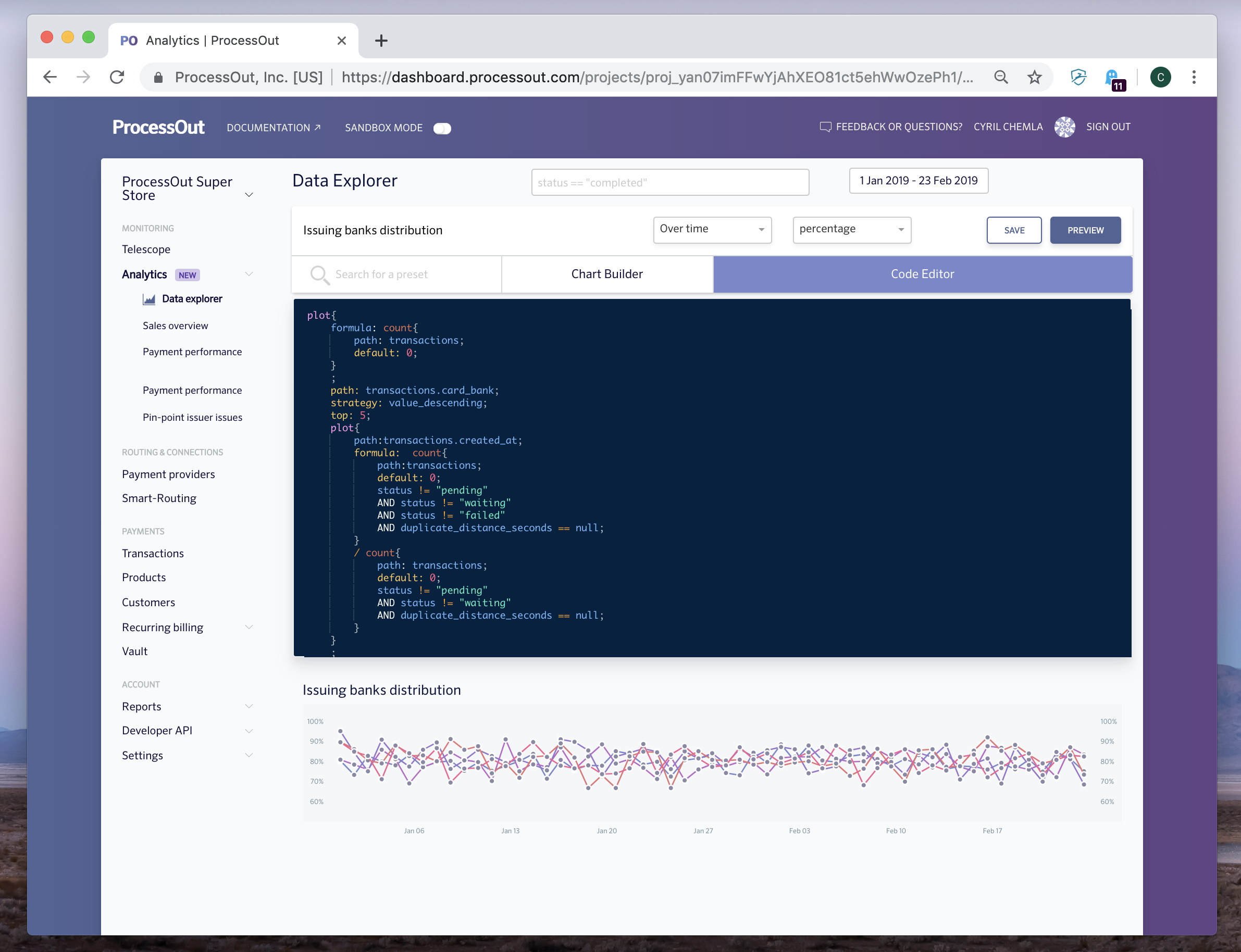
The company is adding new features to make it easier to get insights from your payment data. You can now customize your data visualization dashboards with a custom scripting language called ProcessOut Lang. This way, if you have an internal payment team, they can spot issues more easily.

ProcessOut can also help you when it comes to generating reports. The company can match transactions on your bank account with transactions on different payment providers.

If you’re a smaller company and can’t optimize your payment module yourself, ProcessOut also builds a smart-routing checkout widget. When a customer pays something, the startup automatically matches card information with the best payment service provider for that transaction in particular.

Some providers are quite good at accepting all legit transactions, such as Stripe or Braintree. But they are also more expensive than more traditional payment service providers. ProcessOut can predict if a payment service provider is going to reject this customer before handing the transaction to that partner. It leads to lower fees and a lower rejection rate.

The company recently added support for more payment service providers in Latin America, such as Truevo, AllPago and Mercadopago. And ProcessOut now routes more transactions in one day compared to the entire month of October 2018.

As you can see, the startup is scaling nicely. It will be interesting to keep an eye on it.

Security flaw in French government messaging app exposed confidential conversations

The French government just launched its own messaging app called Tchap in order to protect conversations from hackers, private companies and foreign entities. But Elliot Alderson, also known as Baptiste Robert, immediately found a security flaw. He was able to create an account even though the service is supposed to be restricted to government officials.

Tchap wasn’t built from scratch. The DINSIC, France’s government agency in charge of all things digital, forked an open source project called Riot, which is based on an open source protocol called Matrix.

In a few words, Matrix is a messaging protocol that features end-to-end encryption. It competes with other protocols, such as the Signal Protocol that is widely used by consumer apps, such as WhatsApp, Signal, Messenger’s secret conversations and Google Allo’s incognito conversions — Messenger and Allo conversations aren’t end-to-end encrypted by default.

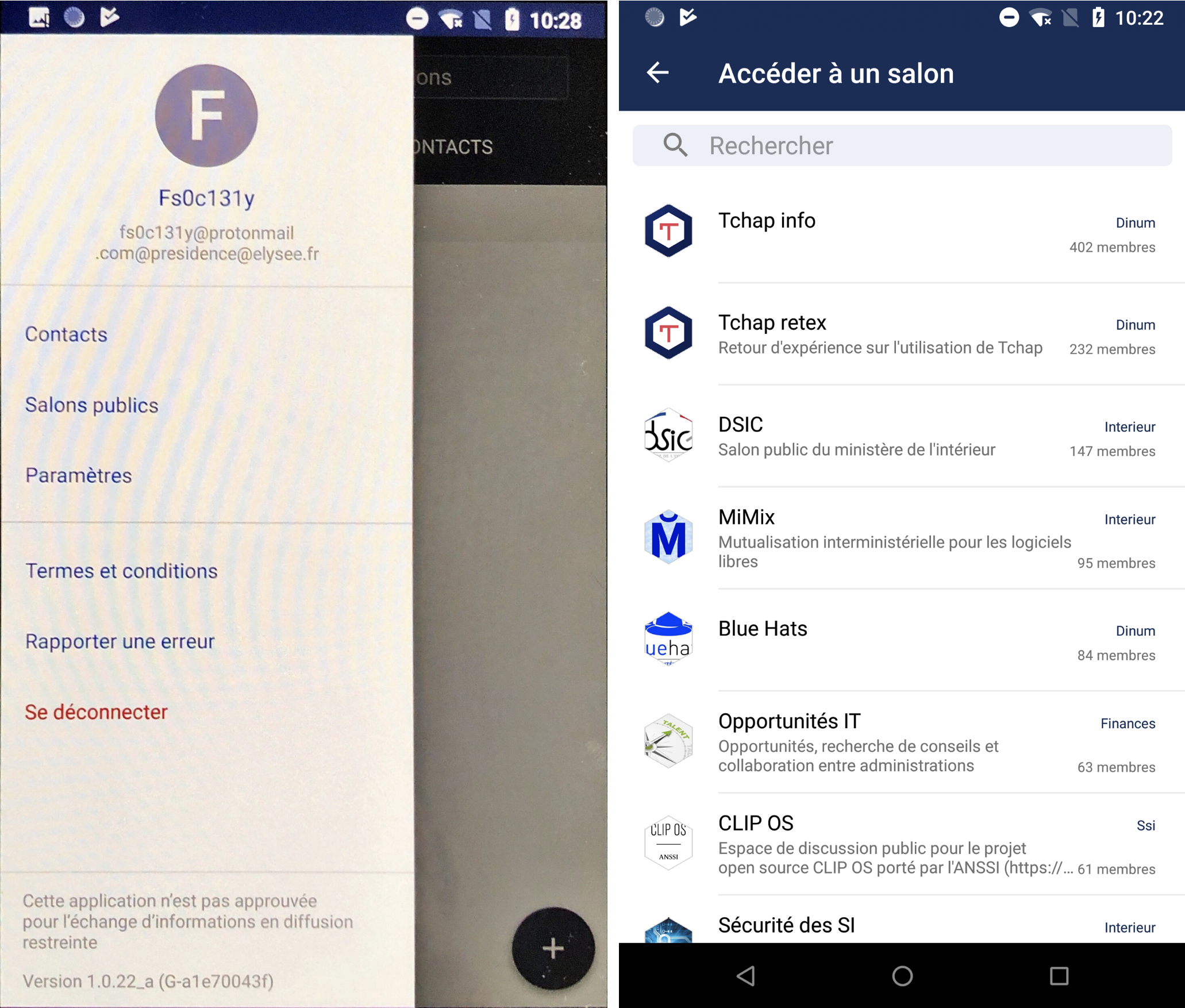
Riot is a Matrix client that works on desktop and mobile. You can join rooms, start private conversations, share photos and do everything you’d expect from a modern messaging app. Here’s what it looks like:

Developing Tchap became essential as Emmanuel Macron’s campaign team relied heavily on Telegram — the French government still uses Telegram and WhatsApp for many sensitive conversations. By default, Telegram doesn’t use end-to-end encryption. In other words, people working for Telegram could easily read Macron’s conversations. It’s a serious security weakness.

Similarly, you don’t want the Ministry of Defense to use Slack to talk about sensitive operations. The U.S. government could potentially issue a warrant to access those conversations on Slack’s servers.

Tchap features end-to-end encryption, and encrypted messages are stored on French servers. Access is restricted to government officials as you need to have an active email address that ends in @something.gouv.fr, or in @elysee.fr.

Yesterday, Alderson found out that you can create an account and access public channels even if you don’t have an official address. Adding @elysee.fr at the end of his email address was enough to receive the confirmation email to his real email address.

Alderson quickly disclosed the bug to the Matrix team. Matrix quickly issued a fix and deployed it. It was related to the identification system used by the French government.

https://platform.twitter.com/widgets.js

According to Alderson, there’s a bug in the parsing method used in a well-known Python module. The bug hasn’t been fixed since July 2018.

The good news is that Tchap is officially launching today. The DINSIC managed to fix this security flaw just in time before the official launch and somebody could leverage it. In its press release, the government says that the DINSIC will launch a bug bounty program to identify other vulnerabilities.

Sequoia reveals first cohort for its ‘Surge’ accelerator program in India and Southeast Asia

Back in January, Sequoia India announced plans for its first early-stage startup accelerator program in India and Southeast Asia, and today the firm announced its first cohort of 17 startups.

To recap, the program — which is called Surge — gives each startup a $1.5 million check and participation in a four-month program that’s split across India and Singapore, as well as the wider Sequoia global presence in China and San Francisco.

The program kicked off last month, but the startups were only unveiled for the first time today — here they are:

  • Azani Sports: a ‘full stack’ sports clothing startup based in India that sells online and through selected high street retails
  • Bobobox: a capsule hotel company based in Indonesia
  • Bulbul: a live-streaming service with a focus on e-commerce across India
  • DancingMind: a Singapore startup that uses VR to enable remote for stroke victims and patients of debilitating diseases like Parkinson’s
  • Doubtnut: an India-based education startup that uses photos, videos and AI
  • Flynote: a travel booking service with a focus on personalized trips
  • Hippo Video: a platform developing, editing and analyzing marketing and sales videos
  • InterviewBit Academy: a computer science training and development platform in India — that’s not unlike recent Y Combinator graduate Skill-Lync
  • Khatabook: an accounting service for SMEs in India that already claims 120,000 weekly users
  • Qoala: a micro-insurance startup based in Indonesia, which competes with rivals like PasarPolis — which is backed by three of Indonesia’s unicorns
  • ShopUp: a social commerce startup that helps sellers in Bangladesh do business through Facebook — that’s a similar concept to established Indian startups Meesho (another YC alum) and LimeRoad which enable sellers on WhatsApp
  • Skillmatics: a startup headquartered in India that develops learning games for pre-school and primary school kids aged under 10
  • Telio: a b2b commerce platform that aims to digitize the process of brands and wholesalers selling to retailers
  • Uiza: a Singapore-Vietnam startup that lets publishers and companies develop their own video infrastructure independent of platforms like YouTube
  • Vybes: an e-commerce platform for social media influencers that’s based out of Singapore
  • Zenyum: a startup that provides invisible braces for consumers in Southeast Asia at a lower cost than traditional alternatives

There’s one additional startup which is being kept ‘under the radar’ for now, Sequoia said.

Sequoia India managing director Shailendra Singh previously told TechCrunch that Surge would support a ‘curated’ selections of fellow VCs who could invest alongside in the cohort alongside the firm, and Sequoia said that the 17 startups have attracted a total of $36 million in investment. A spokesperson also pointed out that five of the selection have at least one female co-founders, which is almost certainly above average for the region although it is tricky to get reliable data covering India and (in particular) Southeast Asia.

Surge is an interesting effort for Sequoia, which has traditionally played in post-seed and growth stages of the investment cycle. Sequoia closed its most recent fund for India and Southeast Asia at $695 million last year, and it also has access to a globally active ‘growth’ fund that is targeted at $8 billion. Reports have suggested that Surge will get its own sparkling new $200 million fund, which would make a lot of sense given the potential conflict and confusion of investing via its main fund. But the firm is declining to comment on that possibility for now.

One major addition to the program that has been confirmed, however, is Rajan Anandan, the executive who previously ran Google’s business in India and Southeast Asia and is a well-known angel investor. His arrival was announced earlier this month and he will lead the Surge initiative.

His recruitment is a major win for Sequoia, which is betting that Surge’s early stage push will reap it richer dividends in India and Southeast Asia. That part remains to be seen, but certainly, there is a dearth of early-stage programs in both regions compared to other parts of the world.

Uber’s self-driving car unit raises $1B from Toyota, Denso and Vision Fund ahead of spin-out

Uber’s has confirmed it will spin out its self-driving car business after the unit closed $1 billion in funding from Toyota, auto-parts maker Denso and SoftBank’s Vision Fund.

The development has been speculated for some time — as far back as October — and it serves to both remove a deeply-unprofitable unit from the main Uber business: helping Uber scale back some of its losses, while giving Uber’s Advanced Technologies Group (known as Uber ATG) more freedom to focus on the tough challenge of bringing autonomous vehicles to market.

The deal values Uber ATG at $7.25 billion, the companies announced. In terms of the exact mechanics of the investment, Toyota and Denso are providing $667 million with the Vision Fund throwing in the remaining $333 million.

The deal is expected to close in Q3, and it gives investors a new take on Uber’s imminent IPO, which comes with Uber ATG. The company posted a $1.85 billion loss for 2018, but R&D efforts on ‘moonshots’ like autonomous cars and flying vehicles dragged the numbers down by accounting for over $450 million in spending. Moving those particularly capital-intensive R&D plays into a new entity will help bring the core Uber numbers down to earth, but clearly there’s still a lot of work to reach break-even or profitability.

Still, those crazy numbers haven’t dampened the mood. Uber is still seen as a once-in-a-generation company, and it is tipped to raise around $10 billion from the IPO, giving it a reported valuation of $90 billion-$100 billion.

Like the spin-out itself, the identity of the investors is not a surprise.

The Vision Fund (and parent SoftBank) have backed Uber since a January 2018 investment deal closed, while Toyota put $500 million into the ride-hailing firm last August. Toyota and Uber are working to bring autonomous Sienna vehicles to Uber’s service by 2021 while, in further proof of their collaborative relationship, SoftBank and Toyota are jointly developing services in their native Japan which will be powered by self-driving vehicles.

The duo also backed Grab — the Southeast Asian ride-hailing company that Uber owns around 23 percent of — perhaps more aggressively. SoftBank has been an investor since 2014 and last year Toyota invested $1 billion into Grab, which it said was the highest investment it has made in ride-hailing.

“Leveraging the strengths of Uber ATG’s autonomous vehicle technology and service network and the Toyota Group’s vehicle control system technology, mass-production capability, and advanced safety support systems, such as Toyota Guardian, will enable us to commercialize safer, lower cost automated ridesharing vehicles and services,” said Shigeki Tomoyama, the executive VP who leads Toyota’s ‘connected company’ division, said in a statement.

Here’s Uber CEO Dara Khosrowshahi’s shorter take on Twitter

Boston Dynamics debuts the production version of SpotMini

Last year at our TC Sessions: Robotics conference, Boston Dynamics announced that SpotMini will be its first commercially available product. A revamped version of the product would use the company’s decades of quadrupedal robotics learnings as a basis for a robot designed to patrol office spaces.

At today’s event, founder and CEO Marc Raibert took to the stage to debut the production version of the electric robot. As noted last year, the company plans to produce around 100 models this year. Raibert said that the company is aiming to start production in July or August. There are robots coming off the assembly line now, but they are betas being used for testing, and the company is still doing redesigns. Pricing details will be announced this summer.

New things about the SpotMini as it moves closer to production include redesigned components to make it more reliable, skins that work better to protect the robot if it falls and two sets of cameras on the front and one on each side and the back, so it can see in all directions.

The SpotMini also has an arm (with a hand that’s often mistaken for its head) that is stabilized in space, so it stays in the same place even when the rest of the robot moves, making it more flexible for different applications.

Raibert says he hopes the SpotMini becomes the “Android of robots” (or Android of androids), with navigation software and developers eventually writing apps that can run in and interact with the controls on the robot.

SpotMini is the first commercial robot Boston Dynamics is set to release, but as we learned earlier year, it certainly won’t be the last. The company is looking to its wheeled Handle robot in an effort to push into the logistics space. It’s a super hot category for robotics right now. Notably, Amazon recently acquired Colorado-based start up Canvas to add to it sown arm of fulfillment center robots.

Boston Dynamics made its own acquisition earlier this month — a first for the company. The addition of Kinema will bring advanced vision systems to the company’s robots — a key part in implementing these sorts of systems in the field.

Netflix to open a production hub in New York and invest up to $100 million in the city

Start spreading the news. Netflix is coming to New York City in a big way.

The streaming media service has committed to invest up to $100 million to build a production hub and hire hundreds of new staffers in the Big Apple, according to a statement from Governor Andrew M. Cuomo.

Netflix’s new production hub will include an expanded Manhattan office and six sound stages in Brooklyn that could bring in hundreds of executive positions and thousands of production crew jobs to New York within the next five years, according to a statement from the Empire State Development Corp. 

“New York has created a film-friendly environment that’s home to some of the best creative and executive talent in the world, and we’re excited to provide a place for them at Netflix with our production hub,” said Jason Hariton, Director of Worldwide Studio Operations & Real Estate at Netflix, in a statement.

The new corporate offices Netflix has planned will occupy 100,000 square feet in Manhattan at 888 Broadway, housing 127 new executive content acquisition, development, production, legal, publicity and marketing positions. They’ll join the 32 employees Netflix currently has in New York.

Netflix already produces Orange is the New Black, Unbreakable Kimmy Schmidt, She’s Gotta Have It, The Irishman, Someone Great, Private Life and Russian Doll in New York and has leased 161,000 square feet to build sound stages and support spaces in Brooklyn’s East Williamsburg neighborhood.

To sweeten the pot for Netflix, the Empire State Development Corp. has offered $4 million in performance-based Excelsior Tax Credits over ten years, which the corporation says are tied to real job creation. To receive the incentive, Netflix must create 127 jobs by 2024 at its executive production office and retain those jobs for another five years.

Russian hacked ‘at least one’ Florida county prior to 2016 election

Russian operatives successfully targeted and hacked “at least one” Florida county government in the run up to the 2016 U.S. presidential election, according to new findings by the Special Counsel Robert Mueller.

The report, published Thursday by the Justice Department, said the county was targeted by the Russian intelligence service, known as the GRU. The hackers sent spearphishing emails to more than 120 email accounts used by county officials responsible for administering the election, the report said.

According to the findings:

In August 2016, GRU officers targeted employees of [REDACTED], a voting technology company that developed software used by numerous U.S. counties to manage voter rolls, and installed malware on the company network… the spearphishing emails contained an attached Word document coded with malicious software (commonly referred to as a Trojan) that permitted the GRU to access the infected computer.

The findings are a significant development from previous reporting that said Florida’s election systems were merely targets of the Russian operatives.

Sen. Bill Nelson (D-FL) was derided after he claimed just days before his eventual re-election that hackers had gained access to the state’s election systems. According to NBC News, some of Nelson’s assertions were based off classified information that was not yet public.

Nelson’s remarks came almost a year after The Intercept published a classified document — later discovered to have been sent by since-jailed NSA whistleblower and Reality Winner — showing that intelligence pointed to a concerted effort by the GRU to target election infrastructure. The NSA said the hackers sent emails impersonating voting technology company VR Systems to state government officials.

The Orlando Sentinel confirmed Thursday following the release of Mueller’s report’s that Volusia County was sent infected emails containing malware, suggesting Volusia County — north of Orlando — may have been the target.

Mueller’s report confirmed that the FBI investigated the incident.

The office of Florida’s secretary of state said that Florida’s voter registration system “was and remains secure,” and “official results or vote tallies were not changed.”

Two years later following the 2018 midterm elections, the Justice Department and Homeland Security said there was “no evidence” of vote hacking or tampering.

Google’s Ivan Poupyrev shows off Jacquard, which connects his Levi’s jacket to the cloud

Ivan Poupyrev, the technical projects lead at Google’s Advanced Technology and Projects division, just gave a TED talk that was simultaneously a presentation and a demo of new technology.

Poupyrev was showing off Jacquard, a device that allowed him to use the sleeve of his jacket as a controller for his presentation slides. Google has talked about this work before, and there’s even a $350 Levi’s jacket available for purchase.

But today, Poupyrev actually used Jacquard to control his presentation, and laid out the vision behind the project. Although it didn’t quite work at first, once Poupyrev fixed things backstage and restarted his presentation, he could swipe forward on his sleeve to advance the presentation, or swipe back and revisit the previous slide.

Poupyrev didn’t offer many details about the Jacquard device itself, but he said it can be connected to clothing and other objects with just “a few electrodes,” and that it can recognize the object and then “reconfigure itself” to offer the right kinds of interaction.

The device he held up on stage was small and grey — I could have mistaken it for the key fob that I used to swipe into my old apartment. According to Poupyrev’s website, Jacquard also involves a conductive thread that can be woven on a standard loom.
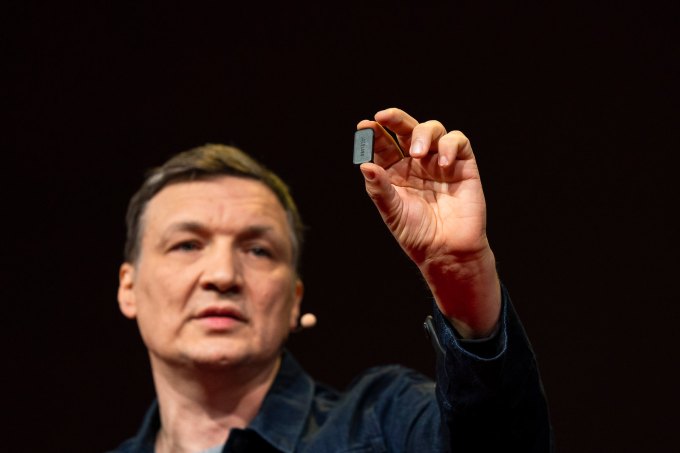
Ivan Poupyrev

Ivan Poupyrev speaks at TED2019: Bigger Than Us. April 15 – 19, 2019, Vancouver, BC, Canada. Photo: Bret Hartman / TED

Why would you want to control a presentation from your jacket sleeve? Poupyrev (who’s also worked as a researcher for Walt Disney Imagineering and Sony) described our current options for computer interaction as “disappointing,” so he’s been looking to “hack into the things you use every day and make them interactive.”

“We need to make technology that changes makers of things into makers of smart things,” he said.

As these everyday objects become more interactive and connected, Poupyrev said it’s important to avoid fragmentation: “We have to create a single computing platform, which powers all those things.” In his view, the cloud is that platform, with Jacquard serving as the connection between everyday objects and the cloud.

Poupyrev suggested that Google could give Jacquard tags to manufacturers to incorporate into their products. It’s rolling out first through the aforementioned partnership with Levi’s, and Poupyrev was wearing a Jacquard-powered Levi’s jean jacket onstage.

“This jacket I’m wearing can control my mobile phone and presentation, but it remains a jacket,” he said. In other words, you can add new interactivity to clothing or furniture without interfering with their core function — just as a smartphone can now browse the Internet, take photos, install apps and more, while still allowing you to make phone calls.

Ivan Poupyrev

Ivan Poupyrev speaks at TED2019: Bigger Than Us. April 15 – 19, 2019, Vancouver, BC, Canada. Photo: Ryan Lash / TED

“We would like to let people who make those things — artists and engineers, brands and craftsmen — to imagine and create this new world where things are connected, where you don’t need keyboards and screens and mouses to interact with a computer,” he said.

After the presentation, TED’s Chris Anderson joined Poupyrev onstage. Anderson sounded impressed by the demo, but he also pointed out that it could “terrify some people,” since it potentially creates “the biggest ever surveillance network” for Google or another company.

When asked why Google would bring such a device to market, Poupyrev said, “I’m not a businessman, I’m a researcher.” Anderson pressed him on whether there needs to be “some kind of contract” ensuring that this data isn’t abused, to which Poupyrev replied, “I completely agree.” He said that in Google’s initial partnerships, “the data is completely locked in.”

“We’re trying to figure out what exactly are we going to do with this data,” he said. “We’re sensitive to this particular concern.”

Breeze Automation is building soft robots for the Navy and NASA

San Francisco soft robotics startup Breeze Automation made its debut today onstage at TechCrunch’s TC Sessions: Robotics + AI event at UC Berkeley. Co-founder and CEO Gui Cavalcanti joined us onstage at the event to showcase the contract work the company has been doing for organizations like NASA and the U.S. Navy.

Cavalcanti last joined TechCrunch onstage in September 2016, decked out in aviator sunglasses and full American flag regalia as a co-founder of fighting robot league MegaBots. These days, however, the Boston Dynamics alum’s work is a lot more serious and subdued, solving problems in dangerous settings like under water and outer space.

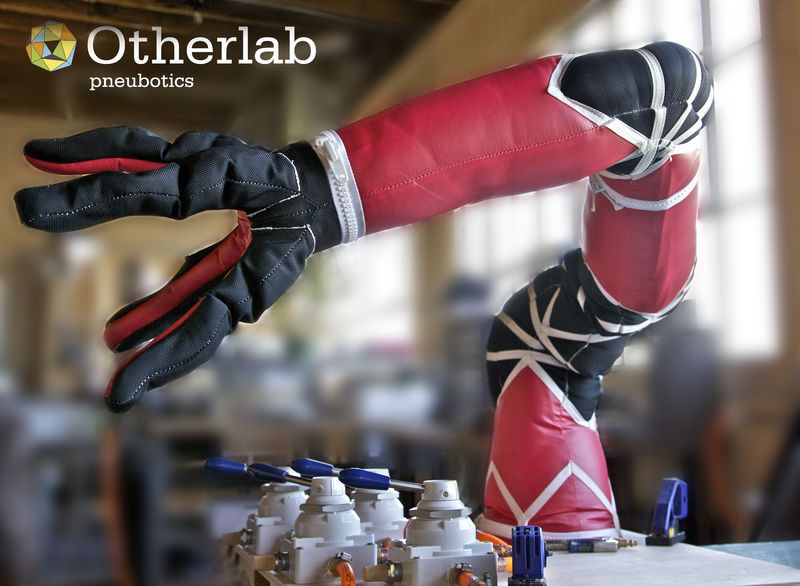
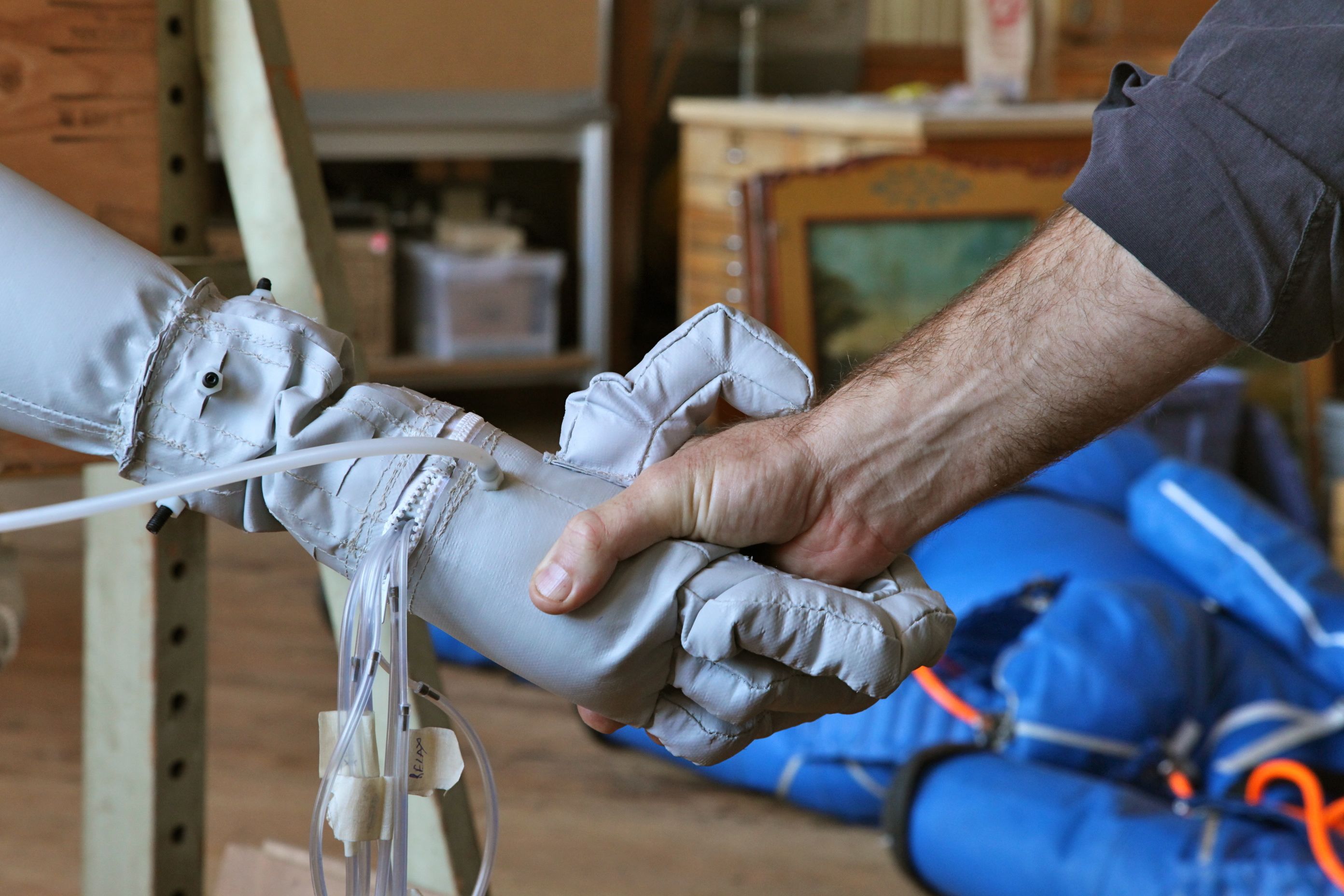
Developed as part of San Francisco R&D facility Otherlab, Breeze leverages the concept of highly adaptable soft robotics. The company’s robotic arms are air-filled fabric structures.

“The concept Otherlab has been developing for around seven years has been this idea of Fluidic Robots, hydraulic and Pneumatic Robots that are very cheap,” Cavalcanti told TechCrunch in a conversation ahead of today’s event. “Very robust to the environment and made with very lightweight materials. The original concept was, what is the simplest possible robot you can make, and what is the lightest robot you can make? What that idea turned into was these robots made of fabric and air.”

Breeze separates from much of the competition in the soft robotics space by applying these principles to the entire structure, instead of just a, say, gripper on the end of a more traditional robotic arm.

“All of that breaks down the second you get out of those large factories, and the question of how do robots interact to the real world becomes a lot more pressing,” Cavalcanti says. “What we’re trying to do is take a lot more of the research around soft robotics and the advantages of being fully sealed systems that are moved with really compliant sources of actuation like air. It turns out that when you’re trying to interact with an environment that’s unpredictable or unstructured, and you’re going to bump into things and you’re going to not get it right because you don’t have full sensing of the state of the world. There’s a lot of advantages to having entire manipulators and arms be soft instead of just the end effector.”

Breeze showcased several works in progress, including a system developed for the Navy that uses an HTC Vive headset for remote operation. The company’s work with NASA, meanwhile, involves the creation of a robotic system that doesn’t require a central drive shaft, marking a departure from more traditional robotic systems.

“You’re now looking at robot joints that can handle significant loads, that could be entirely injection molded,” explains Cavalcanti. “You don’t need a metal shaft, you don’t need a set of bearings or whatever. You can just have a bunch of injection mold, or plastic pieces that’s put together and there’s your robot.”

Most of the company’s funding is currently coming from federal contracts from places like the Navy and NASA, but going forward, Breeze is shifting more toward commercial contracts. “Our mission right now is to harden our technology and prepare for real-world application, and that is pretty much 100 percent our focus,” he says. “Once we do harden it, there are a variety of options for going commercial that we’d like to explore.”