Daily Crunch: Samsung responds to Galaxy Fold concerns

The Daily Crunch is TechCrunch’s roundup of our biggest and most important stories. If you’d like to get this delivered to your inbox every day at around 9am Pacific, you can subscribe here.

1. Samsung responds to reviewer complaints about its Galaxy Fold phone

Samsung has issued a statement about its new folding phone. Apparently a number of reviewers either mistakenly destroyed their phone screens or had the screens bork on them after a few days of use.

In response, the company said it “will thoroughly inspect these units in person to determine the cause of the matter.”

2. Pinterest prices IPO above range

The company will sell 75 million shares of Class A common stock at $19 apiece in an offering that should attract $1.4 billion in new capital for the visual search engine.

3. Apple expands global recycling programs, announces new Material Recovery Lab in Austin

Apple says it’s building a new, 9,000-square-foot Material Recovery Lab based in Austin, Texas, focused on discovering future recycling processes.

Special counsel Robert Mueller (L) arrives at the U.S. Capitol for closed meeting with members of the Senate Judiciary Committee June 21, 2017 in Washington, DC. (Photo by Alex Wong/Getty Images)

4. The Mueller Report

Granted, this isn’t primarily a tech story, but it’s obviously going to be the big news of the day, and tech plays a key role. Check out all our coverage of the latest developments at the link above.

5. Twitter acqui-hires highlight-sharing app Highly

The company is scooping up the team behind highlight-sharing app Highly. This talent could help Twitter build its own version of Highly or develop other ways to excerpt the best content from websites and get it into the timeline.

6. Phantom Auto raises $13.5M to expand remote driving business to delivery bots and forklifts

Autonomous vehicles are hard and everyone seems to be waking up to that fact. Companies like Phantom Auto are expanding into new areas as they wait for autonomous vehicle developers to catch up.

7. Salesforce is buying MapAnything, a startup that raised over $84M

MapAnything helps companies build location-based workflows, something that could come in handy for sales or service calls.

The different playbooks of D2C brands

Over the past half a decade, the tidal wave of niche brands delivering new kinds of products to consumers and doing so online has changed the retail and CPG landscapes forever.

This shift has in some way caused a shakeout in traditional retail, with once-popular retailers announcing store closures (JCPenney, Sears) or even liquidation (Payless, Toys R Us) and has sent fashion houses and CPG brands on a soul-searching journey. The changing demographics and desires of shoppers have also fueled the decline of traditional brands and their distribution mechanisms.

This bleak scenario of incumbent consumer brands is in stark contrast to the rapid emergence of a host of digitally-native Direct to Consumer (D2C) brands. A few D2C brands have been successful enough to become unicorns! Retailers like Walmart, Nordstrom, and Target have quickly adapted to the D2C era.

Walmart has made a string of acquisitions beginning with Jet.com and Bonobos. Nordstrom has broadened its assortment to include D2C brands, Target has partnered with Harry’s, Quip, and Flamingo – all of which have rolled out their products in Target’s stores across the country. Target has also invested in Casper, which is the latest D2C brand to become a Unicorn.

Venture capital firms have invested over four billion dollars in D2C brands since 2012, with 2018 alone accounting for over a billion. With investment comes pressure to scale and deliver profits. And this pressure is bringing the focus on some pertinent questions – How are these D2C brands going to evolve and how could they sustain as businesses?

Like always, the pioneering companies find their path and we then derive the playbooks out of them. From PipeCandy’s analysis of several D2C brands, we see the following approaches taken by D2C brands.

  • Playbook 1: Brand’s purpose anchored around one product category
  • Playbook 2: Brand’s purpose anchored around multiple product categories
  • Playbook 3: Brand’s purpose anchored around aggregation of other brands (for sale or rent)

We discuss the market size and capital availability factors that influence the paths and the outcomes.

Table of Contents

  1. D2C playbooks
    1. Playbook 1: Brand’s purpose anchored around one product category
    2. Playbook 2: Brand’s purpose anchored around multiple product categories
    3. Playbook 3: Brand’s purpose anchored around aggregation of other brands (for sale or rent)
  2. Access to capital and how D2C playbooks are impacted
  3. The VC route to scale
  4. The non-VC route to scale
  5. Outcome without hitting scale
  6. Roll-ups by strategic buyers
  7. Roll-ups by financial buyers
  8. Brand incubators

Brand’s Purpose anchored around one product category:

Many of these D2C brands that have experienced early success owe their rise largely to an authentic relationship with consumers that is built on the promise of one product. In many ways, focusing on one product line and a small set of SKUs makes total business sense.

Design, Production, Marketing & Customer Support complexities can stay manageable with such deliberate narrowing down of focus.

In some categories, you could stay focused on one product line for a long time and build a successful company.

Digital health investments slide in the first quarter to $2 billion, according to Mercom Capital

Venture investors, private equity, and corporations funneled $2 billion into digital health startups in the first quarter of 2019, down 19% from the nearly $2.5 billion invested a year ago.

There were also 38 fewer deals done in the first quarter this year than last year, when investors backed 187 early stage digital health companies, according to data from Mercom Capital Group.

While private investments declined, public equities soared in the first quarter — with 66% of the digital health companies that Mercom tracks beating the S&P 500, compared to the previous quarter when nearly the same amount of public companies were underwater compared to the S&P. 

Among startups, data analytics and mobile health apps, drew the most capital, with analytics focused companies raising $557 million for the quarter. Mobile health apps raked in $392 million while telemedicine-focused startups claimed another $220 million — making up the ublk of the funding in the digital healthcare space.


The top investments went to Doctolib, the European back-office support software developer, which raised $170 million; Health Catalyst, which pulled in $100 million; and Calm, which grabbed another $88 million from investors, according to Mercom. 


CloudBees acquires Electric Cloud to build out its software delivery management platform

CloudBees, the enterprise continuous integration and delivery service (and the biggest contributor to the Jenkins open-source automation server), today announced that it has acquired Electric Cloud, a continuous delivery and automation platform that first launched all the way back in 2002.

The two companies did not disclose the price of the acquisition, but CloudBees has raised a total of $113.2 million while Electric Cloud raised $64.6 million from the likes of  Rembrandt Venture Partners, U.S. Venture Partners, RRE Ventures and Next47.

CloudBees plans to integrate Electric Cloud’s application release automation platform into its offerings. Electric Flow’s 110 employees will join CloudBees.

“As of today, we provide customers with best-of-breed CI/CD software from a single vendor, establishing CloudBees as a continuous delivery powerhouse,” said Sacha Labourey, the CEO and co-founder of CloudBees, in today’s announcement. “By combining the strength of CloudBees, Electric Cloud, Jenkins and Jenkins X, CloudBees offers the best CI/CD solution for any application, from classic to Kubernetes, on-premise to cloud, self-managed to self-service.”

Electric Cloud offers its users a number of tools for automating their release pipelines and managing the application lifecycle afterward.

“We are looking forward to joining CloudBees and executing on our shared goal of helping customers build software that matters,” said Carmine Napolitano, CEO, Electric Cloud. “The combination of CloudBees’ industry-leading continuous integration and continuous delivery platform, along with Electric Cloud’s industry-leading application release orchestration solution, gives our customers the best foundation for releasing apps at any speed the business demands.”

As CloudBees CPO Christina Noren noted during her keynote at CloudBees’ developer conference today, the company’s customers are getting more sophisticated in their DevOps platforms, but they are starting to run into new problems now that they’ve reached this point.

“What we’re seeing is that these customers have disconnected and fragmented islands of information,” she said. “There’s the view that each development team has […] and there’s not a common language, there’s not a common data model, and there’s not an end-to-end process that unites from left to right, top to bottom.” This kind of integrated system is what CloudBees is building toward (and that competitors like GitLab would argue they already offer). Today’s announcement marks a first step into this direction toward building a full software delivery management platform, though others are likely to follow.

During his company’s developer conference, Labourey also today noted that CloudBees will profit from Electric Cloud’s long-standing expertise in continuous delivery and that the acquisition will turn CloudBees into a “DevOps powerhouse.”

Today’s announcement follows CloudBees’ acquisition of CI/CD tool CodeShip last year. As of now, CodeShip remains a stand-alone product in the company’s lineup. It’ll be interesting to see how CloudBees will integrate Electric Cloud’s products to build a more integrated system.


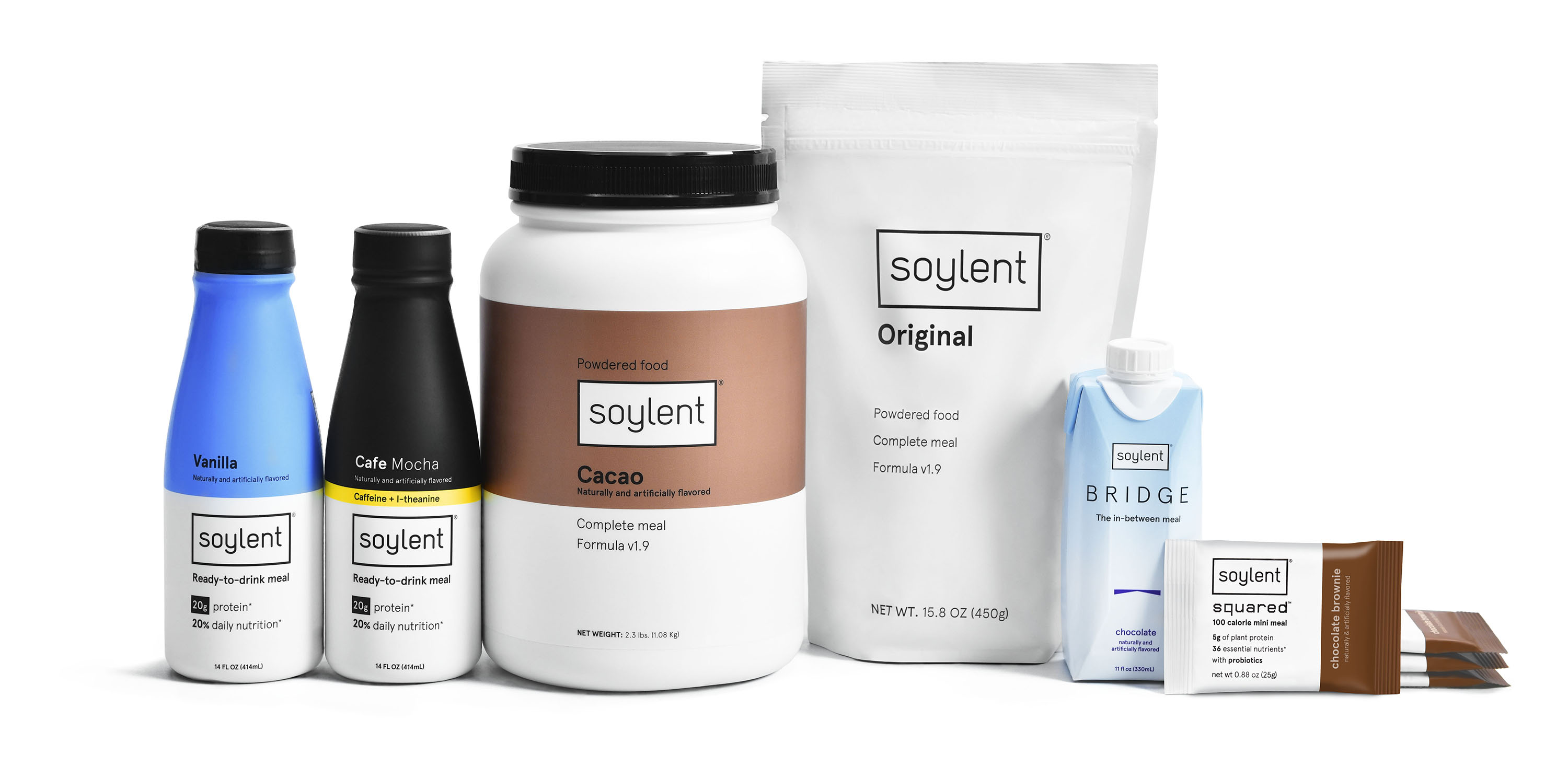
Soylent now sells solid snack bars

Soylent is leaving liquids behind as it journeys deeper into the packaged food business with a selection of snack sized bars.

The 100 calorie bar has 5 grams of plant protein, 36 nutrients and probiotics for digestive health. Snack bars come in three flavors — chocolate brownie,  citrus berry and salted caramel.

It’s the second new product launch for Soylent this year. In January the company came out with a single sized version of its pre-packaged meal replacement shakes called the “Soylent Bridge”.

Pitching snack-sized bars opens the company up to an even bigger market than its shakes and liquids. Data from Research and Markets indicates that snack bar sales in the U.S. alone could reach $8.8 billion by 2023.

“It’s very much a step on the road. It’s a  big one for us and one that we’re extremely excited for given the focus for better for you sustainable nutrition. We’re moving into the chewable bar space in a more disruptive way,” says chief executive, Brian Crowley. “We’re on this journey of moving from a morning meal replacement in drink, ready to drink and powder to a complete nutrition platform you can enjoy throughout the day.”

Soylent snack bars

Its expansion into the snack bar scene also serves to differentiate Soylent (whose name is derived from the soy bean and lentil food featured in the 1960’s novel “Make Room! Make Room!” and not the better known version which made its way into the big screen adaptation) from competitors like Huel.

Launched in the UK, but with a strong presence in Los Angeles now, Huel raised $26 million (GBP 20 million) from Highland Europe to expand sales of its powders and packaged drinks into new geographies (chiefly, it would seem, in the U.S.).

Meanwhile, French consumers are already enjoying solid snacks and shakes from Feed — a Soylent-like startup that’s selling in Europe.

Soylent consumers shouldn’t expect to see the company move into some of the more arcane arts practiced by the “self-optimization” crowd. “Look at the Bulletproofs and the functional supplements and the nootropics… There is good science behind them, but it’s serving an affluent audience,” Crowley says.

Crowley wants Soylent to be a low-cost highly nutritional option for every consumer.

The company says all the bars contain the same ingredients as the company’s lines of ready-to-drink liquids and powders — macronutrients combined with 26 vitamins and minerals, 9 amino acids, 2 essential fatty acids, including omega-3 and omega-6.

The bars do add probiotics to support digestive health and contain 3 grams of sugar.

Currently, the bars are only sold online by the case — and each case holds 30 squares.

Zoom pops 81% in Nasdaq debut

Shares of Zoom (Nasdaq: ZM) began trading at $65 a pop Thursday morning after the video conferencing unicorn priced its shares at $36 apiece Wednesday, above its anticipated range.

The company initially planned to price its shares at between $28 and $32 per share, but following big demand for a piece of a profitable tech business, Zoom increased expectations, announcing plans to sell shares at between $33 and $35 apiece.

The initial public offering gives Zoom a fully-diluted market cap of roughly $10 billion, or 10 times larger than the $1 billion valuation it garnered with its last round of private funding in 2017.

Next iPhone could feature an ultra-wide lens

A new report from Apple analyst Ming-Chi Kuo obtained by 9to5mac details the cameras in the next-generation iPhones. The report confirms previous rumors — the successors of the iPhone XS and XS Max will have three camera sensors on the back of the device.

In addition to the main camera and the 2x camera, Apple could add an ultra-wide 12-megapixel lens. Many Android phones already feature an ultra-wide lens, so it makes sense that Apple is giving you more flexibility by adding a third camera.

Kuo thinks Apple will use a special coating on the camera bump to hide the lenses. It’s true that pointing three cameras at someone is starting to look suspicious.

OnLeaks and Digit shared the following render (without any special coating) a few months ago:

The iPhone XR update will feature two cameras instead of one. I bet Apple will add a 2x camera.

On the front of the device, Apple could be planning a big upgrade for the selfie camera. The company could swap the existing camera sensor with 4 layers of glass with a camera sensor that has 5 layers of glass.

Apple could also be giving the camera a resolution bump, jumping from 7 megapixels to 12 megapixels. All three models should get the new selfie camera.

USDA launches pilot program allowing SNAP recipients to shop for groceries online

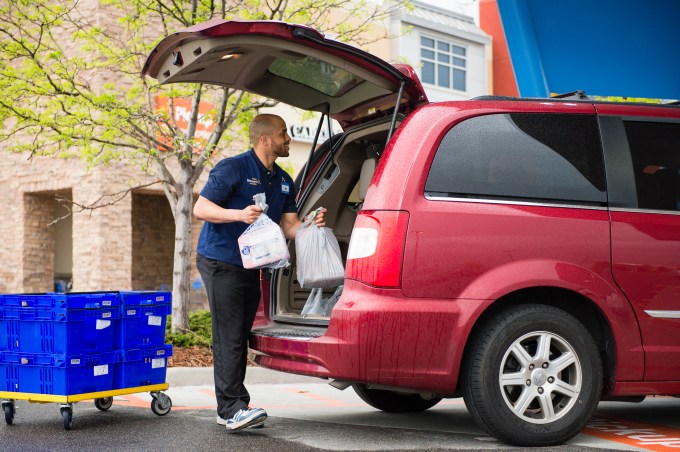
The USDA this morning announced the launch of a pilot program that will open up online grocery shopping to those on public assistance. During a two-year pilot program, those receiving SNAP (Supplemental Nutrition Assistance Program) benefits — often referred to as “food stamps” — will be able to shop for groceries from online retailers, including Walmart, Amazon, and soon, ShopRite and others. The pilot is live in New York state at launch, with availability that varies by retailer.

Amazon’s program will encompass the grocery and household selections available on both AmazonFresh and Prime Pantry, the retailer says, without the requirement of a membership fee. This program will operate only in the New York City area, as will ShopRite, when it joins the pilot next week.

Meanwhile, Walmart’s pilot will cover grocery pickup and delivery in upstate New York locations.

The USDA says other retailers are expected to join the pilot in the months ahead. Eventually, the program will also expand to other areas in New York and beyond, including Alabama, Iowa, Maryland, Nebraska, New Jersey, Oregon and Washington.

Plans for the program have been in the works for years. The 2014 Farm Bill authorized the USDA to conduct and evaluate a pilot for online purchasing using SNAP, before rolling out support nationwide. During this pilot, the goal is to test that SNAP benefits are processed safely and securely, and to better understand the challenges involving online acceptance of SNAP.

This is also the first time that SNAP participants will be able to order grocery delivery online  — something that the USDA believes should no longer be considered a luxury.

At times, online retailers can offer lower prices on items, which can benefit budget shoppers. Plus, not all online grocery items are marked up, versus what you can buy in store. That tends to be more true for fast delivery services like Instacart or Shipt. Walmart, for example, charges the same prices for its online groceries as it does in stores. And when free delivery is offered, SNAP recipients can save both time and gas.

These are all the same perks that any e-commerce shopper enjoys, but can be even better appreciated by those who don’t have a car, can’t afford gas, or work multiple jobs trying to make ends meet and don’t have time to shop.

“People who receive SNAP benefits should have the opportunity to shop for food the same way more and more Americans shop for food – by ordering and paying for groceries online. As technology advances, it is important for SNAP to advance too, so we can ensure the same shopping options are available for both non-SNAP and SNAP recipients,” said Secretary of Agriculture Sonny Perdue, in a statement. “We look forward to monitoring how these pilots increase food access and customer service to those we serve, specifically those who may experience challenges in visiting brick and mortar stores,” he added.

The pilot program will involve the use of electronic benefit (EBT) cards issued by New York to allow for the online purchasing. Walmart and Amazon are live today, with ShopRite and others joining in the weeks ahead.

Amazon says the program will “dramatically increase access to food for more remote customers and help to mitigate the public health crisis of food deserts,” — a reference to areas where it’s difficult to find healthy food choices, which leads to Americans opting for convenience foods and fast foods instead. This, in turns, can lead to further health problems down the road.

The USDA today proclaimed this is the “first time SNAP customers can pay for their groceries online.” That’s true, but comes with a caveat. In 2017, Walmart began EBT acceptance for groceries bought online starting in one store in the Houston market and four more in Boise. Its program supported SNAP and EBT Cash / TANF but not WIC. However, those customers could only order grocery pickup, not delivery.

The difference between that program and the USDA’s program, Walmart clarified to TechCrunch, is that SNAP recipients would have to pay for their groceries at the pickup location by choosing “Pay at Pickup” at checkout. They weren’t actually processing the transactions online, but rather in a parking stall at the Walmart store.

Walmart says it has since expanded that earlier SNAP at Pickup program to 40 stores across several states. For the USDA program, however, it has nearly 275 Grocery Pickup stores in the nine eligible states where the pilot is set to run.

“We are excited to be part of the USDA’s pilot program and to be able to make our Grocery Pickup and Delivery service available to more and more people, regardless of their payment method,” a Walmart spokesperson said. “Access to convenience and to quality, fresh groceries shouldn’t be dictated by how you pay. This pilot program is a great step forward and we are eager to expand this to customers in other states where we already have a great online grocery business.”

Amazon has also rolled out support to those on public assistance before today. In 2017, it launched a low-cost version of Prime for U.S. customers with a valid EBT card, and later followed by offering low-cost Prime to Medicaid recipients last year.

Other retailers who were selected for the USDA pilot include Dash’s Market, FreshDirect, Hy-Vee, Safeway, and Wright’s Markets. They are not yet live.


HipChat founders launch Swoot, a social podcast app

Pete Curley and Garret Heaton, who previously co-founded team chat app HipChat and sold it to Atlassian, are officially launching their new product Swoot today. The app makes it easy for users to recommend podcasts and see what their friends are listening to.

This might seem like a big leap from selling enterprise software — and indeed, Curley said the company was initially focused to creating another set of team collaboration tools.

What they realized, however, was that HipChat is “actually a consumer product that the company just happens to pay for because the employees demand it” — and he said they weren’t terribly interested in trying to build a business around a more traditional “top-down sales process.”

Meanwhile, Curley said he’d injured his back while lowering one of his children into a crib, which meant that for months, his only form of exercise was walking. He recalled walking around for hours each day and, for the first time, listening to podcasts.

“I was actually way behind the times,” he said. “I didn’t know this, that everyone else was listening to them … This is like the dark web of content.”
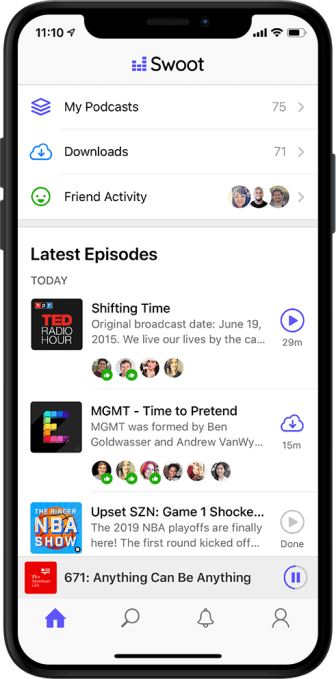
Swoot Screenshot 1

The startup has already raised a $3 million seed funding round led by True Ventures .

“Pete and Garret both have incredible product and entrepreneurial experience, plus they have built successful businesses together in the past,” said True Ventures co-founder Jon Callaghan in a statement. “Their focus of solving the disjointed podcast listening experience through Swoot’s elegant design fills a clear gap in media discovery.”

Discovery — namely, finding new podcasts beyond the handful that you already subscribe to — is one of the biggest issues in podcasting right now. It’s something a number of companies are trying to solve, but in Curley’s view, the key is to make the listening experience more social.

He noted that social sharing features are getting added to “literally everything,” including your bathroom scale, except “the one thing that I actually wanted it for.”

Curley also contrasted the podcast listening experience with YouTube: “We don’t realize how big [podcasting] is because there is no social thing where you see that Gangnam Style has 8 billion views, and you realize that the entire world is watching. There’s no view count, no anything that tells you what’s popular.”

So he’s trying to provide that view with Swoot. Instead of focusing on overall view counts (which might not be that impressive in a new app), Swoot gives you two main ways to track what’s popular among your friends.
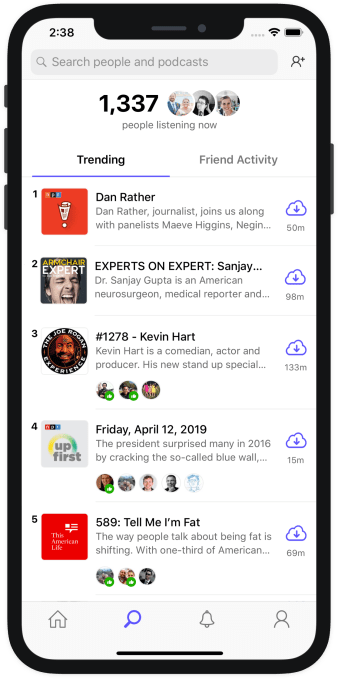
Swoot Screenshot 2

There’s a feed that shows you everything that your friends are listening to or recommending, plus a list of episodes that are currently trending, with little icons showing you the friends who have listened to at least 20 percent of an episode.

Curley said the team has been beta testing the app by simply releasing it on the App Store and telling friends about it, then letting it spread by word of mouth until it was in the hands of around 1,000 users. During that test, it found that 25 percent of the podcasts that users listened to were coming from friends.

Curley also noted that this approach is “episode-centric” and rather than “show-centric.” In other words, it’s not just helping you find the next podcast that you want to subscribe to and listen to for years — it also helps surface the specific episode that everyone’s listening to right now.

“In the 700,000 shows that exist, if you’re the 690,000 worst-ranked show, but you have one great episode that should be able to go viral, that’s basically impossible to do right now, because audio is crazy hard to share,” Curley said.

In the course of our conversation, I brought up my experience with Spotify — I like seeing what’s popular, but when a friend recently mentioned specific songs that they could see I’d been listening to on the service, I was a bit creeped out.

“It’s funny, I actually thought, how ironic that Spotify is getting into podcasting now [through the acquisitions of Gimlet and Anchor],” Curley replied. “They actually had this correct mechanism applied to the wrong thing. Music is a deeply personal thing.”

Which isn’t to say that podcast listening isn’t personal, but there’s more of an opportunity to discover overlapping interests, say the fact that you and your friends all listen to true crime podcasts.

Curley also said that the app is deliberately to ensure that “the service does not get worse because a ton of people follow you” — so they see what you listen to, but they can’t comment on it or tell you that you’re an idiot for listening.

At the same time, he also said the team will be adding a mode to only share podcasts you actively recommend, rather than posting everything you listen to.

As for making money, Curley suggested that he’s interested in exploring a variety of opportunities, whether that’s integrating with other subscription or tipping services, or in creating ad opportunities around promoting different podcasts.

“My actual answer is, there are a bunch fo people trying to monetize right now, but I don’t think there’s a platform even close to mature enough to even try to monetize podcasting yet, other than podcasters doing their own advertising,” he said. “I think the endgame, where the real money is made in podcasting, actually hasn’t been come up with yet.”


Read the Mueller report here

The Mueller report has been published. It was posted at 11am ET, a month after Special Counsel Robert Mueller submitted his findings to the Justice Department examining Russian interference in the 2016 U.S. presidential election.

Per remarks by U.S. attorney general William Barr speaking this morning, there are three major components to the report:

  • How the Russian troll farm, the so-called Internet Research Agency sowed social discord among American voters through disinformation efforts across social media;
  • The involvement of the Russian government’s intelligence unit, the GRU, in hacking into computers belonging to the Democratic National Committee and the Hillary Clinton campaign to steal documents and emails;
  • And the investigation of the Trump campaign’s links and connections over possible collusion with the Russian government during the 2016 presidential election,

We’ve uploaded the final redacted report here. You can read below. You can follow along with TechCrunch’s coverage of the Mueller report, and read more about how and why we’re covering it.