Bankin’ raises $22.6 million for its financial coach

French startup Bankin’ is raising a new $22.6 million funding round (€20 million). The company has managed to attract 2.9 million users in France and wants to become the only app you need to manage your money.

Overall, Bankin’ has raised over $32 million (€28.4 million). Investors include Omnes Capital, Commerz Ventures, Génération New Tech, Didier Kuhn, Simon Dawlat and Franck Lheurre.

Bankin’ first developed an aggregator so that you could view all your bank accounts from a single app. The company has been using a combination of APIs and scrapping to connect to nearly all French banks, 85 percent of Spanish and British banks and 65 percent of German banks.

The app automatically categorizes your transactions and sends you push notifications to alert you of important changes. There’s also a budget feature that can predict how much money you’ll have at the end of the month.

Bankin’ went one step further and started adding transfers from the app. If you want to ditch your bank app, you need to be able to view your balance and your transactions, but you also need to be able to send and receive money.

And now, Bankin’ wants to become your financial coach with automated recommendations and human-powered conversations. The app has been redesigned a couple of months ago to put these recommendations front and center.

For instance, the app can tell you if it’s time to renegotiate your loan, or that you should optimize your savings. The startup partners with other fintech companies, such as Yomoni, Pretto, Transferwise and Fluo, as well as online banks. This could be an interesting acquisition channel for other companies and a good revenue opportunity for Bankin’.

Finally, Bankin’ also sells access to its API called Bridge. For instance, Sage, Milleis Banque, Cegid and RCA use Bridge so that you can connect your third-party bank accounts and view them from your main bank account.

With today’s funding round, the company plans to hire reasonably. There are now 50 people working for Bankin’ and the startup plans to hire 20 more people this year.

Phantom Auto raises $13.5M to expand remote driving business to delivery bots and forklifts

Remote driving startup Phantom Auto has raised $13.5 million of financing in a Series A round led by Bessemer Venture Partners — capital used to expand a logistics business targeting sidewalks, warehouses and cargo yards, all the places where autonomy and teleoperation are being deployed today.

The startup, founded in 2017, has raised about $19 million to date. Byron Deeter and Tess Hatch from Bessemer have joined Phantom’s board.

The so-called “race” to deploy self-driving trucks, robotaxi services and other applications of autonomous vehicle technology on public roads has encountered a speed bump of sorts that has sent ripples throughout the nascent industry.

In short: autonomous vehicles are hard and everyone seems to be waking up to that fact.

As deployment timelines have moved, companies have quieted. Some have pivoted, shuttered, or been snapped up in acquisitions by other better capitalized companies looking for talent. Other companies, like Phantom Auto that are adjacent to the industry, are expanding into new areas as they wait for autonomous vehicle developers to catch up.

Phantom Auto co-founder Elliot Katz emphasized that the company is still working with customers deploying autonomous passenger and commercial vehicles on public roads. This new logistics business, however, holds more near-term potential. 

“We continue to be designed into our customers’ stacks who are focusing on AVs on public roads, but it will take some time for autonomous passenger vehicles and commercial trucks to be deployed at scale,” Phantom founder Shai Magzimof said in a statement.

The company is working with some of the largest logistics companies in the world, Katz said. Phantom Auto isn’t providing a full list of customers yet. One named partner is Dutch yard truck manufacturer Terberg.

Katz told TechCrunch that customers include companies launching autonomous delivery robots. They’re also using the platform to remotely operate forklifts and yard trucks equipped with its teleoperation software. Yard trucks are used by major retailers, for example. 

There has been zero innovation with yard trucks in the past 40 years,” Katz said. “And customers in this segment, are itching to gain efficiencies. That’s that’s the name of the game for them. They see this as a path to get there.”

Phantom Auto’s teleoperation platform allows a remote driver, sometimes located thousands of miles away, to take control of an autonomous vehicle if needed. The platform, which uses public cellular networks, isn’t designed to take over in a split second in hopes of avoiding an accident. Instead, it’s used as a safety backup to take control of the vehicle if it encounters a difficult scenario and gets confused, or is even involved in an accident.

In the logistics application, the Phantom Auto system is used in low speed environments. A remote control center could control a company’s yard trucks anywhere in the country.

Phantom Auto isn’t employing the remote drivers in this use case. Instead, Katz said these logistics customers typically want to train their own employees how to use the platform. And this doesn’t necessarily replace drivers who are on the ground operating these yard trucks or forklifts. The system is seen as a way to use workers at one location that is experiencing a lull in activity to remotely operate a busier spot farther away.

For delivery robots, the platform can be used to help the vehicle handle tricky situations like stairs or other complex environments.


Spotinst, the startup enabling companies to purchase and manage excess cloud capacity, acquires StratCloud

Spotinst, the cloud automation and optimization startup founded in Tel Aviv but now with offices in San Francisco, New York, and London too, has acquired AWS partner StratCloud. Terms of the deal remain undisclosed, although I’m hearing it combines both cash and stock and was somewhere in the region of $5 million.

As part of the acquisition, StratCloud’s team of 15 people will be joining Spotinst, including founder Patrick Gartlan, who will become VP, Cloud Services at Spotinst. StratCloud hadn’t raised any venture capital but instead was bootstrapped by Gartlan, who was the former CTO of Cloud Optimization company CloudCheckr.

Founded in 2015, Spotinst enables enterprises to optimize their cloud infrastructure usage by automating the process of using excess — and therefore cheaper — capacity from leading cloud providers.

As TechCrunch’s Ron Miller previously explained, cloud platforms like AWS, Microsoft Azure and Google Cloud Platform, all of which Spotinst supports, have to maintain more resources than they need at any given time. All three companies offer steep discounts to customers who want to access these resources, but they come with a strict condition that the platforms can take those resources back whenever they need them. Which is where Spotinst (and today’s acquisition of StratCloud) comes in.

Spotinst’s platform manages the process of acquiring spare capacity, powered by predictive AI, and seamlessly switches providers before it’s withdrawn. This ensures that cloud computing “workloads” keep functioning, while the customer still receives the best possible price.

Meanwhile, StratCloud tech is described as an “optimization platform” that buys, sells and converts reserved capacity, therefore maximizing savings for on-demand infrastructure. “This leads to lower compute payments, without engineers having to change anything in the applications and infrastructure they manage,” explains Spotinst.

Related to this, Spotinst will migrate StratCloud’s several dozen customers to the Spotinst Platform where they’ll continue to receive all of the current functionality.

Overall, the acquisition means Spotinst can now offer a complete solution for cloud users, including offering reserved instances and unused computer power so that enterprises can run any workload and support large-scale migrations on any cloud provider. In addition, Spotinst says the combined technologies give Managed Service Providers (MSPs) a comprehensive tool to optimize cloud workloads for all of their managed customers.

Spotinst claims over 1,500 enterprise customers in 52 countries, including Samsung, N26, Duolingo, Ticketmaster and Wix. The company currently employs approximately 150 staff across its four offices and has raised $52 million in VC funding to date.

Congress readies for Mueller report to be delivered on CDs

If there weren’t enough obstacles already standing between Congress and the results of the special counsel’s multiyear investigation, lawmakers are expecting to need an optical drive to read the document.

A Justice Department official told the Associated Press that a CD containing the Mueller report would be delivered to Congress tomorrow between 11 and noon Eastern. At some point after the CDs are delivered, the report is expected to be made available to the public on the special counsel’s website.

Any Congressional offices running Macs will likely have to huddle up with colleagues who still have a CD-capable drive. Optical drives disappeared from Apple computers years ago. With people increasingly reliant on cloud storage over physical storage, they’re no longer as popular on Windows machines either.

Tomorrow’s version of the report is expected to come with a fair amount of detail redacted throughout, though a portion of Congress may receive a more complete version at a later date. The report’s release on Thursday will be preceded by a press conference hosted by Attorney General William Barr and Deputy Attorney General Rod Rosenstein. If you ask us, there’s little reason to tune into that event rather than waiting for substantive reporting on the actual contents of the report once it’s out in the wild. Better yet, hunker down and read some of the 400 pages yourself while you wait for thoughtful analyses to materialize.

Remember: No matter what sound bites start flying tomorrow morning, digesting a dense document like this takes time. Don’t trust anyone who claims to have synthesized the whole thing right off the bat. After all, America has waited this long for the Mueller report to materialize — letting the dust settle won’t do any harm.

Starbucks challenger Luckin’s fundraising spree continues with $150M investment

Coffee startup Luckin is continuing its fundraising spree as it sets its sight on becoming an alternative to Starbucks in China.

The a-year-and-a-half old company announced on Thursday that it closed a Series B-plus raise totaling $150 million. The fresh proceeds valued Luckin at $2.9 billion post-money, up from $2.2 billion just four months ago.

While many question Luckin’s cash-fueled expansion, Blackrock, which owns a 6.58 percent stake in Starbucks, shows its confidence in the Chinese startup by pumping $125 million through its private equity fund into Luckin’s new round.

With that, the New York-based investment firm has its bet on two contrasting models for China’s coffee consumption. While Starbucks zeroes in on the brick-and-mortar experience, Luckin is a network of last-mile coffee delivery centers plus places for people to pick up orders and sit down targeting busy white-collar workers.

In a move that would amp up its battle with Luckin, Starbucks teamed up with Alibaba’s food delivery unit Ele.me last August to put hot and cold drinks in people’s hands.

Luckin did not disclose how it will spend the fresh capital infusion, but the pace at which it’s raising suggests the startup is in dire need of cash. The new round arrived less than a year after it secured a $200 million Series A in July and another $200 million from a Series B in December.

Indeed, Luckin founder Qian Zhiya, a former executive at auto rental firm Car Inc, confessed the company burned through $150 million within just six months from launching. A big chunk of money had gone to shelling out deep discounts for consumers, while the coffee challenger’s offline expansion was as cash-intensive.

As of late, Luckin has opened 2,000 outlets consisting of small prep kitchens, pickup stations and cafes in 22 Chinese cities, up from 1,700 locations reached in December. That gives Luckin less than eight months to fulfill its ambition of becoming the “biggest coffee chain in China by the number of outlets run and cups sold.” The goal is to top 4,500 outlets by the end of 2019.

Starbucks, which made its foray into China 20 years ago, has also been aggressively putting up storefronts. It currently runs 3,600 stores across 150 cities in China, up from 3,300 last May.

When it comes to actual people using the service, Starbucks still enjoys a huge lead. The Luckin app that allows one to order and pay has 650 thousand unique downloads in March, data from research firm iResearch shows. Starbucks’s app is more than four times its size with 2.81 million unique downloads from the same period.

Other investors who joined in on Luckin’s latest round included existing backers such as Singapore’s sovereign wealth fund GIC, Chinese government-controlled China International Capital Corporation, Dazheng Capital and Joy Capital, whose founding partner Liu Erhai sits on Luckin’s board.

Samsung responds to reviewer complaints about its Galaxy Fold phone

Samsung has issued a statement about its new, folding phone as early photos of tech reviewers with their shiny new toys were replaced on social media (and in numerous columns) with complaints from those same tech reviewers about problems with the phone’s screen.

Apparently a number of reviewers either mistakenly destroyed their phone screens or had the screens bork on them after a few days of use. It’s not a good look for Samsung.

However, our own Brian Heater had his hands on the Samsung phone, and has had nary a dent in his two days of use.

He wrote:

This sort of thing can happen with pre-production models. I’ve certainly had issues with review units in the past, but these reports are worth mentioning as a note of caution with a product, which we were concerned might not be ready for prime time only a couple of weeks ago.

At the very least, it’s as good a reason as any to wait a couple of weeks before more of these are out in the world before dropping $2,000 to determine how widespread these issues are.

All of that said, I’ve not had any technical issues with my Samsung Galaxy Fold. So far, so good. A day or so in does, however, tend to be the time when the harsh light of day starts to seep in on these things, after that initial novelty of the company’s admittedly impressive feat begins wane.

In its response, the company is bravely forging ahead and (sort of) blaming the messenger for not using the thing correctly. The phones will go on sale in the U.S. on April 26 as planned.

No less esteemed a tech reviewer than Recode’s Walt Mossberg called the response from Samsung “Really weak“.

Here’s the statement in full:

“A limited number of early Galaxy Fold samples were provided to media for review. We have received a few reports regarding the main display on the samples provided. We will thoroughly inspect these units in person to determine the cause of the matter.

Separately, a few reviewers reported having removed the top layer of the display causing damage to the screen. The main display on the Galaxy Fold features a top protective layer, which is part of the display structure designed to protect the screen from unintended scratches. Removing the protective layer or adding adhesives to the main display may cause damage. We will ensure this information is clearly delivered to our customers.”

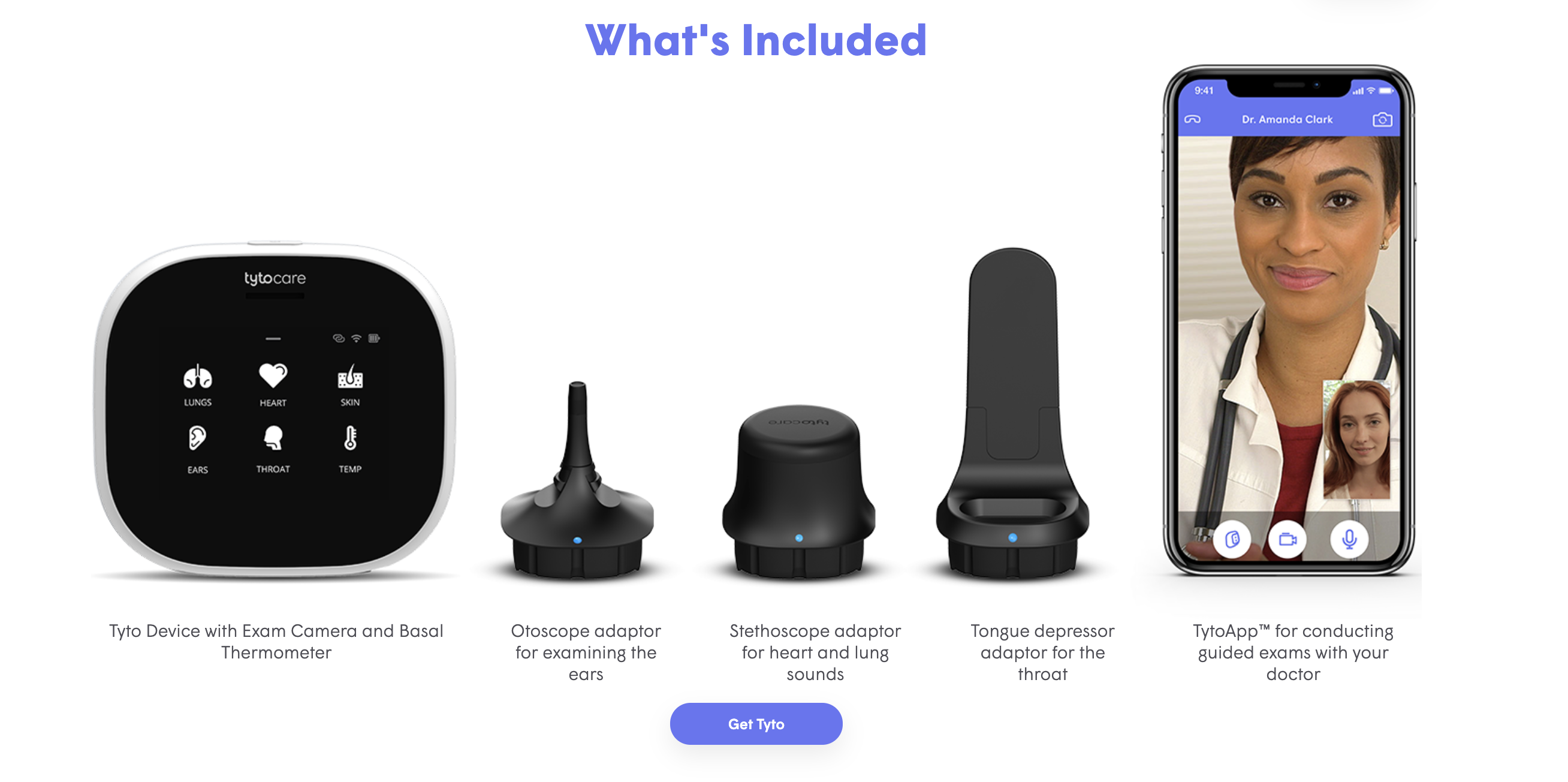
Consumers get another digital home health offering as Tyto Care and Best Buy launch TytoHome

Best Buy is partnering with the Israeli technology Tyto Care to become the official retailer for the company’s all-in-one digital diagnostics kit through its physical stores in California, the Dakotas, Ohio and Minnesota and through its online store.

Tyto previously sold its technology through healthcare plans, making its handheld examination device with attachments that act as a thermometer, a stethoscope, an otoscope and a tongue depressor available to families with insurance that wanted to reduce the cost of checkups through remote monitoring. The company’s handheld device comes with an exam camera so it can prompt users on where to position the device to get the most accurate readings.


Now, through Best Buy, consumers can buy the company’s kit for $299.99. Through a partnership with American Well, users of the TytoHome kit have access to the company’s LiveHealth Online consultation service (if they live outside of Minnesota or the Dakotas). Which means patients can use the device to perform a medical exam and send the information to a physician for a diagnosis any time of the day or night.

As part of the deal, Tyto Care is partnering with additional regional health care systems to provide medical care to consumers throughout the country. The first is Sanford Health, a Minnesota-based not-for-profit health system operating in Minnesota, North Dakota and South Dakota. 

For Best Buy the move builds on the company’s attempts to move quickly into providing digital healthcare services just like it provides technical support through its Geek Squad.

Last year the company bought GreatCall, which sells connected health and emergency response services to the AARP crowd.

“We’re excited to partner with Best Buy, LiveHealth Online, American Well and regional health systems to extend our on-demand telehealth platform across the U.S., enhancing primary care delivery,” said Dedi Gilad, the chief executive and co-founder of Tyto Care, in a statement.

The company, based in Herzliya, Israel, has raised $56.7 million to date from investors including Sanford Health, the Japanese Itochu Corp., Shenzhen Capital Group, Ping An, LionBird, Fosun Group, Orbimed and Walgreens.

The company said at the time that it would use the cash to expand in the U.S. and to other international markets in Asia and Europe.

“These strategic partnerships will enable us to gain further momentum and accelerate our growth, deepening our foothold in the U.S. and other new strategic markets,” said GiladTyto Care said in a statement at the time.

PathAI raises $60 million for its computer vision-based pathogen detection technology

With a clinical version of PathAI‘s computer vision-based pathogen detection service still at least one year from coming to market, the diagnostic technology developer has snagged $60 million in its latest round of financing.

The company’s tech is used by doctors to analyze cell samples taken from patients to determine the presence or absence of bacterium, viruses, cancerous cells or other disease causing agents.

These days, PathAI’s technology is used less in hospitals for patient care and more by pharmaceutical companies developing new drugs,  according to the company’s co-founder and chief executive, Dr. Andy Beck.

Our biggest focus today is a research platform we use it to examine new therapeutics for serious diseases,” Beck says. “We see that as a really important problem for patients… accelerating how we get safe and effective medicines to patients.”

That’s an attractive market given that pharmaceutical companies have more money to spend on new technology than hospitals.

When the company does work with pathologists, they’re using the technology for research purposes, says Beck. Any clinical diagnostic work would have to go through trials and be approved by regulators, he says.

“For this direct clinical use it’s in the one to two year timeframe,” he says. 

General Atlantic led the company’s latest round with additional capital coming from previous investors General Catalyst, 8VC, DHVC, REfactor Capital, KdT Ventures, and Pillar Companies.

PathAI has grown its staff to over 60 employees in the past year, and the company has signed partnerships with Bristol-Myers Squibb and Novartis .

As a result of the financing, General Atlantic managing director, Dr. Michelle Dipp will take a seat on the company’s board.

“PathAI’s work could radically improve the accuracy and reproducibility of disease diagnosis and support the development of new medicines to treat those diseases,” said David Fialkow, Managing Director at General Catalyst, in a statement. 


100 Car2go Mercedes hijacked in Chicago crime spree

Car2go, free-floating car-sharing service owned by Daimler, temporarily shut down its service in Chicago on Wednesday after dozens of Mercedes-Benz vehicles were stolen using the app.

The Chicago Police Department was alerted by Car2Go that some of their vehicles may have been rented by deceptive or fraudulent means through a mobile  app, a spokesperson wrote in an emailed statement to TechCrunch.

The news was first reported via tweet by Brad Edwards, a reporter with CBS Chicago. Edwards reported that sources said that many of the vehicles were allegedly used to commit other crimes. CPD did not provide any details about how the vehicles were used and said the investigation was ongoing.

https://platform.twitter.com/widgets.js

Car2go launched in Chicago last June, the first time in four years that the company added a U.S. city to its ranks. The car-sharing company lets customers rent out vehicles on a short-term basis. Daimler’s diminutive Smart cars were once the lone option for Car2go customers. The company has expanded its offerings in recent years and now offers Mercedes-Benz CLA and GLA, as well as the two-door Smartfortwo vehicles.

CPD said 100 vehicles are still unaccounted for. It is believed that 50 vehicles, all of them Mercedes-Benz remain in the greater Chicago area. Police are questioning more than a dozen persons of interest.

CPD said it’s working with Car2go to determine whether there are any other vehicles whose locations cannot be accounted for.  At this time the recoveries appear to be isolated to the West Side, CPD said.

While the perpetrators appear to have gained access to the vehicles through “fraudulent means,” Car2go emphasized that no personal or confidential member information has been compromised.

TechCrunch received a tip from a user who received this “temporary pause in service” message when trying to use the app. Car2go confirmed the shut down and added that it will provide an update as soon as possible.


Car2go is going through a branding and organizational transition. Daimler  AG and BMW Group officially agreed to merge their urban mobility services into a single holding company back in March 2018 with a 50 percent stake each. In February, the companies announced plans to unify their services under five categories by creating five joint ventures — Reach Now, Charge Now, Park Now, Free Now and Share Now.

Pinterest prices IPO above range

Pinterest priced shares of its stock, “PINS,” above its anticipated range on Wednesday evening, CNBC reports. The company will sell 75 million shares of Class A common stock at $19 apiece in an offering that will attract $1.4 billion in new capital for the visual search engine.

The NYSE-listed business had planned to sell its shares at between $15 to $17 and didn’t increase the size of its planned offering prior to Wednesday’s pricing.

Valued at $12.3 billion in 2017, the initial public offering gives Pinterest an initial market cap of approximately $10 billion.

The IPO has been a long time coming for the nearly 10-year-old company led by co-founder and chief executive officer Ben Silbermann . Given Wall Street’s lackluster demand for ride-hailing company Lyft, another consumer technology stock that recently made its Nasdaq debut, it’s unclear just how well Pinterest will perform in the days, weeks, months and years to come. Pinterest is unprofitable like its fellow unicorns Lyft and Uber, but its financials, disclosed in its IPO prospectus, illustrate a clear path to profitability. As for Lyft and Uber, Wall Street analysts, among others, still question whether either of the businesses will ever achieve profitability.

Eric Kim of consumer tech investment firm Goodwater Capital says despite the fact that Pinterest and Lyft are very different companies, Lyft’s falling stock has undoubtedly impacted Pinterest’s offering.

“They are so close together, it’s hard for those not to influence one another,” Kim told TechCrunch. “It’s a much different category, but they are still both consumer tech and they will both be trading at a double-digital revenue multiple.

The San Francisco-based company posted revenue of $755.9 million in the year ending December 31, 2018 — 16 times less than its latest decacorn valuation — on losses of $62.9 million. That’s up from $472.8 million in revenue in 2017 on losses of $130 million.

The stock offering represents a big liquidity event for a handful of investors. Pinterest had raised a modest $1.47 billion in equity funding from Bessemer Venture Partners, which holds a 13.1 percent pre-IPO stake, FirstMark Capital (9.8 percent), Andreessen Horowitz (9.6 percent), Fidelity Investments (7.1 percent) and Valiant Capital Partners (6 percent). Bessemer’s stake is worth upwards of $1 billion. FirstMark and a16z’s shares will be worth more than $700 million each.

Zoom — another tech company going public on Thursday that, unlike its peers, is actually profitable — priced its shares on Wednesday too after increasing the price range of its IPO earlier this week. The price values Zoom at roughly $9 billion, nearly surpassing Pinterest, an impressive feat considering Zoom was last valued at $1 billion in 2017 around when Pinterest’s Series H valued it at a whopping $12.3 billion.

Profitability, as it turns out, may mean more to Wall Street than Silicon Valley thinks.