Co-Star raises $5 million to bring its astrology app to Android

Nothing scales like a horoscope.

If you haven’t heard of Co-Star, you might just be in the wrong circles. In some social scenes it’s pretty much ubiquitous. Wherever conversations regularly kick off by comparing astrological charts, it’s useful to have that info at hand. The trend is so notable that the app even got a shout out in a New York Times piece on VCs flocking to astrology startups.

This week, the company behind probably the hottest iOS astrology app announced that it has raised a $5.2 million seed round. Maveron, Aspect, 14w and Female Founder Fund all participated in the round, which follows $750,000 in prior pre-seed funding. The company plans to use the funding to craft an Android companion to its iOS-only app, grow its team and “build features that encourage new ways get closer, new ways to take care of ourselves, and new ways to grow.”

TechCrunch spoke with Banu Guler, the CEO and co-founder of Co-Star about what it was like talking to potential investors to drum up money for an idea that Silicon Valley’s elite echo chambers might find unconventional.

“We certainly talked to some who were dismissive,” Guler told TechCrunch in an email. “But the reality is that interest in astrology is skyrocketing… It was all about finding the right investors who see the value in astrology and the potential for growth.”

“There are people out there who think astrology is silly or unserious. But in our experience, the number of people who find value and meaning in astrology is far greater than the number of people who are turned off by it.”

If you’ve ever used a traditional astrology app or website to look up your birth chart — that is, to determine the positions of the planets on the day and time you were born — then you’ve probably noticed how most of those services share more in common with ancient Geocities sites than they do with bright, modern apps. In contrast, Co-Star’s app is clean and artful, with encyclopedia-like illustrations and a simple layout. It’s not something with an infinite scroll you’ll get lost in, but it’s pleasant to dip into Co-Star, check your algorithmically-generated horoscope and see what your passive aggressive ex’s rising sign is.

In a world still obsessed with the long-debunked Meyers-Briggs test, you can think of astrology as a kind of cosmic organizational psychology, but one more interested in peoples’ emotional realities than their modus operandi in the workplace. For many young people — and queer people, from personal experience — astrology is a thoroughly playful way to take stock of life. Instead of directly predicting future events (good luck with that), it’s is more commonly used as a way to evaluate relationships, events and anything else. If astrology memes on Instagram are any indication, there’s a whole cohort of people using astrology as a framework for talking about their emotional lives. That search for authenticity — and no doubt the proliferation of truly inspired viral content — is likely fueling the astrology boom. 

“By positioning human experience against a backdrop of a vast universe, Co–Star creates a shortcut to real talk in a sea of small talk: a way to talk about who we are and how we relate to each other,” the company wrote in its funding announcement. “It doesn’t reduce complexity. It doesn’t judge. It understands.”
Kids on 45th just raised millions in seed funding to sell lightly used kids clothes — sight unseen

A seemingly endless number of startups has attracted funding in recent years to make life easier for people with money to spend. They’re sold sell nice clothes, chic shoes, cool office space, on-demand car services, on-demand laundry services, on-demand cleaning services, anti-aging therapies. It goes on and on.

Overlooked in the process is the overwhelmingly majority of Americans. In 2015, the top 1 percent of U.S. made more than 25 times what families in the bottom 99 percent did, a gap that has been growing. Most families aren’t spending money on making life easier or more glamorous for themselves because they can’t afford it. More, they’re often too busy to think much about it.

There are rare exceptions to startups that cater to more affluent populations. One company that comes to mind is Propel, a New York-based startup whose app helps food stamp recipients improve their financial health. Another is Yenko, a for-profit outfit committed to improving graduation outcomes.

Now, an even newer player has entered onto the scene whose proposition makes all the sense in the world for the many harried, overworked, and budget-conscious families out there. Called Kids on 45th, the nearly two-year-old, Seattle-based startup bundles up what it describes as nearly new clothing that suits the current season, and it sends it to customers sight unseen for far less than they would pay elsewhere, and requiring a lot less of their time.

The company ties back to a Seattle consignment store of the same name that’s been up and running since 1989. Entrepreneur Elise Worthy describes it as a “cornerstone” of the local parenting community, and she would know. She decided to buy the business two year ago, not only to save it when it teetered on the brink of closure, but to better understand how she might turn it to a scalable enterprise.  She learned plenty, too, including that when moms came into the store because their children had outgrown their clothes, they weren’t looking for anything specific. “They were just trying to solve a problem. They didn’t care if it was this pair or that pair; they just needed pants.”

The observation led to a revelation that Worthy could build an online business without creating an elaborate website with photos and clothing descriptions. In fact, she decided to build an anti-browsing experience that allows a shopper to say what sizes are needed, and what types of items (coats, pants, shirts), one sentence about his her kid’s style, and that’s it. It’s highly counterintuitive for today’s e-commerce landscape. But a customer mostly clicks a few boxes, then waits for however many items were ordered to arrive. Because each item is priced at between $3 and $4, what that shopper doesn’t like, he or she can just donate.

Indeed, part of what makes Kids on 45th work as a business is that it’s saving on a lot of fronts. Aside from not creating and maintaining a sophisticated, content-rich website, the company doesn’t accept returns, which can prove a crushing expense for other e-commerce concerns. According to the National Retail Federation, return rates on clothing are close to 40 percent when the merchandise is bought online.

The startup, which is bundling clothes for newborns to kids up to age 16, also has systems in place that should enable it to scale, including an exclusive fulfillment relationship with one of the country’s few aggregators of thrift clothing. After paying for clothes that this partner deems to be in high-quality condition — it has plenty of options, thanks to the more than 20 billion pounds of clothing that Americans donate each year — Kids on 45th puts its staff of 15 stylists to work. “We optimize for the mom who is holding both her cell phone and her kid,” explains Worthy. “We want her to be able to check out in less than two minutes, then hand over that hunting experience to us.”

Kids on 45th has a few other things going for it, as well. First, it doesn’t charge on a subscription basis, unlike some other startups boxing up kids’ clothing, like Rockets of Awesome and Kidbox, and it insists that it doesn’t need to. “We don’t want to trap moms,” says Worthy. “We’ll send them reminder emails,” she says, and they come right back. “Our retention is on a par with companies that charge subscriptions. Moms return at the same rate on their own.”

The idea of ordering bundles of kids clothing is also catching on fast. Just yesterday, Walmart announced that it’s partnering with Kidbox to enable shoppers to purchase up to six different boxes from Walmart each year. Each will include four to five items and cost $48, said the company. That’s roughly the same average order size at Kids on 45th, says Worthy, though the startup sends off between 12 to 15 items for the same amount.

Not last, while Kids on 45th is decidedly unflashy, it’s capitalizing on one of of the biggest trends in the world right now: growing awareness about landfills throughout the U.S. that are teeming with textiles that could easily be recycled, if only there were more places for it to go.

Certainly, the young company has momentum. It says has already shipped more than half a million items just a year after launching its online business. It also just raised $3.3 million in seed funding. Its backers include Yes VC, Maveron, SoGal Ventures, Sesame Street Ventures & Collaborative Fund, Liquid 2 VC, and Brand Foundry Ventures. No doubt they’re looking for returns, as VCs do. But it’s also an investment about which they can feel good. if Kids on 45th can intercept more of the lightly used goods in the world and put them to smart use, more power to it.

Notes from the Samsung Galaxy Fold: day two

I would be remiss if I didn’t mention the technical difficulties multiple reviewers have been experiencing with their units. This sort of thing can happen with pre-production models. I’ve certainly had issues with review units in the past, but these reports are worth mentioning as a note of caution with a product, which we were concerned might not be ready for prime time only a couple of weeks ago.

At the very least, it’s as good a reason as any to wait a couple of weeks before more of these are out in the world before dropping $2,000 to determine how widespread these issues are.

All of that said, I’ve not had any technical issues with my Samsung Galaxy Fold. So far, so good. A day or so in does, however, tend to be the time when the harsh light of day starts to seep in on these things, after that initial novelty of the company’s admittedly impressive feat begins wane.

Using the device in the lead up to our big robotics event tomorrow, a number of TechCrunch co-workers have demanded a few minutes with the the device. The reviews so far have been mixed, with most calling out the thick form factor when closed, as well as the crease. The latter, at least, is really dependent on environmental lighting. In the case of the backstage area at this event, it’s harsh overhead office lighting, which tends to bring the crease out when the phone is facing the ceiling.

On the other hand, I used the phone to watch videos while using the elliptical at the gym this morning. Titled toward me, the crease wasn’t noticeable. It’s also one of the ideal use cases for the product.

Some more notes:

  • The company’s stated “day long” life is pretty on the money. I got just over 24 hours of standard use (subtracting my five hours on a plane).
  • The screen has a built-in protector that looks a lot like the kind of adhesive guard Samsung’s phones ship with. Don’t peel it off. You will damage the phone.
  • I accidentally (I swear) dropped it off a table. It survived unscathed.
  • So many fingerprints.
  • The green finish looks like gold under certain lights. I definitely would have gone in for blue.
  • We used the handset for a Google Hangout. It was kind of perfect. Kept open at an angle, it can prop itself up.
  • The snap to close is still satisfying.

Day One Notes 


Chipotle customers are saying their accounts have been hacked

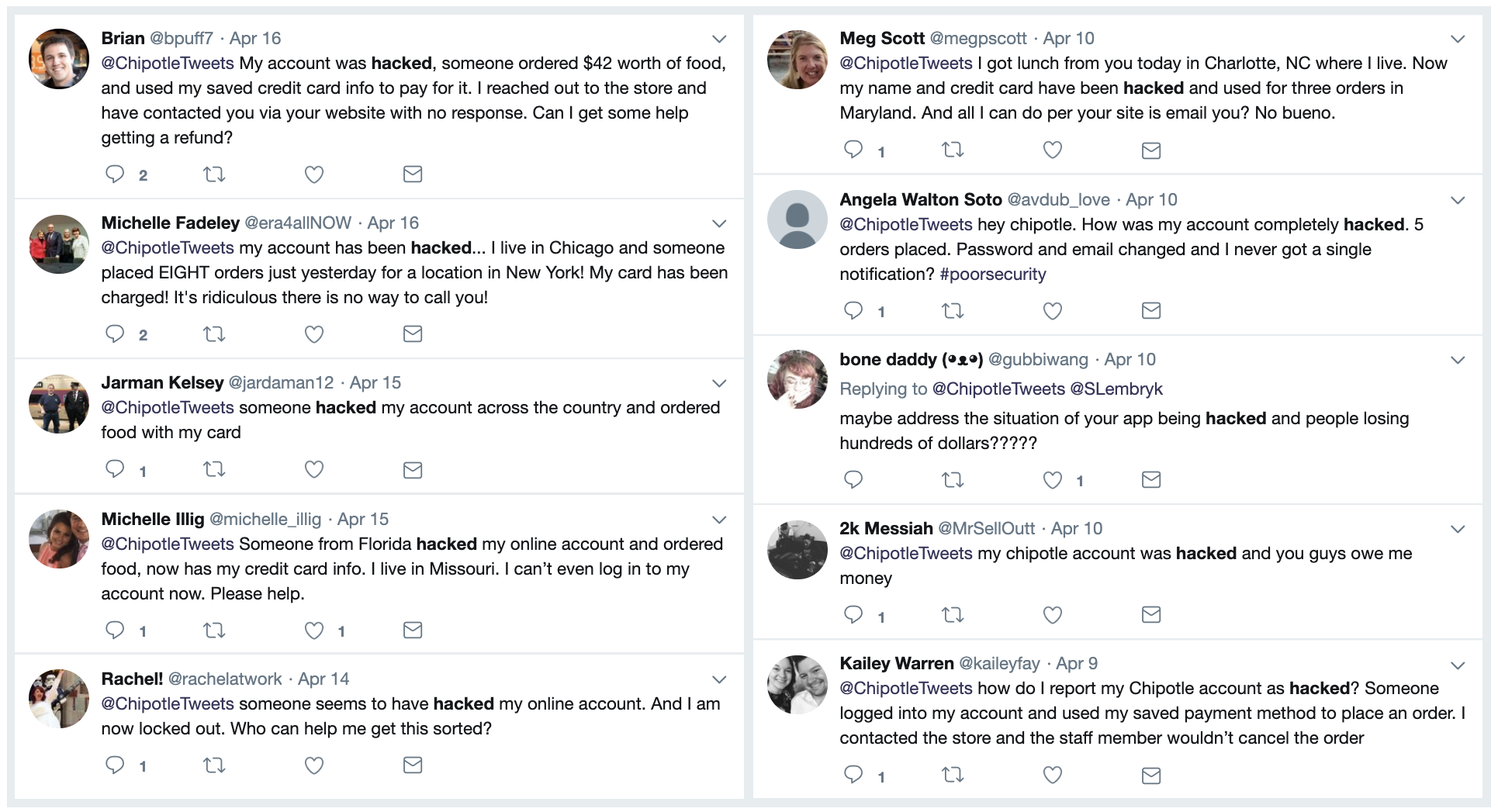
A stream of Chipotle customers have said their accounts have been hacked and are reporting fraudulent orders charged to their credit cards — sometimes totaling hundreds of dollars.

Customers have posted on several Reddit threads complaining of account breaches and many more have tweeted at @ChipotleTweets to alert the fast food giant of the problem. In most cases, orders were put through under a victim’s account and delivered to addresses often not even in the victim’s state.

Many of the customers TechCrunch spoke to in the past two days said they used their Chipotle account password on other sites. Chipotle spokesperson Laurie Schalow told TechCrunch that credential stuffing was to blame. Hackers take lists of usernames and passwords from other breached sites and brute-force their way into other accounts.

But several customers we spoke to said their password was unique to Chipotle. Another customer said they didn’t have an account but ordered through Chipotle’s guest checkout option.

Tweets from Chipotle customers. (Screenshot: TechCrunch)

When we asked Chipotle about this, Schalow said the company is “monitoring any possible account security issues of which we’re made aware and continue to have no indication of a breach of private data of our customers,” and reiterated that the company’s data points to credential stuffing.

It’s a similar set of complaints made by DoorDash customers last year, who said their accounts had been improperly accessed. DoorDash also blamed the account hacks on credential stuffing, but could not explain how some accounts were breached even when users told TechCrunch that they used a unique password on the site.

If credential stuffing is to blame for Chipotle account breaches, rolling out two-factor authentication would help prevent the automated login process — and, put an additional barrier between a hacker and a victim’s account.

But when asked if Chipotle has plans to roll out two-factor authentication to protect its customers going forward, spokesperson Schalow declined to comment. “We don’t discuss our security strategies.”

Chipotle reported a data breach in 2017 affecting its 2,250 restaurants. Hackers infected its point-of-sale devices with malware, scraping millions of payment cards from unsuspecting restaurant goers. More than a hundred fast food and restaurant chains were also affected by the same malware infections.

In August, three suspects said to be members of the FIN7 hacking and fraud group were charged with the credit card thefts.

Salesforce is buying MapAnything, a startup that raised over $84 million

Salesforce announced today it’s buying another company built on its platform. This time it’s MapAnything, which as the name implies, helps companies build location-based workflows, something that could come in handy for sales or service calls.

The companies did not reveal the selling price, and Salesforce didn’t have anything to add beyond a brief press release announcing the deal.

“The addition of MapAnything to Salesforce will help the world’s leading brands accurately plan: how many people they need, where to put them, how to make them as productive as possible, how to track what’s being done in real time and what they can learn to improve going forward,” Salesforce wrote in the statement announcing the deal.

It was a logical acquisition on many levels. In addition to being built on the Salesforce platform, the product was sold through the Salesforce AppExchange, and over the years MapAnything has been a Salesforce SI Partner, an ISV Premier Partner, according the company.

“Salesforce’s pending acquisition of MapAnything comes at a critical time for brands. Customer Experience is rapidly overtaking price as the leading reason companies win in the market. Leading companies like MillerCoors, Michelin, Unilever, Synchrony Financial and Mohawk Industries have all seen how location-enabled field sales and service professionals can focus on the right activities against the right customers, improving their productivity, and allowing them to provide value in every interaction,” company co-founder and CEO John Stewart wrote in a blog post announcing the deal.

MapAnything boasts 1900 customers in total, and that is likely to grow substantially once it officially becomes part of the Salesforce family later this year.

MapAnything was founded in 2009, so it’s been around long enough to raise over $84 million, according to Crunchbase. Last year, we covered the company’s $33.1 million Series B round, which was led by Columbus Nova.

At the time of the funding CEO John Stewart told me that his company’s products present location data more logically on a map instead of in a table. ‘“Our Core product helps users (most often field-based sales or service workers) visualize their data on a map, interact with it to drive productivity, and then use geolocation services like our mobile app or complex routing to determine the right cadence to meet them,” Stewart told me last year.

It raised an additional $42.5 million last November. Investors included General Motors Ventures and (unsurprisingly) Salesforce Ventures.

Zoom, the profitable tech unicorn, prices IPO above range

Zoom, a relatively under-the-radar tech unicorn, has defied expectations with its initial public offering. The video conferencing business priced its IPO above its planned range on Wednesday, confirming plans to sell shares of its Nasdaq stock, titled “ZM,” at $36 apiece, CNBC reports.

The company initially planned to price its shares at between $28 and $32 per share, but following big demand for a piece of a profitable tech business, Zoom increased expectations, announcing plans to sell shares at between $33 and $35 apiece.

The offering gives Zoom an initial market cap of roughly $9 billion, or nine times that of its most recent private market valuation.

Zoom plans to sell 9,911,434 shares of Class A common stock in the listing, to bring in about $350 million in new capital.

If you haven’t had the chance to dive into Zoom’s IPO prospectus, here’s a quick run-down of its financials:

  • Zoom raised a total of $145 million from venture capitalists before filing to go public
  • It posted $330 million in revenue in the year ending January 31, 2019 with a gross profit of $269.5 million
  • It more than doubled revenues from 2017 to 2018, ending 2017 with $60.8 million in revenue and 2018 with $151.5 million
  • Its losses have shrunk from $14 million in 2017, $8.2 million in 2018 and just $7.5 million in the year ending January 2019

Zoom is backed by Emergence Capital, which owns a 12.2 percent pre-IPO stake; Sequoia Capital (11.1 percent); Digital Mobile Venture, a fund affiliated with former Zoom board member Samuel Chen (8.5 percent); and Bucantini Enterprises Limited (5.9 percent), a fund owned by Chinese billionaire Li Ka-shing.

Zoom will debut on the Nasdaq the same day Pinterest will go public on the NYSE. Pinterest, for its part, has priced its shares above its planned range, per The Wall Street Journal.

Wonderloop’s networking app lets you swipe left on video profiles instead of pictures

There isn’t much left to be done in online networking apps. We are all familiar with professional (LinkedIn), social (Facebook), realtime (Twitter), and dating (Tinder, Bummble etc). But profile photos of the people you’re interacting with only get you so far. And we’ve all known that person who looked smart in the photo and turned out to be not so amazing in real life. Photos don’t communicate a person’s energy, body language or their voice.

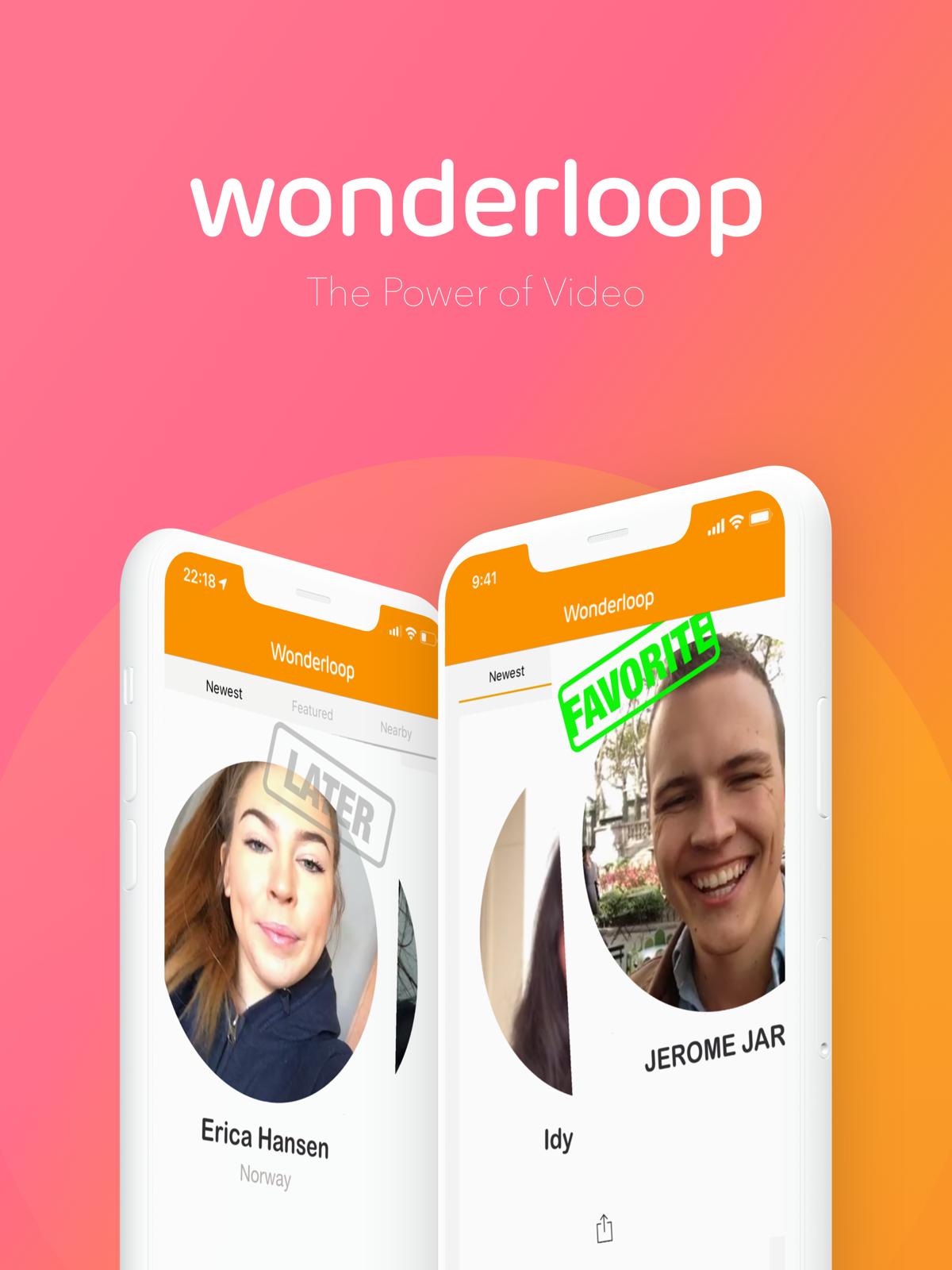
An app called Wonderloop hopes to solve this problem, with video profiles, like this one.

It’s now added swiping people, Tinder-style. Left for “later and right for “favorite”. In addition, you can see who’s “Nearby” with a location feature, making it more likely you may even bump into this person. How’s that for making your day more… interesting?

Founder Hanna Aase says Wonderloop is not so much “LinkedIn with video” as much as it is “About.me with video”. Why? Well, because it also has a web-platform, allowing you to share your video profile outside the app, as well as message inside it.

I must admit, it’s fair to say that the impression you get from a person from watching them for 10 seconds on a video is pretty persuasive.

Aase says Wonderloop could end up being your personal “video ID” providing each user with their unique video profile. She says Wonderloop’s aim is to create a search engine out of people on video.

“To see people on video creates trust. Wonderloop’s goal is that every person in the world should have a video identity. We want to help users get seen in this world. You use Wonderloop for the first step of turning a stranger into a potentially cool person in your life,” she added.

She thinks the app will be used by people to make new friends, connect influencers with fans, connect entrepreneurs, connect freelancers and travelers and of course a bit of dating here and there.

She’s also hoping the app will appeal to Millennials and Generation-Z who, as frequent travelers, are often into meeting people “nearby.” “We did research and were surprised to the extent the age group 16-20 wish to find new friends,” she says. For instance, apps like Jodel are used by young people to reach out to chat to complete strangers nearby (although with no names attached).

Right now the app is invite-only, but users can apply inside the app. Aase says: “We hope to do it in stages as the company grows and in a way where users feel the community is a place they feel safe and can share who they are on video. But being invite-only also makes us differentiated to all other services.”

Buy now, pay later and save on passes to Disrupt San Francisco 2019

It’s super early-bird season for startuppers of every stripe, meaning it’s time to grab the lowest prices on passes to Disrupt San Francisco 2019, going down on October 2-4 at Moscone North. Check out all the different pass types that fit any level of needs and budgets. Register for your pass now to lock in the lowest price, plus you can pay for your pass in four installments if need be.

Here’s how the buy-now-pay-later installment plan works. Follow the normal process to purchase your pass. When it comes time to pay, select the payment plan option. You pay 25 percent of the pass price (plus fees) now, and then pay off the remaining balance in three equal payments to take place on July 15, August 15 and September 15. Note: Discounted Student, Government or Nonprofit Innovator passes are not eligible for payment installments.

Whether you’re a founder, investor, industry leader, developer or technologist, you can lock in your pass and experience all the excitement and action of Disrupt SF 2019 at super savings. Three program-packed days feature hands-on workshops, product demonstrations, top-notch speakers, moderated Q&A sessions and world-class networking — for starters.

Don’t miss Startup Battlefield, TechCrunch’s famous pitch competition — and who can resist the hundreds of innovative startups exhibiting in Startup Alley? It’s a breeding ground of opportunity.

There’s still time to apply to compete in Startup Battlefield — or to be selected as a TC Top Pick and exhibit in Startup Alley for free. It doesn’t cost a thing to apply or participate, so fill out this application to be considered for both of TechCrunch’s VIP early-stage startup programs.

Disrupt SF 2019 takes place on October 2-4. Be kind to your bottom line and buy your pass at the lowest price, spread your payments over four months and enjoy your Disrupt experience knowing you got the best ROI possible. Can’t wait to see you in October!

Is your company interested in sponsoring or exhibiting at Disrupt SF? Click here

FCC looks to slap down China Mobile’s attempt to join US telecom system

The FCC has proposed to deny an application from China Mobile, a state-owned telecom, to provide interconnect and mobile services here in the U.S., citing security concerns. It’s another setback to the country’s attempts to take part in key portions of American telecommunications.

China Mobile was essentially asking to put call and data interconnection infrastructure here in the U.S.; It would have come into play when U.S. providers needed to connect to Chinese ones. Right now the infrastructure is generally in China, an FCC spokesperson explained on a press call.

In a draft order that will be made public tomorrow and voted on in May, FCC Chairman Ajit Pai moves to deny the application, which has been pending since 2011. Such applications by foreign-owned entities to build and maintain critical infrastructure like this in the U.S. have to pass through the Executive, which only last year issued word that it advised against the deal.

In the last few months, the teams at the FCC have reviewed the record and came to the conclusion that, as Chairman Ajit Pai put it:

It is clear that China Mobile’s application to provide telecommunications services in our country raises substantial and serious national security and law enforcement risks. Therefore, I do not believe that approving it would be in the public interest.

National security issues are of course inevitable whenever a foreign-owned company wants to be involved with major infrastructure work in the U.S., and often this can be taken care of with a mitigation agreement. This would be something like an official understanding between the relevant parties that, for instance, law enforcement in the U.S. would have access to data handled by the, say, German-owned equipment, and German authorities would alert U.S. about stuff it finds, that sort of thing.

But that presupposes a level of basic trust that’s absent in the case of a company owned (indirectly but fully) by the Chinese government, the FCC representative explained. It’s a similar objection to that leveled at Huawei, which given its close ties to the Chinese government, the feds have indicated they won’t be contracting with the company for infrastructure work going forward.

The denial of China Mobile’s application on these grounds is apparently without precedent, Pai wrote in a separate note: “Notably, this is the first time the Executive Branch has ever recommended that the FCC deny an application due to national security concerns.”

It’s likely to further strain relations between our two countries, though the news likely comes as no surprise to China Mobile, which probably gave up hope some time around the third or fourth year its application was stuck in a bureaucratic black hole.

The draft order will be published tomorrow, and will contain the evidence and reasoning behind the proposal. It will be voted on at the FCC open meeting on May 9.

Shared electric scooter rides accounted for 45.8 percent of all micromobility trips in 2018

Shared electric scooters are close to overtaking bike-sharing, according to the National Association of City Transportation Officials. In 2018, of the 84 million micromobility trips taken, 38.5 million of those were on scooters.

The other 45.5 million trips were on bikes — either ones from station-based bike-shares or dockless shared bikes. Rides on station-based bikes accounted for 36.5 million trips, an increase of nine percent from 2017. Compared to the year prior, more than twice as many trips were taken on micromobility services.

“Managing the many new shared vehicle types on city streets is a challenge,” NACTO Director of Strategy Kate Fillin-Yeh said in a statement. “The data cities receive from vendors can be spotty, complicating efforts to regulate systems or make good policies. Much of the equipment is new and largely untested at scale, and the market is changing rapidly, with an uncertain financial outlook. The most successful shared micromobility systems have been planned hand-in-hand with cities, and we’re excited to help cities create and support transportation options that shift more trips to sustainable, safe modes.”

While station-based bikes saw more usage than the year before, NACTO says electric scooters have likely been the driving factor for the decrease in usage of dockless bikes. Dockless bikes “have largely disappeared from city streets, with the notable exception of dockless bikes still in use in Seattle,” Nacto writes. That’s partly why NACTO predicts dockless bike rides will continue to decrease in 2019.

That’s great news for Lyft, which acquired CitiBike and Ford GoBike provider Motivate last year. That’s not great of news for Uber, which acquired dockless bike-share startup JUMP early last year.