Walmart partners with subscription-based children’s clothing startup, Kidbox

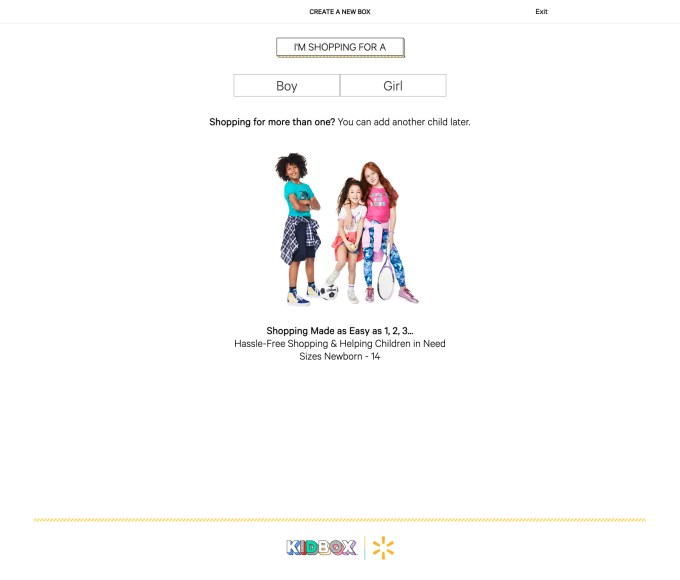
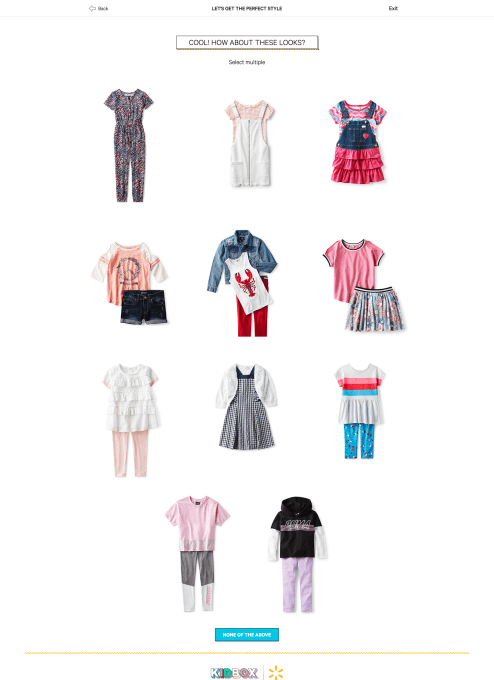
Walmart is getting into subscription-based fashion with today’s announcement of a partnership with Kidbox — a sort of “StitchFix for kids” where parents receive a personalized, curated box of children’s clothing on a seasonal basis. The deal will see Kidbox offered to Walmart.com’s online shoppers, where they can fill out a short style quiz, then receive their box of four to five fashion items for around $48 — or 50 percent the retail prices of the bundled items.

The boxes are available in Sizes 0 through 14 for girls and 0 through 16 for boys, and include styles like sweaters, denim, dresses, graphic tees, and more — based on whatever is seasonally appropriate. Kidbox today also has relationships with over 120 fashion brands, including BCBG, Butter Super Soft, C&C California, Puma, and others.
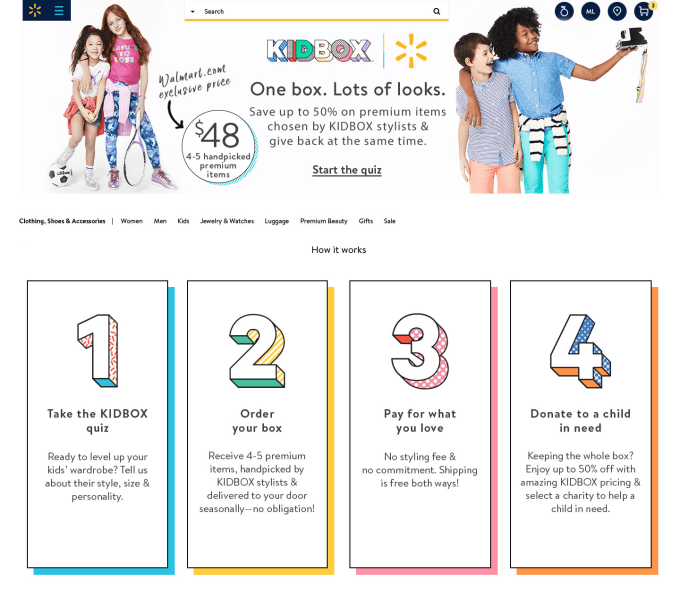
Like other subscription fashion box businesses, Kidbox last year launched its own private labels, too, based on its understanding of consumer trends and interests. To determine what will sell, the company leverages data it gleams from things like the initial style survey, customer feedback, and by noting which items are most purchased or most returned, among other factors.

“Walmart has done a lot over the past year to establish itself as a go-to retailer for all things fashion, and we’re honored to partner with the retailer to expand its kids’ assortment online, while also saving parents time and offering them the value and convenience of a stylebox,” said Miki Berardelli, Kidbox CEO, in a statement. “At Kidbox, we pride ourselves on understanding kids’ fashion preferences while also creating moments for them to learn about the importance of giving back,” she added.
For Walmart, the partnership allows the retailer to enter into the subscription-based fashion businesses without having to build out its own service from the ground-up. Nor does it have to figure out the logistics involved with something like its own version of Amazon’s Prime Wardrobe, which heavily promotes in-house brands, but can be difficult to use since you can only shop Prime Wardrobe apparel — not all of Amazon Fashion.

Walmart also sees Kidbox as a way to expand its growing children’s apparel assortment, which has added more than 100 brands over the last year, including Betsey Johnson, Kapital K, Levi’s, Limited Too and The Children’s Place. More broadly, it wants to further increase its investment in online fashion  — whether that’s by hosting high-end retail like Lord & Taylor; offering branded storefronts like those from Bonobos or Nike; doing celeb collabs like those with Sofia Vergara, Drew Barrymore, Ellen DeGeneres, Kendall & Kylie; or by acquiring  fashion brands like ModCloth, ShoeBuy, ELOQUII, and others.

Walmart Kidbox shipments will also contribute to the subscription businesses’ “give back” program, where each box purchased translates to clothing given to a child in need, in partnership with Delivering Good.
“We are thrilled to partner with Kidbox to introduce our first kids’ subscription apparel service offering premium fashion brands at a substantial savings,” said Denise Incandela, Head of Fashion, Walmart U.S. eCommerce. “Over the last year, we have significantly expanded our portfolio of kids’ fashion brands as part of our broader effort to establish Walmart.com as a destination for fashion. Our partnership with KIDBOX enables us to round out our offering with additional national and premium kids’ brands.”

The partnership with Walmart follows Kidbox’s raise last year of $15.3 million in Series B funding to expand and scale its business. Canvas Ventures led the round, which saw participation from existing investors Firstime Ventures and HDS Capital, plus new strategic partners Fred Langhammer, former CEO of The Estée Lauder Companies Inc., and The Gindi Family, owners of Century 21 department stores.

Kidsbox isn’t the only subscription fashion box business to turn to traditional retail in recent months. This February, Kidbox rival Rockets of Awesome took a $12.5 million investment from Foot Locker, which will sell Rockets of Awesome merchandise on its own website and in its Kids Foot Locker stores.

Kidbox also competes with StitchFix, which has its own kids’ line and Amazon Prime Wardrobe, which lets customers shop for girls, boys or baby, in addition to adult apparel.

 

Security imperfection in EA’s Origin customer presented gamers to programmers

Electronic Arts has fixed a powerlessness in its web based gaming stage Origin after security scientists discovered they could trap a clueless gamer into remotely running malevolent code on their computer.

The bug influenced Windows clients with the Origin application introduced. Countless gamers utilize the Origin application to purchase, get to and download diversions. To make it simpler to get to an individual game’s store from the web, the customer has its very own URL plot that enables gamers to open the application and burden an amusement from a site page by clicking a connection with origin:// in the address.

But two security scientists, Daley Bee and Dominik Penner of Underdog Security, found that the application could be deceived into running any application on the exploited people computer.

“An assailant could’ve ran anything they wanted,” Bee told TechCrunch.

‘Popping calc’ to exhibit a remote code execution bug in Origin. (Picture: supplied)

The specialists gave TechCrunch evidence of-idea code to test the bug for ourselves. The code permitted any application to keep running at indistinguishable dimension of benefits from the signed in client. For this situation, the scientists popped open the Windows adding machine — the go-to application for programmers to demonstrate they can run code remotely on an influenced computer.

But more regrettable, a programmer could send malignant PowerShell directions, a in-assembled application regularly utilized by attackers to download extra pernicious segments and introduce ransomware.

Bee said a malignant connection could be sent as an email or recorded on a website page, yet could likewise activated if the noxious code was joined with a cross-webpage scripting abuse that ran consequently in the browser.

It was likewise conceivable to take a user’s account get to token utilizing a solitary line of code, enabling a programmer to access a user’s account without requiring their password.

EA representative John Reseburg affirmed a fix was taken off Monday. TechCrunch affirmed the code never again worked following the update.

Origin’s macOS customer wasn’t influenced by the bug.

EA lays off 350 people

Alibaba will let you find restaurants and order food with voice in a car

Competition in the Chinese internet has for years been about who controls your mobile apps. These days, giants are increasingly turning to offline scenarios, including what’s going on behind the dashboard in your car.

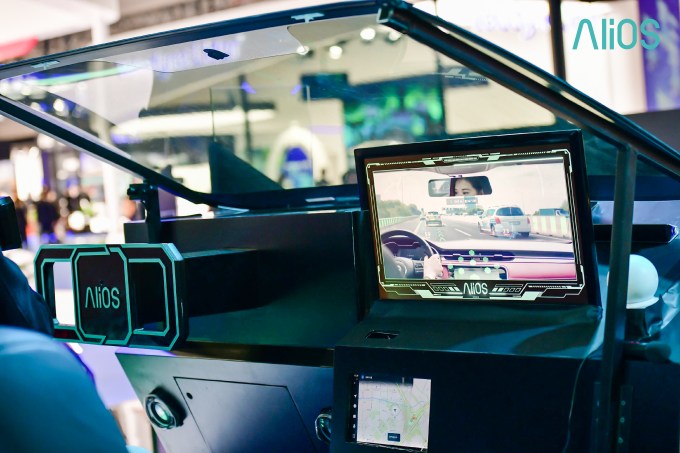
On Tuesday, Alibaba announced at the annual Shanghai Auto Show that it’s developing apps for connected cars that will let drivers find restaurants, queue up and make reservations at restaurants, order food and eventually complete a plethora of other tasks using voice, motion or touch control. Third-party developers are invited to make their in-car apps, which will run on Alibaba’s operating system AliOS.

Rather than working as standalone apps, these in-car services come in the form of “mini apps,” which are smaller than regular ones in exchange for faster access and smaller file sizes, in Alibaba’s all-in-one digital wallet Alipay . Alibaba has other so-called “super apps” in its ecosystem, such as marketplace Taobao and navigation service AutoNavi, but the payments solution clearly makes more economic sense if Alibaba wants people to spend more while sitting in a four-wheeler.

There’s no timeline for when Alibaba will officially roll out in-car mini apps but it’s already planning for a launch, a company spokesperson told TechCrunch.

Making lite apps has been a popular strategy for China’s internet giants operating super apps that host outside apps, or “mini-apps”; that way users rarely need to leave their ecosystems. These lite apps are known to be easier and cheaper to build than a native app, although developers have to make concessions like giving their hosts certain level of access to user data and obeying rules as they would with Apple’s App Store. For in-car services, Alibaba says there will be “specific review criteria for safety and control” tailored to the auto industry.

alios cars alibaba

Photo source: Alibaba

Alibaba’s move is indicative of a heightened competition to control the operating system in next-gen connected cars. For those who wonder whether the ecommerce behemoth will make its own cars given it’s aggressively infiltrated the physical space, like opening its own supermarket chain Hema, the company’s solution to vehicles appears to be on the software front, at least for now.

In 2017, Alibaba rebranded its operating system with a deep focus to put AliOS into car partners. To achieve this goal, Alibaba also set up a joint venture called Banma Network with state-owned automaker SAIC Motor and Dongfeng Peugeot Citroen, which is the French car company’s China venture, that would hawk and integrate AliOS-powered solutions with car clients. As of last August, 700 thousand AliOS-powered SAIC vehicles had been sold.

Alibaba competitors Tencent and Baidu have also driven into the auto field, although through slightly different routes. Baidu began by betting on autonomous driving and built an Android-like developer platform for car manufacturers. While the futuristic plan is far from bearing significant commercial fruit, it’s gained a strong foothold in self-driving with the most mileage driven in Beijing, a pivotal hub to test autonomous cars. Tencent’s car initiatives seem more nebulous. Like Baidu, it’s testing self-driving and like Alibaba, it’s partnered with industry veterans to make cars, but it’s unclear where the advantage lies for the social media and gaming giant in the auto space.