Ikea invests in Livspace, a one-stop platform for interior design based in India

Fresh from raising $70 million last year via big names including Goldman Sachs and TPG Growth, Livspace, an India-based startup that offers a one-stop-shop for interior design, has lured yet another marquee investor: Ikea.

The startup said today it has taken an undisclosed investment from Ingka Investments, the VC arm of Ikea parent Ingka Group, which operates 90 percent of Ikea’s retail footprint. Livspace CEO and co-founder Anuj Srivastava declined to provide a value for the deal, but he told TechCrunch that the stake involved is a minor one while there is no plan to bolt a larger round on to this investment. Deal Street Asia first reported news of the deal.

“There is strong strategic and commercial potential,” Srivastava, a former Googler who started Livspace in 2015, said of the new investor. “This is an opportunity to create the best possible omnichannel experience for consumers.”

India is a tough place for international retail companies but Ikea has made progress in recent times.

The company opened its first India-based store in Hyderabad last year and, having gained FDI approval to operate retails store, it is planning a substantial expansion with at least 25 new stores in the offing.

Livspace, for those unaware of it, runs a service that is aimed at taking the hassle out of interior design. The company’s platform connects homeowners with designers and the supply chain to go through ideas, chose a plan and implement it. That includes, among other things, 3D virtual renders of a renovation, offline meetings at a Livspace design center and, in some cases, customized furnishings. By bringing all parties together, Livspace claims to offer cost savings to consumers as well as higher rates and more efficient use of time for designers.

That model resonates with Ikea (Ingka), according to Srivastava, who said the company sides began talking following the announcement of Livspace’s Series C round last September.

“We’ve felt the natural synergy always existed,” he said. “This is an extremely strong endorsement of our vision.”

Synergies, indeed, although somewhat frustratingly neither party is saying how they will work together going forward. The obvious suggestion would be that Ikea products become available through Livspace, but Srivastava said the specifics are still to be agreed.

Further down the line, though, he admitted that Ikea’s involvement could fuel an international expansion beyond India. Going overseas is something that the company is openly talked up in the past and, with Ikea’s global footprint of 367 stores across 30 markets, the investment from Ingka could give Livspace a running start in new markets.

That, like the details of the alliance, is something that will come later, however.

“The India business is keeping us really, really busy at this time,” said Srivastava on that possibility.

“We’re engaged in exploratory activities but there’s no immediate plan or timeline,” he added as a tease. A new market launch isn’t likely until something like 12-18 months down the line, the Livspace CEO said.

As for whether this deal might be a precursor to an eventual acquisition, such are the synergies, Srivastava said that possibility isn’t being entertained.

“There is no such intention as of now,” he explained. “We continue to have strong interest from financial investors and continue to operate with the intention to stay independent, there’s now even more belief in our platform approach.”

“There is distinctly an investment outlay involved [with] no long term indication of an M&A opportunity,” he added.
Huawei responds to Android ban with service and security guarantees, but its future is unclear

Huawei has finally gone on the record about a ban on its use of Android, but the company’s long-term strategy on mobile still remains unclear.

In an effort to appease its worried customer base, the embattled Chinese company said today that it will continue to provide security updates and after-sales support to its existing lineup of smartphones, but it’s what the company didn’t say that will spark concerns.

Huawei was unable to make guarantees about whether existing customers will continue to receive Android software updates, while its statement is bereft of any mention of whether future phones will ship with the current flavor of Android or something else.

The company, which is the world’s second largest smartphone vendor based on shipments, said it will continue to develop a safe software ecosystem for its customers across the globe. Huawei will also extend the support to Honor, a brand of smartphones it owns. Nearly 50 percent of all of Huawei’s sales comes from outside China, research firm Counterpoint told TechCrunch.

Here’s the statement in full:

Huawei has made substantial contributions to the development and growth of Android around the world. As one of Android’s key global partners, we have worked closely with their open-source platform to develop an ecosystem that has benefitted both users and the industry,

Huawei will continue to provide security updates and after sales services to all existing Huawei and Honor smartphone and tablet products covering those have been sold or still in stock globally. We will continue to build a safe and sustainable software ecosystem, in order to provide the best experience for all users globally.

In addition, the company said it plans to launch the Honor 20 as planned. The device is set to be unveiled at an event in London tomorrow.

Huawei’s lukewarm response isn’t unexpected. Earlier, Google issued a similarly non-committal statement that indicated that owners of Huawei phones will continue to be able to access the Google Play Store and Google Play Protect, but — like the Chinese firm — it made no mention of the future, and that really is the key question.

Indeed, sources within both Google and Huawei have told TechCrunch that the immediate plan of action for what happens next remains unclear.

It could turn out that Huawei is forced to use the open source version of Android, AOSP, which comes stripped of Google Mobile Services, a suite for Google services such as Google Play Store, Gmail, and YouTube. That’s unless it doesn’t plump for its own homespun alternative, which media reports have claimed it has built in the case of an emergency situation.

Huawei’s response comes a day after Reuters reported that Google had suspended some of its businesses with the Chinese technology giant. The Android-maker is complying with a U.S. Commerce Department’s directive that placed Huawei and 70 of its affiliates on an “entity list” that requires any U.S. company to gain government approval before doing business with the Chinese tech company.

In the meantime, the troubles are mounting for Huawei. In addition to Android, the U.S. government’s move has seen Intel, Qualcomm, Xilinx, and Broadcom reportedly pause supplying chips to Huawei until a resolution has been reached.

Want to save €200 on passes to Disrupt Berlin 2019?

Around here at TechCrunch we like to reward action with savings, and right now, the earlier you act the more money you save. Do we have your attention?

Here’s the deal. Disrupt Berlin 2019 takes place on 11-12 December, and you can’t buy passes until the official registration opens in June. But by taking one simple action now, you’ll save an extra €200 off the super-early-bird price for any pass. Just sign up for our mailing list before registration opens. Boom. Act now, save more. Simple.

Once you sign up, we’ll email you a discount code to use when you purchase your pass. Just think about what you’ll do with the €200 you saved — and all the cool stuff you’ll see and do at Disrupt Berlin.

Network with the more than 1,200 attendees — technologists, founders, investors, media, potential customers and possible employers. CrunchMatch, our free business match-matching platform, simplifies networking. It makes connections based on your specific criteria, goals and interests, so you don’t just meet people — you meet the right people. You never know when goals might align, and opportunity might strike.

Startup Battlefield, TechCrunch’s famous pitch-off competition, is an absolute roller coaster ride as teams of exceptional startups compete head-to-head for $50,000 cash, the Disrupt cup and life-altering media and investor exposure.

You’ll find hundreds of early-stage startups showcasing the very best tech products, platforms and services in Startup Alley, the exhibit hall and the heartbeat of every Disrupt. Don’t miss the TC Top Picks — a group of outstanding startups curated by TechCrunch editors — camped out in the Alley.

We’ll have more information in the coming weeks on how you can apply to both the Startup Battlefield and the TC Top Picks program, so keep checking back.

That’s just for starters. We’re hard at work building the roster of speakers — top tech founders, investors and entrepreneurs who will share their stories, insights and maybe a prediction or two along the way. Plus, we always feature panel discussions, workshops, demos and so much more. Stay tuned for more information!

Disrupt Berlin 2019 takes place on 11-12 December. Sign up for our mailing list before registration opens, and you’ll save an extra €200 on passes. Act early, save more — and we’ll see you in Berlin!

Facebook’s latest account purge exposes Africa’s misinformation problem

Facebook last week purged a network of hundreds of pages, groups and Instagram accounts it labeled as producing “coordinated inauthentic behavior” toward Africa.

The activity originated in Israel and was largely targeted toward Nigeria, Senegal, Togo, Angola, Niger, and Tunisia.

It was mostly political in nature and primarily paid for by Archemedes Group, a global political consulting firm, Facebook said.

This isn’t the first case of social media platforms used as vehicles for political manipulation in Africa. Cambridge Analytica, the controversial big-data actor employed in Brexit and Donald Trump’s 2016 presidential victory, was active on the continent before and after both events.

On its recent Africa related deletions, Facebook said:

The people behind this network used fake accounts to run Pages, disseminate their content and artificially increase engagement. They also represented themselves as locals, including local news organizations, and published allegedly leaked information about politicians. The Page administrators and account owners frequently posted about political news, including topics like elections in various countries, candidate views and criticism of political opponents.

The activity took place over 65 Facebook accounts, 161 Pages, 23 Groups, 12 events and four Instagram accounts.  There were 2.8 million accounts that followed one or more of these pages and 5,500 accounts joined at least one of these Groups.

Facebook said more than $800,000 was spent on ads associated with these accounts starting in December 2012 and running as recently as April this year.

Facebook declined to offer TechCrunch additional information on the account deletions beyond their release. But the Atlantic Council’s Digital Forensic Research Lab (DFRL) has been digging deeper and released some initial findings in a Medium Post. In addition to connecting the accounts to activity in Ghana — a country not named in FB’s release — DFRL shed some light on fake news targeted at Nigeria’s February 2019 elections.

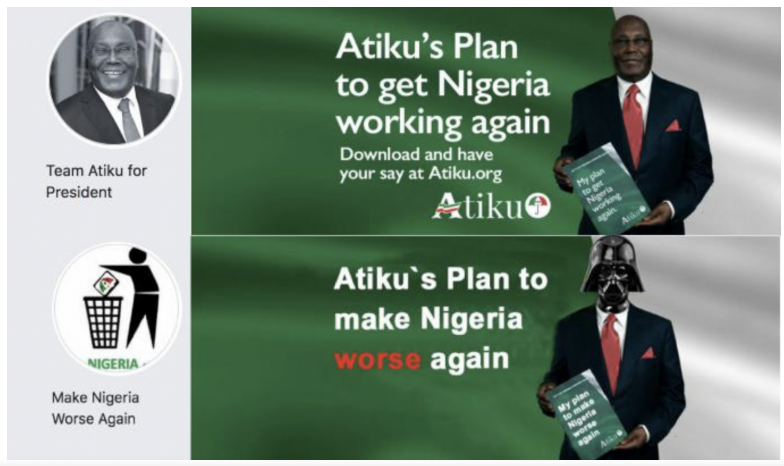
Examples included a “Make Nigeria Worse Again” trolling campaign aimed at the campaign of Atiku Abubakar, who was challenger to Nigeria’s incumbent president Muhammadu Buhari — who won a second-term.

DFRL also shared examples connected to the deleted Facebook accounts aimed at elections in Mali, Tunisia, Niger, Togo, Algeria, and Angola. It noted the ads related to this nexus of activity was paid for in U.S. dollars, Israeli Shekels, and Brazilian reals. “The spending in different currencies suggests how vast the operation was, encompassing multiple regions around the world,” said DFRL’s reporting.

Fake news on social media platforms has reared its head in Africa several times. Cambridge Analytica, backed by U.S. big-data billionaire Robert Mercer, was found to have been involved in elections in Kenya and Nigeria before its controversial role directing pro-Brexit and pro-Trump online activity in 2016. Facebook later banned Cambridge Analytica from its platform.

Social media driven fake news — primarily on Facebook and WhatsApp — became such an issue in Kenya’s 2017 elections the country’s parliament passed a bill in 2018, with specific punitive measures, to combat it. An investigation by the UK’s Channel 4 later revealed that Cambridge Analytica had advised the 2017 presidential campaign of Kenyan incumbent president Uhuru Kenyatta, who won in a disputed run-off vote.

Facebook has prioritized growth in Africa, particularly since Mark Zuckerberg visited the continent’s tech scene in 2016.

The U.S. social media company has grown Africa users to over 200 million and Facebook owned chat-tool, WhatsApp, is the most downloaded messenger app on the continent.

But Facebook’s recent Africa account purge shows when Facebook travels, so too does its list of pros and cons, including the ability of global actors to use it for nefarious uses in local settings.

Several chip companies, including Qualcomm and Intel, have reportedly stopped supplying Huawei after blacklist

Several key suppliers are reportedly cutting off Huawei after the Trump administration added the Chinese telecom equipment and smartphone giant to a trade blacklist last week. According to Bloomberg, semiconductor companies Intel, Qualcomm, Xilinx and Broadcom will no longer supply Huawei until further notice. This follows another report earlier today that Google has suspended some trade with Huawei, leaving it with access only to the open-source version of Android.

In addition to impacting Huawei’s business, the blacklisting has ramifications for telecom providers who are getting ready to launch 5G networks. In China, the three big telecoms (China Mobile, China Unicom and China Telecom), which are all heavily reliant on Huawei, may be forced to delay 5G rollout. Meanwhile, U.S. carriers, especially smaller ones, may have to spend millions of dollars replacing Huawei equipment they have already installed or looking for new suppliers.

In tweet last week from the account Huawei Facts, the company called the blacklist a “lose-lose” situation. In a more recent tweet, it said “Oops! The U.S. is already coming to its senses over a ban on #Huawei, with a government official admitting that it cannot distance itself from the tech giant as easily as it might like. #HuaweiFacts” in response to a report that the administration might grant Huawei a temporary license to prevent service interruptions.

https://platform.twitter.com/widgets.js

Meanwhile, Google’s ban, first reported by Reuters, would give Huawei, the second-largest smartphone brand in the world after Samsung, access only to open-source version of Android, leaving it with a significant disadvantage to other handset makers.

According to Bloomberg, Huawei stockpiled three months worth of chips in anticipation of action by the U.S. government, which it has been at odds with since a 2012 Congressional report deemed it a potential threat to national security (accusations the company has repeatedly denied).

A Xilinx spokesperson told TechCrunch “We are aware of the Denial Order issued by the U.S. Department of Commerce with respect to Huawei, and we are cooperating. We have no additional information to share at this time.” TechCrunch has also contacted Huawei, Broadcom, Qualcomm and Intel for comment.

Google says its app store will continue to work for existing Huawei smartphone owners

Google said today that existing users of Huawei Android devices can continue to use Google Play app store, offering some relief to tens of millions of users worldwide even as it remains unclear if the Chinese tech giant will be able to use the fully-functioning version of Android in its future phones.

Existing Huawei phone users will also be able to enjoy security protections delivered through Google Play Protect, the company said in a statement to TechCrunch. Google Play Protect is a built-in malware detector that uses machine learning to detect and weed out rogue apps. Google did not specify whether Huawei devices will receive future Android updates.

The statement comes after Reuters reported on Sunday that Google is suspending some businesses with Huawei, the world’s second largest smartphone maker that shipped over 200 million handsets last year. The report claimed, a point not addressed by Google, that future Android devices from Huawei will not run Google Mobile Services, a host of services offered by Google including Google Play Store, and email client Gmail. A Huawei spokesperson said the company is looking into the situation but has nothing to share beyond this.

It’s a major setback for Huawei, which unless resolved in the next few weeks, could significantly disrupt its phone business outside of China. The top Android phone vendor, which is already grappling with controversy over security concerns, will have to rethink its software strategy for future phones if there is no resolution. Dearth — or delay in delivery — of future Android updates would also hurt the company’s reputation among its customers around the globe.

“We are complying with the order and reviewing the implications,” a company spokesperson said in a statement.

The two tech companies find themselves in this awkward situation as a result of the latest development in the ongoing U.S-China trade war. Huawei and 70 of its affiliates have been put on an “entity list” by the U.S. Commerce Department over national security concerns, requiring local giants such as Google and Intel to take approval from the government before conducting business with the Chinese firm.

Huawei may have already foreseen this. A company executive revealed recently that Huawei had built its own Android-based operating system in case a future event prevented it from using existing systems. Per Reuters, Huawei can also continue to use AOSP, the open source Android operating system that ships stripped off Google Mobile Services. And on paper, it can also probably have an app store of its own. But convincing enough stakeholders to make their apps available on Huawei’s store and continually push updates could prove incredibly challenging.

TikTok owner ByteDance’s long-awaited chat app is here

In WeChat -dominated China, there’s no shortage of challengers out there claiming to create an alternative social experience. The latest creation comes from ByteDance, the world’s most valuable startup and the operator behind TikTok, the video app that has consistently topped the iOS App Store over the last few quarters.

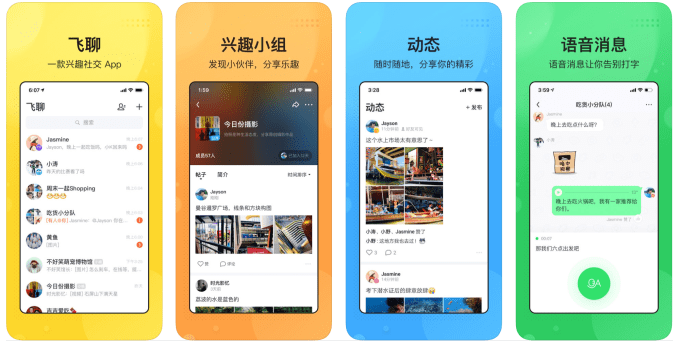
The new offer is called Feiliao (飞聊), or Flipchat in English, a hybrid of an instant messenger plus interest-based forums, and it’s currently available for both iOS and Android. It arrived only four months after Bytedance unveiled its video-focused chatting app Duoshan at a buzzy press event.

Screenshots of Feiliao / Image source: Feiliao

Some are already calling Feiliao a WeChat challenger, but a closer look shows it’s targeting a more niche need. WeChat, in its own right, is the go-to place for daily communication in addition to facilitating payments, car-hailing, food delivery and other forms of convenience.

Feiliao, which literally translates to ‘fly chat’, encourages users to create forums and chat groups centered around their penchants and hobbies. As its app description writes:

Feiliao is an interest-based social app. Here you will find the familiar [features of] chats and video calls. In addition, you will discover new friends and share what’s fun; as well as share your daily life on your feed and interact with close friends.

Feiliao “is an open social product,” said ByteDance in a statement provided to TechCrunch. “We hope Feiliao will connect people of the same interests, making people’s life more diverse and interesting.”

It’s unclear what Feiliao means by claiming to be ‘open’, but one door is already shut. As expected, there’s no direct way to transfer people’s WeChat profiles and friend connections to Feiliao, and there’s no option to log in via the Tencent app. As of Monday morning, links to Feiliao can’t be opened on WeChat, which recently crossed 1.1 billion monthly active users.

On the other side, Alibaba, Tencent’s long-time nemesis, is enabling Feiliao’s payments function through the Alipay digital wallet. Alibaba has also partnered with Bytedance elsewhere, most notably on TikTok’s Chinese version Douyin where certain users can sell goods via Taobao stores.

In all, Flipchat is more reminiscent of another blossoming social app — Tencent-backed Jike — than WeChat. Jike (pronounced ‘gee-keh’) lets people discover content and connect with each other based on various topics, making it one of the closest counterparts to Reddit in China.

Jike’s CEO Wa Nen has taken noticed of Feiliao, commenting with the 👌 emoji on his Jike feed, saying no more.
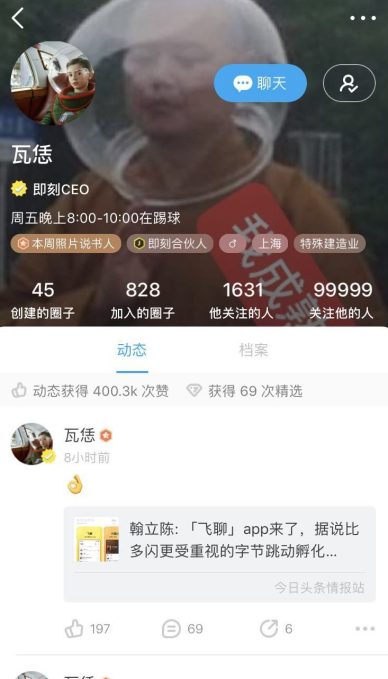
Screenshot of Jike CEO Wa Ren commenting on Feiliao

“I think [Feiliao] is a product anchored in ‘communities’, such as groups for hobbies, key opinion leaders/celebrities, people from the same city, and alumni,” a product manager for a Chinese enterprise software startup told TechCrunch after trying out the app.

Though Feiliao isn’t a direct take on WeChat, there’s little doubt that the fight between Bytedance and Tencent has heated up tremendously as the former’s army of apps captures more user attention.

According to a new report published by research firm Questmobile, ByteDance accounted for 11.3 percent of Chinese users’ total time spent on ‘giant apps’ — those that surpassed 100 million MAUs — in March, compared to 8.2 percent a year earlier. The percentage controlled by Tencent was 43.8 percent in March, down from 47.5 percent, while the remaining share, divided between Alibaba, Baidu and others, grew only slightly from 44.3 percent to 44.9 percent over the past year.

These Johns Hopkins students are slashing breast cancer biopsy costs

Over 2 million women were diagnosed with breast cancer in 2018. And while the diagnosis doesn’t have to be a death sentence for women in countries like the United States, in developing countries three times as many women die from the disease.

Breast cancer survival rates range from 80% or over in North America, Sweden and Japan to around 60% in middle-income countries and below 40% in low-income countries, according to data provided the World Health Organization.

And the WHO blames these low survival rates in less developed countries on the lack of early detection programs, which result in a higher proporation of women presenting with late-stage disease. The problem is exacerbated by a lack of adequate diagnostic technologies and treatment facilities, according to the WHO.

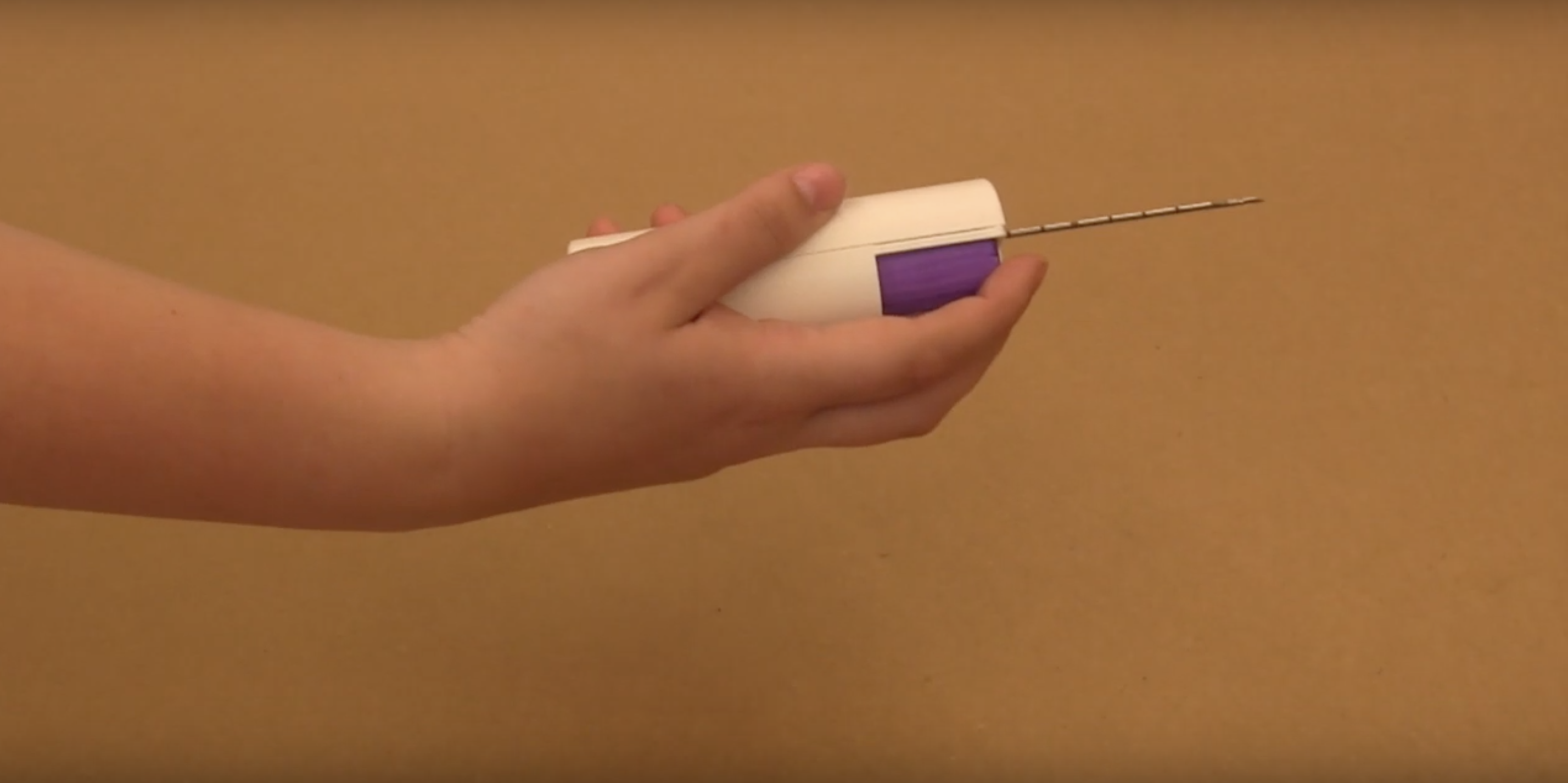
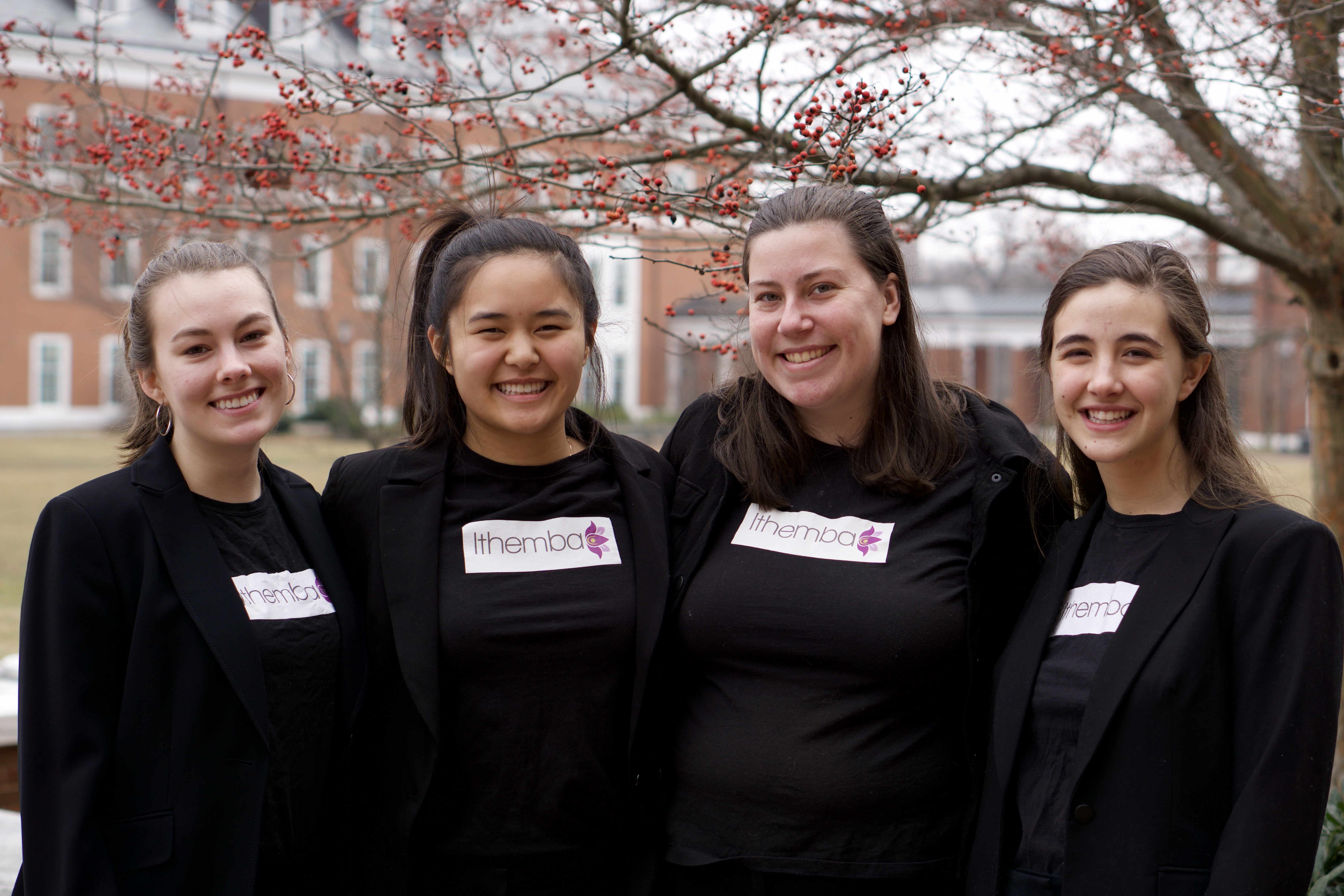
A group of Johns Hopkins University undergraduates believe they have found a solution. The four women, none of whom are over 21-years-old, have developed a new, low-cost, disposable core needle biopsy technology for physicians and nurses that could dramatically reduce cost and waste, thereby increasing the availability of screening technologies in emerging markets.

They’ve taken the technology they developed at Johns Hopkins University and created a new startup called Ithemba, which means “hope” in Swahili, to commercialize their device. While the company is still in its early days, the women recently won the undergraduate Lemelson-MIT Student Prize competition, and has received $60,000 in non-dilutive grant funding and a $10,000 prize associated with the Lemelson award.

Students at Johns Hopkins had been working through the problem of developing low-cost diagnostic tools for breast cancer for the past three years, spurred on by Dr. Susan Harvey, the head of Johns Hopkins Section of Breast Imaging.

While Dr. Harvey presented the problem, and several students tried to tackle it, Ithemba’s co-founders — the biomedical engineering undergrads Laura Hinson, Madeline Lee, Sophia Triantis, and Valerie Zawicki — were the first to bring a solution to market.

Ithemba co-founders Laura Hinson, Madeline Lee, Valerie Zawicki and Sophia Triantis

The 21-year-old Zawicki, who grew up in Long Beach, Calif., has a personal connection to the work the team is doing. When she was just five years old her mother was diagnosed with breast cancer, and the cost of treatment and toll it took on the family forced the family to separate. “My sister moved in with my grandparents,” Zawicki says, while her mother underwent treatment. “When I came to college I was looking for a way to make an impact in the healthcare space and was really inspired by the care my mom received.”

The same is true for Zawicki’s co-founder, Triantis.

“We have an opportunity to  solve problems that really need solving,” says Triantis, a 20-year-old undergraduate. “Breast cancer has affected so many people close to me… It is the most common cancer among women [and] the fact that women in low resource settings do not have the same standard of diagnostic care really inspired me to work on a solution.”

What the four women have made is a version of a core-needled biopsy that has a lower risk of contamination than the reusable devices that are currently on the market and is cheaper than the expensive disposable needles that are the only other option, the founders say.

We’ve designed a novel, disposable portion that attaches to the reusable device and the disposable portion has an ability to trap contaminants that would come back through the needle into the device,” says Triantis. “What we’ve created is a way to trap that and have that full portion be disposable and making the device as easy to clean as possible… with a bleach wipe.”

Ithemba’s low-cost reusable core-needle biopsy device

The company is currently in the process of doing benchtop tests on the device, and will look to file a 510K to be certified as a Class 2 medical device. Already a clinic in South Africa and a hospital in Peru are on board as early customers for the new biopsy tool.

At the heart of the new tool is a mechanism which prevents blood from being drawn back into a needle. The team argues it makes reusable needles much less susceptible to contamination and can replace the disposable needles that are too expensive for many emerging market clinics and hospitals.

Zawicki had been working on the problem for a while when Hinson, Lee, and Triantis joined up. “I joined the team when the problem was presented,” says Zawicki. “The project began with this problem that was pitched three years ago, but the four of us are really those that have brought this to life in terms of a device.”

Crucially for the team, Johns Hopkins was fully supportive of the women taking their intellectual property and owning it themselves. “We received written approval from the tech transfer office to file independently,” says Zawicki. “That is really unique.” 

Coupled with the Lemelson award, Ithemba sees a clear path to ownership of the intellectual property and is filing patents on its device.

Zawicki says that it could be anywhere from three to five years before the device makes it on to the market, but there’s the potential for partnerships with big companies in the biopsy space that could accelerate that time to market.

“Once we get that process solidified and finalize our design we will wrap up our benchtop testing so we can move toward clinical trials by next summer, in 2020,” Zawicki says.

Game of Thrones petition reaches 1M signatures ahead of finale

Life is short, difficult and, most likely, ultimately meaningless. In this age of immediate fan service, it’s important to remember that you can’t always get what you want. That goes double when it comes to the final season of a beloved television series (I’m looking at you, The Wire). TV, like life, rarely has a satisfying ending.

But perhaps the internet — the cause of and solution to all of life’s problems — can fix that. Irritated Games of Thrones fans have taken to that bastion the bastion of fan annoyance (no, not that one) Change.org in a futile hope of getting a remake of the show’s eighth and final series to end thing they way they want.

As the petition has cruised past one million signatures, its creators have penned a prediction and spoiler note to let signers know where things stand. Tempering expectations for the possibility of a reshoot, it notes that the state of the world demands escapism via sci-fi and fantasy like GoT and Star Wars.

“I didn’t make this petition to be an entitled, whiny fan,” the petition’s creator writes. “I made it because I was immensely disappointed and needed to vent. Do I have a solution? I’ve got plenty of ideas, but no, I’m not a Hollywood writer. But you don’t need to be a mechanic to know your car is broken.”

Who knows, maybe tonight’s final episode will make everything right. Perhaps it will be so good that the world’s corporations and governments will join forces to end war, obliterate poverty and create a diet soda that doesn’t taste like a liquified pencil eraser. Or maybe we’ll all go back to work to work on Monday knowing that it, like all of us could have been better. And maybe, just maybe true change starts with us, beginning with canceling that HBO account.

Or maybe not. Barry is still pretty great.

Google reportedly suspends select business with Huawei following U.S. ban

The Trump administration Huawei ban is sure to have wide-ranging and long lasting effects for all parties. In the meantime, it seems, a number of those involved in the periphery are treading lightly in hope of not burning bridges on either side. Google has taken accidental center stage, in its role providing Android and a variety of apps for the embattled handset maker.

According to a new report from Reuters, the U.S. software giant has taken some steps toward disentangling itself. Word comes from unnamed sources, who say the company has suspended all businesses with Huawei, aside from those covered by open-source licenses. The list appears to include updates to Android and popular apps like Gmail.

From the sound of it, Google is still attempting to wrap its head around how to proceed with the matter. Huawei, too, is assessing its options. Given the complexity of smartphone hardware and software, handsets routinely utilize components source from a variety of different locations. This fact has complicated things as trade tensions have begun to rise, hitting ZTE particularly hard over accusations that the company had violated U.S.-Iran sanctions.

Huawei has called the ban bad for all parties, but has continued to be defiant, noting its plans to become “self-reliant.” The company has no doubt been preparing for the seeming inevitability of heightened trade tensions, but its determination has some industry observers unconvinced that it can carry on with without any input from Google or U.S. chipmakers like Qualcomm.