Nura’s sound adapting earbuds are up for preorder, will start shipping in September

I’m struggling to come up with a single bit of technology I was more excited about at CES than the Nuraloop. I reviewed Nura’s original product fairly positively, but I’ve never really be an over-ear headphone person. The company’s latest strips a lot of the unnecessary bits from those original Nuraphones, into a far more portable package.

All Nura had back at CES was a dummy prototype of the product, but it was enough to get me excited about the things. Four months later, the headphones are up for pre-order, with an expected delivery date of September. At this stage, the company appears to be gauging interest in the product, offering up early preorders for 30 percent off their $199 final retail price.

The strategy makes sense for a company that still seems to have limited retail reach. Nuraphones were a definite Kickstarter success story, raising $1.8 million. This is a way of gauging that sort of interest without having to return to the crowdfunding well.

If all of the company’s claims hold up, these are looking pretty great. The headphones maintain the same sort of custom sound profiling that made their predecessors great, while stripping away nice but unnecessary elements like the over-ear bass bump. The company’s also promised an extremely impressive 14 hours of playback on a charge — that’s even more than the set OnePlus announced today.

We should be getting out hands on production units prior to ship date, so we’ll happily report back on that end. At $140/199, they’re priced similarly to AirPods. Obviously they’re destined to be much more of a niche device than Apple’s offering, but could be right in the sweet spot for users looking for portability without sacrificing sound quality.

Binance resumes trading following $40M bitcoin hack

Cryptocurrency exchange Binance has resumed trading activity. Users can now cancel open orders, deposit crypto assets into their Binance account, and of course buy and sell cryptocurrencies. You can’t withdraw crypto assets to an external wallet just yet, but the company says that this feature will be available shortly.

https://platform.twitter.com/widgets.js

Last week, the company suffered from a data breach that resulted in hackers stealing the equivalent of over $40 million in bitcoin. Hackers stole API keys, two-factor codes and other information in order to transfer over 7,000 bitcoins to their own wallets. Binance covered the bitcoins lost with its own funds.

Shortly after the company noticed the hack, the company blocked some features on the platform in order to perform a security review. In particular, withdrawals and deposits have been frozen for a week so that hackers can’t steal more crypto assets.

Given that anybody can track the stolen bitcoins by looking up transactions on the bitcoin blockchain, Binance has been talking with other exchanges in order to track and freeze the stolen assets.

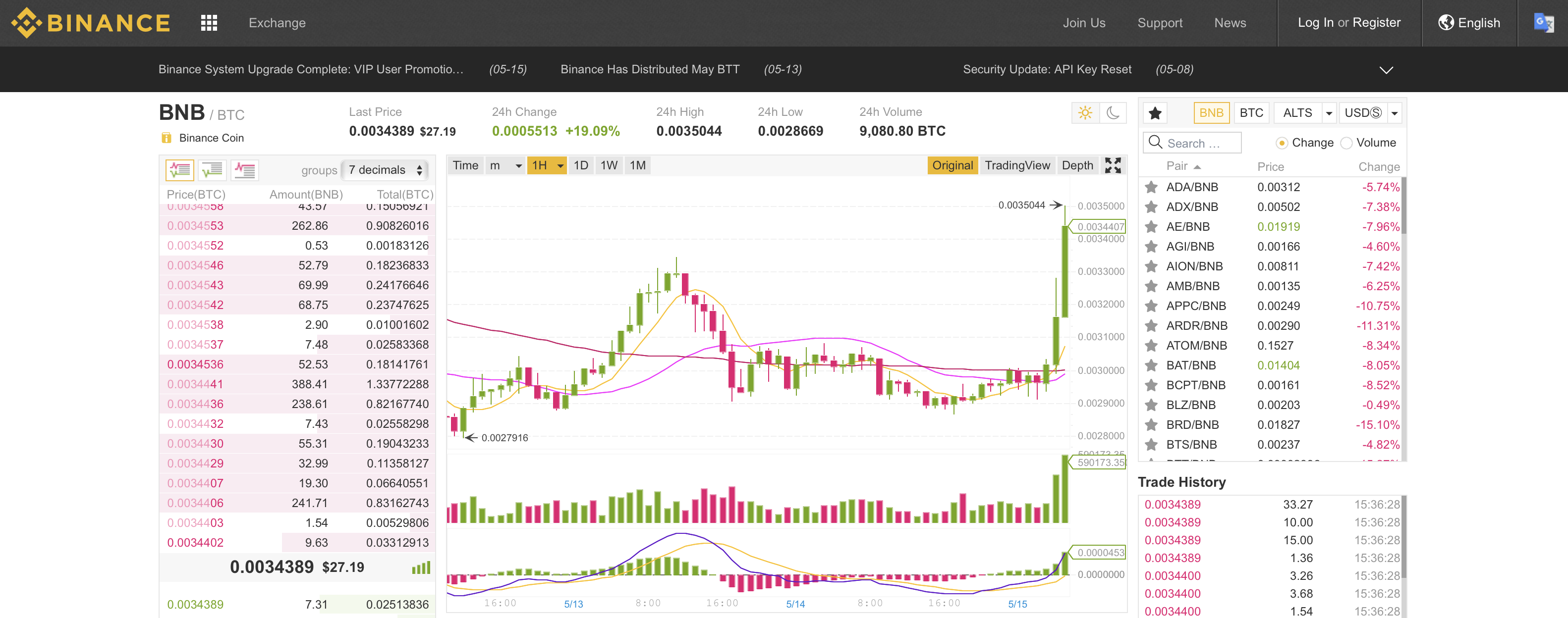
Binance’s own cryptocurrency BNB is currently trading up 19.6 percent against bitcoin compared to 24 hours ago.

Egnyte brings native G Suite file support to its platform

Egnyte announced today that customers can now store G Suite files inside its storage, security and governance platform. This builds on the support the company previously had for Office 365 documents.

Egnyte CEO and co-founder Vineet Jain says that while many enterprise customers have seen the value of a collaborative office suite like G Suite, they might have stayed away because of compliance concerns (whether that was warranted or not).

He said that Google has been working on an API for some time that allows companies like Egnyte to decouple G Suite documents from Google Drive. Previously, if you wanted to use G Suite, you no choice but to store the documents in Google Drive.

Jain acknowledges that the actual integration is pretty much the same as his competitors because Google determined the features. In fact, Box and Dropbox announced similar capabilities over the last year, but he believes his company has some differentiating features on its platform.

“I honestly would be hard pressed to tell you this is different than what Box or Dropbox is doing, but when you look at the overall context of what we’re doing…I think our advanced governance features are a game changer,” Jain told TechCrunch.

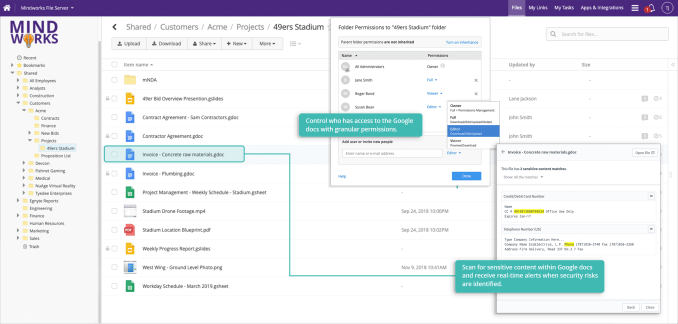
What that means is that G Suite customers can open a document and get the same editing experience as they would get were they inside Google Drive, while getting all the compliance capabilities built into Egnyte via Egnyte Protect. What’s more, they can store the files wherever they like, whether that’s in Egnyte itself, an on-premises file store or any cloud storage option that Egnyte supports, for that matter.

Egnyte storage and compliance platform

G Suite documents stored on the Egnyte platform.

Long before it was commonplace, Egnyte tried to differentiate itself from a crowded market by being a hybrid play where files can live on-premises or in the cloud. It’s a common way of looking at cloud strategy now, but it wasn’t always the case.

Jain has always emphasized a disciplined approach to growing the company, and it has grown to 15,000 customers and 600 employees over 11 years in business. He won’t share exact revenue, but says the company is generating “multi-millions in revenue” each month.

He has been talking about an IPO for some time, and that remains a goal for the company. In a recent letter to employees that Egnyte shared with TechCrunch, Jain put it this way. “Our leadership team, including our board members, have always looked forward to an IPO as an interim milestone — and that has not changed. However, we now believe this company has the ability to not only be a unicorn but to be a multi-billion dollar company in the long-term. This is a mindset that we all need to have moving forward,” he wrote.

Egnyte was founded in 2007 and has raised over $137 million, according to Crunchbase data.

What Uber and Lyft’s investment bankers got right

Startup CEOs heading to the public markets have a love/hate relationship with their investment bankers. On one hand, they are helpful in introducing a company to a wide range of asset managers who will hopefully hold their company’s stock for the long term, reducing price volatility and by extension, employee churn.

On the other hand, they are flagrantly expensive, costing millions of dollars in underwriting fees and related expenses.

Worse, the advice one gets from investment bankers tends to be quite vague. There is all this talk of IPO windows, timing, pricing, and more that is so squishy, particularly for the sorts of Silicon Valley CEOs that prize data over human experience. That has led to more than one experiment to try to disrupt the investment banking sector and the whole going public circus.

Uber and Lyft though are proof though that investment bankers actually are pretty smart in their advice about the pubic markets, and founders should be cautious about ignoring their words.

Let’s look at a few case studies.

First, take the vaunted “IPO window” that is discussed ad nauseam among investment bankers and the financial press which covers them. The idea of the “window” is that you must time a new public equity issue to arrive at a propitious moment in the markets. You want investors who are hungry for growth, and not battening down the hatches preparing for a recession.

Alibaba returns to growth with revenue up 51% to $13.9 billion

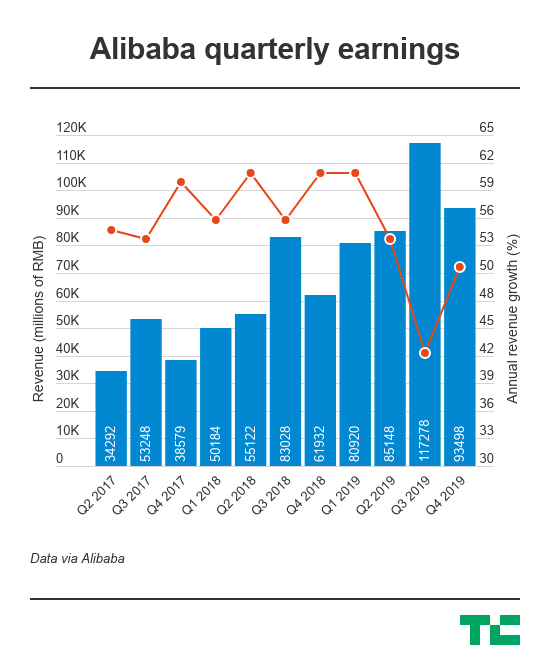
It’s business as usual for Alibaba after the Chinese e-commerce giant bounced back from a lackluster Q3 — which saw its slowest growth for three years. For Q4, the company saw revenue surge 51 percent year-on-year to reach 93.5 billion RMB, or $13.9 billion.

That revenue beat analyst expectations of 91.5 billion RMB, according to Barons, and net income came in at 23.38 billion RMB, or $3.48 billion.

Alibaba positions itself as the gateway to Chinese consumers, and it continues to grow. The company said its mobile monthly users — a metric it uses to measure shoppers — reached 721 million in March, an increase of 22 million in three months and 104 million over the last year. Annual active users were up 18 percent to 654 million and the company’s Chinese marketplaces saw GMV — the value of total goods sold — rise by 19 percent year-on-year in its fiscal 2018.

Speaking on a call with analysts, executive chairman Joe Tsai claimed Alibaba is ideally placed to capitalize on China’s switch from an export economy to domestic consumption, despite the ongoing U.S-China trade war.

“China is opening its markets to more foreign businesses to satisfy the demands of Chinese consumers,” he said. “We have the reach and deep insights… our scale and access to Chinese consumers is simply unrivaled.”

On the earnings call, CEO Daniel Zhang explained that the impressive results were a result of improved conversion rates — thanks to a new app interface featuring more recommendations and video content, an increase in retailer product launches and general user/shopper growth.

A big part of that growth focus is on consumers in more rural areas. Indeed, over the past year, more than 70 percent of the increase in annual active consumers was from less developed cities, Tsai said, adding that spending in tier three, four and five cities is projected to triple to $7 trillion in the coming years. Alibaba clearly believes it can take a large bite of this, despite rivals including Pinduoduo focusing intensely on rural Chinese consumers.

The user growth also arises from Alibaba’s hold on its range of businesses and its ability to channel traffic between them. For example, its online ecommerce app Taobao and e-wallet Alipay brought about 30 percent of total orders to Ele.me, the food delivery service competing head-on with Tencent-backed Meituan Dianping.

Outside of China, Lazada in Southeast Asia and internationally-focused Aliexpress clocked a cumulative 120 million shoppers over the past year although Alibaba is, again, not giving many more details on either service.

Cloud has been a major growth vertical for Alibaba, and once again that proved true although growth is tapering as the business grows larger. Alibaba Cloud, which is ranked as China top cloud service with 42.9 percent market share according to IDC, grew by 76 percent annual to hit 7.73 billion RMB, or $1.15 billion. Alibaba claimed the cloud business services over half of China’s A-listed companies.

Outside its core online retail business, Alibaba continues its big bet on brick-and-mortar retail. Its own supermarket chain Freshhippo (formerly Hema) reached 135 stores, dwarfing its rival JD.com’s counterpart 7Fresh which operates fewer than 15 locations. Digital entertainment is another cash-guzzling business for Alibaba, although the firm once again refrained from revealing user number for its video streaming service Youku, once a pioneer in the industry.

DJI is out-GoProing GoPro with its own action camera

For a brief time, DJI and GoPro were partners — or at least uncomfortable allies. Way back in 2014, the companies were joined together with the intention of building a drone designed to capture athletes in motion. It must have seemed like a perfect piece of synergy from two players at the top of their respective games.

Of course, things didn’t shake out that way. The best laid plans and all that. GoPro went all in on its own drone, but Karma’s launch was wobbly, to say the least. Sixteen days after release, GoPro recalled the drone after battery issues caused it to start falling from the sky. The drone was re-released, but the division was seemingly doomed from the beginning. Early last year, the company announced plans to axe around a fifth of its staff, effectively ending its drone division in the process.

DJI’s own business, on the other hand, has been booming. The Mavic Pro, announced shortly after the Karma, has redefined the consumer drone space, spawning a sequel and several other folding quadcopters from the company, including the Mavic Air, Zoom and Spark. All the while, the Shenzhen-based company has been making strides in imaging, with products like the impressive Osmo Pocket gimbal.

But until now, DJI had never taken a direct swing at GoPro’s true bread and butter: the action camera.

The Osmo Action is a shot across the bow. DJI is gunning directly for GoPro with its own action camera that brings a compelling feature set to the conversation. The camera arrives at a time of relative calm for GoPro. The company’s first quarter financials were looking up, with a 20% year-over-year revenue increase.

Just yesterday, the company’s stock price got a healthy bump on the news that it was shifting manufacturing to Mexico in an attempt to address rising U.S. tariffs resulting from the company’s Chinese manufacturing. Thinknum published its own take on GoPro’s future, as the California-based company appears to be undergoing a hiring spike on the software side. We’ve reached out to GoPro, asking whether this points to a shift away from hardware moving forward, but have yet to hear back.

For now, of course, GoPro’s still very much invested in the action camera category. The GoPro Hero7 arrived late last year to positive reviews. Our own Lucas Matney gave it good marks for its stabilization and live streaming capabilities, while noting that the company hadn’t made many strides on the hardware front since the last gen.

Quoting Lucas here:

[GoPro’s 2018 story]  seems to be a more conservative one with the company’s new flagship device the Hero7 Black moving mostly laterally on hardware specs while throwing its focus to software tech like digital video stabilization. The moves seem designed to reduce R&D costs while widening the gap between the low and high-end on the company’s far cleaner new product line.

While the action camera market has been crowded for several years now, GoPro’s name continues to be synonymous with the category for many consumers. DJI is far from the first company to go head to head with GoPro in the space, but in 2019, it may well be the best positioned. It has proven itself a master of imaging with drones and gimbals, making the move into action cameras an easy enough lift.

Still, DJI knows enough to not enter a new category without actually bringing something new to the table. The Osmo Action certainly looks like a GoPro at first glance. Imitation is the sincerest form of flattery and all of that, but after a decade and a half of GoPro Heroes, the entire industry appears to have settled on the boxy design as the ideal form factor, with regards to portability, durability and all of that other fun stuff.

The most immediate difference is at the dual-screen design. There’s a standard 2.25 inch rear touchscreen, coupled with a 1.4 inch display on the front. The new feature certainly makes sense on for quick setup options and selfies. While it’s true that plenty of action cameras offer streaming to mobile devices, the front screen works really well for last minute adjustments — and to give you a little added confidence that the camera is capturing what you want.

TechCrunch video producer Gregory Manalo has been playing around with the Osmo Action for a couple of weeks now and so far has a lot of nice things to say about the execution. Like me, he wasn’t entirely sold on the front facing screen initially, but has since come to appreciate the value it adds.

“I found it great for composing the shot on my motorcycle,” Gregory reports back. “You can switch back to the other screen while still recording. Switching screens was snappy. The lack of touch on the front screen is a bummer but not a deal breaker.”

The camera utilizes DJI’s propriety Action OS. I played around with it a bit myself in a briefing about a month or so ago at a parkour gym in Brooklyn. There was a bit of a learning curve for my first few minutes, but once you’ve got the initial lay of the land, it’s quite easy to use on the fly. Gregory concurs, calling it “clean and easy to navigate.”

Ditto for SnapShot. The feature is designed to capture quick shots on the go. As anyone who’s ever used an action (or frankly any) camera can tell you, things don’t always go the way you’ve mapped them out in your head. Press the shutter button once and the camera will power up and start recording in under two seconds.

Of course, you do lose the time it takes to fire up. Gregory again: “What would be even cooler is a pre-record option so that it covers that two seconds of lag. But I’m guessing that would either zap the batteries sooner or add more bulk to the camera somehow.” I suspect that’s a pretty fair assessment of the camera’s limitations on that front.

Once fired up, the camera is capable of shooting 4K videos at up to 60FPS, along with 12 megapixel photos. The Osmo Action features an option effect to de-warp videos, removing the fisheye effect in the process. And in keeping with the rest of DJI’s offerings, there are a number of different in-camera effects for creating compelling videos on the fly, including time-lapse, 8x slow motion and a variety of custom exposure effects that will give you cool shots of things like the stars.

From a shooting standpoint, however, the biggest standouts are HDR and, naturally, Electronic Image Stabilization — something DJI’s perfected over several generations of drones. Strangely, in the current configuration, however, the two features don’t appear to work in tandem.

“The HDR video feature claims three stops of additional dynamic range in the scene with natural transitions between light and dark areas,” Gregory says. “Based on the footage you can definitely tell a difference. I’d shoot with HDR more often than not, just so I can have the information in the footage when I go to post. But here’s the trade-off: EIS cannot be enabled in HDR video.”

It could be arriving in a firmware update, or maybe it’s just more than the hardware is currently capable of handling. Either way, it seems like prime candidate for some future upgrade. For now, however, most of the nits that can be picked here are on the small side. That’s fairly remarkable for what’s essentially a first generation product — albeit one from a well established company.

The Osmo Action is available today, priced at $349. That puts the camera at $50 below the Hero7 Black’s $399 retail price. Though GoPro’s premium action camera has been on sale for some time now. It’s currently priced at $299 on the company’s official site, perhaps in anticipation of the Osmo’s release.

Whatever the case, DJI’s made it very clear that it’s not messing around here. GoPro’s status as the end all, be all of action cameras probably isn’t going away any time soon, but DJI’s just made an extremely compelling argument for its own spot in the conversation.

Boosted’s rugged electric scooter is launching at $1,599

Boosted, the maker of the electric skateboard Boosted Board, has unveiled its next mode of transportation: the electric scooter. Available for pre-order today, Boosted Rev costs $1,599 and is designed to be durable, fast, efficient up hills and safe. The Boosted Rev, which has been about 18 months in the making, will start shipping this summer.

Boosted, which counts mostly men as its core consumer for the electric skateboard, is hoping to diversify its customer base with the launch of scooters.

“We’re the first to admit not everyone will ride a skateboard,” Boosted CEO Jeff Russakow told TechCrunch. “What’s most exciting is making the technology more accessible to more people.”

At its core, the scooter uses the same power system and technology as the Boosted board. This makes it “not a toy, but a vehicle-grade scooter,” Russakow said.

The scooter, which features dual-wheel drive, is able to travel up to 24 mph with a range of 22 miles, and climb and descend 25 percent grade hills. Rev is designed to handle thousands of miles per year for several year, Boosted co-founder and CTO John Ulmen told TechCrunch. The scooter also comes with three ways to break, though, Boosted is confident people will only really use one. That’s via the throttle wheel, which enables one-handed acceleration and braking. The two other breaking mechanisms are the traditional disc brake and fender brake.

Similar to other scooters, the Rev has three ride modes that respectively max out at 12, 18 and 24 mph. Unlike many other scooters on the market, Rev features air-filled, wide tires to help with shock absorption and traction. I had a chance to ride the Rev for a few minutes on the streets of San Francisco and can say it’s a superior experience to the likes of Unagi, Lime and Bird when it comes to acceleration, braking and shock absorption.

While there are a number of electric scooter startups operating shared services, including one founded by former Boosted CEO Sanjay Dastoor, there are not as many operating in the direct-to-consumer space. Besides, Boosted does not see shared electric scooters as competition. The market for ownership, Russakow said, is “a different but bigger market.”

“It’s been great to see scooter share because people get exposed to scooters as commute options,” Russakow said. “But we think we’re serving the by-far largest market.”

Bird, earlier this month, announced its entrance into the direct-to-consumer space. Russakow said that’s just validation that ownership where the market is going.

Down the road, it would make sense for Boosted to launch additional scooter models, given Boosted offers four types of its skateboard. The company has yet to commit to additional scooter models, but Russakow says there is a range of directions Boosted could go, be that a more economical scooter model or even another form factor.

American Express is acquiring Resy

American Express has today announced its intentions to acquire Resy, the CRM and reservation platform based out of New York. The terms of the deal were not disclosed.

Resy launched back in 2014 as a platform that allowed users to buy reservations from restaurants in situations where they’d usually have to book months in advance. For restaurants, it allowed them to offload unused inventory.

Over time, Resy realized the opportunity to provide software to restaurants. About a year ago, the company unveiled a new suite of tools for restaurant partners, including Resy Fly, Business Intelligence, and Resy Surveys.

Resy Fly uses data to help restaurants understand how to manage their inventory, looking at signals like date, time, weather, and the average time spent eating at a restaurant. Using this data, restaurants can be more agile in the way they offer their reservations and tables on an ongoing basis.

Business Intelligence lets restaurants take a look at information like KPIs, revenue and ratings from third-party sources like Foursquare. Resy Surveys, in a similar vein, gives restaurants an easy tool to send out surveys to existing customers to learn more about what they want.

In November, Resy acquired its smaller competitor Reserve for an undisclosed amount. As a result of the acquisition, Resy now serves approximately 4,000 restaurants across the U.S., and through partnerships with other reservation platforms, the company serves 10,000 restaurants worldwide.

The Amex deal will allow American Express to offer further benefits and experiences to its cardmembers that aren’t your standard points and rewards.

“Five years ago we set out to change the way the restaurant industry thinks about technology,” said Ben Levanthal, cofounder and CEO at Resy. “We have focused on delivering world-class hospitality software, thrilling diners with access and amazing experiences at great restaurants, and imagining and building the future of restaurant technology. These are the things we think about everyday and we believe joining Amex will provide us an opportunity to peruse these fundamentals with greater scale and deeper resources. It is a step-change moment for the hospitality industry as we bring the collective resources of American Express and Resy together.”

According to Crunchbase, Resy has raised a total of $15 million from investors such as Vayner RSE, Lerer Hippeau Ventures, and Airbnb. Resy says that its full staff of full-time and part-time employees, including cofounder and CTO Michael Montero and cofounder and CEO Ben Levanthal, will move over to Amex. The company also says that the Resy brand name will live on.

American Express has been on a slight shopping spree of late. In March, the company announced it would be acquiring LoungeBuddy to make the travel experience less hellish for cardmembers. Amex also acquired a Japanese restaurant platform called Pocket Concierge in January. Last year, Amex also quietly acquired a UK-based, restaurant fintech startup called Cake for a reported $13.3 million.

“Resy is a company that we at American Express have always admired and have always wanted to partner with,” said Chris Cracchiolo, SVP of Global Loyalty and Benefits at American Express. “In just 5 years Resy has become an essential part of consumers and restaurants dining experiences, connecting diners with the most sought-after restaurants across the world, and helping your restaurants partners grow. They share our passion for dining and also our commitment to helping restaurants thrive.”

Karat nabs $28M led by Tiger Global to grow its human-powered online interview platform for engineering jobs

A high demand for engineering talent in our digital world has driven companies that need to make these technical hires to cast their nets wider in the search for good people. Now, a company that has built a platform that it says helps companies do this in a more accurate and efficient way has raised a round of growth funding.

Karat — which takes on the process of technical interviewing on behalf of clients like Citrix, Roblox, InVision and the Chan Zuckerberg Initiative by connecting already-sourced candidates with live engineers to interview, test and evaluate the candidates for the next step of the recruitment process — has raised $28 million in funding, a growth round that is being led by Tiger Global Management, with participation from previous backers Norwest Venture Partners and Joe Lonsdale’s firm 8VC.

The company is not disclosing its valuation but this latest round brings the total raised to $41 million, and in the last round, Karat had a modest valuation of $55 million, according to data in PitchBook. Given that the company has grown by quite a bit since then — it tripled the number of interviews conducted last year and will triple again this year; and while it doesn’t disclose the total number of clients or interviews, it says the biggest will run 10,000 interviews in a year through Karat — I’m guessing the valuation is now over $100 million, but possibly lower than $200 million.

Karat is taking an interesting approach to a problem that many others are chasing: how best to leverage the growth of tech tools to improve the antiquated hiring process, which had been one of the earliest verticals to get the dot-com treatment (many flash-in-the-pan, and some huge online job sites being rife in the first dot-com boom), but has seen surprisingly little innovation since then.

Yesterday, we reported that LinkedIn has now notched up 20 million job postings — a number it claims makes it now the biggest job site for professional jobs in the world — but when it comes to more targeted searching, and then the very big task of how to handle the volume of inbound interest (alongside more proactive recruiting) and find needles in that haystack, there is still a lot more to be done.

One specific area close to TechCrunch’s heart is the area of technical recruiting — finding the right engineers and others in adjacent fields that are central to the growth of tech companies. Startups like Hired are working on building better candidate pipelines, while Triplebyte is building online coding tests to help better screen and sift people to different job opportunities. Even e-learning startups like Coursera are eyeing up how they can fit into the mix to better connect people with jobs. But it’s not just startups sizing up the opportunity Google is also stepping up its game (as is Facebook).

Karat, interestingly, is taking a slightly analogue approach to the problem of technical recruitment: it focuses specifically on pairing up human interviewers — themselves engineers — with the candidates, lists of which have been provided to Karat by the companies themselves. Those interviewing engineers might be working full-time elsewhere and doing this on the side, or more likely taking a career break and using this to stay busy in a relevant way.

Indeed, Jeff Spector, who co-founded the company with Mo Bhende, described one of the company’s leading interviewers, which he said typifies the kind of contractor — they are all contractors, not full-time employees — who provides interviewing services to Karat. This particular engineer is ex-eBay and travels around “in his van”, using a blur-out technique to interview in whichever Airbnb where is happens to be staying. This particular engineer-interview has done 2,400 interviews. “They love the flexibility,” Spector said. These interviewers are sourced globally, he says, which makes it possible to conduct the video calls in a 24-7 format to suit people’s busy lives (most might already be in jobs) and multiple locations.

Those interviewers, incidentally, are not left to wing it themselves: they are given careful scripts, Spector said, which are crafted after detailed conversations with the client around what it being sought.

“There is not a lot of autonomy in this area,” said Bhende. “We have a team of content engineers designing interview questions and battle testing them and figuring out scoring before handing them to the interviewers.”

Those scripts include problem-solving segments that increase in difficulty, and the idea is that the two engineers, candidate and interviewer, work on them together.

This is one reason why Spector said that the company does not have plans to expand to have AI-based interviews. The person giving the interview is encouraged to give hints if there are problems, because part of the assessment is to figure out how the candidate works in group and collaborative situations. It’s a very clever aspect which I have to admit I didn’t think about but makes a huge amount of sense.

This is part one of the interview service. The second part is the write up that the interviewer provides, which is turned into actionable information for the company client to decide whether to take the candidate into the next level of recruitment.

The third part is a large raft of data insights that Karat amasses from across the body of interviews: these are provided in a consultancy-like service to help the companies both figure out their hiring strategies, whether they are offering competitive salaries, whether they should be looking for different skillsets, benchmarking against competitors, and so on.

Longer term, the plan will be to expand Karat to cover other kinds of job categories: a Karat for finance or a Karat for sales, said Bhende. That’s the future though: even with the huge surge of interest in tech and computing, a chronic shortage of engineers continues to loom large, and that makes the chase to find the right people faster and more accurate a golden opportunity for Karat.

With $12 million more in the bag, the furniture subscription service Feather heads to Los Angeles

Furniture subscription rental service, Feather, is heading to Los Angeles and Orange County, California with $12 million in new funding and “thousands” of customers in New York and San Francisco.

Sourcing its furniture from West Elm, Feather has come up with a business model that it says solves the problem fast furniture quickly filling up landfills as new renters buy furniture on the cheap and discard their old pieces when they move (which is more frequently than ever).

For a monthly fee subscribers can choose to rent that classy West Elm sofa, love seat, bed frame or table and Feather will let their customers add, swap, buy or return furniture at will.

Deliveries to Feather’s new, LA and Orange County geographies will begin on May 20.

Feather’s furniture is delivered and assembled free of charge using its own logistics system, the company said.

The new $12 million in financing was led by Spark Capital and included Kleiner Perkins, Bain Capital Ventures, Y Combinator, PJC, Fuel Capital and the individual investor and Behance co-founder, Scott Belsky.

Feather said it would the money to increase its headcount and investment in “reverse logistics”.

The company launched in New York in 2017. Founded by Jay Reno, Feather initially didn’t start out with a rent-to-own model, but evolved over the ensuing two years to give customers more choice.

“People’s lives are constantly changing and they shouldn’t be burdened by owning their furniture,” said Jay Reno, Founder and CEO of Feather. “At Feather, we believe that by providing people with furniture flexibility, we allow them to fully embrace life’s changes, while reducing their environmental impact in the process. We’re excited that Spark Capital sees the value in what we’ve created and look forward to working with them to achieve our mission.”