Uber Black launches Quiet Driver Mode

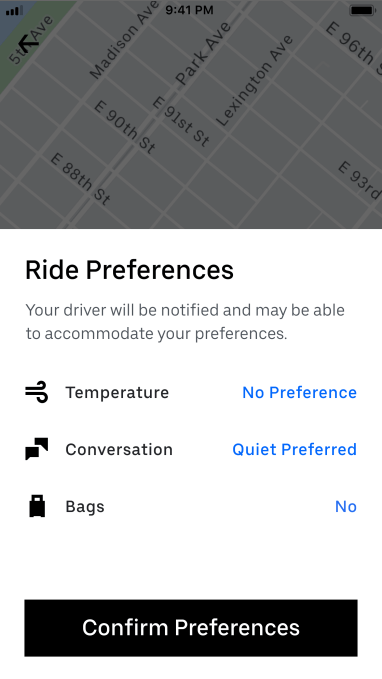
Tired of chatty drivers? Uber is finally giving users its most requested feature: an in-app way to request minimal conversation during your ride. The “Quiet Mode” feature is free and will be available to everyone in the US tomorrow, but only on Uber Black and Uber Black SUV premium rides. Users can select “Quiet preferred”, “happy to chat” or leave the setting at “No preference”. The desire for silence might convince more riders to pay for Uber’s more expensive vehicle types so they can work, nap, take a call, or just relax in the car.

Quiet Mode comes as part of a new slate of Rider Preferences features that users can set up before they hail an Uber Black or SUV. A Bags option lets users signal that they have luggage with them so the driver knows to pull over somewhere they can help load them into the trunk. The Temperature control lets them request the car be warm or cold so drivers know whether to crank the air conditioning.

Uber Black drivers will also now have to wait up to 15 minutes after arriving before cancelling on you as is standard with private car services, though you’ll start to be charged after 5. Uber Black riders will get premium phone support like members of Uber Rewards’ highest Diamond tier. And Uber is going to require nicer and newer cars for future drivers signing up for Uber Black, with centralized rules written by Uber HQ instead of local branches. “We’re looking to create more differentiation between the premium products and the regular products to encourage more trips” Uber product manager Aydin Ghajar tells me. Quiet Mode in particular “is something that people have been asking for for a long time.

I think Quiet Mode is going to be a hit, perhaps because I requested that Uber build a “Quiet Ride Mode” in my December product wish list after suggesting it last July. The feedback I received from many male readers was that there are worse things than having to chat with a friendly driver, and it’s dehumanizing to demand they stay silent. But that ignores the fact that women often feel uncomfortable when male drivers incessantly talk to them, and it can get scary when it turns into unwanted flirtation considering the driver is in control. That’s why I hope Uber plans to expand this to UberX as well as international markets, though the company had nothing to share on that.

What Uber’s Ghajar did reveal was that “the reaction of Uber black drivers was overwhelmingly positive because they want to deliver a great experience to their rider…but they don’t necessarily know what the rider wants. These guys take a lot of pride in what they do as customer service agents”.

Uber did extensive research of drivers’ perceptions in the three months it took to develop the feature. But due to employment laws, it can’t actually require that drivers abide by user requests for quiet, though they might get negative ratings if they ignore them. “It’s not mandatory. The driver is an independent contractor. We’re just communicating the rider’s preference. The driver can have that information and do with it what they want” Ghajar insists.

Jeff Bezos personally dumps a truckload of dirt on FedEx’s future

Amazon want to be plenty of things, the most predictable of which is its ambitions to control America’s shipping backbone. The company’s efforts to bring users whatever they desire in 24 hours requires movements by land, air and sea.

Today, the company broke ground on expanding its airborne ambitions, breaking ground on a three million square-foot Prime Air airport outside Cincinnati (in Kentucky). In case the optics of three million square feet is lost on you, it’s essentially a parking garage for a 100 cargo jets. Amazon doesn’t even have that many jets yet, but the hub is a housing for the company’s grand logistics ambitions.

Per Bezos’ tweet, Amazon is investing $1.5 billion in this effort. The company says the hub will create 2,000 jobs.

https://platform.twitter.com/widgets.js

Like most ground breaking events, it was a ceremonial affair with a lot of pomp and photo-ops. CEO Jeff Bezos himself made a surprise appearance, jumping into the driver’s seat of a front-end loader and dropping some dirt onto an already hefty pile.

The optics were also clear that Amazon is adding salt to the wound as it moves to take down the country’s logistics kings like FedEx and UPS.

Even as Amazon looks to add new regional Prime Air hubs in Texas and Ohio this year, it’s clear the tech giant still has a lot of ground to make up. Amazon has a few dozen planes flying several hundred flights per week while UPS and Fedex have hundreds of planes flying thousands of flights.

One thing that’s certain, Amazon is encroaching on the core businesses of FedEx and UPS while it doesn’t quite seem like Amazon is in any danger of the opposite coming true.

Trendy luggage brand Away packs on $100M, rolls past $1.4B valuation

Away‘s new lofty valuation proves how far you can get with excellent branding.

The direct-to-consumer seller of Instagrammable luggage has collected $100 million in new funding at a $1.4 billion valuation in a round led by Wellington Management, with support from Baillie Gifford, Lone Pine Capital and Global Founders Capital, reports The Wall Street Journal .

We’ve reached out to Away for comment.

The capital will be used to build additional brick-and-mortar stores, as well as add to Away’s portfolio of merchandise with an eye toward expanding into generic travel gear. To date, Away has sold more than 1 million suitcases.

“When someone’s going on a trip, we want to make everything that they need to go on on that trip,” Away co-founder and chief brand officer Jen Rubio said recently on NPR’s How I Built This podcast.

Rubio’s eye for branding and social media expertise has bolstered the company, as has various celebrities’ early adoption of the brand. Rubio got her start at Warby Parker as the company’s head of social media. In 2015, she brought her idea for a modern luggage company to Steph Korey, Warby’s former head of supply chain.

Away’s new valuation, up from $400 million in 2018, firmly places Away into the unicorn club. It joins several other recently added female-founded companies to the exclusive group, such as Rent The Runway and Glossier.

Here’s a closer look at its funind history, via PitchBook:

August 2015: $2.5 million seed round at a $7.2 million valuation
September 2016: $8.5 million Series A at a $40 million valuation
May 2017: $20 million Series B at a $120 million valuation
June 2018: $50 million Series C at a $400 million valuation
May 2019: $100 million at a $1.4 billion valuation

Away has brought in a total of $181 million, including the latest investment. Previously, Away raised a $50 million Series C and claimed in the announcement that it had already hit profitability, a notable accomplishment for a startup that was still shy of 3-years-old.

Away is backed by Forerunner Ventures, Accel, Battery Ventures, Comcast Ventures, Shawn Carter, Slack CEO Stewart Butterfield and Karlie Kloss.

Butterfield and Rubio’s are romantically linked and perhaps soon-to-be married? The well-known Slack executive Tweeted shortly after the WSJ story on Away broke asking Rubio to marry him. She has yet to announce her response.

All in a day’s work.

CrowdStrike, a cybersecurity unicorn, files to go public

If you thought Uber’s disastrous initial public offering last week would deter fellow venture-backed technology companies from pursuing the public markets in 2019, you thought wrong.

Crowdstrike, yet another multi-billion-dollar Silicon Valley ‘unicorn’ has filed to go public. The cloud-based cybersecurity platform valued at $3.3 billion in 2018 revealed its IPO prospectus Tuesday afternoon.

The company plans to trade on the Nasdaq under the ticker symbol “CRWD.” According to the filing, it intends to raise an additional $100 million, through that figure is typically a placeholder amount. To date, Crowdstrike has raised $480 million in venture capital funding from Warburg Pincus, which owns a 30.3 percent pre-IPO stake, Accel (20.3 percent) and CapitalG (11.2 percent).

As we’ve come to expect of these companies, Crowdstrike’s financials are a bit concerning. While its revenues are growing at an impressive rate from $53 million in 2017 to $119 million in 2018 to $250 million in the year ending January 31, 2019, its spending is far outweighing its gross profit. Most recently, the company posted a gross profit of $163 million on total operating expenses of about $300 million.

CrowdStrike is not yet profitable. Its total losses are increasing year-over-year from $91 million in 2017, $135 million in 2018 and $140 million in 2019.

Headquartered in Sunnyvale, the business was founded in 2011 by chief executive officer George Kurtz and chief technology officer Dmitri Alperovitch, former McAfee executives. CrowdStrike, which develops security technology that looks at changes in user behavior on networked devices and uses that information to identify potential cyber threats, has reportedly pondered an IPO for some time.

The business sells its endpoint protection software to enterprises on a subscription basis, competing with Cylance, Carbon Black and others. In its S-1, CrowdStrike makes a case for its offering based on the rise of cloud computing and the growing threat of cybersecurity breaches. It estimates a total addressable market worth $29.2 billion by 2021.

“We founded CrowdStrike in 2011 to reinvent security for the cloud era,” the company writes. “When we started the company, cyberattackers had a decided, asymmetric advantage over existing security products. We turned the tables on the adversaries by taking a fundamentally new approach that leverages the network effects of crowdsourced data applied to modern technologies such as artificial intelligence, or AI, cloud computing, and graph databases.”

San Francisco passes city government ban on facial recognition tech

On Tuesday, San Francisco’s Board of Supervisors voted to approve a ban on the use of facial recognition tech by city agencies. The measure,  known as the Stop Secret Surveillance Ordinance, will be the first ban of its kind for a major American city and the seventh major surveillance oversight effort for a municipality in California. The ordinance passed by a vote of eight to one, with San Francisco District 2 Supervisor Catherine Stefani dissenting.

Importantly, the ordinance also includes a provision that would require city departments to seek specific approval before acquiring any new surveillance equipment. The proposal bans local government uses of facial recognition technology, including applications by police. The ban would not impact facial recognition tech deployed by private companies, though it would affect any companies selling tech to the city government.

In 2016, Santa Clara county passed its own predecessor to San Francisco’s surveillance oversight policy, but that ordinance did not include a ban. Last week, the board’s Rules Committee elected to move forward with a vote on the proposal.

“I want to be clear — this is not an anti-technology policy,” Peskin said during Tuesday’s board meeting. Peskin deemphasized the ban aspect of the ordinance, instead framing it as a form of oversight and an outgrowth of the sweeping data privacy reforms signed into law by California Governor Jerry Brown last year.

Peskin clarified that the ordinance is an accountability measure “to ensure the safe and responsible use” of surveillance tech and to allow the public to be involved in decisions like how long data is stored and who can see it.

Other cities and states are looking into bans on facial recognition tech, though San Francisco’s own efforts were the most mature. For example, a bill in Washington state would require facial recognition software to open itself to third party testing. In that case, major tech companies are weighing the cost to their future business against public sentiment that facial recognition and other surveillance techniques are an invasive way for tech companies to leverage their power.

Across the bridge from San Francisco, Oakland and Berkeley are both mulling their own regulations on facial recognition tech, known as the Surveillance and Community Safety Ordinance and Surveillance Technology Use and Community Safety Ordinance, respectively. The East Bay might not be far behind San Francisco’s own vote.

Among the many more divisive aspects of the facial recognition tech is its impact on people of color. Recent research suggests that non-white individuals are not recognized as accurately as their white peers, a discrepancy that bakes racial profiling right into the tech itself.

The split over the ban is energizing both anti-surveillance groups and proponents of high tech policing. The ban’s supporters include the ACLU, the Electronic Frontier Foundation and local groups like Oakland Privacy.

“Critics are worried that the U.S. government will use facial recognition for mass surveillance, as the Chinese government is doing,” ITIF Vice President Daniel Castro said of the decision. “… In reality, San Francisco is more at risk of becoming Cuba than China—a ban on facial recognition will make it frozen in time with outdated technology.”

“If unleashed, face surveillance would suppress civic engagement, compound discriminatory policing, and fundamentally change how we exist in public spaces,” the ACLU of Northern California’s Matt Cagle and Brian Hofer, Chair of Oakland’s Privacy Advisory Commission, wrote in an op-ed arguing in favor the ordinance last week.

Preparing for a future of drone-filled skies

The last few months have seen an escalating series of incidents in which the harmful elements of drones have loomed large in the public eye. In April, rumors of a coup in Saudi Arabia flared after a recreational drone was shot down when flying into an unauthorized zone in the capital. August saw a drone attack on the president of Venezuela. In late December, 10,000 flights carrying 140,000 passengers were grounded over the course of 36 hours at Gatwick Airport in the United Kingdom. In the months since, a number of airports, ranging from Dublin to Dubai, have experienced delays on account of drone activity. The Gatwick incident alone is estimated to have cost the aviation industry as much as $90 million.

While these are spectacular incidents, they speak to the growing ubiquity of drones. Perhaps even more telling than those events were the efforts that authorities put into air security for the Super Bowl. In the days leading up to the event, PBS reported a “deluge” of drones despite a ban on their presence in the airspace around the stadium.

These incidents underline the conclusion that mapping the skies — as well as policing them — is moving from the theoretical to the practical. Just as Google took the noise of the early internet and arranged it into something comprehensible and navigable, so we need to organize and understand the sky as drones become a growing part of civilian life.

Most of the examples I outlined above are “bad drone” problems — problems related to drones that might be hostile — but understanding what entities are up in the air is critical for “good drone” problems too. While drones have risen to prominence primarily as threatening entities, they’ll soon be central in more benign contexts, from agriculture and weather forecasting to deliveries and urban planning. We could soon pass a tipping point: In early 2018, the Federal Aviation Authority (FAA) announced that their drone registry had topped 1 million drones for the first time. While most of those were owned by hobbyists, the agency expects commercial drone numbers to quadruple by 2022. At some point, it’s going to be vital that we have systems for ensuring “good drones” don’t crash into each other.

We need to organize and understand the sky.

For comparison, the FAA reports that in the U.S. there are around 500 aircontrol towers coordinating 43,000 airplane flights a day, with up to 5,000 planes in the sky at any one moment. Some 20,000 airway transportation system specialists and air traffic controllers spend their professional lives keeping those 5,000 planes from bumping into each other. Consider, then, the effort and resources required to prevent potentially hundreds of thousands, or even millions, of concurrently airborne drones from colliding. This a big problem with real stakes.

Countless companies have emerged in recent years to tackle the challenge of organizing this ecosystem. Significant investor capital has gone into different approaches to making sense of a sky filled with drones, from point-sensor solution providers such as Echodyne and Iris Automation to drone management systems such as KittyhawkAirMap and Unifly“Bad drone” solutions ranging from lasers and ground-based bazookas to malware and enormous net shields have cropped up.

The most exciting approach, however, is a unified one that addresses both “good drone” and “bad drone” challenges; one that maps well-intentioned drones and defends against nefarious ones. In this case, knowledge is the first step to understanding, which enables suitable action. In practice, that means we need to start with a firm data layer — typically gathered through a radar detection system. That data layer allows practitioners to determine what and where entities are in the air.

With that data in hand, understanding the nature of those entities becomes possible — specifically, if they’re benign or malicious. That designation enables the final step: action. For benign drones, that means routing them to the right destination or ensuring they don’t crash into other drones. In the case of malicious drones, action means mobilizing one of the exciting solutions we mentioned above — malware, lasers or even defensive drones to neutralize the potential threat.

A full-stack approach is helpful for formulating a seamless response, but the most important element is the data layer. It’s still early days in the mainstreaming of drones, but there’s great value in getting a headstart on creating the infrastructural and security framework for when that moment arrives. Gathering data now gives us more of a baseline for drones in the future. It also allows new entrants to offer solutions on top of that foundation. Moreover, there are strong positive externalities at work here: As with cellular networks 25 years ago, the decision of early adopters to adopt detection and defense systems benefits others who are slower to move. When Gatwick puts that infrastructure in place, Heathrow benefits.

Ultimately, there are as many — if not more — reasons to get excited about solving the problem of drone-filled skies as there are reasons to be concerned about their negative implications. Creating the rails for what Goldman Sachs estimated will be a $100+ billion market is a tremendous opportunity. The sooner we plan for the positive implications of drones in addition to their malicious potential, the better.

Stocks gain back some ground as investors assess the trade war’s impact

Stocks had their best trading day in a while on Tuesday as investors took a break from selling to assess the actual effects of the trade war with China.

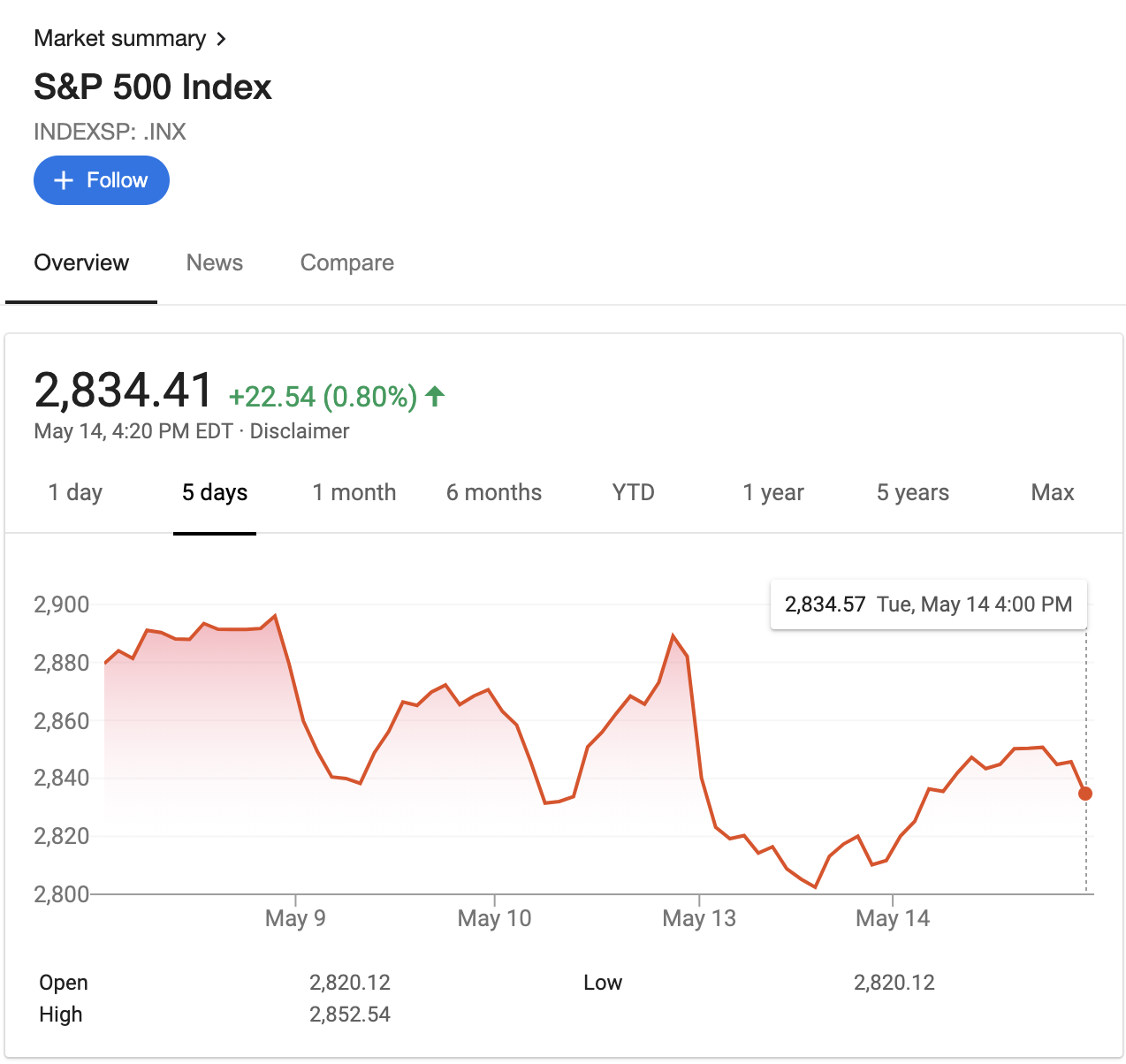
Both the Dow Jones Industrial Average and the S&P 500 gained back some of their losses with the DJIA climbing 207.06 points to close at 25,532.05 and the S&P hitting 2,834.41, up 0.8%. The Nasdaq Composite Index wrapped its trading day at 7,734.49.

Tech stocks like Cisco Systems and Microsoft both rose to lead the way for a sector that could be hit hard by any prolonged trade war between the U.S. and China. Even Apple was up 1.6% on the day after taking a bit of a pummeling as both the U.S. and China announced new rounds of tariffs and import duties.

While some investors are calling the rally more of a dead cat bounce than something that markets can sustain, other investors point out that the fundamentals behind U.S. investing haven’t changed, even as costs are set to rise.

Indeed, economists cited by The New York Times think the tariffs gross domestic product in the U.S. will only decline by 0.3 percentage points at most over the long term.

Still, that assessment doesn’t take into account the impact on consumer wallets and consumer confidence should a prolonged trade war and rising prices force everyday Americans to rethink their spending habits.

Even the modest gains from today’s trading don’t recoup all of the losses the markets have suffered since the new round of tit for tat tariffs began when the U.S. walked away from negotiations and imposed new duties on goods.

Facebook pivots to what it wishes it was

In Facebook’s dreams, it’s a clean and private place. People spend their time having thoughtful discussions in “meaningful” Groups, planning offline meetups with Events, or laughing together in a Facebook Watch party.

In reality, Facebook is a cluttered mess of features that seem to constantly leak user data. People waste their time viewing inane News Feed posts from “friends” they never talk to, enviously stalking through photos of peers, or chowing on click-bait articles and viral videos in isolation.

That’s why Facebook is rolling out what could be called an “aspirational redesign” known as FB5. Rather than polishing what Facebook was, it tries to spotlight what it wants to be. “This is the biggest change we’ve made to the Facebook app and site in five years” CEO Mark Zuckerberg said to open Facebook’s F8 conference yesterday.


The New Facebook

Most noticibly, that starts with sucking much of the blue out of the Facebook interface to making it look sparse and calming — despite a More button that unveils the social network’s bloat into dozens of rarely-used features. A new logo features a brighter blue bubble around Facebook’s distinctive white f, which attempts to but a more uplifting spin on a bruised brand.

Functionally, FB5 means placing Groups near the center of a freshly tabbed interface for the both Facebook’s website and app, and putting suggestions for new ones to join across the service. “Everywhere there are friends, there should be Groups” says the head of the Facebook app Fidji Simo. Groups already has 1 billion monthly users, so Facebook is following the behavior pattern and doubling down. But Facebook’s goal is not only to have 2.38 billion people using the feature — the same number as use its whole app — but to get them all into meaningful Groups that emblemize their identity. 400 million already are. And now Groups for specific interests like gaming or health support will get special features, and power users will get a dashboard of updates across all their communities.

Groups will be flanked by Marketplace, perhaps the Facebook feature with the most latent potential. It’s a rapidly emerging use case Facebook wants to fuel. Zuckerberg took Craigslist, added real identity to thwart bad behavior, and now is bolting it to the navigation bar of the most-used app on earth. The result is a place where it’s easy to put things up for sale and get tons of viewers. I once sold a couch on Marketplace in 20 minutes. Now sellers can take payments directly in the app instead of with cash or Venmo, and they can offer to ship items anywhere at the buyer’s expense. By following Zuckerberg’s mandate that 2019 focus on commerce, Facebook has become a viable Shopify competitor.

If Groups is what’s already working about Facebook’s future, Watch is the opposite. It’s a product designed to capture the video viewing bonanza Facebook observes on Netfli and YouTube. But without tentpole content like a “Game Of Thrones” or “Stranger Things”, it’s failed to impact the the cutlural zeitgeist. The closest thing it has to must-see video is Buffy The Vampire Slayer re-runs and a docuseries on NBA star Steph Curry. Facebook claims 75 million people now Watch for at least one minute per day though those 60 seconds don’t have to be  sequential. That’s still just 4 percent of its users. And a Diffusion study found 50 percent of adult US Facebook users had never even heard of Watch. Sticking it front and center demonstrates Facebook commitment to making Watch a hit even if it has to cram it down our throats.

Not The Old Facebook

The products of the past got little love on stage at F8. Nothing new for News Feed, Facebook’s mint but also the source of its misinformation woes. In the age of Snapchat and Zuckerberg’s newfound insistence on ephemerality to prevent embarassment, the Timeline profile chronicling your whole Facebook life got nary a mention. And Pages for businesses that were the center of its monetization strategy years ago didn’t find space in the keynote, similar to how they’ve been butted out of the News Feed by competition and Facebook’s philosophical shift from public content to friends and family.


The one thing we heard a lot about but didn’t actually see much of was privacy. Zuckerberg started the conference declaring “The future is private!” He spoke about how Facebook plans to make its messaging apps encrypted, how it wants to be a living room rather than just a townhall, and how it’s following the shift in user behavior away from broadcasting. But we didn’t see any new privacy protections for the developer platform, a replacement for its Chief Security Officer that’s been vacant for nine months, or the Clear History feature Zuckerberg announced last year.

“I get that a lot of people aren’t sure that we’re serious about this. I know that we don’t exactly have the strongest reputation on privacy right now, to put it lightly” Zuckerberg joked without seeming to generate a single laugh. Combined with having little to show to enhance privacy, making fun of such a dire situation doesn’t instill much confidence. When Zuckerberg does take things seriously, it quickly manifests itself in the product like with Facebook’s 2012 shift to mobile, or in the company like with 2018’s doubling of security headcount. He knew mobile and content moderation failures could kill his network. But does someone who told Time magazine in 2010 that “What people want isn’t complete privacy” truly see a loose stance on privacy as an existential threat?

Interoperable, encrypted messaging will boost privacy, but it’s also just good business logic given Zuckerberg’s intention to own chat — the heart of your phone. Facebook’s creepiness stems from it sucking in data to power ad targeting. Nothing new was announced to address that. Despite his words, perhaps Zuckerberg doesn’t aspire to make Facebook as private as he aspired to make it mobile and secure. 

Wired reported that Zuckerberg authored a strategy book given to all employees ahead of the IPO that noted “If we don’t create the thing that kills Facebook, someone else will.” But F8 offered a new interpretation. Maybe given the lack of direct competitors in its league, and the absence of a mass exodus over its constant privacy scandals, it was the outdated product itself that was killing Facebook. The permanent Facebook. The all-you-do-is-scroll Facebook. The bored-of-my-friends Facebook. Users were being neglected rather than pushed or stolen. By ignoring the past and emphasizing the products it aspires to have dominate tomorrow — Groups, Marketplace, Watch — Facebook can start to unchain itself from the toxic brand poisoning its potential.

Apply now for Startup Battlefield at Disrupt SF 2019

We’re looking for fearless early-stage startup founders who want to launch their business on a global stage. We’re talking about competing in Startup Battlefield, our legendary, life-altering pitch-off that takes place at Disrupt San Francisco 2019 on October 2-4. Do you have what it takes to be legendary? Apply right here and find out. What have you got to lose? Applying and participating in Startup Battlefield is free.

We’re not kidding when we say legendary. Since 2007, more than 857 startups have competed, launched and now form the Startup Battlefield alumni community. They’ve gone on to collectively raise more than $8.9 billion in funding and produce more than 110 exits. Compete in the Battlefield and you’ll join this community that includes auspicious names like Mint, Dropbox, Yammer, TripIt, Getaround and Cloudflare — to name just a few.

Here’s how Startup Battlefield works. Discerning TechCrunch editors with an eye for successful startups review all the applications and will select a cadre of 15-30 startups to compete. Regardless of where you ultimately place in the competition, you’ll receive an intense amount of attention from investors, media and potential customers.

Each team receives extensive — and free — pitch coaching from our Battlefield-tested editorial team. You’ll be thoroughly prepped and ready come the big day. When you step out onto the Main Stage, you’ll have just six minutes to pitch and demo your product to our judges — comprised of expert VCs and techies — and then answer any questions they fire at you.

Round-one survivors go on to the final round and pitch again to a new set of judges, and from that impressive field will come one outstanding startup to hoist the Disrupt cup and lay claim to the — wait for it — $100,000 equity-free cash prize.

And if that process isn’t stressful enough, consider that all this fast-paced pitching takes place in front of a live audience. We’re talking thousands of tech icons, founders, press, investors — you name it. We also live-stream the entire event to the world (and make it available later on-demand) on TechCrunch.com, YouTube, Facebook and Twitter. Lots and lots of awesome exposure.

Startup Battlefield takes place at Disrupt SF 2019 on October 2-4. Are you a startup legend waiting to happen? There’s only one way to find out. Apply to compete in Startup Battlefield. Come and show us what you’ve got.

If you’re not ready to compete in the Battlefield, why not apply for our TC Top Picks program? If you make the cut, you’ll receive a free Startup Alley Exhibitor Package and plenty of media and investor exposure.

Innowatts raises $18 million for its energy monitoring toolkit for utilities

Innowatts, an automated toolkit for energy monitoring and management targeting utilities has raised $18.2 million in a new round of funding from investors led by Energy Impact Partners .

Previous investors, Shell Ventures, Iberdrola and Energy and Environment Investment participated along with another new investor, Evergy Ventures.

As utilities respond to new, renewable power coming online and adapt to the challenges presented by natural disasters and intermittent energy sources stressing old power grid assets, they are increasingly turning to new software toolkits to adapt.

Innowatts and its software fit squarely into that category of offering.

“Competing in today’s complex and evolving marketplace requires utility companies use data and intelligence to drive business and customer value,” said Siddhartha Sachdeva, founder and chief executive of Innowatts, in a statement.

The company’s technology is used to analyze meter data from 21 million customers globally in 13 regional energy markets.

Innowatts boasts that it’s the largest body of customer intelligence data consumed by a software company. How that data will be used is an open question.

“We invest in companies driving the transformation of the energy sector towards an increasingly decarbonized, digitized, and electrified future – solutions that our utility partners can commercialize at scale and have the greatest impact,” said Michael Donnelly, Partner and Chief Risk Officer at EIP, in a statement. “Innowatts is poised to become a key building block in the software-driven, intelligent grid of the future, and we look forward to working closely with them alongside our utility partners.”

The company uses the data it collects to predict the potential for outages or problems created by surges in energy demand so that utilities can dispatch resources to meet that demand without sacrificing reliability for customers.

“Utilities have the opportunity to deliver more value to customers, at lower costs and with greater personalization than ever before, while helping streamline the complex energy marketplace,” said Geert van de Wouw, Vice President Shell Ventures.