Tempo Automation raises $45M Series C for its turnkey circuit board manufacturing solution

Tempo Automation, a San Francisco-based startup that helps shorten the time from prototype to production for electronics manufacturers, announced today that it has raised a $45 million Series C led by returning investor Point72 Ventures. The round also includes new investor Lockheed Martin and existing investors Lux Capital and Uncork Capital.

The company’s turnkey solution allows manufacturers to upload a CAD and have it turned into a circuit board in as little as three days. Founded in 2013, Tempo Automation’s services are tailored for low-volume manufacturers and include customers in a broad range of industries, including aerospace, consumer electronics, automotive and medical tech.

Tempo’s last funding round was $20 million Series B in 2018. In its latest funding announcement, the company said its Series C will be used for hiring and to develop software that will make its manufacturing process quicker and more accurate.

“Tempo is reinventing electronics manufacturing by putting software automation at the center of what they do. Tempo’s interconnected smart factory is modernizing the manufacturing process, which allows them to deliver a far superior customer experience. We see considerable market opportunity for Tempo, and we are pleased to support their continued growth,” said Point72 partner and Tempo Automation board member Sri Chandrasekar in a press statement.

Sonos finally gets Google Assistant integration

After delaying a promised 2018 arrival (while offering a beta as consolation), Google Assistant is finally arriving on select Sonos speakers. Not an earth shattering bit of news, but certainly a nice little free software upgrade for those who already own a Sonos One speaker or Sonos Beam soundbar.

It’s a mutually beneficial deal for all parties. The addition of another assistant on top of Alexa lets Sonos embrace the growing smart home space without picking sides. For Google, meanwhile, it means getting its smarts on some decent home audio equipment beyond the Home Max speaker it doesn’t talk much about these days.

Initially available just in the U.S., users who download the update can use it for your standard array of smart assistant functions, including music playback, weather and smart home controls, using the speakers’ built-in mic array.

Sonos is clearly enjoying the ability to play both sides here. As it notes in a press release, the hashtag Sonos life means never having to settle for one.

The Google Assistant is Sonos’ second built-in voice assistant. Customers on Sonos will have the ability to choose an assistant for each individual speaker, with multiple voice assistants on a single system. With the Google Assistant on Beam in the living room and Alexa on the Sonos One in the kitchen, start a song with the Google Assistant, ask Alexa what’s playing, and vice versa.

The feature will start rolling out in other countries including the UK, Germany, Canada, Australia, France and The Netherlands in July, with more coming later in the year.

The Statue of Liberty gets an AR app to celebrate its new museum

This week, the new $100 million Statue of Liberty Museum opens in the shadow of one of America’s most iconic landmarks. The 26,000 square foot space offers insights into the statue’s storied history, along with context for that majority of visitors who ultimately can’t make it inside the structure.

For those who can’t don’t make it to Liberty Island at all, meanwhile, there’s the brand new Statue of Liberty app, which hits the iOS App Store today. Led by fashion designer Diane von Furstenberg, the Yap Studios-developed app offers myriad methods for bringing New York Harbor’s landmark to life.

“I told Apple I would love people who go to the Statue of Liberty to have an Apple experience,” von Furstenberg said in an event ahead of launch. “They invited me to spend two days with full immersion at Apple. The I realized that wasn’t just giving the people who visited an Apple experience, but it was also to Apple a Statue of Liberty experience. And that meant doing an app.”

Augmented reality provides the most fundamental underlying experience. There are a handful of distinct AR experiences in the app designed to offer some insights into the size, scope and history of Lady Liberty for those who aren’t able to experience it first hand.

There’s a torch panorama view, which showcases the the status view of lower Manhattan. Users can also plop a life-size AR reproduction of the statue’s foot directly in front of them or witness a recreating of the making of the statue, glimpsing inside to its struts ad watch its copper material develop the familiar green patina.

There’s an audio component, as well, including a three-part podcast mini-series narrated by von Furstenberg that explores some of the statue’s secret history. For those who end up visiting the island, there’s also a location-based audio tour in the app. Interestingly, Yap opted not to provide an in-person visual AR experience, though one could be coming down the road.

Meantime, the Statue of Liberty app is available now, only to iOS users.

Lambs, the radiation-proof underwear company formerly known as Spartan, is now selling beanies

Earlier this year, Spartan, the French manufacturer of a silver-lined underwear designed to block EMF radiation from cell phones and wireless routers, relocated to the U.S. and raised some capital from the Los Angeles-based investment firm, Science.

Now the company has relaunched as Lambs and is adding a radiation-proof silver-lined beanie to its $29-per-pair underwear already on sale in the U.S. The company’s goal is to capitalize on paranoia around the effects of cell phone radiation on health and possible links to cancer.

Any link between exposure to radiation from cell phones or wi-fi and cancer or other deleterious health effects is tenuous at best, according to the American Cancer Society, but that didn’t stop Lambs (nee’ Spartan) from launching at the Consumer Electronics Show in 2017 with a pitch designed to prey on fears about the potential health risks.

Indeed, there are no studies that definitively prove a link between radiation emitted by cell phones and cancer. The most serious health risk associated with cell phones is an accident caused by distracted driving, according to the National Cancer Institute.

The three co-founders Arthur Menard, Pierre Louis Boyer, and Thomas Calichiama were undeterred by the science and — spurred on by capital from Science — are expanding on their product line.

Since relocating to the U.S., the team went back to the drawing board and redesigned their underpants to align more with American tastes.

Now, the new and improved underwear and new beanie are going to be available to anyone who wants bacteria-resistant, silver-lined, underwear and headwear so they can wrap precious metals around their family jewels.

The company also plans to launch a line of t-shirts later this year. A line of women’s underwear is also on the roadmap.

LinkedIn integrates and updates jobs and hiring platforms, hits 20M job postings

LinkedIn, the social networking platform for the working world that’s now owned by Microsoft, has leveraged its role as a repository for people’s work profiles into making itself a job hunting and recruitment powerhouse.

The company today has amassed more than 20 million job listings — up from a mere 300,000  five years ago — and sees its 600 million users collectively apply to jobs 25 million times per week. That activity also translates to big business: paid subscriptions specifically aimed at recruiters, paid tiers for average users who want to have more access to contacting people for jobs, job ads and more all contribute to LinkedIn’s bottom line, a business that is projected to hit $6.4 billion in revenues for 2019, growing 27 percent in the last quarter.

Now, LinkedIn is stepping up a gear in the operation. After a two-year effort, LinkedIn is today announcing that it has finally integrated its jobs and hiring efforts and announcing a raft of new features for both.

On the jobs front, they include instant job alerts, a redesign of the Jobs home page, and more salary insights available to all users (including free users), with skills assessments coming soon.

On the recruitment front, LinkedIn Jobs, Recruiter, and Pipeline Builder are all coming together to create a more seamless way to manage how you post ads, source candidates and other leads and ultimately  interact with them in the process of hiring them.

“This will mean higher quality candiates, better jobs and a better fit,” VP of product John Jersin said in an interview. When asked why it took so long to integrate these tools — and why the process didn’t happen five years ago, for example, he answered that it was more of a consequence of how expectations have evolved as tech has evolved to question some of the silos that are incumbent to how we do business.

“We designed these systems in a way that worked well, but no one foresaw what we needed,” he said. “Advancements in AI have driven the strategy, and integrating all this means we can all learn better from each other.”

The new features that LinkedIn is bringing to jobseekers are responses to how our communications have evolved with the rise of the smartphone. It notes that jobseekers who respond to ads faster are more likely  to get the job, so now when a job gets posted that meet your search criteria, you can get a ping within minutes of the posting. Meanwhile, the redesign of the Jobs homepage is more mobile friendly, with added search features that take into account how you navigate on handheld devices.

The skill assessments, meanwhile, seems to me to be a direct response to the many new innovations we’ve seen among e-learning and recruitment startups, where companies like Coursera and Triplebyte are offering more tools to people to figure out where the best fit might be for their skills in the working world. LinkedIn notes that these can both be used by individuals to verify their skills — tackling a perennial problem with people putting empty claims on their resumes — and also recruiters to source people for jobs.

Important steps for the company, but there remain a lot of opportunities for smaller and newer upstarts to take bites out of LinkedIn’s business in areas where it is still being slow to develop.

For example, we’ve seen the emergence of interesting, more targeted recruitment startups that focus on, say, recruiting with racial diversity in mind (as in the case of Handshake) or focusing on, say, women returning to work after having children (as in the case of the Mom Project). While LinkedIn has made some baby steps (no pun intended) in this area, there is still a ways to go, opening the door to others to come in.

“This is a challenging and multifaceted problem,” admitted Jersin, “but LinkedIn is committed to trying to solve it.” He said the company has quietly started to work on ways of picking up more information that “could be more useful” in addressing questions like these. “One thing that is important is a sense of trust,” he noted as one of the challenges that needs to be tackled online. “I think we are very lucky to be one of the few companies out there that can say that we would use this information responsibly, in the interests of jobseeker.”

Google announces $11.2 million grant fund for organizations working on safety

Google.org, the charitable arm of Google, just announced a new grant fund for European organizations. This fund in particular will support nonprofits, universities, research teams and for-profit social enterprises working on safety issues and combatting abuse.

Google .org has already partnered with the Institute for Strategic Dialogue to help organizations in the U.K. But they want to take this program one step further by expanding to other organizations across Europe.

Each eligible organization will receive between €50,000 and €1 million (between $56,000 and $1.12 million). Applications are open until June 28th. Google lists hate, extremism and child safety as key areas for today’s new fund.

The timing of this announcement is interesting. Last week, Google spent a lot of time talking about its efforts when it comes to privacy at its Google I/O developer conference.

Digital ministers of the G7 as well as Australia, India and New Zealand are also meeting in Paris tomorrow to discuss tech regulation. Among other things, they’ll talk about transparency on moderation processes to make sure that big online platforms remain safe.

With Google’s new fund, the company shows that it also cares about these issues and is already acting in order to make the web safer for everyone. But a grant fund doesn’t necessarily replace audit processes and legal requirements.

InnoVen Capital, one of Asia’s most prominent venture debt firms, adds $200M more to its kitty

Founders might not believe it, but managing a venture capital firm isn’t all that dissimilar to a startup. Case in point today: InnoVen Capital, one of Asia’s most prominent venture debt firms, has pulled in $200 million in new money to continue its expansion in the region.

The money comes from InnoVen’s two shareholders — Singapore sovereign fund Temasek and Singapore’s UOB — each of which has added $100 million in additional firepower for the fund, which is popularising debt-based financing within Asia’s startup ecosystems.

The organization came to be in 2015 when Temasek acquired the Indian ‘branch’ of Silicon Valley Bank expressly to offer differentiated financing to startups. The spinout was named InnoVen and it quickly expanded beyond India with the opening of an office in Singapore in 2016 and then an outpost in Beijing in early 2018.

The firm operates without a specific fund size unlike many other investors, but already there are some numbers to indicate its growing role in Asia.

That regional play is still in its early days, but already the business has deployed over $500 million in financing to more than 200 companies, according to Ashish Sharma, the former head of GE Capital India who leads InnoVen’s India business.

The fund operates at Series A and beyond and Sharma told TechCrunch that its investment levels have sped up over the past two to three years, thanks in particular to the addition of offices in Southeast Asia and China.

Recent deals from the fund have included investments in Moglix, Carsome, RedDoorz, Awfis and even a stealthy startup, Indonesia-based logistics venture Kargo which included debt within its first round of funding. Already, the Chinese arm has accrued 30 deals in a little over a year, and some of the biggest names backed across the region include Vision Fund company OYO and Naspers investments Swiggy, which recently raised $1 billion, and Byju’s.

Yet despite InnoVen’s increased profile, there remains confusion on the role of venture debt in Asia. Anecdotally, I’ve heard many misguided opinions from so-called venture capital-focused reporters — and not just in Asia — who see debt-based investment as a ‘last resort’ for companies. Its addition in a round is a tell-tell sign of a struggling business, they claim.

That’s completely wrong, according to InnoVen’s Sharma.

“It doesn’t come in from a position of weakness, that’s a big misconception,” he explained to TechCrunch in an interview. “In fact, venture debt is not available to companies which are in trouble. Most companies that raise venture debt do so from a position of strength.”

“They’ll say ‘We’re raising $100 million, let’s lay in $20 million of venture debt to optimize the dilution,’” Sharma added. “We’ve helped some very large companies use venture debt to get to the next level.”

Ashish Sharma leads InnoVen Capital’s business in India [Image via InnoVen Capital]

Ambitious growth story? Check.

A business that’s misunderstood by many? Check.

Who said running a VC firm isn’t like running a startup?

Spotify-owned Soundtrap launches a podcast studio in the cloud

In November 2017, Spotify picked up the online music studio Soundtrap as part of its efforts to offer more services to artists on its platform. Now that Spotify has a growing interest in podcasts and the needs of podcast creators, Soundtrap is launching a new product to address that market instead. The company today announced the launch of  Soundtrap for Storytellers, a cloud-based podcast creation platform with a number of advanced features, including the ability to transcribe and edit podcasts, collaborate with others, and more.

Soundtrap isn’t the only podcast creation service Spotify now owns. It also bought the lightweight podcast creation app Anchor in February 2019 as part of its big push into podcasts.

Like Anchor, Soundtrap is focused on making it easier to podcast. But unlike Anchor, which is free, Soundtrap is available by subscription, starting at $14.99 per month (or $11.99 per month, if billed annually).

The pricing represents the differentiated feature set Soundtrap provides. While Anchor offers lightweight podcast creation — it began as a mobile app — it also now provides hosting, distribution, and monetizaton. Soundtrap, meanwhile, is focused on recording, editing and publishing primarily to Spotify.

When Spotify first acquired Soundtrap, it was focused on collaborative music making — now, that same technology is being turned to podcasting.

This includes built-in features like recording, remote multi-track interviewing with video chat, interactive transcripts, full audio production capabilities, SEO optimization and more.

For example, the new service will transcribe the podcast (in English only for the time being) — and this transcript is then published along with the podcast to help optimize its discoverability in online search results. (Coincidentally, Google just announced at its I/O developer conference last week it would now index podcasts in its search results, allowing users to play episodes from the browser or save them for later listening.)

The platform also allows multiple podcasters to talk and record on separate tracks as they work on the same podcast together, by sending a link to join the session to remote guests. This is similar to a number of existing solutions like Zecastr, Ringr, Cleanfeed, Clearcast, and Cast, for instance. Also like some existing solutions, Soundtrap will offer sound effects. And like Simplecast, it offers distribution.

Where the service shines, however, is in its editing studio. Here, you can edit the spoken-word audio file much like you would a text document, which makes things a lot easier. This is one of its unique features — and something that could make it a compelling alternative to existing solutions.
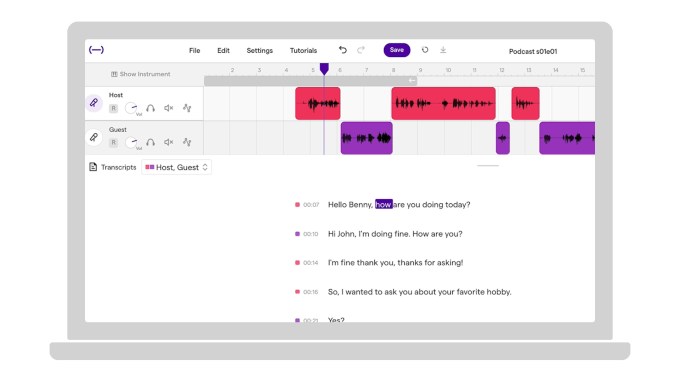
Another part of the service’s value proposition is also that it’s a one-stop shop…of sorts. Today, many podcasters hop from product to product — one to record, one to edit, and another to publish. Soundtrap includes all these options within its platform.

However, one big issue is that Soundtrap only directly publishes to Spotify itself, in addition to feeding the transcript to search engines. To distribute the podcast elsewhere, creators will have to download the mastered podcast they create with Soundtrap, then use another service for distribution.

Given Soundtrap’s higher price point than competitive solutions, that could be a sticking point as it can’t fully replace all aspects of the podcasters’ workflow.

And because Soundtrap is not a hosting solution, podcasters will have to look elsewhere for analytics.

“The Soundtrap team has done a fantastic job with this new product,” said Charlie Hellman, Spotify’s Head of Creator Marketplace, in a statement. “Part of Spotify’s mission is to grow the number of creators able to build podcasts worldwide. Soundtrap for Storytellers gives podcast creators incredible editing capabilities, collaboration in real-time, and the ability to publish their podcast to Spotify,” he added.

Soundtrap’s full suite is available on the desktop, with a subset of its tools available on iOS and Android.

Additional reporting: Chris Gates

EV startup Rimac scores $90M investment from Hyundai and Kia

Rimac Automobili, the European EV startup that landed an investment from Porsche last year, has again gained the backing of traditional automakers after Hyundai Motor Company and Kia Motors jointly invested €80 million, or around $90 million.

Beyond the significant cash infusion, the three parties said the deal includes “a strategic partnership to collaborate on the development of high-performance electric vehicles.” In other words, Hyundai and Kia — both of which fall under the ownership of Hyundai Motor Group — plan to work very closely with Rimac, which is based in Croatia, to bring electric vehicles to market under their brands.

Already we have an idea of what that will look like.

Today’s announcement teased an electric car within Hyundai’s N sports car division and a “high-performance fuel cell electric vehicle,” both of which will include collaboration between the Korean group and Rimac. (It’s worth noting that Rimac is already a supplier for Hyundai Motor Group so the two sides are well acquainted.)

Rimac’s back story is fascinating. The company was founded in 2009 by then-21-year-old Mate Rimac who developed an electric vehicle in his garage. Today, the company is 500 people strong and aside from supplying parts to manufacturers — specifically high-voltage battery technology and electric powertrains — it designs in-car digital interfaces, runs a subsidiary-focused on electrics, and develops impressive electric “hypercars.” Its vehicles include the C Two, pictured at the top of this post at the Geneva International Motor Show.

The startup’s own boilerplate explains neatly why it is teaming up with major names like Porsche and Hyundai.

“The next challenge ahead is to grow from a low volume manufacturer of complex high-end electrification components, to an established Tier-1 supplier for the industry,” it reads.

Decades of automotive know-how from its investors with experience is sure to help there.

[Left to right] Mate Rimac, founder and CEO of Rimac Automobili, and Euisun Chung, Executive Vice Chairman of Hyundai Motor Group, seal the deal

As for Hyundai Motor Group, the Korean firm has embarked on a series of deals as it looks to tap into tech to grow its business. That’s included investments in companies like Grab in Southeast Asia ($250 million), car infotainment startup Audioburst and, in India, car rental service Revv and Uber rival Ola, in a deal related to its EV unit.

On the partnership side, Hyundai is working with Russia’s Yandex on self-driving tech, Amazon on virtual showrooms and more.

Amazon rolls out Alexa Guard, to help protect your home while you’re out

Amazon announced this morning that it’s begun to roll out Alexa Guard to all Echo customers in the U.S. The feature lets the company’s line of smart home products double as home security devices while the user is out. Say “Alexa, I’m leaving” on your way out the door, and the Echo device will start listening.

The key feature here is something called “Smart Alerts,” which listen for key sounds, indulging breaking glass and smoke and carbon monoxide alarms. If the Echo hears the noise, it will send you an alert, coupled with an audio recording of noise.

It’s an interesting new addition and one that leverages the sometimes controversial fact that the device’s mics are designed to always be listening. Amazon points out that it worked with licensed contractors to break hundreds of different glass windows with different instruments in order to create a wide range of different sounds for Alexa to listen for.

The new feature works with different smart home devices, as well. Users with Ring or ADT pro monitoring can set it up to forward alerts to their providers. Users with Away Lighting setup, meanwhile, can use the alert to flip on lights in order to make it look like you’re still around.

The app is rolling out as a free addition to all Echo owners in the U.S.