India’s largest mobile wallet company Paytm now offers a credit card

Paytm, India’s largest mobile wallet app, has branched out to several businesses in recent years. On Tuesday, it added another category to the list: credit cards.

The firm, operated by One97 Communications, today unveiled Paytm First Credit Card with lofty benefits as it races to bulk up its financial offerings. The cards, issued by Citi Bank, will be the first in the country to offer unlimited, one percent cashback on purchases, Paytm claimed in a statement. The company is hoping to rope in about 25 million credit card customers in the coming months.

The penetration of credit cards remains very low in India with under 50 million people possessing one. With people conducting most of their businesses through cash in the nation, banks have little understanding of a customer’s credit history and score. And it also doesn’t help that banks in India are still wary of issuing credit cards to those who don’t perfectly fit the traditional blue collar job.

But why is a company that made its name through a mobile payment wallet open to its customers engaging with credit card companies? Paytm itself is struggling to grow its business. Its ecommerce business Paytm Mall remains tiny despite bleeding money. And payments itself has become a commoditized space with wallet services playing catch up to well-funded apps such as Flipkart-owned PhonePe and Google Pay that are built on top of UPI, a government-backed infrastructure.

It is still positioned to do well in the credit cards space. Paytm, with more than 200 million active users, rivals banks on both the number of customers and volume of transaction it processes. “Our new offering is designed to bring utmost flexibility to our customers in their digital payment options and will help spur large-ticket cashless payments,” Vijay Shekhar Sharma, chairman and CEO of One97 Communications said in a statement.

https://platform.twitter.com/widgets.js

Backed by SoftBank, Alibaba, and most recently Warren Buffett’s Berkshire Hathaway, Paytm also has the capital to spur the adoption of its new credit card. As part of the package, Paytm’s credit card holders will be able to avail dining, shopping, travel and other offers that Citi Bank provides to its privilege customers. In the first four months of issuing a card, the company will offer its customers discounts worth Rs 10,000 ($142) on spending of Rs 10,000.

Paytm First Credit Card will work both in India and elsewhere and support contactless transactions. Like any other credit card, customers will be able to pay back a sum in multiple monthly instalments. Paytm First Credit Card will charge users a nominal fee of Rs 500 ($7.1) that will be waived off if their spendings through the card exceeds Rs 50,000 ($710) in a year.

Paytm’s foray into credit cards business comes as it has been trying to expand its financial services offering. In recent years, it has launched a digital payments bank, and has started to offer prepaid Forex cards for international purchases. It also lets customers buy gold, and employers issue food allowance wallets for their staff.

Earlier this year, the company launched Paytm First, a subscription bundle that includes access to subscriptions from other services such as Zomato, Uber, Gaana, and Eros Now. In an interview with TechCrunch late last month, Paytm’s Sharma said payments is the moat around which you can build a number of services. “Now that’s a business model… payment itself can’t make you money.”

JD.com to foster connected vehicle fleets with $55M investment

JD.com, the Chinese answer to Amazon and Alibaba’s long-time rival, is looking to further automate its logistics network after agreeing to pour 376 million yuan (around $55 million) into Jiangsu Xinning Modern Logistics in exchange for up to 10 percent stake.

That’s according to a filing released on Monday by Xinning, a China-listed logistics firm with supply chain services tailored to consumer electronics. The ally appears as a good fit since much of JD’s revenue is driven by big-ticket electronics and home appliances sales.

In a separate filing on Monday, Xinning said it’s inked a strategic partnership with JD Logistics, JD’s loss-making logistics arm, to build out a big data system that will boost efficiency and cut costs by optimizing matches between cargos and vehicles. The digital solution aims to reach 200 thousand vehicles by 2020 and over 2 million eventually, and will fulfill both JD’s in-house as well as its third-party demand but will prioritize the former.

JD separates itself from its rivals by keeping a logistics unit and carrying its own inventory, a costly strategy which the firm markets as an assurance for better quality control and user experience. By comparison, Alibaba and ecommerce upstart Pinduoduo outsource their logistics needs to third-party partners.

JD’s hefty spending on logistics has long tested investor patience, but in recent years the behemoth started to more aggressively monetize the massive infrastructure network it first constructed for its in-house business. In late 2016, JD opened its logistics service to third-party merchants and further expanded the offering to consumers who can now mail packages through JD as they would with FedEx.

The opening up has begun to reap early rewards in terms of cost-saving. In the first quarter, JD’s fulfillment expenses ratio was down 0.5 percent year-over-year to 6.7 percent, driven by “better utilization of logistics infrastructure and improved unit economics as a result of the third-party logistics service business,” said chief financial executive Sidney Huang in the company’s earnings call last week.

Huang pointed out the cost improvement had come prior to the recent wage and benefit changes in JD’s delivery unit. In April, the ecommerce firm announced it would remove minimum wages for its couriers in favor of a per-piece incentive scheme, a decision that industry observers worry would damage couriers’ morale. Contrary to speculation, most of its delivery staff saw income boost following the change, and JD does “not expect to realize any meaningful cost savings” from the transition, according to Huang.

On a larger scale, JD’s net income attributed to ordinary shareholders set a record high 7.3 billion yuan ($1.06 billion) in the first quarter, mainly driven by the fair value change of investments during the quarter although JD did not specify which funding activity accounted for the spoils. Revenues increased 20.9 percent to 121.1 billion ($18 billion), which was the slowest growth the company ever logged but the figure surpassed analysts’ estimate.

The record-smashing season came while JD is ensnarled in a high-profile lawsuit that charges its founder and CEO Richard Liu of raping a Chinese student at the University of Minnesota. If charged and convicted, the executive, who owns nearly 80 percent of the company’s voting rights, could face up to 30 years in prison.

Healthcare booking platform DocPlanner scores €80M Series E

DocPlanner, the Poland-founded healthcare booking platform that now processes 1.5 million bookings every month globally, has closed €80 million in Series E financing.

The round is led by One Peak Partners and Goldman Sachs Private Capital, with existing investors Piton Capital and ENERN Investments also participating, and brings total raised to date to around €130 million.

Founded in 2012, as it stands to day DocPlanner’s offering has two pillars: a consumer-facing marketplace and reviews site, and cloud software for private healthcare providers, including individual doctors, dentists and other healthcare professionals.

The marketplace operates in 15 countries and lists more than 2 million healthcare professionals. It has also garnered 2.4 million patient reviews.

The DocPlanner SaaS is designed to enable doctors and clinics to optimise their “patient flow,” reduce no-shows, and digitize the administrative side of their practices. The premise is that digitisation can reduce a provider’s non-patient facing workload and ultimately improve healthcare outcomes for patients.

Meanwhile, DocPlanner says the Series E will be deployed to help it continue penetrating core markets in Europe and Latin America with its SaaS-based marketplace offering. The company will also continue invest in R&D to offer additional software to doctors and clinics.

It currently has 1,000 employees globally across offices in across offices in Warsaw, Barcelona, Istanbul, Rome, Mexico City and Curitiba. A large recruitment drive is also underway, with over 100 openings.

Once again, DocPlanner is talking up the possibility of further acquisitions, too. The company says it is on the lookout for young, innovative cloud-based software companies to help accelerate growth. Previous acquisitions include buying competitors in Turkey and Spain, in 2014 and 2016, respectively.

Pleo, the multi-card business spending platform, closes $56M Series B

Pleo, the Danish fintech that offers a “business spending platform” that lets companies easily issue employees with cards and manage expenditure, has raised a hefty $56 million in Series B funding.

Leading the round is Stripes, the New York-based growth fund, with participation from existing investors, Kinnevik, Creandum and Founders. I understand that the new funding values the company at a little under half a billion dollars and brings the total amount raised to $79 million.

Founded in 2015 by ex-Tradeshift early employees Jeppe Rindom and Niccolo Perra, Pleo aims to transform business expense processes so that employees aren’t left out of pocket waiting to be reimbursed or have to jump through too many bureaucratic hoops trying to make company purchases. The platform consists of “smart” company cards paired with software and mobile apps to automatically match receipts and track company spending in real-time.

The Pleo MasterCard is a prepaid card that can be charged up and handed out to employees, either physically or virtually. This is then coupled with Pleo’s backend system and apps. Features of the software includes the ability to categorise spending automatically and capture receipts associated with each transaction.

Pleo also eliminates expense reports and automates bookkeeping tasks via integrating directly with various accounting software providers. Meanwhile, the prepaid element means no waiting to be reimbursed for expenses and less waiting for approval, which is traditionally a real pain-point for employees and companies alike.

In a call, Pleo co-founder and CEO Jeppe Rindom tells me that the fast-growing startup is helping to create a whole new product category: Pleo is neither a business bank account or simply accounting or expenses management software. Instead, the company’s “business spending platform” has elements of both but is as much about enabling and embracing a change in company culture than simply better financial technology.

“We are helping to export Nordic company culture,” he says, in reference to a more flat company hierarchy where employees are empowered to take more responsibility and have greater autonomy. The Pleo platform’s features and the transparency it affords means that more employees can be given company cards underpinned by micro-budgets and spending limits for the things they need to purchase in order to get on with the job.

Likewise, Rindom says that forward thinking companies are also recognising that bestowing more trust with employees and less pain-points with regards to expense reimbursement is also a potential recruiting and retention tool. He says that while a company’s chief financial officer is typically the buyer of Pleo, the product itself is targeting employees, who remain its biggest advocate.

To that end, more than 3,500 companies have switched to Pleo across the U.K., Denmark, Germany and Sweden. Its customers include Airsorted, The Tab, Lyst, Yoyo, Pizza Pilgrims and Roskilde Festival amongst others, with “hundreds” of businesses joining Pleo every month.

Pleo says it will use the new funding to expand and more than triple its headcount, from 120 to 400 employees by the end of 2020. It also plans to accelerate product development with the aim to service “the entire purchase process” for SMEs across the whole of Europe. This will include adding credit, invoices, mobile payments, a vendor marketplace, VAT reclaims and more.

“While we are competing with banks in this one area we are not aiming to become one,” adds Rindom in a statement. “We remain committed to providing the best product in the market for business spending. We haven’t touched the funds from our Series A round less than a year ago, yet we see enormous potential and demand for Pleo”.

Seed investor Gree Ventures makes first close of new $130M fund — and rebrands to Strive

There’s big news for one of India and Southeast Asia’s longest-running early-stage investors after Gree Ventures, the fund attached to Japanese gaming firm Gree, announced the first close of its third fund, which is targeted at $130 million.

Gree has been a fixture in Southeast Asia since 2012, but now the firm is rebranding to Strive (or “STRIVE” to quote the press release) for the new fund. Rebrandings often seem token, but, in this case, it makes a lot of sense to stop being called Gree (“GREE”) because the company is just one LP of many.

“People often confuse us as a single LP fund,” Nikhil Kapur — who has been promoted to partner — told TechCrunch in an interview. “But we’re quite independent from Gree, plus we’re not a corporate fund and we’re not investing in gaming.”

Indeed, in this case, the fund is talking to non-Japan-based LPs for the first time over potential participation. Confirmed LPs include past backers SME Support JAPAN — which is part of the Ministry of Economy, Trade and Industry of Japan — Gree itself and members of the Mizuho Financial Group. Opening the doors to prospective LPs in Southeast Asia is about adding “more local networks in these markets,” Kapur explained.

Those details, it is very much business as usual for Strive, which is putting the focus on B2B. Kapur said that 60-70 percent of past investments have tended to be on B2B deals, but now fund three is — for the first time — almost entirely dedicated to that segment.

Southeast Asia has seen some seed investors move further down the chain — Jungle Ventures’ new fund is targeting a $230 million final close, while Golden Gate Ventures’ third fund is $150 million while it also has a ‘growth fund’ aimed at $200 million — but Strive is sticking to early stage.

As seed funds go, $130 million is a lot but there’s plenty of nuance to that figure — it won’t all go to early-stage checks.

The fund is split across India, Southeast Asia and Japan — with around half of that allocation estimated for deals outside of Japan. That leaves around $25 million for ‘first checks.’ Kapur said that the outlined goal is to find 20 startups to back, and then double down on them with that follow-on capital. Interestingly, he said that there’s no hard allocation between the three focus regions and follow-on capital is allocated freely to those companies which are performing well and ready to grow, irrespective of geography.

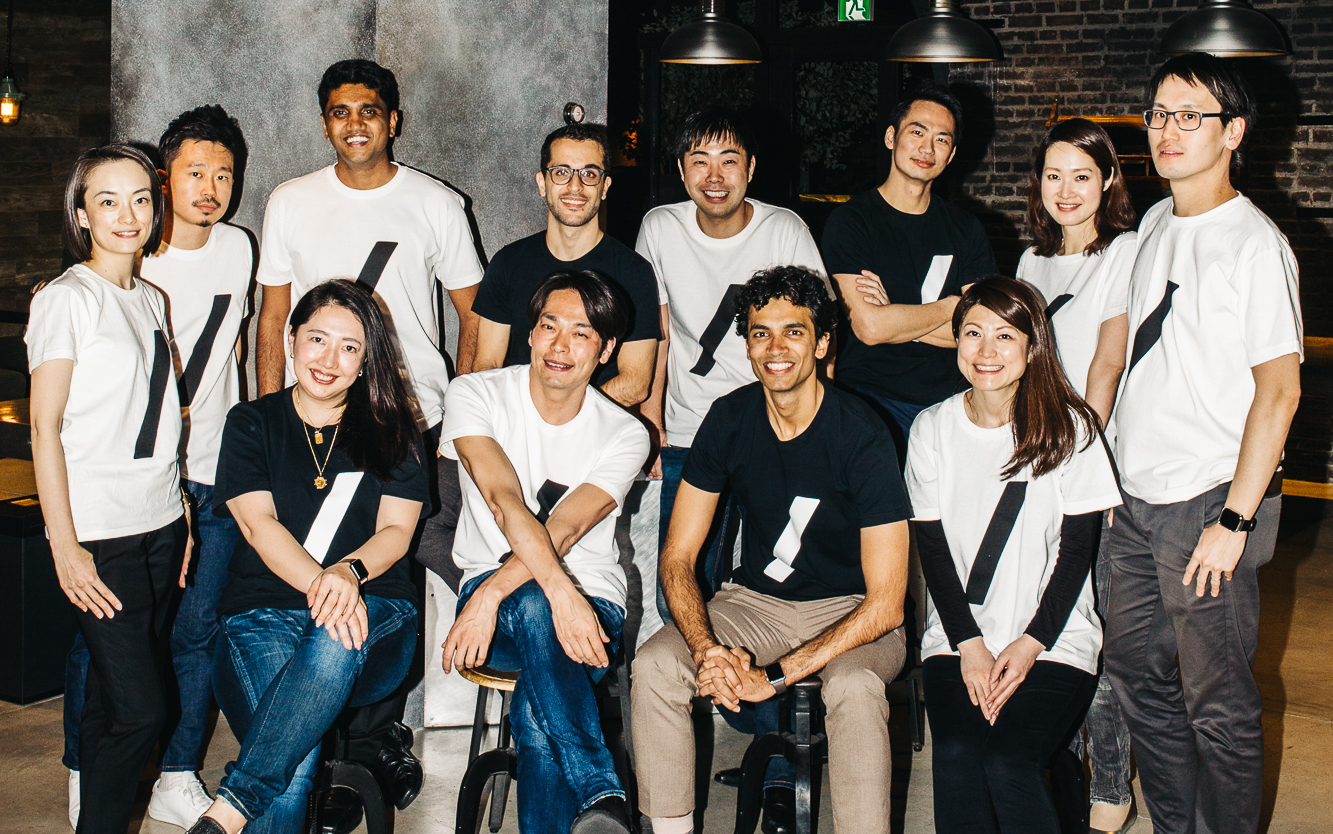
The Strive team

Looking more closely at India and Southeast Asia, Kapur and investment manager Ajith Isaac pointed to increased synergies between the two regions. Indeed, large Southeast Asian players like Grab and Go-Jek have tapped India’s talent pool and located their R&D centers and engineering teams in the country, while Indian startups area increasingly foraying into Southeast Asia for market expansion.

“We see these regions not remaining separate in the near future… [and] becoming very intertwined,” Kapur said, pointing out that in venture capital firms like Accel and Lightspeed and following Sequoia India and investing directly in startups in Southeast Asia.

“The region will become very much interlocked and there’s a gap in people who can bridge it… that’s where we see a differentiated value-add on our side,” he added.

Southeast Asia itself has matured immensely since the Gree fund’s early days, but Kapur and Isaac — investment manager Samir Chaibi is the third member on the non-Japan side of the fund — maintain that there’s still “a gap in terms of institutional capital on seed stage” in some verticals where angel investors are helping new ventures get off the ground with first checks and early backing. That’s where the new Strive fund is keen to make its mark.

The fund, which has traditionally been very lean in terms of personnel, will also bulk up its own numbers. Kapur said he is hiring local teams in India and Indonesia with a viewing to growing the non-Japanese headcount to six people by the end of the year.

Meet the TC Hackathon at Vivatech 2019 judges & hackmaster

In just three short days, some of the best hackers, coders, programmers and creative tech geniuses in the world will arrive in Paris to compete in the TechCrunch Hackathon at VivaTech 2019 on 17-18 May.

After the participants pour their heart, soul and skills into creating something amazing out of nothing, it will all come down to the judges. They’ll determine the best overall project of the hackathon — and select the one team that deserves to win the TechCrunch €5,000 grand prize.

You deserve to know more about the people who will judge your products, so, here’s the lowdown on the talented experts who stand ready to be impressed.

Dr. Aurélie Jean has been working for more than 10 years as a research scientist and an entrepreneur in computational sciences, applied to engineering, medicine, education, economy, finance and journalism. In the past, Aurélie worked at the Massachusetts Institute of Technology and at Bloomberg. Today, Aurélie works and lives between USA and France to run In Silico Veritas, a consulting agency in analytics and computer simulations. Aurélie is an advisor at the Boston Consulting Group and an external collaborator for The Ministry of Education of France. Aurélie is also a science editorial contributor for Le Point, teaches algorithms in universities and conducts research.

Julien Meraud has a solid track record in e-commerce after serving international companies for several years, including eBay, PriceMinister and Rakuten. Before joining Doctolib, Julien was CMO of Rakuten Spain, where he improved brand online acquisition, retention, promotions and campaigns. Julien joined Doctolib at the very beginning (2014), becoming the company’s first CMO and quickly holding CPO functions additionally. At Doctolib, Julien also leads Strategy teams that are responsible for identifying and sizing Doctolib’s potential new markets. Julien has a Master’s degree in Marketing, Statistics and Economics from ENSAI and a specialized Master in Marketing Management from ESSEC Business School.

Laurent Perrin is the co-founder and CTO of Front, which is reinventing email for teams. Front serves more than 5,000 companies and has raised $79 million in venture funding from investors such as Sequoia Capital, DFJ and Uncork Capital. Prior to Front, Laurent was a senior engineer at various startups and helped design scalable real-time systems. He holds a Master’s in Computer Science from École Polytechnique and Télécom ParisTech.

Neesha Tambe is the head of Startup Battlefield, TechCrunch’s global startup launch competition. In this role she sources, recruits and vets thousands of early-stage startups per year while training and coaching top-tier startups to launch in the infamous Startup Battlefield competition. Additionally, she pioneered the concept and launched CrunchMatch, the networking program at TechCrunch events that has facilitated thousands of connections between founders, investors and the startup community at-large. Prior to her work with TechCrunch, Neesha ran the Sustainable Brands’ Innovation Open — a startup competition for shared value and sustainability-focused startups with judges from Fortune 50 companies.

Renaud Visage is the technical co-founder of San Francisco-based Eventbrite (NYSE: EB), the globally leading event technology platform that went public in September 2018. Renaud is also an angel investor, guiding founders that are solving challenging technical problems in realizing their global ambitions, and he works closely with seed VC firm Point Nine Capital as a board partner, representing the fund on the board of several of their portfolio companies. Renaud also serves on the board of ShareIT, the Paris-based tech for good acceleration program launched in collaboration with Ashoka, and is an advisor to the French impact investing fund, Ring for Good. In 2014, Renaud was included in Wired UK’s Top 100 digital influencers in Europe.

In addition to our judges, here’s the hackmaster who will be the MC for the event.

Romain Dillet is a senior writer at TechCrunch. Originally from France, Romain attended EMLYON Business School, a leading French business school specialized in entrepreneurship. He covers many things, from mobile apps with great design to privacy, security, fintech, Apple, AI and complex tech achievements. He also speaks at major tech conferences. He likes pop culture more than anything in the world. He now lives in Paris when he’s not on the road. He used to live in New York and loved it.

The TC Hackathon at VivaTech 2019 takes place on 17-18 May and you can still sign up to hack on one of our fantastic challenges by EDHECErametSanofiCegedimIBM, Galeries Lafayette / Publicis Sapient and Corvid by Wix.

Don’t miss this opportunity — sign up right now!

Urban closes $10M Series B in bid to become ‘one-stop shop’ for on-demand wellness services

Urban, the London-headquartered company that lets you book a growing range of wellness services on-demand — now including massage, osteopathy, facial, and nail services — has raised $10 million in Series B funding.

The round, which includes an earlier $4.5 million equity crowdfund, is led by Accelerated Digital Ventures (ADV). Two of Urban’s previous backers, Passion Capital and Felix Capital, also followed on.

In a call, Urban founder Jack Tang told me the fund raise will be used by the company to accelerate its goal of becoming a “one-stop shop” for on-demand wellness services, with new product categories planned, including fitness.

Tang has also talked about adding digital only well-ness offerings, harnessing the skills of its practitioners where a face-to-face booking isn’t needed, in addition to a planned content push. This, he believes, will help Urban to launch in further cities and countries in the future but with lower user acquisition costs since its brand will already be known. The company currently operates in several U.K. cities along with Paris.

Related to this Series B, Urban has already begun the process of recruiting a team of 30 engineers in Lithuania at its Vilnius office. The Lithuania team will work on all aspects of the platform, including the client-facing apps, the practitioner business software, Urban’s corporate offering and data science projects.

A security failing that left Urban’s customer database exposed was discovered in late 2018 (and subsequently plugged), and Tang says that much better systems have been put in place since to ensure nothing like that ever happens again. He also explained that by expanding the company’s engineering base, more people will be solely dedicated to security.

Meanwhile, Tang says that the move into wellness services beyond massage has helped Urban to get near to profitability and significantly improve unit economics. The new services have been well received by Urban’s customer base, with 80 percent of new service revenue driven by existing customers. Therefore, the fundraise, he says, isn’t about plugging gaps in revenue but about doubling down on the company’s mission to empower “city-dwellers” to prioritise their wellbeing.

With that said, Tang also cautioned that in the U.K. we are entering a “silent recession,” citing various macro economic data, including that related to consumer spending. Brexit, he thinks, is also a factor. Therefore, he says that it is important for Urban to remain in a strong position to weather any economic storm when discretionary spending will inevitably contract.

Shares of SoftBank Group, Uber’s biggest stakeholder, slide after its disappointing IPO

As Uber’s biggest shareholder, SoftBank Group had high hopes for the ride-sharing company’s stock market debut last week. Instead, the Japanese conglomerate’s shares have been sliding along with Uber’s following its disappointing initial public offering. SoftBank shares began sliding at the end of last week after Uber set its IPO price at the low end of its planned range. Since the start of trading on Friday morning, SoftBank Group shares have fallen 14.4 percent in value from 11,700 yen (about $106.69) to 10,020 yen (about $91.37)

On paper, SoftBank Group, which became an investor in Uber in early 2018, had expected to make a profit of $3 billion from its debut. According to its IPO filing, SoftBank Group is Uber’s largest shareholder, owning 16.3 percent of pre-IPO shares through its Vision Fund.

After shares continued falling on their second day of trading, Uber CEO Dara Khosrowshahi told employees in a memo that “like all periods of transition, there are ups and downs. Obviously, our stock did not trade as well as we had hoped post-IPO. Today is another tough day in the market, and I expect the same as it relates to our stock.”

All major market indexes fell on Monday as the China-U.S. trade war continued to escalate, with China planning to raise customs on American imports after the U.S.increased tariffs on Chinese goods last week.

Walmart announces next-day delivery on 200K+ items in select markets

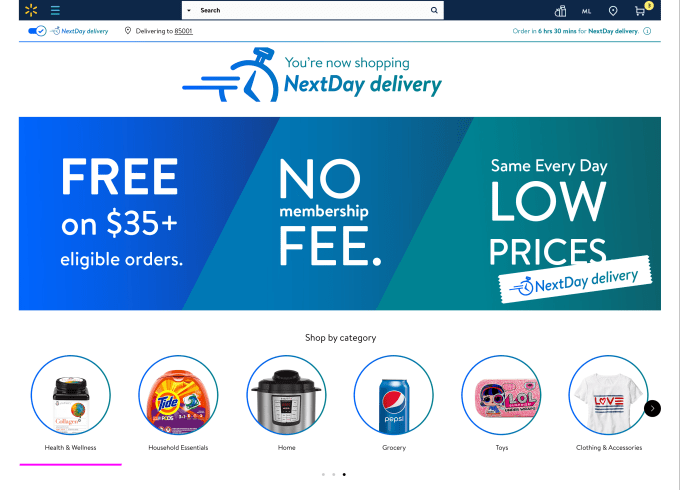
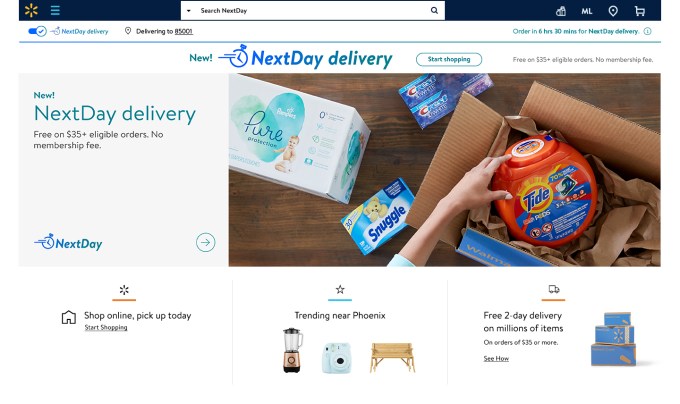
This month, Amazon announced it’s investing $800 million in its warehouses and delivery infrastructure in order to double the speed of Prime shipping by reducing it to only one day. Now Walmart is following suit with a one-day shipping announcement of its own. The rival retailer says it will begin to offer free, NextDay delivery on select Walmart .com orders over $35 — without a membership fee.

This offer will initially be available to customers only in Phoenix and Las Vegas beginning on Tuesday, May 14, 2019, and will then expand to customers in Southern California over the next few days. The rollout will then continue “gradually” over the months ahead, with a goal of reaching 75% of the U.S. population — including 40 of the top 50 U.S. metros — by year-end.

Today, Amazon Prime covers more than 100 million items, which are available for two-day shipping to Prime’s more than 100 million subscribers. To make an inventory of that size available for one-day shipping is a massive investment on Amazon’s part.

Walmart, on the other hand, is starting smaller. Its NexDay delivery will be available as a standalone, curated shopping experience where customers can browse up to 220,000 of the most frequently purchased items.

This includes things like diapers, electronics, toys and household needs, and soon more. Everything in the cart has to be NextDay-eligible and total more than $35 to qualify. The cut-off times for the order will vary by location, Walmart says. Orders will be delivered primarily by national carriers, and in some cases, regional carriers.

This more limited focus in terms of inventory (for now at least) makes NextDay more of a competitor to Target’s Restock than to Amazon one-day Prime ambitions, as — like Restock — it requires a $35 minimum order. Restock, though, has customers “filling a box” with items and is largely focused on day-to-day shopping. Meanwhile, Walmart’s NextDay selection is wider than Restock’s some 35,000 items. (However, ahead of Walmart’s announcement, Target pushed out news that its same-day “Drive Up” curbside service had now expanded to over 1,250 U.S. stores.)

Walmart’s focus on matching Amazon’s efforts — but with a different set of conditions and “without a membership fee” — is now par for the course.

For example, Walmart in early 2017 first announced it would begin to offer free, two-day shopping on more than 2 million items with no need for a membership — as long as orders totaled $35.00 or more. The retailer had been trialing such a sped-up shipping system for years — starting with a test of its answer to Prime back in 2015. Dubbed ShippingPass at the time, the program initially began with 1 million items and three-day delivery, then was lowered to two days while the number of eligible items doubled. 

This past October, Walmart expanded two-day shipping to its Marketplace sellers, as well.

Now, it’s focused on one-day. Walmart says this is not in response to Amazon’s news, but rather had plans already in progress.

“We can offer fast, convenient shipping options because we’ve built a network of fulfillment assets that are strategically located across the U.S. We’ve also done extensive work to ensure we have the right products in the right fulfillment centers based on where customers are located and what they’re ordering,” said president and CEO of Walmart E-Commerce, Marc Lore.

Lore had sold his e-commerce startup Jet.com to Walmart for $3 billion in 2016. While it lives on as a more urban-focused delivery service, its influence on Walmart’s broader e-commerce efforts — particularly around delivery logistics — is seen in these expanded efforts to improve delivery times that also reduce costs while keeping prices low for consumers. Jet, for example, had offered credits to consumers who bought their items from the same nearby warehouse. That’s not entirely different from what Walmart NextDay is doing.

As Lore explains, NextDay is affordable for Walmart.

“Our new NextDay delivery isn’t just great for customers, it also makes good business sense. Contrary to what you might think, it will cost us less – not more – to deliver orders the next day,” he says. “That’s because eligible items come from a single fulfillment center located closest to the customer. This means the order ships in one box, or as few as possible, and it travels a shorter distance via inexpensive ground shipping. That’s in contrast to online orders that come in multiple boxes from multiple locations, which can be quite costly.”

Forrester analyst Sucharita Kodali suggests a bit more caution. She agrees that having another place to get overnight shipping is a win for consumers, but there could still be challenges.

“I think that makes sense theoretically, but whether or not they can make the economics work depends on the quality of the assortment and how many people actually use it. Also, I don’t know how easily it scales,” she says.

XPRIZE seeks high-tech solutions to California’s fire problems

The fire season is just a few weeks away here in California, and it’s expected to be worse than ever. But there’s a new plan in the works to help catch fires before they get out of control. XPRIZE is organizing a public competition for technology that can quickly find and extinguish wildland fires.

Announced by Gov. Gavin Newsom and XPRIZE founder Peter Diamandis on Friday at the Near Future Summit in San Diego, the competition will be open to any company and inventor in the world.

“It’ll be head-to-head between companies, and if one can detect and extinguish a fire in a repeatable fashion, then it becomes technology that every farm, every piece of land [can get],” Diamandis explained on stage. “Let’s reinvent what has been an old form of fire suppression — of people putting themselves in danger.”

Instead of the remote (and decaying) fire lookouts like the one that Jack Kerouac lived in on Desolation Peak, this wildland firefighter turned tech writer imagines Internet of Things devices and satellites helping to pick up even small smoke or heat trails, perhaps combined with some drones that can go dump precision-guided buckets of water.

XPRIZE competitions are designed to attract outside investment for new approaches to major problems, with its ambitious goals typically taking many years for anyone to win. So far, the nonprofit entity has successfully fostered results around space flight, health care and pollution cleanup among many other areas. The fire prize is currently finding sponsors to support the full program and has already raised an initial half-million dollars in funding from Dick Merkin, the CEO of Heritage Provider Network, to develop the plan.

The problem that this prize addresses has only been getting more obvious. Climate change, urban sprawl into naturally burning ecosystems, and an overly successful historical approach to limiting wildland fires have all contributed to bigger and more damaging conflagrations in recent decades.

Today, California is full of kindling-like new plant growth from the wet winter we just had, and it is just about dried out and ready to burn when the next lightning storm, mechanical spark, cigarette butt or willful arsonist shows up.

The winner of the prize will not be able to solve all of the bigger problems, of course, but detection and fast suppressions will at least buy humans time to figure out the other parts while preventing much of the state from going up in smoke.

“Just since 2015 we’ve had ten of the most destructive wildfires in California’s entire history,” Newsom highlighted. “You look at the last 24 months, all those headlines… We lost 139 lives to 16,600 wildfires. We lost over 32,000 structures in this state. [We’re] still trying to calculate the destruction in terms of costs. Just the debris removal costs currently in Paradise… are now close to three billion dollars.”

Meanwhile, like much else in the state, firefighting infrastructure is stuck in the middle of last century.

Gavin Newsom at the near future summit

“I mean, we’re still trying to get old-time cameras out there in the forest,” Newsom continued. “We still have an analog 911 system in the state of California. We have 234 of these Cal Fire forest stations. Over half of them are more than 50 years old, or dilapidated, falling down. People can’t even be pre-positioned out there. It is hard to describe how antiquated we are in this response. The first responders do an extraordinary job, and the mutual aid from around the world is second to none. But we shouldn’t just be celebrating that heroism on the back end. We should be celebrating the heroism and ingenuity on the front end.”

Diamandis offered a few more ideas for what a successful prize competitor might offer.

“You should be able to say in this 500 acres of forest land, there should not be a fire over ten times the size of a camp fire…. If something gets spotted by infrared by satellites, and drones, that is bigger than that, [then] put it out immediately. Autonomously. The concept is a fire detection and extinguishing XPRIZE. Can we find it and put it out before it grows? How it gets put out, is it drones, is water cannons, who knows? That’s our hope, and our working with you, you got plenty of test facilities here.”

He and Newsom also highlighted the economic angles and the physical proximity of the problem, noting geographic areas like the East Bay Hills where (to my knowledge) some of the wealthy and tech-focused Near Future attendees live — which could help with fundraising for the prize.

“They’re not insuring folks in what they call this wildland urban interface any longer,” Newsom noted. “Eleven million Californians live in that wildland-urban interface. You’re seeing your deductibles go up, your premiums go up — or they’re simply not renewing it because they cannot absorb these losses anymore.”

The governor has also been busy debating other ways to plan against fires as he unveils his first state budget. The prize concept, which he has talked about before, is in this light a handy way to save taxpayer dollars, while potentially getting far better tools than the state could build or buy today. If successful, it could also produce solutions for the many other fire-prone parts of the world.