Facebook sues analytics firm Rankwave over data misuse

Facebook might have another Cambridge Analytica on its hands. In a late Friday news dump, Facebook revealed that today it filed a lawsuit alleging South Korean analytics firm Rankwave abused its developer platofrm, and has refused to cooperate with a mandatory compliance check regarding how it used Facebook data.

TechCrunch has attained a copy of the lawsuit, first uploade by NBC News’ Dave Ingram. It alleges that Rankwave misused Facebook data outside of the apps where it was collected, purposefully delayed responding to a cease-and-desist order, claimed it didn’t violate Facebook policy, lied about not using its apps since 2018 when they were accessed in April 2019, and then refused to comply with a mandatory audit of its data practices.

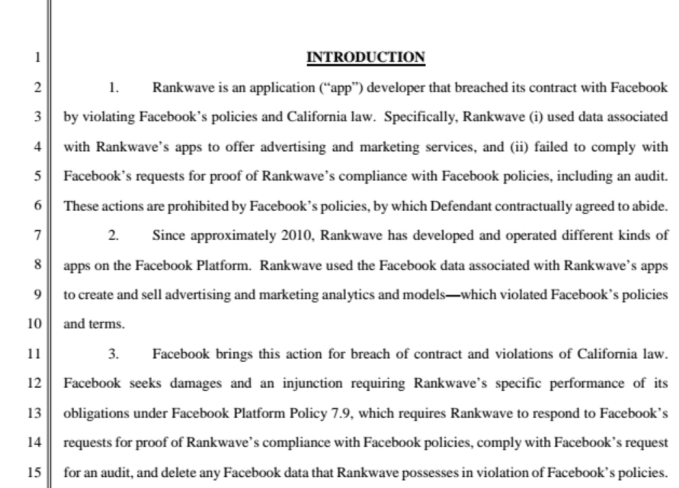
Rankwave-Complaint

Facebook writes taht “Rankwave used data associated with Rankwave’s apps to offer advertising and marketing services, and failed to comply with Facebook’s requests for proof of Rankwave’s compliance with Facebook policies, including an audit. These actions are prohibited by Facebook’s policies, by which Defendant contractually agreed to abide.”

More specifically, Facebook cites that its “Platform Policies largely restrict Developers from using Facebook data outside of the environment of the app, for any purpose other than enhancing the app users’ experience on the app.” But Rankwave used Facebook data outside those apps.

Facebook alleges that “Rankwave’s B2B apps were installed and used by businesses to track and analyze activity on their Facebook Pages . . . Rankwave operated a consumer app called the “Rankwave App.” This consumer app was designed to measure the app user’s popularity on Facebook by analyzing the level of interaction that there users had with the app user’s Facebook posts. On its website, Rankwave claimed that this app calculated a user’s “Social influence score” by “evaluating your social activities” and receiving “responses from your friends.”

Facebook is seeking monetary damages plus injunctive relief restraining Rankwave from accessing the Facebook Platform, requiring it to comply with Facebook’s audit, requiring that it delete all Facebook data.

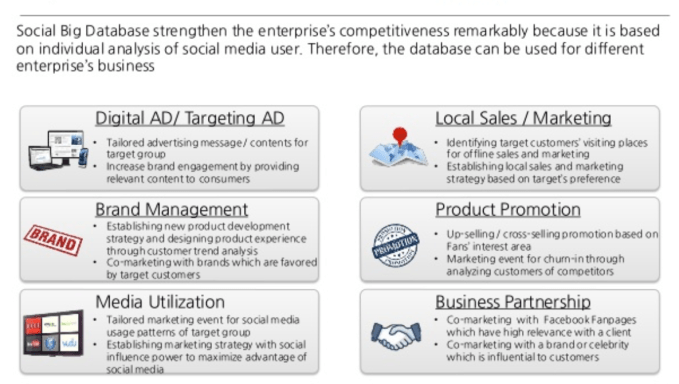
You can learn more about Rankwave’s analytics practices from this 2014 presentation.

Equity Shot: Judging Uber’s less-than-grand opening day

Hello and welcome back to Equity, TechCrunch’s venture capital-focused podcast, where we unpack the numbers behind the headlines.

We are back, as promised. Kate Clark and Alex Wilhelm re-convened today to discuss the latest from the Uber IPO. Namely that it opened down, and then kept falling.

A few questions spring to mind. Why did Uber lose ground? Was it the company’s fault? Was it simply the macro market? Was it something else altogether? What we do know is that Uber’s pricing wasn’t what we were expecting and its first day was not smooth.

There are a whole bunch of reasons why Uber went out the way it did. Firstly, the stock market has had a rough week. That, coupled with rising U.S.-China tensions made this week one of the worst of the year for Uber’s monstrous IPO.

But, to make all that clear, we ran back through some history, recalled some key Lyft stats, and more.

We don’t know what’s next but we will be keeping a close watch, specifically on the next cohort of unicorn companies ready to IPO (Postmates, hi!).

Equity drops every Friday at 6:00 am PT, so subscribe to us on Apple PodcastsOvercast, Pocket Casts, Downcast and all the casts.

A brief history of Uber’s bumpy road to an IPO

It’s been nine years since UberCab made its first appearance on the WordPress pages of this website. In the ensuing years, the startup has grown from an upstart looking to upend the taxi cab cartels, to a juggernaut that has its hands in every form of transportation and logistics service it can think of.

In the process, Uber has done some things that might give (and in fact has given) some shareholders pause.

From its first pitch deck to this historic public offering, TechCrunch has covered the über startup that has defined the post-financial-crisis era of consumer venture investing.

Here are some of the things that shouldn’t get swept into the dustbin of Uber’s history as the company makes its debut as a public company.

  • In 2014 Uber used a tool called “God View” to track the movements of passengers and shared those details publicly.At the time, the company was worth a cool $18.2 billion, and was already on the road to success (an almost pre-ordained journey given the company’s investors and capitalization), but even then, it could not get out of the way of its darker impulses.
  • A former executive of the company, Emil Michael, suggested that Uber should investigate journalists who were critical of the company and its business practices (including PandoDaily editor Sarah Lacy).
  • As it expanded internationally, Uber came under fire for lax hiring practices for its drivers. In India, the company was banned in New Delhi, after a convicted sex offender was arrested on suspicion of raping a female passenger.
  • Last year, the Equal Employment Opportunity Commission opened an investigation into the company for gender discrimination around hiring and salaries for women at the company. Uber’s problems with harassment were famously documented by former employee Susan Fowler in a blog post that helped spur a reckoning for the tech sector.
  • Uber has been forced to pay fines for its inability to keep passenger and driver information private. The company has agreed to 20 years of privacy audits and has paid a fine to settle a case that was opened by the Federal Trade Commission dating back to 2017.
  • While Uber was not found to be criminally liable in the death of an Arizona pedestrian that was struck and killed by a self-driving car from the company’s fleet, it remains the only company with an autonomous vehicle involved in the death of a pedestrian.
  • Beyond its problems with federal regulators, Uber has also had problems adhering to local laws. In Colorado, Uber was fined nearly $10 million for not adhering to the state’s requirements regarding background checks of its drivers.
  • Uber was also sued by other companies. Notably, it was involved in a lengthy and messy trade secret dispute with Alphabet’s onetime self-driving car unit, Waymo. That was for picking up former Waymo employee Anthony Levandowski and some know-how that the former Alphabet exec allegedly acquired improperly before heading out the door.
  • Uber even had dueling lawsuits going between and among its executives and major shareholders. When Travis Kalanick was ousted by the Uber board, the decision reverberated through its boardroom. As part of that battle for control, Benchmark, an early investor in Uber sued the company’s founder and former chief executive,  Travis Kalanick for fraud, breach of contract and breach of fiduciary duty.
  • Uber’s chief people officer, Liane Hornsey was forced to resign following a previously unreported investigation into her alleged systematic dismissals of racial discrimination complaints within Uber.
  • Lawsuits against the company not only dealt with its treatment of gender and race issues, but also for accessibility problems with the ride-hailing service. The company was sued for allegedly violating Title II of the Americans with Disabilities Act and the California Disabled Persons Act.
  • The ride-hailing service also isn’t free from legal woes in international markets. Earlier this year, the company paid around $3 million to settle charges that Uber had violated local laws by operating in the country illegally.
  • Finally, the company’s lax driver screening policies have led to multiple reports of assault by drivers of Uber passengers. Uber recently ended the policy of forcing those women to engage in mandatory arbitration proceedings to adjudicate those claims.
  • Not even the drivers who form the core of Uber’s service are happy with the company. On the eve of its public offering, a strike in cities across the country brought their complaints squarely in front of the company’s executive team right before the public offering, which was set to make them millions.

Virgin Galactic is ‘coming home’ to Spaceport America in New Mexico

Aspiring space tourism outfit Virgin Galactic has just announced its readiness to shift its operations to New Mexico’s Spaceport America, from which the company’s first commercial flights will take off. “Virgin Galactic is coming home to New Mexico where together we will open space to change the world for good,” said Virgin founder Sir Richard Branson at a press event.

The plan isn’t exactly a surprise, since Virgin Galactic and New Mexico collaborated on the creation of the spaceport, which at present is the only thing of its kind in the world. But moving from a testing and R&D hangar to a place where actual customers will board the spaceships is a major milestone.

I talked with George Whitesides, VG’s CEO, about what the move really means and, of course, when it will actually happen.

We’re fulfilling the commitment that we made years ago to bring an operational spaceline to the world’s first purpose-built spaceport,” he told me. “So what does that mean? One, the vehicles are moving, and all the stuff that goes along with operating those vehicles. And all the people that operate the vehicles, and the staff that are so called customer-facing.  And you’ll have all the relevant supply chain folks and core infrastructure folks who are associated with running a spaceline.”

Right now, that rather complicated list really only adds up to about a hundred employees — a large part of the workforce will remain in Mojave, where R&D and new vehicle engineering will continue to be based in the form of The Spaceship Company.

“As we move towards commercial services, we’re thinking more about what comes next, like hypersonic and point to point spaceflight,” Whitesides said.

That said, VG isn’t finished with its existing craft just yet. You can expect a couple more, depending on what the engineers think is necessary. But it’s not a “huge number.”

Moving to Spaceport America from its Mojave facilities is being undertaken now for several reasons, Whitesides explained. In the first place, the craft is pretty much ready to go.
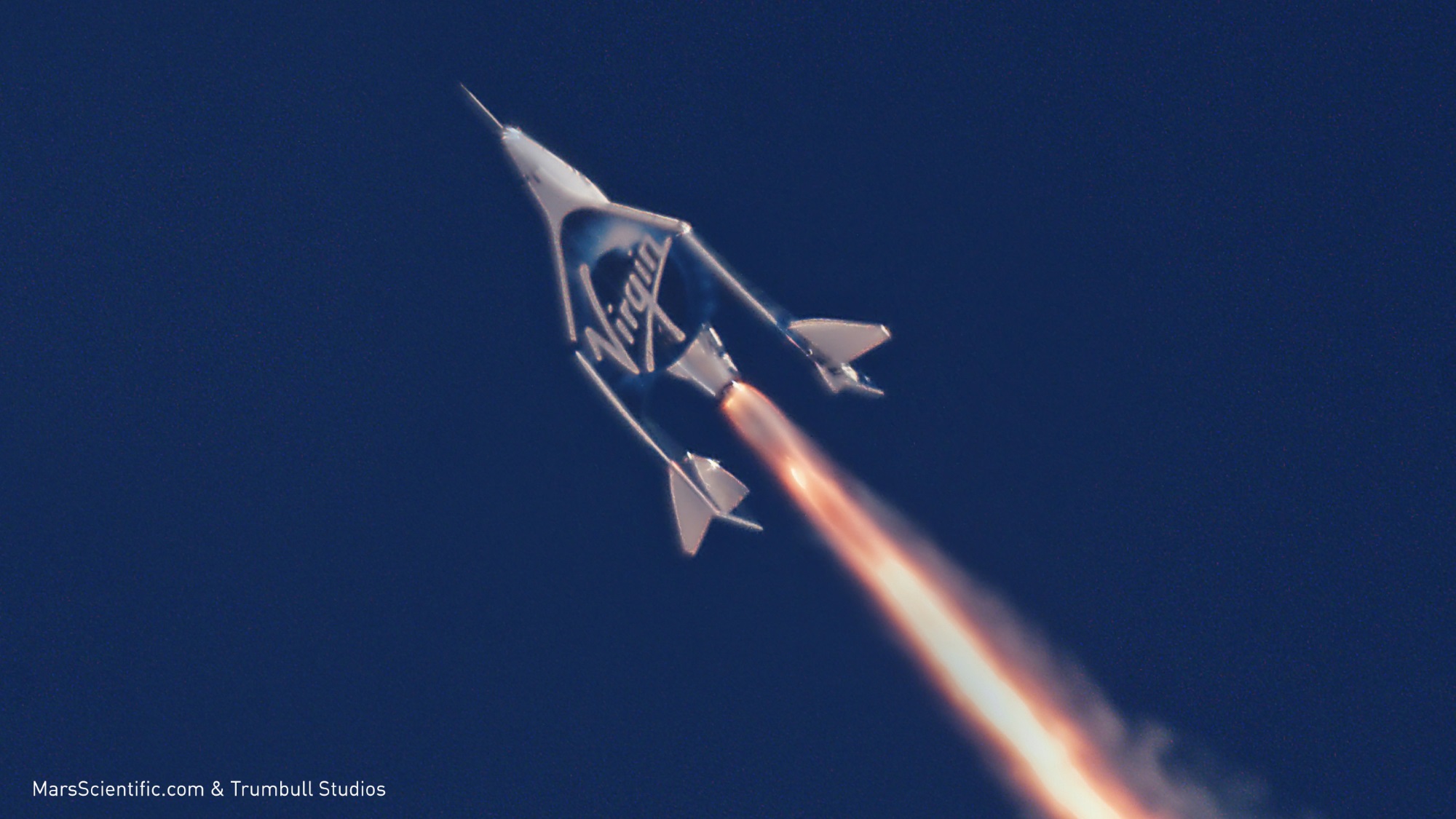
“The last flight we did, we basically demonstrated a full commercial profile, including the interior of the vehicle,” he said. “Not only did we, you know, go up to space and come down, but because Beth was in the back — Beth Moses, our flight instructor — she was sort of our mock passenger. She got up a couple times and moved around, she was able to verify our cabin conditions. So we started thinking, maybe we’re at a place where we could move.”

The paperwork from the FAA and other authorities is in order. The spaceport has been ready for some time, too, at least the difficult parts like the runway, fuel infrastructure, communications equipment, and so on. Right now it’s more like they need to pick the color for the carpet and buy the flatscreens and fridges for inside.

“But the people perspective is a key part of this,” Whitesides continued. “These people have families, they have kids. We always thought, wouldn’t it be nice to move over the summer, so they don’t have to leave in the middle of a school year? If we start now, our employees can more easily integrate into the community in New Mexico. So we said, actually let’s just do this right now. It’s a bold choice and a big deal but it’s the right thing to do.”

And what about the vehicles, VMS Eve and VSS Unity? How will they get there?
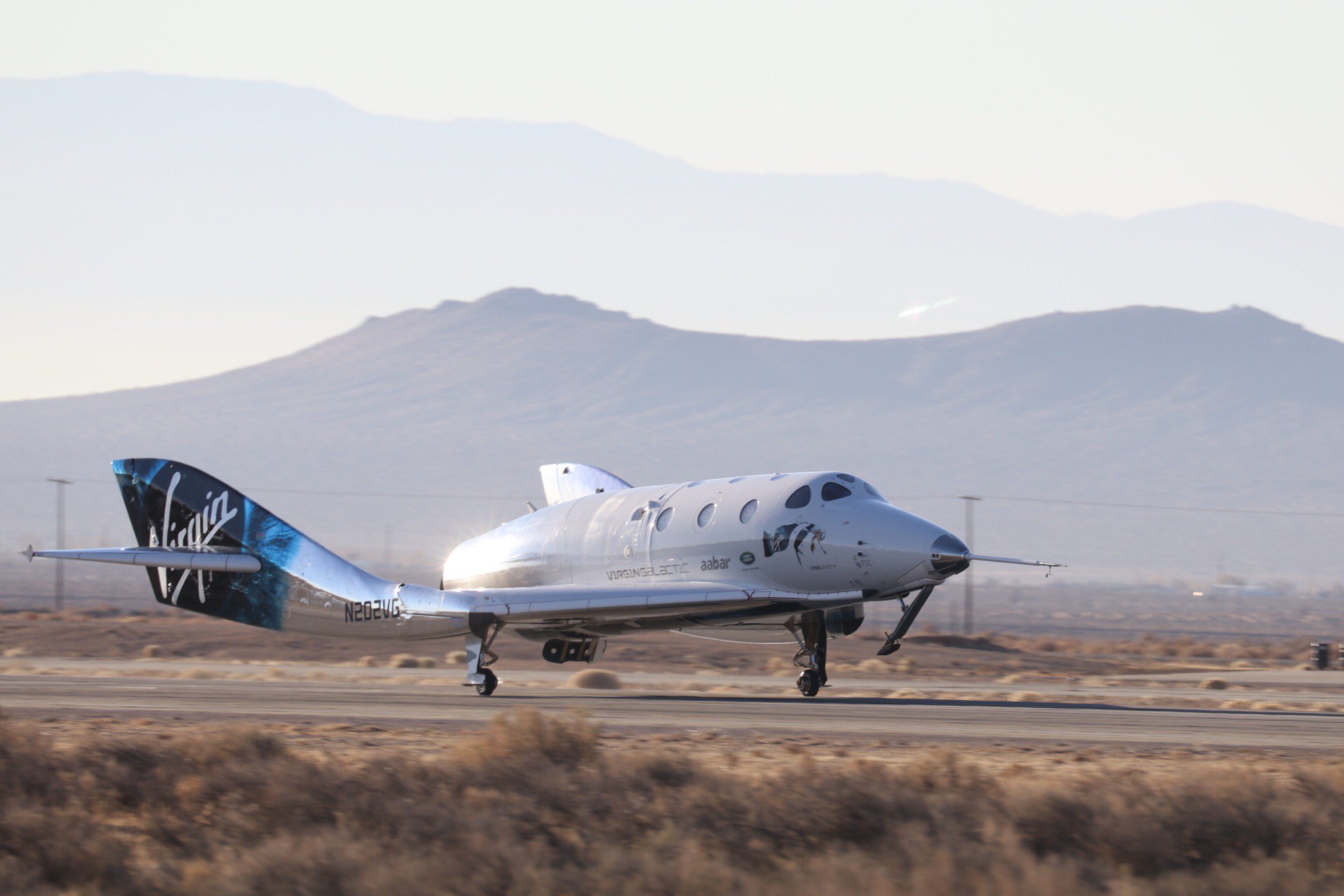
“That’s the great thing about an air launch system.” said Whitesides. “It’s the easiest part, in a way. Once all the other stuff is down there we’ll look deep into each other’s eyes, and say ‘are we ready?’ And then we put together the spaceship and go. It’s built to fly longer distances than that — so we’ll start the day with our base of operations in Mojave, and end the day with our base of operations in New Mexico.”

And a lovely base it will be. The spaceport, designed by Foster & Partners in the UK, is a striking shape that rises out of the desert and should have all the facilities necessary to run a commercial spaceline — it’s probably the only place in the world that would work for that purpose, which makes sense as it was built for it.

“Because we’re horizontal take-off and landing, operationally on the ground side, it basically looks like an airport. The coolest looking airport ever, but an airport,” Whitesides said. “It’s got a big beautiful runway — but you’ll notice that it’s got Earth to space comms links, this special antenna, and instead of a tower we have a mission control, and of course there’s the special ground tankage — oxidizer tanks and that kind of propulsion related infrastructure.”

The airspace surrounding the spaceport is also restricted all the way from the surface up to infinity, which helps when your flights span multiple air traffic levels. “And it’s already a mile up, so that’s an asset,” Whitesides observed. A mile closer to space — more a convenience than a necessity, but it’s a good start.

The actual moving operations should take place over the summer. The remaining test flights aren’t yet scheduled but I’m sure that will soon change — and you’ll definitely hear about it when the first commercial flights are put on the books.

Elon Musk’s “pedo guy” defamation case is going to trial

A defamation case filed last year against Tesla and SpaceX CEO Elon Musk after he repeatedly called a British cave diver “pedo guy” will go to trial on October 22, a U.S. district judge determined Friday.

Vernon Unsworth, the British cave diver, filed a defamation lawsuit in September 2018  in the U.S. District Court for the Central District of California after Musk called him a “pedo guy” and made other statements insinuating he was a pedophile in a public attack on Twitter.

U.S. District Judge Stephen V. Wilson denied a motion to dismiss the case and instead scheduled a date for trial. The decision means that Unsworth’s case is strong enough to go to trial.

Musk’s lawyers argued that statements on the internet, and more specifically on unmoderated forums like Twitter are presumptively opinion, not objective fact. Defamation law doesn’t apply to opinions or insults. But Wilson rejected Musk’s argument, in part because of an email interaction he had with Buzzfeed reporter and ex-TechCrunch journalist Drew Olanoff .

“Considering the totality of the circumstances—including the general context of Defendant’s statements, the specific context of the statements, and the statements’ susceptibility of being proved true or false—a reasonable factfinder could easily conclude that Defendant’s statements, as pleaded in the complaint, implied assertions of objective fact,” Wilson wrote in the decision.

The lawsuit alleges that between July 15 and August 30, Musk periodically used Twitter and emails to the media to publish false and defamatory accusations against Unsworth, including accusations of pedophilia and child rape.

The initial “pedo guy” attack came after Unsworth gave a critical interview to the media saying Musk’s mini sub “had absolutely no chance of working.” The diving expert ended an interview segment by suggesting Musk should “stick his submarine where it hurts.”

Musk lashed out on Twitter and insinuated that Unsworth was a pedophile. He later deleted the offending tweet and tried to backpedal — even offering an apology of sorts on Twitter. And it could have all ended there. But then Musk dug it all up again during a debate with Olanoff — once again on Twitter. Olanoff had brought up the “pedo guy” attack as an example of Musk telling untruths.


GitHub gets a package registry

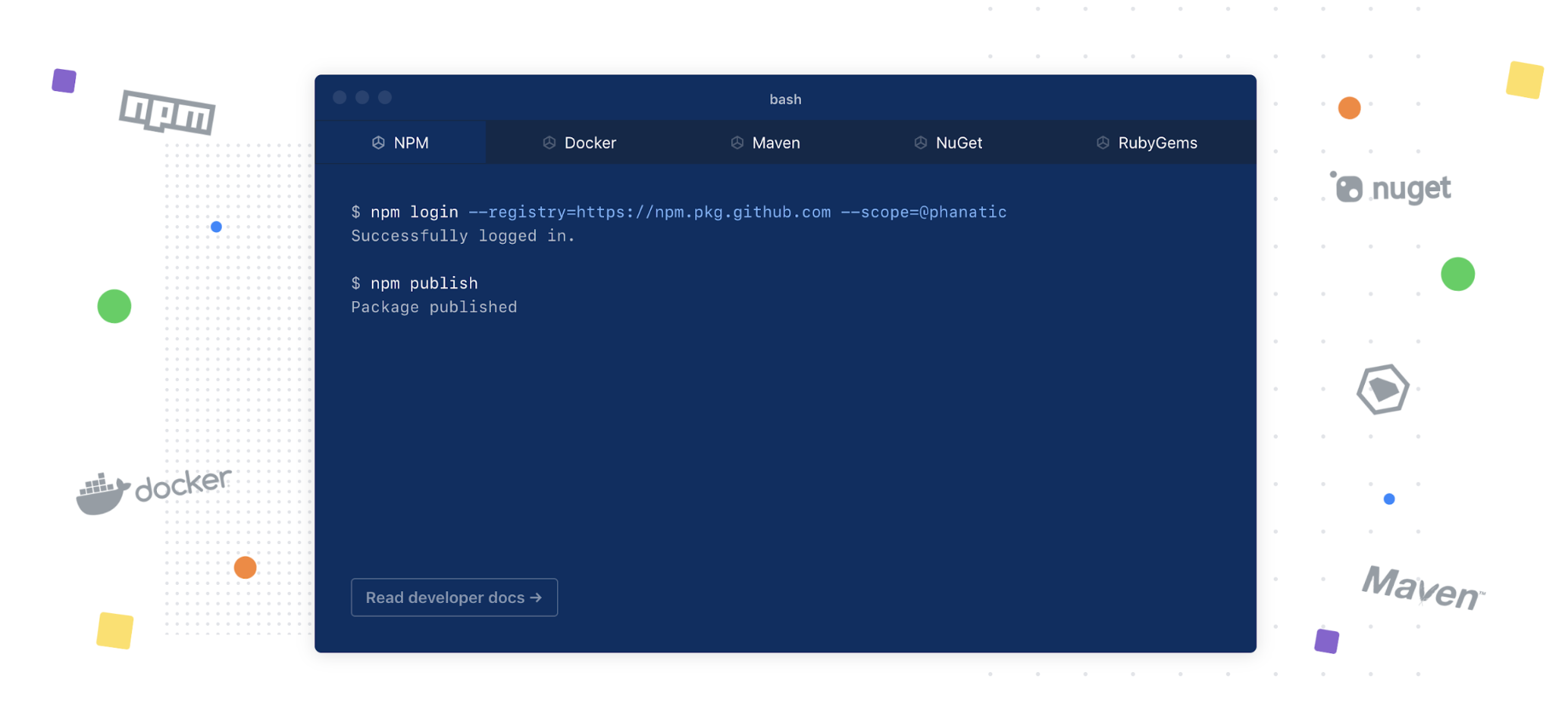
GitHub today announced the launch of a limited beta of the GitHub Package Registry, its new package management service that lets developers publish public and private packages next to their source code.

To be clear, GitHub isn’t launching a competitor to tools like npm or RubyGems. What the company is launching, however, is a service that is compatible with these tools and allows developers to find and publish their own packages, using the same GitHub interface they use for their code. The new service is currently compatible with JavaScript (npm), Java (Maven), Ruby (RubyGems), .NET (NuGet) and Docker images, with support for other languages and tools to come.

GitHub Package Registry is compatible with common package management clients, so you can publish packages with your choice of tools,” Simina Pasat, Director of Product Management at GitHub, explains in today’s announcement. “If your repository is more complex, you’ll be able to publish multiple packages of different types. And, with webhooks or with GitHub Actions, you can fully customize your publishing and post-publishing workflows.”

With this, businesses can then also provide their employees with a single set of credentials to manage both their code and packages — and this new feature makes it easy to create a set of approved packages, too. Users will also get download statistics and access to the entire history of the package on GitHub.

Most open-source packages already use GitHub to developer their code before they publish it to a public registry. GitHub argues that these developers can now also use the GitHub Package Registry to publish pre-release versions, for example.

Developers already often use GitHub to host their private repositories. After all, it makes sense to keep packages and code in the same place. What GitHub is doing here, to some degree, is formalize this practice and wrap a product around it.

Uber’s first day as a public company didn’t go so well

Ouch. Yikes. Oof. Sigh.

Those are some of the friendlier phrases I imagine came out of the mouths of bankers, investors, executives and really anyone who has been paying close attention to Uber’s road to the stock markets today when the company debuted on the New York Stock Exchange below its initial public offering price.

The ride-hailing business (NYSE: UBER), previously valued at $72 billion by venture capitalists, priced its stock at $45 apiece for a valuation of $82.4 billion on Thursday. It began trading this morning at $42 apiece only to close even lower at $41.57 or down 7.6 percent from its IPO price.

Still, the IPO was successful enough for Uber. The business now has $8.1 billion on its balance sheet to invest in growth and ideally, transform into a profitable business.

Anyone that expected Uber to climb past $100 billion at its IPO is surely disappointed. And those who projected a valuation of some $120 billion, well they’re probably feeling pretty dumb. Nonetheless, Uber’s new market cap makes its exit one of the most valuable in history and represents a landmark event for tech, mobility and the gig economy at large.

Where the stock will go from here, who knows. Lyft, as we’ve observed, has taken quite a hit since it completed an IPO in March. The Uber competitor is currently trading at a higher price than Uber: $51 per share with a market cap of about $14.6 billion. Its stock has fallen all week long, however, after the company posted losses of more than $1 billion in the first quarter of 2019.

Tinder is preparing to launch a lightweight version of its dating app called ‘Tinder Lite’

Tinder is preparing to launch a version of its popular dating app aimed at users in emerging markets. The app, which will be called “Tinder Lite,” offers a smaller, more lightweight version of the current flagship app, the company says. Smaller app size is a defining characteristic of most of today’s “Lite” apps, which are specifically focused on addressing the unique needs of users in areas where data usage, bandwidth, and storage space is a concern.

Most major tech companies now offer “Lite” apps for the large and rapidly growing online user base coming from these emerging markets — and specifically India, as of late.

For example, Google has a full suite of lightweight “Go”-branded apps like Google Go, Gmail Go, Files Go, YouTube Go, Google Maps Go, and Google Assistant Go. There’s also Facebook Lite, Instagram Lite, Messenger Lite, Twitter Lite, Uber Lite, Spotify Lite, and even TikTok Lite, to name a few others.

Tinder, apparently, believes it too has reached the point of needing a Lite version, given the dating app’s traction and growth. While the company doesn’t share the size of its total user base, the Tinder app averaged 4.7 million paid subscribers in Q1, up by 1.3 million from the same time last year, parent company Match Group said this week when announcing its Q1 2019 earnings. In addition, the BBC estimated in 2017 that Tinder had around 57 million total monthly active users.

Match Group this week announced its plans for Tinder Lite for the first time during an earnings call with investors.

The company didn’t share an exact launch date for Tinder Lite, but according to Match Group CEO Mandy Ginsberg, the app is “coming soon.”

Ginsberg was speaking about the promise of Southeast Asia in particular when she mentioned Tinder Lite. She had noted that internet penetration had grown by nearly 15 percent in the region over the past five years, which made it a key area to target.

“This area has more than a dozen high-density cities with over a million people, and more young people are moving to large cities. These are really important factors that make the need for our app high,” she explained. “…We are excited about the Tinder Lite app that will be coming soon. It’s a big step forward addressing the needs of consumers there. Tinder Lite will be a smaller app to download. It will take less space on your phone, making Tinder more effective, even in more remote areas or regions. And keep in mind, these are regions where data usage still comes at a premium.” Ginsberg said.

Tinder already has a presence in in the key Indian market, and its parent company Match Group recently restructured its Asia-Pacific team with the aim of further growing its dating app brands, including Tinder, in the region.

Tinder Lite, like some of other “Lite”-branded apps from tech companies, may remove some of Tinder’s heavier features to focus on the core experience of swiping and matches. But the company hasn’t said what will or will not be included in the slimmed-down version.

“As a result of our continued investment and growth in this region, we expect that APAC will make up one-fourth of our company’s total revenue by 2023,” Ginsberg added.

Uber’s trading debut: who was (and wasn’t) at the opening bell

Uber finally made its debut Friday on the New York Stock Exchange, ending its decade-long journey from startup to publicly traded company.

So far, it’s been a ho-hum beginning with shares opening at $42, down from the IPO price. The share price is hovering just under $44.

Thirteen people, including executives, early employees, drivers and customers, were on the balcony for the historic bell ringing that opened the markets Friday. Noticeable absentees were co-founder Garrett Camp and former CEO and co-founder Travis Kalanick, who was ousted in June 2017 from the company after a string of scandals around Uber’s business practices.

Kalanick, who still sits on the board and has 8.6% stake in Uber, wasn’t part of opening bell ceremony. Kalanick and Camp were both at the NYSE for the event.

Here is who participated in the opening bell ceremony.

The bell ringer

Austin Geidt, who rang the bell, was employee number four when she started as an intern in 2010. is one of Uber’s earliest employees.

Geidt joined Uber in 2010 and has since worked in numerous positions at the company. She led Uber’s expansion in hundreds of new cities and dozens of new countries. Geidt now heads up strategy for Uber’s Advanced Technologies Group, the unit working on autonomous vehicles.

Executives

CEO Dara Khosrowshahi stood next Geidt at the opening of the market Friday. Khosrowshahi joined Uber in 2017 after Kalanick resigned and the board launched an extensive search for an executive who could change the culture at the company and prepare it for an eventual IPO.

Khosrowshahi was the CEO of Expedia, before joining Uber. Khosrowshahi gave a one-year update on his time at Uber during TechCrunch Disrupt in September 2018.

Uber CTO Thuan Pham has been with the company since 2013. Prior to coming to Uber, Pham was vice president of engineering at VMWare.

Rachel Holt, vice president and head of New Mobility, was also on hand. Holt has worked at Uber since October 2011, when the company was live in just three cities. In May 2016, she became VP and regional general manager of Uber’s operations in the U.S. and Canada.

She was promoted to head up new mobility in June 2018. She’s responsible for the ramp-up and onboarding of additional mobility services, including public transit integration, scooters, car rentals and bikes.

Rachel Holt. Getty Images 

Other executives included Pierre-Dmitry Gore-Coty and Andrew MacDonald, both vice presidents and regional general managers at Uber as well as Jason Droege, a vice president who heads up Uber Eats.

Droege, who joined Uber in 2014, has the official title of head of UberEverything. This is the team that created the food delivery service Uber Eats, which now operates in 35 countries.

Drivers

Uber had five drivers on hand for the opening bell, who represented different services and geographies.

Among the drivers were:

  • Jerry Bruner, a Los Angeles-based driver who is a military veteran and former professional golfer. Bruner has completed more than 30,000 Uber trips.
  • Tiffany Hanna, a military veteran, is based out of Springfield, Missouri. Hanna is truck driver who uses the Uber Freight carrier app. 
  • Jonelle Bain, a New York-based driver. Uber, which shared the bios of the drivers, said Bain is taking coding classes and plans to become a software engineer.
  • Onur Kerey is a driver based out of London. Kerey is deaf. According to his bio, “he doesn’t let his disability get in the way of his passion for driving or connecting with others.”
  • J. Alexander Palacio Sanchez is based in Australia and has been driving with Uber since 2015. His true passion is acting, according to Uber, and at the urging of his riders, he auditioned for the role of Kevin in The Heightsand landed it.

Customers

One customer, Elise Wu, also participated in the opening bell. Wu owns Kampai, a family of restaurants in France that serves affordable cuisine made available for delivery through Uber Eats.

Blue Moon Brewing is capitalizing on Bezos’ news with a lunar lander keg

Every so often, a big corporation manages to play the news cycle just right. Generally such things aren’t recommended and can fairly easily backfire, but the MillerCoors-owned Blue Moon Brewery would have been silly not to have capitalized on yesterday’s big announcement from Jeff Bezos’s Blue Origin.

The company fired off a silly tweet yesterday and is doubling down with the announcement of a limited edition keg “inspired” by the newly announced Blue Moon lunar lander. It’s set for a release in July, to coincide with the 50th anniversary of the Apollo 11 moon landing.

As for what it will look like — the above is clearly just a mockup. One assumes Bezos and co. will have to play along if the thing is going to look like Blue Origin’s model, with a couple of taps up top. Pricing, available and all that good stuff will be arriving closer to its July 20 launch. The real thing, meanwhile, isn’t set to arrive until 2024, coinciding with Vice President Mike Pence’s stated goals for a U.S. return to the lunar surface.

In the meantime, you can watch the full unveiling here: