Twitter publishes latest government data request figures

Twitter’s latest transparency report is out.

The social media giant said it received six percent fewer requests for user data from governments between June and December 2018 than during its previous reporting period.

According to the newly released data, Twitter received 6,904 government requests for information on 11,112 accounts — the exact number of requests as its most recent report but with fewer accounts affected. The company turned over some data in just over half of all cases.

The U.S. filed the most requests — a total of 2,092 requests for data on 3,860 accounts, representing about one-third of all global requests.

Twitter also had 30 requests for data on 108 Periscope video-streaming accounts, disclosing some information in 40 percent of cases.

The company said it had received permission to disclose two national security letters (NSLs), which are subpoenas issued by the FBI with no judicial oversight that often come with a gag order. Although the company didn’t publish the letters as it has done previously, the two affected users have been informed.

Twitter also said it suspended 166,513 accounts associated with the promotion of terrorism, down 19 percent on the previous reporting period, and suspended 458,989 accounts for violating its rules relating to child sexual exploitation.

Saas Management startup Intello scores $2.5 million extended seed

Intello, the New York City-based Saas management platform, announced a $2.5 million extended seed round today, along with some product enhancements.

The round was led by Resolute Ventures . Harrison Metal and Magnetico Ventures also participated along with various individual angel investors including Zane Lackey from Signal Sciences, Chris Smoak from Atrium and Zach Sherman from Timber. Today’s investment brings the total raised to $4 million, according the company.

Mike Hirshland, a partner at lead investor Resolute Ventures, saw Intello helping customers deal with a serious and growing issue inside companies. “They are solving the pain of SaaS sprawl that every organization is facing by empowering modern IT, finance and security teams with better visibility,” he said in a statement.

When everyone can sign up for these services for free or with a credit card outside the purview of IT, this can lead to potential issues around security and compliance. Since last year’s $1.3 million seed round, the startup has expanded beyond simply understanding what SaaS products a company has to include a compliance component, says Barak Kaufman, co-founder and CEO at Intello.

“We are really focused on what we view as end-to-end SaaS management, which includes spend optimization and mapping out unused products and licenses. We are still still doing that, but as we are selling primarily to IT, and sometimes InfoSec directors, the product has evolved passed that to working on compliance,” Kaufman explained.

To help with that, Intello has updated the product to map redundant applications along with the ability to change, add or remove licenses for third-party applications. This gives IT more control over unsanctioned applications including removing them from the system or limiting access to them if that is the goal.

The product is also now integrated with popular single sign on tools, Okta and Onelogin, to help companies map the usage of all the SaaS tools being used, whether free or paid, through their SSO tools.

The company offers more than two dozen integrations out of the box so far including popular SaaS tools like Salesforce, Box, Zendesk, Google, Slack and Office 365. It plans to build dozens more and with a goal of having 100 by the end of this year.

Intello currently has 12 employees and 900 companies using the free and paid versions of the solution. Customers include InVision, Sprinklr and Instacart.

Singapore passes controversial ‘fake news’ law which critics fear will stifle free speech

Singapore has passed a controversial bill that could equip the government with extensive powers to police online media and free speech.

The bill was first drafted last month and, as had been expected, it passed 72-9 in Singapore’s parliament, dominated by the ruling People’s Action Party (PAP) party, late on Wednesday.

As we reported last month, the bill caused concern through its potential to stifle free speech since a key feature enables the government, and in factor any minister, to force “corrections” to be added to online content that is deemed to be “false.”

Beyond media, the flex also extends to social media. According to the law, those found to be “malicious actors” face a fine of up to SG$50,000 ($37,000) or five years in prison for their content. If posted using “an inauthentic online account or a bot,” the fine jumps to a maximum of SG$100,000 ($74,000) or a potential 10-year jail term. Platforms like Facebook and Twitter face fines of up to SG$1 million ($740,000) for their role in such situations.

Designed to cover “a false statement of fact… has been or is being communicated in Singapore” or cases where politicians believe that issuing a correction is “in the public interest,” the bill also claims reach overseas — or, rather, intended reach overseas. Politicians can trigger it in situations judged to be “in the interest of friendly relations of Singapore with other countries.”

It remains to be seen how much success the Singapore government will have with its efforts. Domestic media may well be under control — the World Press Freedom Index ranks Singapore 151 out of 183 countries and self-censorship is common — but influencing newsrooms based overseas and social networks will likely prove difficult.

Facebook, for example, last November resisted calls to remove content flagged as defamatory by the government. That clearly frustrated officials.

“This shows why we need legislation to protect us from deliberate online falsehoods,” the Ministry of Law wrote in an announcement at the time.

How a takedown would work — and how the government might access encrypted chats on apps like WhatsApp and Telegram, which are also part of its focus — also remains unclear at this point.

The law has been criticized by free speech groups.

“Singapore’s new ‘fake news’ law is a disaster for online expression by ordinary Singaporeans, and a hammer blow against the independence of many online news portals they rely on to get real news about their country beyond the ruling People’s Action Party political filter,” Human Rights Watch deputy Asia director Phil Robertson wrote on Twitter.

“Singapore’s leaders have crafted a law that will have a chilling effect on internet freedom throughout Southeast Asia, and likely start a new set of information wars as they try to impose their narrow version of “truth” on the wider world,” he added.

Human Rights Watch — which came out with strong criticism of the bill last month — was criticized by the Singapore government last month which hit back at “its long-standing practice of issuing biased and one-sided statements about Singapore.”

Meanwhile, on the more assistive end of the dissenting voices, the Asia Internet Coalition — a group that represents Facebook, Google, Twitter, LinkedIn, Line and others — penned an editorial in Singapore’s Straits Times newspaper suggesting changes to the bill.

The opinion piece — which, irony alert, is restricted by a paywall — recommended specific processes, an imperial body to vet decisions, exemptions for opinion articles, satire and more, as well as a request for “clear and well-defined language and scope.”

Robertson is concerned that other counties in Southeast Asia will take the ball Singapore has punted and run with it, thereby creating other restrictive online content policies. That’s already happened to some extent. In Vietnam, a draconian cybersecurity law went into operation on January 1 while Thailand passed a controversial law granting a wide scope of powers to authorities in February.

Mint House raises $15m to give business travelers a better hotel

Hotels are convenient but rarely homey. Short term rentals through Airbnb or HomeAway are often comfy but can be a pain to book and check-in. Business travelers often have to pick the best of two lousy options. Mint House is summed up best by Tige Savage, Revolution Venture managing partner: “Mint House is the best of a hotel without the worst of a hotel and the best of an Airbnb without the worst of an Airbnb.”

The New York-based Mint House is today announcing a $15 million financing round led by Revolution Ventures with participation from other investors and hotel industry veterans. The influx of capital and industry connections should go a long way in allowing the company to expand its offering that caters to business travelers looking for apartment-style accommodations with the predictability and reliability found in top-tier hotels.

Mint House is entering a crowded market dominated by Airbnb and monstrous industry incumbents. Mint House founder and CEO, Will Lucas, explained to TechCrunch how the company stands apart from hotels and short-term rentals. He said the company strives to provide the business traveler with a comprehensive hotel experience.

The service works a lot like a modern hotel. Travelers book online and proceed with their trip. Once the traveler arrives in the area or lands at the airport, a geofence is tripped, triggering directions to enter the building and room. The traveler doesn’t have to find someone to give them the key; their phone unlocks the door to an apartment-style room. Lucas says this takes a lot of stress off the property owner as the traveler does not need to bother anyone in the building — tenets or management alike.

Right now Mint House is focusing on markets in the US besides the top markets of New York City, San Francisco, and Los Angeles. Mint House is available in Indianapolis, Denver, Nashville, Miami, and Detroit. Lucas said he feels there are opportunities in these markets and often there are even worse accommodations available than in the busiest cities. Still, the total offering is relatively small: there are 200 rooms in operation, and 200 are scheduled to open by summer 2019. Travelers can book a Mint House through their app, website, or on travel sites like Expedia, Booking.com or Airbnb.

Mint House leases buildings from property owners, and Lucas was adamant that it’s the company’s goal to be a preferred partner with the real estate industry. He says that so far properties are receptive to Mint House’s business plan, and to be a global brand, the real estate community company needs welcome Mint House. Each property, even though some might be residential or mixed-use, have a dedicated staff of cleaners and management employed by Mint House. Likewise, each city Mint House operates in has a dedicated staff in-market overseeing the local operation.
“We understand that we have two customers – the multifamily developers and the business traveler – and by prioritizing both we’ve been able to secure A+ properties and deliver a top-rated guest experience,” Lucas said.” We have also formed a team of investors and advisors that are perfectly suited to help us differentiate ourselves in this lucrative market. With expertise and relationships in growing cities, as well as how to build world-renowned hospitality brands and services, we are confident that we can continue to build and expand alongside landlords and hospitality partners.”
Each market offers different regulations that Mint House has to follow. Lucas says the company supports whatever regulation they need to follow. It’s clear he’s trying to keeping Mint House on the right side of regulation. And he has help. Mint House has attracted the attention of several industry veterans that know how to grow a hospitality company.

Several notable hospitality veterans also participated in the financing round including Tom Mangas, the former CEO of Starwood Hotels, Carl Sparks, the former CEO of Travelocity, Kerry Hatch, the former president of St. Regis Hotels, and Rob Stewart, the Executive Vice Chairman of JBG Smith. Philippe Bourguignon, Vice Chairman of Revolution Places, former CEO of Club Med and Euro Disney and former president of Accor Hotels, Asia Pacific will join the board.

The deep network of industry insiders should help Mint House carve out a space of their own in the competitive hospitality world. It’s a tough market. Mint House has to get buy-in from business travelers and property owners alike. It’s a two-front battle. But as a frequent traveler myself, Mint House’s value proposition is compelling. I don’t need a hotel lobby or lackluster gym; I want a bed, couch and a TV without the terrible hotel menu system.

Factmata gets backed by eyeo, maker of Adblock Plus, and takes over its Trusted News app

“Fake news” — news content that either misleads people with half-truths, or outright lies — has become a permanent fixture of the internet. Now, as tech and media platforms continue to search for the best way to fight it, Factmata — a London startup backed by Biz Stone, Craig Newmark, Mark Cuban, Mark Pincus, and more to build a platform to detect when false information is shared online — is announcing a new investor and partnership that will see it expanding its scope.

The company is picking up an investment from eyeo, the company behind Adblock Plus, and as part of it, Factmata is taking on the running of Trusted News, the Chrome extension that eyeo launched last year to give a nudge to those browsing content on the web to indicate whether a story is legit or shit.

Dhruv Ghulati, the CEO of Factmata — who co-founded the company with Sebastian Riedel, and Andreas Vlachos (Riedel’s other fake-news-fighting startup, Bloomsbury AI, was acquired by Facebook last year) — said that the financial terms of the deal were not being disclosed. He added that “eyeo invested both cash and the asset” and that “it’s a significant amount that strategically helps us accelerate development.” He points out that Factmata has yet to raise money from any VCs.

Trusted News today — an example of how it looks is in the screenshot above — has “tens of thousands” of users, Ghulati said, and the aim will be to continue developing and taking those numbers to the next level, hundreds of thousands of users by changing up the product. The plan will be to build extensions for other browsers — “You can imagine a number of platforms across browsers (eg Brave) search engines (eg Mozilla), hosting companies (eg Cloudflare) could be interested but we haven’t engaged in discussions yet,” he said — as well as to expand what Trusted News itself provides.

“The goal… is to make it a lot more interactive where users can get involved in the process of rating articles,” he said. “We found that young people especially surprisingly really want to get involved in debating how an article is written with others and engaging in rating systems, rather than just being handed a rating to trust.”

Ghulati said that eyeo’s decision to hand off running Trusted News to Factmata was a case of horses for courses.

“They are giving it to us in return for a stake because we are the best placed and most focused natural language understanding company to make use of it, and progress it forward fast,” he said. “For Factmata, we partner with a company that has proven ability to generate large, engaged community growth.”

“Just as eyeo and Adblock Plus are protecting users from harmful, annoying ads, the partnership between Factmata and Trusted News gets us one step closer to a safer, more transparent internet. Content that is harmful gets flagged automatically, giving users more control over what kind of content they trust and want to read,” said Till Faida, CEO & Co-Founder, eyeo, in a statement.

Factmata has already started thinking about how it can put some of its own technology into the product, for example by adding in the eight detection algorithms that it has built (detailed in the screenshot above that include clickbait, hate speech, racism, etc.). Ghulati added that it will be swapping out the way that Trusted News looks up information. Up to now, it’s been using a tool from MetaCert to power the app, a database of information that’s used to provide a steer on bias.

“We will replace MetaCert and make the system work at the content level rather than a list lookup, using machine learning,” he said, also noting that Factmata plans to add other signals “beyond just if the content is politically hyperpartisan or hate speech, and more things like if it is opinionated, one-sided, and or could be deemed controversial. “We won’t deploy anything into the app until it reaches 90% accuracy,” Ghulati said. “Hopefully from there, humans get it more accurate, per a public testing set we will make available for all signals.”

Ghulati himself is a machine learning specialist and while we haven’t heard a lot from Factmata in the last year, part of that is likely because building a platform from scratch to detect a problem that seems to have endless tentacles (like the web itself) can be a challenge (just as Facebook, which is heavily resourced and still seems to let things slip through).

He said that the eight algorithms it’s built “work well” — which more specifically he said are rating at more than 90 percent accuracy on Factmata’s evaluation sets on US English language news articles. It’s been meanwhile refining the algorithms on short form content using YouTube video transcripts, Tweets, Blog posts, and a move into adding more languages, starting with French.

“The results are promising on the expanded types of content because we have been developing proprietary techniques to allow the models to generalise across domains,” he said.

Factmata has also been working with ad exchanges — as we noted back when Factmata first raised $1 million, this was one of the big frontiers it wanted to tackle, since ad networks are so often used to disseminate false information. It’s now completed case studies with 14 major ad exchanges, SSPs and DSPs and found that up to 4.92 percent of a sample of pages served in some ad exchanges contain high levels of hate speech or hyperpartisan language, “despite them thinking they were clean and them using a number of sophisticated tools with bigger teams than us.”

“This for us showed us there is a lot of this type of language out there that is being inadvertently funded by brands,” he noted.

It’s also been gathering more training data to help classify content, working with people who are “experts in the fields of hate speech or journalistic bias.” He said that Factmata has “proven our hypothesis of using ‘expert driven AI’ makes sense for classifying things that are inherently subjective.” But that is in conjunction with humans: using experts leads to inter-annotator agreement rates above 68 percent, whereas using non experts the agreement of what is or is not a claim or what is or is not bias is lower than 50 percent.

“The eyeo deal along with other commercial partnerships we’re working on are a sign: though the system is not 100 percent accurate yet, within a year of building and testing our tech is ready to start commercialisation,” Ghulati added.

Cybersecurity insurance startup Coalition raises $40M in Series B funding

Coalition, a cybersecurity insurance company, has raised $40 million in its latest round of funding.

Fintech investment giant Ribbit Capital led the investment with participation from Greenoaks Capital and Hillhouse Capital.

Coalition’s insurance covers expenses incurred from liabilities related to third-parties, such as fines and penalties — as well as fraud, breach response, extortion and ransomware recovery, and device replacement, and more. The company also aims to give U.S.-based customers an at-a-glance look at their cybersecurity posture — from alerts, threat intelligence, and advice on what to improve, such as vulnerability fixing.

With its Series B, the company said it’s planning to expand its data analytics platform used to assess a company’s security posture. The funding will also expand its engineering and incident response team.

Coalition, which declined to state its valuation, previously raised $10 million in February 2018.

Cybersecurity insurance remains a fickle area. Amid an ongoing threat of breaches and data exposures, having an insurance policy in place to get a company back on its feet is smart. But many companies previously believed to be covered by cybersecurity insurance are not. When shipping giant Maersk was knocked offline by ransomware during the NotPetya attack incurring more than $300 million in damages, its insurer Zurich declared the Russian-backed attack was an act of war and didn’t pay out.

Even when companies do pay out, it’s not a silver bullet.

Coalition’s proactive security efforts to try to prevent data breaches — and subsequent costs — is one way to save paying up. Will that scale up to another global cyberattack? Let’s hope we never find out.

Alexa, does the Echo Dot Kids protect children’s privacy?

A coalition of child protection and privacy groups has filed a complaint with the Federal Trade Commission (FTC) urging it to investigate a kid-focused edition of Amazon’s Echo smart speaker.

The complaint against Amazon Echo Dot Kids, which has been lodged with the FTC by groups including the Campaign for a Commercial-Free Childhood, the Center for Digital Democracy and the Consumer Federation of America, argues that the ecommerce giant is violating the Children’s Online Privacy Protection Act (Coppa) — including by failing to obtain proper consents for the use of kids’ data.

As with its other smart speaker Echo devices the Echo Dot Kids continually listens for a wake word and then responds to voice commands by recording and processing users’ speech. The difference with this Echo is it’s intended for children to use — which makes it subject to US privacy regulation intended to protect kids from commercial exploitation online.

The complaint, which can be read in full via the group’s complaint website, argues that Amazon fails to provide adequate information to parents about what personal data will be collected from their children when they use the Echo Dot Kids; how their information will be used; and which third parties it will be shared with — meaning parents do not have enough information to make an informed decision about whether to give consent for their child’s data to be processed.

They also accuse Amazon of providing at best “unclear and confusing” information per its obligation under Coppa to also provide notice to parents to obtain consent for children’s information to be collected by third parties via the online service — such as those providing Alexa “skills” (aka apps the AI can interact with to expand its utility).

A number of other concerns are also being raised about Amazon’s device with the FTC.

Amazon released the Echo Dot Kids a year ago — and, as we noted at the time, it’s essentially a brightly bumpered iteration of the company’s standard Echo Dot hardware.

There are differences in the software, though. In parallel Amazon updated its Alexa smart assistant — adding parental controls, aka its FreeTime software, to the child-focused smart speaker.

Amazon said the free version of FreeTime that comes bundled with the Echo Dot Kids provides parents with controls to manage their kids’ use of the product, including device time limits; parental controls over skills and services; and the ability to view kids’ activity via a parental dashboard in the app. The software also removes the ability for Alexa to be used to make phone calls outside the home (while keeping an intercom functionality).

A paid premium tier of FreeTime (called FreeTime Unlimited) also bundles additional kid-friendly content, including Audible books, ad-free radio stations from iHeartRadio Family, and premium skills and stories from the likes of Disney, National Geographic and Nickelodeon .

At the time it announced the Echo Dot Kids, Amazon said it had tweaked its voice assistant to support kid-focused interactions — saying it had trained the AI to understand children’s questions and speech patterns, and incorporated new answers targeted specifically at kids (such as jokes).

But while the company was ploughing resource into adding a parental control layer to Echo and making Alexa’s speech recognition kid-friendly, the Coppa complaint argues it failed to pay enough attention to the data protection and privacy obligations that apply to products targeted at children — as the Echo Dot Kids clearly is.

Or, to put it another way, Amazon offers parents some controls over how their children can interact with the product — but not enough controls over how Amazon (and others) can interact with their children’s data via the same always-on microphone.

More specifically, the group argues that Amazon is failing to meet its obligation as the operator of a child-directed service to provide notice and obtain consent for third parties operating on the Alexa platform to use children’s data — noting that its Children’s Privacy Disclosure policy states it does not apply to third party services and skills.

Instead the complaint says Amazon tells parents they should review the skill’s policies concerning data collection and use. “Our investigation found that only about 15% of kid skills provide a link to a privacy policy. Thus, Amazon’s notice to parents regarding data collection by third parties appears designed to discourage parental engagement and avoid Amazon’s responsibilities under Coppa,” the group writes in a summary of their complaint.

They are also objecting to how Amazon is obtaining parental consent — arguing its system for doing so is inadequate because it’s merely asking that a credit or debit/debit gift card number be inputted.

“It does not verify that the person “consenting” is the child’s parent as required by Coppa,” they argue. “Nor does Amazon verify that the person consenting is even an adult because it allows the use of debit gift cards and does not require a financial transaction for verification.”

Another objection is that Amazon is retaining audio recordings of children’s voices far longer than necessary — keeping them indefinitely unless a parent actively goes in and deletes the recordings, despite Coppa requiring that children’s data be held for no longer than is reasonably necessary.

They found that additional data (such as transcripts of audio recordings) was also still retained even after audio recordings had been deleted. A parent must contact Amazon customer service to explicitly request deletion of their child’s entire profile to remove that data residue — meaning that to delete all recorded kids’ data a parent has to nix their access to parental controls and their kids’ access to content provided via FreeTime — so the complaint argues that Amazon’s process for parents to delete children’s information is “unduly burdensome” too.

Their investigation also found the company’s process for letting parents review children’s information to be similarly arduous, with no ability for parents to search the collected data — meaning they have to listen/read every recording of their child to understand what has been stored.

They further highlights that children’s Echo Dot Kids’ audio recordings can of course include sensitive personal details — such as if a child uses Alexa’s ‘remember’ feature to ask the AI to remember personal data such as their address and contact details or personal health information like a food allergy.

The group’s complaint also flags the risk of other children having their data collected and processed by Amazon without their parents consent — such as when a child has a friend or family member visiting on a playdate and they end up playing with the Echo together.

Responding to the complaint, Amazon has denied it is in breach of Coppa. In a statement a company spokesperson said: “FreeTime on Alexa and Echo Dot Kids Edition are compliant with the Children’s Online Privacy Protection Act (COPPA). Customers can find more information on Alexa and overall privacy practices here: https://www.amazon.com/alexa/voice [amazon.com].”

An Amazon spokesperson also told us it only allows kid skills to collect personal information from children outside of FreeTime Unlimited (i.e. the paid tier) — and then only if the skill has a privacy policy and the developer separately obtains verified consent from the parent, adding that most kid skills do not have a privacy policy because they do not collect any personal information.

At the time of writing the FTC had not responded to a request for comment on the complaint.

Over in Europe, there has been growing concern over the use of children’s data by online services. A report by England’s children’s commissioner late last year warned kids are being “datafied”, and suggested profiling at such an early age could lead to a data-disadvantaged generation.

Responding to rising concerns the UK privacy regulator launched a consultation on a draft Code of Practice for age appropriate design last month, asking for feedback on 16 proposed standards online services must meet to protect children’s privacy — including requiring that product makers put the best interests of the child at the fore, deliver transparent T&Cs, minimize data use and set high privacy defaults.

The UK government has also recently published a Whitepaper setting out a policy plan to regulate Internet content which has a heavy focus on child safety.

With new Fit technology, Nike calls itself a tech company

In 1927, Charles Brannock, the son of a local shoe company owner in Syracuse, N.Y., invented the Brannock Device. The steel measurement tool with five scales has been the most effective way in the U.S. to find an accurate shoe size.

Industry-wide, 60% of consumers are wearing the wrong-sized shoes. Not only is there a discrepancy among different styles of shoes (high heels to leather boots), sizing can often differ from brand to brand within one type of shoe (like adidas sneakers to Nike sneakers) and even silhouette to silhouette within a singular brand.

For instance, I’ve owned Nike React Epic sneakers with Flyknit technology in a women’s size 10. I have men’s suede Nike Air Max 95s in a 9.5. All of my men’s Air Jordan 1s are comfortably a men’s size 8.5, but I have a women’s pair in an 11, and my Air Jordan 4s are an 8. Meanwhile, my Nike Air Max 720s feel decidedly too small at a men’s 8.5. And this is all within one brand.

During the 92 years since its introduction, the birth of the internet, and some other society-altering technological advances, the Brannock Device has somehow remained uncontested. Until now.

This summer, Nike will introduce Nike Fit, a foot-scanning solution designed to find every person’s best fit. Conceptually, Nike Fit falls somewhere between “why would we reinvent the wheel” and “we don’t even need that wheel.”

Nike Fit uses a proprietary combination of computer vision, data science, machine learning, artificial intelligence and recommendation algorithms to find your right fit. With sub two-millimeter accuracy through dozens of data points, measurements are fed into the machine learning model that accommodates every detail of every Nike silhouette down to the materials that were used, the lacing systems and other critical aspects of fit. This is then paired with AI capabilities to learn a wearer’s personal fit preference and how they relate to the population as a whole.

Users can either find their size with the augmented reality feature in the Nike app or, soon, visit participating stores to use the technology. I recently had the opportunity to do both.

Within the Nike app, I used my phone’s camera to capture an empty space where the floor meets the wall as a point of reference, with the app’s guidance ensuring a level plane. I stood with my heels against the wall I captured as my reference point and pointed the camera down at my feet as if to take a photo. Once my feet were properly aligned with the outline guide within the app, I simply touched the button that looks just like I’m taking a photo.
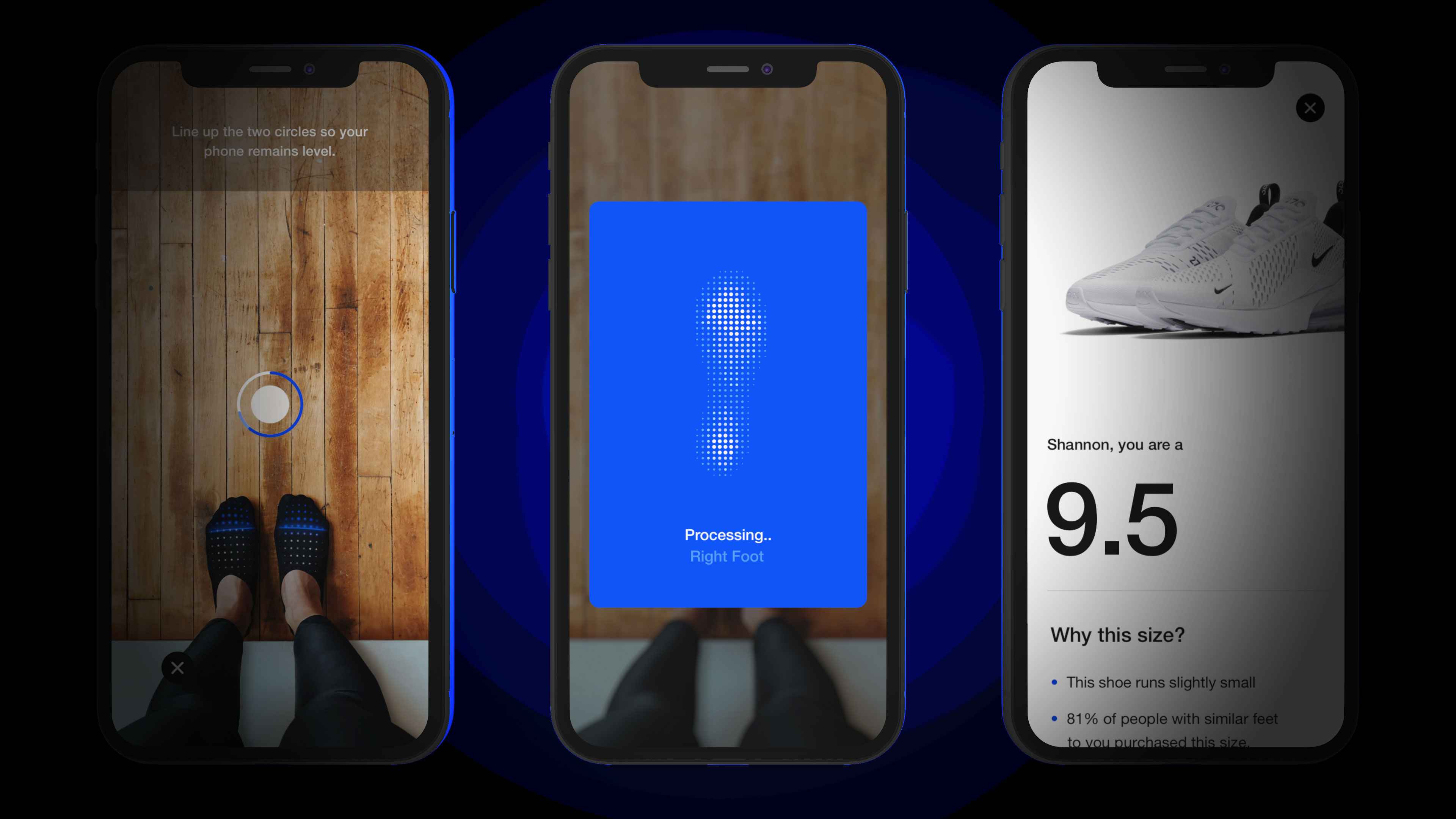
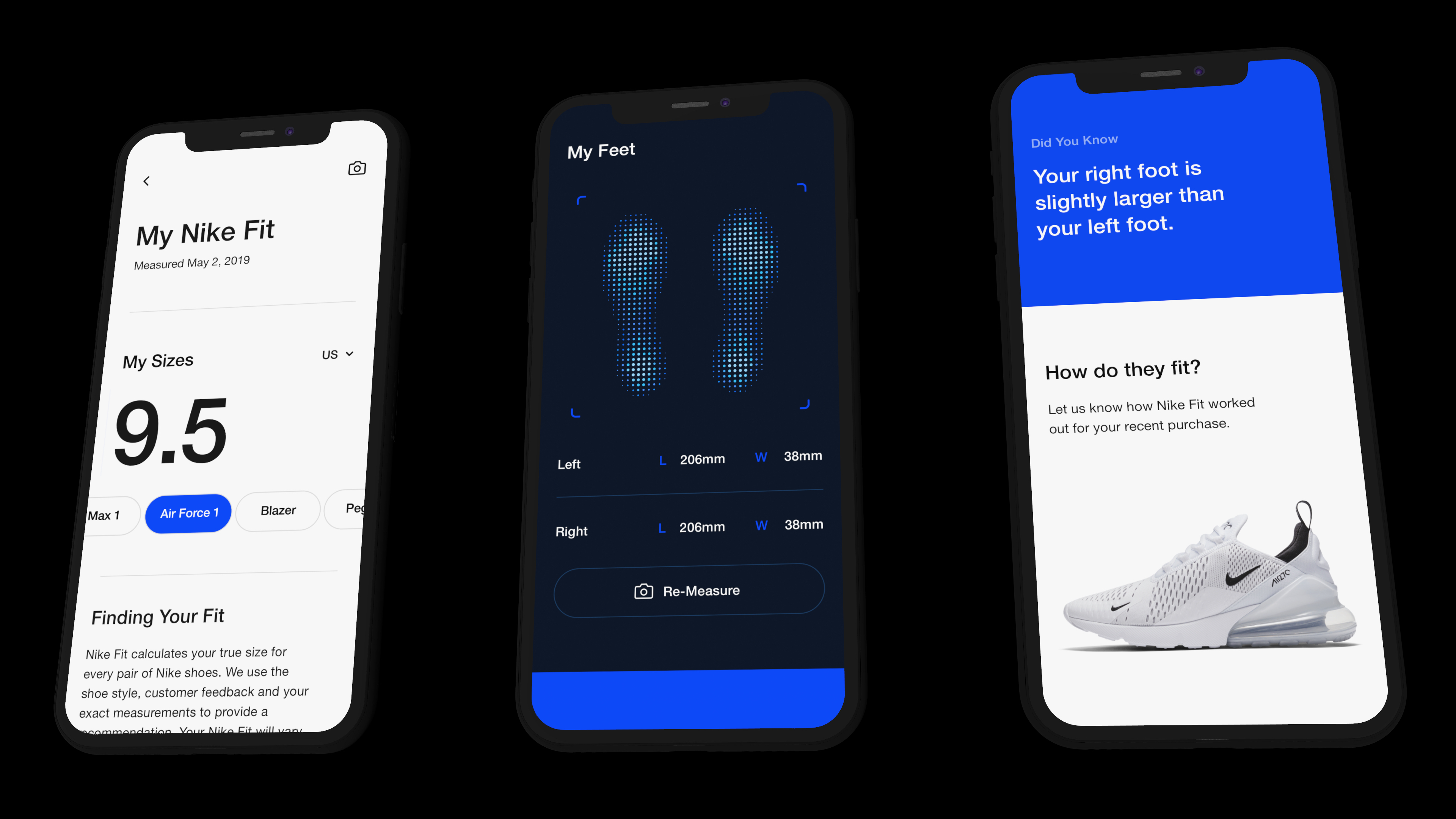
In seconds, this action scans the feet and collects 13 data points, the best of the 32 points Nike is capable of capturing. Despite all of the data being collected, users will only be offered the length and width measurements, down to the millimeter, of each foot individually.

“Augmented reality is a new type of experience for a lot of consumers and sets a lot of challenges for them,” says Josh Moore, Nike’s vice president of design and user experience. “We’ve been doing a lot of experiments and creating new features in our SNKRS app over the last few years where we really learned a lot about how to use augmented reality successfully. Specifically, we know we have to guide our users through the journey at their own pace so they can comprehend as they go.”

“We’re talking about phones with cameras measuring your feet,” Moore continues. “It’s a new type of experience where you’re using your device, the device’s camera, the 3D space around you, and you’re using your body. There’s no common UX pattern for this.”
The in-store experience differs in a few ways. It wasn’t enough to simply have great technology, it also had to reduce friction within the in-store buying process. The idea is to reduce the amount of time associates spend going back and forth grabbing sizes from the stock room in order to ensure time spent with customers is higher quality and more efficient.

At the Retail Lab on Nike’s campus, I stood on a mat while a Nike sales associate scanned my feet with a handheld iTouch device. With the measurements taken (my right foot is 1 millimeter longer than my left, while my left is 1 millimeter wider than my right), the associate can provide a range of sizes for me, which includes where my best fit could fall in any shoe in Nike’s catalog. Once they look up the shoe I’m interested in, the app will offer the best fit size for my measurements and that shoe. If it’s available, they’ll bring out that size, and if there is any disbelief, they’ll bring out the size you’d like to try, as well.
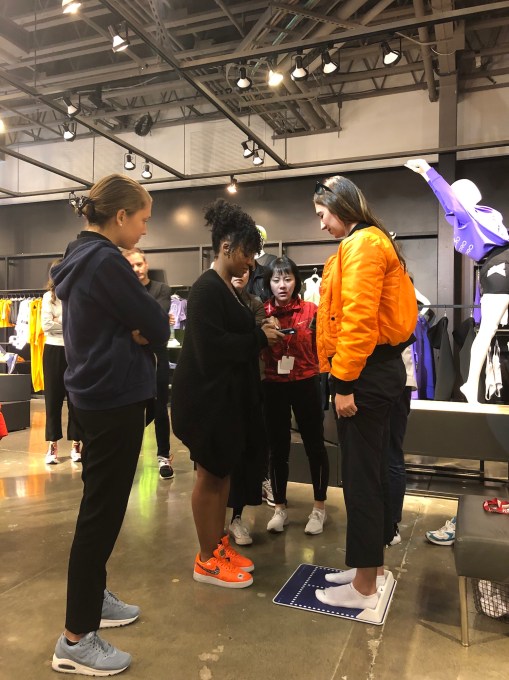
Trying the Nike Fit experience at the Retail Lab on Nike’s campus

Whether using the app to find the right fit and make a purchase or going into the store, associates and customers can record which size is purchased, as well as other personal preferences around fit.

“Before a shoe arrives onto the market, it will already be trained into the solution. But since the solution encompasses both machine learning and AI, its accuracy out of the gate is astonishing and just gets even better,” says Michael Martin, vice president of Nike direct products, growth and innovation.

With more data, Nike will not only have continual improvements of an individual’s fit preferences, it will also learn the greater population’s preferences around each specific model, offering insight on creating better-fitting shoes. 

In development for just over 12 months, Nike Fit was being tested in three stores — one each in Seattle, Dallas and Pasadena, Calif. — only six months after Nike acquired Israeli startup, Invertex, whose entire mission was to create scans of the human body for better fit customization.

“Fundamentally, at this stage, Nike is a technology company. It’s a technology company that builds upon its historical strengths in footwear design, storytelling and inspiration, and it’s able to use those in combination to solve problems that no one else can solve,” says Martin. “We think this is arguably our biggest solution to date.”

Despite being for footwear right now, the technology created for Nike Fit has the potential to change retail in a lot of ways. One can imagine women being able to use the tech to find the right bra size. It could also make buying denim easier. As individualism and inclusivity have become marketing tools, custom fit seems like a natural next step, but until now, there hasn’t been a clear-cut solution.

Nike Fit will be introduced in select stores in the U.S. and within the Nike app in early July 2019, with Europe to follow later in the summer.

Nike has always had a place in the conversation alongside the likes of Apple when upper echelon branding and storytelling is discussed. With the introduction of Nike Fit, Nike just does it — again.

Fortnite Season 9 adds two locations and wind transport, but is mostly just new virtual items

It’s that time again. Parents across the world are doling out $15 to Epic Games after the developer released Season 9, the latest update for its hit game Fortnite that’s particularly popular among kids and young adults.

Fortnite is estimated to have over 250 million players, and it has proven to be a major money-spinner for Epic thanks to sales of seasonal Battle Passes, skins and virtual items for avatars. That’s very much for the focus for Season 9, which dropped today and is really about the cosmetics with the latest Battle Pass unlocking over 100 rewards, including a range of new skins and characters.

Season 9 is an upgrade that’ll keep existing gamers locked into Fortnite through evolution — there are no radical changes to excite new or less active players.

In terms of gameplay, Fortnite has added two new locations. Neo Tilted replaces Tilted Towers, which was destroyed by a volcano eruption last week, then there’s Mega Mall which is an upgrade on Retail Row. Epic has added ‘Slipstreams’ which are turbines that power a wind-based transport system for getting across the map quickly, and potentially adding an interesting new combat angle.

There’s also a new ‘Fortbytes,’ which is essentially a hidden item challenge. Gamers who bought a Battle Pass can collect a series of 100 collectible computer chips which are scattered across the map. There are an initial 18 released, with a new arrival each day — those who collect them all can unlock rewards and “secrets.”

There’s just one new gun on offer, the combat shotgun which doesn’t seem particularly impressive, while grenades have returned. A large number of weapons have been removed — or “vaulted” in Epic parlance — and they include clingers, pump shotgun, poison dart trap, scoped revolver, suppressed assault rifle, thermal assault rifle, and balloons.

That’s about the sum of the new update, although Fortnite does now include three new limited time games: three-person squad ‘trios,’ a ‘solid gold’ mode that uses legendary weapons and ‘one shot,’ a sniper-only battle set in a low gravity environment.

Google and Qualcomm launch a dev kit for building Assistant-enabled headphones

Qualcomm today announced that it has partnered with Google to create a reference design and development kit for building Assistant-enabled Bluetooth headphones. Traditionally, building these headphones wasn’t exactly straightforward and involved building a lot of the hardware and software stack, something top-tier manufacturers could afford to do, but that kept second- or third-tier headphone developers from adding voice assistant capabilities to their devices.

“As wireless Bluetooth devices like headphones and earbuds become more popular, we need to make it easier to have the same great Assistant experience across many headsets,” Google’s Tomer Amarilio writes in today’s announcement.

The aptly named “Qualcomm Smart Headset Development Kit” is powered by a Qualcomm QCC5100-series Bluetooth audio chip and provides a full reference board for developing new headsets and interacting with the Assistant. What’s interesting — and somewhat unusual for Qualcomm — is that the company also built its own Bluetooth earbuds as a full reference design. These feature the ability to hold down a button to start an Assistant session, for example, as well as volume buttons. They are definitely not stylish headphones you’d want to use on your commute, given that they are bulky enough to feature a USB port. But they are meant to provide manufacturers with a design they can then use to build their own devices.

In addition to making it easier for developers to integrate the Assistant, the reference design also supports Google’s Fast Pair technology that makes connecting a new headset to an Android Phone without the usual hassle that comes with connecting a headset for the first time.

“Demand for voice control and assistance on-the-go is rapidly gaining traction across the consumer landscape,” said Chris Havell, senior director, product marketing, voice and music at Qualcomm. “Combined with our Smart Headset Platform, this reference design offers flexibility for manufacturers wanting to deliver highly differentiated user experiences that take advantage of the power and popularity of Google cloud-based services.”