Masayoshi Son claims Vision Fund LPs are already up 45% — but that’s mostly paper gains

Uber, WeWork and Slack’s IPOs are poised to pay out for SoftBank’s Vision Fund, but already the megafund is claiming impressive results. At SoftBank Corp’s annual shareholder meeting, chairman Masayoshi Son revealed return rates for LPs for the first time: and funds value is up 45 percent.

The Vision Fund is fascinating for many reasons — not to mention its insane $100 billion size — and Son detailed that LPs in the fund cover two different bands. One set has a fixed distribution of seven percent through preferred equity, that covers $40 billion. The remaining $58.6 billion of regular equity pays out based on fund (portfolio) performance which, Son revealed, is at 45 percent (after fees) two years into the Vision Fund’s life.

Son called the early results “very high” and “rare” for venture capital.

“Some people criticized [us, saying:] ‘You have been too aggressive and you can’t deliver good results by just investing so much,’ but we show this result,” Son said in comments that were translated into English for an online broadcast of his speech to shareholders.

Son pointed out that even a blended return, which includes the seven percent fixed payout, stands at 29 percent.
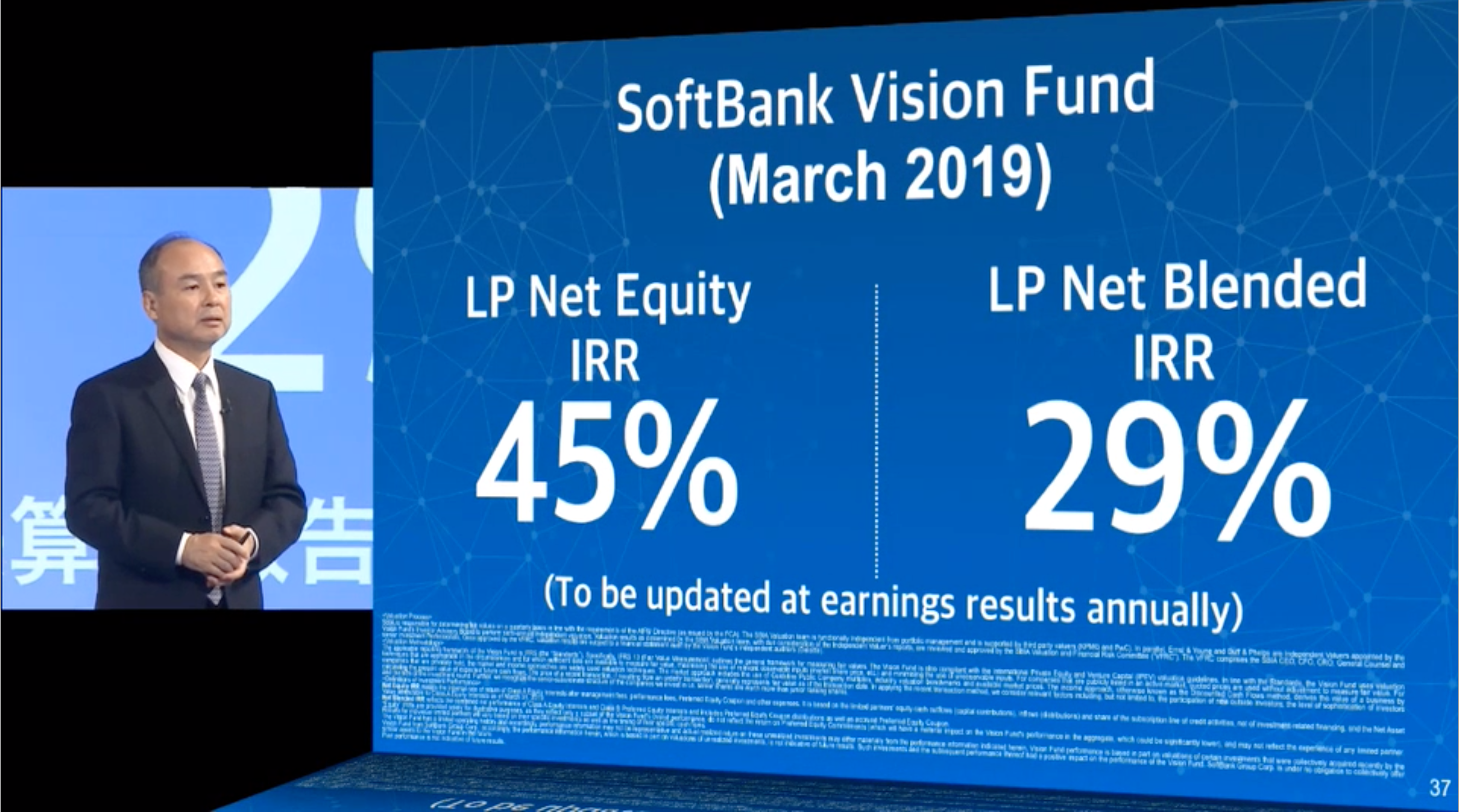
In contrast to the conventional secrecy of VC firms, SoftBank President Masayoshi Son is opening the books on the Vision Fund’s performance

The SoftBank supremo claimed many underestimate how involved the parent company is in the fund — a lot of light is shone on Saudi investor PIF and particularly its link to the murder of journalist Jamal Khashoggi, an outspoken critic of the regime — but he pointed out that SoftBank Corp represents 48 percent of the regular equity in the fund and is thus in line for a large share of the spoils.

SoftBank’s paper-based return from the fund reached 62 percent IRR which even Son himself admitted is a lofty target that the Vision Fund will struggle to maintain. SoftBank’s IRR was 44 percent during Son’s 18-year tenure leading the business, which he said makes him bullish for the future.

“I don’t like number two. From my personality perspective, I can’t accept number two, I need to be number one. I’ve been like that since I was a kid,” he said — again via a translator — of SoftBank’s goal to assemble a group of ‘global champions’ in the Vision Fund.
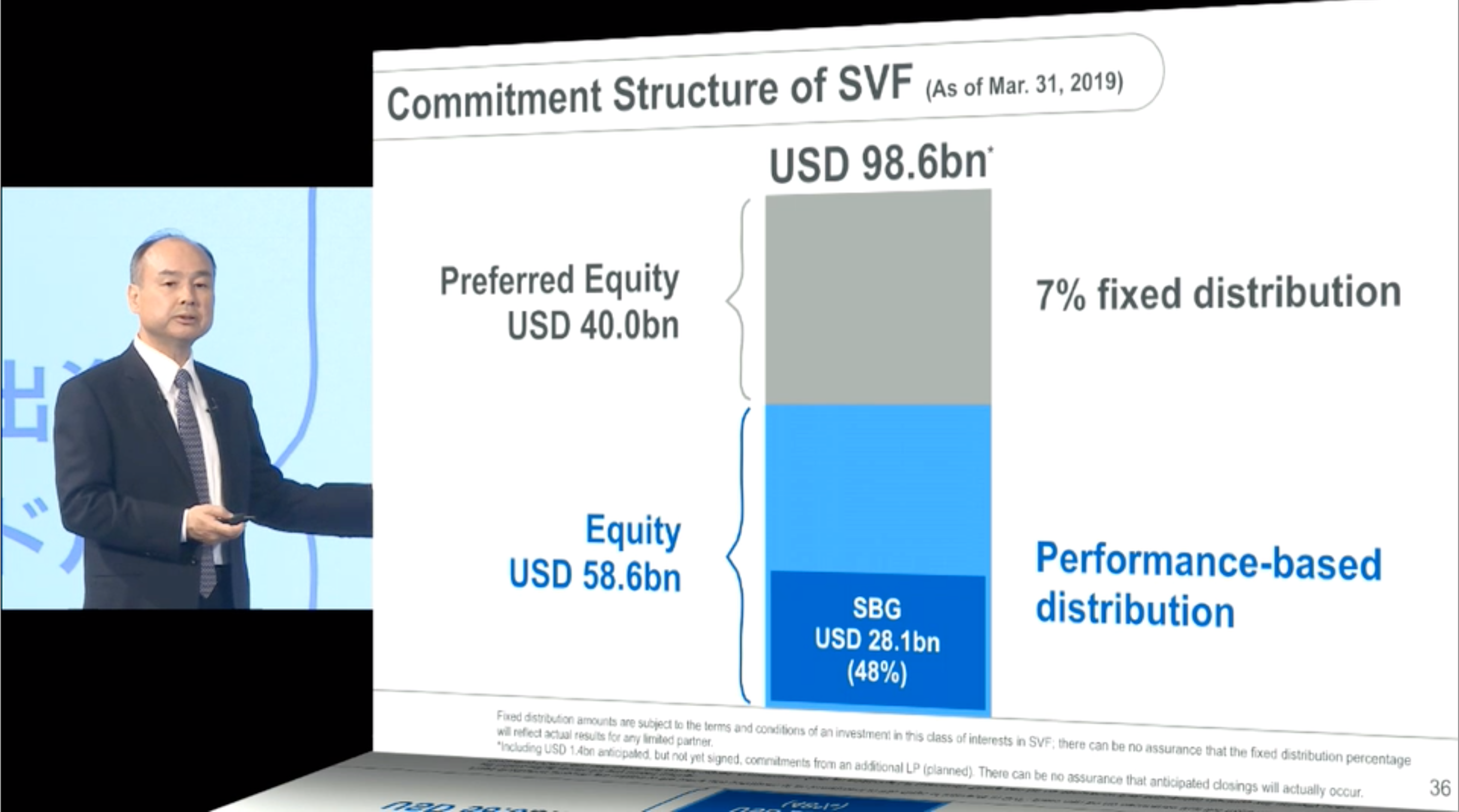
SoftBank Corp (SBG in the chart above) stands to gain significantly if and when the Vision Fund can convert paper gains into returned capital

The Vision Fund has collected 82 investments to date, and SoftBank’s earnings show that two exits in the year were Flipkart, which sold to Walmart for $16 billion last year, and Nvidia, after the Vision Fund dumped its entire stake in February following a downturn in its share price. SoftBank generated income of ¥146.7 billion and ¥138.3 billion, respectively, from those deals. That’s a combined ¥306.8 billion including derivative gain, or around $2.8 billion.

However, SoftBank mostly relies on “unrealized gains” on investments like Uber, OYO and others for its impressive numbers — in other words, how much the value of its stake in these companies has increased as they raise more capital and increase their valuations. These are, of course, paper gains until they pay out via acquisition or — what is most likely the goal for the Vision Fund — IPO. Indeed, the Vision Fund itself is reportedly planning a listing of its own.

That’s a major caveat for the IRR numbers that SoftBank claimed, since the majority of its investments haven’t exited for hard cash at this point. The fact that these assets have increased in value suggests that, as and when they do, the payouts will be handsome, but getting them liquidated is, as most VCs will tell you, the hard part.

Ping An Health and Guardant Health — two of its less prominent investors — went public last year in Hong Kong and the U.S, respectively, but it is still early days for the rest of the Vision Fund herd. That said, over the coming weeks, we’ll see the results of SoftBank’s prominent bets as Uber, WeWork and Slack head to the public markets and that’ll give a clearer indication of the progress and value for LPs.

Already, the Vision Fund is tipped to make a $3 billion paper gain from Uber’s IPO on an investment made at the end of 2017 — the fund is Uber’s largest shareholder — but how much it realizes will depend on what it sells at the bell, what it holds and how Uber’s share price develops.

In sticking with his unconventional approach to venture capital, Son is promising to provide an annual update. That’s a long time to wait and there are sure to be more explosive developments over the next 12 months particularly as SoftBank is increasing its deal volume per quarter.
Tencent’s new alternative to PUBG is already topping the revenue chart

In a move clearly driven by economic interests and an urgency to meet stringent regulations, the world’s largest games publisher Tencent pulled its mobile version of PlayerUnknown’s Battlegrounds on Wednesday and launched a new title called Game for Peace (the literal translation of its Chinese name 和平精英 is ‘peace elites’) on the same day.

As of this writing, Game for Peace is the most downloaded free game and top-grossing game in Apple’s China App Store, according to data from Sensor Tower data. That’s early evidence that the new title is on course to stimulate Tencent’s softening gaming revenues following a prolonged licensing freeze in China. Indeed, analysts at China Renaissance estimated that Game for Peace could generate up to $1.48 billion in annual revenue for Tencent.

Tencent licensed PUBG from South Korea’s Krafton, previously known as Bluehole, in 2017 and subsequently released a test version of the game for China’s mobile users.

Game for Peace is available only to users above the age of 16, a decision that came amid society’s growing concerns over video games’ impact on children’s mental and physical health. Tencent has recently pledged to do more ‘good’ with its technology, and the new game release appears to be a practice of that.

Tencent told Reuters the two titles are from “very different genres.” Well, many signs attest to the fact that Game for Peace is intended as a substitute for PUBG Mobile, which never received the green light from Beijing to monetize because it’s deemed too gory. Game for Peace received the license to sell in-game items on April 9.

For one, PUBG users were directed to download Game for Peace in a notice announcing its closure. People’s gaming history and achievement were transferred to the new game, and players and industry analysts have pointed out the striking resemblance between the two.

“It’s basically the same game with some tweaks,” said a Guangzhou-based PUBG player who has been playing the title since its launching, adding that the adjustment to tone down violence “doesn’t really harm the gamer experience.”

“Just ignore those details,” suggested the user.

For instance, characters who are shot don’t bleed in Game for Peace. A muzzle flash replaces gore as bloody scenes no longer pass the muster. And when people are dying, they kneel, surrender their loot box, and wave goodbye. Very civil. Very friendly.

“It’s what we call changing skin [for a game],” a Shenzhen-based mobile game studio founder said to TechCrunch. “The gameplay stays largely intact.”

Other PUBG users are less sanguine about the transition. “I don’t think this is the correct decision from the regulators. Getting oversensitive in the approval process will prevent Chinese games from growing big and strong,” wrote one contributor with more than 135 thousand followers on Zhihu, the Chinese equivalent of Quora.

But such compromise is increasingly inevitable as Chinese authorities reinforce rules around what people can consume online, not just in games but also through news readers, video platforms, and even music streaming services. Content creators must be able to decipher regulators’ directives, some of which are straightforward as “the name of the game should not contain words other than simplified Chinese.” Others requirements are more obscure, like “no violation of core socialist’s values,” a set of 12 moral principles — including prosperity, democracy, civility, and harmony — that are propagated by the Chinese Communist Party in recent years.

Check out all the challenges at the TC Hackathon at VivaTech

Money, prizes, glory — it could all be yours, but only if you’re good enough. Do you have the stamina, focus and coding chops it takes to create something awesome out of nothing in less than 24 hours? Then sign up to compete in the TechCrunch Hackathon at VivaTech 2019 in Paris on 17-18 May.

The hackathon is open to everyone — across Europe and beyond, so join hundreds of other hackers, UX/UI designers, coders and like-minded techies for a full-on coding free-for-all. And we do mean free — it won’t cost you a thing to participate.

Here’s how the hackathon works. Teams, which can range from 4-6 people, choose one of several sponsored hack contests when they register. If you don’t have a team, that’s OK — you can find one when you arrive onsite. You and your team have just 24 hours to design, code and create a working solution to your chosen challenge. Don’t worry, we’ll have plenty of food and drink to fuel your focus — including plenty of coffee. Once you’re finished, you’ll have just 60 seconds for a rapid-fire project pitch and presentation onstage in front of the sponsors and TechCrunch judges.

Each sponsor will be awarding prizes to the projects that address their challenges the best, including up to €5,000 in cash. On top of all that, TechCrunch judges will be scoring each pitch presentation on a scale of 1 to 5 and will declare one team the overall hackathon winner — with a €5,000 grand prize. Huzzah! Plus, if your team earns a combined TechCrunch score of three or higher, you also score two free tickets each to both TechCrunch Disrupt Berlin 2019 and VivaTech 2020.

Here’s the lowdown on all the sponsored challenges:

EDHEC Challenge

Making an impact can have different meanings, and we believe that one of them is about improving how we support student’s careers. Have you ever asked yourself “have I chosen the right studies and the right career for me?” According to the French Ministry of Higher Education, 150,000 french students decide to change their degree course. Participating in VivaTech is a great way to solve this issue through innovation. So let’s help them find the path that suits them best for their future career! The winner of this challenge will receive a €5,000 prize.

Eramet Challenge

In the 21st century, metal alloys are everywhere, e.g. computers, electric cars, satellites. You can find up to 20 different alloys in a single computer. The quality requirements of customers are extremely tight nowadays. Eramet, a global mining and metallurgical group, challenges you to find a solution that can provide our customers with 100% transparency on our supply chains, from the extraction of ore from the mine to the final product, with a heavy focus on the quality, environmental, social and ethical aspects. The winner of this challenge will receive a €5,000 prize.

Sanofi-Cegedim-IBM Challenge

Collective intelligence can help to find smart solutions to make healthcare professionals’ (HCPs) practice easier and bring better care to people living with cardio-metabolic challenges like diabetes. Sanofi, Cegedim and IBM will provide anonymized electronic health records for you to design data-driven solutions for HCPs and their patients. How to optimize time and effort? How to better predict and personalize care? How can we avoid health complications and allow better decision making? The best product that addresses this challenge will receive €5,000 in prize money.

Galeries Lafayette Publicis Sapient Predictive Mode Challenge

Discovering emerging brands and proposing an offer aligned with consumer expectations is a permanent challenge. Data can help us identify major upcoming trends and measure the potential of a brand or collection by uncovering fashion trends of tomorrow through text mining algorithms and pattern recognition in images and videos. If you wish to put your creativity and data analysis skills to link fashion and deep learning algorithms, this challenge is made for you! The best product that addresses this challenge will receive a prize worth €5,000.

Corvid by Wix Challenge

There are plenty of community, collaboration and project management tools available for developers to use. But how do we make these essential assets better? In this challenge, the team with the best hack that uses Corvid by Wix, an open development platform that lets you build, manage, deploy and scale advanced web applications, will receive a €5,000 prize.

Be sure to check out more info on all the sponsored hackathon challenges and prizes. Here’s the official agenda and, if you have any other questions, take a look at the TC Hackathon FAQ.

The TechCrunch Hackathon at VivaTech 2019 takes place on May 17-18. Money, prizes, glory — plus camaraderie and a whole lot of fun — can be yours. Sign up for your free ticket today and show us your stuff in Paris.

Drone sighting at Germany’s busiest airport grounds flights for about an hour

A drone sighting caused all flights to be suspended at Frankfurt Airport for around an hour this morning. The airport is Germany’s busiest by passenger numbers, serving almost 14.8 million passengers in the first three months of this year.

In a tweet sent after flights had resumed the airport reported that operations were suspended at 07:27, before the suspension was lifted at 08:15, with flights resuming at 08:18.

It added that security authorities were investigating the incident.

https://platform.twitter.com/widgets.js

A report in local press suggests more than 100 takeoffs and landings were cancelled as a result of the disruption caused by the drone sighting.

https://platform.twitter.com/widgets.js

It’s the second such incident at the airport after a drone sighting at the end of March also caused flights to be suspended for around half an hour.

Drone sightings near airports have been on the increase for years as drones have landed in the market at increasingly affordable prices, as have reports of drone near misses with aircraft.

The Frankfurt suspension follows far more major disruption caused by repeat drone sightings at the UK’s second largest airport, Gatwick Airport, late last year — which caused a series of flight shutdowns and travel misery for hundreds of thousands of people right before the holiday period.

The UK government came in for trenchant criticism immediately afterwards, with experts saying it had failed to listen and warnings about the risks posed by drone misuse. A planned drone bill has also been long delayed, meaning new legislation to comprehensively regulate drones has slipped.

In response to the Gatwick debacle the UK government quickly pushed through an expansion of existing drone no-fly zones around airports after criticism by aviation experts — beefing up the existing 1km exclusion zone to 5km. It also said police would get new powers to tackle drone misuse.

In Germany an amendment to air traffic regulations entered into force in 2017 that prohibits drones being flown within 1.5km of an airport. Drones are also banned from being flown in controlled airspace.

However with local press reporting rising drone sightings near German airports, with the country’s Air Traffic Control registering 125 last year (31 of which were around Frankfurt), the 1.5km limit looks similarly inadequate.

Uber begins trialing e-bikes and bicycles rides in India

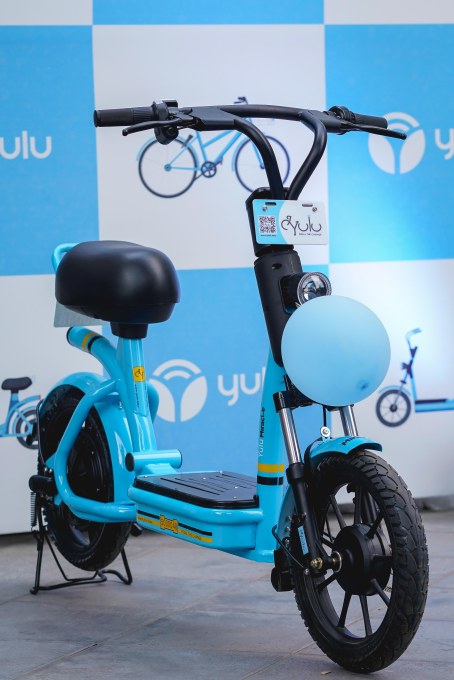
Uber has partnered with bicycle sharing platform Yulu in India as it looks to grab a piece of the growing e-bikes market that are increasingly posing a challenge to taxi services in the nation.

The San Francisco-headquartered firm, which is expected to go public later this week, said it will provide its users in Bengaluru with Yulu’s e-bikes and bicycles as part of a pilot. The announcement, financial details of which were not disclosed, comes days after users in Bengaluru began to spot Yulu’s e-bikes and bicycles options in Uber app. Uber did not say what it intends to do after the pilot.

Bangalore-based startup Yulu, which was launched by InMobi cofounder Amit Gupta, operates about 500 e-bikes and 4,500 bicycles on its platform. The two-year-old startup has raised about $7 million in funding from a number of big profile names including Blume Ventures, 3One4 Capital, Flipkart cofounder Binny Bansal, and Freshworks cofounder Girish Mathrubootham.

Today’s announcement, one of the handful it has made in India in last one year, comes as future of Uber’s business in the country appears clouded with uncertainty, a person familiar with the matter said. The service, still available in under three-dozen cities, competes with Ola, which has presence in over 100 cities. Amit Jain, who ran Uber India and was promoted to oversee the company’s APAC business last year, left the company last month.

Uber, which once committed to investing $1 billion in India and which has left Southeast Asia market after selling the local business to Grab, appears to have put its foot off the paddle in the APAC region. It said Pierre-Dimitri Gore-Coty, who heads the firm’s EMEA business, will replace Jain to oversee the APAC business.

Ola has also made bigger bets on e-bikes. The company, which like Uber is backed by SoftBank, invested $100 million in scooter rental startup Vogo late last year. Vogo, which operates in Bengaluru and Hyderabad, said it will use the capital to add an additional 100,000 scooters to its platform.

Vogo competes with Bounce, which offers more than 6,000 bikes. The market of two-wheelers has grown in India despite the proliferation of taxi services in the country in recent years. With major cities in India grappling with ever growing traffic issues, the future of two-wheelers seems brighter than ever. 2019 could be the year when e-bikes gain serious momentum in the nation, Jayanth Kolla, an analyst with research firm Convergence Catalyst said.

In a statement, Uber said Yulu’s e-bikes can clock up to 25km/hr, something which is “faster than your average traffic speed.” The other charm of Yulu’s e-bikes is that like other e-bikes, users don’t need to get a license to ride one of these. Those who participate in the pilot program will be able to avail Yulu’s e-bikes by unlocking a QR code from the Uber app.

“Along with being environment and traffic friendly, these self-ride e-bikes are also pocket friendly, taking into account the varying needs and budgets of the consumer,” the company said in a statement. “We understand that the push towards electrification has to be multi-modal, and the collaboration with Yulu only goes to demonstrate the intent therein.”

How to save an additional €200 off passes for Disrupt Berlin 2019

It might feel strange to think about December in May, but the smart money goes to startuppers who do just that. Why? Because we’re returning — for the seventh time — to Europe’s international city extraordinaire to host Disrupt Berlin 2019, which takes place on 11-12 December. And what better way to celebrate than to offer an extra €200 off ticket prices before the official registration even opens?

That’s €200 off the super-early-bird ticket price, folks. And all you have to do to reap the reward is sign up for our mailing list before registration opens in June. We’ll email you a discount code to use when it comes time to book your pass. It’s the easiest €200 you’ll ever save.

Join us in Berlin along with hundreds of other participants from more than 50 countries, including European Union members, Israel, Turkey, Russia, Egypt, India, China and South Korea, to name just a few. Those numbers include hundreds of early-stage startup founders, savvy investors and top tech media outlets. It’s two programming-packed days of networking, connection, inspiration, opportunity and fun with tech icons, potential partners, investors and customers.

Explore possibility in Startup Alley — our famed exhibition floor — where you’ll find hundreds of startups displaying tech products, platforms, services, demos and more. Make connections that could change the course of your career or startup trajectory. You never know who you’ll meet in the Alley.

Don’t miss Startup Battlefield, the pitch competition with a $50,000 cash prize that’s launched a thousand ships — OK, we jest about the ships. But it has launched 857 companies that have gone on to collectively raise more than $8 billion in funding and generated 109 exits. It’s a thrill to watch, and an even bigger thrill to compete. We’ll have more info on how you can apply in the coming weeks, so keep checking back.

We’re in the process of creating an outstanding agenda and a roster of expert speakers. Last year we heard from Frank Salzgeber from the European Space Agency, Lizzie Chapman from ZestMoney, an Indian fintech startup, and Rafal Modrzewski from satellite company ICEYE among many others. We’ll roll out more info on speakers in the coming weeks and months — yet another reason to check back.

We’re building out the best Disrupt Berlin ever, and this is your opportunity to attend at the lowest possible price. Take your business to the next level at Disrupt Berlin 2019 on 11-12 December. Simply sign up for our mailing list before registration opens in June and save an extra €200 off the super-early-bird ticket price. We’ll see you in Berlin!

Is your company interested in sponsoring or exhibiting at Disrupt Berlin 2019? Contact our sponsorship sales team by filling out this form.

Chipper Cash convinces Joe Montana to invest in African fintech

The African no-fee, cross-border payment startup Chipper Cash has raised a $2.4 million seed round led by Deciens Capital.

The payments company also persuaded 500 Startups and Liquid 2 Ventures—co-founded by Joe Montana—to join the round.

Chipper Cash’s Ugandan chief executive, Ham Serunjogi, pitched the U.S. football legend directly. “He was quite excited about what we’re doing and his belief that the next wave of [tech] growth will come from…Africa,” Serunjogi told TechCrunch.

Chipper Cash went live in October 2018, joining a growing field of fintech startups aiming to scale digital finance applications across Africa’s billion plus population.

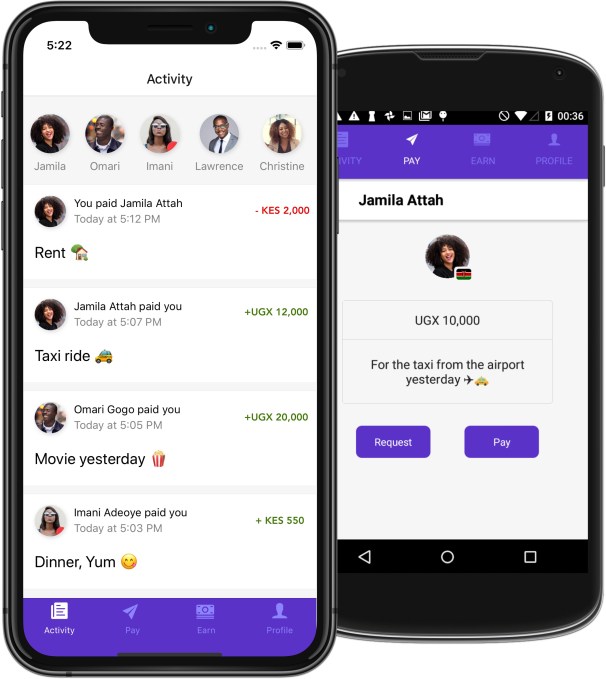
The venture Serunjogi co-founded with Ghanaian Maijid Moujaled offers no-fee, P2P, cross-border mobile-money payments in Africa.

Based in San Francisco based startup—with offices in Ghana and Nairobi—Chipper Cash has processed 250,000 transactions for over 70,000 active users, according to Serunjogi.

In conjunction with the seed round, Chipper Cash is launching Chipper Checkout: a merchant focused, C2B, mobile payments product.

This side of the startup’s offerings isn’t free, and Chipper Cash will use revenues from Chipper Checkout—in addition to income generated from payment volume float—to support its no-fee mobile money business.

Sheel Mohnot, who led 500 Startups’ investment in Chipper Cash, likened company’s model to PayPal.

“When PayPal started it was just a consumer to consumer free app. It still is free for consumer to consumer, they but they monetized the merchant side. That model is tried and tested. It just doesn’t exist in Africa, so Chipper has the opportunity to do that,” he told TechCrunch.

In addition to Kenya’s M-Pesa—the global success story for digital payments—there are a number of mobile money products in Africa, from MTN’s Mobile Money in Ghana to Tigo Pesa in Tanzania.

The limiting factor, though, according to Chipper Cash’s CEO is interoperability, or that mobile-money transfers across product platforms, currencies, and borders generally don’t work.

“Our tech settles cross-border currency transactions in real-time, and that’s part of the value proposition of the platform,” he said.

The startup will expand beyond its current four country operations in Ghana, Kenya, Rwanda, Tanzania, and Uganda within the next 12 months. Chipper Cash also plans to tap the global remittance market for Sub-Saharan Africa, a large pool of roughly $38 billion, in the near future.

Remittances won’t be the firms’ top focus, however. Serunjogi believes there’s more volume to be found within Africa. “Demographics, migration, and regional economic-integration within the continent means there’ll be an infinitely growing amount of cross-border commercial activity within Africa,” he said. “When it comes to payments, the pie is growing and…the percentage of that pie that is digital payments will also grow.”

The journey for Chipper Cash’s founders from Africa to founding a startup and pitching to Joe Montana passes through Iowa. Serunjogi and Moujaled met when doing their undergraduate degrees at Grinnell College.  Stints at Silicon Valley companies followed: Facebook for Serunjogi and Flickr, Yahoo!, and Imgur for Moujaled.
Chipper Cash was accepted in 500 Startups’ Batch 24 in 2018 and their demo day for the accelerator program gained the attention of Liquid 2 Ventures.

The VC fund’s Rocio Wu invited them to pitch to Joe Montana and the team in March 2019.

“Africa is extremely fragmented with different languages, cultures and currencies, Chipper Cash is uniquely positioned to tackle cross-border mobile payments with interoperability,” Wu told TechCrunch on the investment.

Wu will join Chipper Cash as a board observer. The startup is the second Africa investment for the fund. Liquid 2 Ventures is also an investor in logistics startup Lori Systems, the 2017 Startup Battlefield Africa winner.

Startups building financial technologies for Africa’s 1.2 billion population are gaining greater attention of investors. As a sector, fintech (or financial inclusion) attracted 50 percent of the estimated $1.1 billion funding to African startups in 2018, according to Partech.

By a number of estimates, the continent’s 1.2 billion people represent the largest share of the world’s unbanked and underbanked population. An improving smartphone and mobile-connectivity profile for Africa (see GSMA) turns this scenario into an opportunity for mobile based financial products.

As more startups enter African fintech, Chipper Cash believes it can compete on its cross-currency and no-fee offerings and the growing size of the market. “It’s so large that it is unlikely to be a zero-sum game in terms of who wins. There will be multiple successful players,” said Serunjogi

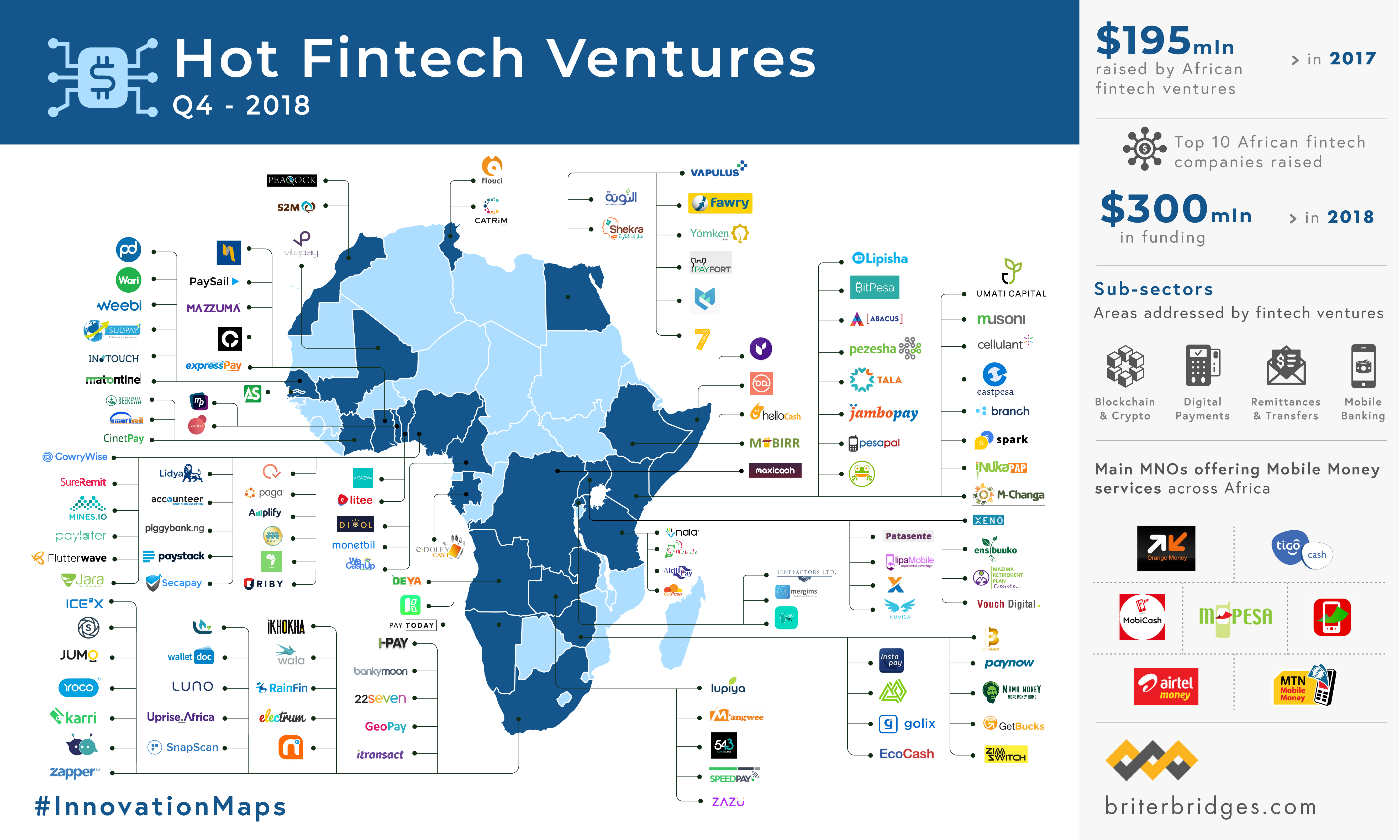
Chipper Cash also joins a list of African founded, Africa focused fintech firms that have chosen to set up HQs in San Francisco with offices and operations on the continent. Payments gateway company Flutterwave and lending venture Mines.io (both with Nigerian founders) maintain SF headquarters with operations in Lagos. Serunjogi touts the benefits of this two continent organizational structure for access to both VC and developer markets in the U.S. and Africa.

As for Chipper Cash’s continuing relationship with investor Joe Montana, “Having access to a someone with the leadership qualities of Joe to provide advice and guidance…that’s something that’s priceless,” said Serunjogi.

Tink, the European banking platform, partners with British incumbent NatWest

It’s easy to push a narrative of fintech upstarts versus the big incumbent banks, but the more subtle reality is that as well as competing on numerous fronts, there are partnerships being formed across the board. The latest such move sees Tink, the Sweden-based banking platform that raised €56 million in new funding in February, partner with British bank NatWest.

The agreement gives NatWest access to Tink’s Personal Finance Management (PFM) and “Data Enrichment” products, which will be integrated into NatWest’s core mobile banking app. This will allow NatWest to improve its mobile banking offering by giving NatWest customers personalised insights into their finances based on transaction history. The features built with Tink’s technology are planned to go live in Q4 2019.

The bigger picture is that by partnering with Tink, NatWest is aiming to meet increased customer expectations with regards to digital financial services. Undoubtedly, a plethora of fintech startups and challenger banks have raised the UX and feature bar significantly in the U.K. and right across Europe, not least via high quality mobile apps and better use of data, while incumbent banks have been scrambling to catch up.

“Historically banks have tried to build everything themselves, but we are now seeing a big shift where they want to partner with the best to propel development, quickly launch new features and stay competitive,” Tink co-founder and CEO Daniel Kjellén tells me.

“Today more and more banks choose to leverage the external building blocks that’s available to them and add in-house uniqueness on top of that. We’ve seen the same development when it comes to hosting – banks are now choosing cloud-based solutions such as AWS instead of on-premise solutions”.

To that end, although originally launched in Sweden in 2013 as a consumer-facing finance app with bank account aggregation at its heart, Tink has since repositioned its offering to provide the same underlying technology and more to banks and other financial service providers.

Through various APIs, Tink provides four pillars of technology: “Account Aggregation,” “Payment Initiation,” “Personal Finance Management” and “Data Enrichment.” These can be used by third parties to roll their own standalone apps or integrated into existing banking applications.

Along with NatWest, Tink has partnerships with a number of other banks including Klarna, BNP Paribas Fortis, ABN AMRO, SEB and Nordea.

Meanwhile, PFM (personal finance management) functionality in some form or another can now be found in numerous banking apps and fintech chatbots, and I put it to Kjellén that a PFM feature is now a commodity. He pushes back.

“It’s true that customer’s expectations on digital banking services are increasing and incentivising the incumbents to develop their PFM tools at a more rapid pace than before,” he says. “But the future where PFM is completely data-driven and where product recommendations, advice and decisions can be put on autopilot is still very far from a commodity”.

“The most advanced players are now building products that… take their PFM apps from being read-only to data-driven and actionable. It’s this combination of functionalities that will be game-changing for the industry”.

Heetch raises $38M to take on Uber in French-speaking countries

With Uber just days away from going public, a small challenger has raised some funds of its own to take it and the rest of the field on in francophone markets. Heetch, a ride-sharing platform based out of Paris with operations across France and French-speaking Africa, has picked up a Series B of $38 million, at a valuation that we understand to be around $150 million.

Very small potatoes compared to the $90 billion value some have ascribed to its much larger competitor. But the list of Heetch’s investors — a combination of strategic and financial players — speaks to both the untapped opportunity that investors (and founders) think still exists in the wider market, and the fact that many believe that Uber doesn’t address everything and everyone, and there remains room for more companies to approach the need to transport people in different ways. (Indeed, others like Gett, which this week announced a $200 million round, also capitalising on these gaps.)

The round is being led by Cathay Innovation and Total Ventures (the investment arm of the oil and energy giant), with participation from existing shareholders Idinvest Partners, Innov’Allianz, Alven, Felix Capital, and Via-ID, and it brings the total raised to around $70 million (following from previous rounds of $12 million in 2017 and $20 million in 2018). The funding will be used to bring Heetch to more markets — today it is in France, Belgium, Morocco and the Ivory Coast, and the plan is to expand Algeria, Cameroon and Senegal later this year — as well as to continue hiring, particularly engineers in Paris.

It helps, too, that Heetch has had its share of interest from acquirers over the years, including — our sources tell us — an approach from one of the world’s biggest ridesharing platforms. (It was rebuffed on the low price offered.)

Heetch was started in 2013 by Teddy Pellerin and Jacob Matthieu to fill what it saw as a clear gap in the market in Paris: providing rides to 20-somethings back to the outskirts and suburbs of Paris after late nights out in clubs in town — a market that was not being served by other taxi companies, nor by public transport.

As Pellerin, who is now the CEO, describes it, Heetch took a casual approach to solving this casual passenger problem: the idea was to make the service truly peer-to-peer, by bringing on drivers that were the same age and just like the people that were being driven (they might have been coming home from the same clubs).

The idea caught on virally with its user base — would you expect anything less of a service aimed at millennials? But, alas, not with the regulators, who shut down the service for not using licensed drivers.

Ironically, it was just then that Heetch got approached to be acquired, and also was picking up its earliest funding from Felix.

“We took a different approach when we backed them,” said Antoine Nussenbaum, who led the deal for Felix. “We were making a strong statement: we believe that in service categories that feel commoditised, you can build a specific community and experience, and that has been more than proven to date with Heetch.”

In fallow mode, the company rebuilt itself with a refocus on working with professional drivers, but while also trying to keep some of the ethos that made it stand out from others like Uber and the other big player in the market in France, the Daimler-majority-owned Chauffeur Prive (which earlier this year rebranded to Kapten). By continuing to serve younger users; driving to parts of the wider metro area that others would not; by taking a smaller cut from the drivers in order to incentivise them to drive with Heetch over others; and by taking a “nice guy” approach to the business.

“We are more like Lyft,” Pellerin said. “We have a friendly service, with good interactions between riders and drivers. We are also better at servicing younger users because we are a bit cheaper.”

And it added a twist: it saw a chance to export its model to other francophone markets where public and private transportation infrastructure were not overly developed, and its app could be minimally adjusted to work. These days, Pellerin said that while Paris is still Heetch’s biggest market, its second-largest today is Casablanca in Morocco (and Brussels in Belgium is third).

Ironically for a company that got its start by clearly violating local regulations, one notable aspect of how Heetch is growing is that today it’s adjusting its model to tailor it to the regulatory and other requirements in each country, which might include working with professional drivers, or even painting cars a specific color in order to operate a livery service.

Interestingly, there is another way that the company is different from Uber (which racked up $1 billion in losses last quarter): it’s close to becoming profitable, Pellerin noted, in the four markets where it is active today.

“We are very proud to join forces with Heetch and its talented team. We are convinced of Heetch’s potential and believe in its development strategy in Europe and Africa, a region we monitor closely. Millions of Africans will be able to benefit from Heetch’s services. This investment fits perfectly with our investment thesis around mobility and complements our global portfolio in the space which includes Drivy-Getaround, Momenta, Glovo, and OnTruck,” said Jacky Abitbol, Partner at Cathay Innovation, in a statement.

Educational gaming platform Kahoot acquires math app maker DragonBox for $18M

Kahoot, the popular e-learning platform that provides a range of games to teach subjects (it has described itself as the “Netflix of education”), has made its first acquisition: it has acquired DragonBox, a startup that builds math apps, for $18 million in a combination of cash and shares.

Åsmund Furuseth, Kahoot’s CEO and co-founder, said in an interview that the deal was being done at an uptick to Kahoot’s previous valuation of $376 millon; the bigger company is now creeping up to $400 million.

It’s a relatively strong exit for DragonBox, which had raised less than $500,000 since 2012 primarily from going through incubators and accelerators, according to PitchBook.

The plan will be to bring DragonBox — which, like Kahoot, has roots in Norway — on wholesale to continue growing DragonBox’s existing business, as well as to supplement Kahoot’s offering. Today the smaller startup already has millions of users in Europe, including schools that use it to teach K-12 math curriculum subjects, but alongside that it will also to start to develop more educational content for the main Kahoot platform.

That Kahoot platform up to now has grown organically through a combination of both Kahoot-created, and user-created content (users can build their own games on Kahoot); as well as through serving two markets: K-12 users, and enterprise customers for corporate training. Furuseth sees DragonBox as supplementing the first of these, specifically by helping it expand into more parent-led and home learning that supplements what children might be getting in classrooms.

That’s an area where Kahoot already has a sizeable business. Furuseth said that of the 1 billion plays that its platform saw in 2018, 700 million came from K-12 classrooms, 30 million came from enterprises, and the rest — around 270 million — came from people using Kahoot at home, playing around 100 million games. That speaks to an opportunity to build more content to serve that third sector, which is where DragonBox will fit.

“Since day one, DragonBox has made learning math more fun and engaging for children around the world. Together with Kahoot!, we will enable millions of more users to enjoy learning math in an awesome way,” said Jean-Baptiste Huynh, math teacher, CEO and co-founder of DragonBox.

Furuseth added that the company is also looking at making further acquisitions to continue growing Kahoot alongside its own organic growth, tapping into the fact that there are dozens of smaller startups in the world of education that will be challenged to scale up on their own. (Not the small number of enterprise users in the mix today: my guess is that’s an area where the company may try to grow through more bolt-on businesses.)

“In general, it’s hard for many small and even successful ed-tech companies to reach a large mass of users because it’s difficult to cut through the noise,” Furuseth said in an interview. “We think our brand can help by reaching out with more learning experiences now and in the future.”

Under Furuseth as CEO, the company has been trying to tap into that also by way of a new accelerator that it launched last year called Ignite, which it sees partly as a way to help grow those businesses, as well as a way to find promising startups that it might worth with or acquire itself.