Sharp will resume selling its smart TVs in the US this year

Good news for U.S. consumers, the smart TV market is about to get more competitive after Sharp announced plans to resume selling TVs in America before the end of this year.

The Japanese firm quit the U.S. in 2015 when crumbling finances threatened its very existence. It was bailed out by Hon Hai Precision — the Taiwanese manufacturing firm better known as Foxconn — in a $3.5 billion deal that attracted controversy inside Japan, where a home-backed agreement had been preferred by many. Still, under new management, it is seeking expansion to continue its rebound.

Sharp sold its license to China’s Hisense when it exited, and this week it said that it has struck a deal to regain it, although the terms have not been disclosed.

That relationship is certainly frosty: Sharp sued the Chinese firm, which is state-owned, alleging that it had put Sharp’s badge on sub-quality products. The suit was dropped at the beginning of last year. Sharp said at the time that it intended to return to the North American market itself, and now it has the deal it required.

Sources told Reuters that the firm may also be considering other markets in the Americas beyond the U.S, Hisense also acquired its rights for that region, but the U.S. market is obviously the headline expansion.

For now, Sharp said it will bring TVs to market that combine 5G, AIoT — a buzzy acronym that stands for ‘artificial intelligence of things’ — and 8K/4K picture quality. We’ll have to wait for more on what the exact product line-up will look like.

Disney reports strong second-quarter, but takes $353 million write-down on Vice

Walt Disney Co. is writing down its investment in Vice Media for the second time in less than a year. In its otherwise upbeat second-quarter earnings report, the company said it was taking an impairment of $353 million for Vice.

This follows the $157 million write-down Disney disclosed during its fourth-quarter earnings report in November. Vice Media was valued at about $5.7 billion post-money in June 2017 and raised a total of $1.4 billion in funding, including $500 million from Disney in 2015. Last week, however, the Wall Street Journal reported that the media company had taken $250 million in debt financing from investors led by George Soros as it tries to find a way to reverse its slowed growth and stalling traffic.

Disney owns 21% of Vice, in addition to smaller stakes through 21st Century Fox, which it acquired in March, and A&E Networks, a joint venture between Heart Corporation and Disney-ABC Television, one of its subsidiaries.

The Vice write-down was a low point in an otherwise strong quarter for Disney. The company reported a 3% increase in revenue to $14.9 billion and earnings per share of $1.61, beating analysts’ expectations. It also announced three new “Star Wars” films will be released starting in December 2022, along with a roster of other upcoming titles that includes “Cruella” and the “Avatar” sequels.

TechCrunch has contacted Vice Media for comment.

In a statement to Business Insider, a Vice spokesperson said it is “on target to meet, if it not exceed, its financial targets for the third straight quarter,” adding that “our new executive team’s strategic plan is well underway and with the recent capital rise, we will continue investing in the long-term growth of our five global businesses—television, studio, digital, news and our advertising agency, Virtue.”

‘Weird Cuts’ is Google’s new AR experiment that lets you cut out pieces of reality to make collages

In addition to preserving art and historic landmarks around the world, Google’s Arts & Culture division also likes to collaborate with artists to experiment with integrations between technology and art. The latest of these efforts, a new AR app called “Weird Cuts,” was formally introduced this evening at the Google I/O developer conference. The concept for the app was created by artists Zach Lieberman and Molmol Kuo, and was developed with the support of Google Arts & Culture. And it’s definitely an odd (but also fun) tool for playing around with augmented reality — without having any sort of real intention in mind beyond “making weird AR collages.”

Experiments like this, though seemingly lighthearted, are important in terms of getting a better understanding of a new technology, and how people want to interact with it. Today, many AR apps are built for specific purposes — like placing furniture in a room to see how it goes with your existing décor, or getting up-and-close with something you normally couldn’t otherwise — like the great, white shark shown in AR during yesterday’s Google I/O keynote.

Weird Cuts, meanwhile, doesn’t have any higher aim beyond just having fun and being creative.

The app consists of two modes — a cutout mode and a collage mode.

The idea is that you should walk around and collect a bunch of different materials from the world in front of your camera’s viewfinder while in the cutout mode. These images are cut into shapes that you then assemble when you switch to collage mode. To do so, you’ll arrange your cutouts in the 3D space by moving and tapping on the phone’s screen.

You can also adjust the shapes while holding down your finger and moving up, down, left and right — for example, if you want to rotate and scale your “weird cuts” collage shapes.

The end result is a sort of multi-dimensional work of “art” (or perhaps, bit of nonsense, depending on your skill level) created with the found objects and your own improvisational efforts.

The new app, which is published by the artists but credits Google Arts & Culture, is a free download on Google Play.

Pearl, the healthcare spinout from LA-based AI startup, GumGum, raises $11 million

GumGum, the Los Angeles-based startup that’s spent the past decade applying machine learning technologies to advertising and sports, has spun out a new healthcare startup focused on the dental industry called Pearl.

The company has raised $11 million in financing from undisclosed strategic investors and Craft Ventures, the investment firm set up by former Yammer founder, David Sacks.

GumGum’s co-founder, Ophir Tanz, stepped down from the adtech giant to run the new startup last month, while GumGum’s president and chief operating officer, Phil Schraeder took the reins as chief executive at GumGum.

“This idea was seeded within GumGum,” says Tanz. “I started the process of collecting dental x-rays over three years ago.”

GumGum’s strategy has been to build out a holding company of computer vision driven businesses, Tanz says. Both its portfolio of services for advertising and for sports franchises have become profitable on their own, and the opportunity in healthcare was too tempting of a target to pass up.

For Tanz, the decision to set up Pearl as a separate business was necessary for the new company to be able to focus on a huge opportunity to transform a portion of the healthcare industry that has remained largely untouched by machine learning applications.

It’s also a space that’s ripe for technology to come in and give a more clear-eyed assessment of patient health than the industry standard currently provides.

“We are isolated from the larger health-care system. So when evidence-based policies are being made, dentistry is often left out of the equation,” Jane Gillette, a dentist in Bozeman, Montana, who works closely with the American Dental Association’s Center for Evidence-Based Dentistry, told “The Atlantic” recently. “We’re kind of behind the times, but increasingly we are trying to move the needle forward.”

Pearl may be one way to move that needle.

It’s also a return to the family business, for Tanz, whose father worked as a dentist for decades.

“The thing with dentistry is that it’s always somehow the forgotten medicine, but it’s such a massive market opportunity,” says Tanz. 

Machine learning in the dental business can achieve four main objectives, says Tanz. It can reduce fraud for insurers, validate the performance of dentists in networks that are being created through the consolidation of small practices by large private equity firms, and automate workflows inside the dental office.

Imagine having diagnostics tools integrated with medical devices through software that can be distributed and updated remotely, giving practitioners the best quality information. That’s the goal for Pearl, Tanz says.

Eventually, the company will look to expand to other verticals within healthcare, but for now, the new money is focused on building out its toolkit for teeth.

“We’ll expand beyond dental eventually,” says Tanz. “We’re going to be focused on dentistry and the dental category and the laboratory for quite a while.”

The company is coming to market with three products: “Second Opinion”, which scans x-rays and identifies pathologies and anatomy to ensure a proper diagnosis; “Practice Intelligence”, which delivers advanced analytics for dental practices and groups to deal with patients more effectively; and “Smart Margin”, which provides feedback on intraoral scans for dental restoration and manufacturers.

“Pearl will have an immediate positive impact on the dental category,” said Tanz, “It will streamline tedious, repetitive tasks, enhance profitability across dentistry, and, most importantly, it will improve the standard of care by validating diagnoses, removing large elements of uncertainty from the dental equation.”

Google to allow users to pay for Android apps using cash

Today, the Android platform sees more app downloads than iOS, but Apple’s App Store continually dominates in terms of revenue. Now, Google is aiming to narrow the revenue gap by introducing a new way for users in emerging markets to pay for apps: with cash. The company today announced it’s launching “pending transactions,” which offers users different ways to pay that don’t require a credit card or any other traditional form of online payment.

Lack of access to credit is one of many reasons why users in emerging markets gravitate towards free-to-play and ad-supported games and applications, instead of paid downloads and in-app purchases.

To address this problem, Google has already rolled out other payment options over the years — like support for eWallets, UPI in India, and carrier billing, for example. Over the past year, it’s added 20 more carrier billing partnerships, bringing the total number of carriers supporting this option to over 170 worldwide, to reaching over a billion users through this one billing option.

But carrier billing isn’t a universal option, and it’s not always a preferred one.

To reach those users who rely more on cash, Google is now rolling out another payment option.

“We know that emerging markets are a key area of growth for you all, which is why we’re excited to announce ‘pending transactions,’” said Aurash Mahbod, the Director of Engineering responsible for the Play Store and Games on Google Play, speaking at the Google I/O Developer conference today.

“This is a new class of delayed form of payment – like cash, bank transfer and direct debit,” he explained.

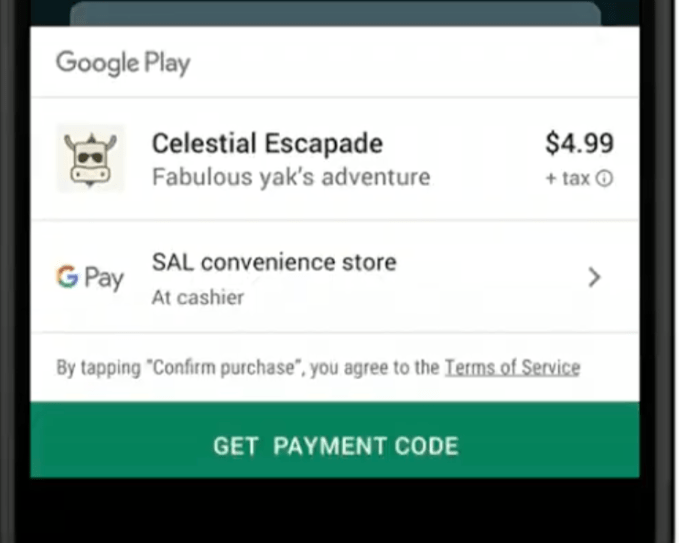
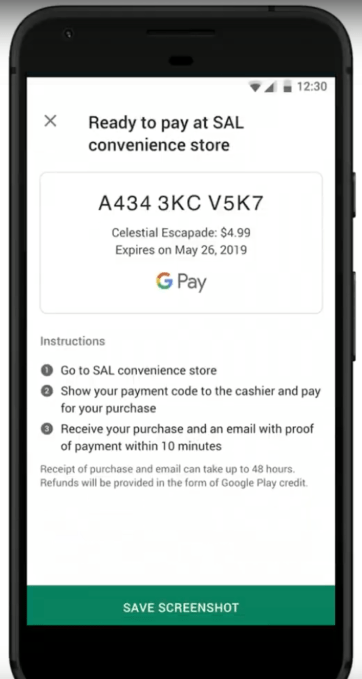
The option gives an Android user the ability to choose an alternative payment method at checkout when paying for an application or in-app purchase. Instead of charging an attached credit card, for instance, the user can instead opt to receive a payment code which they can use to pay for their purchase using cash at a nearby store.

Once at the store, the user shows the payment code to the cashier and pays. Within 10 minutes after completing the transaction, the user will receive their purchase and an email with their proof of payment. (The fine print notes this can take up to 48 hours, at times, however).

While this makes paying for apps and updates easier for cash-only Android users, if they later want a refund, they won’t get cash back — only Play Store credit.


The Pending Transactions option is one of several updates arriving in the new Google Play Billing Library (version 2.0), but is the most interesting in terms of what it means for increasing the number of paid transactions in emerging markets.

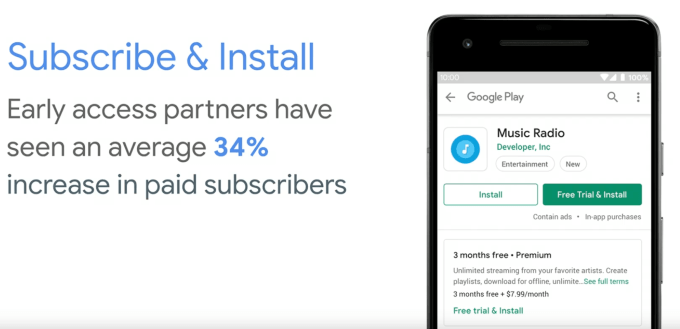
Another notable update is the option, “Subscribe & Install”, which offers users a free trial subscription at the same time they install the app — all in one click of a button.

This feature is currently available in Early Access, and partners who have used the option are seeing an average of 34% growth in paid subscribers, Google said.

The Google Play Billing Library 2.0 — now the official way to integrate apps with Google Play Billing —  is available now in Java, with C++ and Kotlin support coming soon.

More information about the new options will be posted to the Android Developers site here.

Execs at Mobike, the bike sharing startup, are raising $20M to buy out the European business by end of June

Some big changes are afoot for Mobike, the Chinese bike-sharing company that was acquired by IPO-bound on-demand service startup Meituan-Dianping for $2.7 billion last year. Mobike executives in Europe are raising $20 million from outside investors as part of a plan to spin off the European operation. Under the deal, Mobike would not completely divest from the spun-out division: it would retain a 49 percent share.

It had previously been reported that the company is in the process of spinning off its European operations as part of a wider retreat from global operations. Our sources have confirmed that the outside investment and spinoff would value the European portion of the business at between $80 million and $100 million.

A source close to the company also tells us that the deal is expected to close by the end of June. The plan is for Paul Zhu, currently European regional general manager for Mobike, to become CEO of the new EU Mobike.

Mobike has operations in the UK, France, Germany, Italy, Spain and The Netherlands, but it is not clear how many users it currently has in the region, or indeed globally. As it has shuttered operations in some cities in the region — most recently in Newcastle in the north of England — Mobike is also slowly rolling out services elsewhere — for example, this week in Padua, Italy.

Steve Milton, a UK spokesperson for Mobike, declined to comment for this article.

Bike-sharing startups, in which people use apps to find, ‘unlock’ and pay for bike rentals, were hailed as the next hot area for on-demand transportation for urban dwellers, following on from the fast growth of car-based services like Uber and Lyft (and more recently followed by scooters and e-bikes). Dozens of bike startups were collectively pumped up with hundreds of millions of dollars in funding as they ramped up their inventories to compete against each other.

It turned out to be a bubble in the making. In the worst-case scenarios, hundreds of basic, bright bikes filling city streets led to vandalization and clutter. In the best-case scenarios, some of the biggest startups, like Mobike, Jump and Motivate, eventually were acquired — in their respective cases to Meituan, Uber and Lyft. Still, among those and others like Ofo that remained independent, there have been wobbles, and others that appeared to have crashed out altogether.

Yet as e-hailing companies continue to diversify and expand into multi-modal transportation, there will be more acquisitions.

We understand that Careem, the Dubai-based transportation startup that itself is getting acquired by Uber for $3.1 billion, is buying a bike-sharing startup focused on the Middle East region (which means contenders could include Nextbike, Cyacle, and Byky). The deal is expected to close in coming days and may likely come into its own when a bike deal Careem announced at the end of April with the Dubai transport authority takes shape.

Meituan, which is now publicly traded and is valued at around $42 billion, more recently said it would rebrand Mobike to Meituan Bike, which will not only bring it closer to the parent company, but further distance it from Mobike’s earlier aggressive expansion and some of the bad reputation it picked up along the way.

Its international footprint isn’t the only thing that’s been slashed. Hongji Bike — co-founded by the original co-founder of Mobike — said it had picked up a number of engineers from the company to ramp up its efforts to build bikes, scooters and other personal vehicles for a variety of on-demand transportation startups. (Its customers include Lime, which ordered 40,000 scooters from it last year, the company said this week.)

What Pixel 3a tells us about the state of the smartphone — and Google

Announced yesterday at Google’s opening I/O keynote, the Pixel 3a arrives at a tenuous time for the smartphone industry. Sales figures have stagnated for most of the major players in the industry — a phenomenon from which Google certainly isn’t immune.

CEO Sundar Pichai discussed exactly that on the company’s Q1 earnings call last week. “While the first quarter results reflect pressure in the premium smartphone industry,” he explained, “we are pleased with the ongoing momentum of Assistant-enabled Home devices, particularly the Home Hub and Mini devices, and look forward to our May 7 announcement at I/O from our hardware team.”

That last bit was a clear reference to the arrival of the new budget tier of Google’s flagship offering. The 3a is a clear push to address one of the biggest drivers of slowing smartphone sales. With a starting price of $399, it’s a fraction of the price of top handsets from competitors like Apple and Samsung.

There’s been a fairly rapid creep in flagship prices in recent years. Handsets starting at north of $1,000 hardly warrant a second glance anymore, while many forthcoming foldables are hovering around double that.

As Google VP of Product Management Mario Queiroz told me ahead of launch, “The smartphone market has started to flatten. We think one of the reasons is because, you know, the premium segment of the market is a very large segment, but premium phones have gotten more and more expensive, you know, three, four years ago, you could buy a premium phone for $500.”

Inflated prices have certainly made device purchases more burdensome for buyers. That, coupled with a relative lack of compelling new features has gone a ways toward slowing down upgrade cycles, hurting sales in the process.

I’ve enjoyed my early hands-on time with the 3a — more to come on that later. It’s important to note the different factors that have allowed Google to get to this stage. A key driver is, of course, Google’s purchase of massive R&D resources from HTC. That result of HTC’s dip into sub-replacement level hardware manufacturer has resulted in the ability to develop hardware in house, on the relatively cheap at a new campus in Taipei.

Also important is Google’s ongoing quest to further uncouple the importance of hardware from smartphone upgrades. The company’s big investments in machine learning and artificial intelligence particularly are driving many of the innovations best demonstrated on the imaging side of things. Devin captured this sentiment in this piece written in the wake of the iPhone XS announcement.

Notably, the Pixel 3a has essentially the same camera hardware as the pricier 3. Google cut some corners here, but that wasn’t one. There are still and will continue to be some limitations to what the 3a is able to do, based on processing power, but the line between what the two devices can do is already pretty blurry when it comes to taking photos.

There’s another factor that’s been looming over Pixel sales in all of this — but for several reasons, Pichai wasn’t ready to discuss it on the call. For years, the line has been hampered by carrier exclusivity, something that feels like it ought to be relegated to the smartphone past.

Certainly that sort of arrangement makes sense for young companies like OnePlus or Palm, which are looking for a way into a market, while seeking to maintain manageable growth. But Google certainly has the resources to grow outside of a single carrier deal. And the fact of the matter (as Huawei has discovered the hard way) is that carrier distribution and contracts as still key drivers of smartphone distribution here in the States, even as most manufacturers also offer unlocked devices. I suspect those upfront costs are enough to make many consumers do a double take — even though we all know in our hearts the contract is ultimately where they get you.

Thankfully, Google announced that it will be making the Pixel 3 and 3a available on a lot more carriers, starting this week. That move ought to have a marked impact on the Pixel’s sales figures going forward. The addition of Sprint and T-Mobile among others means a lot more retail shelf space and ad dollars across the U.S. Devices are a harder sell when your average consumer has to go out of their way to find them — not to mention the difficulty of convincing users to switch carriers for a new device.

I’d caution against using Q2 results as a direct measure of the 3a’s appeal and Google’s move toward a six-month device release cycle. At this early stage it’s too early to uncouple that from new customers who are coming on board courtesy of those carrier additions. Even so, the device is an interesting litmus test for the current state of the smartphone, right down to the return of the headphone jack.

GM in talks to sell shuttered Lordstown factory to Workhorse for EV pickups

General Motors is in talks to sell its Lordstown vehicle factory in Ohio to Workhorse Group, a battery-electric transportation technology company, to produce EV pickup trucks.

It’s a development that could produce a positive outcome for Workhorse, GM and the laid-off workers at the Lordstown factory that stopped producing the automaker’s Chevrolet Cruze in March. Not to mention President Trump, who has promised to bring back manufacturing jobs to the U.S. and was the first to reveal the talks via Twitter.

This good news story, however, has loads of caveats.

The deal between GM and Ohio-based Workhorse is not settled, according to Jalopnik, which reported the two companies have been in negotiations since the beginning of the year and many details still must be resolved. Tom Colton, who represents Workhorse in the deal, told Jalopnik that they’re in “roughly preliminary discussions.”

GM told TechCrunch that Workhorse had approach the company earlier this year and that talks had progressed enough to now involve other people. In other words, the deal is promising enough to now involve the United Autoworkers Union, which

The UAW’s position, however, presents one of many hurdles to the deal. The UAW wants GM to assign a product to Lordstown and continue operating it. It’s unclear if that stance would change if Workhorse committed to making this a union shop. A GM spokesperson indicated that Workhorse was willing to work with the UAW.

Then there’s the matter of money. Workhorse is a small company with less than 100 employees that has struggled financially at various points since its founding in 1998. The company, which earlier this year  borrowed $35 million from hedge fund Marathon Asset Management, reported just $364,000 in revenue in the first quarter, down from $560,000 in the same period last year.

As of March 30, 2019, the company had cash, cash equivalents and short-term investments of $2.8 million compared to $1.5 million as of December 31, 2018.

Workhorse, which was once owned by Navistar and sold in 2013 to AMP Holding, does have a customer pipeline for its electric trucks that includes UPS. It’s also hoping to win a contract with the United States Postal Service.

It’s unclear how much GM wants for the Lordstown plant and how Workhorse will find the funds to pay for it. The proposed structure of the deal provides some hints.

Under this potential deal, a new entity led by Workhorse founder Steve Burns, would acquire the facility. Workhorse would hold a minority interest in the new entity. This new entity would allow Workhorse to seek new equity without diluting existing shareholder value.

“The first vehicle we would plan to build if we were to purchase the Lordstown Complex would be a commercial electric pickup, blending Workhorse’s technology with Lordstown’s manufacturing expertise,” Workhorse CEO Duane Hughes said in a release issued by GM.

Since last November, GM has been in discussions with the UAW regarding the impact of changing market conditions on the Lordstown facility. These discussions will include this opportunity, GM said.

Lordstown was deemed “unallocated” by GM, a designation that means the company decided to stop producing the Cruze or any other vehicle at the factory. The decision resulted in the elimination of some 1,200 jobs. About a quarter of those workers have been transferred to other GM factories.

In March, GM announced plans to invest $300 million into a Michigan factory to produce a new Chevrolet electric vehicle, reversing a decision to build the EV outside of the United States. The announcement came on the heels of recent job cuts and plant closures by GM, moves that have complicated bargaining with union workers over a new four-year contract and has sparked intense criticism from Trump over the decision to end production the Lordstown factory.

President Trump was the first to broadcast the GM-Workhorse news via Twitter. GM soon followed with a news release, saying that the move has the potential to bring significant production and electric vehicle assembly jobs to the plant.

“We remain committed to growing manufacturing jobs in the U.S., including in Ohio, and we see this development as a potential win-win for everyone,” GM chairman and CEO Mary Barra said in a statement. “Workhorse has innovative technologies that could help preserve Lordstown’s more than 50-year tradition of vehicle assembly work.”

GM is interested in producing an electric pickup, Barra indicated during the company’s first quarter earnings call. However, GM told TechCrunch that the company’s EV pickup plans are not tied to Workhorse.


#1 app YOLO Q&A is the Snapchat platform’s 1st hit

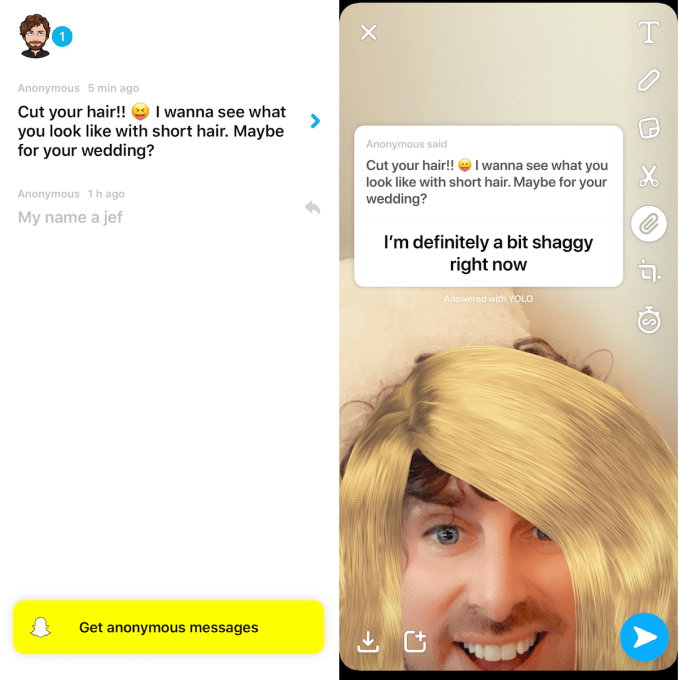
There’s a new teen app sensation. Anonymous question-asking app YOLO has rocketed to the #1 US app position with the help of Snapchat. Built on top of the Snap Kit platform, YOLO uses Snapchat for login and Bitmoji profile pics to let you add an “ask me anything” sticker to your Snapchat Story. Friends can swipe up to open YOLO on iOS and send an anonymous question there that you then answer through another sticker posted to your Story. One source says “EVERYONE at my high school is using it right now.” And what’s crazy is that YOLO’s inventor tells me the whole thing was an accident.

If you’re getting deja vu, you might be thinking of Sarahah. That app blew up in late 2017 by letting you attach a link from your Snapchat Story to your Sarahah profile where people could ask you anonymous questions…until it was kicked off of iOS and Android in early 2018 for facilitating bullying. Now the question is whether YOLO’s warning during signup that it has “no tolerance for objectionable content or abusive users” or its in-app flagging and blocking features will protect it from teen misuse or Apple and Google’s wrath.

YOLO’s anonymous question app built on Snap Kit is now the #1 US app

YOLO’s rise highlights just how curious teens are and how desperate they can be for honest feedback or anonymous gossip. Given the prompt via Snapchat to say something to friends without having to take responsibility, kids are flocking to download YOLO. Since they don’t have to create a new profile or pic thanks to Snap Kit importing their account and Bitmoji, and can use Snapchat’s ubiquity amongst teens to distribute their question and answers, YOLO is super easy to join. That pushed it to the #1 US app according to App Annie.

YOLO creator Gregoire Henrion

But as with Sarahah, Secret, YikYak, and other anonymous apps before it, YOLO is vulnerable to being used to spread hate speech and bullying. Given school-age kids can get in trouble for insulting someone in the hallway, they’re quick to torment peers though apps, especially if they piggyback on one everyone already uses.

Now Yolo’s developer, a startup called Popshow, is desperately trying to keep the app’s servers from melting and add new features so teens stick around. There was no publicly available info about who started Popshow, even in its trademark and incorporation filings. But after some digging, a source revealed that Popshow and YOLO were started by Gregoire Henrion, former co-founder and CEO of music video making app Mindie.

“It was not supposed to be a success. It was just for us to learn” Henrion tells me in his first interview about his startup. “Let’s just put it on the App Store and see how people behave. It went 100% viral. It’s crazy. Even we didn’t believe our eyes when we saw that [it went to #1]”

Henrion’s previous startup Mindie had let you share soundtracked video clips to your Snapchat story. It raised $1.2 million from Lowercase, SV Angel, Dave Morin, Troy Carter and more. But in 2015 it got blocked from Snapchat for being a security risk since it required users to provide their Snap username and password. YOLO actually takes advantage of Snapchat’s Snap Kit platform that was designed specifically to eliminate the need for Mindie’s sketchy integrations. Mindie missed its opportunity to become Musical.ly, which was later bought and merged into global phenomenon TikTok. Mindie eventually got acquired by Justin Bieber-backed selfie app and content production collective Shots in 2016.

By 2017, Henrion and Mindie co-founder Clément Raffenoux were back building a new startup. They raised a small pre-seed round from SV Angel, Shrug Captial, Product Hunt’s Ryan Hoover, and some angel investors and experimented with the Popshow video reactions app. Then the pair decided to explore the anonymous app space. But rather than being completely anonymous and public, YOLO lets users privately review questions, decide which they want to answer and who to share that content with via Snapchat, and include a selfie when they share so respondents know there’s a real person on the other side. “We feel that anonymity can unlock super good behaviors. We think we’re more empathic, more human than other anonymous apps before us” Henrion explains.

The result was “1000X what we expected” Henrion beams. And he insists the growth is totally organic. “We tried some shitty things just to try them, but they don’t work” including replying from Popshow’s account to thousands of people who tweeted ‘I miss Vine’. “I don’t believe in fake growth anymore. We just literally put it in the store, people typed YOLO into search, and the loop was so effective that the product caught on.”

YOLO lets you ask for anonymous questions via your Snapchat Story, receive them on YOLO, and then post the answers back to Snapchat

The challenge will be maintaining YOLO’s momentum. Another anonymous Q&A app called TBH raced to the #1 app spot in September 2017, got acquired by Facebook 3 weeks later, but fell out of the top 500 apps by the end of November before being shut down last year. Teens are extremely fickle. If they deem YOLO “over”, get bored due to a lack of new features, are overwhelemed by harassment, or a new fad arises, it could crash out of the charts. Henrion says his team is scrambling to evolve YOLO into something more expansive without losing simplicity, while developing automated tools to weed out bullies.

There’s also the threat of Snapchat just building similar anonymous Q&A functionality into its own app. But that’s the risk of building atop any platform that otherwise massively reduces an app’s development and marketing costs. With so much of YOLO powered by Snap Kit, and it all just being an experiment, Henrion won’t lose much if his app dies and he moves on to the next idea.

Red Circle’s latest feature makes it easy to tip podcast creators

A group of former Uber employees unveiled their podcasting startup RedCircle last week, and now they’re already launching new features — specifically the ability for listeners to make small tip payments to podcasters.

RedCircle has created a web-based podcast player of its own, but CEO Michael Kadin (previously an engineering manager at Uber) said the mission isn’t to compete with other podcast apps. Instead the team aims to create the tools podcasters need to build a real business.

In fact, RedCircle is already offering some of those tools — like hosting and analytics — for free, and it also launched a cross-promotion marketplace where those podcasters can team up to try to grow each others’ audiences.

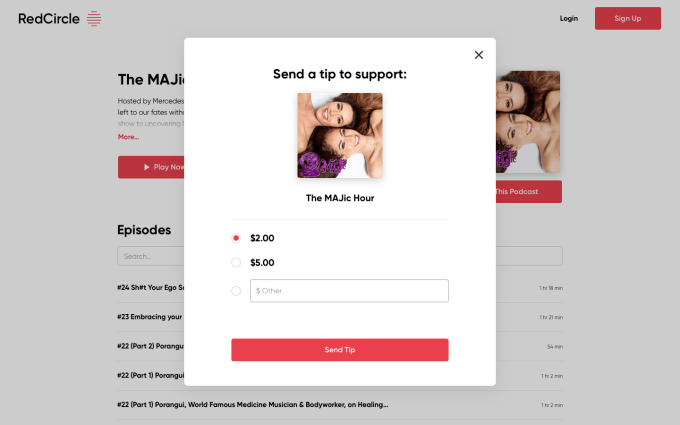
As for the new tipping feature, it appears as a button on the RedCircle player, allowing users to pay $2, $5 or a custom amount with just a few clicks (you’ll also need to enter your credit card info, of course). The startup can also automatically insert a tipping link into a podcast’s show notes, so listeners will find out about it regardless of the player they use.

Co-founder Jeremy Lermitte (a former product manager at Uber) added that tipping provides a way for fans to compensate a podcaster for an episode they particularly enjoyed without making the long-term commitment of, say, signing up for a Patreon subscription.

“This allows you to engage at your own pace,” Lermitte said.

Podcasters can and do accept one-time payments via PayPal or Venmo, but Kadin said RedCircle offers more data about who’s making the payments, while also providing a 1099 form for taxes and “all the other things you want to turn this into a real thing, versus something casual.”

“The first thing podcasters say they need is to grow their audience,” he added. “The second thing is to make money from it. Now we’re working on both of those problems. Just give us another week and a half and we’ll make even more progress.”

RedCircle has raised a $1.5m seed round led by Roy Bahat at Bloomberg Beta.