Slack, the ubiquitous workplace messaging tool, will make its pitch to prospective shareholders on Monday at an invite-only event in New York City, the company confirmed in a blog post on Wednesday. Slack stock is expected to begin trading on the New York Stock Exchange as soon as next month.
Slack, which is pursuing a direct listing, will livestream Monday’s Investor Day on its website.
An alternative to an initial public offering, direct listings allow businesses to forgo issuing new shares and instead sell existing shares held by insiders, employees and investors directly to the market. Slack, like Spotify, has been able to bypass the traditional roadshow process expected of an IPO-ready business, as well as some of the exorbitant Wall Street’s fees.
Spotify, if you remember, similarly livestreamed an event that is typically for investor’s eyes only. If Slack’s event is anything like the music streaming giant’s, Slack co-founder and chief executive officer Stewart Butterfield will speak to the company’s greater mission alongside several other executives.
Slack unveiled documents for a public listing two weeks ago. In its SEC filing, the company disclosed a net loss of $138.9 million and revenue of $400.6 million in the fiscal year ending January 31, 2019. That’s compared to a loss of $140.1 million on revenue of $220.5 million for the year before.
Additionally, the company said it reached 10 million daily active users earlier this year across more than 600,000 organizations.
Slack has previously raised a total of $1.2 billion in funding from investors including Accel, Andreessen Horowitz, Social Capital, SoftBank, Google Ventures and Kleiner Perkins.
The beauty of podcasting is that anyone can do it. It’s a rare medium that’s nearly as easy to make as it is to consume. And as such, no two people do it exactly the same way. There are a wealth of hardware and software solutions open to potential podcasters, so setups run the gamut from NPR studios to USB Skype rigs.
We’ve asked some of our favorite podcast hosts and producers to highlight their workflows — the equipment and software they use to get the job done. The list so far includes:
Launched in 2012, Welcome to Night Vale quickly grew into one of the most popular narrative podcasts in the medium’s history. Centered on the strange goings-on of a desert town, the series has spawned its own mini-empire, including tours, books and and upcoming television adaptation. Co-creators Jeffrey Cranor and Joseph Fink have also launched a series of independent shows under the Night Vale Presents banner, including Alice Isn’t Dead, The Orbiting Human Circus (of the Air) and I Only Listen To The Mountain Goats.
Their latest series, Start With This, is designed to motivate writers, featuring discussions on method and tips for getting the creative juices flowing. Each episode gives the listener writing assignments designed to be shared through its membership forum on Patreon.
This week, on How I Podcast, Cranor shares his home and portable recording rigs.
In my home, I have a large closet I converted to a recording space. I did this by cleaning out all of the junk we had been storing there over the years and then sticking up some acoustic foam. But I travel a lot for work, and I can’t always bring the closet with me to various Hampton Inns.
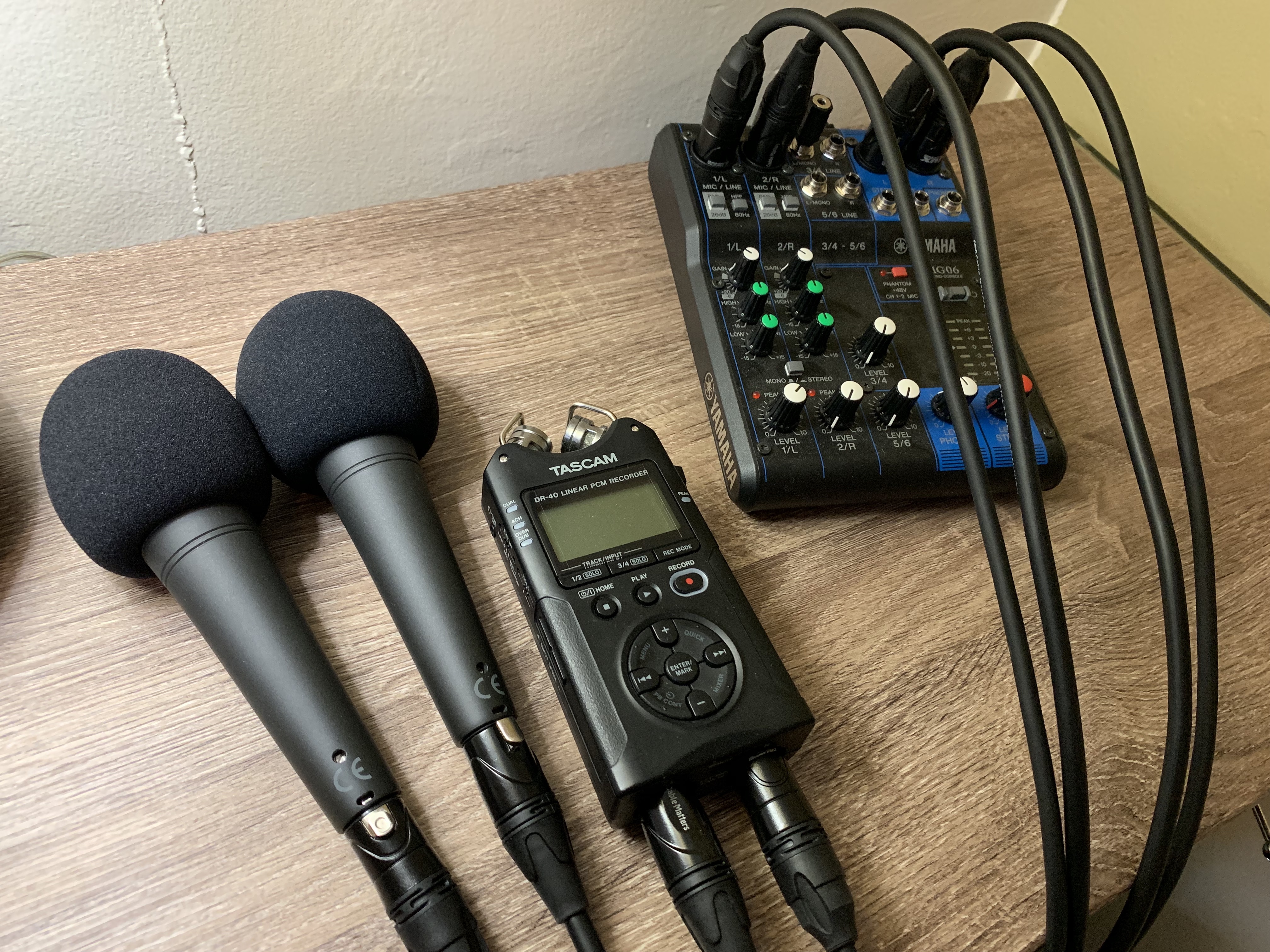
A couple years ago I bought a Tascam DR-40 portable recorder — perfect for packing on tours and vacations. The Tascam solved most any issue I would run into podcast-wise while I was away from NY. The only items I ever really needed to record were brief monologues (ads, show intros, credits, etc). So if a Bombas ad came in, I could just throw a blanket over my head to prevent hotel echo, and then record the spot on the Tascam, looking, I’m sure, like the world’s least-spooky ghost.
This winter, my writing partner Joseph Fink and I both ended up in Los Angeles for a few weeks. We also have a brand new podcast called Start With This, wherein we talk to each other for half an hour about creativity and storytelling, and then give writing assignments to listeners.
So, I picked up a couple of Shure-48s (cheaper than 58s, and for talking only, just as good) and a Yamaha MG-06 Stereo Mixer. This was about $200 total, which was the most I’ve ever spent at once on podcasting equipment. The mixer’s light and easy to pack, and the Shure mics are rock solid.
At home I have an MXL 770 on an extendable arm and it’s great, but there’s something so physically liberating about having just a Shure mic on an XLR cable. Recording these SWT episodes on the road using handhelds really loosened up the feel of the conversations. I might actually change my set up when I get back home to NY.
HBO has been releasing little glimpses of its adaptation of the classic graphic novel “Watchmen,” but now we’ve got a full teaser trailer.
“Watchmen” has already been turned into a big-budget film by director Zack Snyder. While the movie was neither a disaster nor a big success, the results were still disappointing, since the original graphic novel (written by Alan Moore and drawn by Dave Gibbons) routinely appears on lists of the greatest comics of all time.
One of the main problems with the movie, at least in my view, is that Moore and Gibbons’ story is so perfectly suited to the comics format that any is going to feel like a step down. Perhaps “Watchmen” TV creator Damon Lindelof felt something similar, since he said last year that the comics “will not be retread nor recreated nor reproduced nor rebooted” on the show.
Instead, he suggested that the series would treat the comics as “our Old Testament” and tell new stories about what comes after.
While the teaser mostly sticks to cryptic, ominous imagery, that does seem to be approach here — depicting a world where costumed vigilantes have been shaping American history for decades, and where the catastrophic events that ended “Watchmen” are receding into the past.
By the way, Lindelof’s involvement is what makes me excited for the show. While he’s best-known for co-creating “Lost,” his most recent project was “The Leftovers,” which I’d argue is itself a contender for greatest television show of all time. So even though I’m not convinced the world really needed another version of “Watchmen,” I’m very interested to see what Lindelof does with the characters.
One hundred and fifty years before John Nash received his Nobel prize, a train left Versailles for Paris. On board were two brothers returning home from visiting friends. Always a pleasant journey through the French countryside, this one was, unfortunately, in peril. The train crashed and one of the two brothers, Joseph, was severely injured with a broken bone and other fractures. Joseph Bertrand on that day was 20 years old and was already a professor of mathematics with a doctorate he received at the age of 17 for a thesis in thermodynamics.
Joseph later would challenge another French mathematician Antoine Augustin Cournot, reworking an economic situation in which two companies dominate a market, formally known as the Bertrand duopoly. He proposed that in a state of duopoly, whereby players offer a non-differentiated product and are not in cooperation, their customers buy from whichever one sells it for cheaper. The Bertrand duopoly is a harsh situation where prices eventually converge to costs making it economically impossible for its players to exist in the long run. It was a time when only profitable companies existed.
Bertrand’s work was one of the foundations upon which John Nash would later build. Where Bertrand defined a cutthroat competition, Nash recognized that competitors don’t always know what the other’s cost structure is or what they would do in response to one’s actions, therefore keep making tactical decisions in their businesses resulting in certain payoffs. He stated that there exists a profile of strategies such that each competitor’s strategy is an optimal response to the other’s, there is a point of balance in which neither competitor has anything to gain by changing strategies. That point is called the “Nash Equilibrium.”
John Nash shared the Nobel prize in 1994 with another brilliant mind: John Harsanyi. Harsanyi examined the uncertainty around each party’s knowledge and understanding of the other’s decisions and how beliefs can be embedded into a framework of game theory. These games are called games of incomplete information. Harsanyi said that the payoff structures are not always known and come with a certain probability distribution so one should take probability into account when making a tactical economic move and calculating the results.
From Bertrand to Nash to Harsanyi, many companies have struggled with competition, conditions of duopoly, price pressures and survival. Some survived, some did not. Others reached a profitable state of Nash equilibrium and still exist to this day.
Fast-forward to today… here comes Uber and Lyft.
Consider a hypothetical situation where Lyft runs a promo in a specific market. Doing so will impact Lyft’s market share, total revenue, and overall profits. It will also impact Uber’s market share and total revenue in that market, but not profit per ride because they have not yet responded to the move by adjusting their price. The same situation applies to Lyft if Uber runs a promo. They will choose to respond or not respond based on their beliefs of the payoff they will receive. They will keep playing this game until they conclude there’s nothing to gain by offering more promos at which point, they will have reached Nash equilibrium.
Harsanyi’s work is quite relevant here because the two companies have a reasonably good idea about the outcome of each action and each other’s costs but do not precisely know what they were, and they compete with a certain level of belief about each other’s preferences and payoffs. Based on their beliefs, each company will have to assign a certain level of probability to the outcomes of their actions and the responses of their competitor.
We must also note that in the very beginning, competitors know less about each other, but the longer they play the game, the more they will learn and make adjustments to their moves. Going public brings more transparency about each company so with that they will learn even more. The more each competitor will know about each other the more informed their decisions and responses will be so the rideshare game should ultimately reach Nash equilibrium.
So, which one will prevail? At this point, there are a number of questions one must ask as an investor. Are Uber and Lyft in Nash equilibrium today? If they are in Nash equilibrium, and we know that this state means they’re losing money every day, they will ultimately deplete all reserves. If not, what would that final state of equilibrium be? Would it be a profitable state for these companies and their investors? In a state of Nash equilibrium, what price would each company charge their customers in a given market?
Secondly, do Uber and Lyft exist in a Bertrand duopoly? Their products are identical. One driver can drive for both companies in the same car and they often do. Bertrand would be baffled at how fierce this competition is. In his mind, price wars would end when price equals cost leaving no profit for either party or no economic interest to continue their businesses. In this case, these companies convinced investors to raise massive levels of outside capital so that they can afford to charge prices below their cost, operating at deficits hoping they would beat the competition and at some point, reach profitability.
There are two things companies can do to escape Bertrand duopoly: either come up with a lower cost structure or differentiate the product. If one can come up with a lower cost structure, such asdriverless cars, and the other does not, that one wins. If one introduces a new product, such as bikes or scooters and breaks into a brand-new market, they escape Bertrand and gain an edge. But as long as the companies maintain a status of non-differentiated products, according to Bertrand, customers would go with the cheaper of the two, prices would go lower, drivers earn less, and economic benefits erode.
Bertrand assumed a very commoditized world and did not take into consideration the softer elements of competition. In the absence of cost-cutting solutions such as driverless cars, attributes such as “company culture” come into play. If two companies charge the same price, would consumers split 50-50 like Bertrand said, or would they pick the company they think is “nicer?” Or, what is the premium or discount attributable to “niceness” of companies?
In the war between Uber and Lyft, or in any other duopoly, the ability of companies to make calculated decisions at times of competition remains a vital piece of the puzzle. The strategy comes in two steps. First, all decisions must be made at optimal levels reaching a state of Nash equilibrium. At this point, there are no further decisions to make that’ll provide an additional economic benefit to either party. Once that’s done, then differentiation efforts begin so that the parties may escape Bertrand. And those happen on two fronts: cost and product differentiation. It’s certainly a complex task and both companies have smart teams in place to make the calculations. It will be exciting to watch the battles in the years to come.
(If you’re an investor, would it make sense to invest in both companies in a Bertrand duopoly? Perhaps that’s like betting on both black and red in a game of roulette. Remember, if the ball lands on zero, both bets lose!)
Two years ago, Apple changed the way its app store ratings worked by allowing developers to decide whether or not their ratings would be reset with their latest app update — a feature that Apple suggests should be used sparingly. Today, Google announced it’s making a change to how its Play Store app ratings work, too. But instead of giving developers the choice of when ratings will reset, it will begin to weight app ratings to favor those from more recent releases.
“You told us you wanted a rating based on what your app is today, not what it was years ago, and we agree,” said Milena Nikolic, an Engineering Director leading Google Play Console, who detailed the changes at the Google I/O Developer conference today.
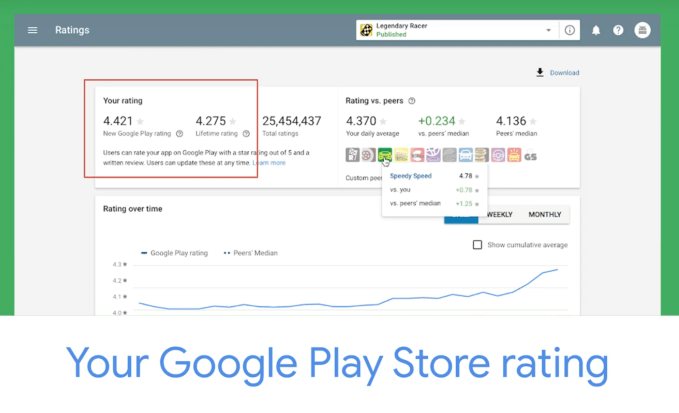
She explained that, soon, the average rating calculation for apps will be updated for all Android apps on Google Play. Instead of a lifetime cumulative value, the app’s average rating will be recalculated to “give more weight” to the most recent users ratings.
With this update, users will be able to better see, at a glance, the current state of the app — meaning, any fixes and changes that made it a better experience over the years will now be taken into account when determining the rating.
“It will better reflect all your hard work and improvements,” touted Nikolic, of the updated ratings.
On the flip side, however, this change also means that once high-quality apps which have since failed to release new updates and bug fixes will now have a rating that reflects their current state of decline.
It’s unclear how much the change will more broadly impact Google Play Store SEO, where today app search results are returned based on a combination of factors, including app names, descriptions, keywords, downloads, reviews and ratings, among other factors.
End users of the Google Play Store won’t see the new, recalculated rating until August, but developers can preview their new rating today in their Play Store console.
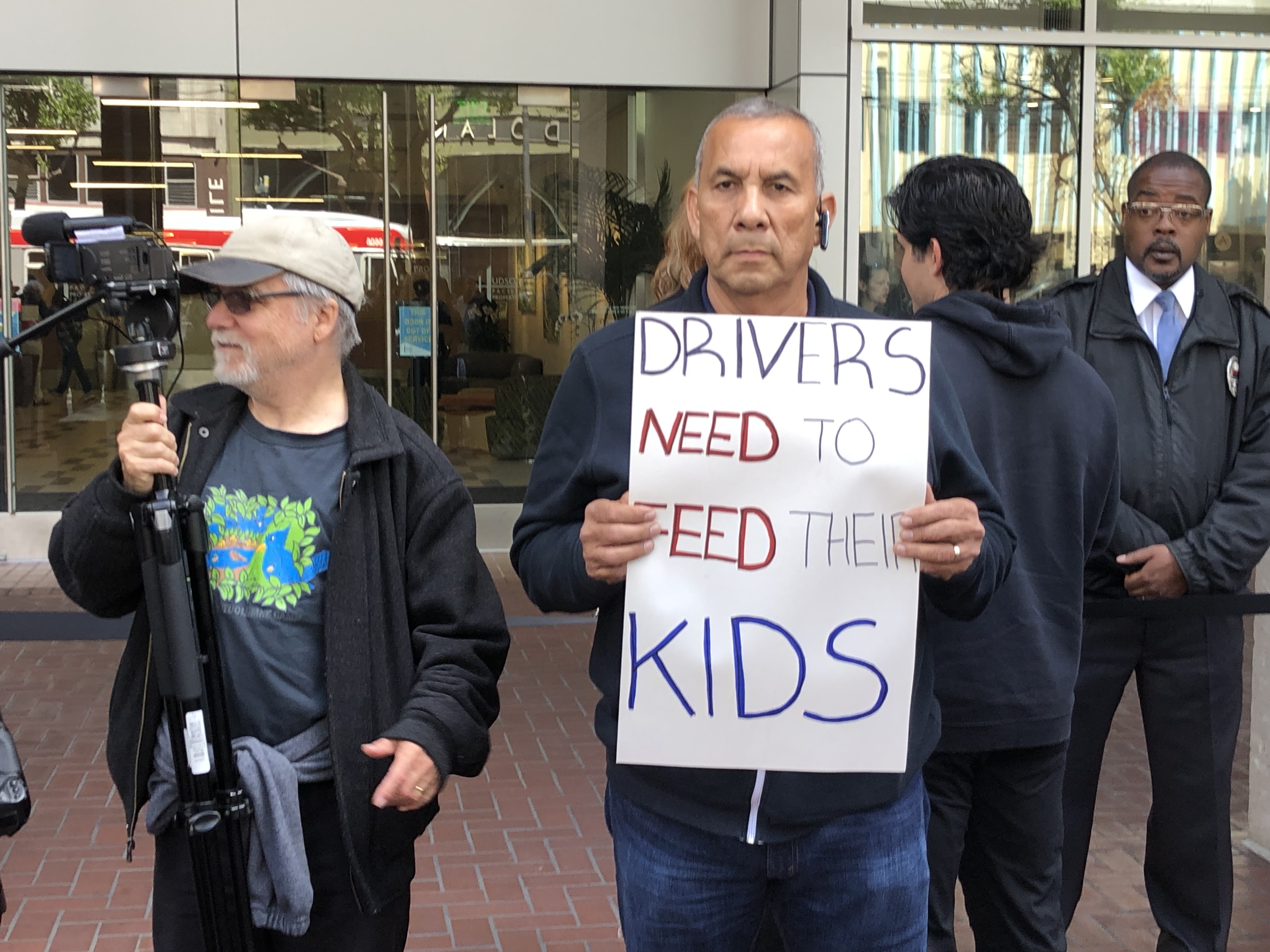
Ahead of Uber’s IPO, more than100 people are protesting outside of the transportation company’s headquarters in San Francisco. They’re here demanding four key things: better wages, transparent policies, benefits and a voice, Uber driver and Gig Workers Rising member Mostafa Maklad told TechCrunch ahead of the protest.
“Uber year after year keeps cutting the rate and how much money they pay to drivers year after year,” Maklad said. “Right now, to make the same money I used to make when I started, you have to drive between 70 to 80 hours a week to make even a little less than how much money I used to. They put a lot of stress on us drivers to drive a lot of hours in order to make money. If you don’t, you can’t make money and it’s not going to be worth it.”
As part of Uber’s IPO, the company offered some drivers bonuses but pale in comparison to what executives will walk away with. Uber offered some drivers a bonus up to $40,000, while Lyft offered drivers up to $10,000.
“All of us are not happy, not just with the award, but with the way they treat drivers,” Maklad said.
While some drivers want to be W-2 employees and others don’t mind being 1099 independent contractors, these drivers are united around those four key demands.
“Whether we are classified as independent contractors or employees, we are workers and human beings and deserve to be treated with dignity,” Maklad said. “They are making millions of dollars off our back and labor.”
The protest in San Francisco is a part of a bigger, worldwide effort to strike. Last week, The New York Taxi Workers Association called on U.S.-based drivers to stand in solidarity with drivers in London and log off from both Uber and Lyft today between 7 a.m. and 9 a.m.
Uber is pricing its IPO between $44 to $50 a share, seeking a valuation up to $84 billion. Lyft set a range of $62 to $68 for its IPO, seeking to raise up to $2.1 billion. Since its debut on the Nasdaq, Lyft’s stock has suffered after skyrocketing nearly 10% on day one. Lyft is currently trading at around $60 per share.
In a statement to TechCrunch earlier this week, Uber said:
“Drivers are at the heart of our service — we can’t succeed without them — and thousands of people come into work at Uber every day focused on how to make their experience better, on and off the road,” an Uber spokesperson said. “Whether it’s more consistent earnings, stronger insurance protections or fully funded four-year degrees for drivers or their families, we’ll continue working to improve the experience for and with drivers.”
Virtual reality is the ultimate money pit. Tech giants are selling low-margin hardware on which users play software that was funded by those same companies. This strategy seems to continue year after year without a hockey stick chart in sight.
While VR may still be waiting for its breakout hardware hit, there has already been a clear software standout. Beat Games released Beat Saber one year ago. The popular game is part Guitar Hero, part Fruit Ninja, and it utilizes the benefits of VR to let players slice their way through an EDM soundtrack, which the company’s music-mixing CEO produced.
While a few VR studios have surpassed lifetime revenue in the low millions, Beat Games sold more than 1 million copies of the $20 game after just nine months on the market. The title’s addicting gameplay has left it endlessly showcased across the web by game streamers, enabling a mainstream success that the VR market really hasn’t seen yet.
Beat Games CEO Jaroslav Beck says the title’s success is “dope,” but he’s more concerned with ensuring he doesn’t leave anything on the table, whether that’s expansion into esports or arcades or the fitness market. I chatted with Beck about what it means to actually finish a game in the era of freemium, why he doesn’t want to become a manager and how Beat Games has never raised VC funding.
‘Unlocked my head’
Beck didn’t come up with the idea for Beat Saber. Like a lot of people who have bought the game, his first experience with it was watching an early demo on the web built by a couple of tinkering Czech programmers.
Ján Ilavský and Vladimír Hrinčár had been building games together since high school. The pair had published a few games; their biggest success was Chameleon Run, a mobile game that won an Apple Design Award in 2016. Following that success, the duo set its sights on building something for virtual reality.
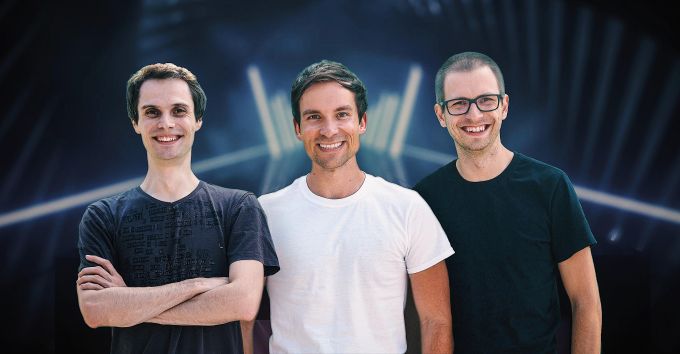
Beat Games co-founders (left to right) Hrinčár, Beck and Ilavský
They were already a year into development when Beck saw a demo on Facebook. At the time, Beck had been living in L.A. building out customers for his own studio, Epic Music Productions, where he had already done some work for clients like EA, Blizzard and Disney. Despite thinking the VR market might be a passing fad, the Beat Saber demo piqued his interest and led him to more online investigating.
“I was so skeptical, but then I saw the teaser that these two had put out and it was like something had unlocked my head,” Beck told TechCrunch.
After discovering the pair shared his Czech background, he contacted them and flew out to Prague to convince them to let him build the soundtrack for their new game. He also planted the idea of starting a new company around the title if it achieved the success that he thought it would.
Convincing the “strict programmers” to build a venture around their demo was more challenging than expected, he admits, but Beck eventually got them onboard to finish the game. The team of perfectionists had a tougher time hitting their deadlines than expected, and even after releasing an “early access version” of the title a year ago, Beck still talks about finishing the game as though it’s a far-flung dream. This, despite the fact that Beat Saber is one of the most-downloaded games in VR’s early history.
How the team reached this achievement requires dissecting the qualities of a viral game, which is no small task. Beck thinks the game was successful simply because Ján and Vladimír built the type of game they wanted to play without ever worrying about building a commercial hit.
But for a medium that’s been so difficult to showcase without putting on the headset, the Beat Saber team set out early-on to ensure the game was highly visible. Because many of the songs were Beck’s, it was much simpler to ensure that YouTubers could freely post footage of the gameplay without concerns for takedowns or reduced monetization. It worked, it wasn’t long after the game’s release that top streamers like Pewdiepie and Jacksepticeye were playing the game for their massive subscriber bases.
Beck says that videos showcasing the game on YouTube have now received more than 2 billion views. That popularity has gradually expanded offline, with plenty of gamers that I’ve chatted with saying that the viral Beat Saber videos led them to get VR systems in the first place.
But Beat Saber isn’t just helping sell VR headsets, it’s changing how the systems are built.
Oculus has been using Beat Saber as a way to benchmark the quality of its new inside-out tracking system, ensuring that the new headsets can handle the game’s most advanced modes.
My little bit from the F8 keynote. @BeatSaber really was the most important benchmark for tracking, from my point of view! pic.twitter.com/ZXikUj9gOI
“Our tracking team continued to improve their technology until we could play Expert+ songs and achieve the sorts of scores we see on Rift,” Oculus director of ecosystem Chris Pruett told TechCrunch. “Beat Saber proved to be a very valuable bar against which we have been able to measure our overall tracking quality.”
Beck similarly says that one of Valve’s recent code updates for its SteamVR tracking system was made specifically to account for the tracking needs of Beat Saber’s fastest players.
‘Capturing the full potential’
After smashing through VR sales records, one of Beat Games biggest challenges might be ensuring that the platform’s limited reach doesn’t end up stifling its own growth.
The company is already working on some of its own hardware after partnering with South Korea’s SKonec to build custom VR arcade machines so that players in Asia can try out the title without having to fully buy-in to virtual reality.
Some in the VR industry see Beat Saber’s success as a sign that the VR industry’s days of lackluster growth are behind it.
“…The most interesting data point for me is that Beat Saber sold over one million copies in a year and is making over $20 million in revenue,” Tipatat Chennavasin, a co-founder of The VR Fund and an advisor to Beat Games, told TechCrunch in an email interview. “That makes it not just the biggest VR games success story but also the biggest indie games success story on any platform of the past year. Angry Bird’s success on iOS helped legitimize smartphones as a gaming platform when it made $6 million in one year.”
Finding the widest audience has led the Beat Games team ensure that their code is lean and that the game “could run on a washing machine” if it needed to, Beck says. Even optimizing the game has been intensive work for the small team. Despite having such a hot title, Beck and his co-founders aren’t racing to turn their endeavor into an empire. In the past year, they’ve grown to just eight full-time employees.
“It’s complicated because we don’t really want to scale that much because then we’ll just become managers of a huge team,” he says. “We created the game and we want to be the ones to finish it.”
In an industry seemingly filled with investments that didn’t live up to the industry’s hype, Beat Games has never received outside funding.
“I’m really proud that we were able to build the company with this mindset of making decisions based on what is good for the game and not what is the most profitable thing,” he says. “I think the worst thing for a developer is that you get this awesome idea that you’re super excited about and then investors tells you, ‘Yeah that’s cool, but we’ll be broke.’ Then it’s like, what’s the point? You didn’t start making these game just to become crazy rich, right?”
“I’m not saying we will never raise funding, though,” he quickly adds.
Beck says that the team has some ideas for follow-on titles for Beat Games, but that completing their first effort is the studio’s central priority. Finishing Beat Saber seems like it should be well within the team’s reach, but Beck seems to see “finishing” the game as a nebulous task better defined by what’s left on the table rather than what they actually ship.
“Finishing the game isn’t about just bringing in all of these new features, but it’s about capturing the full potential of the game, whether that’s in eSports, fitness or in just exploring music,” Beck says. “That’s a lot of work… the question is if we will survive until then (laughs) but I sure hope that we do.”
Lora DiCarlo, a startup coupling robotics and sexual health, has $2 million to shove in the Consumer Electronics Show’s face.
The same day the company was set to announce their fundraise, The Consumer Technology Association, the event producer behind CES, decided to re-award the Bend, Oregon-based Lora DiCarlo with the innovation award it had revoked from the company ahead of this year’s big event.
“We appreciate this gesture from the CTA, who have taken an important step in the right direction to remove the stigma and embarrassment around female sexuality,” Lora DiCarlo founder and chief executive officer Lora Haddock (pictured) told TechCrunch. “We hope we can continue to be a catalyst for meaningful changes that makes CES and the consumer tech industry inclusive for all.”
In January, the CTA nullified the award it had granted the business, which is building a hands-free device that uses biomimicry and robotics to help people achieve a blended orgasm by simultaneously stimulating the G spot and the clitoris. Called Osé, the device uses micro-robotic technology to mimic the sensation of a human mouth, tongue and fingers in order to produce a blended orgasm for people with vaginas.
Lora DiCarlo’s debut product, Osé, set to release this fall. The company says the device is currently undergoing changes and may look different upon release.
“CTA did not handle this award properly,” CTA senior vice president of marketing and communications Jean Foster said in a statement released today. “This prompted some important conversations internally and with external advisors and we look forward to taking these learnings to continue to improve the show.”
Lora DiCarlo had applied for the CES Innovation Award back in September. In early October, the CTA notified the company of its award. Fast-forward to October 31, 2018 and CES Projects senior manager Brandon Moffett informed the company they had been disqualified. The press storm that followed only boosted Lora DiCarlo’s reputation, put Haddock at the top of the speakers’ circuit and proved, once again, that sexuality is still taboo at CES and that the gadget show has failed to adapt to the times.
In its original letter to Lora DiCarlo, obtained by TechCrunch, the CTA called the startup’s product “immoral, obscene, indecent, profane or not in keeping with the CTA’s image” and that it did “not fit into any of [its] existing product categories and should not have been accepted” to the awards program. CTA later apologized for the mishap before ultimately re-awarding the prize.
At the request of the CTA, Haddock and her team have been working with the organization to create a more inclusive show and better incorporate both sextech companies and women’s health businesses.
“We were a catalyst to a huge, resounding amount of support from a very large community of people who have been quietly thinking this is something that needs to happen,” Haddock told TechCrunch. “For us, it was all about timing.”
Lora DiCarlo plans to use its infusion of funding, provided by new and existing investors led by the Oregon Opportunity Zone Limited Partnership, to hire ahead of the release of its first product. Pre-orders for the Osé, which will retail for $290, will open this summer with an expected official release this fall.
Haddock said four other devices are in the pipeline, one specifically for clitoral stimulation, another for clitoral and vaginal stimulation, one for anywhere on the body and the other, she said, is a different approach to the way people with vulvas masturbate.
“We are aiming for that hands-free, human experience,” Haddock said. “We wanted to make something really interesting and very different and beautiful.”
Next year, Haddock says they plan to integrate their products with virtual reality, a step that will require a larger boost of capital.
Haddock and her employees don’t plan to quiet down any time soon. With their newfound fame, the team will continue supporting the expanding sextech industry and gender equity within tech generally.
“We’ve realized our social mission is so important,” Haddock said. “Gender equality, at its source, is about sex. We absolutely demonize sex and sexuality … When you talk about removing sexual stigmas, you are also talking about removing gender stigmas and creating gender equity.”
U.S. prosecutors have formally brought charges against the alleged co-owners and administrators of Deep Dot Web, who were arrested Tuesday.
Tal Prihar, 37, and Michael Phan, 34 — both Israeli citizens — were charged with one count of conspiracy to commit money laundering, according to a now-unsealed indictment.
Prihar, who resided in Brazil, was arrested by French police in Paris on Monday, while Phan was arrested by Israeli police in a simultaneous raid.
The two are accused of making millions of dollars in commission from Deep Dot Web, a website featuring news, reviews, and information about dark web sites and marketplaces. Prosecutors said the administrators made their commission by linking to marketplaces on the dark web — only accessible through Tor, an encrypted anonymity network.
Many of the dark web marketplaces sold drugs, weapons and data, which hackers could use to break into online accounts.
“It was truly a 50:50 partnership between the two defendants,” said Scott Brady, U.S. attorney for Western Philadelphia, in a press conference in Pittsburg on Wednesday announcing the charges.
According to the district attorney, more than 23 percent of all transactions made on AlphaBay, a dark web marketplace taken down by authorities in 2017, were associated with a referral link from Deep Dot Web. The indictment also said Deep Dot Web referred over 198,000 users to Hansa, another defunct market, accounting for nearly half of the site’s users, of which Deep Dot Web “received a commission on all of those users’ purchases.”
The indictment said Prihar and Phan made $2.15 million in total — almost half of which was collected from AlphaBay.
“This is the single most significant law enforcement disruption of the dark net to date,” said Brady.
A staffer at Deep Dot Web said in a Medium post that Deep Dot Web would generate a slice of the revenue from purchases made on dark web marketplaces, said to be as much as 4 percent. Brazil’s federal police said in a statement the site made millions in dollars in cryptocurrency from referral sales from more than 15,000 dark web users.
Google unveils new Pixel 3 phones, Bird will start selling directly to consumers and PUBG takes a hit in China. Here’s your Daily Crunch for May 8, 2019.
Google’s developer conference is still underway, but we’ve rounded up everything they announced at their big keynote, like more affordable versions of its Pixel 3 phones — the Pixel 3a will start at $399, and come with a 5.6-inch display.
Meanwhile, the Google Home Hub has been rebranded as the Nest Hub, with a price cut and a new, bigger brother.
China’s new rules on video games, introduced last month, are having an effect on the country’s gamers. Tencent introduced “Game for Peace” at the same time as PUBG was delisted from China.
Founded in 2016, HeyJobs aims to tackle the recruitment problem European employers are facing due to steep declines in available workforce as the so-called the “boomer” generation nears retirement.
The company, whose portfolio of dating apps also includes Match.com, PlentyOfFish, OkCupid and Hinge, among others, said in its earnings report that total quarterly revenue grew 14% year-over-year, to $465 million.
When we spoke to CEO Ramin Sayar in 2017, he indicated that Sumo Logic was on its way to becoming a public company. While that hasn’t happened yet, he says that’s still the goal.






 Tech talks of the day